
Judge, 1922-03-18 · page 11 of 36
Judge — March 18, 1922 — page 11: what you’re looking at
What you’re looking at
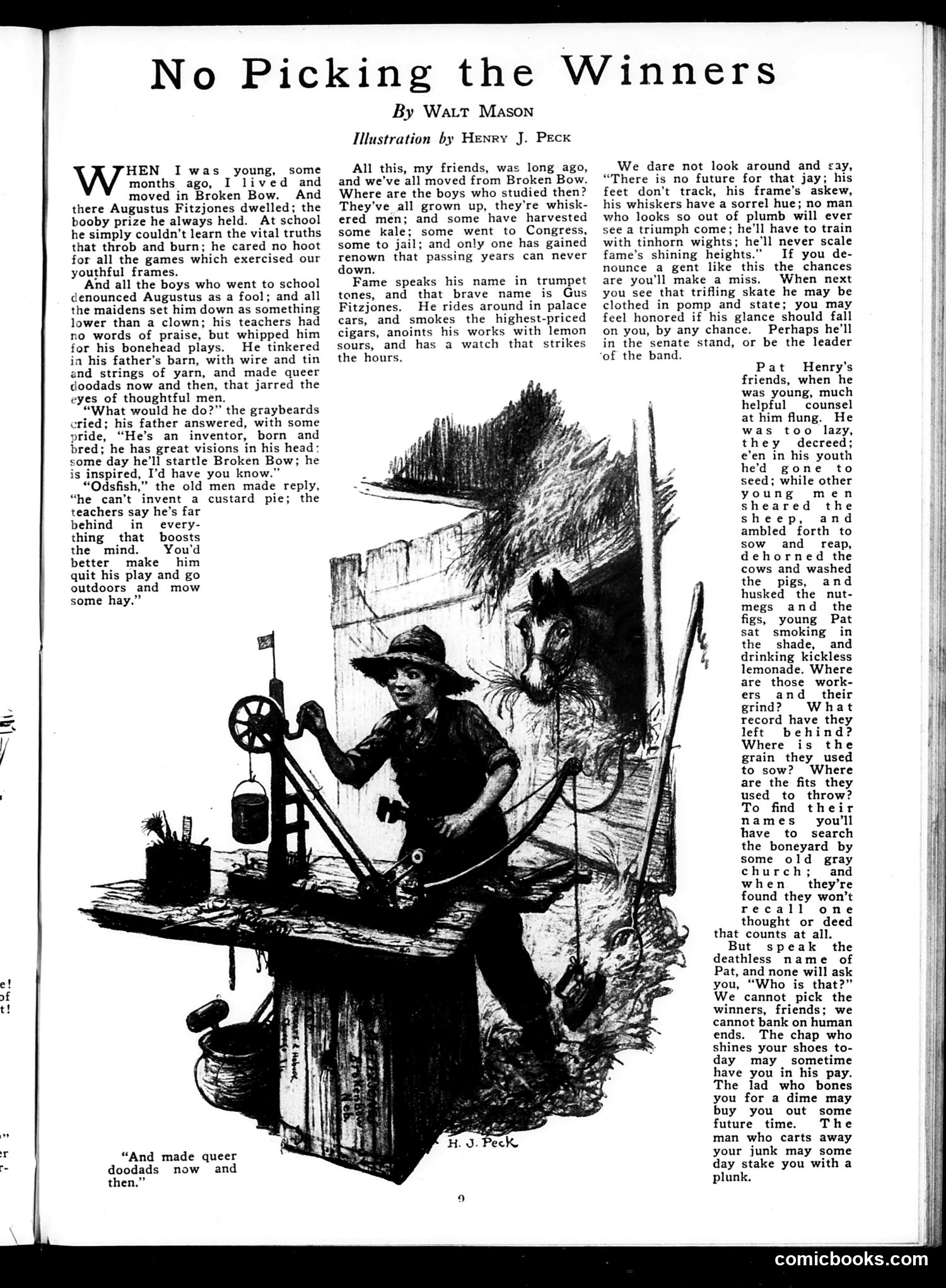
This is Walt Mason's moralizing essay illustrated by Henry J. Peck. The piece uses two cautionary tales—Augustus Fitzjones and Pat Henry—to argue against judging people's potential based on their apparent present circumstances. The cartoon depicts the "doodad" inventor at work in his barn, emphasizing his humble, tinkering origins. Mason's message is clear: Augustus was mocked as a lazy, incompetent fool by teachers and townsfolk, yet he became successful and famous. Similarly, Pat Henry, dismissed as lazy while others worked hard, apparently achieved success—while those industrious workers ended up forgotten in graveyards. The satire targets small-town certainty and snap judgments about human potential. For a modern reader, it's a turn-of-the-century pep talk: don't underestimate underdogs or assume conventional measures of merit predict success. The underlying tension—that hard work doesn't guarantee success while perceived laziness doesn't guarantee failure—challenges rural American values about industry and virtue.
📄 Transcribed text from this page (OCR, searchable)
Machine-transcribed from the original scan — historical spelling and the odd misread are preserved.
of t! HEN Iwas _ young, some months ago, I lived and moved in Broken Bow. And there Augustus Fitzjones dwelled; the booby prize he always held. At school he simply couldn’t learn the vital truths that throb and burn; he cared no hoot for all the games which exercised our youthful frames. And all the boys who went to school denounced Augustus as a fool; and all the maidens set him down as something lower than a clown; his teachers had no words of praise, but whipped him for his bonehead plays. He tinkered ia his father’s barn, with wire and tin and strings of yarn, and made queer doodads now and then, that jarred the eyes of thoughtful men. “What would he do?” the graybeards cried; his father answered, with some pride, “He’s an inventor, born and bred; he has great visions in his head: some day he’ll startle Broken Bow; he is inspired, I'd have you know.” “QOdsfish,” the old men made reply, “he can’t invent a custard pie; the teachers say he’s far behind in every- thing that boosts the mind. You'd better make him quit his play and go outdoors and mow some hay.” No Picking the Winners By Wart Mason Illustration by Henry J. Peck All this, my friends, was long ago, and we've all moved from Broken Bow. Where are the boys who studied then? They've all grown up, they're whisk- ered men; and some have harvested some kale; some went to Congress, some to jail; and only one has gained renown that passing years can never down. Fame speaks his name in trumpet tones, and that brave name is Gus Fitzjones. He rides around in palace cars, and smokes the highest-priced cigars, anoints his works with lemon sours, and has a watch that strikes the hours. We dare not look around and say, “There is no future for that jay; his feet don’t track, his frame’s askew, his whiskers have a sorrel hue; no man who looks so out of plumb will ever see a triumph come; he’ll have to train with tinhorn wights; he'll never scale fame’s shining heights.” I£ you de- nounce a gent like this the chances are you'll make a miss. When next you see that trifling skate he may be clothed in pomp and state; you may feel honored if his glance should fall on you, by any chance. Perhaps he'll in the senate stand, or be the leader of the band. Pat Henry's friends, when he ‘was young, much helpful counsel at him flung. He was too lazy, they decreed; e’en in his youth he'd gone to seed; while other young men sheared the sheep, and ambled forth to sow and_ reap, dehorned the cows and washed the pigs, and husked the nut- megs and_ the figs, young Pat sat smoking in the shade, and drinking kickless lemonade. Where are those work- ers and_ their grind? What record have they left behind? Where is the grain they used to sow? Where are the fits they used to throw? To find their names_ you'll have to search the boneyard by some old gray church; and when __ they’re found they won’t recall one thought or deed that counts at all. But speak the deathless name of Pat, and none will ask you, “Who is that?” We cannot pick the winners, friends; we cannot bank on human ends. The chap who shines your shoes to- day may sometime have you in his pay. The lad who bones you for a dime may buy you out some future time. The man who carts away your junk may some day stake you with a plunk. comicbooks.com