
Judge, 1922-03-18 · page 12 of 36
Judge — March 18, 1922 — page 12: what you’re looking at
What you’re looking at
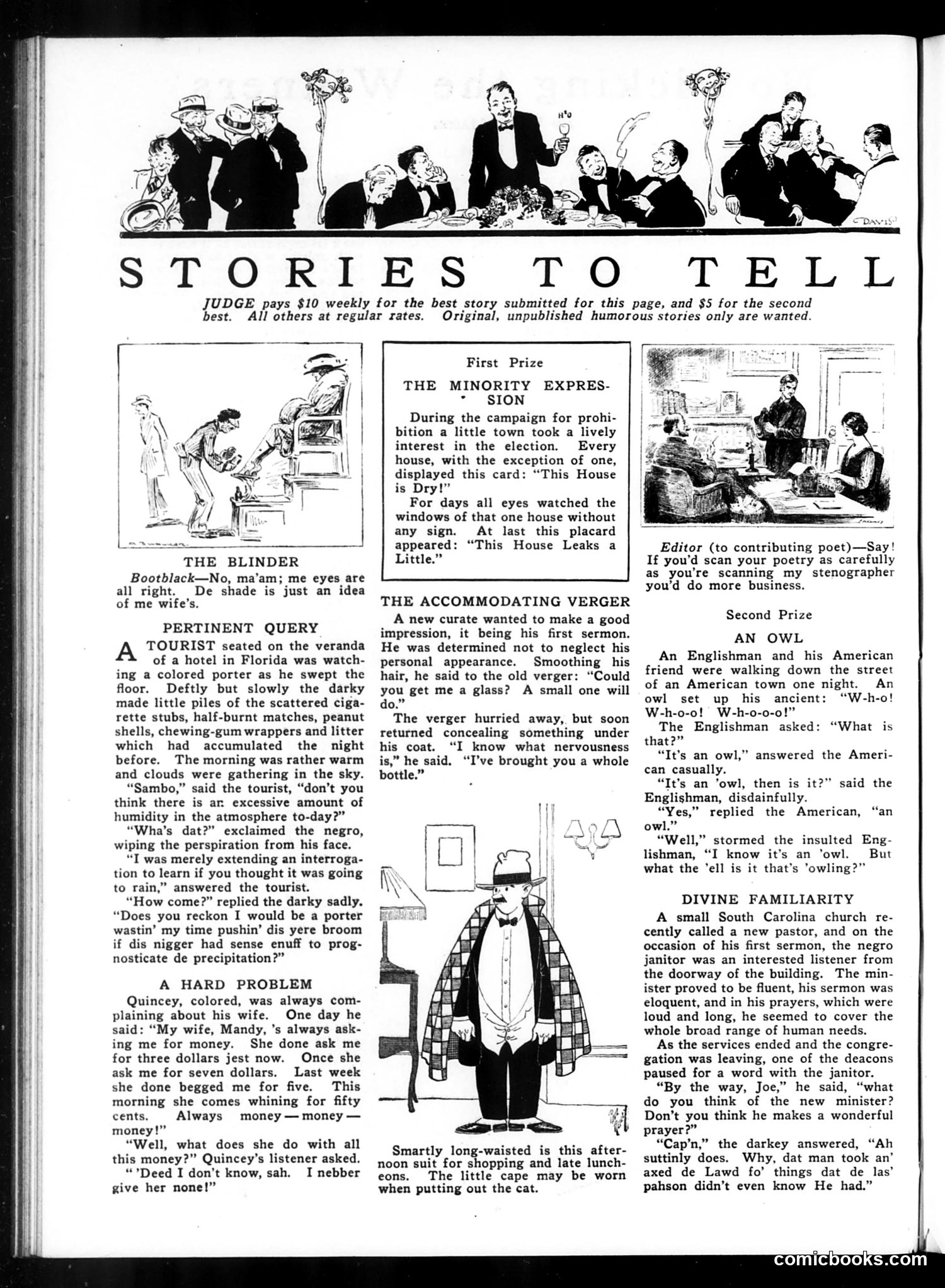
This page from *Judge* magazine presents humorous short stories submitted by readers, with prizes offered. The content reflects early-20th-century American comedy conventions, heavily reliant on racial stereotypes that would be considered offensive today. Several stories use African American characters as the basis for humor: "A Hard Problem" jokes about a Black man's confusion regarding his wife's spending; "Pertinent Query" features a porter speaking in exaggerated dialect; and "Divine Familiarity" involves a Black church janitor. These stories perpetuate era-typical caricatures of Black Americans as intellectually limited or prone to comic misunderstanding. "The Minority Expression" satirizes Prohibition-era politics through a town's temperance campaign. "An Owl" plays on British-American linguistic differences (the pronunciation of "owl" versus the letter "H"). "The Accommodating Verger" offers gentle clerical humor about nervousness and alcohol. The page reflects *Judge's* satirical approach: mixing social commentary with crude stereotyping, now historically significant primarily as evidence of period attitudes rather than humor.
📄 Transcribed text from this page (OCR, searchable)
Machine-transcribed from the original scan — historical spelling and the odd misread are preserved.
STORIES T O TELL JUDGE pays $10 weekly for the best story submitted for this page, and $5 for the second best. THE BLINDER Bootblack—No, ma’am; me eyes are all right. De shade is just an idea of me wife's. PERTINENT QUERY TOURIST seated on the veranda of a hotel in Florida was watch- ing a colored porter as he swept the floor. Deftly but slowly the darky made little piles of the scattered ciga- rette stubs, half-burnt matches, peanut shells, chewing-gum wrappers and litter which had accumulated the night before. The morning was rather warm and clouds were gathering in the sky. “Sambo,” said the tourist, “don’t you think there is ar excessive amount of humidity in the atmosphere to-day?” “Wha’s dat?” exclaimed the negro, wiping the perspiration from his face. “I was merely extending an interroga- tion to learn if you thought it was going to rain,” answered the tourist. “How come?” replied the darky sadly. “Does you reckon I would be a porter wastin’ my time pushin’ dis yere broom if dis nigger had sense enuff to prog- nosticate de precipitation?” A HARD PROBLEM Quincey, colored, was always com- plaining about his wife. One day he said: “My wife, Mandy, ’s always ask- ing me for money. She done ask me for three dollars jest now. Once she ask me for seven dollars. Last week she done begged me for five. This morning she comes whining for fifty cents. Always money — money — money!” “Well, what does she do with all this money?” Quincey’s listener asked. “*Deed I don’t know, sah. I nebber give her none!” All others at regular rates. First Prize THE MINORITY EXPRES- * SION During the campaign for prohi- bition a little town took a lively interest in the election. Every house, with the exception of one, displayed this card: “This House is Dry!” For days all eyes watched the windows of that one house without any sign. At last this placard appeared: “This House Leaks a Little.” THE ACCOMMODATING VERGER A new curate wanted to make a good impression, it being his first sermon. He was determined not to neglect his personal appearance. Smoothing his hair, he said to the old verger: “Could you get me a glass? A small one will do.” The verger hurried away, but soon returned concealing something under his coat. “I know what nervousness is,” he said, “I’ve brought you a whole bottle.” Smartly long-waisted is this after- noon suit for shopping and late lunch- eons. The little cape may be worn when putting out the cat. Original, unpublished humorous stories only are wanted. Editor (to contributing poet)—Say! If you’d scan your poetry as carefully as you're scanning my stenographer you’d do more business. Second Prize AN OWL An Englishman and his American friend were walking down the street of an American town one night. An owl set up his ancient: “W-h-o! W-h-o-o! W-h-o-o-0!” The Englishman asked: “What is that?” “It’s an owl,” answered the Ameri- can casually. “It’s an ’owl, then is it?” said the Englishman, disdainfully. “Yes,” replied the American, “an owl.” “Well,” stormed the insulted Eng- lishman, “I know it’s an ‘owl. But what the ‘ell is it that’s ’owling?” DIVINE FAMILIARITY A small South Carolina church re- cently called a new pastor, and on the occasion of his first sermon, the negro janitor was an interested listener from the doorway of the building. The min- ister proved to be fluent, his sermon was eloquent, and in his prayers, which were loud and long, he seemed to cover the whole broad range of human needs. As the services ended and the congre- gation was leaving, one of the deacons paused for a word with the janitor. “By the way, Joe,” he said, “what do you think of the new minister? Don’t you think he makes a wonderful prayer?” “Cap’n,” the darkey answered, “Ah suttinly does. Why, dat man took an’ axed de Lawd fo’ things dat de las’ pahson didn’t even know He had.”