
A complete issue · 36 pages · 1922
Judge — January 21, 1922
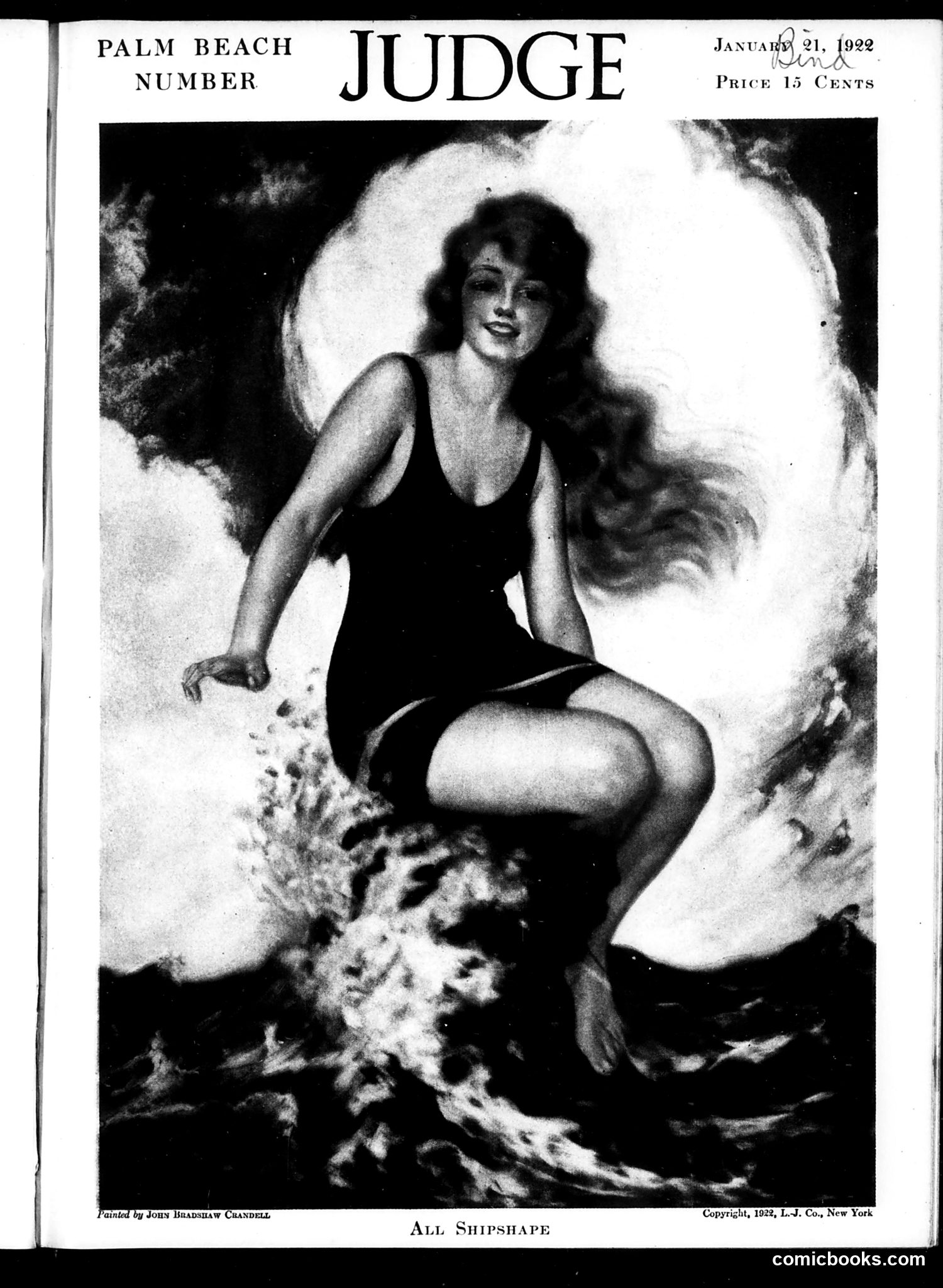
This is the cover of Judge magazine's Palm Beach edition from January 21, 1922. The image shows a woman in a dark bathing suit posed among stylized waves, titled "All Shipshape." The painting is credited to John Bradshaw Crandell. This appears to be primarily a cover illustration rather than political satire. It depicts a fashionable young woman enjoying beach leisure—a lifestyle associated with Palm Beach's wealthy winter resort community. The "All Shipshape" title references nautical themes fitting for a beach setting. The image reflects 1920s aesthetics and the era's evolving attitudes toward women's swimwear and public beach culture, which had become more acceptable during this period. The cover serves as promotional material for Judge's special Palm Beach issue targeting the resort's affluent readership.
This page is **not a cartoon or political satire**, but rather a **magazine advertisement** from an early 20th-century publication. The ad promotes "The Safety Valve," a serialized fiction story by Seammon Lockwood appearing in Leslie's Weekly (January 21 issue). The story features a young, wealthy, audacious heroine involved in mysterious adventures including automobile theft—hence the playful headline "Have You Ever Wanted to Steal an Automobile?" The ad emphasizes the serial contains "action, mystery, thrills and romance" and promises to be "one of the best serials of the year." It costs 10 cents per copy. This reflects early 20th-century popular entertainment marketing, positioning serialized fiction as compelling mass-market content comparable to modern television cliffhangers.
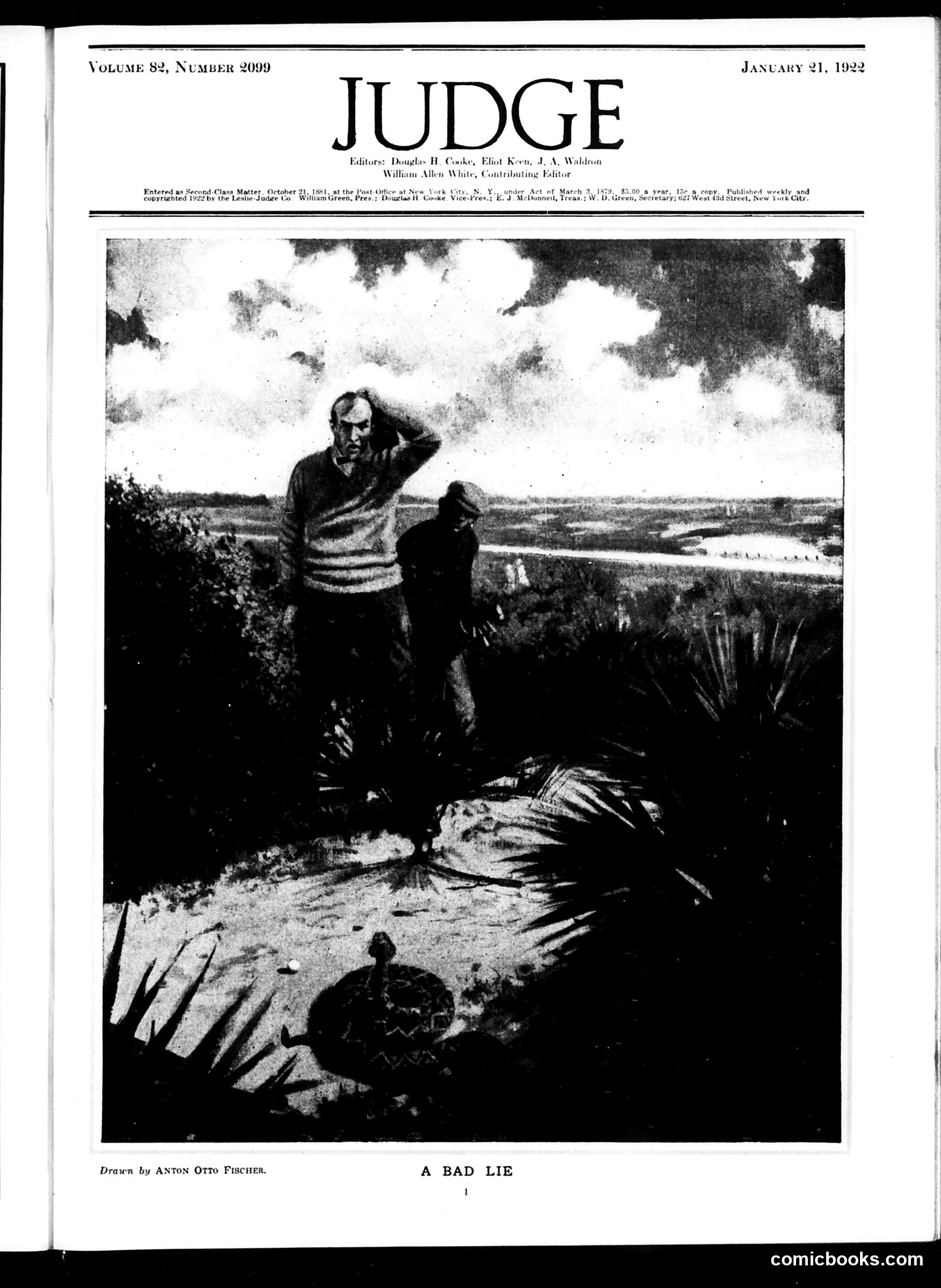
This illustration by Anton Otto Fischer shows two men discovering what appears to be a turtle or similar creature in shallow water or swampy ground, with a expansive landscape behind them. The title "A Bad Lie" suggests the image comments on deception or false claims. Without additional context from the magazine's text or accompanying article, the specific satirical target remains unclear. It could reference a political figure's false statement, a broken promise, or a fabricated claim current to Judge's January 1922 publication date. The rural setting and the men's discovery of the creature might symbolize exposing hidden falsehoods or uncomfortable truths. The precise political or social reference requires knowledge of contemporary 1922 events not evident from the image alone.
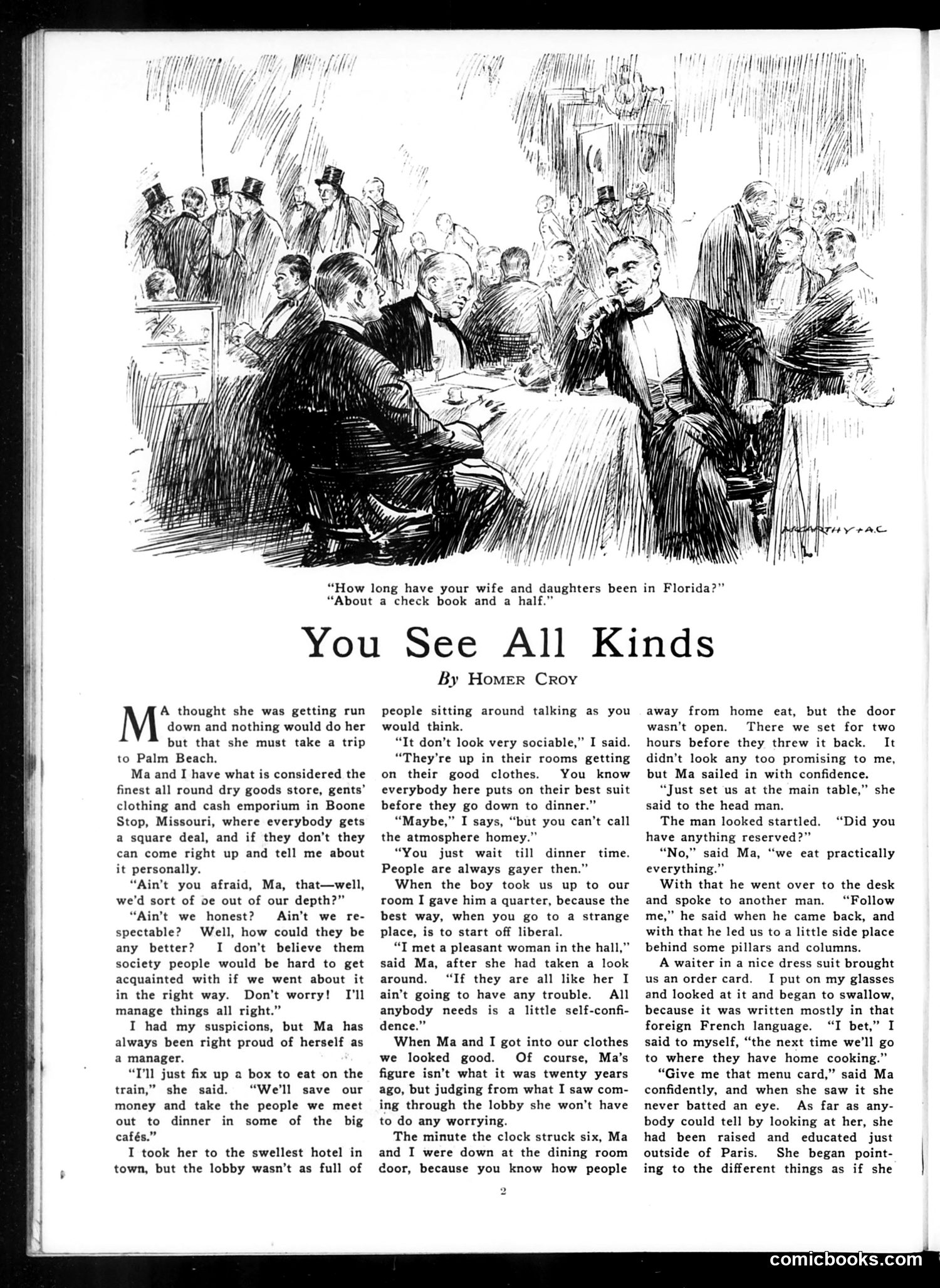
This page contains a short story titled "You See All Kinds" by Homer Croy, illustrated by a sketch of a formal dining room scene. The narrative—not a political cartoon—describes a middle-class couple's dining experience at a hotel, where the narrator's wife grows anxious about proper etiquette and social standing among wealthier guests. The story satirizes American social anxiety and class consciousness of the early 20th century. The humor derives from the wife's embarrassment about appearing unsophisticated (worrying about a French menu she cannot read, being self-conscious about their appearance) and the narrator's matter-of-fact attitude. The cartoon illustrates this social tension in a formal dining setting where the couple feels out of place among more refined patrons.
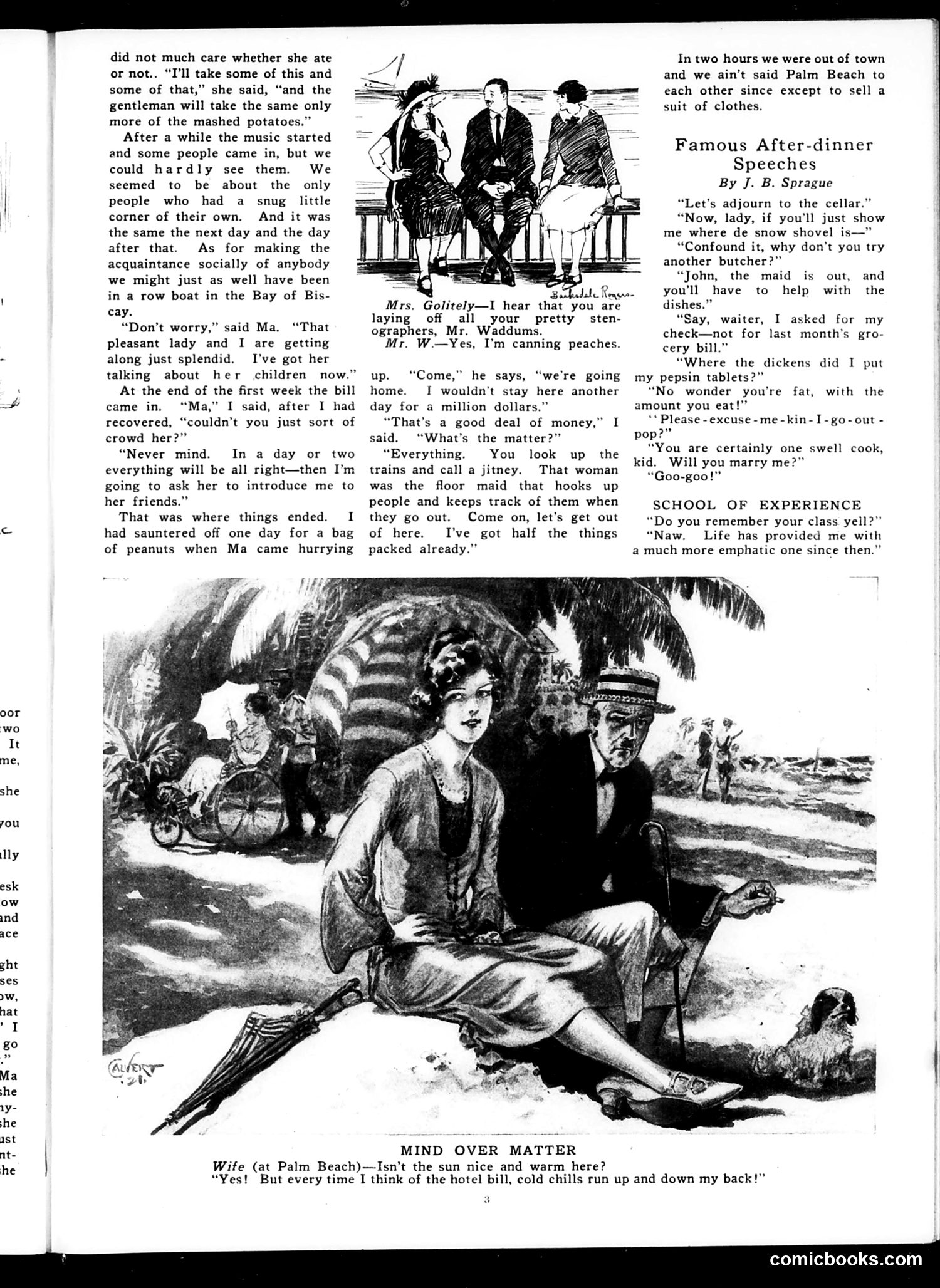
This page contains satirical humor pieces typical of early 20th-century American comedy magazines. The top cartoon depicts three people on a boat, captioned about a woman leaving her husband. The "Famous After-dinner Speeches" section that follows consists of short, punchy jokes about domestic life and social situations—a husband trying to escape to the cellar, a waiter's complaint about unpaid bills, and flirtations about cooking. The larger bottom cartoon, titled "Mind Over Matter," shows a couple at Palm Beach. The wife enjoys the warm beach setting, but the husband remains anxious about the hotel bill—the humor being that financial worry transcends pleasant vacation surroundings. This reflects pre-Depression anxieties about expenses and middle-class economic precarity during leisure travel.
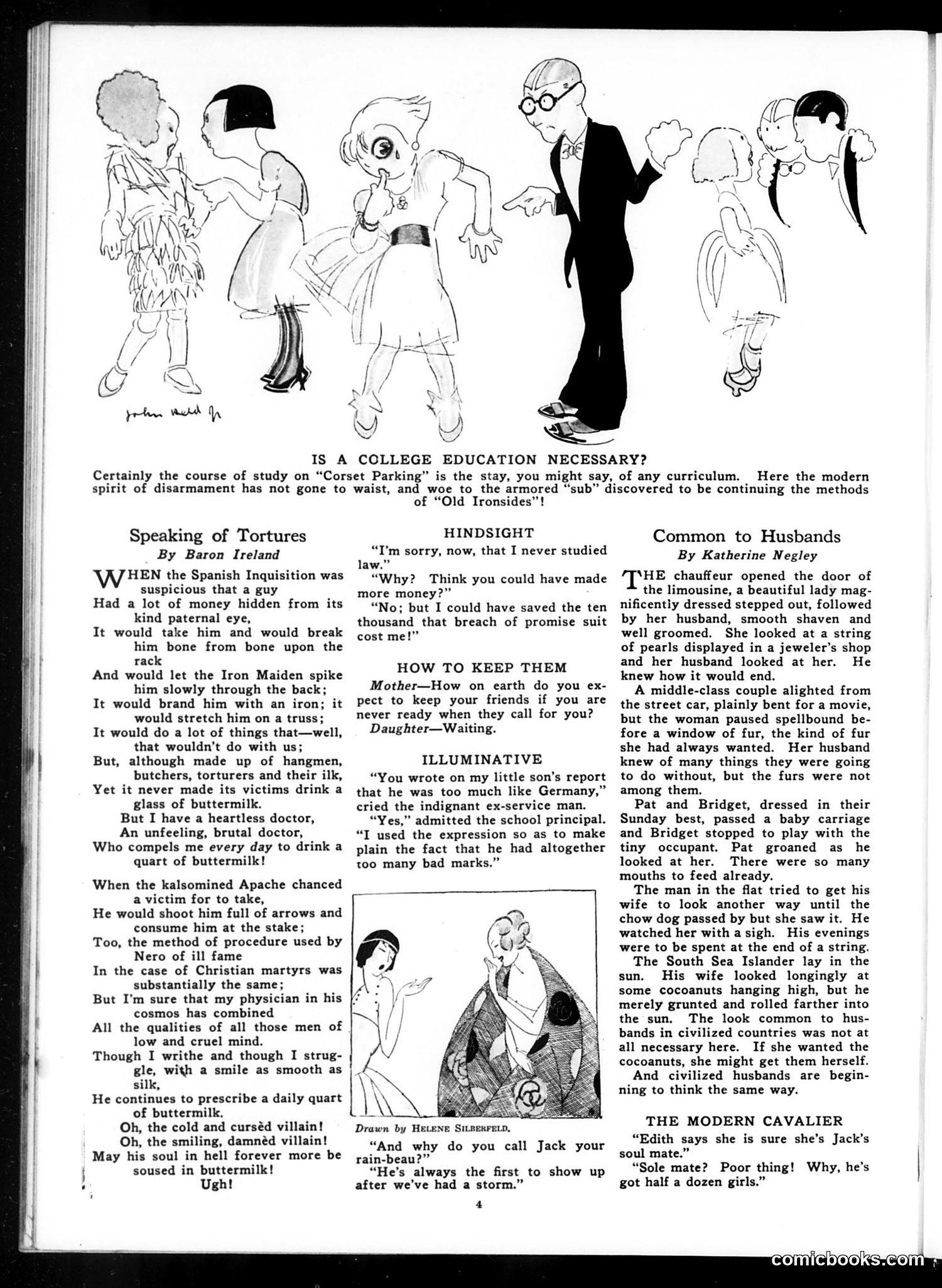
This page satirizes early 20th-century social customs and gender relations. The top illustration mocks "corset parking"—a euphemism for intimate behavior at college—suggesting modern youth have abandoned Victorian propriety despite their education. The three article sections mock different aspects of 1920s society: - **"Speaking of Tortures"**: A dark poem comparing Spanish Inquisition methods to modern suffering, implying contemporary life is equally painful. - **"Hindsight"** and **"How to Keep Them"**: Mock marital advice, suggesting wives suffer regret over education choices and husbands find marriage confining. - **"The Modern Cavalier"**: A brief joke about infidelity, implying men don't commit to single partners. Overall, the page presents cynical commentary on marriage, education's impact on women, and changing social mores of the Jazz Age era.
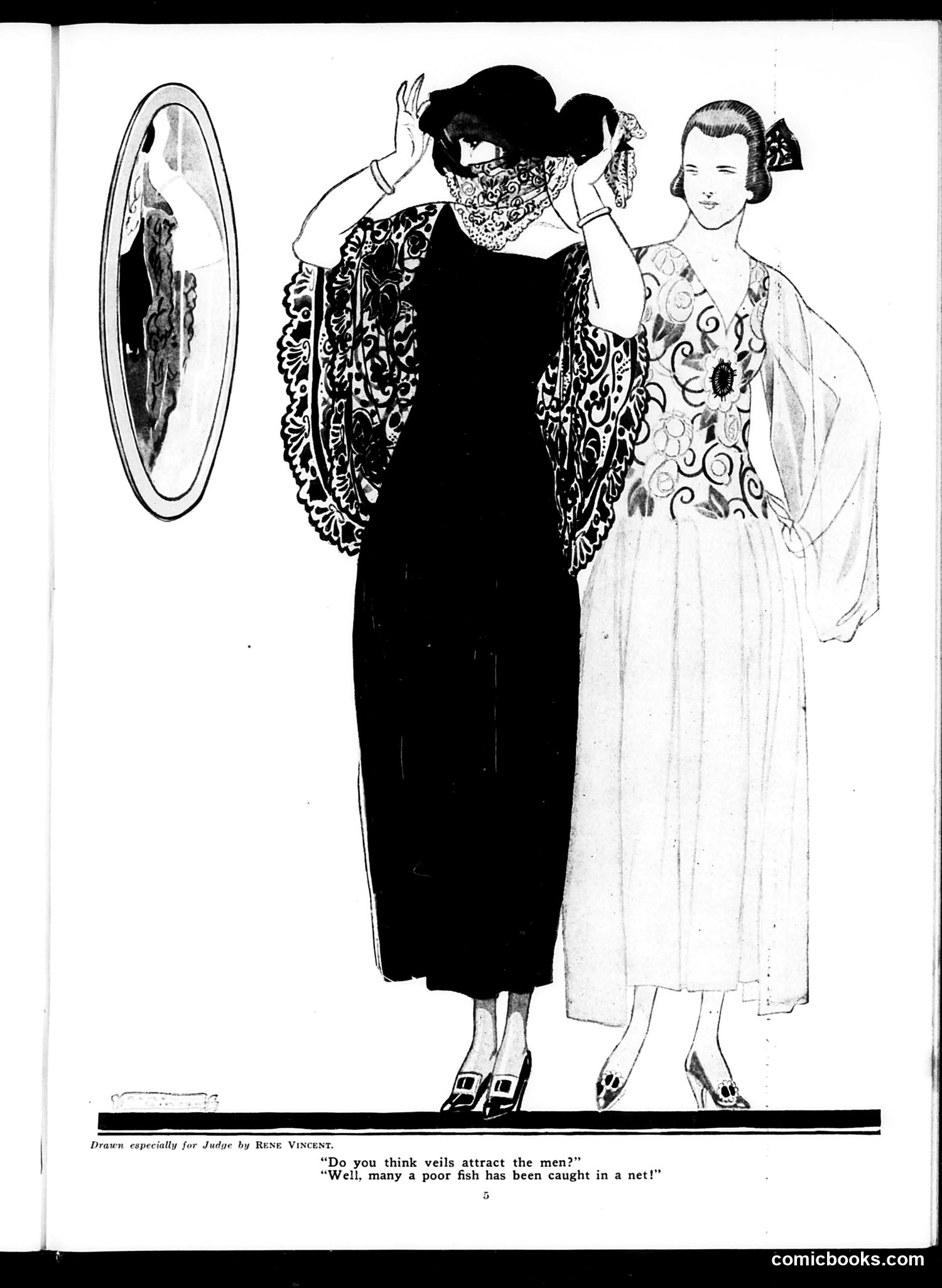
This is a fashion satire cartoon by René Vincent showing two women discussing veils as romantic attractions. The woman on the left wears an ornate, heavily patterned veil covering her face, while the woman on the right wears a lighter dress with decorative embroidery. The joke uses a fishing metaphor: veils are compared to nets that "catch" men like fish. The punchline suggests that veils—fashionable accessories meant to enhance beauty—actually work as traps, implying men are foolish creatures easily ensnared by feminine allure and mystery. This reflects early 20th-century anxieties about women's fashion, femininity as deception, and gender dynamics. The cartoon presents women's fashion choices cynically, as calculated tools of attraction rather than genuine style preferences.
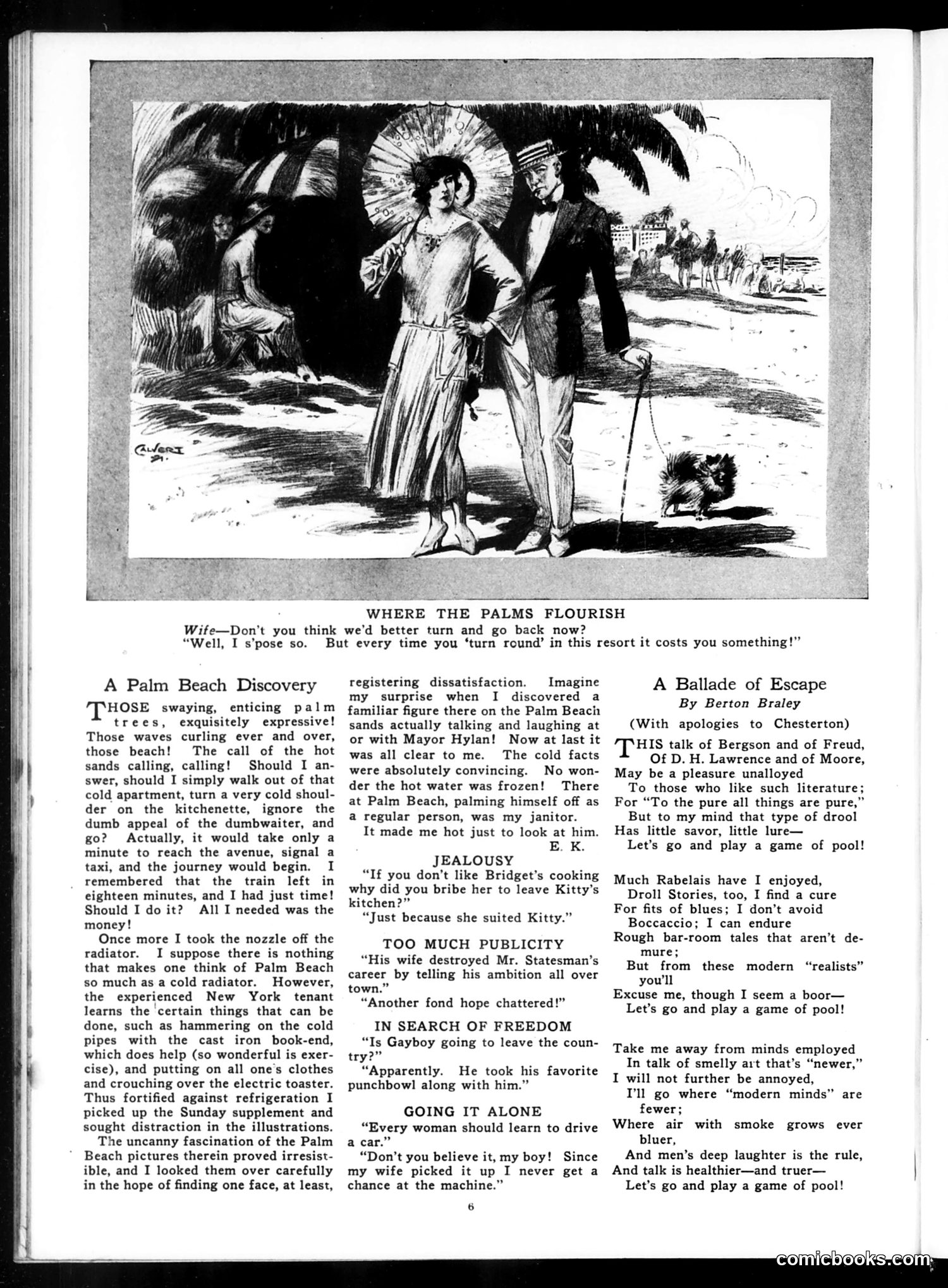
This cartoon satirizes wealth inequality and vacation culture during the early 20th century. A fashionably dressed couple at an exclusive Palm Beach resort realizes the exorbitant cost of leisure—every time they "turn round," expenses mount. The accompanying story mocks New York tenants' desperation: a cold-apartment dweller fantasizes about Palm Beach while struggling with broken heat. He's shocked to spot his janitor there, seemingly living a comfortable life at the resort, which "explains" why his building's hot water is frozen—his janitor is neglecting work for vacation. The joke targets both wealthy pretension and working-class aspiration: the janitor supposedly abandoning his duties for leisure, while the tenant obsesses over a lifestyle he cannot afford. It reflects Depression-era anxieties about economic disparity and the allure of unattainable luxury destinations.
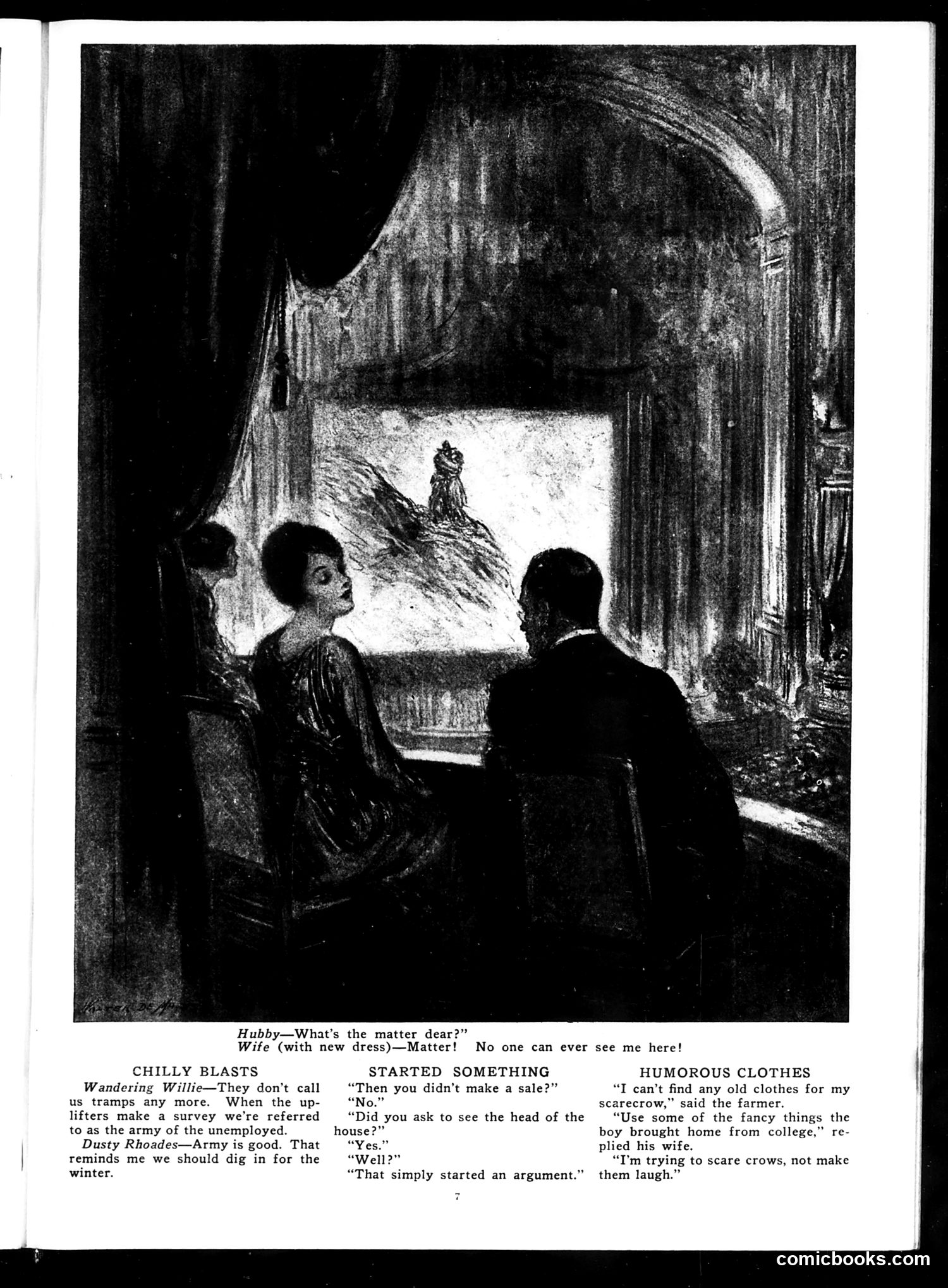
This page contains four brief satirical comics addressing early 20th-century social issues: 1. **Main illustration**: Shows silhouetted figures watching a stage performance, with caption about a wife's new dress being invisible—likely satirizing either fashion extravagance or marital discord over spending. 2. **"Chilly Blasts"**: Two homeless men ("tramps") discuss being rebranded by social reformers as "the army of the unemployed"—satire on euphemistic language used by Progressive-era charity workers, and unemployment during economic hardship. 3. **"Started Something"**: A salesman fails to make a sale because asking to speak with "the head of the house" sparked domestic argument—jokes about evolving gender dynamics and women's household authority. 4. **"Humorous Clothes"**: A farmer's wife suggests using her son's college clothes as scarecrow material, implying collegiate fashion is laughably impractical—satire of college students' affectations. The page mixes class commentary with domestic humor typical of Judge's satirical approach to contemporary American life and social change.
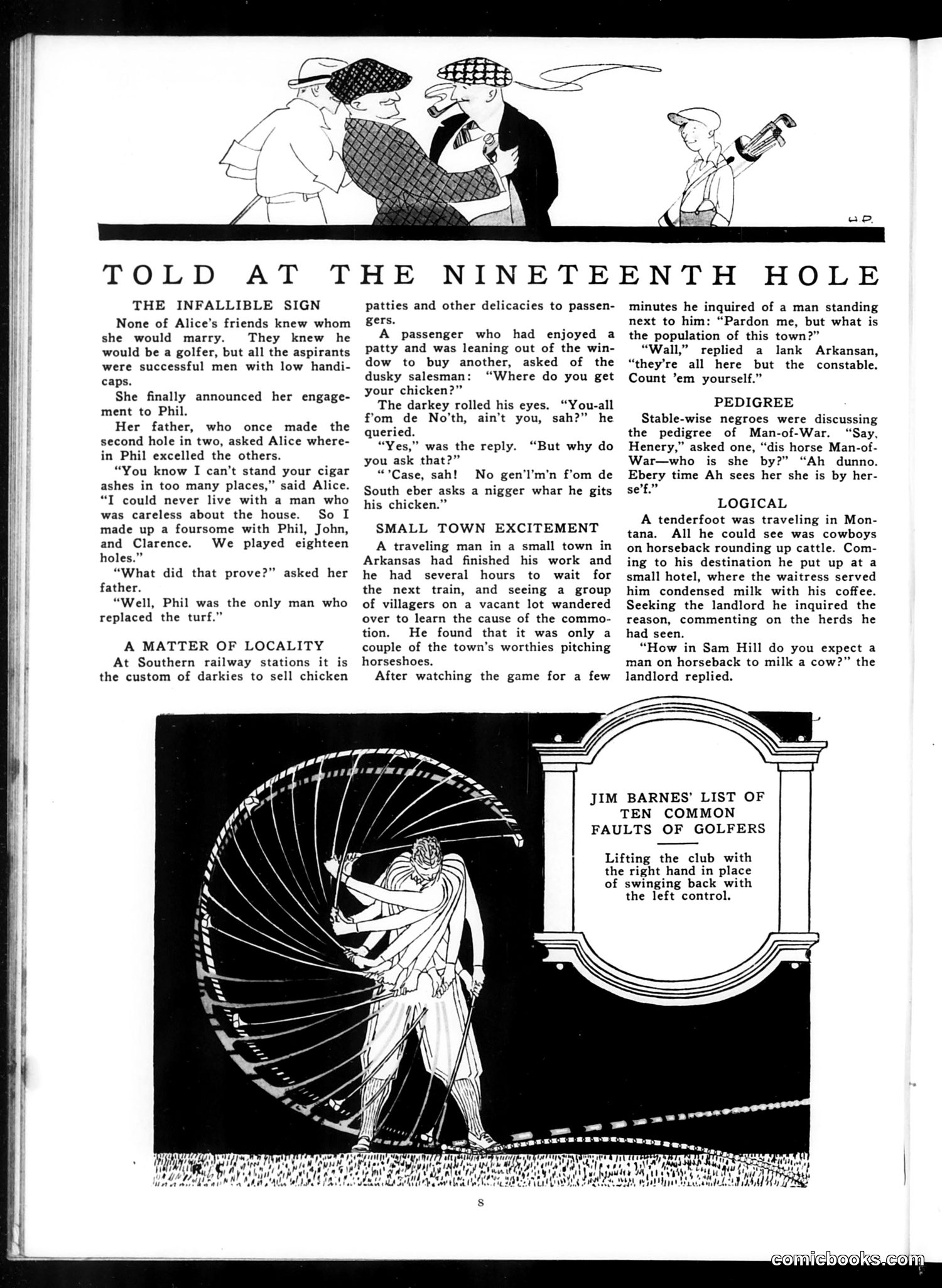
This is a humor page from Judge magazine featuring golf-themed jokes and regional American stereotypes typical of early 20th-century satire. **Main cartoon (top):** Shows a golf dispute at the 19th hole (the clubhouse), depicting gentlemen in conflict over a game—common subject matter for this column. **The stories satirize:** 1. **"The Infallible Sign"**: A woman chooses her fiancé Phil because he replaced divots while golfing—suggesting character can be judged by golf etiquette. 2. **Regional humor**: Mocking Southern dialect and implied illegality in chicken sourcing; poking fun at rural Arkansas's isolation and small populations. 3. **"Logical"**: A tall tale mocking the tenderfoot (inexperienced visitor) expecting dairy production from cowboys, playing on Western tropes. **Context for modern readers**: The page relies on now-offensive racial dialect and stereotypes (transcribed in the OCR) that were mainstream in period magazines. Golf serves as the framework for displaying class, regional, and cultural distinctions among American men. The bottom section promotes Jim Barnes' golf instruction, indicating the magazine's affluent readership.
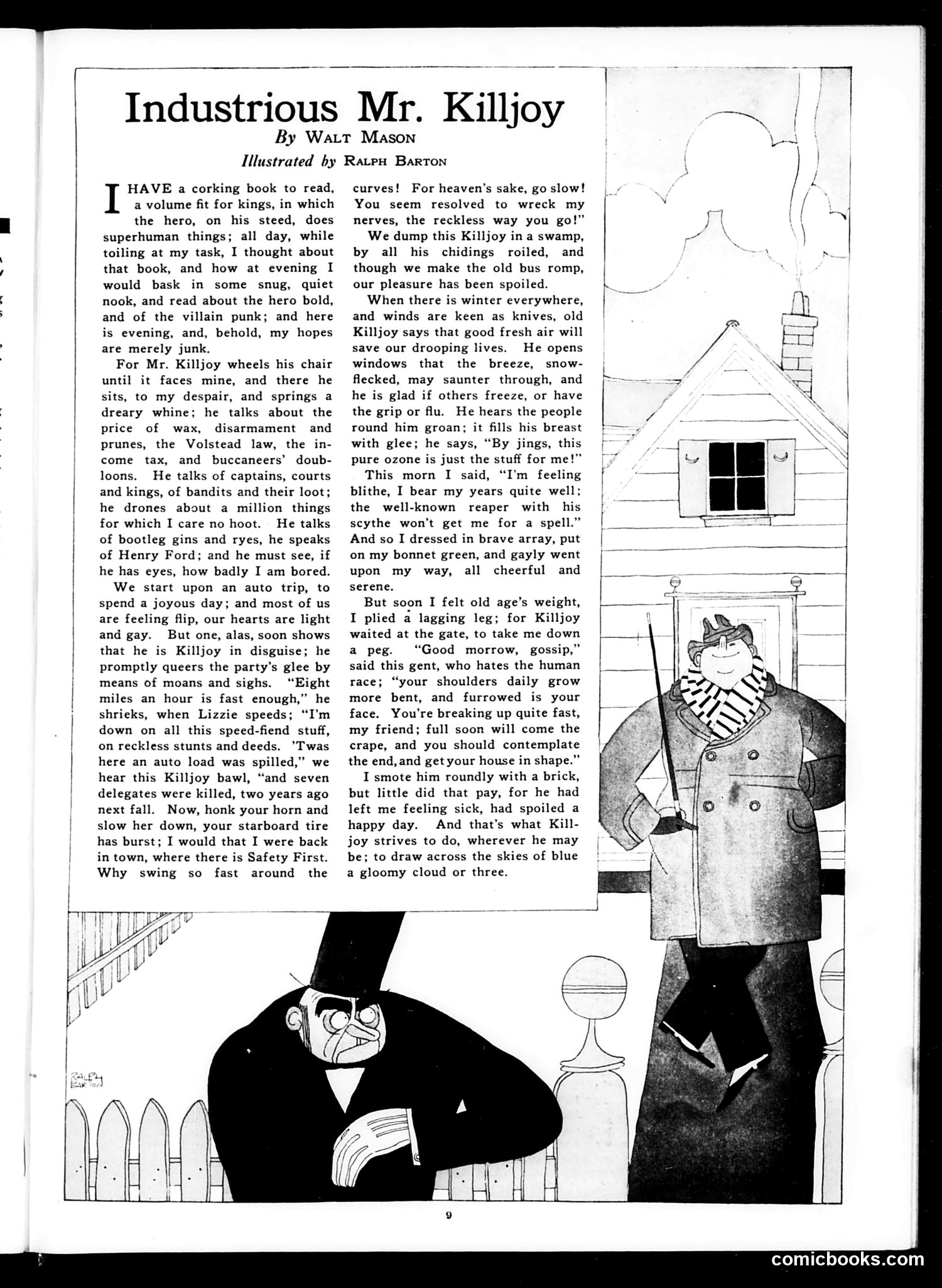
This satirical story by Walt Mason (illustrated by Ralph Barton) depicts "Mr. Killjoy," a persistent pessimist who ruins others' enjoyment through constant complaining and doom-saying. The humor targets a recognizable social type: the chronic complainer who intrudes on others' pleasures. Whether someone tries to read peacefully, take a cheerful car ride, or enjoy good health, Killjoy appears to dampen spirits with complaints about safety, morality, or decline. His objections reference contemporary concerns—the Volstead Law (Prohibition), automobile safety, and influenza. The cartoon's point is social satire about negativity as a character flaw and social nuisance. The narrator's final act of hitting Killjoy with a brick (played for humor) expresses audience frustration with relentless pessimism. The moral: some people make it their mission to "draw across the skies of blue a gloomy cloud or three." For modern readers, this reflects early-20th-century anxiety about progress, safety, and social change—themes still recognizable today.
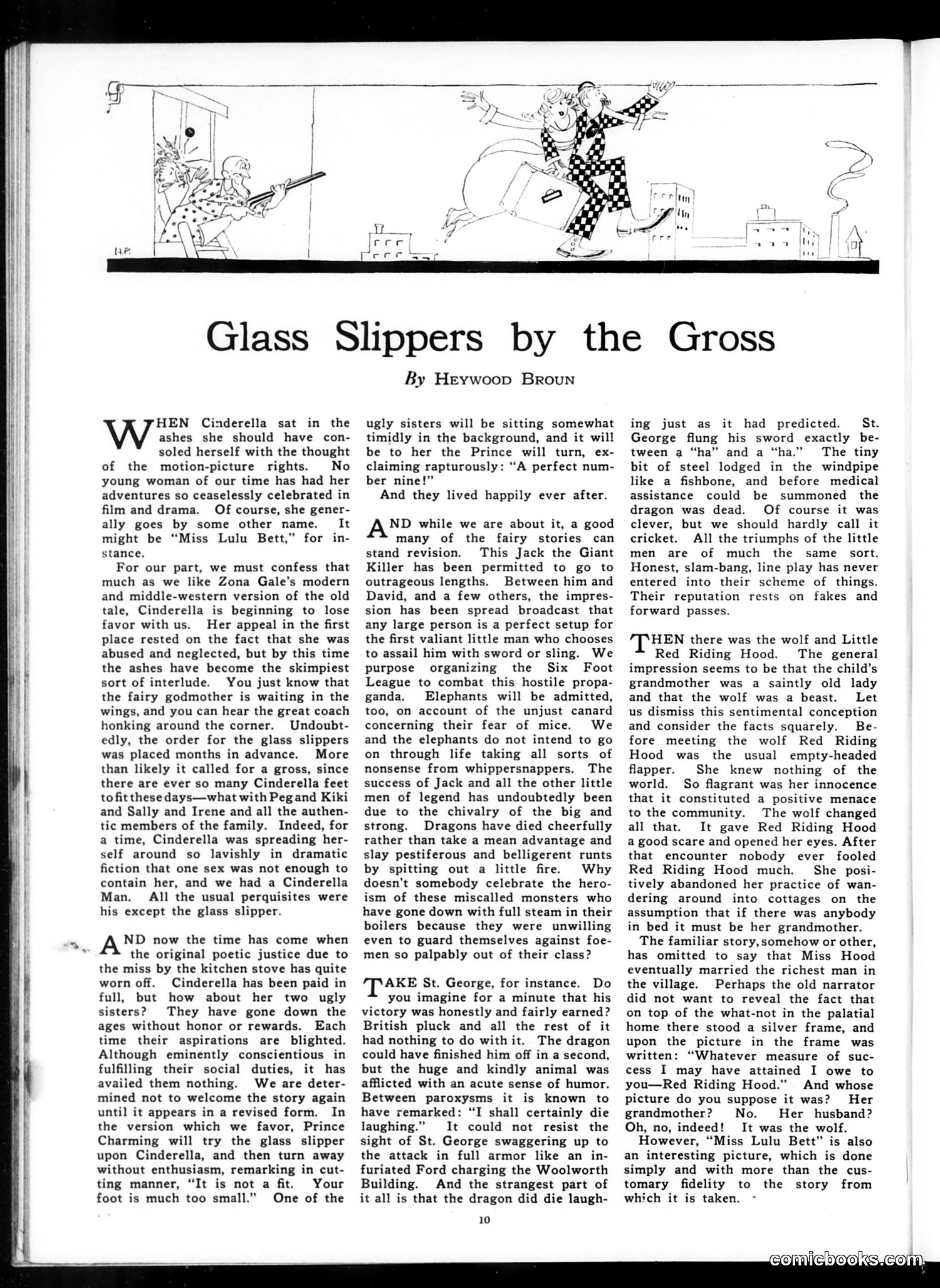
This satirical essay by Heywood Broun critiques the oversaturation of Cinderella adaptations in early 20th-century film and theater (referencing Zona Gale's "Miss Lulu Bett" and a "Cinderella Man"). Broun argues that the fairy tale has lost its appeal through repetition and commercialization—"glass slippers ordered by the gross" suggests mass-market entertainment chasing profits. He proposes revising classic stories to correct their moral lessons, particularly favoring the ugly sisters over Cinderella, and defending giants and dragons who've been unfairly portrayed as villains in folklore. The cartoon at top depicts slapstick action featuring a character being shot from a cannon at buildings—visual comedy unrelated to the text below. This illustrates Judge's typical blend of visual gags and written satire commenting on contemporary popular culture and literary trends.
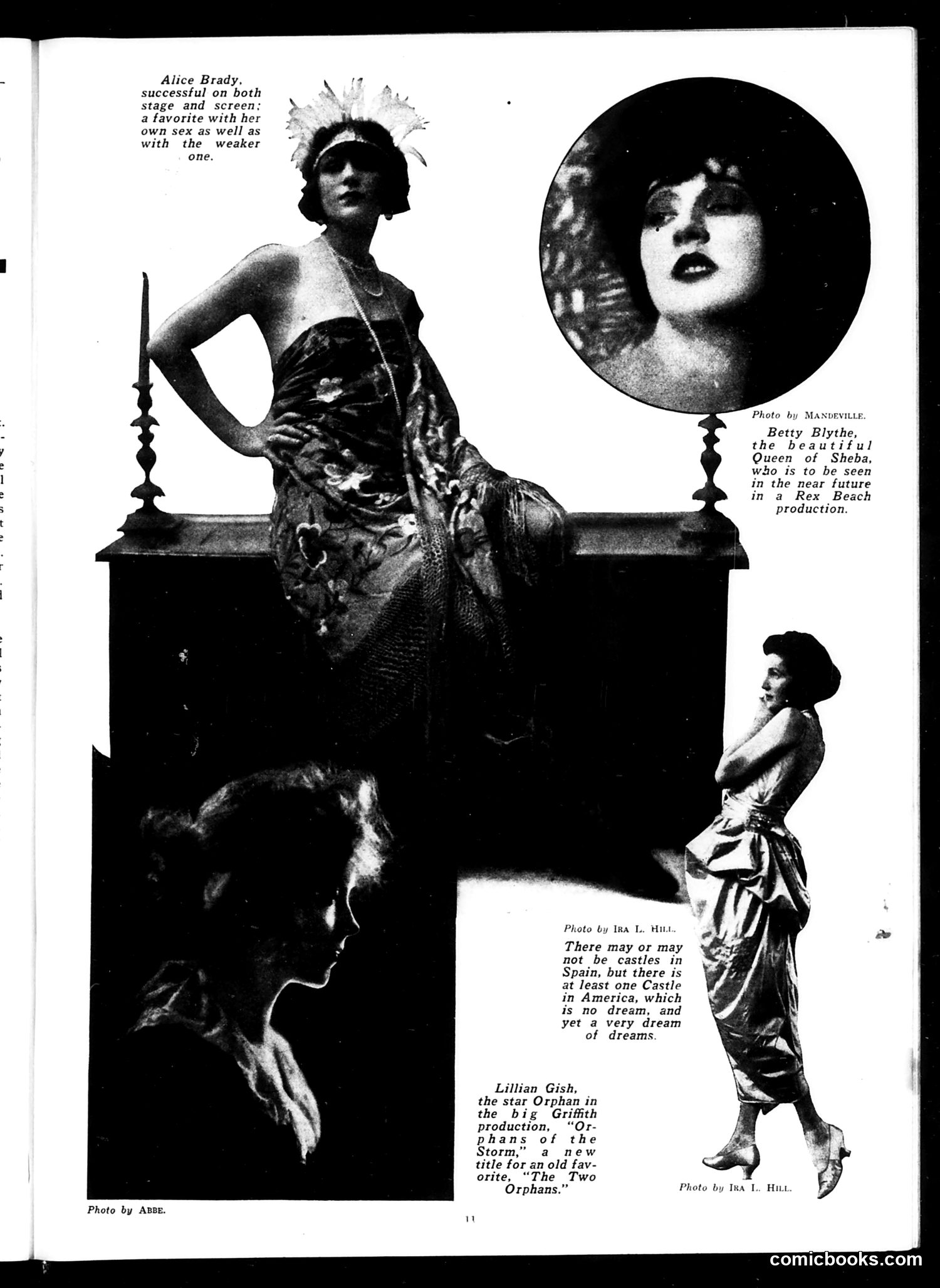
This page is a **celebrity profile spread** featuring prominent **silent film actresses** of the era. Rather than satire, it's primarily promotional content showcasing: - **Alice Brady**: Noted as successful in both stage and film, popular with female and male audiences - **Betty Blythe**: Promoted for an upcoming role as the Queen of Sheba in a Rex Beach production - **Lillian Gish**: Highlighted as the star of D.W. Griffith's production "Orphans of the Storm" (presented as a new title for the older play "The Two Orphans") The humorous note is the pun about "Castle in America" (likely referencing something contemporary—possibly a person named Castle or a venue, context unclear). This appears to be **entertainment journalism rather than political satire**—typical of Judge's mixed content format during the silent film era, when movie stars were major cultural celebrities worthy of magazine coverage.
This page contains theater criticism by George Jean Nathan reviewing contemporary Broadway plays. The cartoon strip at the top illustrates theatrical action—actors in various dramatic poses—but serves mainly as decorative header art rather than political satire. Nathan's reviews discuss A.A. Milne's "The Dover Road" (praised for witty dialogue despite thin plot), Cosmo Hamilton's "Danger" (criticized as overly sexual melodrama appealing to servants and provincials), and Peretz Hirshbein's "The Idle Inn" (a Yiddish drama dismissed as mystical but ultimately dull). The satire is theatrical and social rather than political. Nathan mocks playwrights prioritizing plot over artistry, dismisses Hamilton's pretensions to French sophistication as "New Year's Eve celebration in...Waupaca, Wis.," and derides Yiddish theater as derivative "diluted Russian with a mongrel Celtic strain." The humor targets both inferior dramaturgy and middle-class audience tastes.
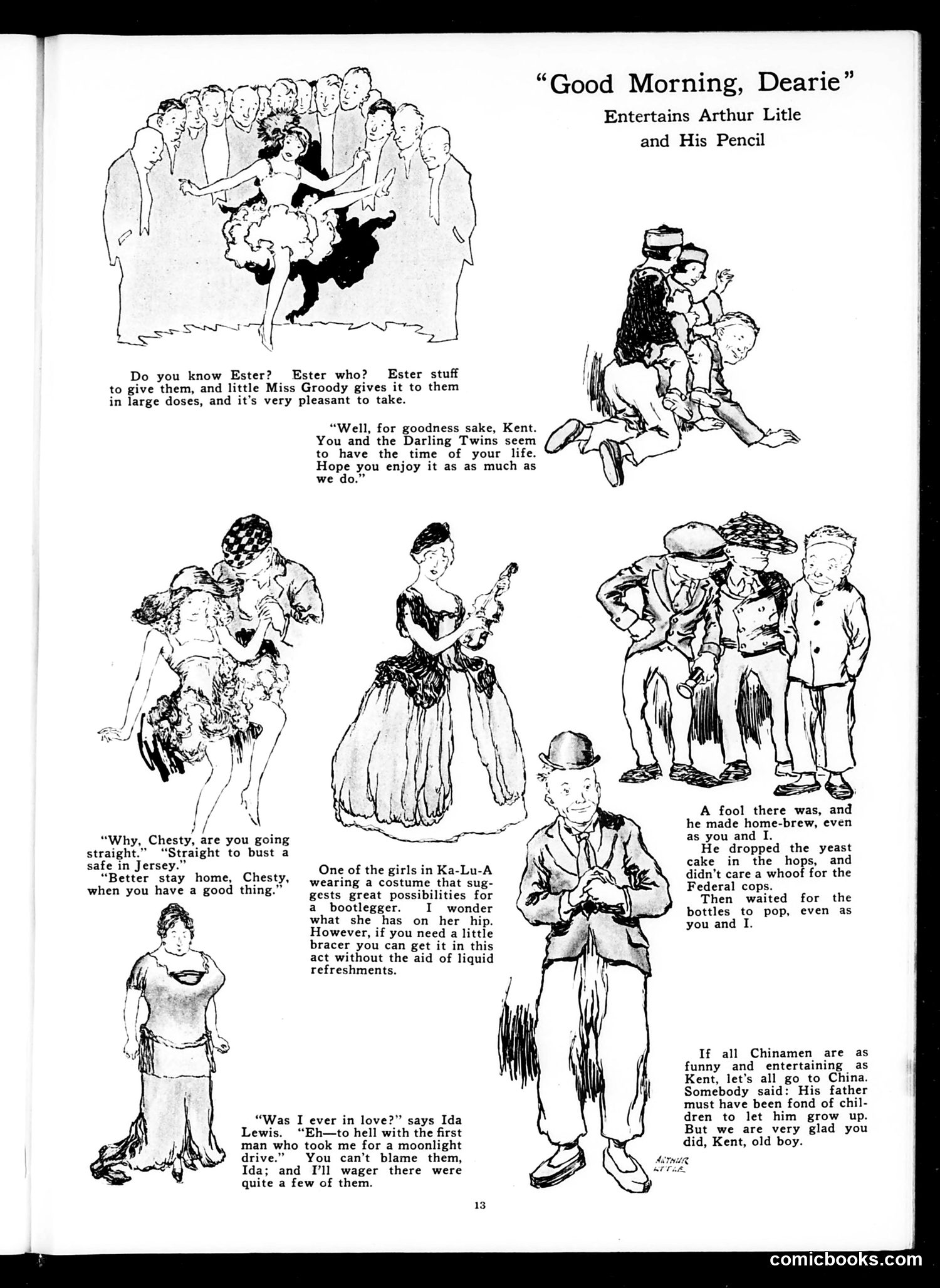
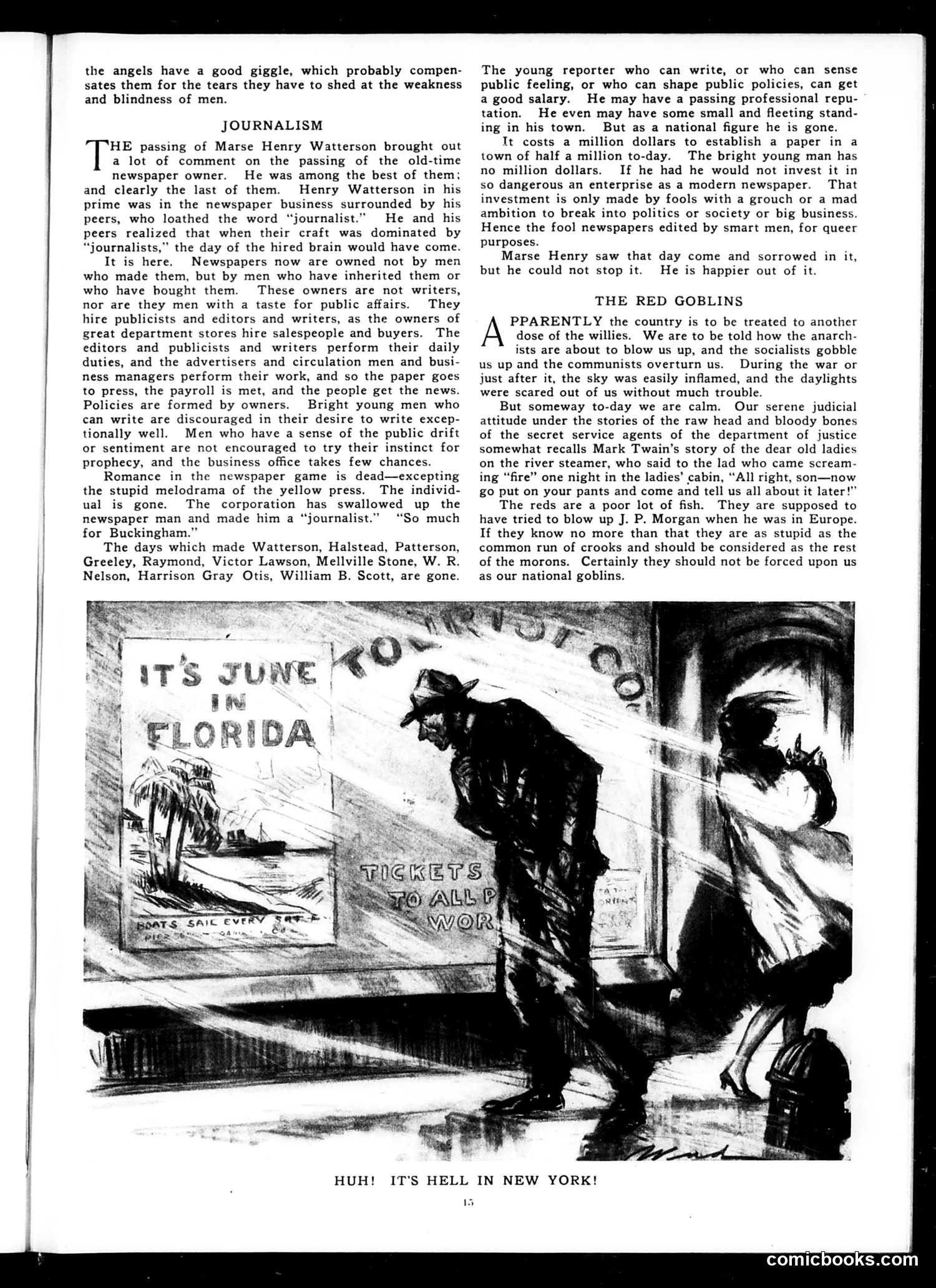
This page features illustrated comedy sketches satirizing Prohibition-era America (likely 1920s-early 1930s). The humor centers on illegal alcohol production and consumption, which was legally banned but culturally widespread. **Key satirical elements:** - **Home-brew jokes**: References to making illegal liquor at home ("dropped the yeast cake in the hops"), mocking both the practice and people's casual disregard for Prohibition laws ("didn't care a whoof for the Federal cops") - **Speakeasies/bootlegging**: Characters mention "Ka-Lu-A" (appears to be a club), with jokes about women hiding alcohol ("what she has on her hip") - **Social commentary**: The sketches mock the hypocrisy of the era—wealthy people openly flouting Prohibition while it remains technically law - **Criminal culture references**: Dialogue about "busting a safe in Jersey" suggests casual acceptance of petty crime The overall tone suggests Judge magazine's satirical critique of Prohibition's failure and America's widespread law-breaking during this period.
This editorial by William Allen White praises young American writers of the early 1920s—Benchley, Dos Passos, Morley, Stewart, Broun, and Marquis—for producing quality literature with distinctive American character: witty, hopeful, and satirical rather than sardonic. However, White issues a cautionary warning to these young writers. He advises them not to become so preoccupied with depicting sexuality and bodily functions (the "beasts of the field" reference) that they neglect the spiritual and aspirational dimensions of human life. White warns against treating life as merely "idle and casual concupiscence," arguing that human experience encompasses deeper meanings—food, family, and noble aspirations matter more than failures. The subtext reflects 1920s anxieties about modernist literature's frank treatment of sexuality and bodily realism, which older critics like White viewed as excessive or spiritually shallow.
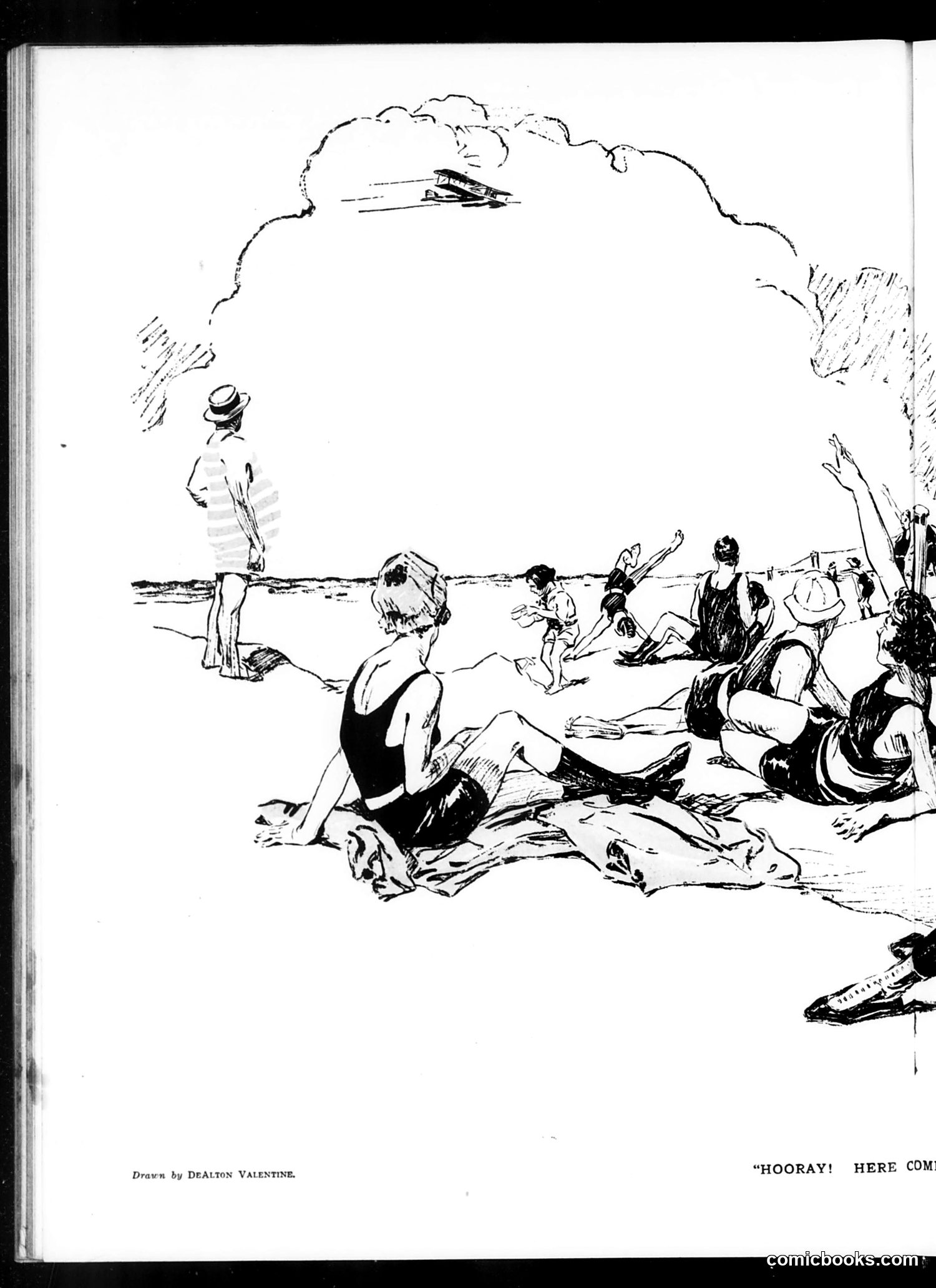
This is a beach scene drawn by Dalton Valentine for *Judge* magazine. The cartoon depicts beachgoers (men and women in period swimwear) celebrating the arrival of something or someone, with one figure pointing skyward at what appears to be an airplane. The partially visible caption "HOORAY! HERE COM[ES]..." suggests the cartoon is commenting on contemporary excitement about aviation or a specific aviator's arrival. Given the era (based on art style and swimwear), this likely references early 20th-century aviation enthusiasm. The specific reference remains unclear without the complete caption, but the satire appears to mock the public's enthusiastic response to modern technology or celebrity. The beach setting contrasts the leisure activity with the dramatic intrusion of technology above.
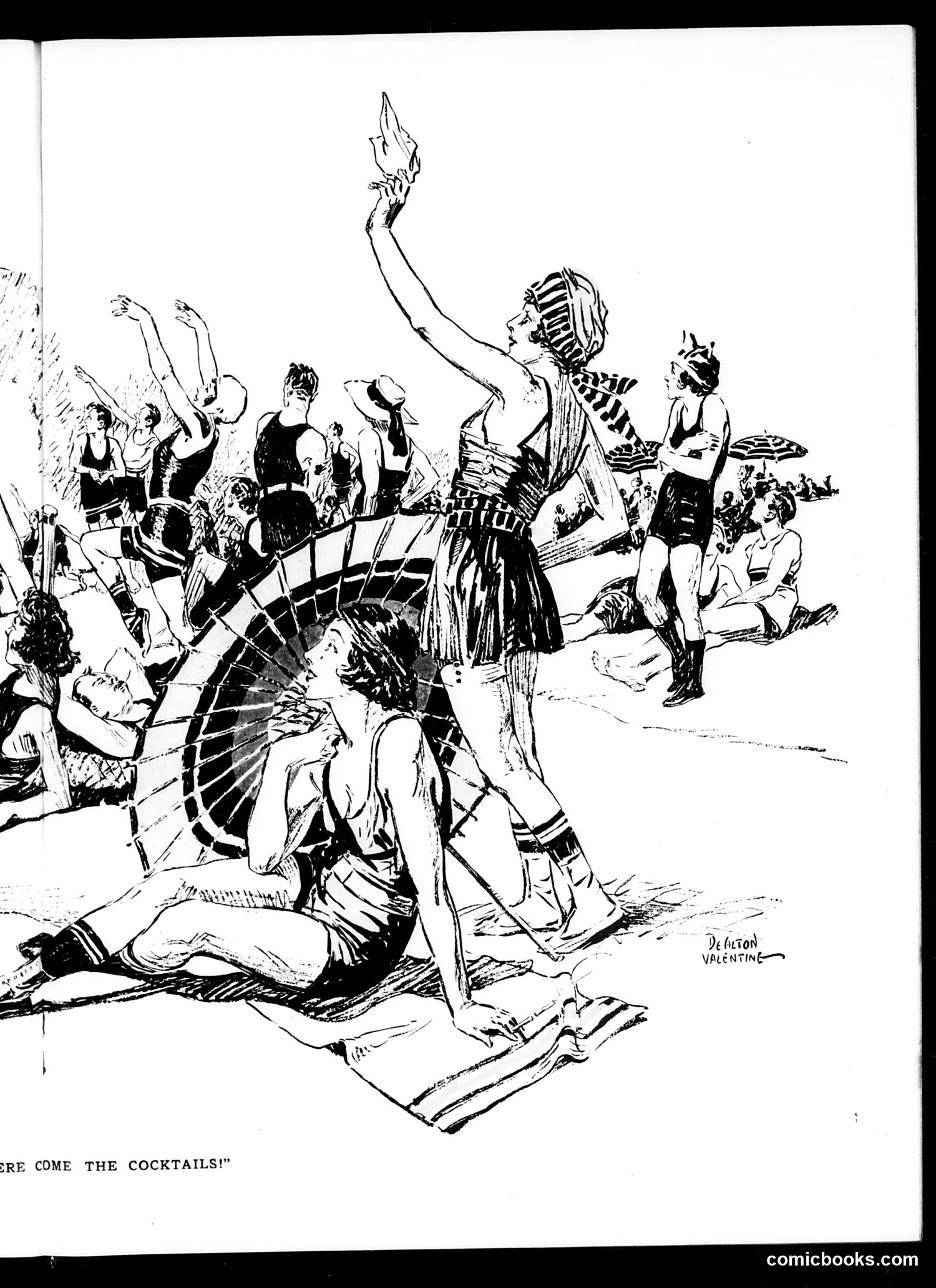
This is an illustration by Delison Valentine depicting a beach or resort scene with figures in 1920s attire. The caption "Here Come the Cocktails!" suggests satire about Prohibition-era social behavior. The central figure appears to be a woman in an elaborate feathered headdress striking a dramatic pose, surrounded by other beachgoers. The exaggerated style and composition likely satirize the Jazz Age's flaunting of Prohibition laws—people openly consuming alcohol despite the constitutional ban (1920-1933). The crowded, chaotic scene with figures in various states of leisure suggests mockery of the era's speakeasies and underground cocktail culture. The elaborate costuming and theatrical poses emphasize the period's decadence and apparent disregard for federal alcohol restrictions. The satire targets both the illegal drinking culture and the fashionable, carefree social attitude surrounding it during Prohibition's enforcement years.
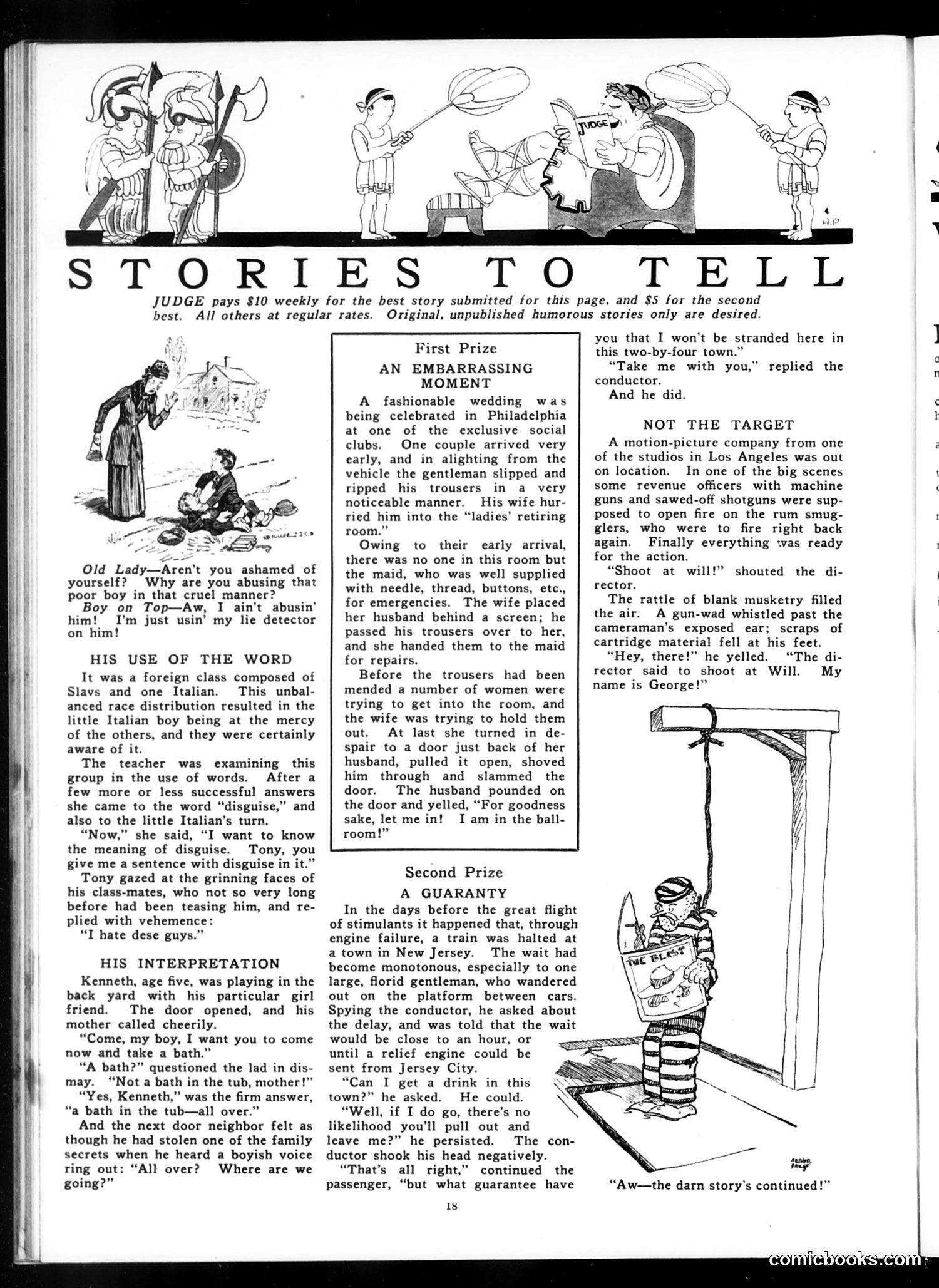
This is a humor page from *Judge* magazine featuring three comic anecdotes submitted by readers, competing for cash prizes ($10 for first place, $5 for second). **The cartoons and jokes satirize:** 1. **"An Embarrassing Moment" (First Prize)**: A society wedding mishap where a gentleman tears his trousers and is accidentally shoved into the ballroom half-naked while waiting for repairs—physical comedy about social pretension and embarrassment. 2. **"His Use of the Word"**: A teacher's lesson on vocabulary backfires when an Italian immigrant boy, teased by classmates, uses "disguise" in the sentence "I hate dese guys"—ethnic humor playing on the boy's accent and his hostile feelings toward bullying. 3. **"A Guaranty" (Second Prize)**: A drunk passenger demands the conductor guarantee he won't be left behind if he gets off the train. The conductor offers himself as collateral—absurdist humor about unreasonable demands and creative problem-solving. These reflect early-20th-century popular comedy conventions: slapstick physical humor, ethnic stereotyping, and situational farce for middle-class audiences.
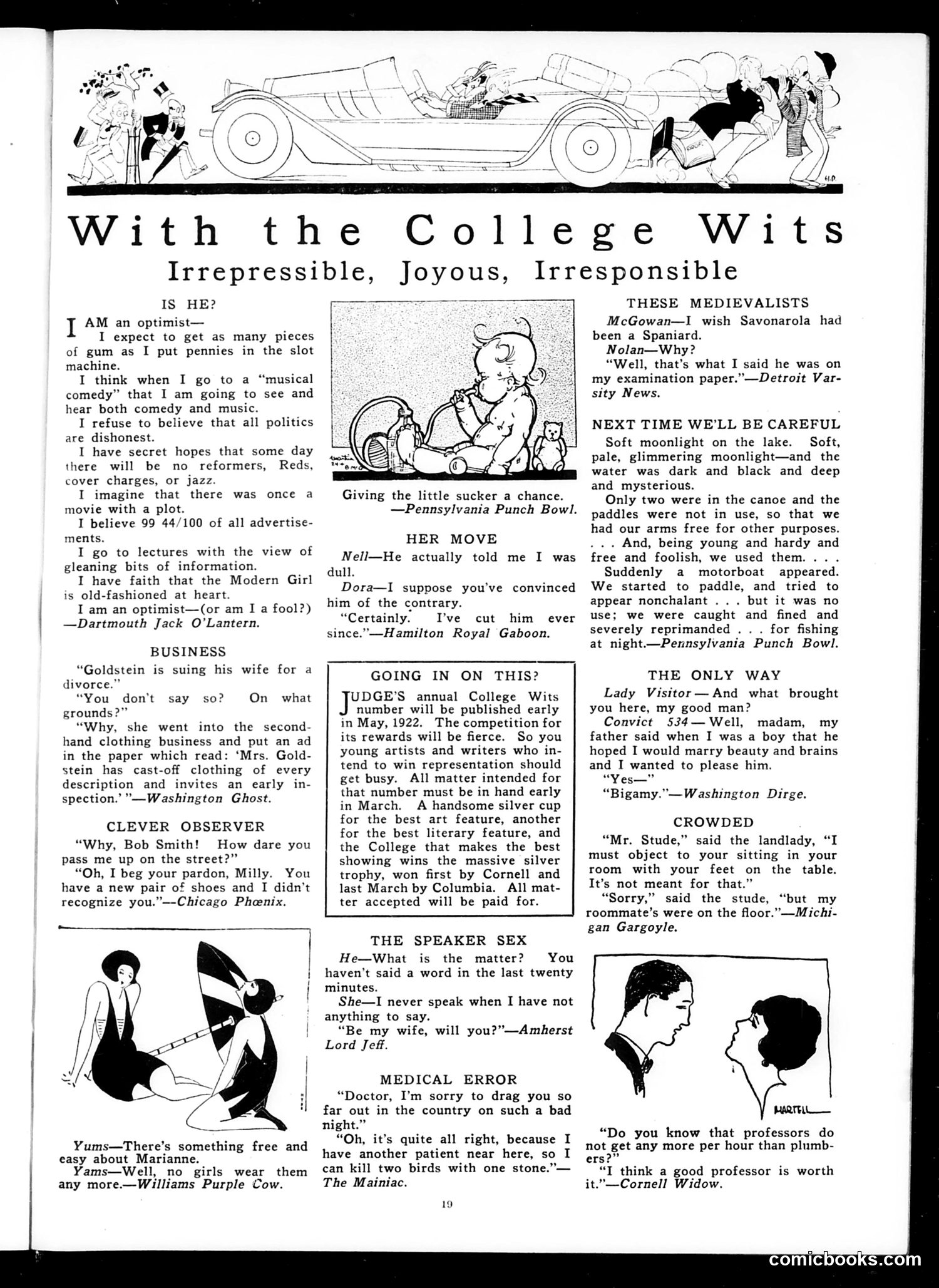
This page collects humor submissions from college students nationwide, showcasing the comedic writing and cartooning style of 1920s collegiate culture. The content reflects typical college-life concerns: romantic miscommunications, academic mishaps, and youthful pranks. The jokes rely on wordplay and ironic reversals—a woman insults a suitor, then punishes him by ignoring him; a motorboat interrupts a romantic canoe moment, leading to an unexpected fine for "fishing at night"; a convict claims bigamy was his way of honoring his father's advice to marry "beauty and brains." The opening illustration shows a car overflowing with college students in exaggerated chaos, capturing the "irrepressible, joyous, irresponsible" spirit described in the subtitle. Judge was soliciting submissions for its annual college competition (judged by competing colleges—Cornell and Columbia mentioned), offering prizes and publication. This represents early 20th-century collegiate magazine culture and student humor standards of the era.
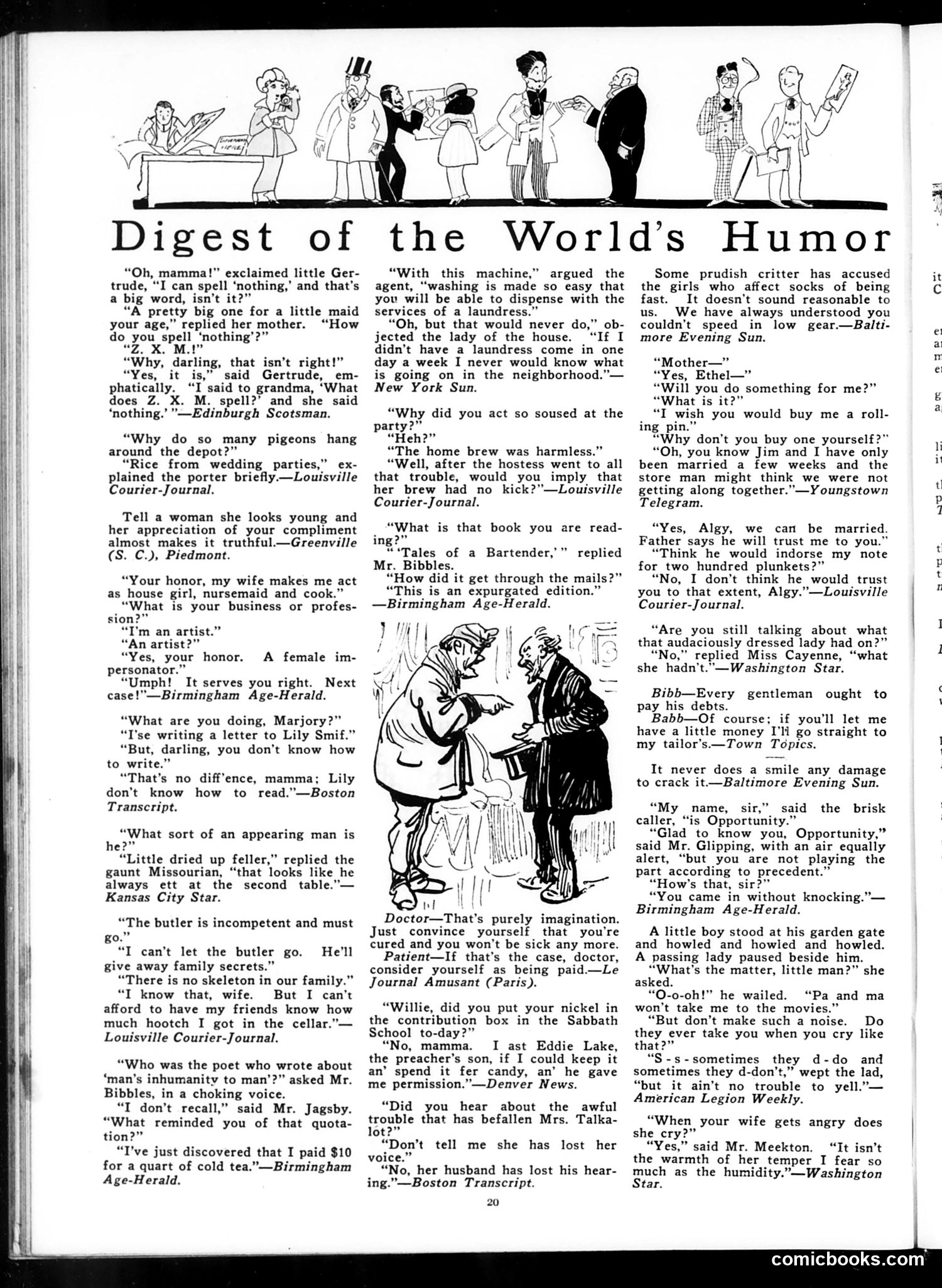
This page is a **humor compilation** collecting jokes from newspapers across America and Europe, not political satire. The cartoons are generic illustrations accompanying lighthearted domestic and social humor typical of early 20th-century publications. The jokes reflect period anxieties: wives controlling husbands, servants gossiping, new washing machines threatening laundry workers' jobs, Prohibition-era home brewing, class consciousness about dining hierarchy, and marital dynamics. One recurring theme is women's education and literacy. The only potentially darker content: jokes about deception (a child writing an unreadable letter, someone being overcharged for "cold tea" instead of alcohol). The "Tales of a Bartender" reference to expurgation suggests Prohibition-era censorship concerns. The page demonstrates how mainstream humor normalized stereotypes about gender roles, class, and domestic life rather than critiquing them—reflecting the values of Judge's middle-class readership.
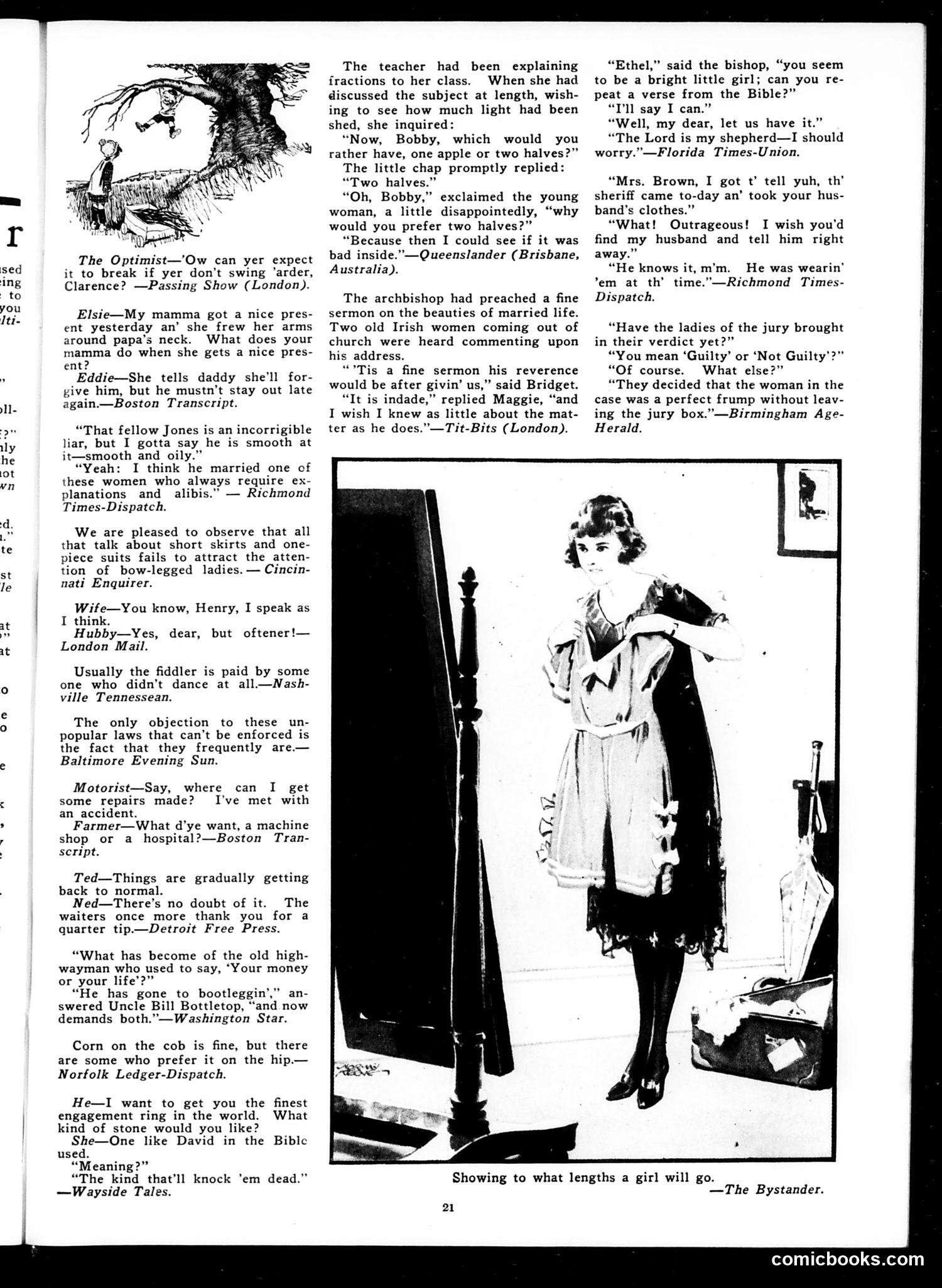
This page contains a collection of brief humorous anecdotes and jokes typical of early 20th-century American satirical magazines, plus one illustration. **The Main Illustration** ("Showing to what lengths a girl will go") depicts a young woman in an interior setting, apparently showcasing fashionable or daring attire—the caption suggests satire about women's changing fashion choices and social behavior. **The Jokes** target various social groups and behaviors: - Marriage dynamics (wives requiring explanations, husbands needing alibis) - Gender relations (wives speaking their minds, women in juries) - Post-WWI recovery ("waiters thanking you for quarter tips") - Class differences (farmers vs. motorists) - Religious hypocrisy (elderly Irish women criticizing a priest's marriage sermon despite their own experience) - Prohibition-era bootlegging The recurring theme is gentle mockery of modern social change—particularly women's increasing independence, shifting gender roles, and evolving courtship/marriage customs. The humor assumes reader familiarity with contemporary debates about women's shorter skirts, jury duty participation, and changing social expectations.
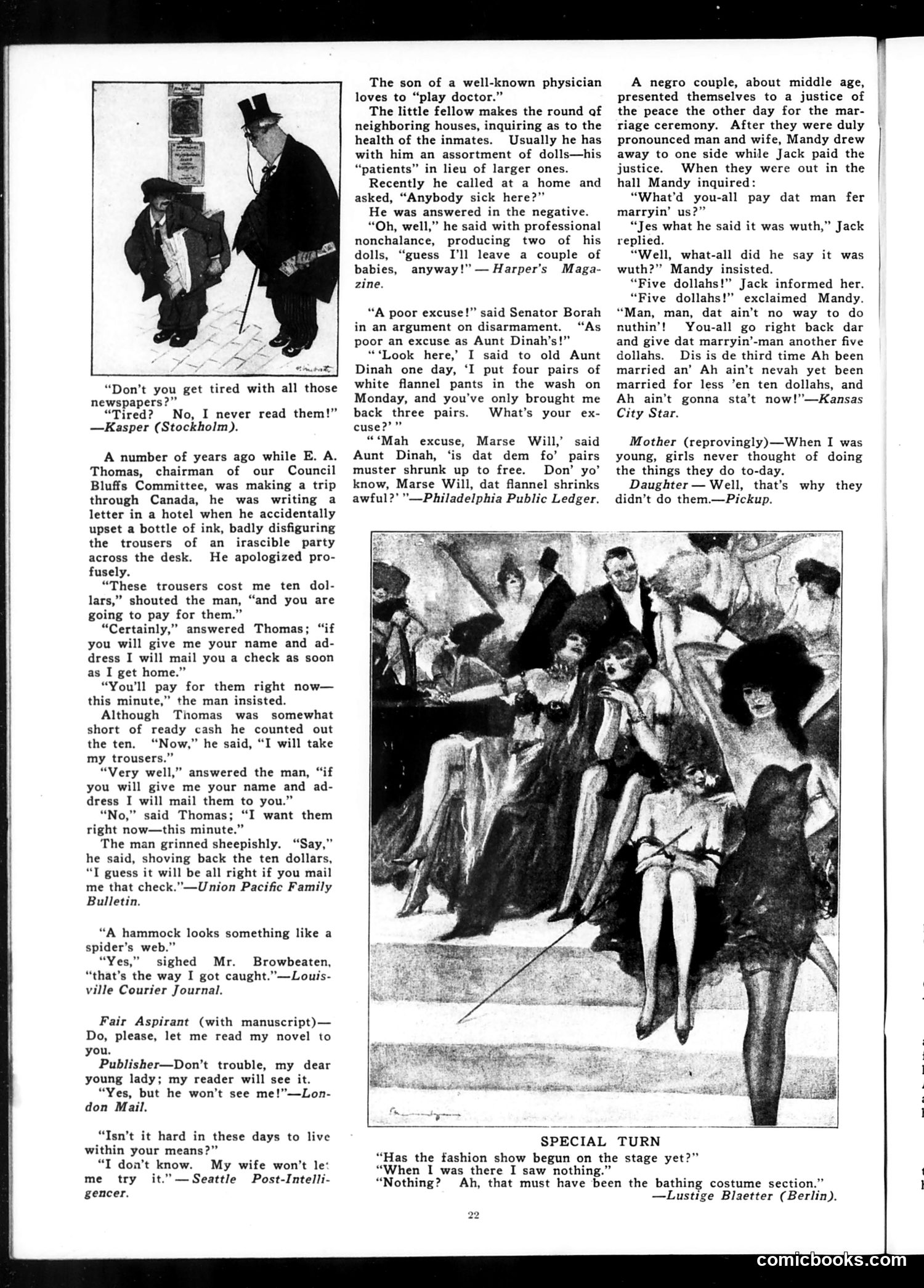
This page contains humorous anecdotes rather than political cartoons. The content reflects early 20th-century American attitudes through comedic stories: **Notable elements:** 1. **Racist stereotypes**: Several anecdotes feature heavy dialect and stereotypical portrayals of Black Americans ("Aunt Dinah," the "negro couple"), reflecting the casual racism acceptable in Judge's era. 2. **Gender humor**: Stories mock women's materialism and vanity (the publisher's visitor, the daughter's modern behavior). 3. **Class commentary**: Tales about wealth, payment disputes, and social awkwardness among different social strata. 4. **One cartoon image** (bottom) shows what appears to be a fashion show scene, captioned "SPECIAL TURN," though details are unclear. The magazine's satire targets broad human foibles—cheapness, marital discord, vanity—through exaggerated anecdotes. The racist language and caricatures, now deeply offensive, were normalized humor for the presumed white middle-class readership Judge targeted.
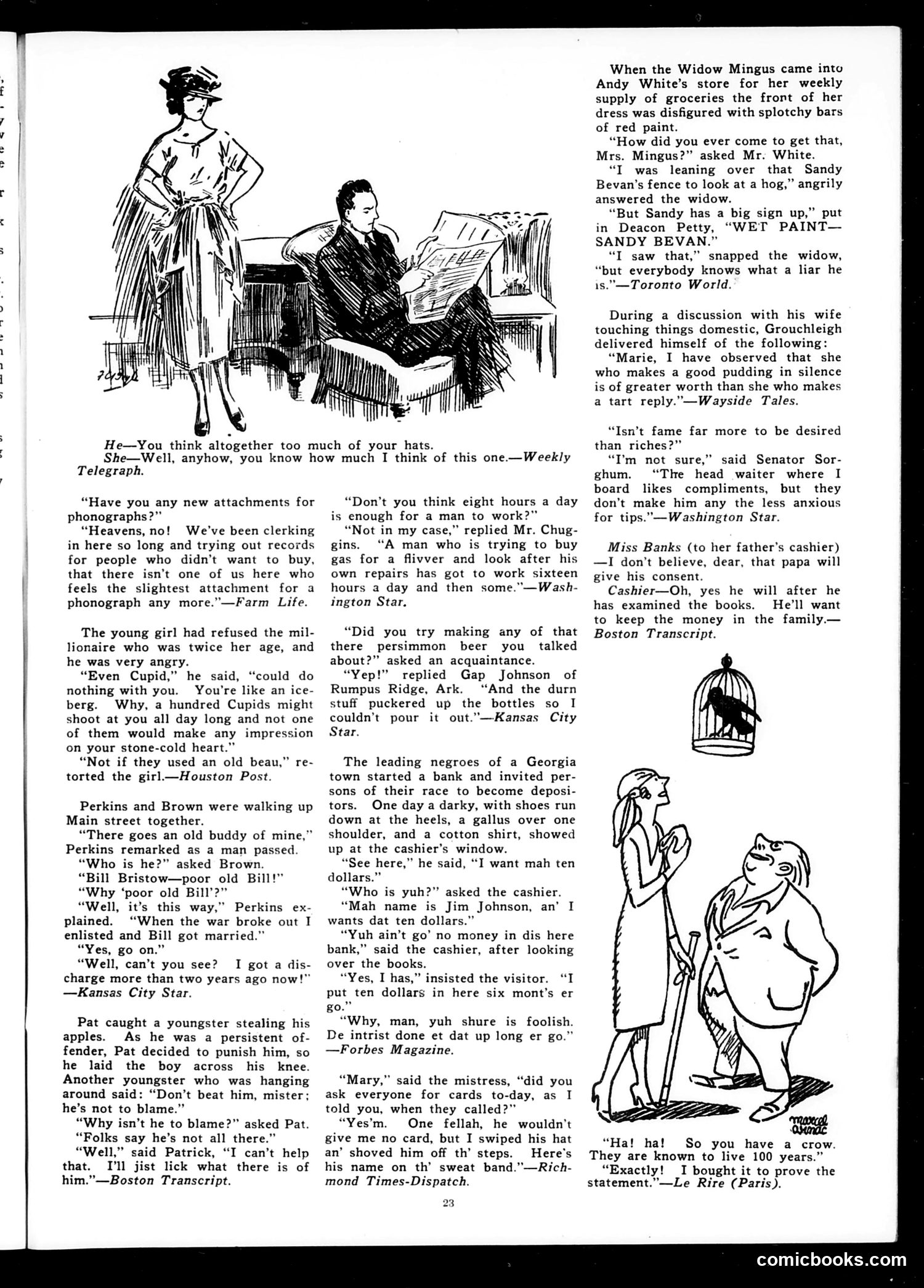
This page contains humorous short anecdotes typical of early-20th-century American humor magazines. The main cartoon (top left) shows a domestic dispute about a woman's hat expenditures—satirizing materialist consumer culture and marital tensions over fashion spending. The surrounding text consists of brief jokes targeting various social groups and situations: - **Working-class struggles**: References to automobile ("flivver") ownership expenses and wartime employment hardships - **Rural/ethnic humor**: Stereotypical depictions of rural Arkansans, Irish immigrants ("Pat"), and African Americans with exaggerated dialect, reflecting period prejudices - **Domestic relations**: Comic scenarios involving servants, wives, and household management **Key context for modern readers**: This humor relies heavily on ethnic and racial caricature that would be considered offensive today. The jokes about Black Americans and Irish immigrants use dehumanizing dialect and stereotypes. The page reflects 1920s-era attitudes where such caricatures were considered mainstream entertainment. The "wet paint" anecdote humorously suggests the widow disbelieves Sandy Bevan because he's chronically dishonest.
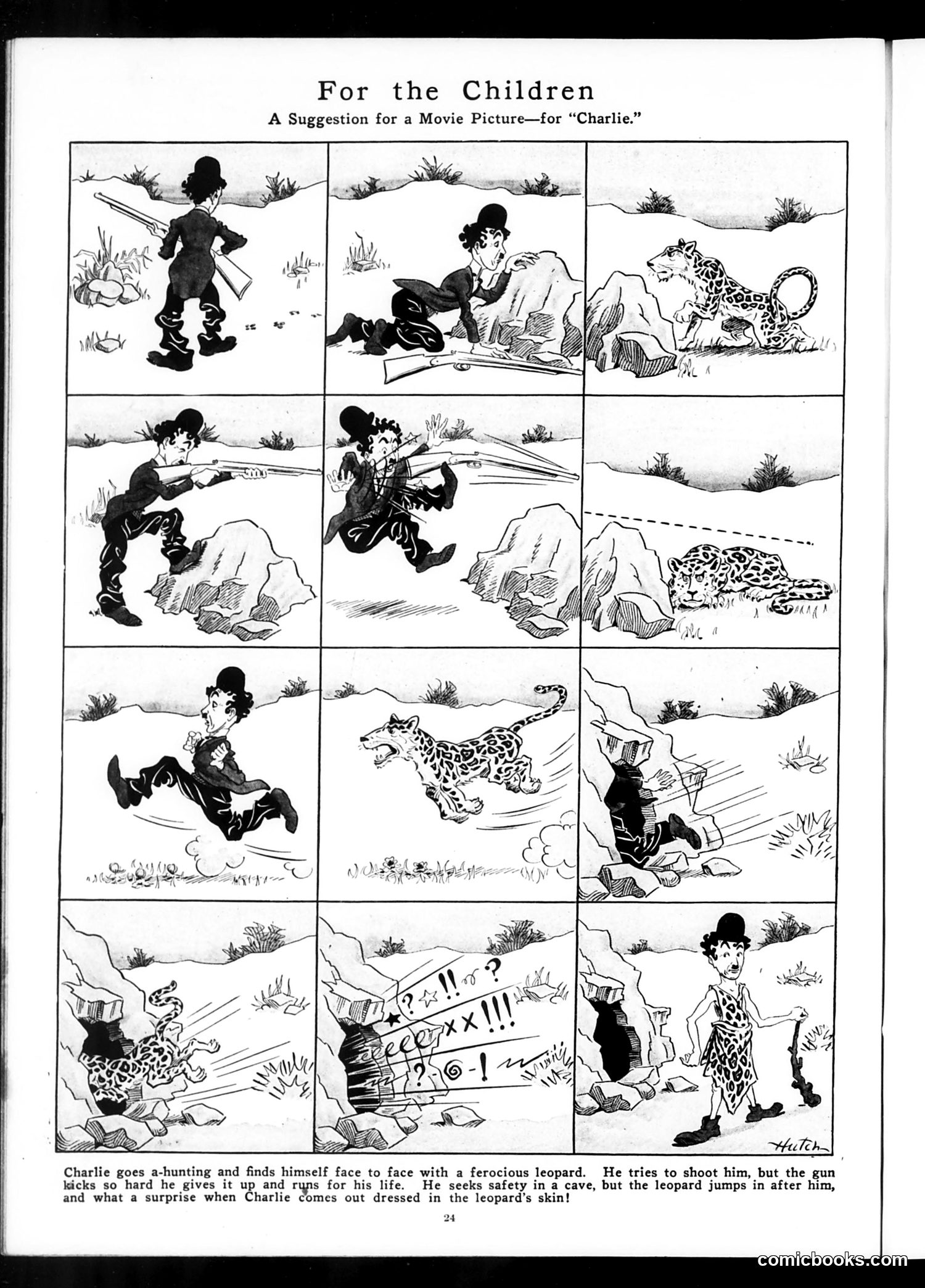
This is a silent-film comedy storyboard for "Charlie," clearly referring to Charlie Chaplin, the era's most famous comedian. The nine-panel sequence shows Chaplin's character hunting, encountering a leopard, attempting to shoot it (the gun's recoil sends him flying), fleeing into a cave, and emerging wearing the leopard's skin as a disguise. The humor relies on classic slapstick: physical comedy (the gun's kickback), peril (the charging leopard), and absurdist resolution (emerging in animal costume). This reflects early 1920s silent-film comedy conventions where visual gags and exaggerated physical reactions were paramount. The caption frames it as wholesome children's entertainment, though the leopard-skin punchline suggests audiences of all ages would appreciate Chaplin's comedic antics.
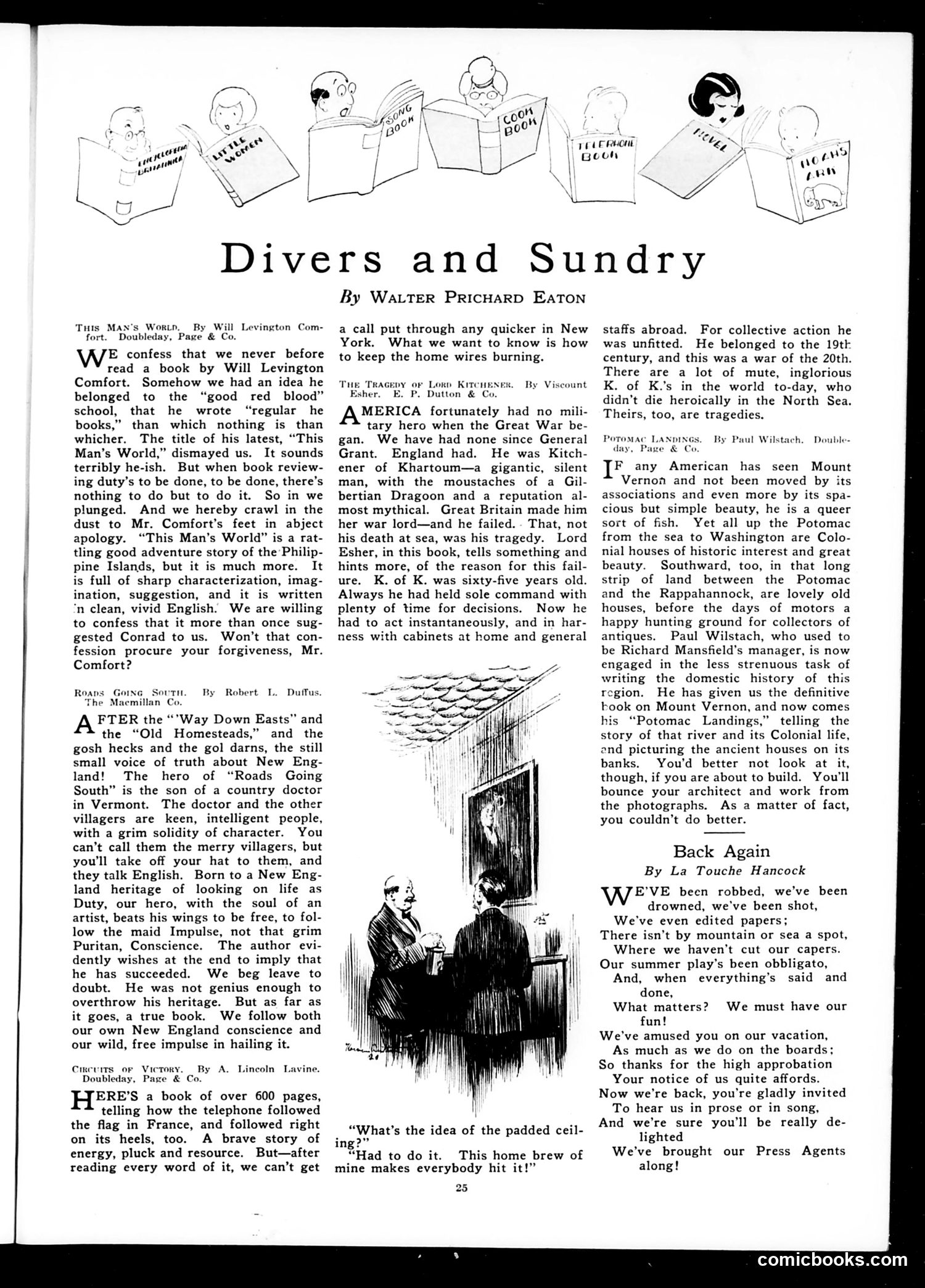
This page from Judge presents book reviews by Walter Prichard Eaton alongside satirical content. The header illustration shows seven people reading books labeled with titles, establishing a literary theme. The reviews discuss contemporary novels: Comfort's "This Man's World" (an adventure story), Duffus's "Roads Going South" (about a New England doctor's son torn between duty and impulse), and a book about telephone service in France during WWI. The most pointed review concerns Lord Kitchener's biography. Eaton argues that Britain's famous WWI military leader—despite his legendary reputation and imposing appearance—ultimately failed because he was a 19th-century military figure unsuited to 20th-century warfare requiring collective action and rapid decisions. He belonged to an older command structure. The cartoon below satirizes Prohibition-era home brewing, showing two men discussing a padded ceiling—necessary because homemade alcohol is so potent it makes people violently hit their heads on it.
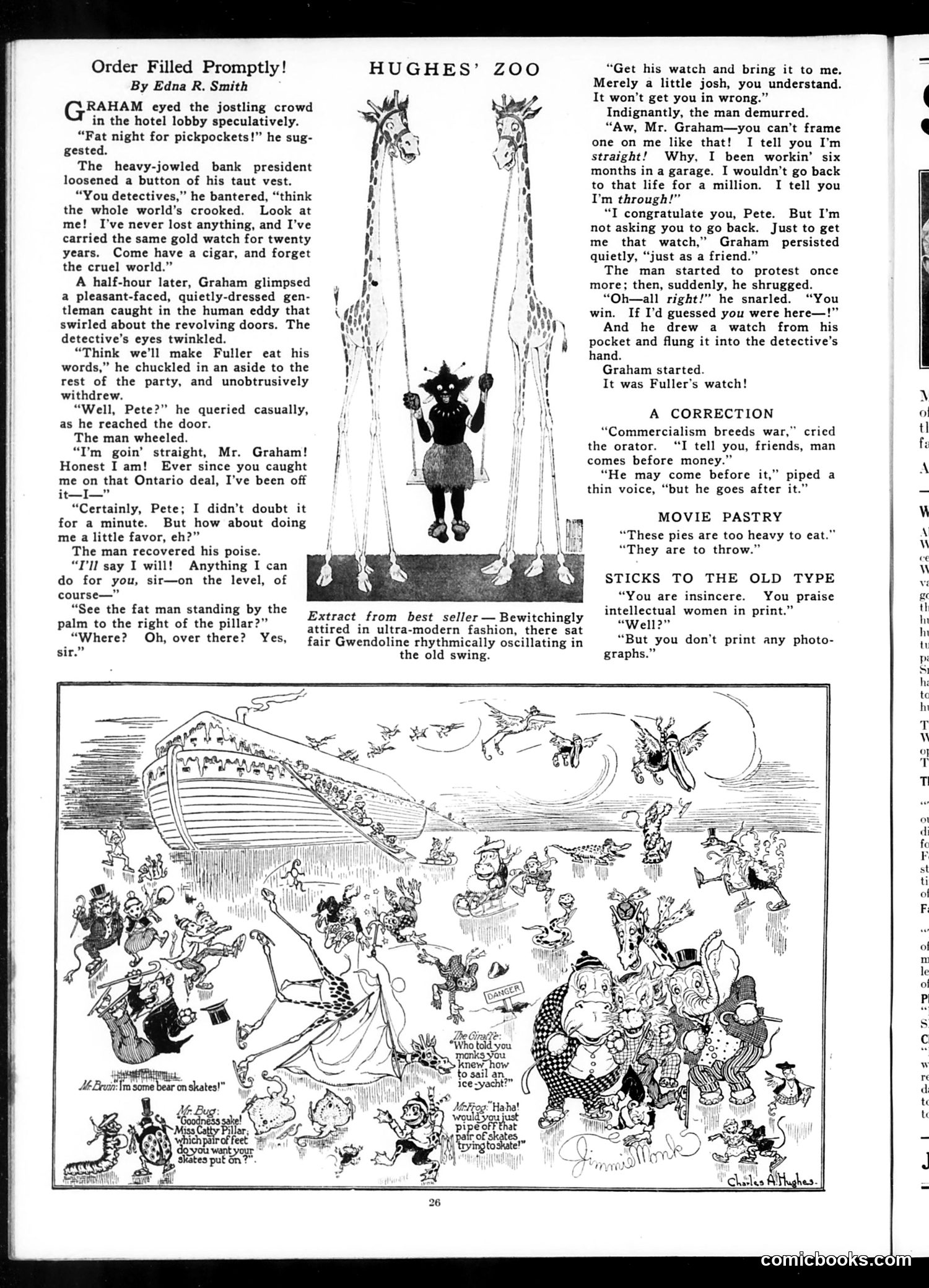
This page contains a detective story ("Order Filled Promptly!" by Edna R. Smith) and several brief satirical items. **Main Story**: Detective Graham catches a pickpocket named Pete by setting a trap using banker Fuller. Graham exploits Pete's reformed reputation to manipulate him into stealing Fuller's watch—proving Fuller's arrogant boast about never losing anything was unfounded. The irony: Fuller's own overconfidence made him vulnerable. **"Hughes' Zoo"**: A Charles A. Hughes cartoon showing giraffes on a swing—appears to be visual whimsy without clear political reference (unclear if "Hughes" references a specific person). **Brief Satires**: - "A Correction": Mocks an anti-war orator by suggesting people follow money, not principles - "Movie Pastry": Jokes about heavy movie-theater pie - "Sticks to the Old Type": Critiques hypocrisy—praising intellectual women in print while refusing to photograph them The page exemplifies Judge's blend of narrative humor, visual satire, and social commentary typical of early 20th-century American humor magazines.
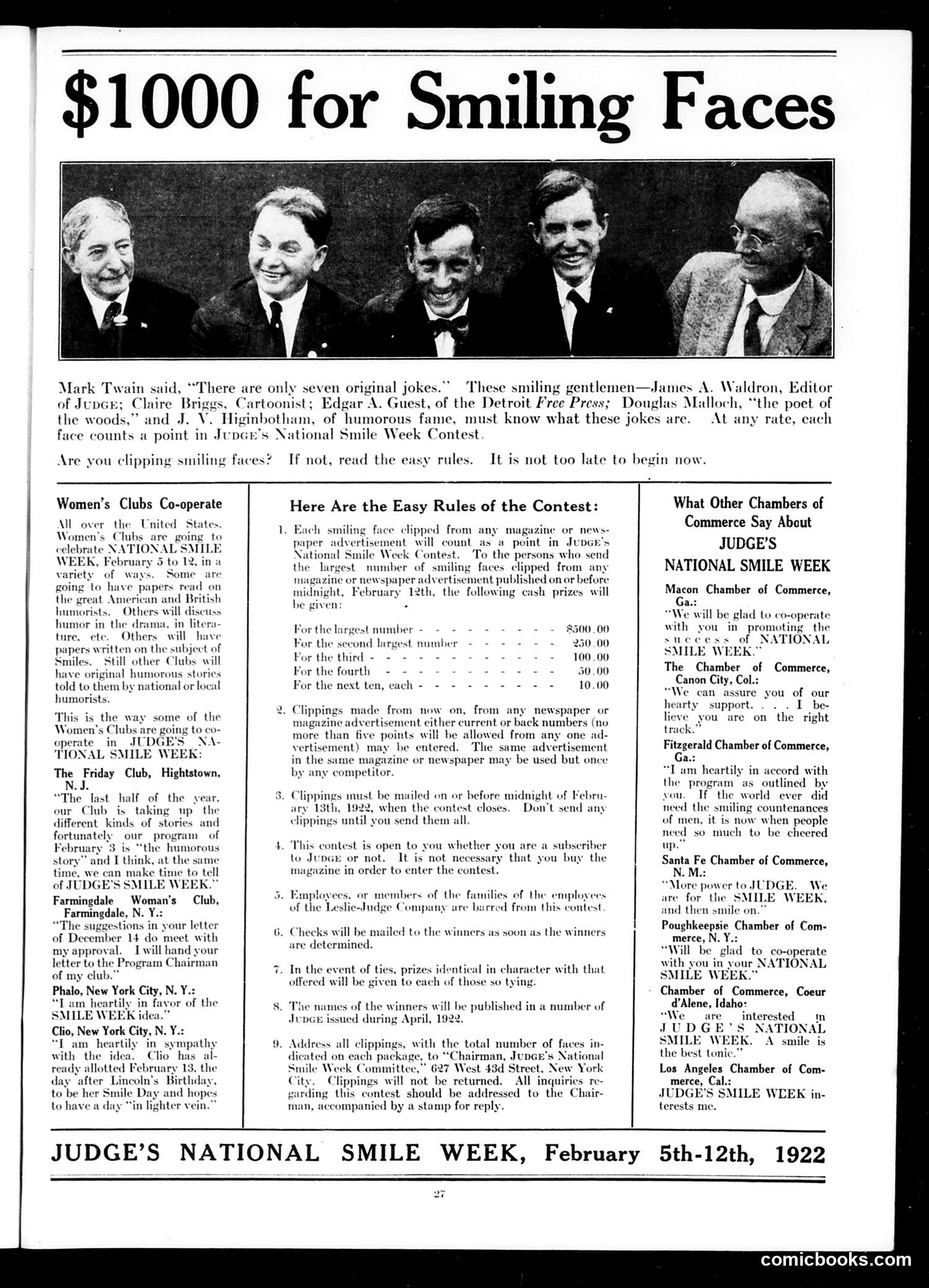
This is primarily a **contest announcement**, not a political cartoon. Judge magazine is promoting its "National Smile Week" (February 5-12, 1922) by asking readers to clip smiling faces from advertisements and mail them in for cash prizes—the largest prize being $500. The five men pictured at the top are noted humorists and editors of the era judging the contest, including cartoonist Claire Briggs and poet Douglas Malloch. The Mark Twain quote ("There are only seven original jokes") frames the humorous context—the idea being that smiles/humor are universal. **The satire is subtle**: In an era of serious post-WWI concerns, Judge is promoting levity and laughter as civic good, with women's clubs nationwide cooperating to celebrate humor. The contest itself is a marketing gimmick disguised as community participation. There's no specific political target—it's promotional content that treats "smiling" almost as patriotic duty during an era when such cultural appeals were common.
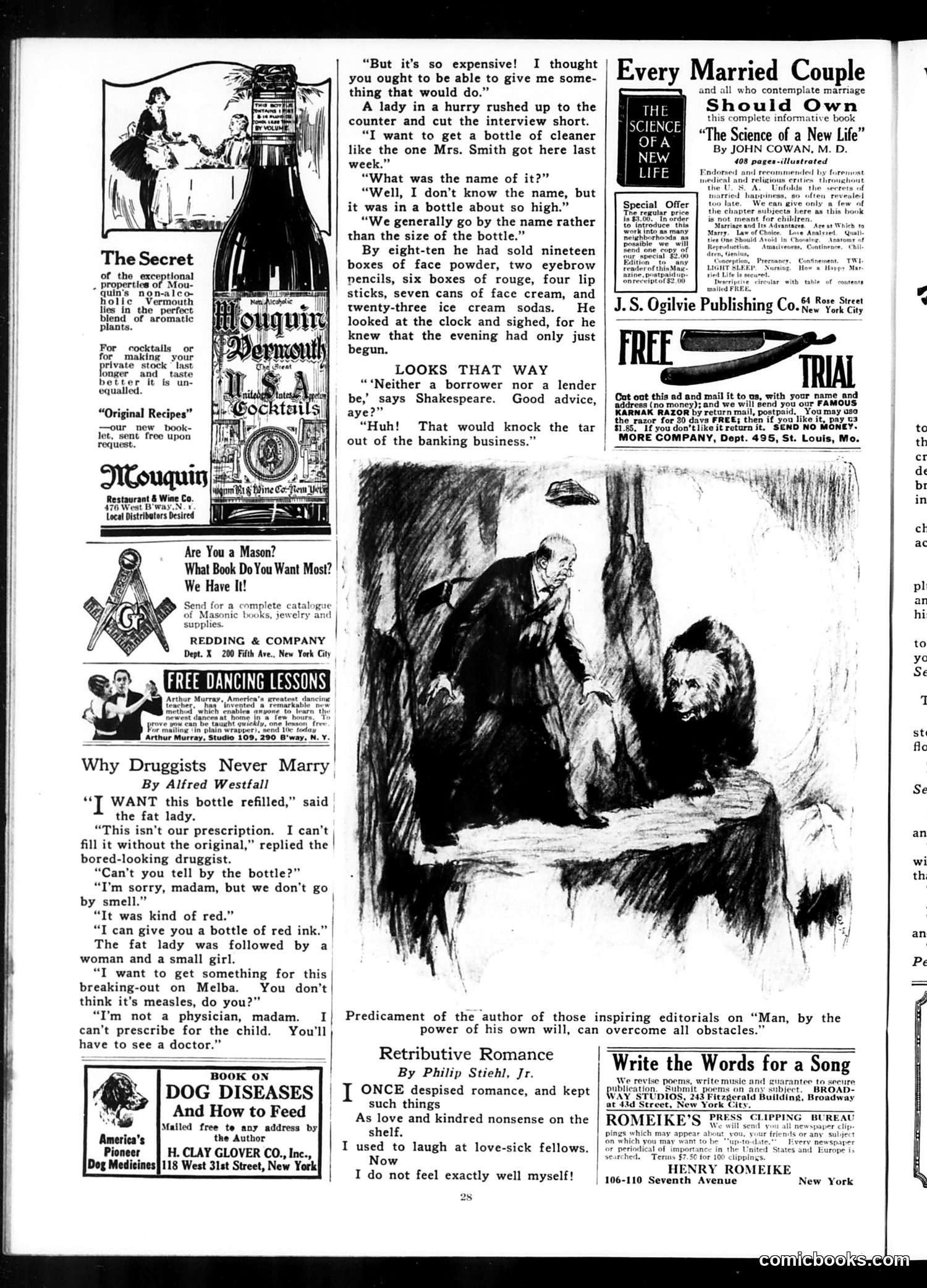
This page contains several satirical pieces mocking everyday American life, circa early 1900s: **"The Secret" (main cartoon):** A druggist endures a chaotic evening of incompetent customers—a woman unable to describe a product by anything but its bottle size, another asking him to prescribe for a child, a man wanting cleaner but unable to name it. The joke: ordinary people are absurdly helpless without basic information, forcing patient service workers to suffer their vagueness and unreasonable demands. **"Why Druggists Never Marry" (bottom section):** Satirizes a druggist's exhausting day serving ridiculous customers, establishing him as perpetually frustrated—hence unmarriageable. **"Retributive Romance":** A brief poem mocking the author's own previous cynicism about love. He once laughed at romantic fools; now lovesickness has humbled him. The overall theme: satire of modern consumer culture and human folly, presented through the lens of a weary professional's daily frustrations.
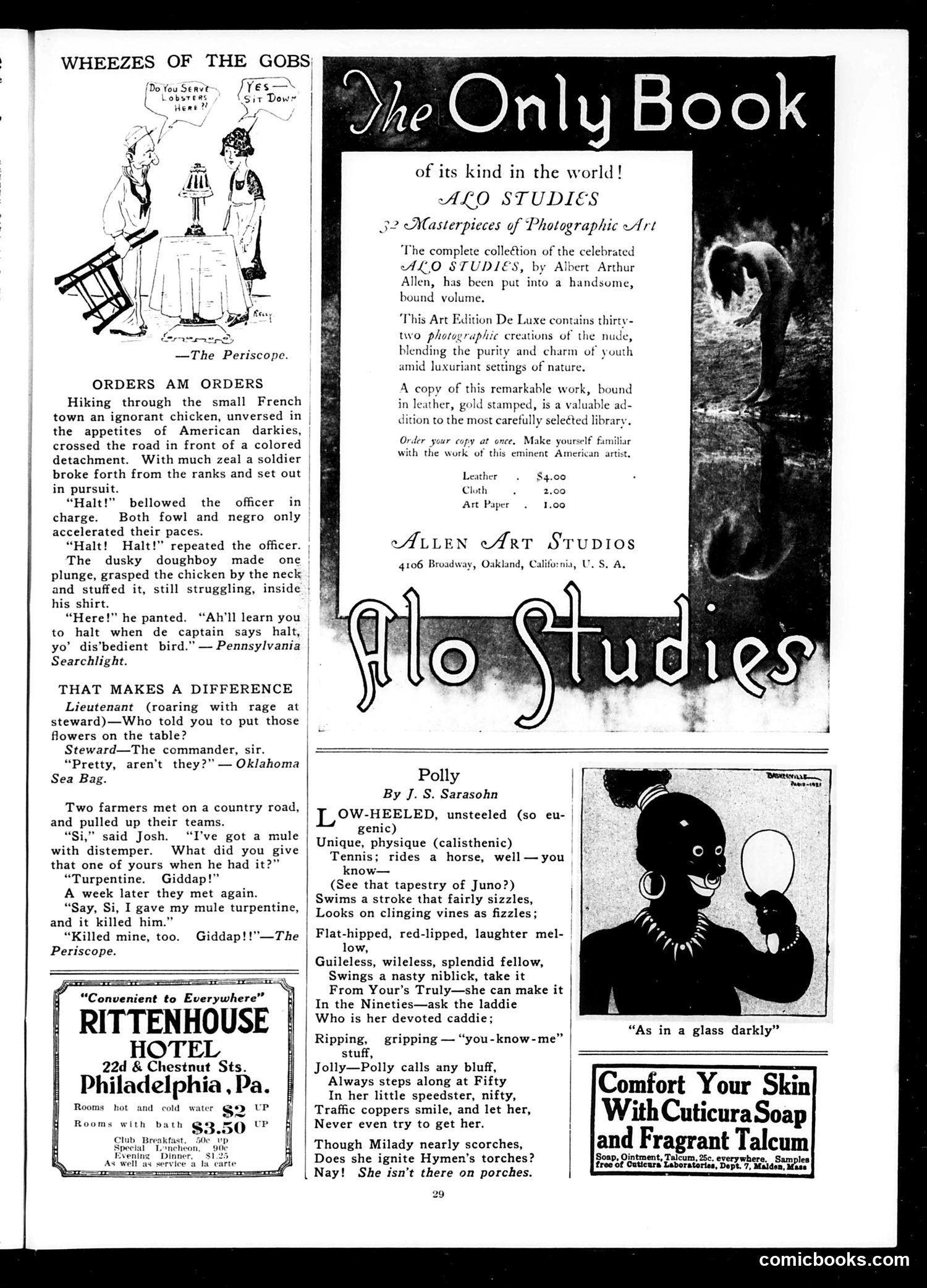
This page contains three main elements: **"Orders Am Orders"** is a racist joke about Black soldiers in WWI. A chicken crosses a military road; when a Black soldier fails to halt it properly, he stuffs the bird in his shirt, telling it: "Ah'll learn you to halt when de captain says halt, yo' dis'bedient bird." The "humor" relies on stereotypes portraying Black soldiers as unintelligent and comparable to animals. **"That Makes a Difference"** is a brief officer's mess joke about miscommunication regarding table flowers. **"Polly"** is a poem describing a modern woman—athletic, drives fast cars, plays golf—but pointedly notes she won't marry ("She isn't there on porches"), apparently satirizing the "New Woman" of the 1920s who prioritized independence and activities over domestic roles. The remaining content is advertising (hotel, art books, soap) typical of magazine pages from this era. The racial stereotype humor reflects the deeply prejudiced attitudes of early 20th-century American popular media.
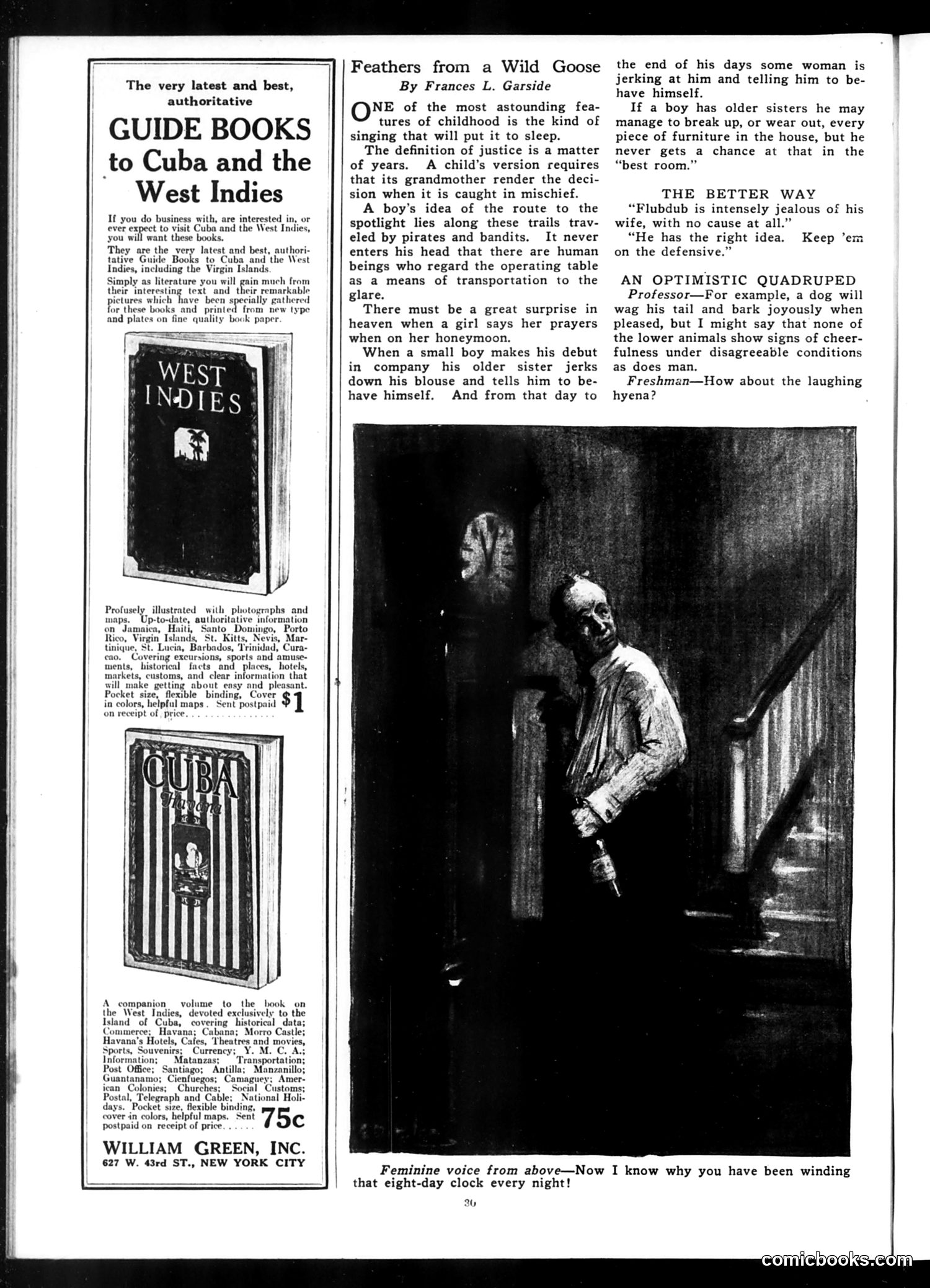
This page is primarily **advertising** for travel guidebooks to Cuba and the West Indies, published by William Green, Inc. Two guide books are promoted: one covering the broader West Indies region ($1) and a companion volume focused exclusively on Cuba (75¢). The ads emphasize these are "the very latest and best, authoritative" resources, featuring photographs, maps, and practical travel information. The right side contains **"Feathers from a Wild Goose,"** a humor column by Frances L. Garside offering satirical observations about human nature—particularly childhood behavior, family dynamics, and gender relations. These are light, domestic jokes rather than political satire: children's singing, sibling dynamics, spousal jealousy, and a professor-student exchange about animal versus human cheerfulness. The accompanying illustration depicts a man winding a clock while a woman's voice comes from above, illustrating the final joke: the husband winds the clock nightly because his wife's nagging keeps him in motion. **Overall:** This is a lighthearted humor and advertising page with no significant political commentary.
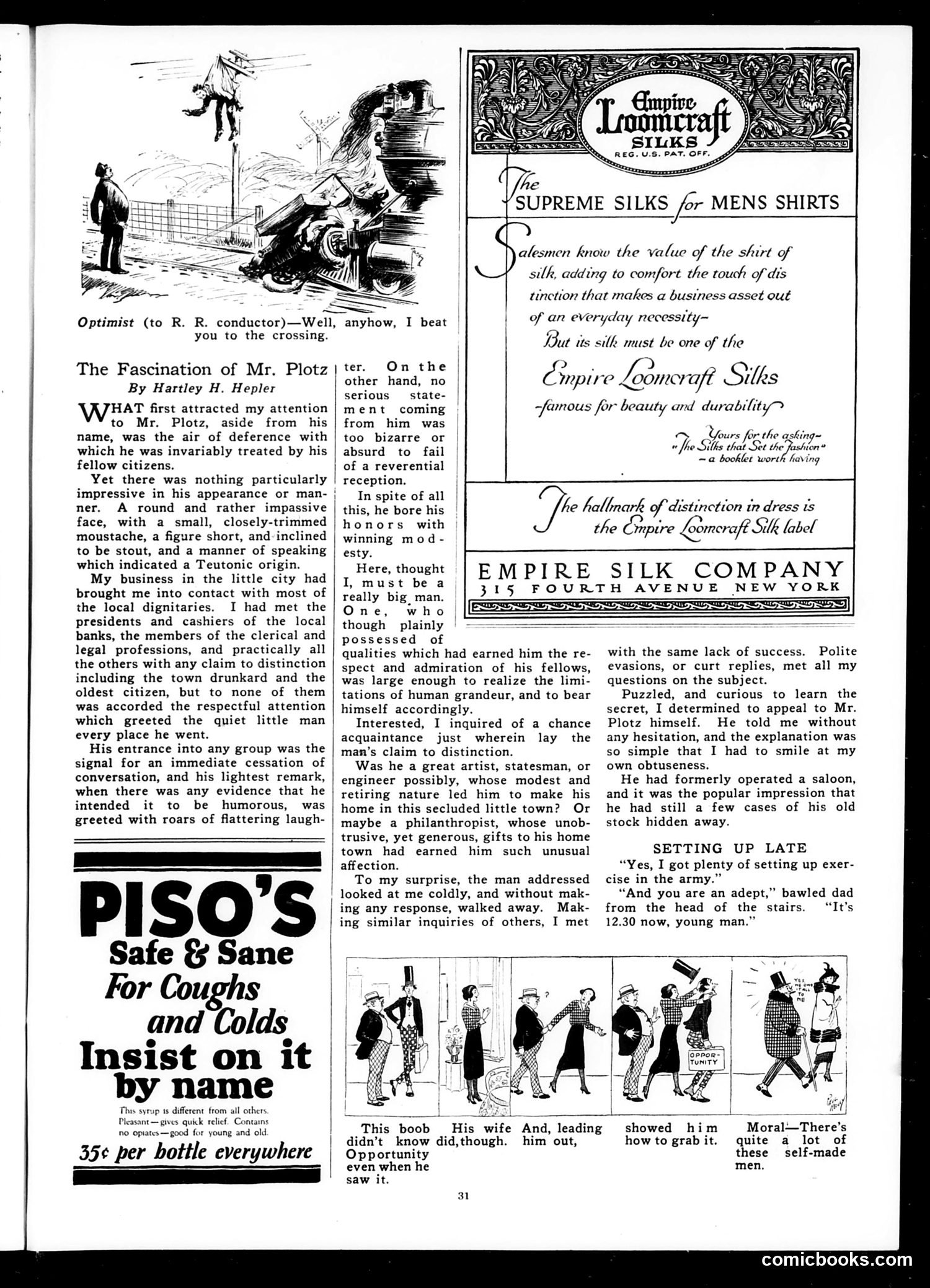
**The Main Cartoon** (top left): Shows a railroad conductor and an optimist at a crossing. The joke is straightforward: the optimist claims he "beat you to the crossing"—a dark humor reference to a fatal train accident. **"The Fascination of Mr. Plotz"** (center story): This satirizes small-town social dynamics. Plotz is a mysterious figure of inexplicable prestige—townspeople defer to him despite his unremarkable appearance. The punchline reveals the "secret": he formerly ran a speakeasy and allegedly still has hidden stock. During Prohibition (1920-1933), this would have made him locally important—people curried favor hoping to access illegal alcohol. The satire mocks both Prohibition's absurdity and how it warped community respect. **Bottom Comic Strip** ("Setting Up Late"): Shows a domestic dispute where a father catches his son coming home at 12:30 AM. The "setting up late" pun and the father's mock-military tone suggest generational conflict over discipline. **Advertisements** occupy significant space, promoting Empire Loomcraft silk shirts and Piso's cough syrup—typical period marketing.
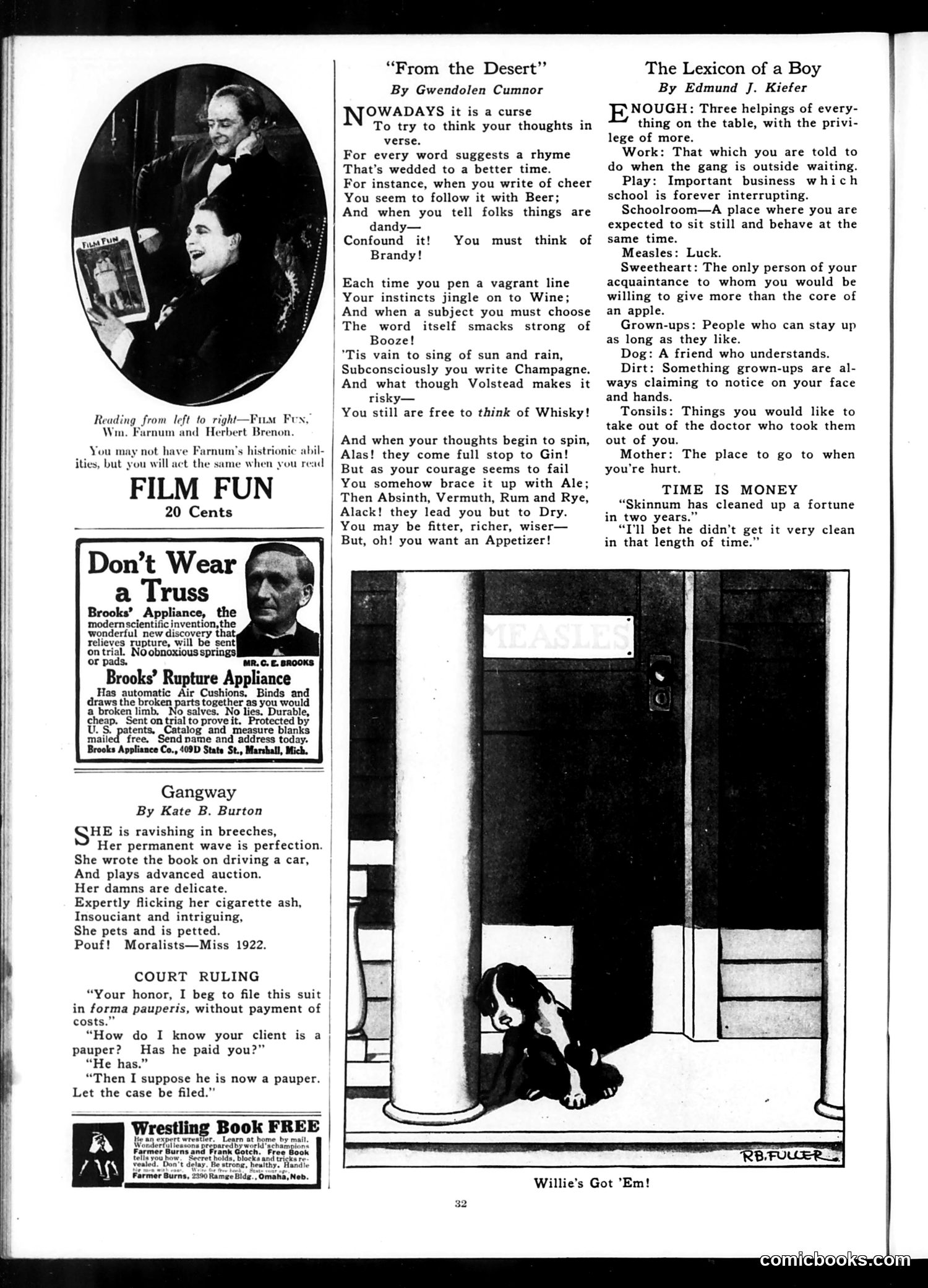
This 1922 *Judge* page satirizes Prohibition-era America through multiple pieces: **"From the Desert"** mocks the unintended consequence of Prohibition (the Volstead Act, passed 1919): despite alcohol being illegal, a poet cannot escape thinking about drinks. Every innocent word—"cheer," "dandy," "rain"—subconsciously rhymes with alcohol ("Beer," "Brandy," "Champagne," "Whisky," "Gin"). The satire suggests Prohibition didn't eliminate desire for alcohol; it merely made the craving more psychologically pervasive. **"The Lexicon of a Boy"** humorously defines childhood concepts from a child's perspective—work versus play, measles as "luck," dirt as something adults obsess over. It's gentle social commentary on adult-child misunderstandings. **"Gangway"** describes the modern 1922 woman: independent, smoking, driving, playing cards, wearing breeches. The sarcastic "Pouf! Moralists—Miss 1922" critiques conservative disapproval of changing female social roles. The remaining content includes advertisements and a legal humor piece. The cartoon "Willie's Got 'Em!" appears to show a child hiding, though its specific reference is unclear without additional context.
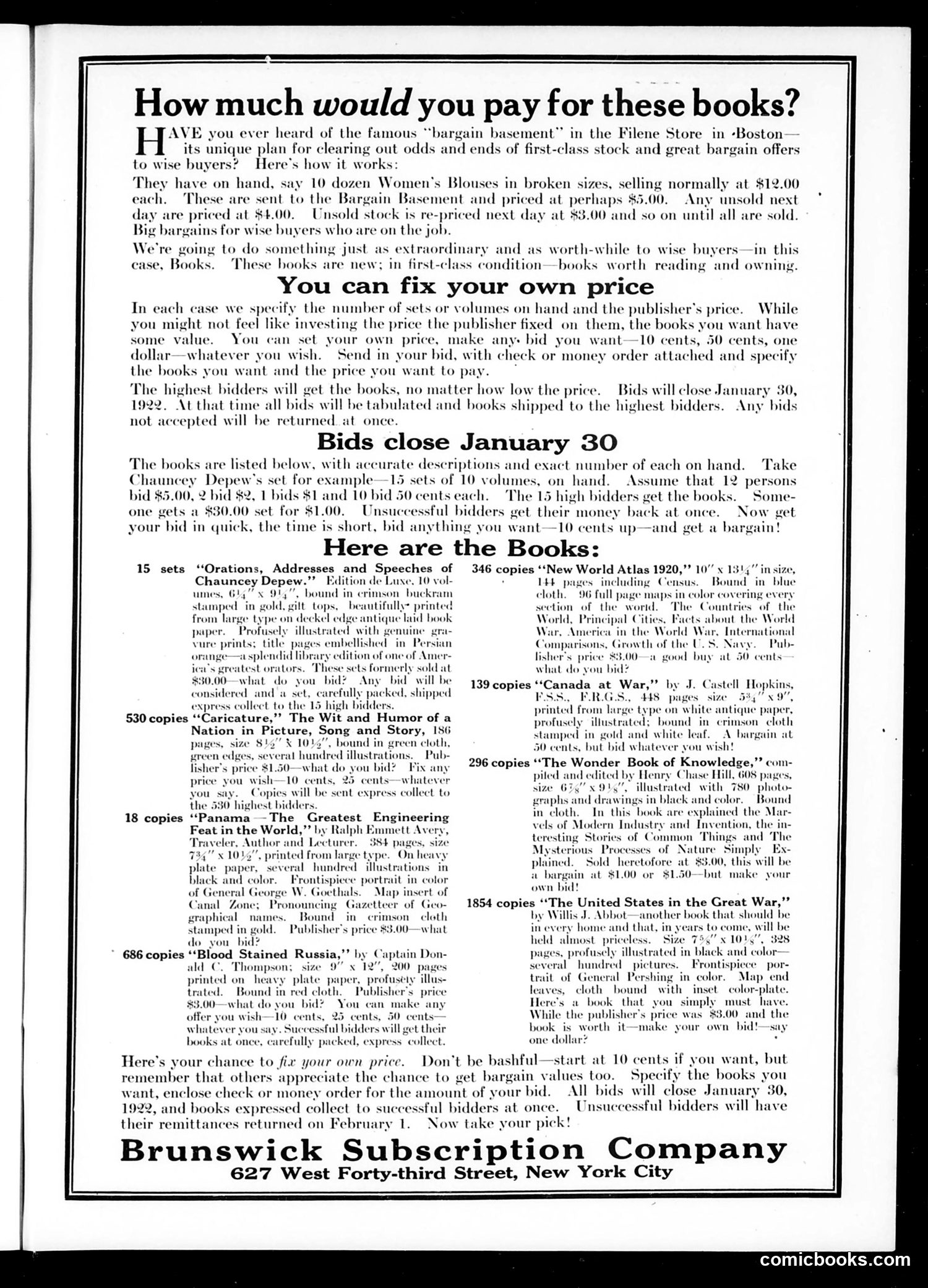
This is primarily a **book auction advertisement**, not a political cartoon. The Brunswick Subscription Company is running a novel clearance sale modeled on Boston's famous Filene's Bargain Basement department store. The page pitches a "name-your-own-price" bidding system for surplus books closing January 30, 1922. Readers could bid as little as 10 cents for volumes normally selling at $3-8, with highest bidders winning regardless of price. The copy humorously frames this as "extraordinary" and "worth-while to wise buyers." The books listed—including Chauncey Depew's speeches, atlases, war histories, and reference works—reflect 1920s interests in post-WWI knowledge and "modern industry." The casual tone and emphasis on getting "bargains" suggests appealing to middle-class readers seeking inexpensive self-improvement. This is commercial content, not satire—Judge published advertisements alongside editorial material.
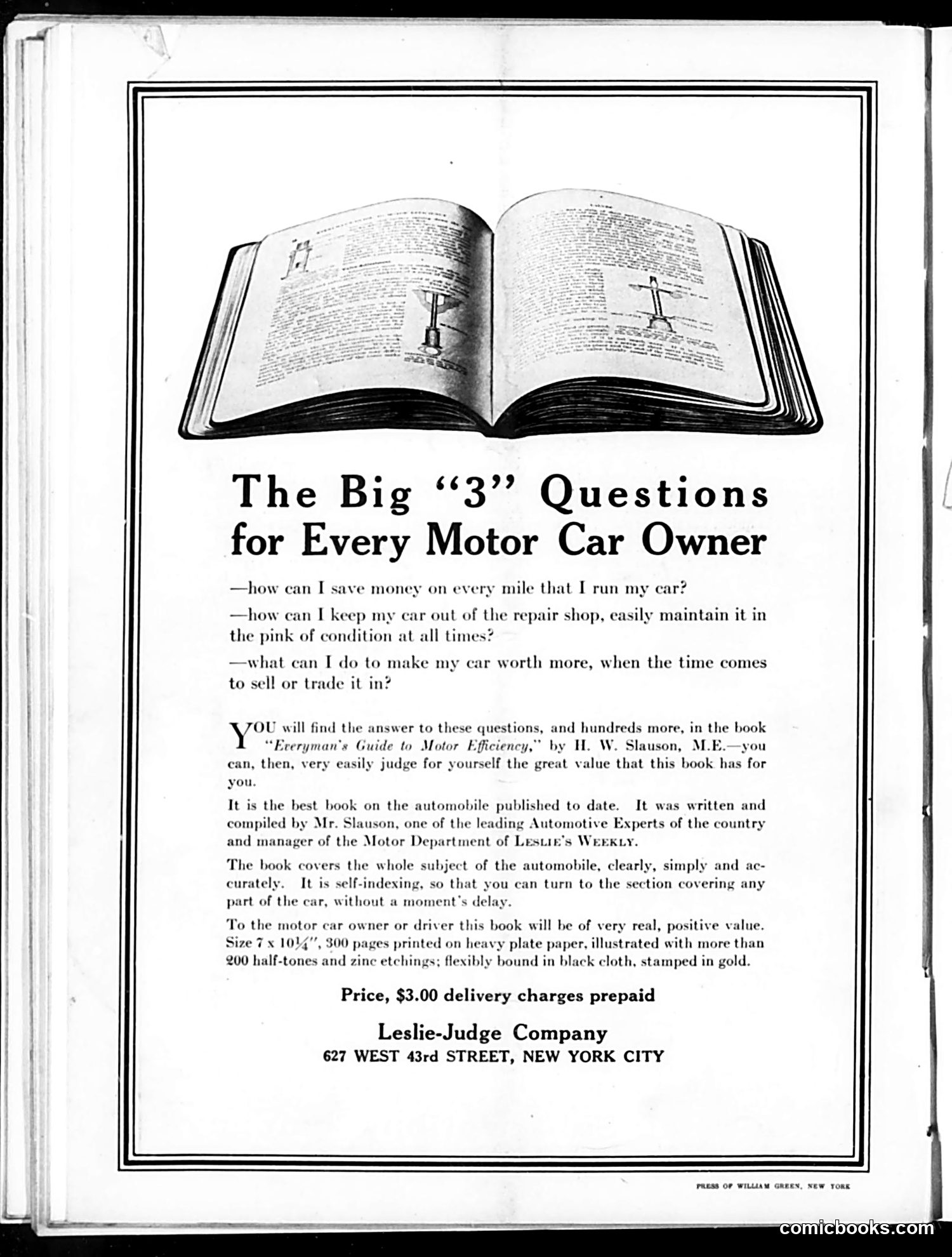
This is primarily an advertisement, not a satirical cartoon. It promotes "Everyman's Guide to Motor Efficiency" by H.W. Slauson, presented as the definitive automobile manual for car owners. The page addresses three practical consumer concerns of the early automotive era: fuel economy, maintenance costs, and vehicle resale value—questions that likely reflect widespread anxieties as motor cars were becoming commonplace. The book is pitched as comprehensive and self-indexing, enabling owners to troubleshoot problems without expert help. Notable context: The publisher, Leslie-Judge Company, owned *Leslie's Weekly*, establishing credibility through the magazine's motor department. The $3.00 price and emphasis on "heavy plate paper" with over 200 illustrations suggest this was a premium product for serious motorists. This reflects an era when cars required significant owner knowledge to maintain and operate—before modern mechanic shops and dealer networks became standard.