
Judge, 1922-01-21 · page 25 of 36
Judge — January 21, 1922 — page 25: what you’re looking at
What you’re looking at
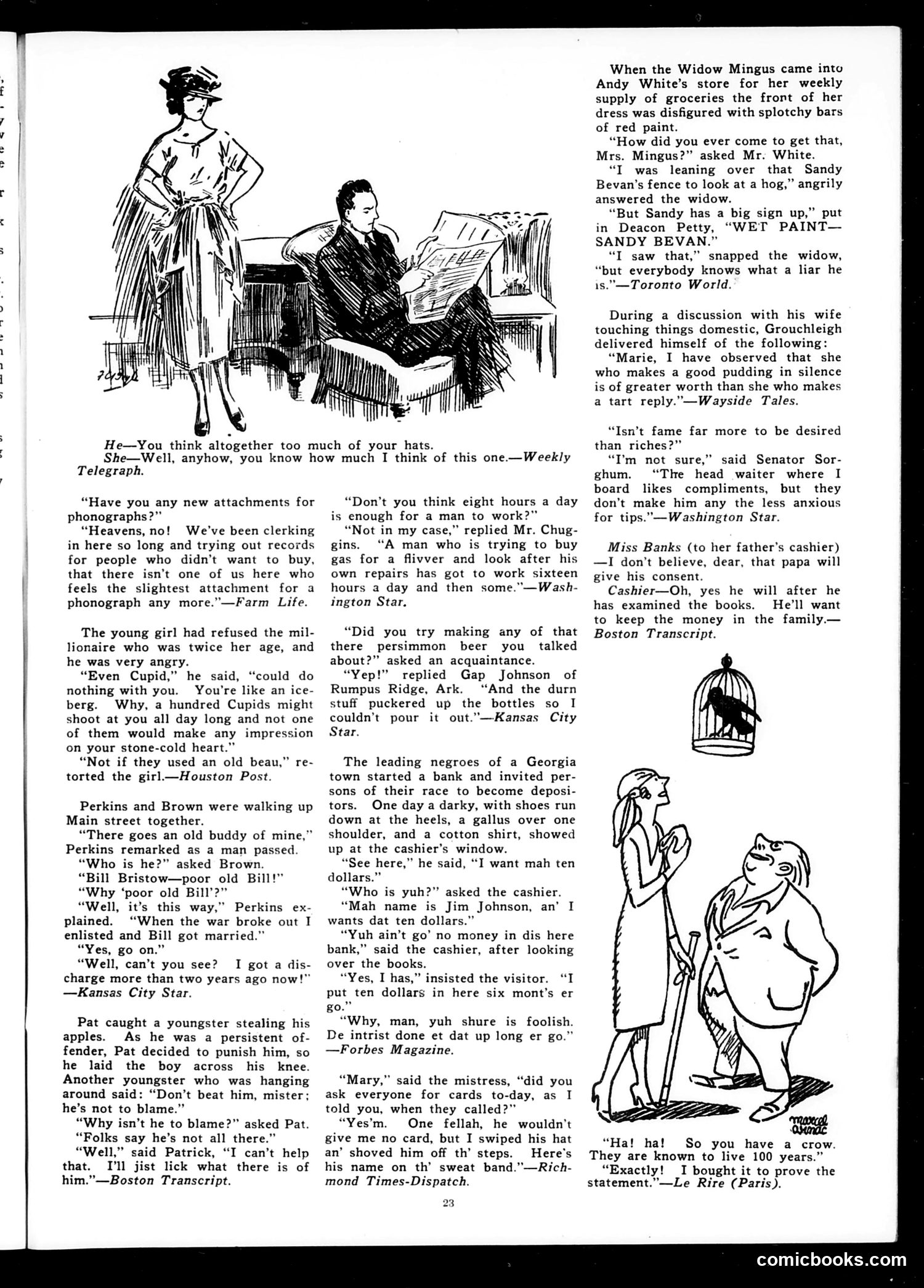
This page contains humorous short anecdotes typical of early-20th-century American humor magazines. The main cartoon (top left) shows a domestic dispute about a woman's hat expenditures—satirizing materialist consumer culture and marital tensions over fashion spending. The surrounding text consists of brief jokes targeting various social groups and situations: - **Working-class struggles**: References to automobile ("flivver") ownership expenses and wartime employment hardships - **Rural/ethnic humor**: Stereotypical depictions of rural Arkansans, Irish immigrants ("Pat"), and African Americans with exaggerated dialect, reflecting period prejudices - **Domestic relations**: Comic scenarios involving servants, wives, and household management **Key context for modern readers**: This humor relies heavily on ethnic and racial caricature that would be considered offensive today. The jokes about Black Americans and Irish immigrants use dehumanizing dialect and stereotypes. The page reflects 1920s-era attitudes where such caricatures were considered mainstream entertainment. The "wet paint" anecdote humorously suggests the widow disbelieves Sandy Bevan because he's chronically dishonest.
📄 Transcribed text from this page (OCR, searchable)
Machine-transcribed from the original scan — historical spelling and the odd misread are preserved.
He—You think altogether too much of your hats. She—Well, anyhow, you know how much I think of this one—Weekly Telegraph. “Have you any new attachments for phonographs?” “Heavens, no! We've been clerking in here so long and trying out records for people who didn’t want to buy, that there isn’t one of us here who feels the slightest attachment for a phonograph any more.”—Farm Life. The young girl had refused the mil- lionaire who was twice her age, and he was very angry. “Even Cupid,” he said, “could do nothing with you. You're like an ice- berg. Why, a hundred Cupids might shoot at you all day long and not one of them would make any impression on your stone-cold heart.” “Not if they used an old beau,” re- torted the girl—Houston Post. Perkins and Brown were walking up Main street together. “There goes an old buddy of mine,” Perkins remarked as a man passed. “Who is he?” asked Brown. “Bill Bristow—poor old Bill!” “Why ‘poor old Bill’?” “Well, it’s this way,” Perkins ex- plained. “When the war broke out I enlisted and Bill got married.” “Yes, go on.” “Well, can’t you see? I got a dis- charge more than two years ago now!” —Kansas City Star. Pat caught a youngster stealing his apples. As he was a persistent of- fender, Pat decided to punish him, so he laid the boy across his knee. Another youngster who was hanging around said: “Don’t beat him, mister; he’s not to blame.” “Why isn’t he to blame?” asked Pat. “Folks say he’s not all there.” “Well,” said Patrick, “I can’t help that. I'll jist lick what there is of him.”—Boston Transcript. “Don’t you think eight hours a day is enough for a man to work?” “Not in my case,” replied Mr. Chug- gins. “A man who is trying to buy gas for a flivver and look after his own repairs has got to work sixteen hours a day and then some.”"—Wash- ington Star. “Did you try making any of that there persimmon beer you talked about?” asked an acquaintance. “Yep!” replied Gap Johnson of Rumpus Ridge, Ark. “And the durn stuff puckered up the bottles so I couldn’t pour it out."—Kansas City Star. The leading negroes of a Georgia town started a bank and invited per- sons of their race to become deposi- tors. One day a darky, with shoes run down at the heels, a gallus over one shoulder, and a cotton shirt, showed up at the cashier’s window. “See here,” he said, “I want mah ten dollars.” “Who is yuh?” asked the cashier. “Mah name is Jim Johnson, an’ I wants dat ten dollars.” “Yuh ain’t go’ no money in dis here bank,” said the cashier, after looking over the books. “Yes, I has,” insisted the visitor. “I put ten dollars in here six mont’s er go.” “Why, man, yuh shure is foolish. De intrist done et dat up long er go.” —Forbes Magazine. “Mary,” said the mistress, “did you ask everyone for cards to-day, as I told you, when they called?” “Yes’m. One fellah, he wouldn't give me no card, but I swiped his hat an’ shoved him off th’ steps. Here's his name on th’ sweat band.”—Rich- mond Times-Dispatch. 23 When the Widow Mingus came into Andy White’s store for her weekly supply of groceries the front of her dress was disfigured with splotchy bars of red paint. “How did you ever come to get that, Mrs. Mingus?” asked Mr. White. “I was leaning over that Sandy Bevan’s fence to look at a hog,” angrily answered the widow. “But Sandy has a big sign up,” put in Deacon Petty, “WET PAINT— SANDY BEVAN.” “I saw that,” snapped the widow, “but everybody knows what a liar he 1s."—Toronto World. During a discussion with his wife touching things domestic, Grouchleigh delivered himself of the following: “Marie, I have observed that she who makes a good pudding in silence is of greater worth than she who makes a tart reply."—Wayside Tales. “Isn’t fame far more to be desired than riches?” “I'm not sure,” said Senator Sor- ghum. “The head waiter where I board likes compliments, but they don’t make him any the less anxious for tips."—Washington Star. Miss Banks (to her father’s cashier) —I don’t believe, dear, that papa will give his consent. Cashier—Oh, yes he will after he has examined the books. He’ll want to keep the money in the family.— Boston Transcript. “Ha! ha! They are known to live 100 years.” So you have a crow. “Exactly! I bought it to prove the statement.”—Le Rire (Paris). comicbooks.com