
Judge, 1922-01-21 · page 12 of 36
Judge — January 21, 1922 — page 12: what you’re looking at
What you’re looking at
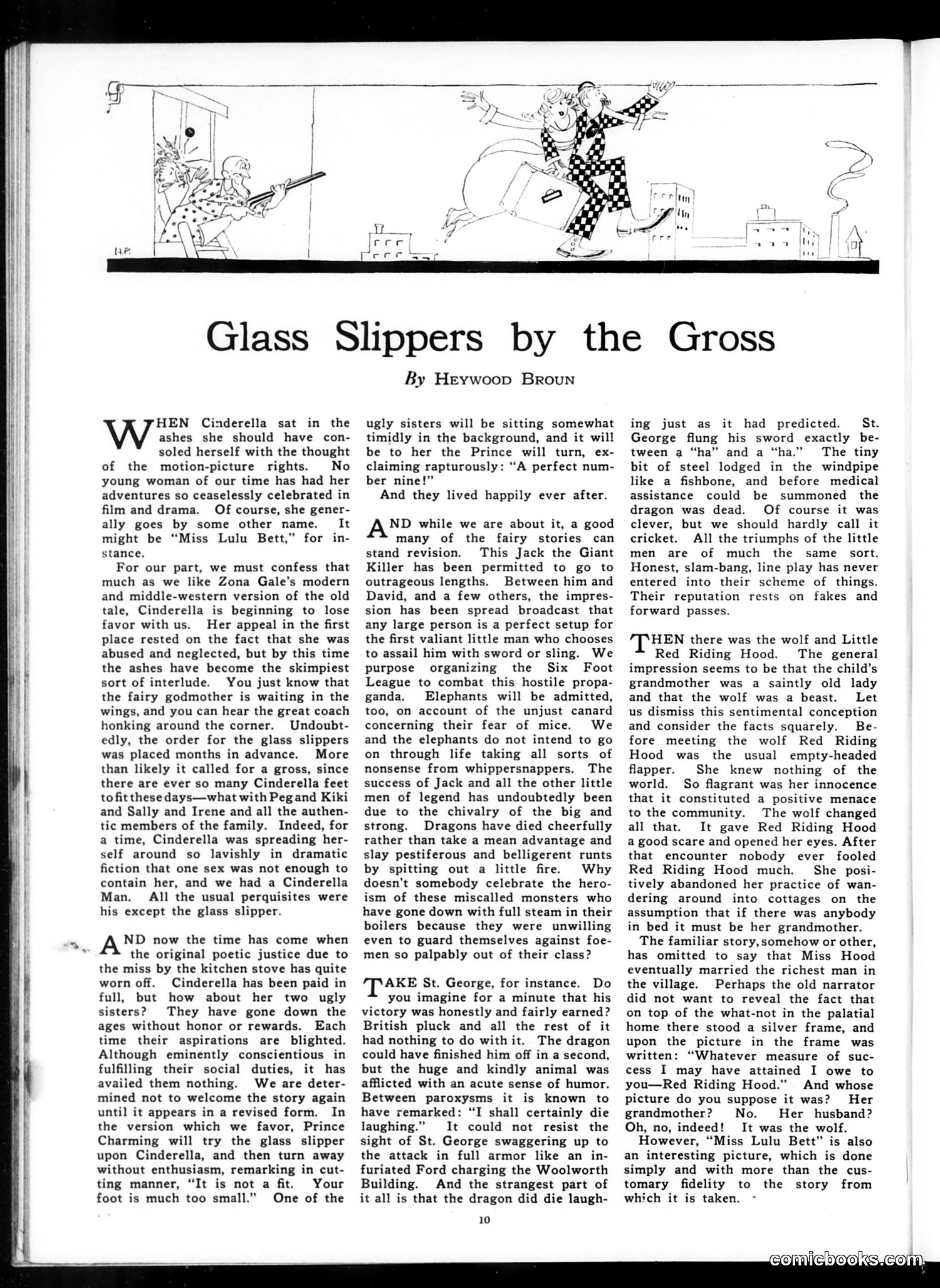
This satirical essay by Heywood Broun critiques the oversaturation of Cinderella adaptations in early 20th-century film and theater (referencing Zona Gale's "Miss Lulu Bett" and a "Cinderella Man"). Broun argues that the fairy tale has lost its appeal through repetition and commercialization—"glass slippers ordered by the gross" suggests mass-market entertainment chasing profits. He proposes revising classic stories to correct their moral lessons, particularly favoring the ugly sisters over Cinderella, and defending giants and dragons who've been unfairly portrayed as villains in folklore. The cartoon at top depicts slapstick action featuring a character being shot from a cannon at buildings—visual comedy unrelated to the text below. This illustrates Judge's typical blend of visual gags and written satire commenting on contemporary popular culture and literary trends.
📄 Transcribed text from this page (OCR, searchable)
Machine-transcribed from the original scan — historical spelling and the odd misread are preserved.
HEN Cinderella sat in the VW ashes she should have con- soled herself with the thought of the motion-picture rights. No young woman of our time has had her adventures so ceaselessly celebrated in film and drama. Of course, she gener- ally goes by some other name. It might be “Miss Lulu Bett,” for in- stance. For our part, we must confess that much as we like Zona Gale’s modern and middle-western version of the old tale, Cinderella is beginning to lose favor with us. Her appeal in the first place rested on the fact that she was abused and neglected, but by this time the ashes have become the skimpiest sort of interlude. You just know that the fairy godmother is waiting in the wings, and you can hear the great coach honking around the corner. Undoubt- edly, the order for the glass slippers was placed months in advance. More than likely it called for a gross, since there are ever so many Cinderella feet to fit these days—what with Peg and Kiki and Sally and Irene and all the authen- tic members of the family. Indeed, for a time, Cinderella was spreading her- self around so lavishly in dramatic fiction that one sex was not enough to contain her, and we had a Cinderella Man. All the usual perquisites were his except the glass slipper. ND now the time has come when the original poetic justice due to the miss by the kitchen stove has quite worn off. Cinderella has been paid in full, but how about her two ugly sisters? They have gone down the ages without honor or rewards. Each time their aspirations are blighted. Although eminently conscientious in fulfilling their social duties, it has availed them nothing. We are deter- mined not to welcome the story again until it appears in a revised form. In the version which we favor, Prince Charming will try the glass slipper upon Cinderella, and then turn away without enthusiasm, remarking in cut- ting manner, “It is not a fit. Your foot is much too small.” One of the Glass Slippers by the Gross By Heywoop Broun ugly sisters will be sitting somewhat timidly in the background, and it will be to her the Prince will turn, ex- claiming rapturously: “A perfect num- ber nine!” And they lived happily ever after. AN? while we are about it, a good many of the fairy stories can stand revision. This Jack the Giant Killer has been permitted to go to outrageous lengths. Between him and David, and a few others, the impres- sion has been spread broadcast that any large person is a perfect setup for the first valiant little man who chooses to assail him with sword or sling. We purpose organizing the Six Foot League to combat this hostile propa- ganda. Elephants will be admitted, too, on account of the unjust canard concerning their fear of mice. We and the elephants do not intend to go on through life taking all sorts of nonsense from whippersnappers. The success of Jack and all the other little men of legend has undoubtedly been due to the chivalry of the big and strong. Dragons have died cheerfully rather than take a mean advantage and slay pestiferous and belligerent runts by spitting out a little fire. Why doesn't somebody celebrate the hero- ism of these miscalled monsters who have gone down with full steam in their boilers because they were unwilling even to guard themselves against foe- men so palpably out of their class? AKE St. George, for instance. Do you imagine for a minute that his victory was honestly and fairly earned? British pluck and all the rest of it had nothing to do withit. The dragon could have finished him off in a second, but the huge and kindly animal was afflicted with an acute sense of humor. Between paroxysms it is known to have remarked: “I shall certainly die laughing.” It could not resist the sight of St. George swaggering up to the attack in full armor like an in- furiated Ford charging the Woolworth Building. And the strangest part of it all is that the dragon did die laugh- 10 ing just as it had predicted. St. George flung his sword exactly be- tween a “ha” and a “ha.” The tiny bit of steel lodged in the windpipe like a fishbone, and before medical assistance could be summoned the dragon was dead. Of course it was clever, but we should hardly call it cricket. All the triumphs of the little men are of much the same sort. Honest, slam-bang, line play has never entered into their scheme of things. Their reputation rests on fakes and forward passes. HEN there was the wolf and Little Red Riding Hood. The general impression seems to be that the child’s grandmother was a saintly old lady and that the wolf was a beast. Let us dismiss this sentimental conception and consider the facts squarely. Be- fore meeting the wolf Red Riding Hood was the usual empty-headed flapper. She knew nothing of the world. So flagrant was her innocence that it constituted a positive menace to the community. The wolf changed all that. It gave Red Riding Hood a good scare and opened her eyes. After that encounter nobody ever fooled Red Riding Hood much. She posi- tively abandoned her practice of wan- dering around into cottages on the assumption that if there was anybody in bed it must be her grandmother. The familiar story, somehow or other, has omitted to say that Miss Hood eventually married the richest man in the village. Perhaps the old narrator did not want to reveal the fact that on top of the what-not in the palatial home there stood a silver frame, and upon the picture in the frame was written: “Whatever measure of suc- cess I may have attained I owe to you—Red Riding Hood.” And whose picture do you suppose it was? Her grandmother? No. Her husband? Oh, no, indeed! It was the wolf. However, “Miss Lulu Bett” is also an interesting picture, which is done simply and with more than the cus- tomary fidelity to the story from which it is taken.