
Judge, 1922-01-21 · page 27 of 36
Judge — January 21, 1922 — page 27: what you’re looking at
What you’re looking at
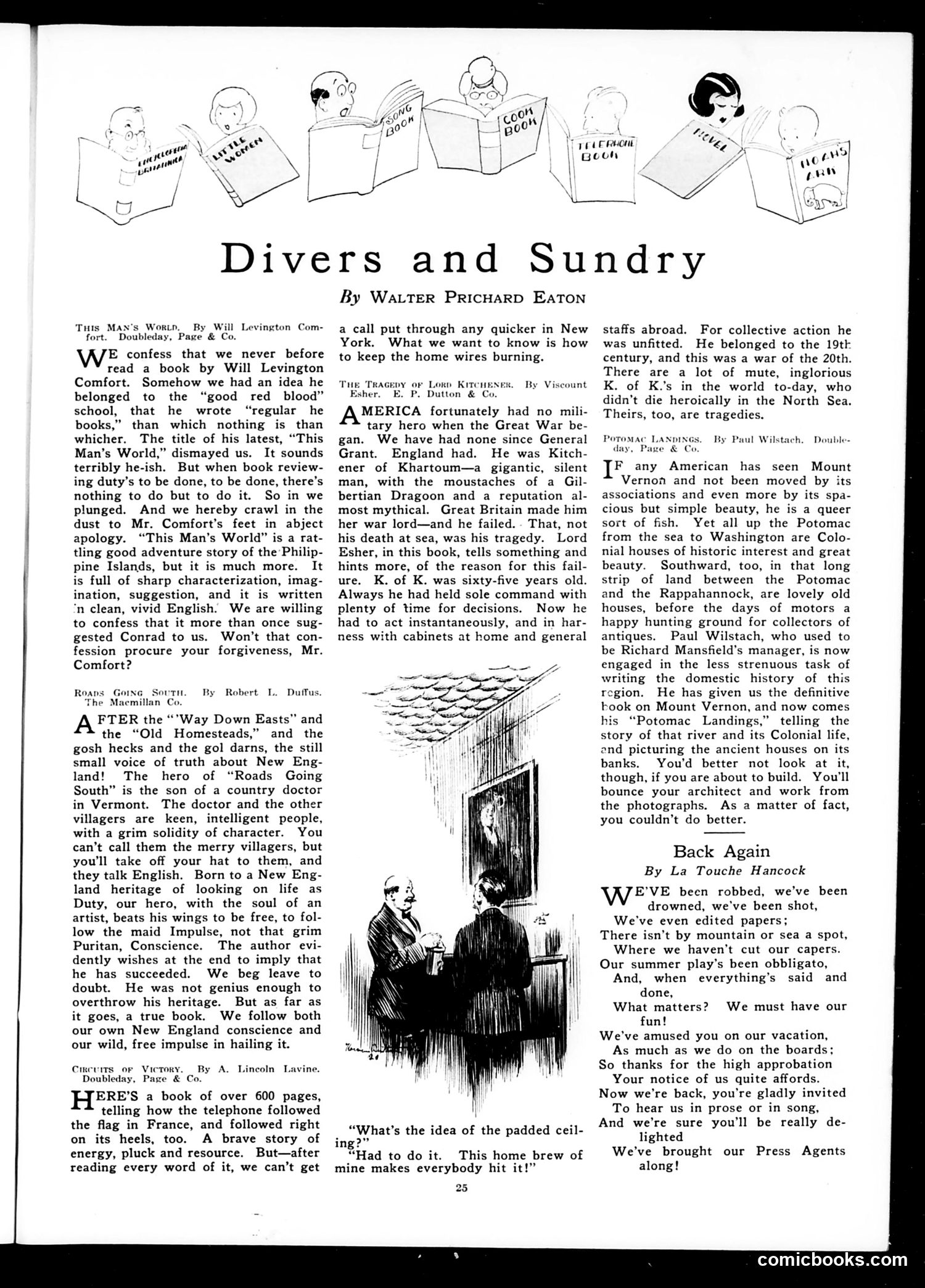
This page from Judge presents book reviews by Walter Prichard Eaton alongside satirical content. The header illustration shows seven people reading books labeled with titles, establishing a literary theme. The reviews discuss contemporary novels: Comfort's "This Man's World" (an adventure story), Duffus's "Roads Going South" (about a New England doctor's son torn between duty and impulse), and a book about telephone service in France during WWI. The most pointed review concerns Lord Kitchener's biography. Eaton argues that Britain's famous WWI military leader—despite his legendary reputation and imposing appearance—ultimately failed because he was a 19th-century military figure unsuited to 20th-century warfare requiring collective action and rapid decisions. He belonged to an older command structure. The cartoon below satirizes Prohibition-era home brewing, showing two men discussing a padded ceiling—necessary because homemade alcohol is so potent it makes people violently hit their heads on it.
📄 Transcribed text from this page (OCR, searchable)
Machine-transcribed from the original scan — historical spelling and the odd misread are preserved.
TELE RHOU Bou gL Divers and Sundry MAN’s Wor-p,” By Will Levington Com- Doubleday, Page & Co. E confess that we never before read a book by Will Levington Comfort. Somehow we had an idea he belonged to the “good red blood” school, that he wrote “regular he books,” than which nothing is than whicher. The title of his latest, “This Man’s World,” dismayed us. It sounds terribly he-ish. But when book review- ing duty’s to be done, to be done, there’s nothing to do but to do it. So in we plunged. And we hereby crawl in the dust to Mr. Comfort’s feet in abject apology. “This Man’s World” is a rat- tling good adventure story of the’Philip- pine Islands, but it is much more. It is full of sharp characterization, imag- ination, suggestion, and it is written ‘n clean, vivid English. We are willing to confess that it more than once sug- gested Conrad to us. Won't that con- fession procure your forgiveness, Mr. Comfort? Tuts fort. Roaps Going Sovrn. By Robert L. Duffus. ‘The Macmillan. Co. FTER the “’Way Down Easts” and the “Old Homesteads,” and the gosh hecks and the gol darns, the still small voice of truth about New Eng- land! The hero of “Roads Going South” is the son of a country doctor in Vermont. The doctor and the other villagers are keen, intelligent people, with a grim solidity of character. You can’t call them the merry villagers, but you'll take off your hat to them, and they talk English. Born to a New Eng- land heritage of looking on life as Duty, our hero, with the soul of an artist, beats his wings to be free, to fol- low the maid Impulse, not that grim Puritan, Conscience. The author evi- dently wishes at the end to imply that he has succeeded. We beg leave to doubt. He was not genius enough to overthrow his heritage. But as far as it goes, a true book. We follow both our own New England conscience and our wild, free impulse in hailing it. Lincoln Lavine. Cievrrs: Victory. By A. Double Page & Co. ERE’S a book of over 600 pages, telling how the telephone followed the flag in France, and followed right on its heels, too. A brave story of energy, pluck and resource. But—after reading every word of it, we can’t get By WALTER PRICHARD EATON a call put through any quicker in New York. What we want to know is how to keep the home wires burning. bY OF LORD KITCHENER. er. P, Dutton & Co. AMERICA fortunately had no mili- tary hero when the Great War be- gan. We have had none since General Grant. England had. He was Kitch- ener of Khartoum—a gigantic, silent man, with the moustaches of a Gil- bertian Dragoon and a reputation al- most mythical. Great Britain made him her war lord—and he failed. - That, not his death at sea, was his tragedy. Lord Esher, in this book, tells something and hints more, of the reason for this fail- ure. K. of K. was sixty-five years old. Always he had held sole command with plenty of time for decisions. Now he had to act instantaneously, and in har- ness with cabinets at home and general By Viscount LGA ih “What's the idea of the padded ceil- ing?” “Had to do it. This home brew of mine makes everybody hit it!” staffs abroad. For collective action he was unfitted. He belonged to the 19tk century, and this was a war of the 20th. There are a lot of mute, inglorious K. of K.’s in the world to-day, who didn’t die heroically in the North Sea. Theirs, too, are tragedies. Potomac: LANDINGS, h. Double- day, Paze & Co. IF any American has seen Mount Vernon and not been moved by its associations and even more by its spa- cious but simple beauty, he is a queer sort of fish. Yet all up the Potomac from the sea to Washington are Colo- nial houses of historic interest and great beauty. Southward, too, in that long strip of land between the Potomac and the Rappahannock, are lovely old houses, before the days of motors a happy hunting ground for collectors of antiques. Paul Wilstach, who used to be Richard Mansfield’s manager, is now engaged in the less strenuous task of writing the domestic history of this region. He has given us the definitive took on Mount Vernon, and now comes his “Potomac Landin, telling the story of that river and its Colonial life, ond picturing the ancient houses on its banks. You'd better not look at it, though, if you are about to build. You'll bounce your architect and work from the photographs. As a matter of fact, you couldn't do better. By Paul Wil Back Again By La Touche Hancock E’VE been robbed, we've been drowned, we've been shot, We've even edited papers; There isn’t by mountain or sea a spot, Where we haven't cut our capers. Our summer play’s been obbligato, And, when everything’s said and done, What matters? We must have our fun! We've amused you on our vacation, As much as we do on the boards; So thanks for the high approbation Your notice of us quite affords. Now we're back, you're gladly invited To hear us in prose or in song, And we're sure you'll be really de- lighted We've brought our Press Agents along! comicbooks.com