
Judge, 1922-01-21 · page 4 of 36
Judge — January 21, 1922 — page 4: what you’re looking at
What you’re looking at
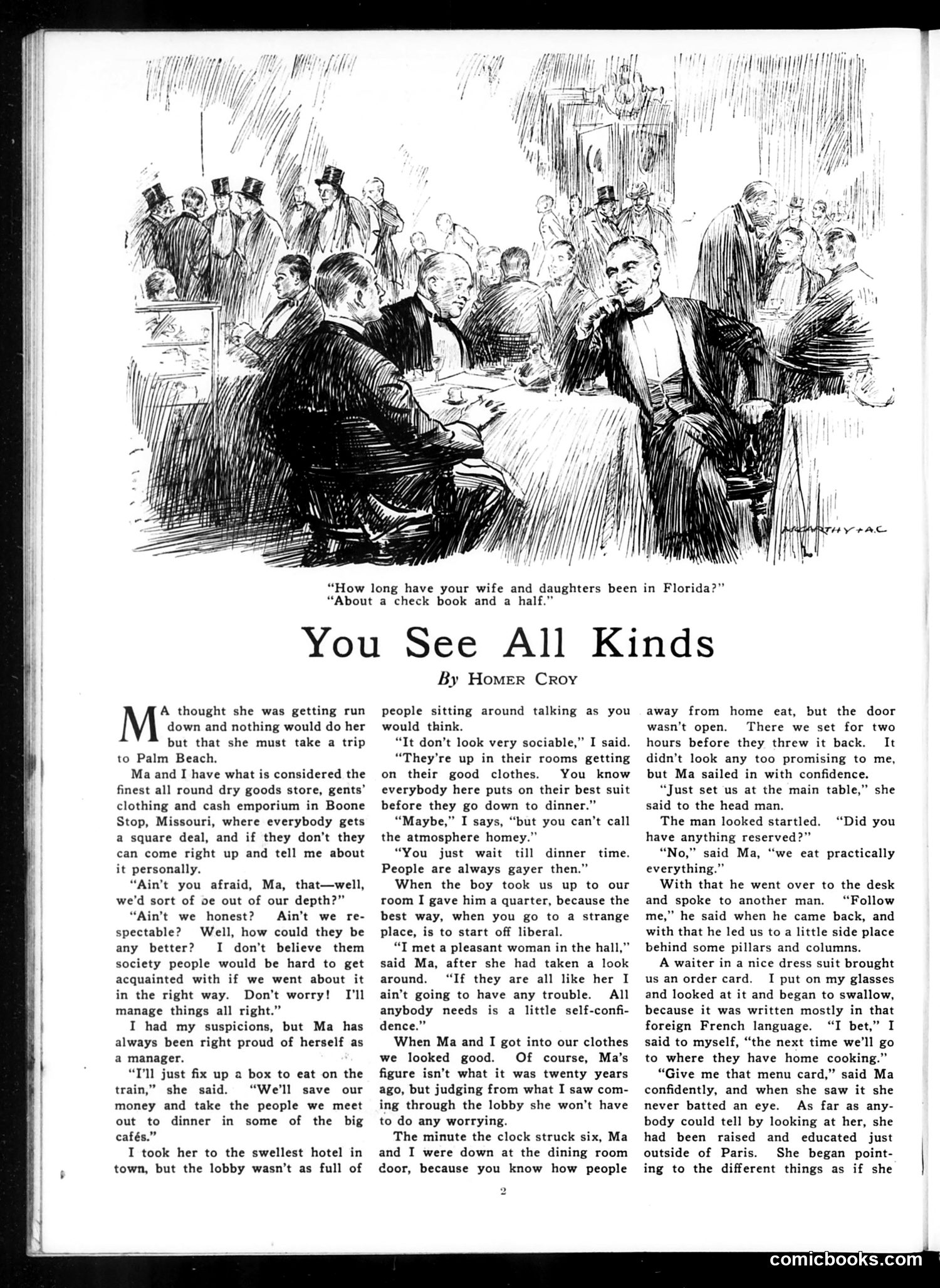
This page contains a short story titled "You See All Kinds" by Homer Croy, illustrated by a sketch of a formal dining room scene. The narrative—not a political cartoon—describes a middle-class couple's dining experience at a hotel, where the narrator's wife grows anxious about proper etiquette and social standing among wealthier guests. The story satirizes American social anxiety and class consciousness of the early 20th century. The humor derives from the wife's embarrassment about appearing unsophisticated (worrying about a French menu she cannot read, being self-conscious about their appearance) and the narrator's matter-of-fact attitude. The cartoon illustrates this social tension in a formal dining setting where the couple feels out of place among more refined patrons.
📄 Transcribed text from this page (OCR, searchable)
Machine-transcribed from the original scan — historical spelling and the odd misread are preserved.
“How long have your wife and daughters been in Florida?” “About a check book and a half.” You See All Kinds A thought she was getting run M down and nothing would do her but that she must take a trip to Palm Beach. Ma and I have what is considered the finest all round dry goods store, gents’ clothing and cash emporium in Boone Stop, Missouri, where everybody gets a square deal, and if they don’t they can come right up and tell me about it personally. “Ain’t you afraid, Ma, that—well, we'd sort of oe out of our depth?” “Ain’t we honest? Ain't we re- spectable? Well, how could they be any better? I don’t believe them society people would be hard to get acquainted with if we went about it in the right way. Don’t worry! I'll manage things all right.” I had my suspicions, but Ma has always been right proud of herself as a manager. “T’ll just fix up a box to eat on the train,” she said. “We'll save our money and take the people we meet out to dinner in some of the big cafés.” I took her to the swellest hotel in town, but the lobby wasn’t as full of By Homer Croy people sitting around talking as you would think. “It don’t look very sociable,” I said. “They’re up in their rooms getting on their good clothes. You know everybody here puts on their best suit before they go down to dinner.” “Maybe,” I says, “but you can’t call the atmosphere homey.” “You just wait till dinner People are always gayer then.” When the boy took us up to our room I gave him a quarter, because the best way, when you go to a strange place, is to start off liberal. “T met a pleasant woman in the hall,” said Ma, after she had taken a look around. “If they are all like her I ain’t going to have any trouble. All anybody needs is a little self-confi- dence.” When Ma and I got into our clothes we looked good. Of course, Ma’s figure isn’t what it was twenty years ago, but judging from what I saw com- ing through the lobby she won’t have to do any worrying. The minute the clock struck six, Ma and I were down at the dining room door, because you know how people time. away from home eat, but the door wasn’t open. There we set for two hours before they threw it back. It didn’t look any too promising to me, but Ma sailed in with confidence. “Just set us at the main table,” she said to the head man. The man looked startled. have anything reserved?” “No,” said Ma, “we eat practically everything.” With that he went over to the desk and spoke to another man. “Follow me,” he said when he came back, and with that he led us to a little side place behind some pillars and columns. A waiter in a nice dress suit brought us an order card. I put on my glasses and looked at it and began to swallow, because it was written mostly in that foreign French language. “I bet,” I said to myself, “the next time we’ll go to where they have home cooking.” “Give me that menu card,” said Ma confidently, and when she saw it she never batted an eye. As far as any- body could tell by looking at her, she had been raised and educated just outside of Paris. She began point- ing to the different things as if she “Did you comicbooks.com