
Judge, 1922-01-21 · page 11 of 36
Judge — January 21, 1922 — page 11: what you’re looking at
What you’re looking at
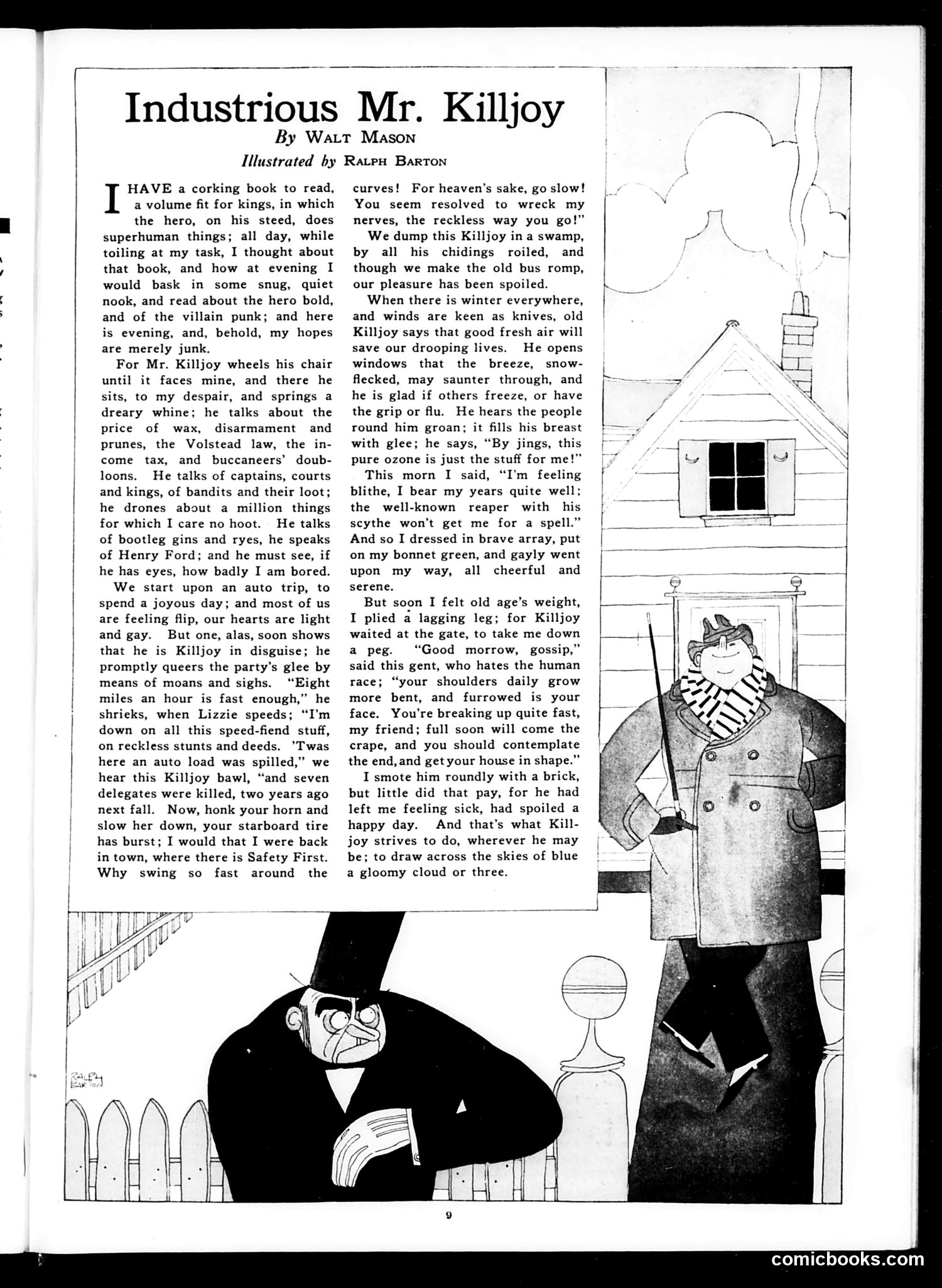
This satirical story by Walt Mason (illustrated by Ralph Barton) depicts "Mr. Killjoy," a persistent pessimist who ruins others' enjoyment through constant complaining and doom-saying. The humor targets a recognizable social type: the chronic complainer who intrudes on others' pleasures. Whether someone tries to read peacefully, take a cheerful car ride, or enjoy good health, Killjoy appears to dampen spirits with complaints about safety, morality, or decline. His objections reference contemporary concerns—the Volstead Law (Prohibition), automobile safety, and influenza. The cartoon's point is social satire about negativity as a character flaw and social nuisance. The narrator's final act of hitting Killjoy with a brick (played for humor) expresses audience frustration with relentless pessimism. The moral: some people make it their mission to "draw across the skies of blue a gloomy cloud or three." For modern readers, this reflects early-20th-century anxiety about progress, safety, and social change—themes still recognizable today.
📄 Transcribed text from this page (OCR, searchable)
Machine-transcribed from the original scan — historical spelling and the odd misread are preserved.
| Industrious Mr. Killjoy By Watt Mason Illustrated by Ravpx Barton HAVE a corking book to read, a volume fit for kings, in which the hero, on his steed, does superhuman things; all day, while toiling at my task, I thought about that book, and how at evening I would bask in some snug, quiet nook, and read about the hero bold, and of the villain punk; and here is evening, and, behold, my hopes are merely junk. For Mr. Killjoy wheels his chair until it faces mine, and there he sits, to my despair, and springs a dreary whine; he talks about the price of wax, disarmament and prunes, the Volstead law, the in- come tax, and buccaneers’ doub- loons. He talks of captains, courts and kings, of bandits and their loot; he drones about a million things for which I care no hoot. He talks of bootleg gins and ryes, he speaks of Henry Ford; and he must see, if he has eyes, how badly I am bored. We start upon an auto trip, to spend a joyous day; and most of us are feeling flip, our hearts are light and gay. But one, alas, soon shows that he is Killjoy in disguise; he promptly queers the party’s glee by means of moans and sighs. “Eight miles an hour is fast enough,” he shrieks, when Lizzie speeds; “I’m down on all this speed-fiend stuff, on reckless stunts and deeds. "Twas here an auto load was spilled,” we hear this Killjoy bawl, “and seven delegates were killed, two years ago next fall. Now, honk your horn and slow her down, your starboard tire has burst; I would that I were back in town, where there is Safety First. Why swing so fast around the curves! For heaven’s sake, go slow! You seem resolved to wreck my nerves, the reckless way you go!” We dump this Killjoy in a swamp, by all his chidings roiled, and though we make the old bus romp, our pleasure has been spoiled. When there is winter everywhere, and winds are keen as knives, old Killjoy says that good fresh air will save our drooping lives. He opens windows that the breeze, snow- flecked, may saunter through, and he is glad if others freeze, or have the grip or flu. He hears the people round him groan; it fills his breast with glee; he says, “By jings, this pure ozone is just the stuff for me!” This morn I said, “I’m feeling blithe, I bear my years quite well; the well-known reaper with his scythe won’t get me for a spell.” And so I dressed in brave array, put on my bonnet green, and gayly went upon my way, all cheerful and serene. But soon I felt old age’s weight, I plied a lagging leg; for Killjoy waited at the gate, to take me down a peg. “Good morrow, gossip,” said this gent, who hates the human race; “your shoulders daily grow more bent, and furrowed is your face. You're breaking up quite fast, my friend; full soon will come the crape, and you should contemplate the end, and get your house in shape.” I smote him roundly with a brick, but little did that pay, for he had left me feeling sick, had spoiled a happy day. And that’s what Kill- joy strives to do, wherever he may be; to draw across the skies of blue a gloomy cloud or three. — a) J | comicbooks.com