
Judge, 1922-01-21 · page 14 of 36
Judge — January 21, 1922 — page 14: what you’re looking at
What you’re looking at
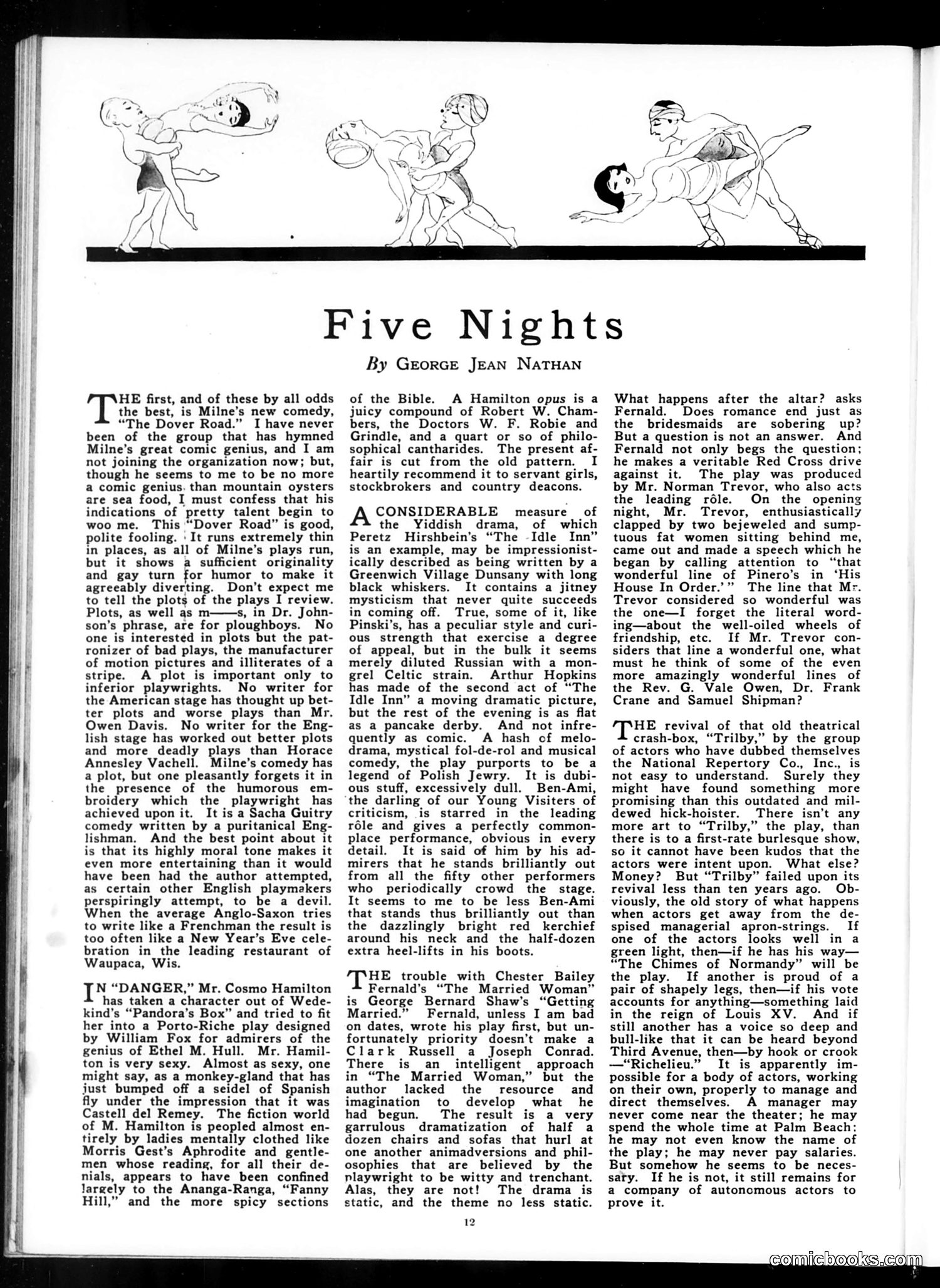
This page contains theater criticism by George Jean Nathan reviewing contemporary Broadway plays. The cartoon strip at the top illustrates theatrical action—actors in various dramatic poses—but serves mainly as decorative header art rather than political satire. Nathan's reviews discuss A.A. Milne's "The Dover Road" (praised for witty dialogue despite thin plot), Cosmo Hamilton's "Danger" (criticized as overly sexual melodrama appealing to servants and provincials), and Peretz Hirshbein's "The Idle Inn" (a Yiddish drama dismissed as mystical but ultimately dull). The satire is theatrical and social rather than political. Nathan mocks playwrights prioritizing plot over artistry, dismisses Hamilton's pretensions to French sophistication as "New Year's Eve celebration in...Waupaca, Wis.," and derides Yiddish theater as derivative "diluted Russian with a mongrel Celtic strain." The humor targets both inferior dramaturgy and middle-class audience tastes.
📄 Transcribed text from this page (OCR, searchable)
Machine-transcribed from the original scan — historical spelling and the odd misread are preserved.
HE first, and of these by all odds he best, is Milne’s new comedy, “The Dover Road.” I have never been of the group that has hymned Milne’s great comic genius, and I am not joining the organization now; but, though he seems to me to be no more a comic genius. than mountain oysters are sea food, I must confess that his indications of pretty talent begin to woo me. This “Dover Road” is good, polite fooling. :It runs extremely thin in places, as all of Milne’s plays run, but it shows a sufficient originality and gay turn for humor to make it agreeably diverting. Don’t expect me to tell the plots of the plays I review. Plots, as well as m- s, in Dr. John- son’s phrase, are for ploughboys. No one is interested in plots but the pat- ronizer of bad plays, the manufacturer of motion pictures and illiterates of a stripe. A plot is important only to inferior playwrights. No writer for the American stage has thought up bet- ter plots and worse plays than Mr. Owen Davis. No writer for the Eng- lish stage has worked out better plots and more deadly plays than Horace Annesley Vachell. Milne’s comedy has a plot, but one pleasantly forgets it in the presence of the humorous em- broidery which the playwright has achieved upon it. It is a Sacha Guitry comedy written by a puritanical Eng- lishman. And the best point about it is that its highly moral tone makes it even more entertaining than it would have been had the author attempted, as certain other English playmakers perspiringly attempt, to be a devil. When the average Anglo-Saxon tries to write like a Frenchman the result is too often like a New Year’s Eve cele- bration in the leading restaurant of Waupaca, Wis. N “DANGER,” Mr. Cosmo Hamilton has taken a character out of Wede- kind’s “Pandora’s Box” and tried to fit her into a Porto-Riche play designed by William Fox for admirers of the genius of Ethel M. Hull. Mr. Hamil- ton is very sexy. Almost as sexy, one might say, as a monkey-gland that has just bumped off a seidel of Spanish fly under the impression that it was Castell del Remey. The fiction world of M. Hamilton is peopled almost en- tirely by ladies mentally clothed like Morris Gest’s Aphrodite and gentle- men whose reading, for all their de- nials, appears to have been confined largely to the Ananga-Ranga, “Fanny Hill,” and the more spicy sections Five Nights By Grorce Jean NATHAN of the Bible. A Hamilton opus is a juicy compound of Robert W. Cham- bers, the Doctors W. F. Robie and Grindle, and a quart or so of philo- sophical cantharides. The present af- fair is cut from the old pattern. I heartily recommend it to servant girls, stockbrokers and country deacons. CONSIDERABLE measure of the Yiddish drama, of which Peretz Hirshbein’s “The -Idle Inn” is an example, may be impressionist- ically described as being written by a Greenwich Village Dunsany with long black whiskers. It contains a jitney mysticism that never quite succeeds in coming off. True, some of it, like Pinski’s, has a peculiar style and curi- ous strength that exercise a degree of appeal, but in the bulk it seems merely diluted Russian with a mon- grel Celtic strain. Arthur Hopkins has made of the second act of “The Idle Inn” a moving dramatic picture, but the rest of the evening is as flat as a pancake derby. And not infre- quently as comic. A hash of melo- drama, mystical fol-de-rol and musical comedy, the play purports to be a legend of Polish Jewry. It is dubi- ous stuff, excessively dull. Ben-Ami, the darling of our Young Visiters of criticism, is starred in the leading réle and gives a perfectly common- place performance, obvious in every detail. It is said of him by his ad- mirers that he stands brilliantly out from all the fifty other performers who periodically crowd the stage. It seems to me to be less Ben-Ami that stands thus brilliantly out than the dazzlingly bright red kerchief around his neck and the half-dozen extra heel-lifts in his boots. ‘THE trouble with Chester Bailey Fernald’s “The Married Woman” is George Bernard Shaw’s “Getting Married.” Fernald, unless I am bad on dates, wrote his play first, but un- fortunately priority doesn’t make a Clark Russell a Joseph Conrad. There is an_ intelligent approach in “The Married Woman,” but the author lacked the resource and imagination to develop what he had begun. The result is a very garrulous dramatization of half a dozen chairs and sofas that hurl at one another animadversions and phil- osophies that are believed by the playwright to be witty and trenchant. Alas, they are not! The drama is static, and the theme no less static. 12 What happens after the altar? asks Fernald. Does romance end just as the bridesmaids are sobering up? But a question is not an answer. And Fernald not only begs the question; he makes a veritable Red Cross drive against it. The play was produced by Mr. Norman Trevor, who also acts the leading réle. On the opening night, Mr. Trevor, enthusiastically clapped by two bejeweled and sump- tuous fat women sitting behind me, came out and made a speech which he began by calling attention to “that wonderful line of Pinero’s in ‘His House In Order.’ The line that Mr. Trevor considered so wonderful was the one—I forget the literal word- ing—about the well-oiled wheels of friendship, etc. If Mr. Trevor con- siders that line a wonderful one, what must he think of some of the even more amazingly wonderful lines of the Rev. G. Vale Owen, Dr, Frank Crane and Samuel Shipman? HE revival of that old theatrical crash-box, “Trilby,” by the group of actors who have dubbed themselves the National Repertory Co., Inc., is not easy to understand. Surely they might have found something more promising than this outdated and mil- dewed hick-hoister. There isn’t any more art to “Trilby,” the play, than there is to a first-rate burlesque show, so it cannot have been kudos that the actors were intent upon. What else? Money? But “Trilby” failed upon its revival less than ten years ago. Ob- viously, the old story of what happens when actors get away from the de- spised managerial apron-strings. If one of the actors looks well in a green light, then—if he has his way— “The Chimes of Normandy” will be the play. If another is proud of a pair of shapely legs, then—if his vote accounts for anything—something laid in the reign of Louis XV. And if still another has a voice so deep and bull-like that it can be heard beyond Third Avenue, then—by hook or crook —“Richelieu.” It is apparently im- possible for a body of actors, working on their own, properly to manage and direct themselves. A manager may never come near the theater; he may spend the whole time at Palm Beach: he may not even know the name of the play; he may never pay salaries. But somehow he seems to be neces- sary. If he is not, it still remains for a company of autonomous actors to prove it.