
A complete issue · 36 pages · 1921
Judge — July 30, 1921
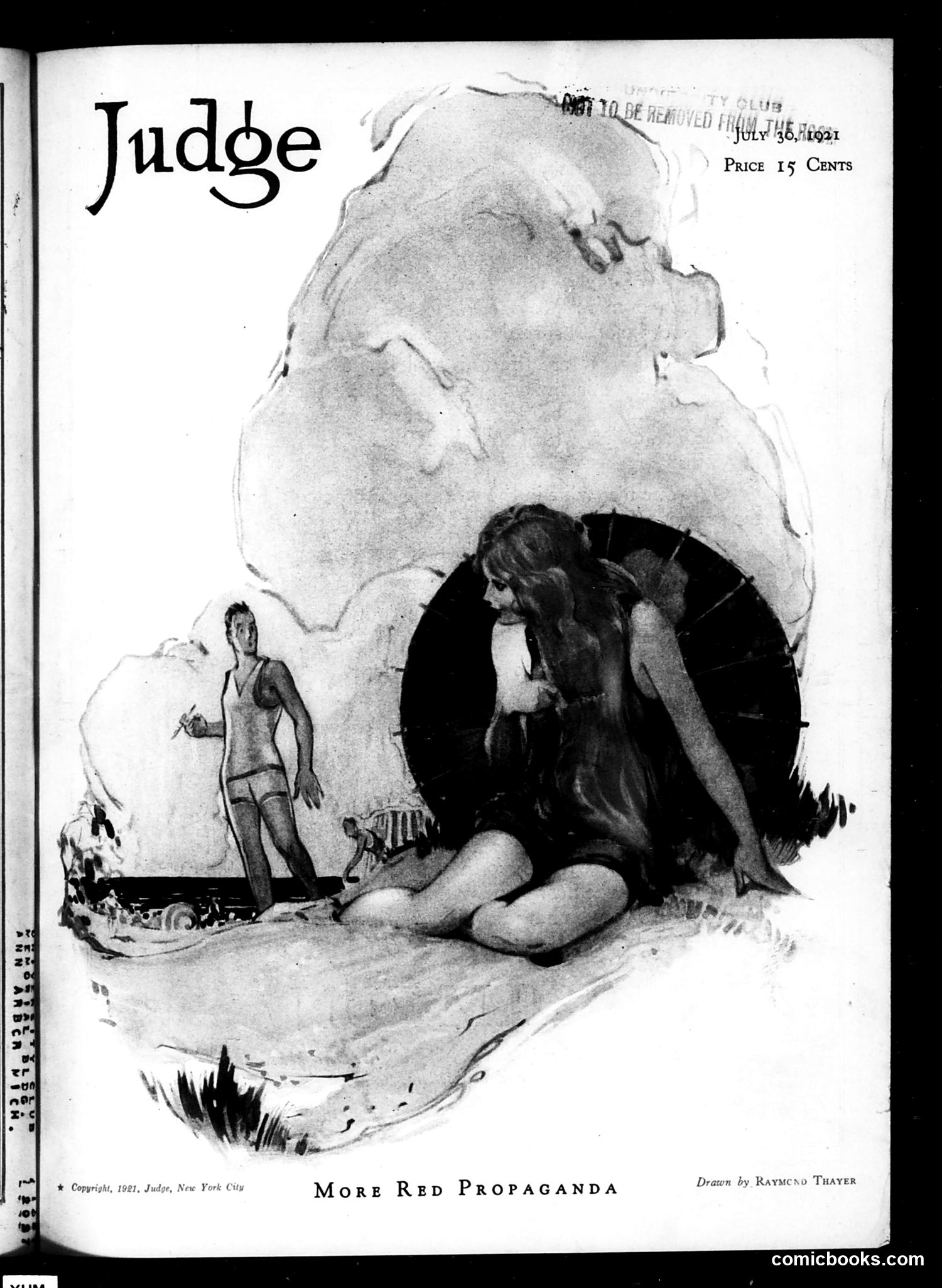
**Title:** "More Red Propaganda" **Image:** A woman sits in a cave opening, while a man in swimwear stands nearby. The cave appears to form a giant face in profile. **Satire:** This cartoon appears to reference anti-communist ("Red") fears prevalent in 1921 America during the post-WWI "Red Scare" period. The cave-as-face imagery likely suggests Bolshevik ideology as a looming, ominous presence. The woman and man's vulnerable positioning, combined with the title, implies propaganda is being used to manipulate or "trap" Americans. **Context:** Judge was a Republican satirical magazine. In 1921, communist anxieties were widespread in America, fueling xenophobia and government crackdowns on suspected radicals. The artist Raymond Thayer emphasizes communist influence as a shadowy threat enveloping unwary citizens.
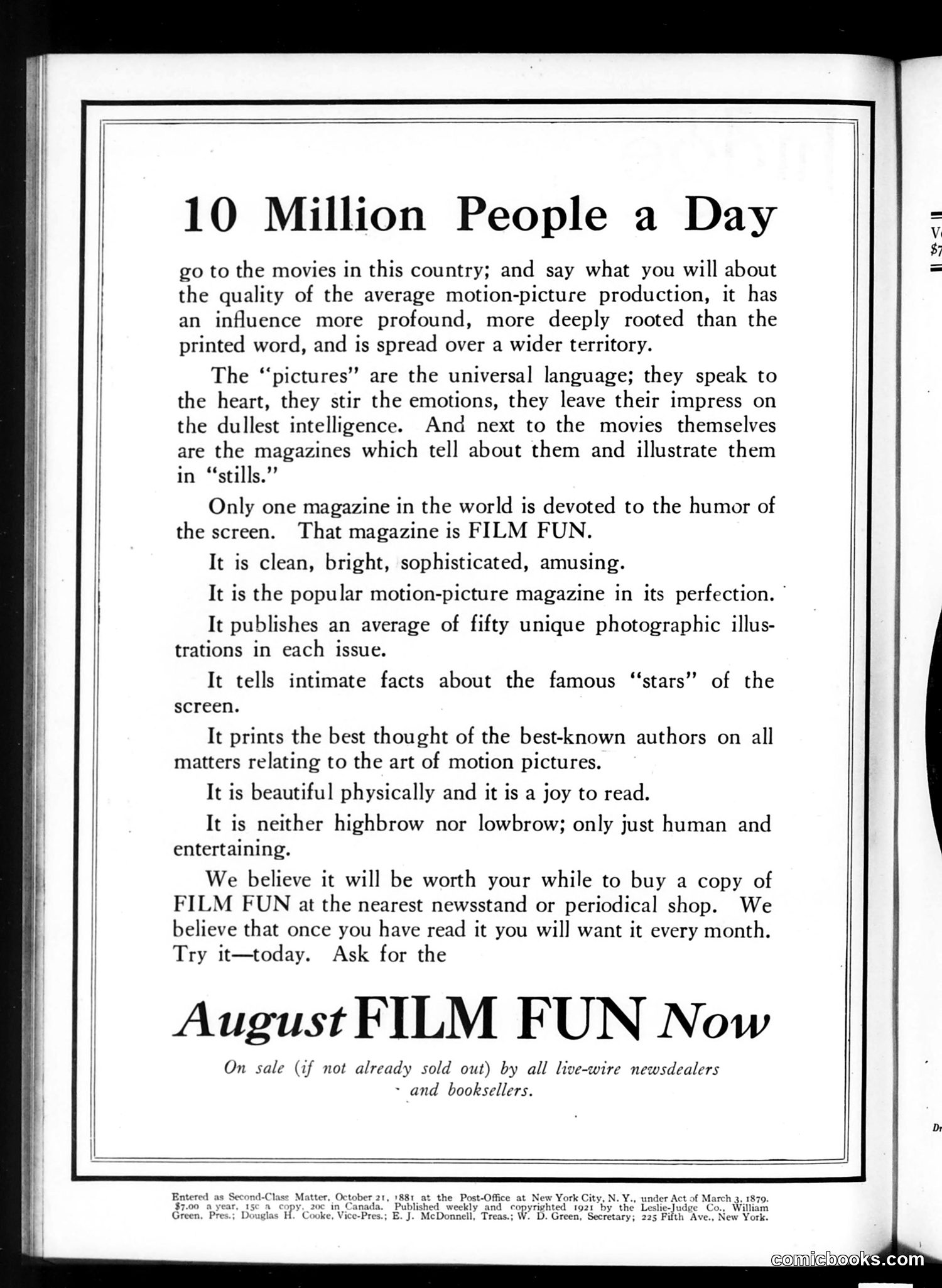
This page is entirely an **advertisement for Film Fun magazine**, not political satire or a cartoon. It promotes the August issue of Film Fun, which was dedicated to humor about motion pictures. The ad emphasizes that 10 million Americans attended movies daily, and that Film Fun was the only magazine devoted to screen comedy. It highlights the magazine's features: approximately 50 photographs per issue, gossip about film "stars," writing by notable authors about cinema, and sophisticated humor. The advertisement positions Film Fun as appealing, accessible entertainment—neither "highbrow nor lowbrow; only just human and entertaining." The call-to-action urges readers to purchase the magazine at newsstands. There are no political cartoons, caricatures, or satirical commentary on this page—it is purely commercial promotion for a popular entertainment publication.
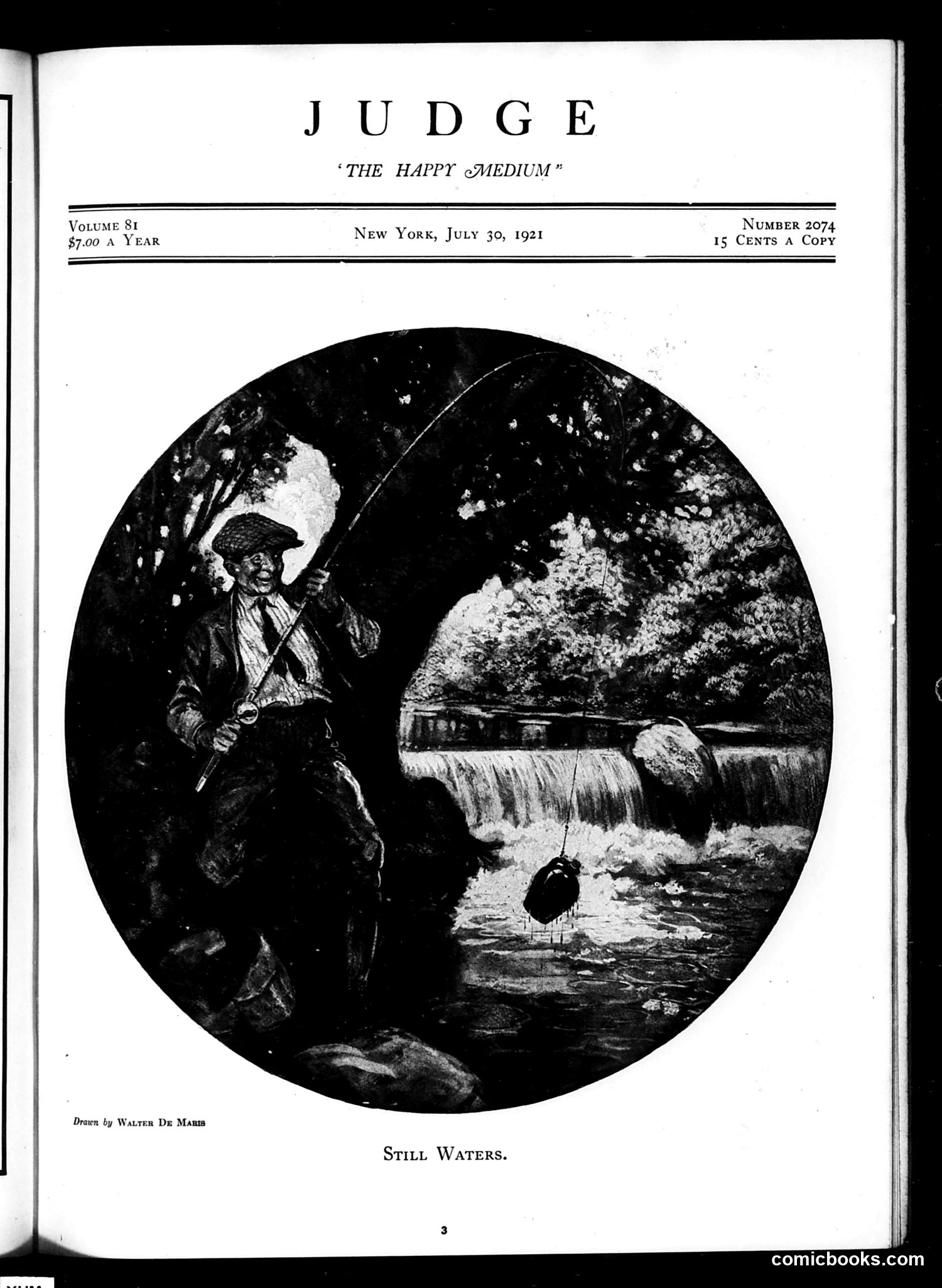
This illustration by Walter De Maris depicts a fisherman casting his line into calm water near a waterfall, with trees framing the scene. The title "Still Waters" is a play on the proverb "still waters run deep," suggesting hidden depths or dangers beneath a placid surface. In the context of 1921 America—during Prohibition and a period of social anxiety—this likely carries satirical meaning about concealed wrongdoing or illicit activity hidden beneath outwardly respectable appearances. The "still waters" of American society may be masking criminal activity, corruption, or other social ills. The specific political target remains unclear from the image alone.
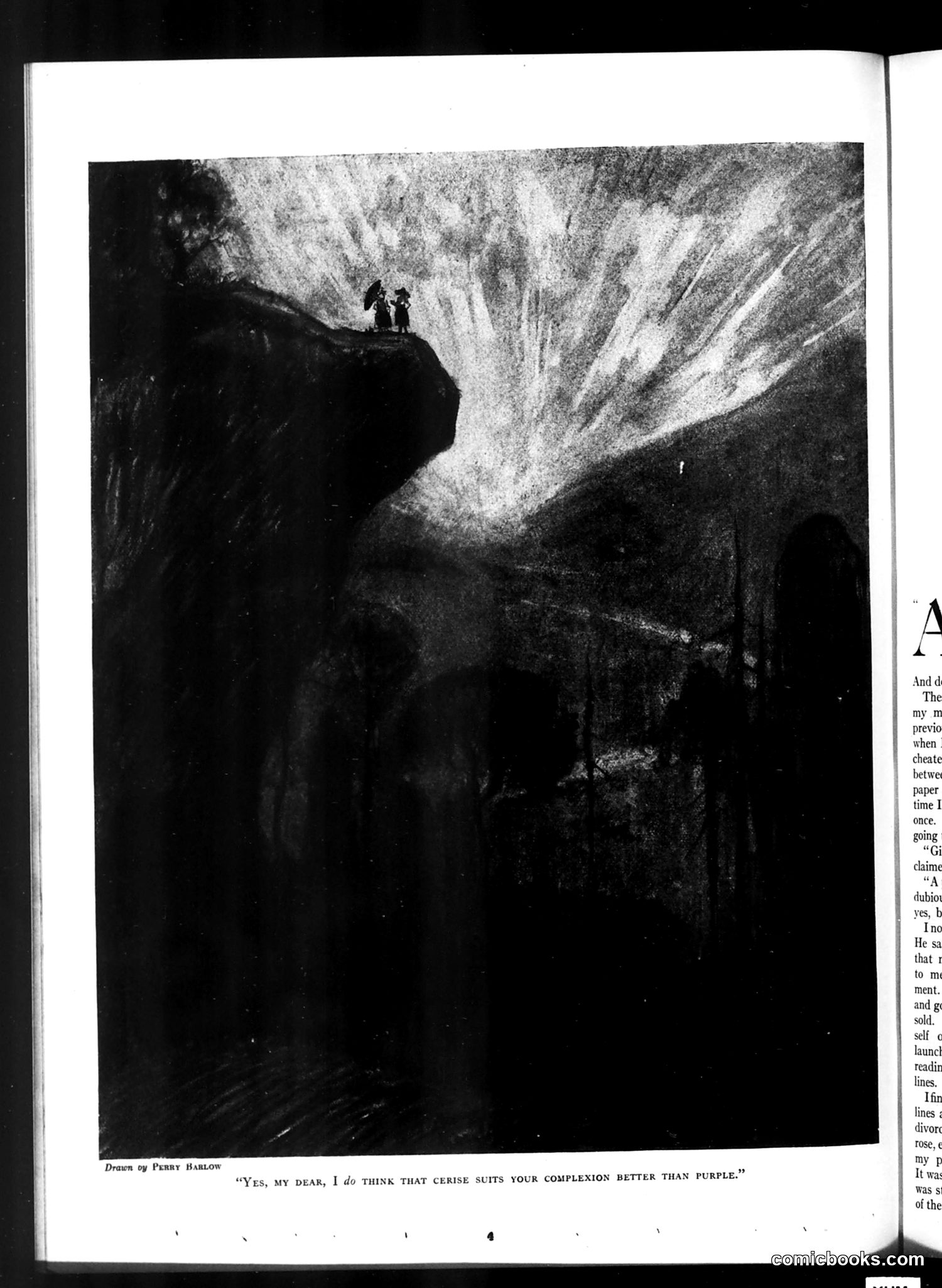
This page features an illustration credited to "Penny Barlow" showing two silhouetted figures on a rocky cliff overlooking a dramatic landscape. The caption reads: "Yes, my dear, I do think that cerise suits your complexion better than purple." The satire appears to be visual rather than overtly political. The joke seems to rest on the absurd juxtaposition of polite, genteel fashion commentary ("cerise suits your complexion better than purple") in what appears to be a dramatic, perilous romantic scenario—two figures isolated on a dangerous cliff edge. The humor lies in maintaining superficial etiquette and concern with fashion colors even in an emotionally or physically charged moment. This reflects early 20th-century satirical commentary on the artificiality of upper-class social conventions and feminine preoccupations with appearance.
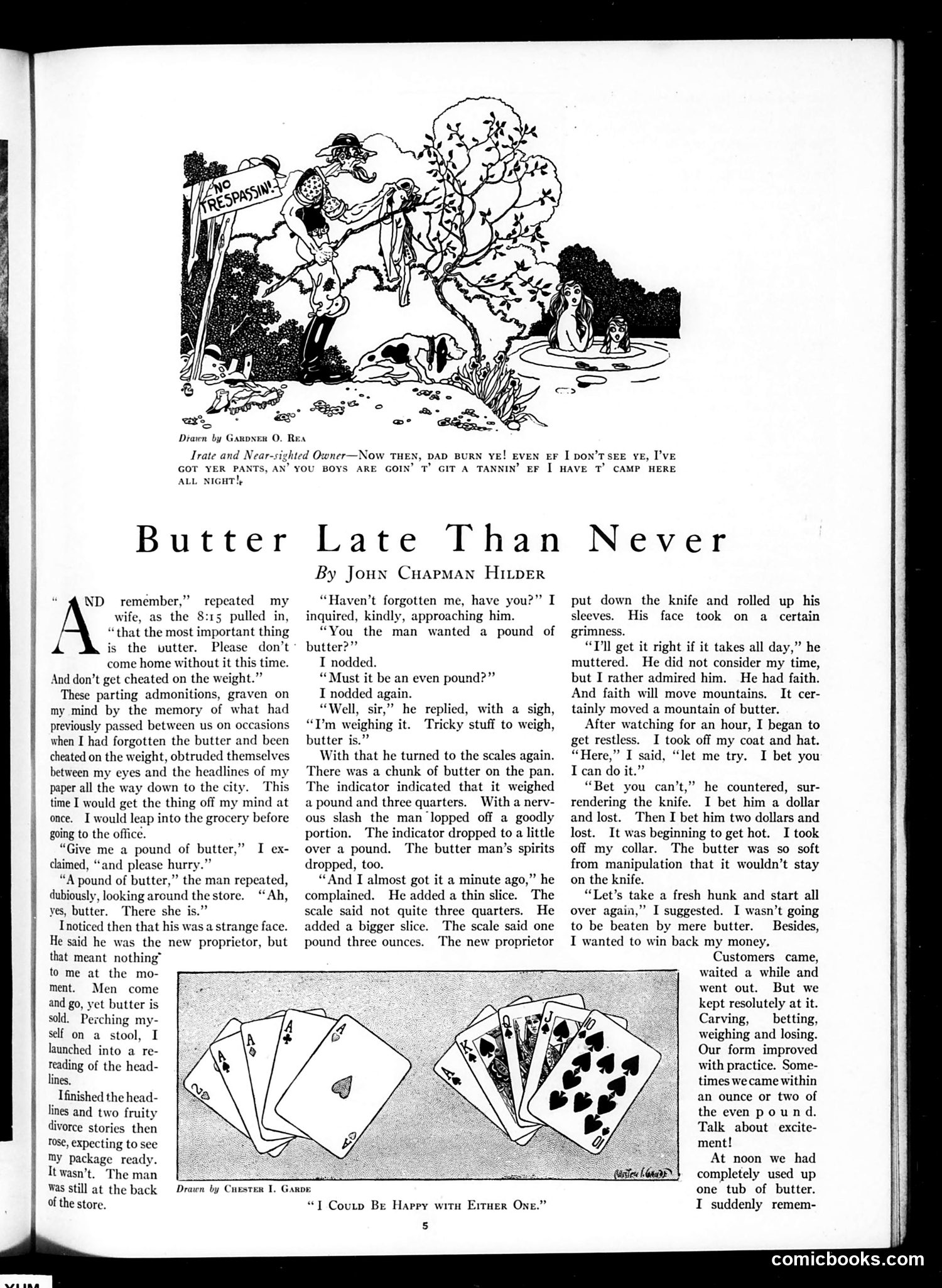
**Main Content:** This is a humorous short story by John Chapman Hilder about a grocer's experience selling butter. The narrative involves a customer disputing the weight of butter purchased, leading to repeated trips to the scales with increasingly smaller portions added. The story is largely a comedic anecdote about retail commerce and customer dissatisfaction. **The Cartoons:** - The header illustration depicts a trespassing scene with a rural family, unrelated to the butter story - The lower illustration shows playing cards labeled "I Could Be Happy with Either One," likely a separate puzzle or game feature **Satire:** The story gently satirizes both penny-pinching customers and the patience required in retail work, reflecting early 20th-century grocery commerce frustrations rather than broader political commentary.
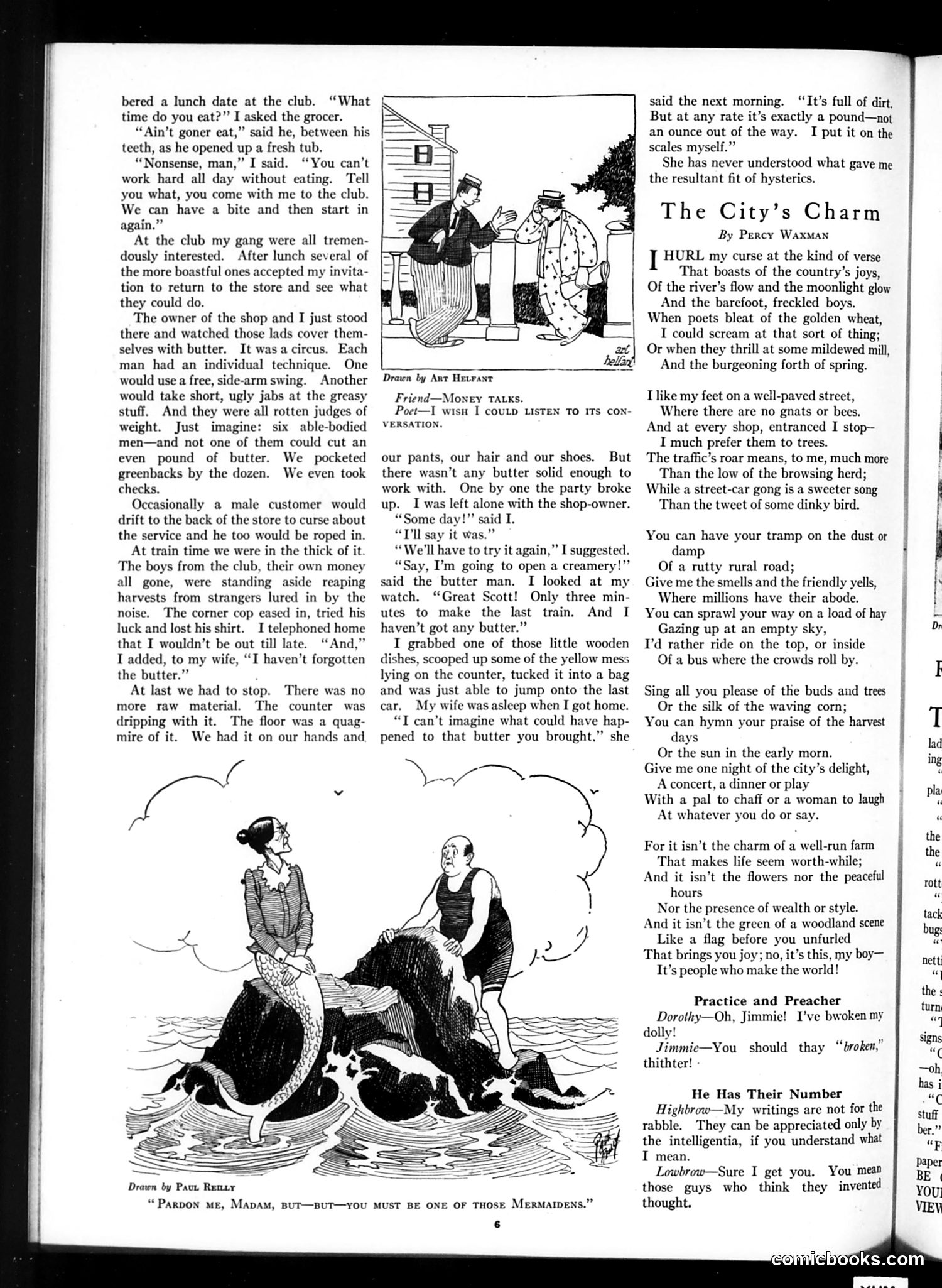
This page contains two distinct pieces: **Top cartoon** (by Art Helfant, titled "Friend—Money Talks"): Shows well-dressed men discussing butter rationing or scarcity, likely referencing post-WWI food shortages or price controls. The humor centers on the absurdity of wealthy men unable to obtain basic groceries despite their means—satirizing how economic restrictions affected even the privileged. **Bottom cartoon** (by Paul Reilly): Two people on a beach with sea creatures. The caption "Pardon me, Madam, but—but—you must be one of those Mermaids" appears to be a pickup-line joke, playing on the woman's appearance or the absurdity of the situation. The right column contains poetry and short humor pieces unrelated to the cartoons. The satire reflects early 20th-century concerns about food scarcity and class divisions.
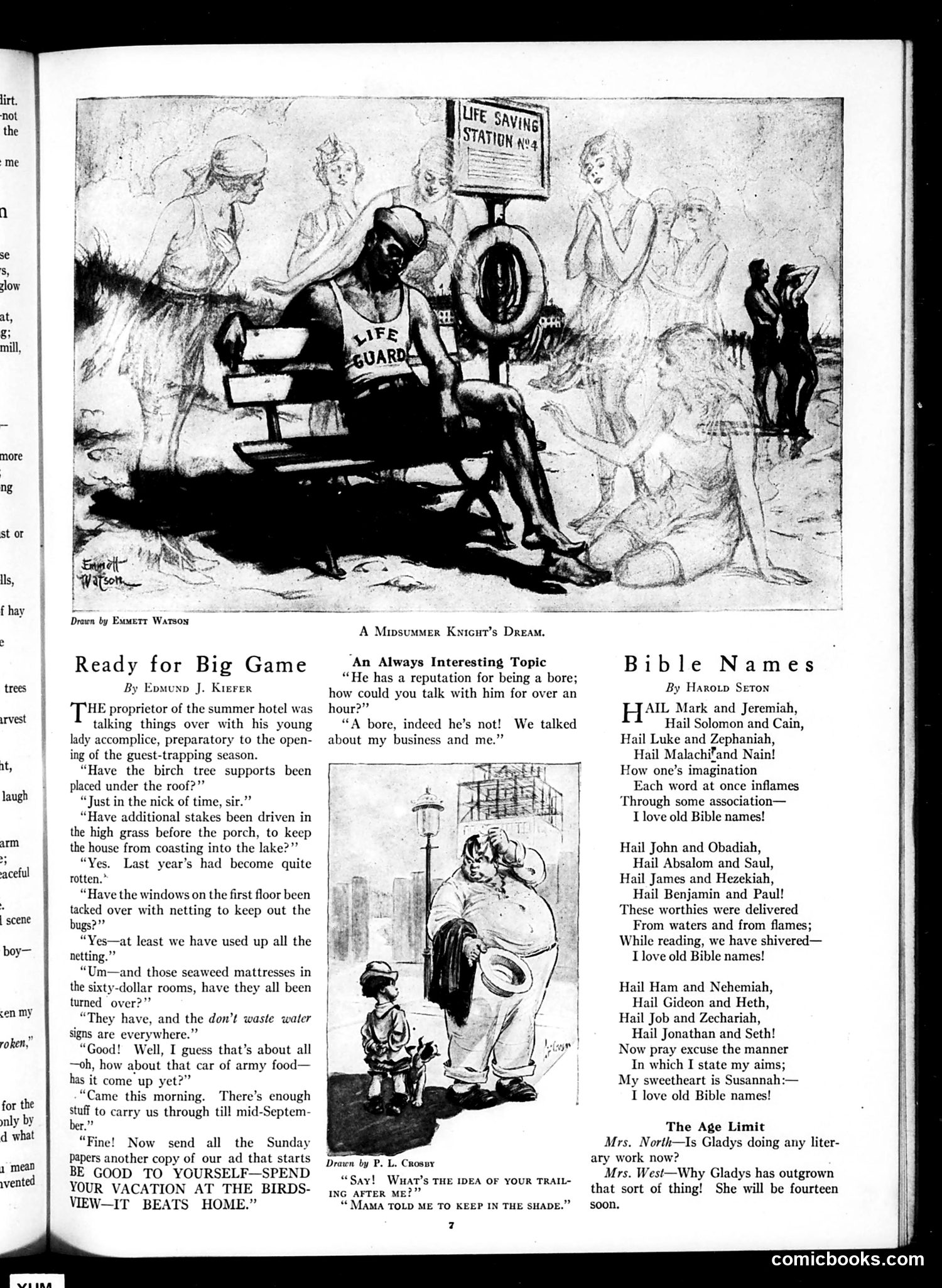
This page contains three separate pieces of light satirical humor typical of Judge magazine: **"Ready for Big Game"** depicts a hotel proprietor and accomplice preparing a summer resort for guests—but the "game" is the guests themselves. The satire targets hospitality fraud: they're installing hidden supports under the roof, stakes in grass, netting over windows, and seaweed mattresses to trap unwary visitors into poor conditions while extracting money. The humor lies in the candid admission of deliberate deception. **"A Midsummer Knight's Dream"** (top illustration by Emmett Watson) shows a lifeguard at a beach station—likely satirizing the pretentiousness or ineffectiveness of such safety measures, though the specific joke is unclear from available context. **"Bible Names"** and **"The Age Limit"** are light verse and brief humor pieces unrelated to satire—simple wordplay and domestic comedy about children growing up. The page mixes social commentary (hotel fraud) with genteel family humor, typical of Judge's broad appeal to middle-class readers.
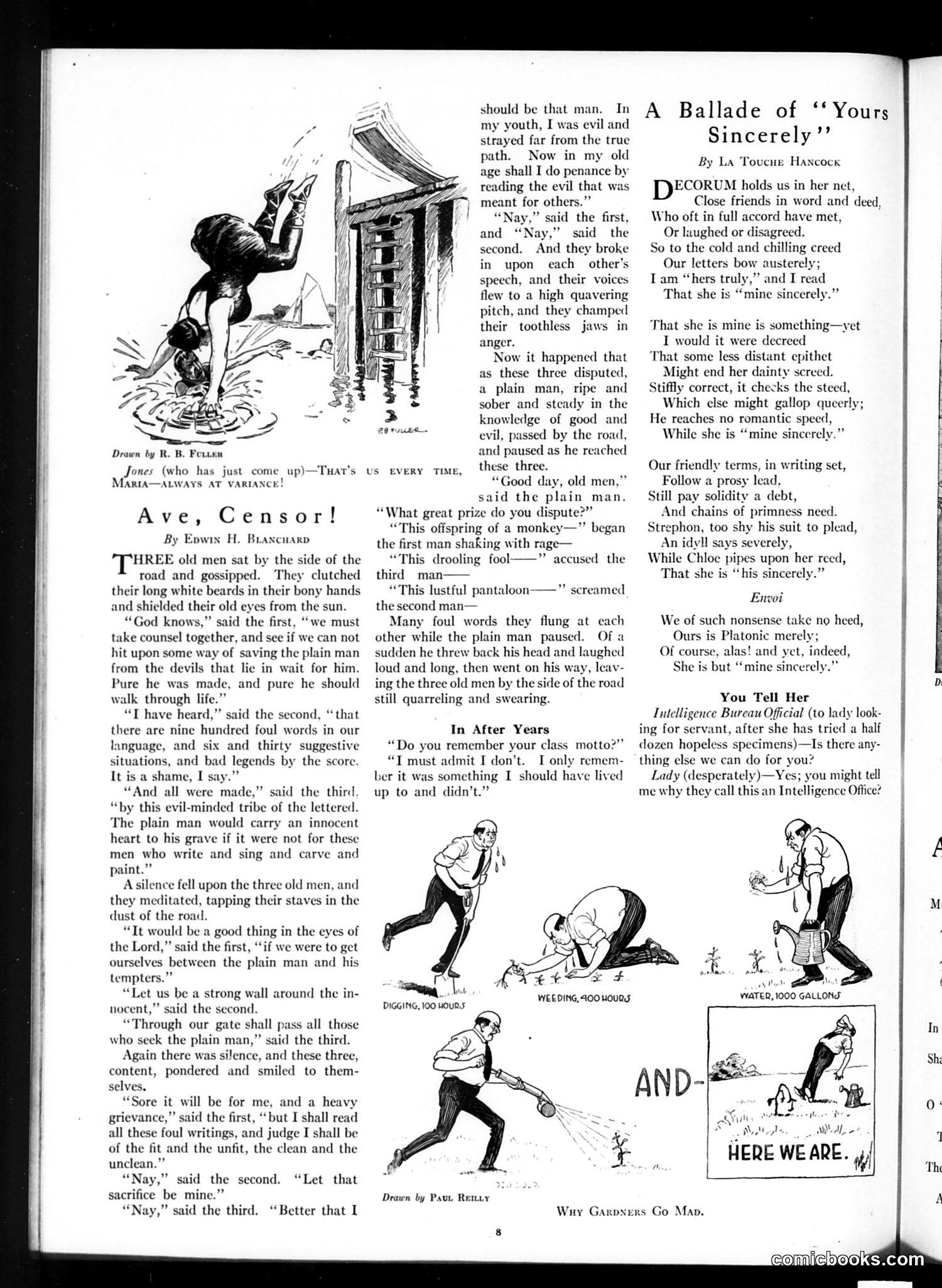
The main story mocks self-appointed moral guardians. Three elderly men—representing censors or moral crusaders—sit debating how to protect "the plain man" from corrupting influences: foul language, suggestive situations, and immoral art. They eagerly volunteer to read all "evil writings" themselves as penance, arguing over who should bear this burden. The satire's point: their overwrought concern is absurd. When an actual plain man passes by, he simply laughs at their quarreling and continues unbothered—suggesting that ordinary people don't need protection from the things censors obsess over. The cartoon attacks censorship movements of the era that sought to suppress "immoral" literature and art. Judge's perspective: censors are self-righteous busybodies whose concern for public morality masks prurient interest in the very material they condemn, while regular people are sensible enough to ignore such crusades.
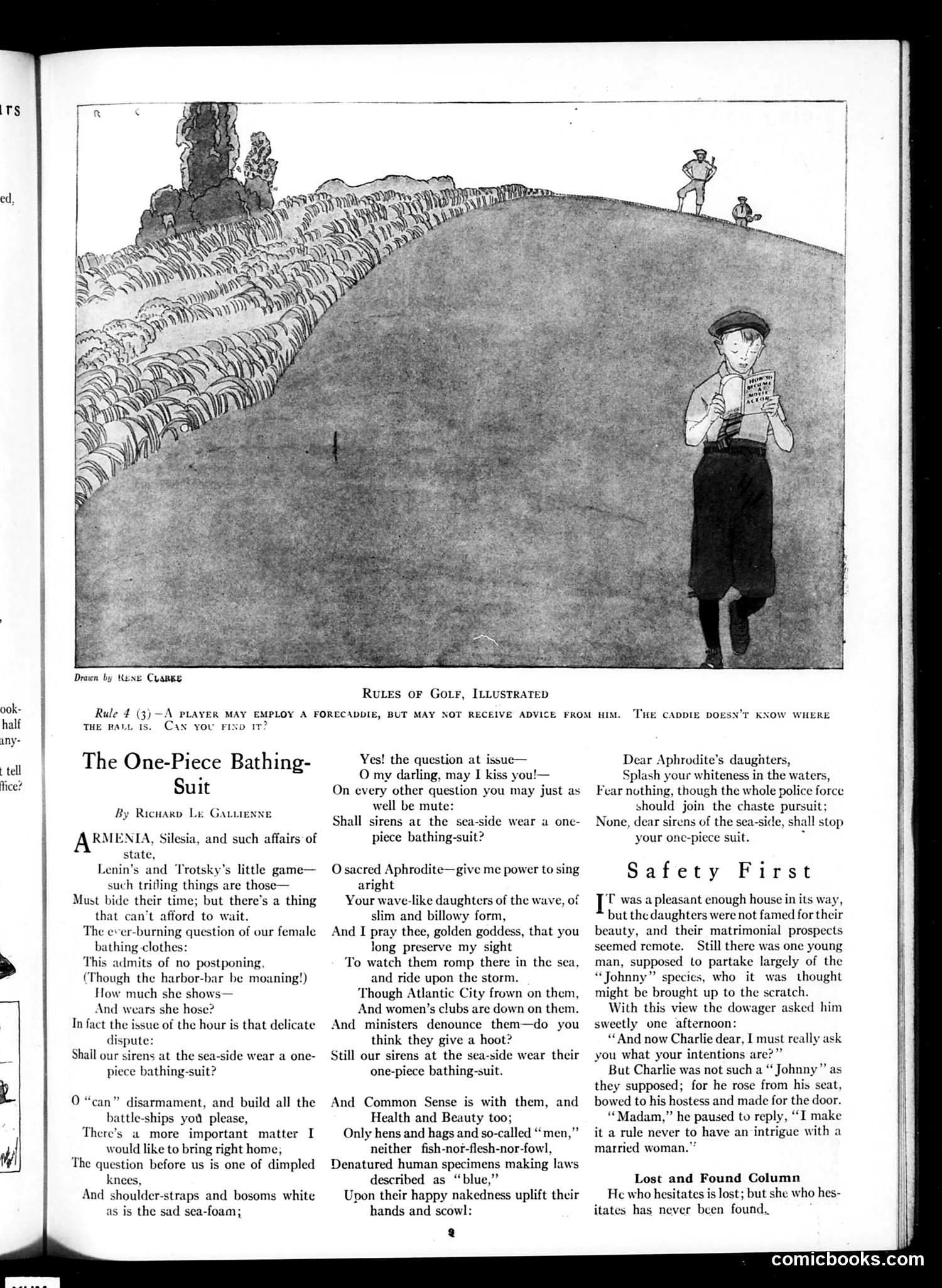
This page contains **two separate pieces of satirical content**: ## "The One-Piece Bathing-Suit" (Main Article) A humorous poem by Richard Le Gallienne satirizing public debate over women's bathing attire. The piece mocks the controversy surrounding one-piece swimsuits—which exposed more of women's bodies than Victorian swimwear. Le Gallienne ridicules moralists and "blue law" enforcers (religious conservatives) who oppose the suits, treating the swimsuit debate as absurdly overblown compared to serious political matters (Armenia, Silesia, Lenin, Trotsky). The tone is playfully libertine, defending women's right to wear revealing beachwear. ## "Rules of Golf, Illustrated" (Cartoon) A single-panel cartoon by Gene Clarke illustrating a golf rule. A man in formal attire stands on a golf course with a scorecard. The joke appears to reference Rule 4(3)—a caddie cannot advise a player on the ball's location. The caption asks "Can you find it?" suggesting the visual punchline involves something deliberately hard to locate on the course. **Context**: Judge was a humor magazine; these pieces reflect early 20th-century social anxieties about changing women's fashion and public behavior.
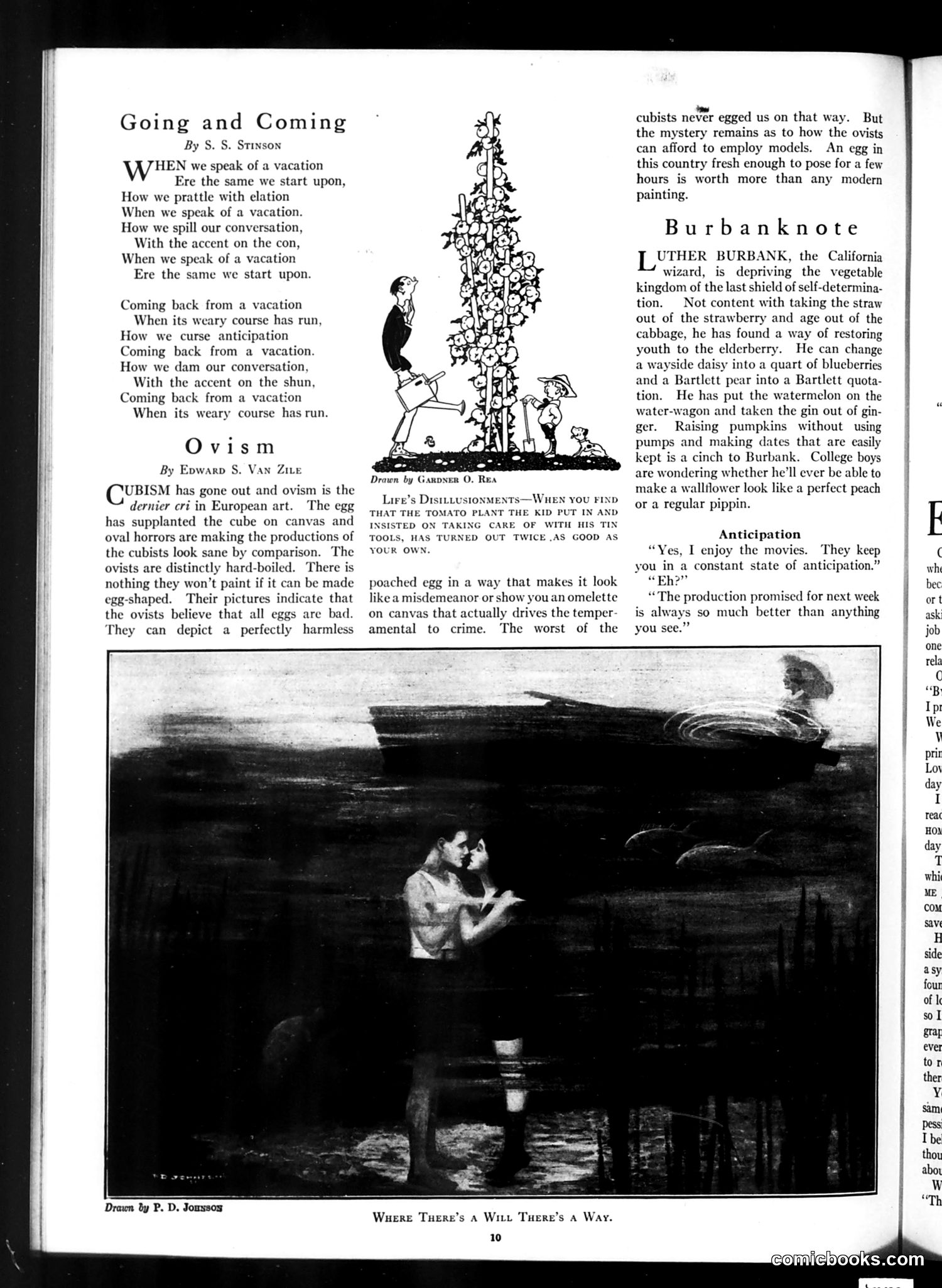
This page contains three distinct satirical pieces: **"Going and Coming"** (poem): Humorously contrasts how people talk *before* vacation versus *after*. Before, they excitedly discuss their plans; after returning, they complain and avoid conversation—emphasized by shifting the accent from "va-*CA*-tion" to "va-*SHUN*." **"Ovism"** (art criticism): Mocks the latest European avant-garde art movement replacing Cubism. "Ovism" treats eggs as artistic subjects, painting them in sinister, crime-inducing ways. The satire suggests modernist art movements are absurdly pretentious—even harmless objects become menacing when rendered by these artists. It's a broader jab at experimental art as incomprehensible and ridiculous. **"Burbanknote"**: References Luther Burbank, the famous California plant breeder/horticulturist known for agricultural innovations. The piece sarcastically credits him with impossible botanical feats (removing "age" from cabbage, making dates "easily kept"), poking fun at his exaggerated reputation. The bottom cartoon caption "Where There's a Will There's a Way" appears unrelated to the text above it.
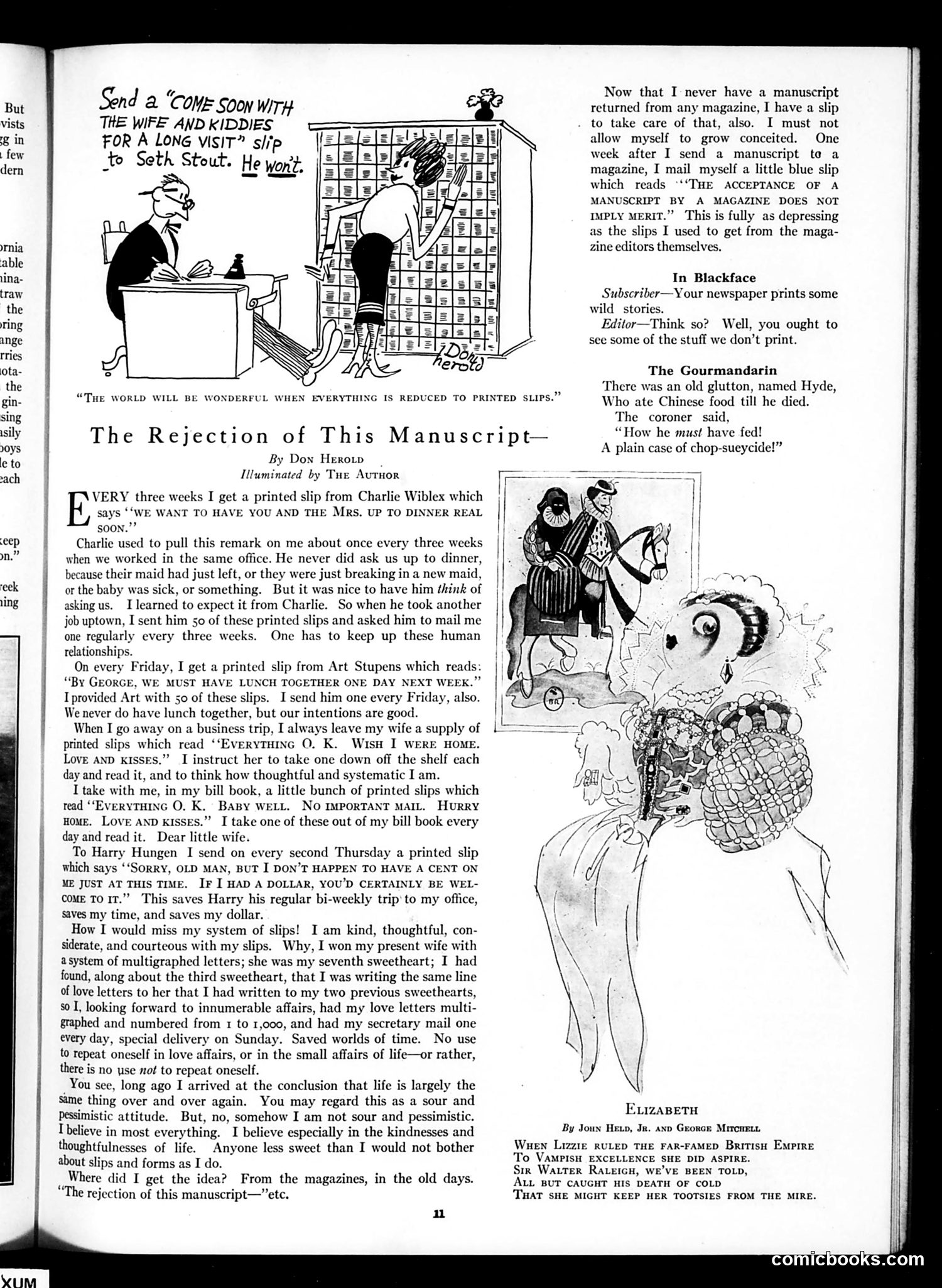
This page satirizes bureaucratic efficiency and hollow social conventions through Don Herold's essay "The Rejection of This Manuscript." The cartoon at top depicts a man at his desk mailing form letters—the joke being that he sends pre-printed slips instead of genuine communication. Herold describes systematizing human relationships with duplicated messages: a colleague's insincere dinner invitation answered with mass-produced slips; fake love letters numbered 1-1,000 used to court his seventh sweetheart; excuses to avoid lending money. The satire targets how people use convenient fictions and mass production to avoid authentic interaction. The irony intensifies when Herold claims this represents his "kindness" and "thoughtfulness." He even sends himself a pre-printed slip reminding him that magazine acceptance "does not imply merit"—genuine humility reduced to form-letter self-deprecation. The accompanying illustrations mock stories about exotic adventures (like the Gourmandarin and Elizabeth narratives), contrasting fantastical tales with Herold's mundane, mechanized life. The overall message: modern efficiency has replaced sincerity, and we accept printed simulacra as genuine connection.
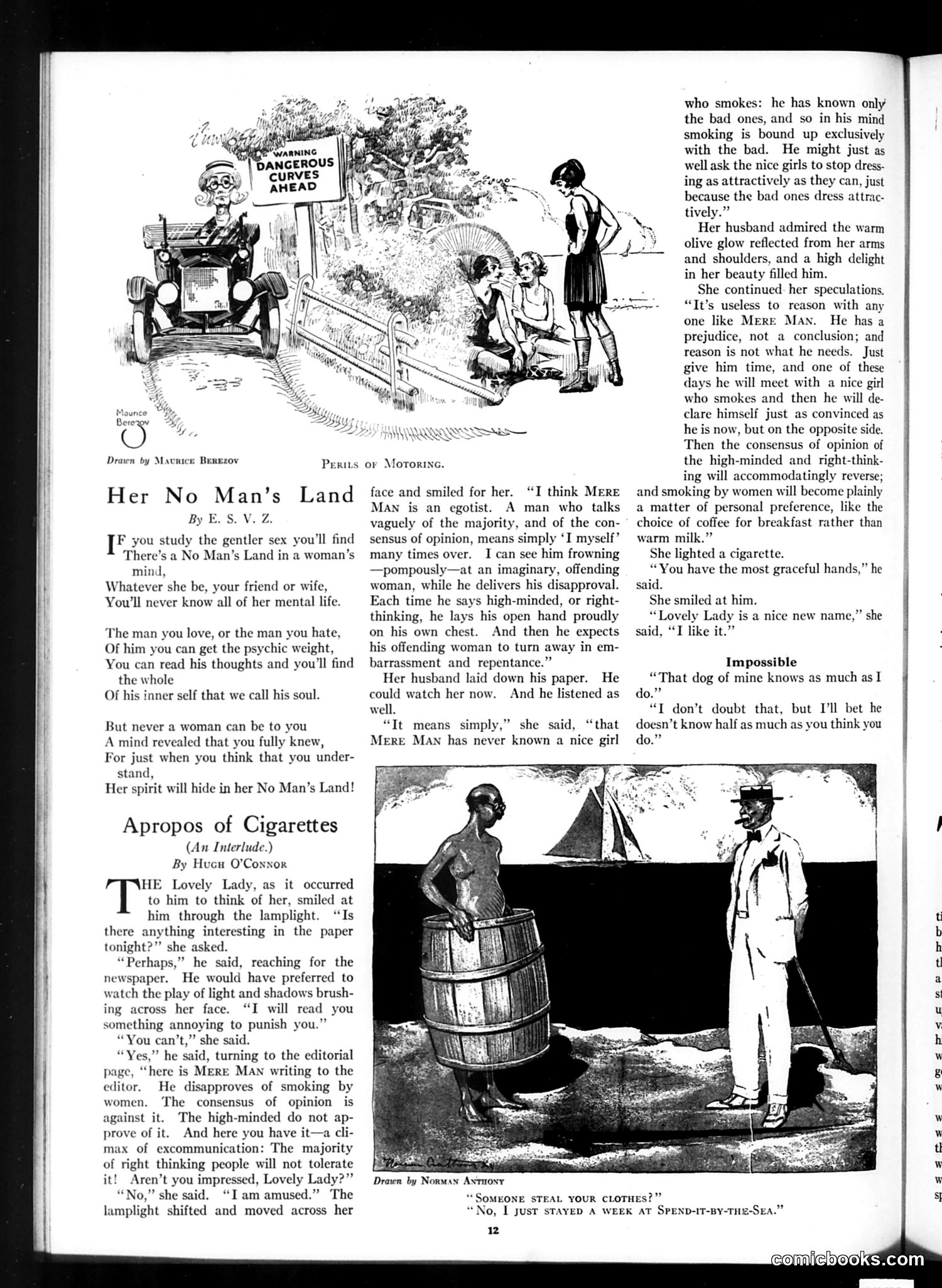
This page contains two satirical pieces critiquing early 20th-century social attitudes about women. **"Her No Man's Land"** is a poem suggesting that women's inner lives remain unknowable to men—a philosophical critique framed as romantic mystery. **"Apropos of Cigarettes"** directly mocks male hypocrisy regarding women smoking. A husband reads an editorial by "Mere Man," a character opposing women's smoking as "high-minded" and morally superior. The wife brilliantly deconstructs this: she argues "Mere Man" conflates his personal opinion with collective morality, and that he's only known "bad" women who smoke. She predicts that once he meets a respectable woman who smokes, he'll reverse his position entirely—and society's "consensus" will shift with him. The satire targets how men rationalize prejudices as moral principles, and how social norms around women's behavior are arbitrarily enforced by those claiming objective standards. The cartoon illustrations (the "Perils of Motoring" and beach scene) provide visual comedy relief to the text-heavy social commentary.
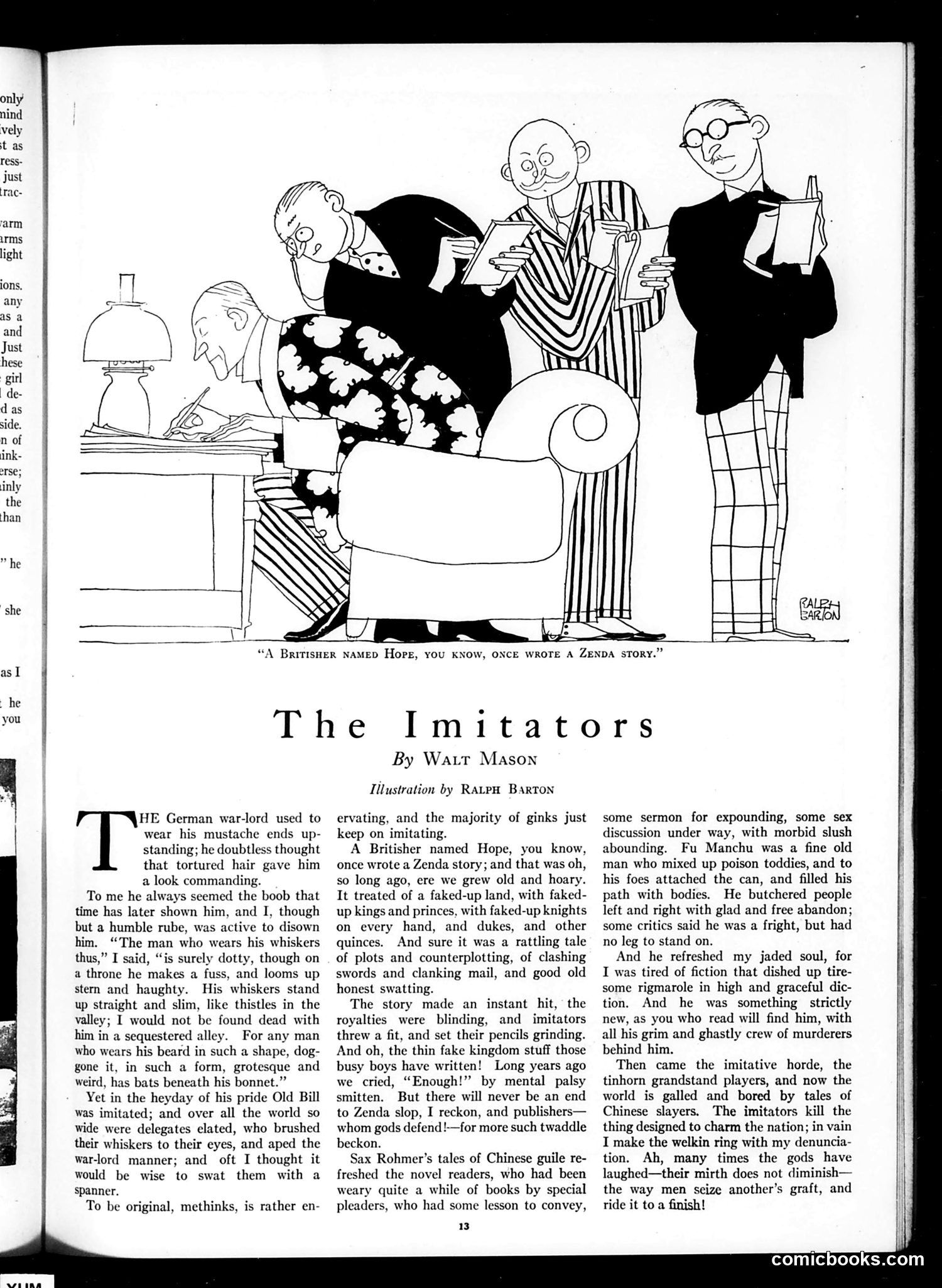
**The Cartoon:** The illustration shows five men in business attire discussing literature around a desk with a lamp. The caption references "a Britisher named Hope" who wrote a "Zenda story." **The Satire's Target:** Mason criticizes widespread literary imitation. He uses two examples: 1. **Anthony Hope's "The Prisoner of Zenda"** (1894)—a popular adventure novel set in a fictional European kingdom that spawned countless inferior imitators. 2. **Sax Rohmer's "Fu Manchu" series**—exotic tales of a Chinese villain that similarly inspired derivative works. **The Point:** Mason argues that original, entertaining works inspire mediocre copycats who exploit the formula until readers tire of the entire genre. He laments how imitators "kill the thing designed to charm the nation" by milking successful concepts dry. **Context:** This reflects early 20th-century publishing's boom-and-bust cycles with popular genres, where publishers rushed imitations to market to capitalize on bestsellers—a practice Mason finds aesthetically and morally lazy.
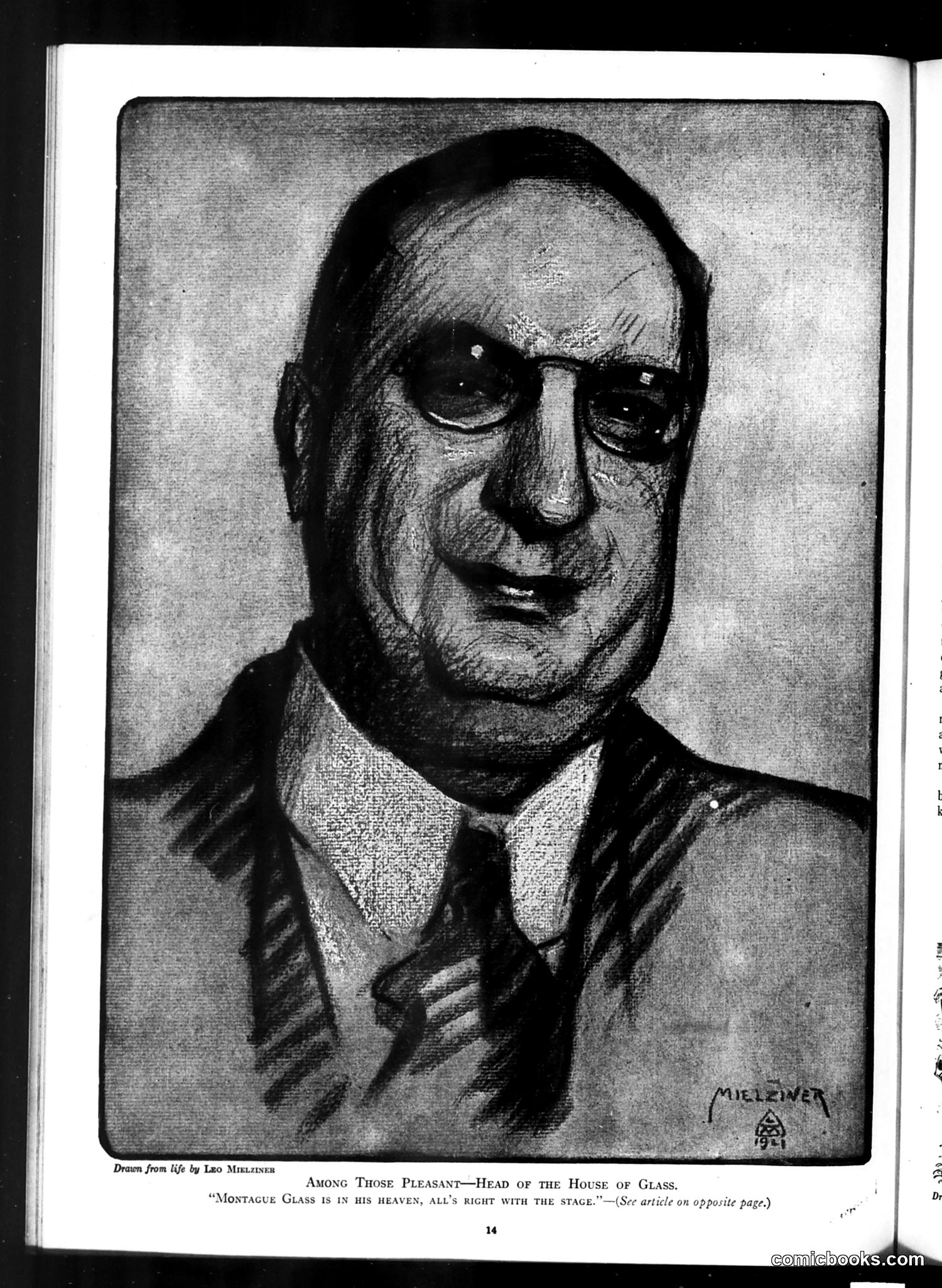
This page features a satirical portrait drawn by Leo Mielziner of **Montague Glass**, labeled "Head of the House of Glass." The accompanying caption quotes: "Montague Glass is in his heaven, all's right with the stage." Glass appears to have been a theatrical figure of significance during this Judge magazine period. The caricature emphasizes his distinctive features—prominent nose, receding hairline, and thick-framed glasses—in Mielziner's characteristic style. The satire likely comments on Glass's success or influence in theater, with the ironic invocation of Browning's "God's in his heaven" suggesting either genuine acclaim or mocking exaggeration of his self-satisfaction. Without additional context about Glass's specific theatrical role or controversies during this era, the precise satirical intent remains unclear, though the theatrical subject matter is evident.
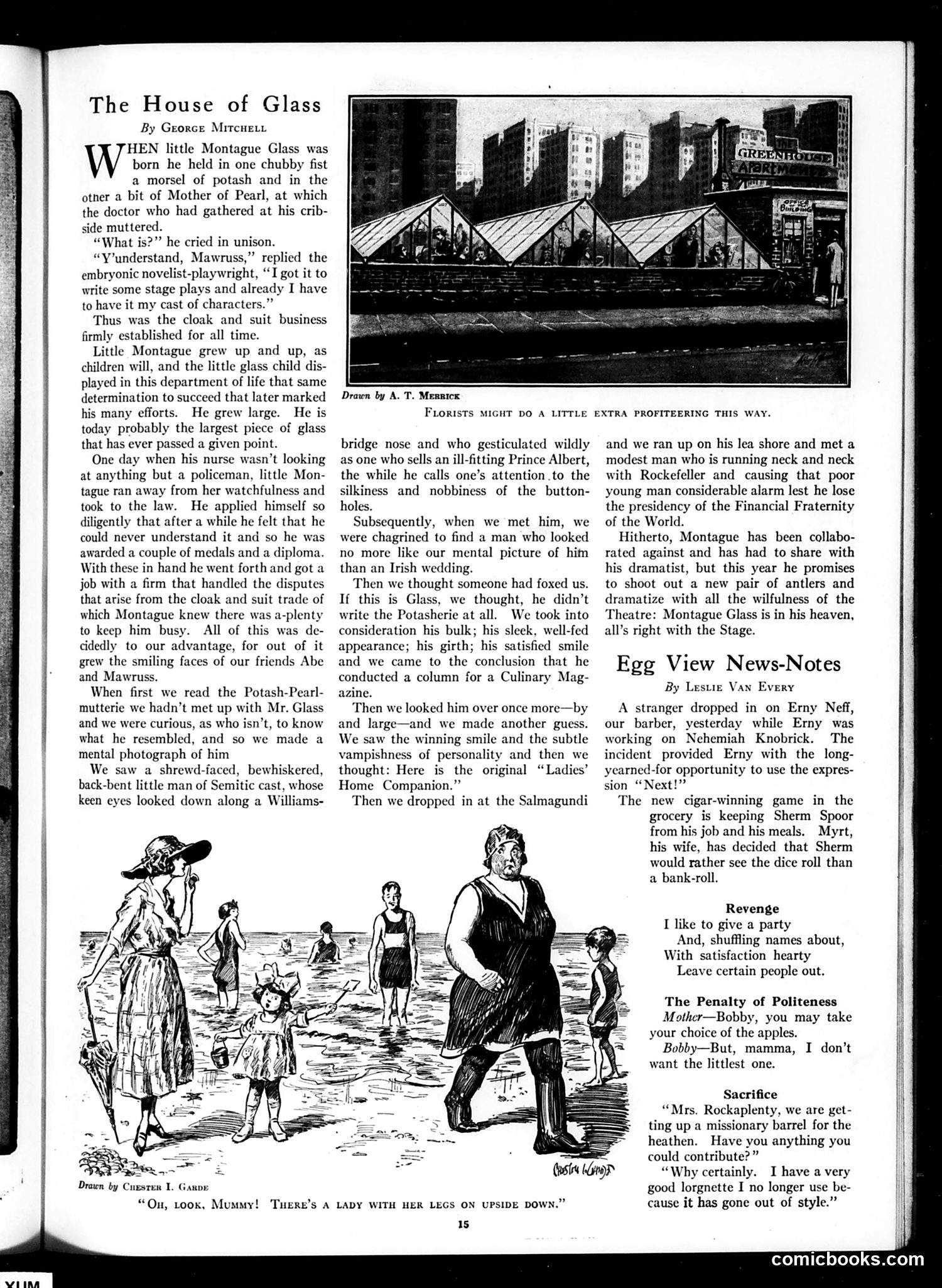
George Mitchell's article humorously profiles **Montague Glass**, a successful playwright and writer of Yiddish-American comedies. The satire works through contrasts: Mitchell expected Glass—author of the popular "Potash and Perlmutter" stories about Jewish garment-industry characters—to physically resemble his creations: a small, shrewd, gesticulating Jewish immigrant in the cloak-and-suit trade. Instead, Glass appears prosperous, well-fed, and dignified—successful enough to rival Rockefeller financially. The joke mocks both Mitchell's initial prejudices and Glass's dramatic distance from his own literary characters. The accompanying cartoons appear unrelated: one shows a beach scene; another makes a crude joke about a woman's bathing posture. The piece celebrates Glass's achievement while gently satirizing American assumptions about writers and ethnic stereotypes.
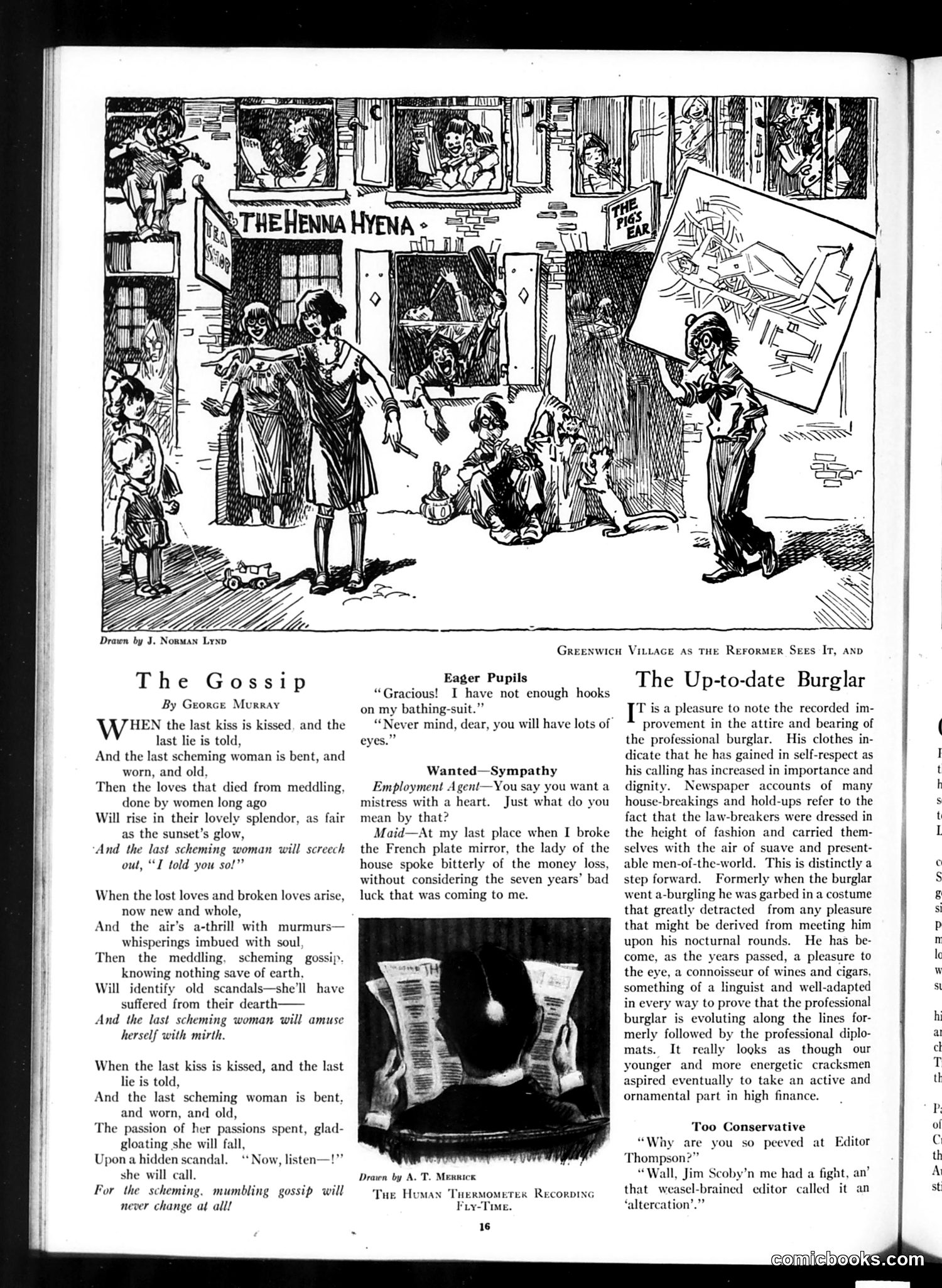
This page from *Judge* contains three satirical pieces mocking social behavior: **"The Gossip"** (verse by George Murray): A poem deriding women who spread rumors and meddle in others' affairs. It presents gossip as an eternal vice—even in the afterlife, scheming women will identify old scandals, finding perverse pleasure in others' misfortunes. The satire targets women's perceived love of scandal-mongering. **"The Henna Hyena"** (top illustration): A satirical look at Greenwich Village reformers. The drawing mocks bohemian reformers' self-righteousness, depicting their idealized but impractical social vision. **"The Up-to-date Burglar"**: Satirizes the apparent "professionalization" of criminals. The piece ironically praises burglars for becoming well-dressed, sophisticated men of style rather than shabby criminals—suggesting they're becoming indistinguishable from respectable society and aspiring to "high finance," mocking both criminal ambition and upper-class pretension. The humor relies on inverted moral values and social criticism typical of early 20th-century satirical magazines.
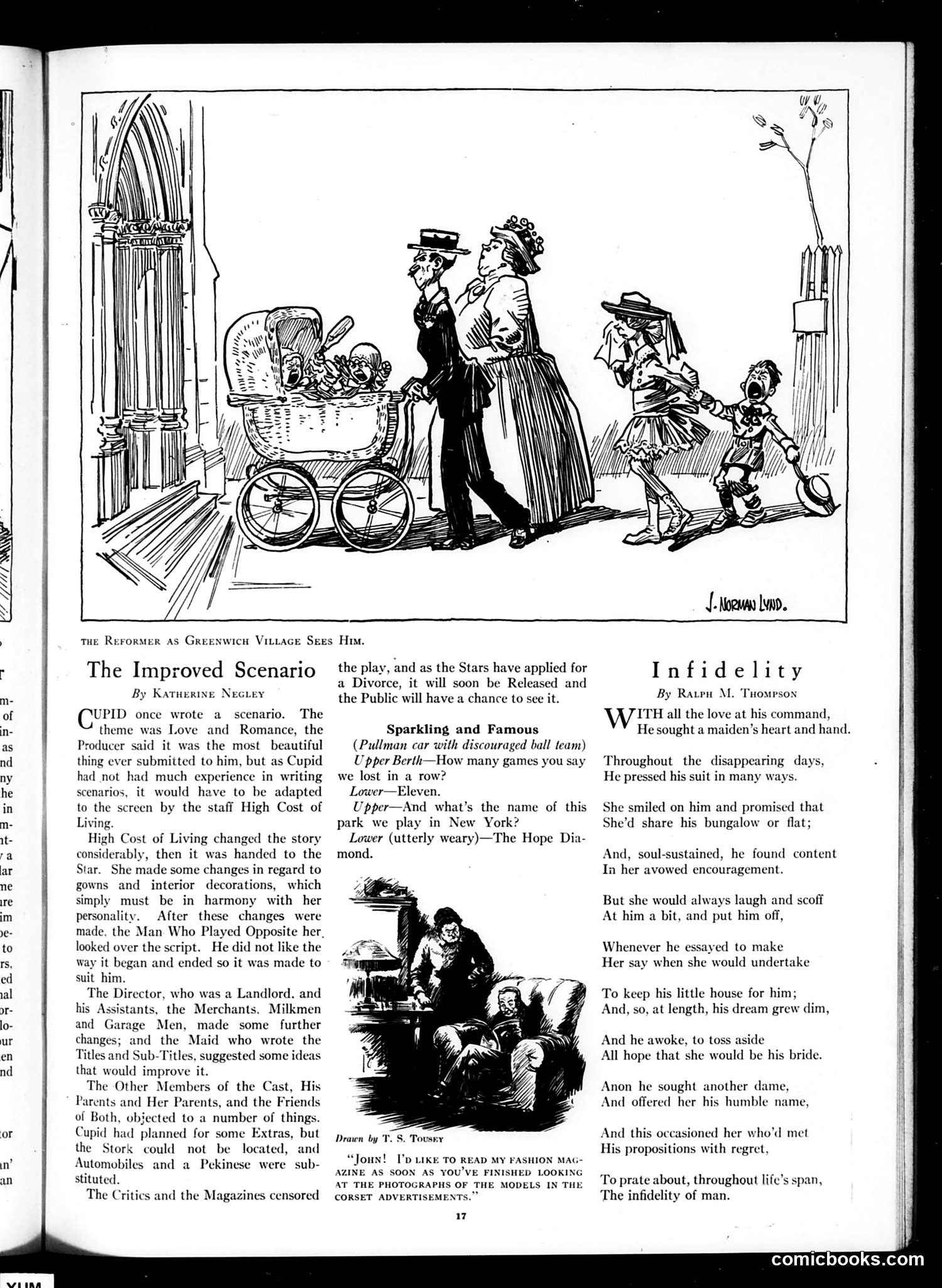
**Top Cartoon:** "The Reformer as Greenwich Village Sees Him" depicts a well-dressed couple with children and a baby carriage outside what appears to be a church or institution. The satire targets social reformers—likely Progressive Era activists—by showing them as pretentious figures parading their "reformed" lifestyle in Greenwich Village, a hub for bohemian intellectuals and radicals. **Main Article:** "The Improved Scenario" satirizes early Hollywood filmmaking. Cupid writes a romantic screenplay, but it gets corrupted as it passes through numerous hands—producers worried about costs, vain stars, directors, staff, cast members, critics, and censors. Each adds changes until the original vision is destroyed. This critiques how commercial concerns and competing egos destroy artistic integrity in cinema. **Poetry Section:** "Infidelity" tells of a man rejected by a woman who then blames *him* for infidelity when he courts another—satirizing female hypocrisy and social double standards. The page reflects early 20th-century anxieties about modernism, Hollywood's growing influence, and gender relations.
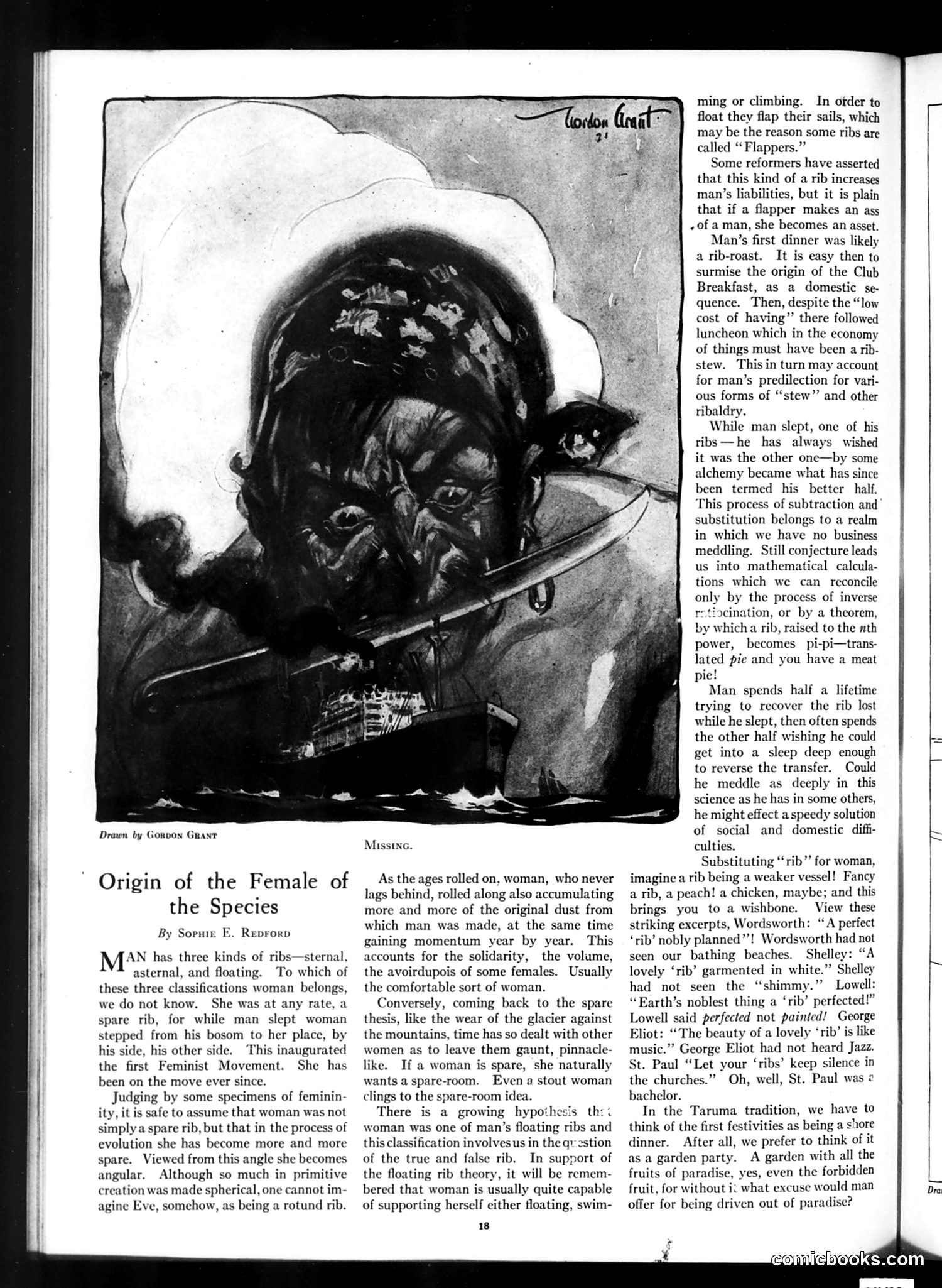
This satirical article by Sophie E. Redford uses anatomical wordplay to mock both women and men in the context of early 20th-century feminism. The piece presents a pseudo-scientific "origin story" of women based on the Biblical creation narrative (Eve from Adam's rib), using anatomy as metaphor. Women are variously described as "spare ribs," "floating ribs," or "flappers"—the last term referring to the independent, modern women of the 1920s who challenged social norms. The satire cuts both ways: it mocks women's newfound independence ("the first Feminist Movement") while simultaneously ridiculing men's dependency on women and their obsession with recovering what they've "lost." The extended riff on cooking (rib-roast, rib-stew, meat pie) crudely reduces female worth to domestic/sexual utility. The cartoon titled "Missing" appears to illustrate a sleeping man, presumably representing the unconscious male losing his metaphorical rib to female independence. The piece is fundamentally anti-feminist commentary dressed in pseudo-intellectual humor typical of *Judge* magazine's satirical approach.
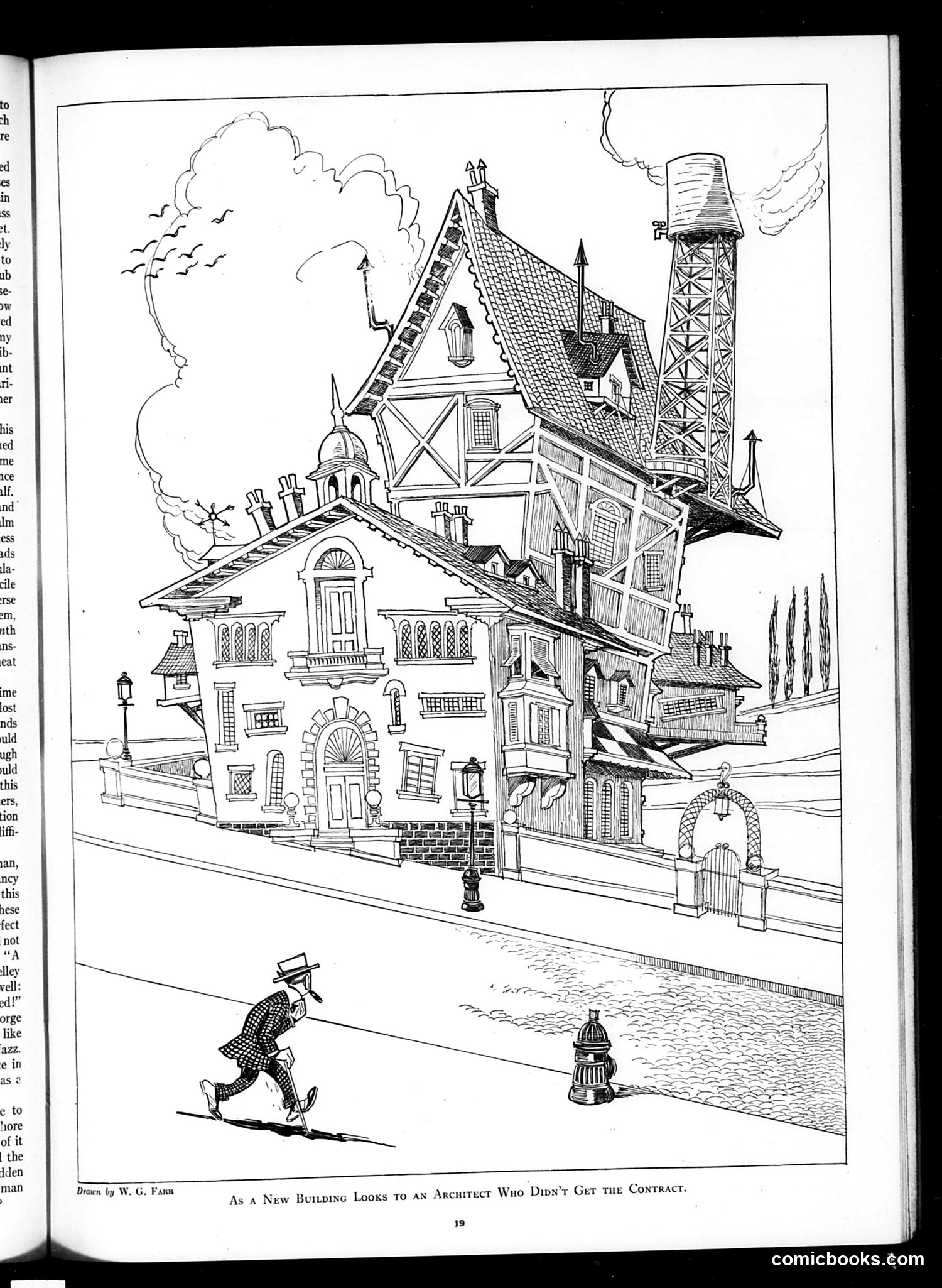
This is a political cartoon satirizing architectural ambition and professional disappointment. The drawing shows an elaborate, fantastical building with multiple towers, ornate details, and whimsical elements—appearing deliberately over-designed and impractical. The caption's joke is that this monstrosity represents how a building "looks to an architect who didn't get the contract"—meaning the architect, bitter about losing the job, imagines the completed project as absurdly flawed and overblown. It's satirizing professional rivalry and wounded ego in architectural circles. The figure running past in the foreground, carrying what appears to be a hat, likely represents either the winning architect fleeing or someone reacting to the disaster. The cartoon critiques architects' tendency to blame competitors for poor designs when they themselves weren't selected.
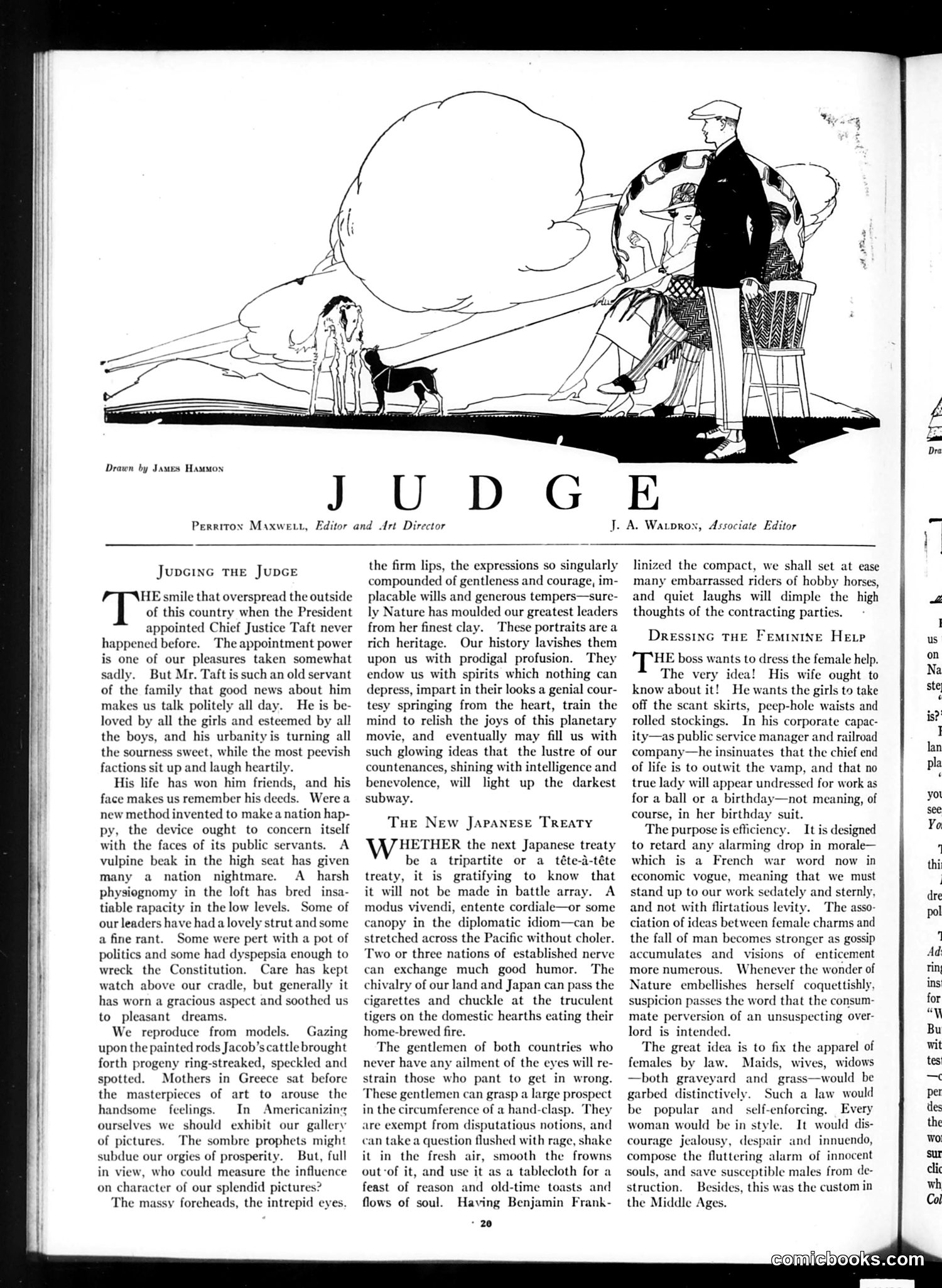
This page contains three distinct pieces from Judge magazine: **"Judging the Judge"** celebrates President Taft's appointment as Chief Justice. The article praises his pleasant appearance and character, arguing that leaders' physical features and demeanor influence national morale and character. **The cartoon at top** (drawn by James Hammon) appears to illustrate this theme, showing well-dressed figures—likely representing Taft and associates—in a formal setting. **"The New Japanese Treaty"** discusses diplomatic negotiations with Japan in optimistic, humorous terms. It suggests that gentlemen of "established nerve" can conduct business with good humor and restraint, avoiding conflict through diplomacy rather than military action. **"Dressing the Feminine Help"** is a brief social satire about a boss wanting to dictate female employees' clothing—his wife objects to this presumption of authority. The overall tone reflects early 20th-century American confidence in leadership, diplomacy, and social order, with satire directed at minor workplace absurdities rather than serious political critique.
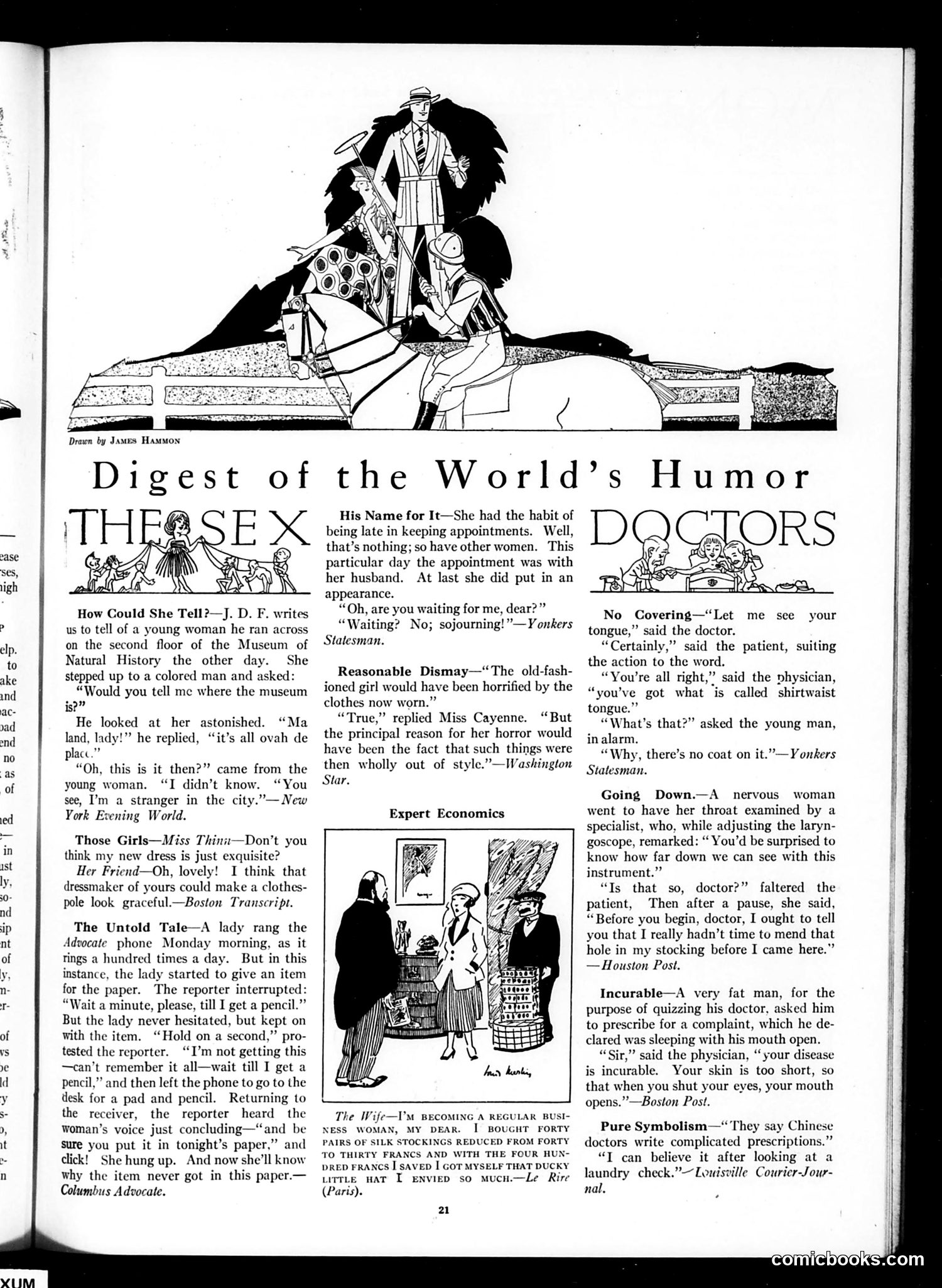
This page from *Judge* magazine presents a collection of brief humorous anecdotes typical of early 20th-century American satire. The top illustration by James Harmon depicts a fashionable woman on horseback, likely representing the "new woman" of the era. The jokes satirize contemporary social attitudes and gender dynamics: - **"How Could She Tell?"** mocks a woman's apparent lack of spatial awareness at a museum - **"Those Girls"** contains backhanded insults about women's fashion choices - **"The Untold Tale"** satirizes newspaper reporters' incompetence - **"His Name for It"** jokes about wives being chronically late - **"Expert Economics"** features a woman proudly explaining her frivolous spending priorities - **"No Covering"** and **"Going Down"** make crude double-entendre jokes about women's bodies and clothing - **"Incurable"** uses physical appearance as the basis for mockery The humor relies on period stereotypes about women's intelligence, vanity, and bodies. Most jokes appear in newspapers' humor columns, indicating this was mainstream entertainment reflecting (and reinforcing) contemporary prejudices about gender roles and class status.
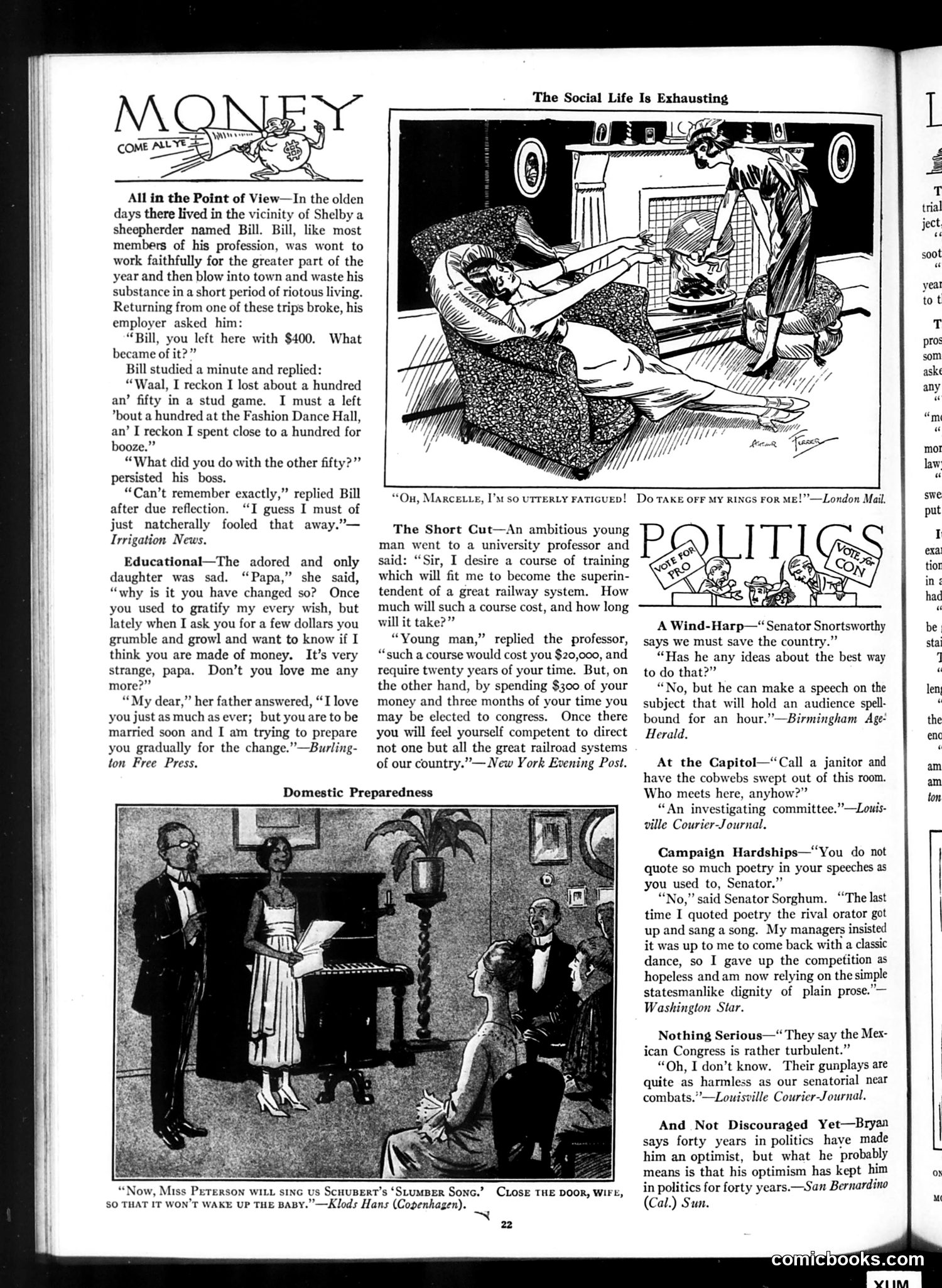
This page contains multiple short humorous anecdotes satirizing American life and politics circa the early 1900s. The top cartoon depicts "The Social Life Is Exhausting"—a woman lounging while demanding her male servant remove her rings, mocking the leisure-class lifestyle and servants' exhaustion from catering to wealthy women's trivial demands. The text pieces satirize: - **"The Short Cut"**: A professor telling a student that three months and $300 spent getting elected to Congress qualifies one to run railroads—mocking Congressional incompetence and the ease of political advancement versus actual professional training. - **Political humor**: Mocking Senator Bryan's 40-year political career as driven by blind optimism rather than accomplishment; deriding senators' tendency toward speech-making rather than solutions; comparing Mexican Congress violence to American Senate "near combats." - **"Domestic Preparedness"**: A couple preparing to have a servant sing loudly to mask a baby's cries—absurd domestic logic. The satire targets wealthy pretension, political incompetence, and Congressional ineffectiveness.
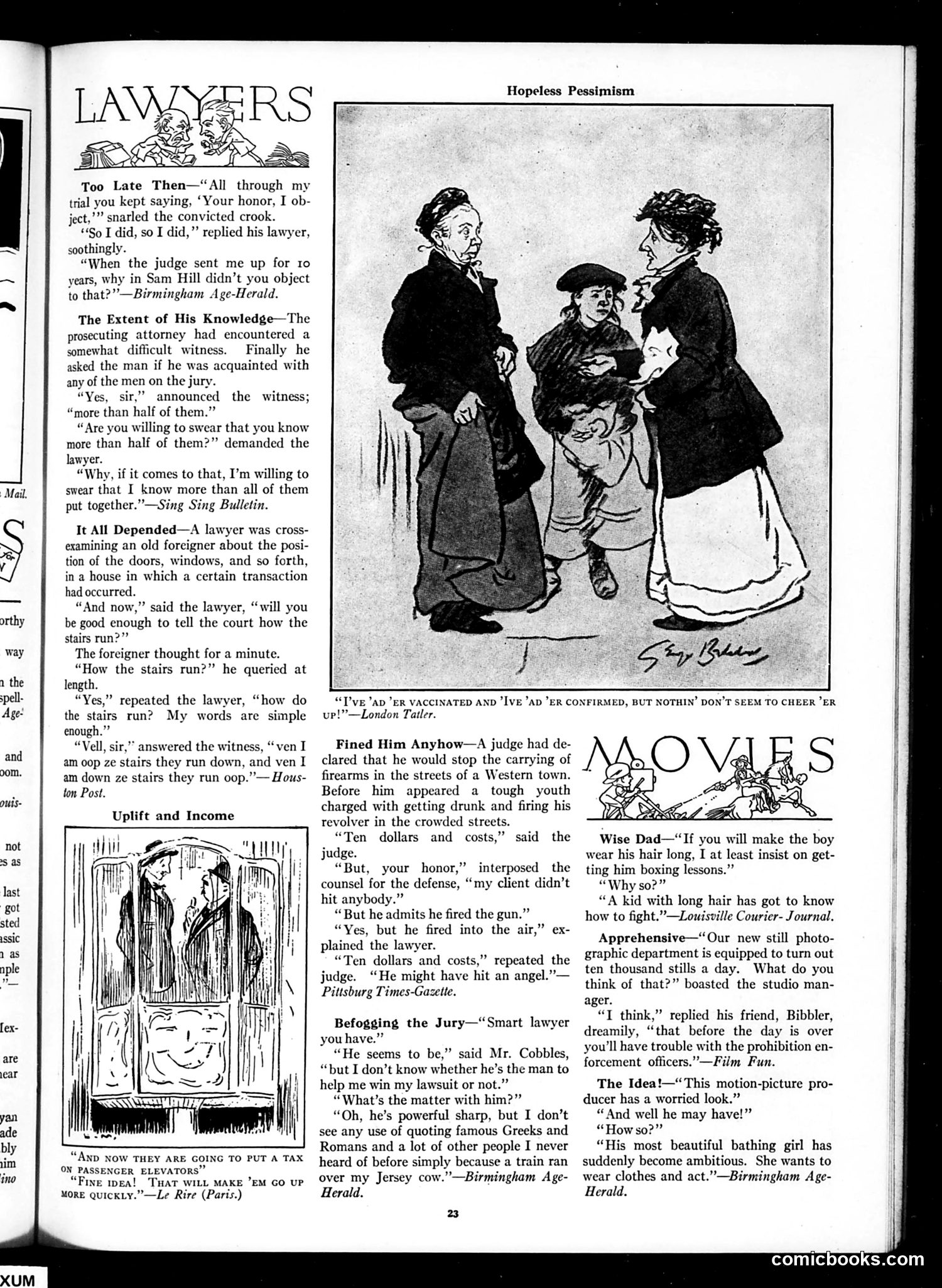
This page from Judge presents several short humorous anecdotes satirizing the legal profession and related social topics. The main cartoons mock lawyers' incompetence and verbosity. One story ridicules a defense attorney who objected constantly during trial yet failed to protect his client from a 10-year sentence. Another mocks a lawyer's pretentious cross-examination of a foreigner about stairs—the witness's literal answer exposes the lawyer's circular questioning. The cartoon "Hopeless Pessimism" depicts a working-class mother whose vaccinated and confirmed daughter remains melancholic—suggesting social problems can't be solved through official measures alone. Other brief jokes satirize judicial absurdity (a judge fining a youth for firing a gun "into the air" rather than hitting someone) and lawyers' tendency to quote classical authorities irrelevantly. A cartoon about elevator taxes pokes fun at economic theory. The bathing-girl joke targets early motion pictures' exploitation of actresses. Overall, the page reflects early 20th-century skepticism toward institutions, professionals, and modernization.
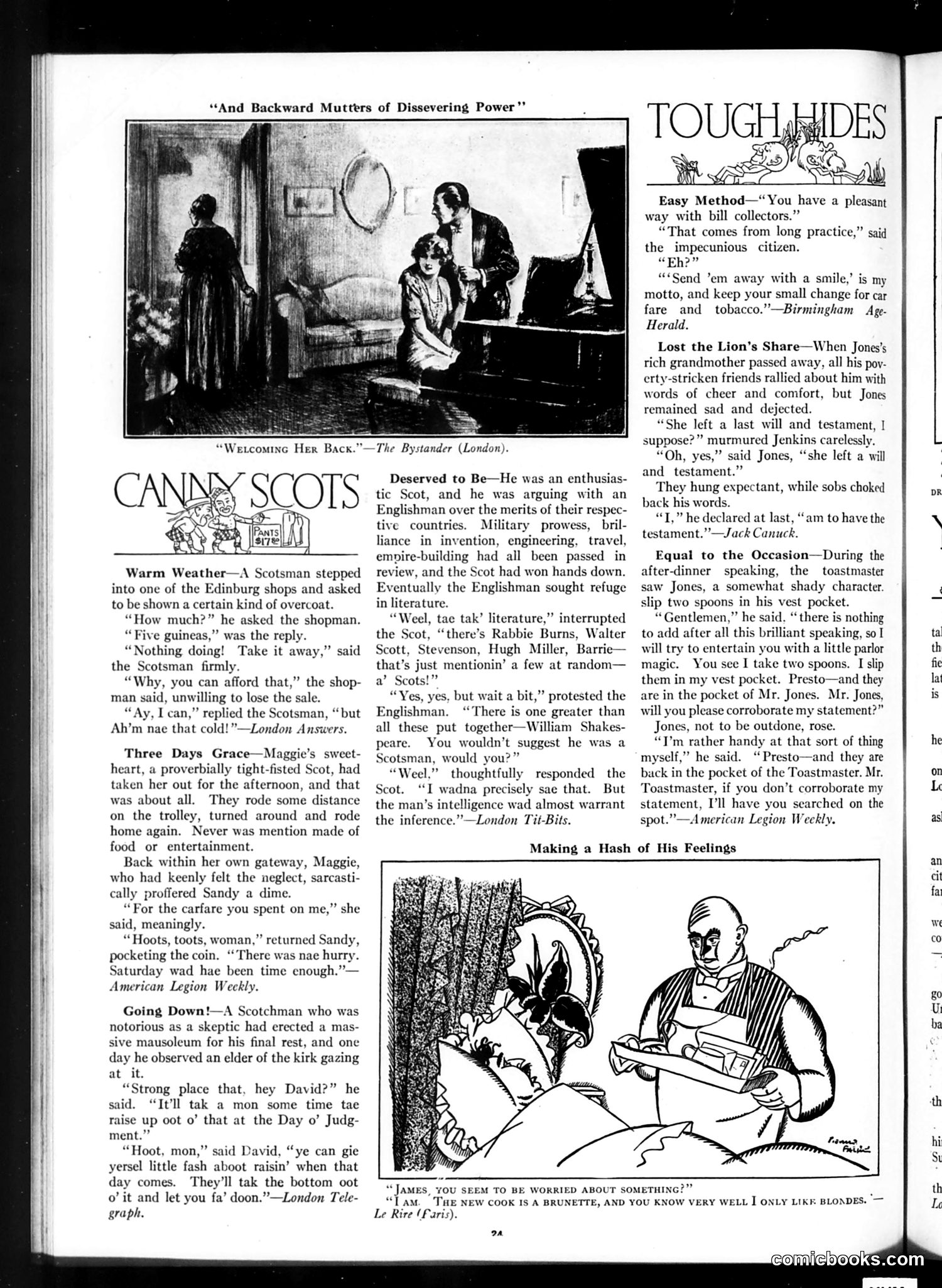
This page from Judge magazine contains several short humorous anecdotes stereotyping Scottish frugality and skepticism—a common theme in early 20th-century Anglo-American humor. **The jokes** mock Scots as cheap (refusing a coat he can afford), ungrateful (the boyfriend Sandy), and irreverent (the skeptic building an elaborate mausoleum). The "Deserved to Be" anecdote has a Scottish character argue that Shakespeare was Scottish based on his intelligence—a humorous reversal of English literary pride. **The bottom cartoon** titled "Making a Hash of His Feelings" shows a man catching another stealing spoons, then turning the theft into a magic trick to avoid embarrassment—satirizing social pretense and quick thinking. **Context**: These pieces reflect period attitudes about national character traits used for comedic effect. The Scottish stereotype emphasizing miserliness and cunning was standard entertainment fare in this era's humor magazines, appealing to contemporary English and American audiences through ethnic stereotyping.
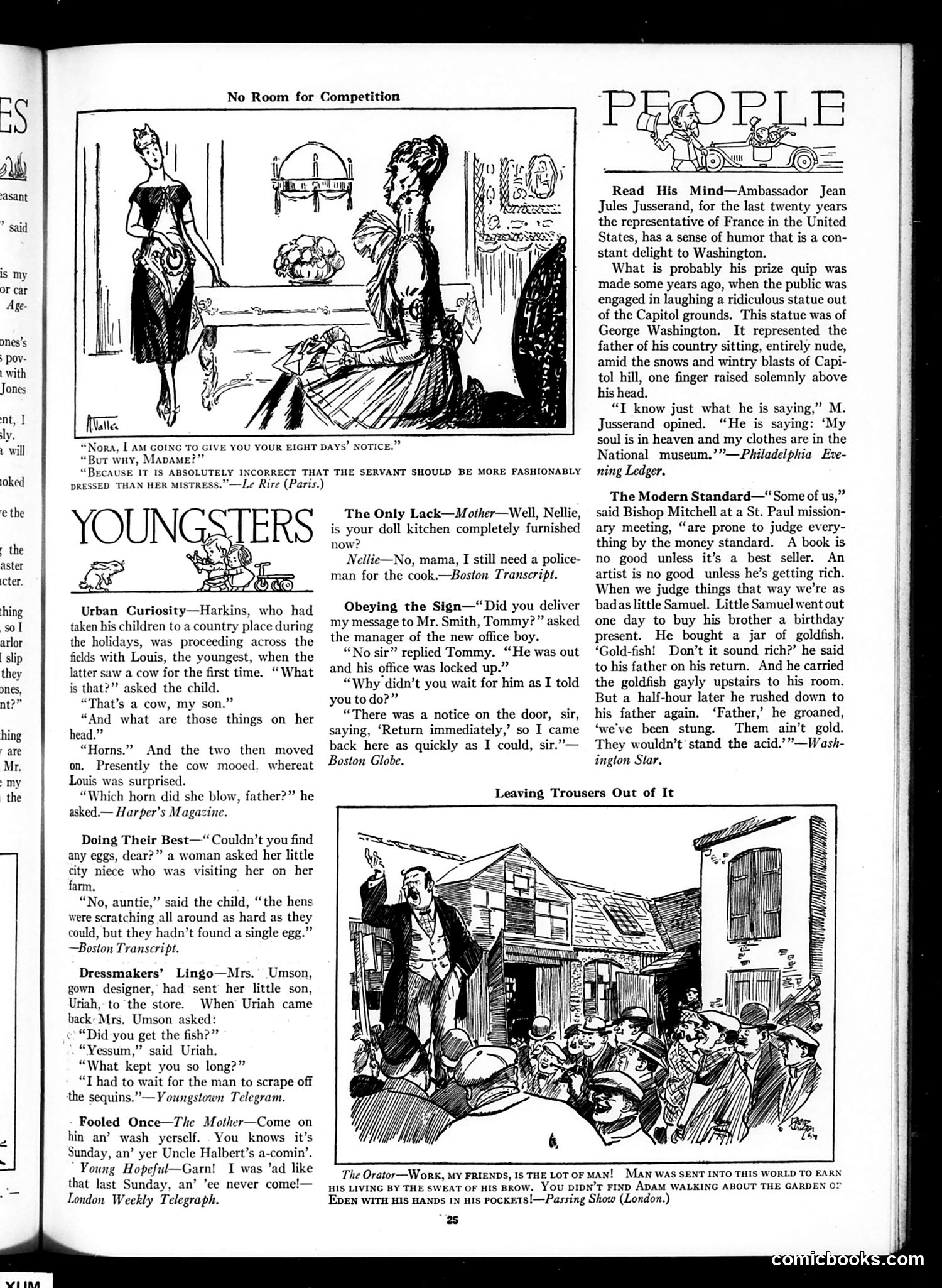
The top cartoon "No Room for Competition" depicts a domestic scene where a fashionably dressed woman dismisses her servant with eight days' notice. The satire targets class tensions and labor dynamics—the caption critiques that "the servant should be more fashionably dressed than her mistress," suggesting anxieties about servants gaining social pretensions or upward mobility that threatened traditional hierarchies. The page primarily contains humorous anecdotes rather than political cartoons. Most are light domestic humor: children's innocent misunderstandings (the cow's horns, dressmakers' terminology), rural confusion, and class-based jokes. The "Read His Mind" section references French Ambassador Jusserand's wit about a controversial nude statue of George Washington in the Capitol—a real public embarrassment the government eventually removed. His quip jokes that Washington's soul is in heaven while his clothes are in a museum. The bottom cartoon "Leaving Trousers Out of It" depicts an orator preaching work ethic by invoking Adam, while the satire notes he contradicts himself—Adam actually *did* have his hands in his pockets (implicitly, idle).
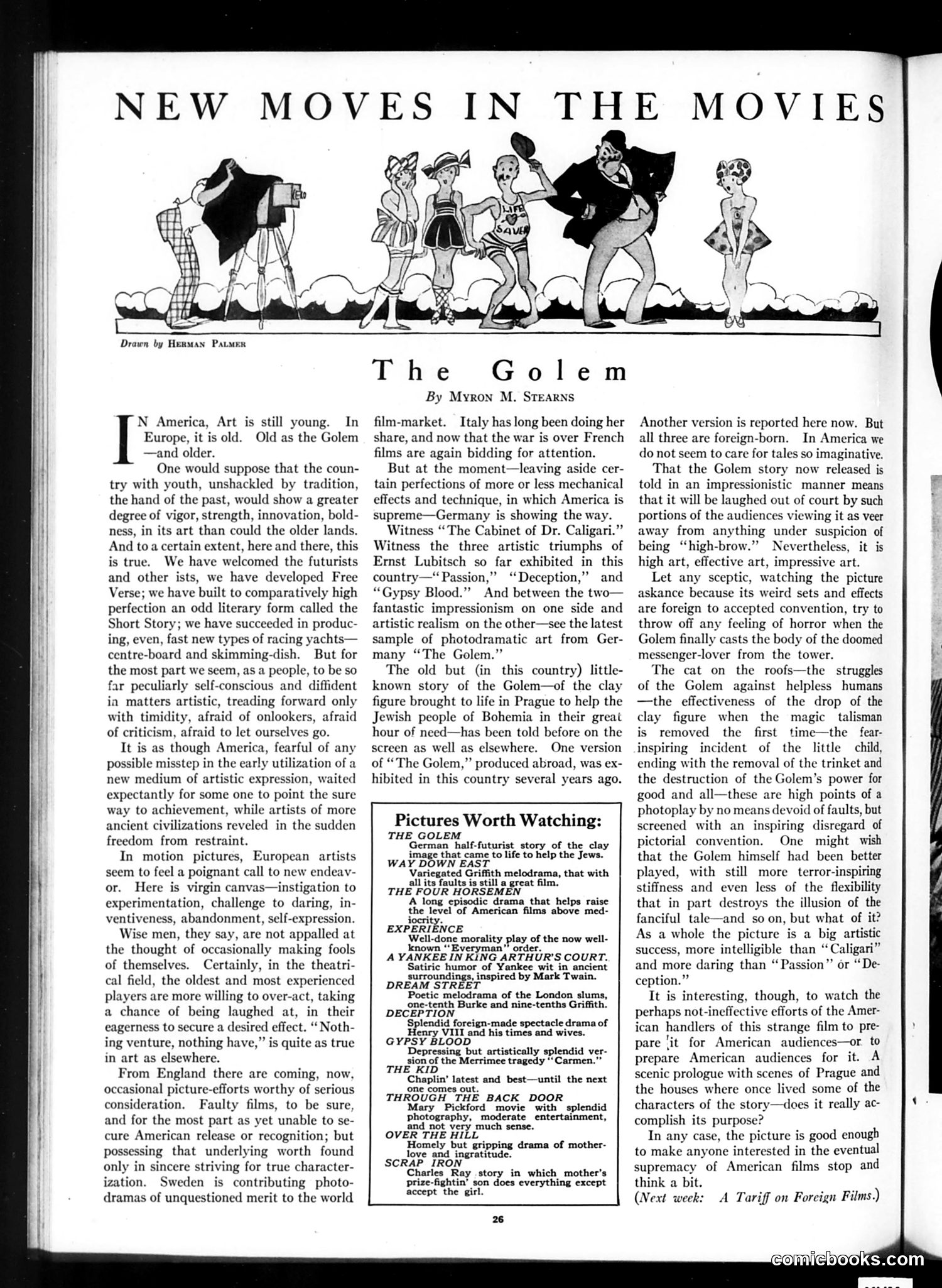
This page analyzes German cinema's artistic superiority over American film. The author argues that America, despite its youth and freedom from tradition, approaches art timidly and awaits European guidance. Germany leads the way, exemplified by "The Cabinet of Dr. Caligari" and Ernst Lubitsch's films, blending "fantastic impressionism" with artistic realism. The featured film, "The Golem," adapts a Jewish legend about a clay figure magically brought to life in Prague to protect persecuted Jews. The accompanying cartoon (drawn by Herman Palmer) satirizes various film genres and artistic movements of the era—showing different character types representing cinema's evolving styles. The article criticizes American filmmakers for lacking boldness and artistic risk-taking compared to their European counterparts, particularly Germans, who embrace experimentation and reject timid convention.
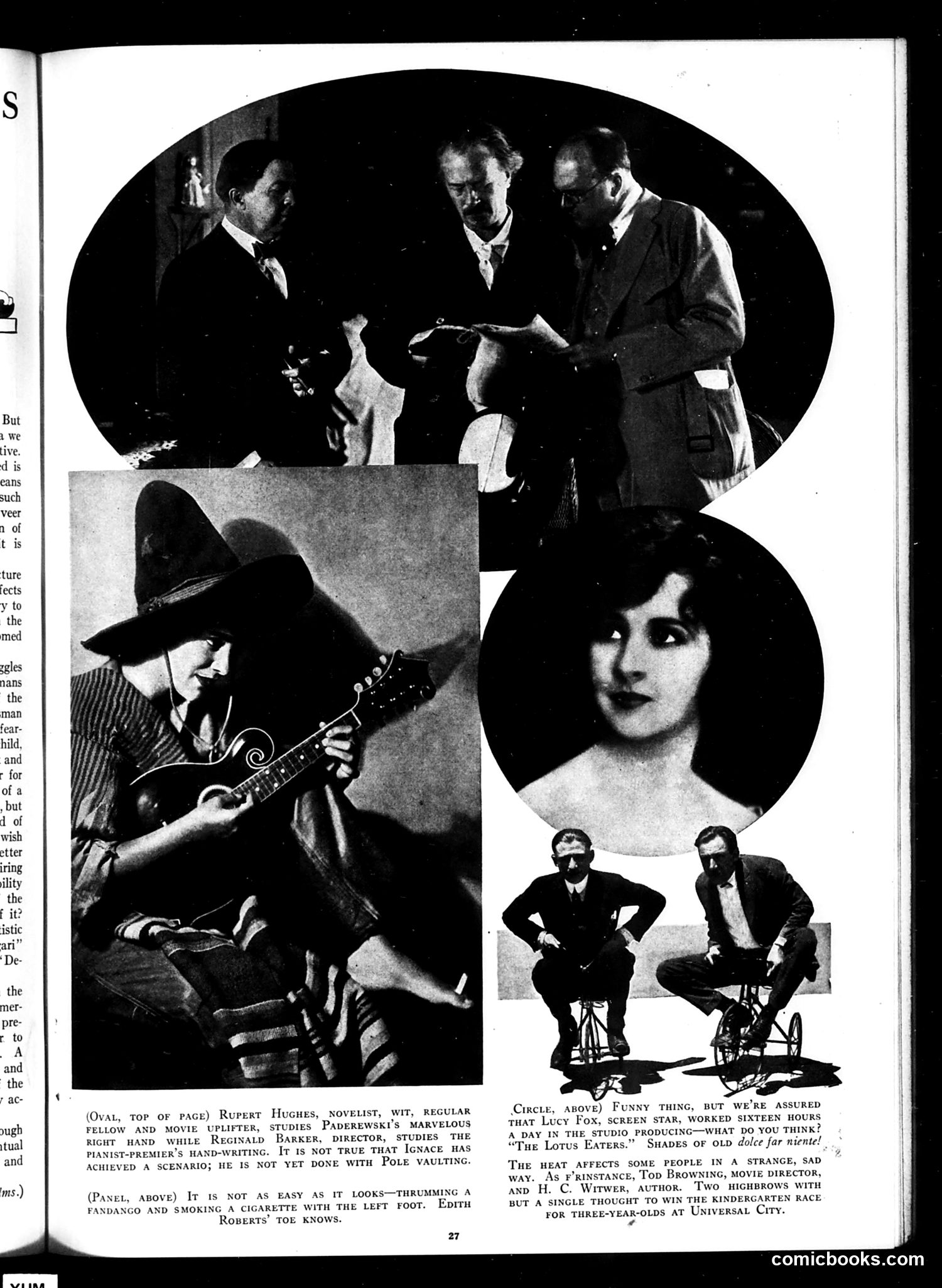
This page satirizes early 1920s Hollywood and literary pretension. The images showcase various entertainment figures: **Top oval**: Rupert Hughes (novelist and film industry figure) is mocked alongside what appears to be industry colleagues, satirizing his involvement in both literature and movies. **Left panel**: A musician playing guitar while smoking—likely ridiculing affected bohemian poses in entertainment. **Right circle**: Lucy Fox, identified as a "screen star," with accompanying figures below her. **The satire's point**: The page mocks the absurd pretentiousness of Hollywood producers, directors, and actors who affect intellectual or artistic sophistication while actually engaged in lowbrow entertainment. References to "The Lotus Eaters" and "dolce far niente" (sweet idleness) suggest these figures pose as cultured while doing trivial work. The humor targets the gap between Hollywood's self-importance and its actual artistic merit—a recurring Judge magazine theme criticizing entertainment industry vanity.
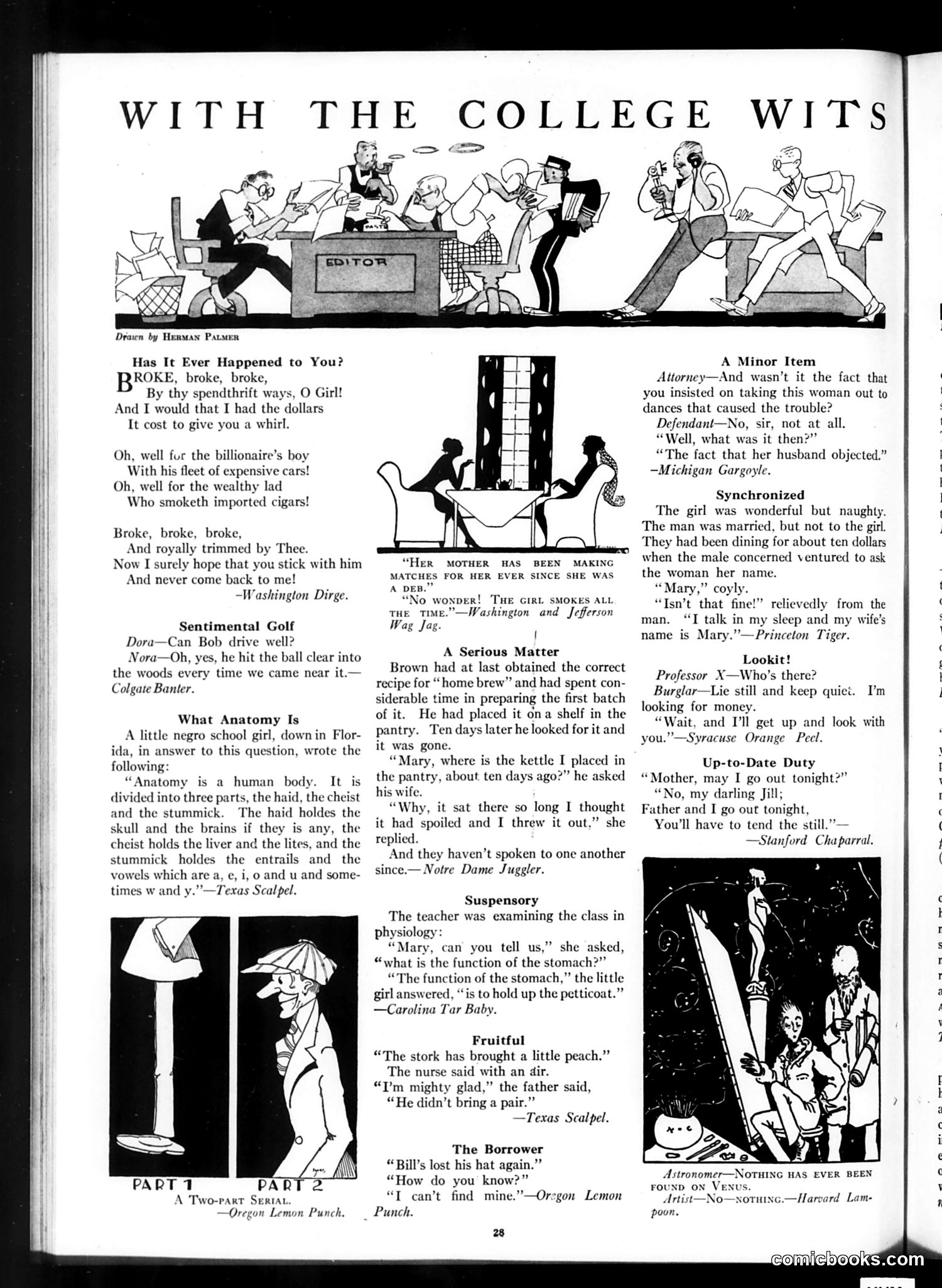
This page from Judge magazine collects humorous short pieces attributed to college humor publications. The content reflects early 20th-century college life and social attitudes. Key themes include: **Economic anxiety**: "Has It Ever Happened to You?" mocks young men spending lavishly on dates, resulting in poverty—a recurring concern during this era. **Gender relations**: Multiple pieces satirize dating, marriage mismatches, and domestic friction (e.g., the wife discarding her husband's homebrewed alcohol). **Prohibition era humor**: "Up-to-Date Duty" jokes about children tending illegal stills while parents go out—reflecting 1920s Prohibition. **Racial caricature**: "What Anatomy Is" presents dialect humor from a Black schoolgirl's misspelled anatomy lesson, reflecting the casual racism endemic to the period. **Innocent absurdism**: Other pieces (the borrower's circular logic, the astronomer joke) are simply wordplay. The drawings are minimal—simple line art by Herman Palmer. This is primarily a text-based humor page typical of Judge's collegiate satire section.
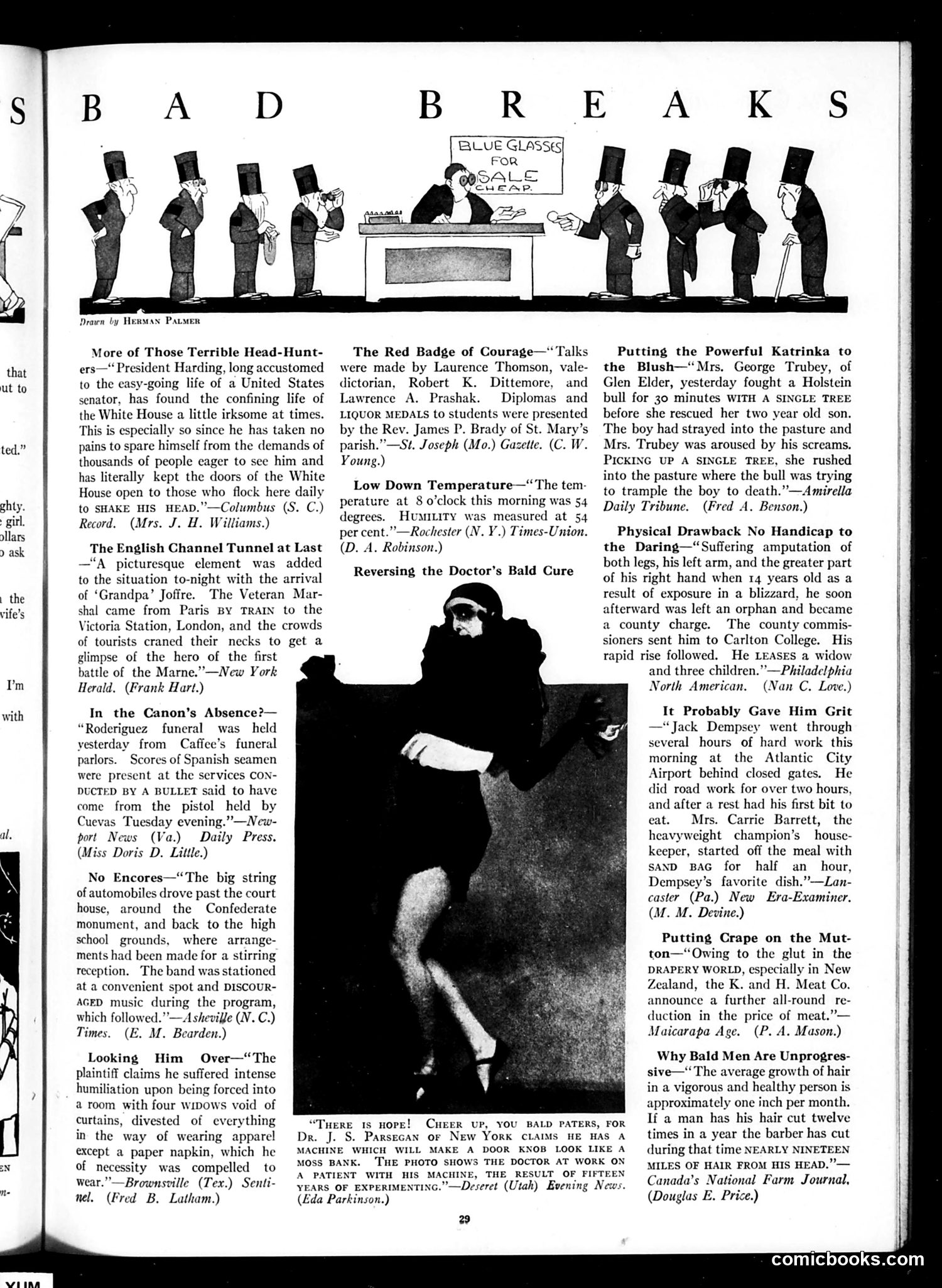
This page consists primarily of humorous "breaks"—newspaper clippings with satirical commentary—a regular Judge feature mocking unintentional comedy in journalism. **Top cartoon**: Shows figures in top hats at a sales counter labeled "Blue Glasses for Sale." The accompanying text mocks President Harding for keeping White House doors open to endless visitors who want to "shake his head"—satirizing both his accessibility and suggesting mental fatigue from constant social demands. **Large middle cartoon**: Titled "Reversing the Doctor's Bald Cure," it depicts a doctor's hair-growth machine that ironically produces the opposite effect. The caption jokes that after "fifteen years of experimenting," the device makes hair loss worse—a jab at pseudoscientific medical quackery popular in the era. The remaining items are newspaper excerpt jokes highlighting absurdities: a funeral "conducted by a bullet," a man forced to sit nude except for a napkin, and a woman fighting a bull with a wooden implement to save her son. The humor relies on readers recognizing the newspaper sources' unintentional comedy through literal or exaggerated reading.
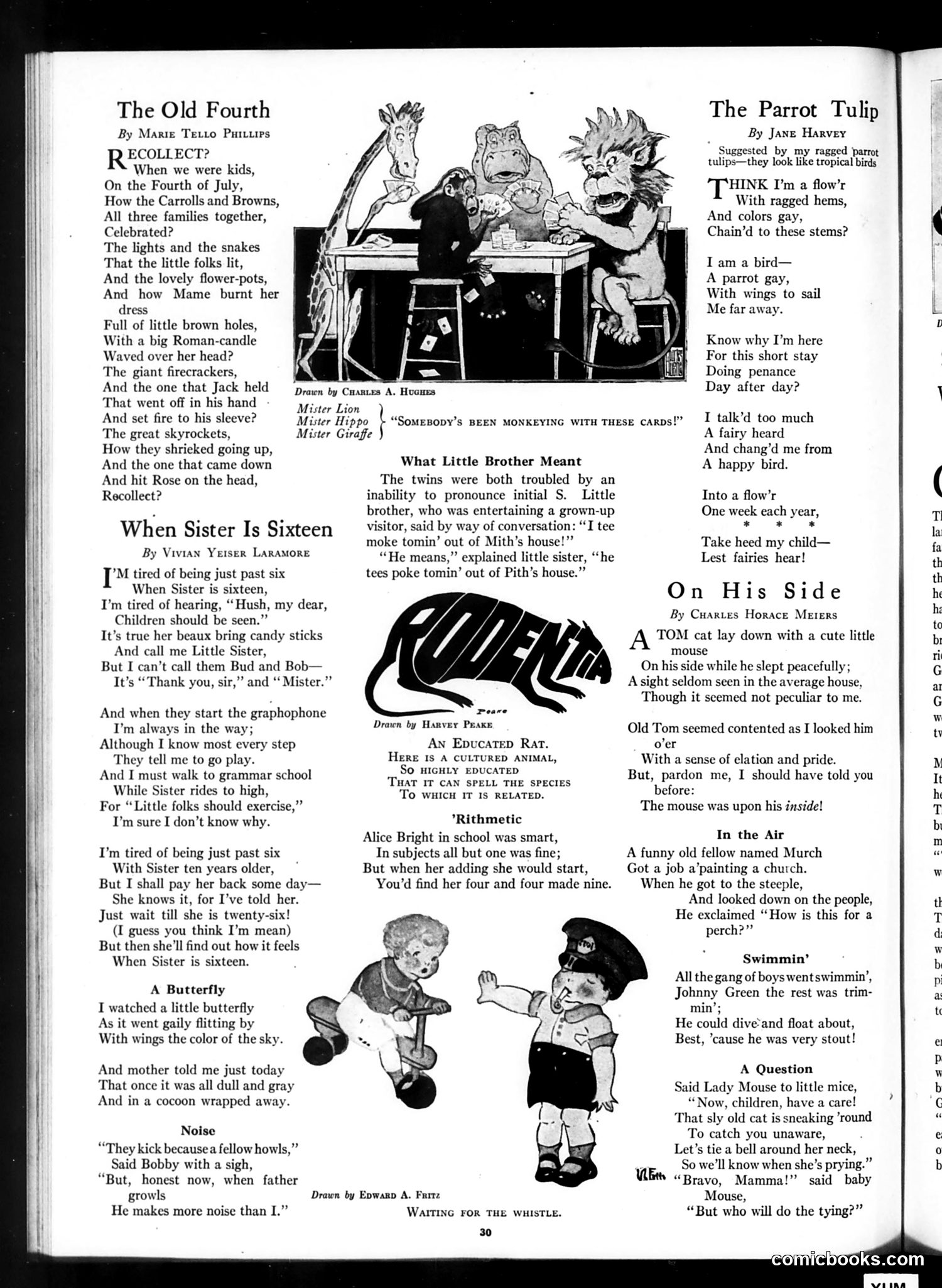
This page from *Judge* contains several humorous pieces typical of early 20th-century American children's and family humor: **"The Old Fourth"** nostalgically recalls Fourth of July celebrations with fireworks mishaps—children burned by Roman candles, firecrackers exploding in hands. It's sentimental nostalgia for dangerous holiday traditions. **"When Sister Is Sixteen"** depicts a younger sibling's frustration at being relegated to "Little Sister" status while an older sister receives male attention and privileges. The humor lies in the narrator's vow of future revenge. **The cartoon "Somebody's Been Monkeying with These Cards"** shows anthropomorphic animals (lion, hippo, giraffe) at a card table—likely satirizing either cheating at cards or anthropomorphic animal characters popular in children's media. **Remaining pieces** include light verse about butterflies, arithmetic errors, an "educated rat," and whimsical scenarios (a painter on a church steeple, boys swimming). Overall, this is family-oriented humor emphasizing childhood experiences, sibling dynamics, and gentle absurdism—typical *Judge* content for general audiences rather than hard political satire.
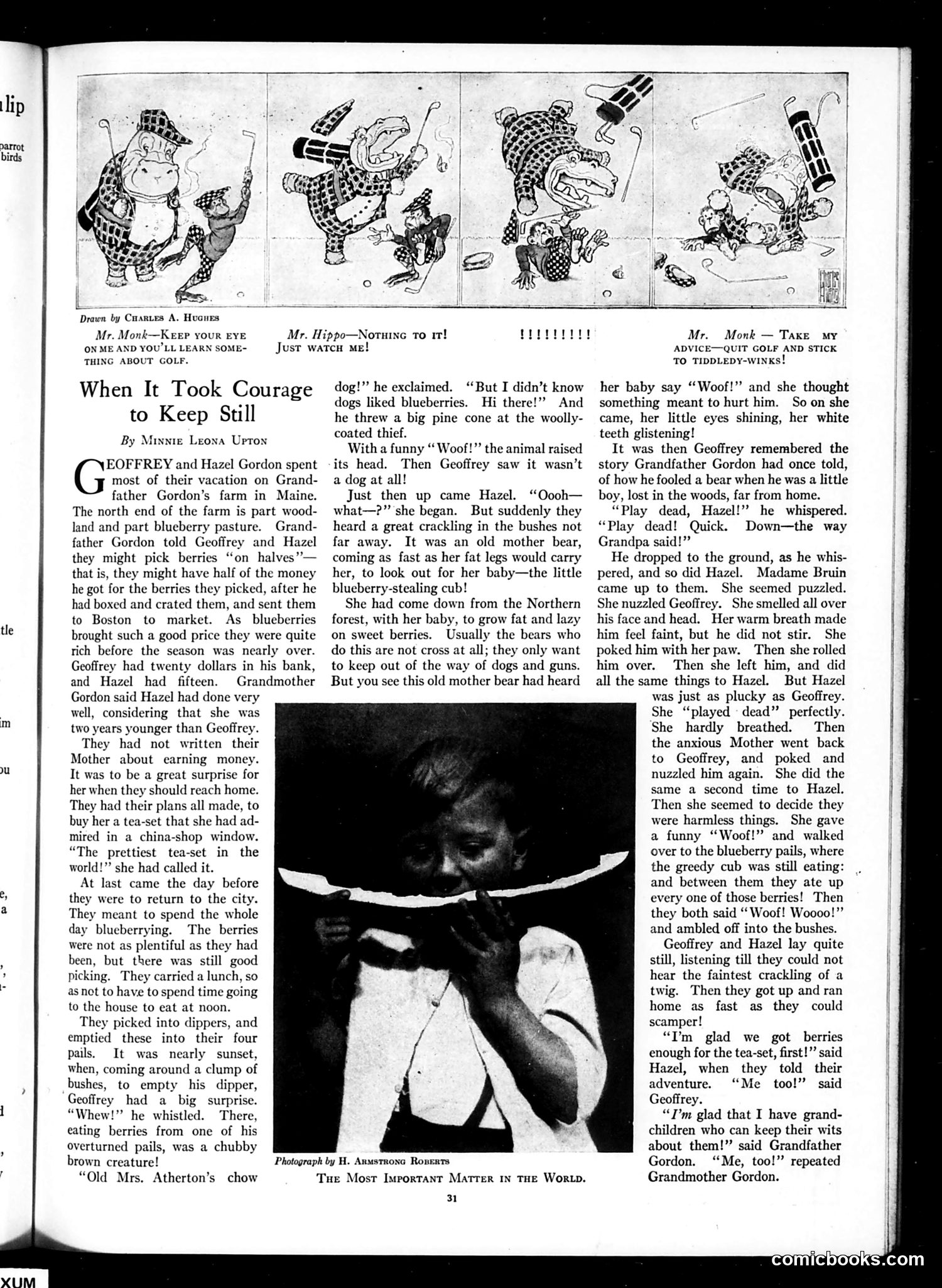
This page contains two distinct elements: **The Cartoon Strip (top):** Charles A. Hughes drew four panels featuring "Mr. Monk" and "Mr. Hippo" as anthropomorphic characters giving golf advice. The captions suggest slapstick humor about golf etiquette—likely satirizing pretentious golfers or absurd instructional claims common in early 20th-century sporting culture. The specific satire is unclear without additional context about who these characters represented. **The Story (main text):** "When It Took Courage to Keep Still" is a children's adventure narrative about two siblings who encounter a mother bear while blueberry picking on their grandfather's Maine farm. The children survive by "playing dead"—a strategy their grandfather had taught them. The story emphasizes courage through restraint and obedience to elders' wisdom. The accompanying photograph shows what appears to be a bear cub, supporting the narrative's authenticity. The juxtaposition suggests Judge mixed humor for adults (the golf cartoons) with wholesome content for family readers (the adventure story).
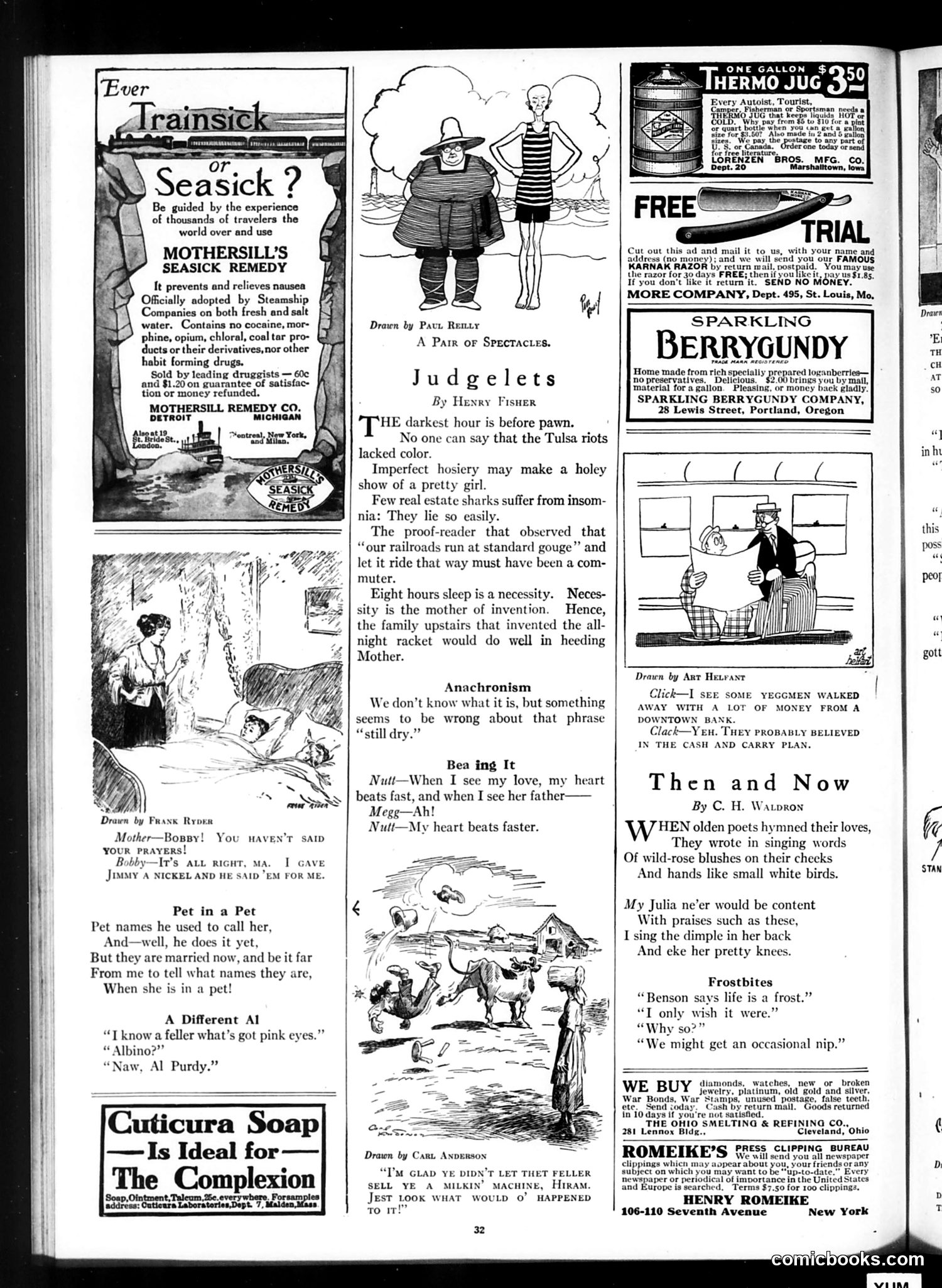
This page from the satirical magazine **Judge** is primarily a collection of **short jokes, humorous sketches, and advertisements** rather than focused political cartoons. **Key content:** The **"Judgelets" section** by Henry Fisher contains brief topical jokes, including a reference to the **Tulsa riots** (likely the 1921 race massacre), which Fisher mocks for having "color"—a grim pun treating a violent tragedy as material for wordplay. Other jokes target common subjects: bad landlords, insomniacs, railroad inefficiency, and dishonest real estate agents. **Visual cartoons** include domestic humor (a child paying another to say prayers), courtship comedy, and rural satire—all typical of Judge's lighthearted approach. **The advertisements** (Mothersill's seasick remedy, Cuticura soap, razor trials) reflect early 20th-century marketing to middle-class readers. The page demonstrates Judge's formula: mixing gentle domestic humor with brief topical commentary and commercial promotion—accessible entertainment rather than sharp political satire.
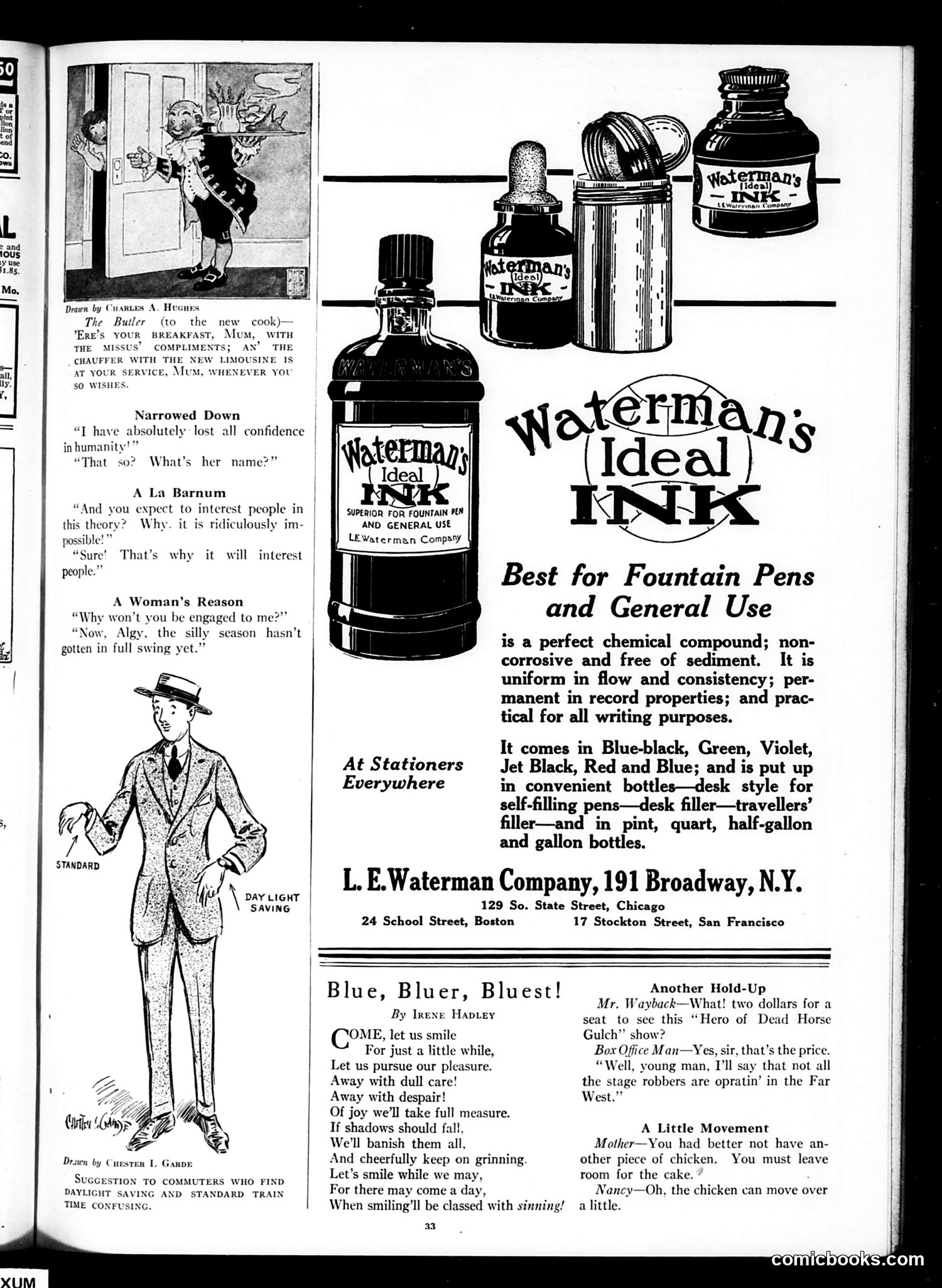
This page from *Judge* magazine contains several short humor pieces and advertisements: **The cartoons** satirize everyday social situations. "Narrowed Down" jokes about a man losing faith in humanity over an unnamed woman—the humor is that "her name" is the punchline, implying a specific woman caused his misanthropy. "A Woman's Reason" plays on the phrase "silly season" (a journalism term for slow news periods), with a woman delaying her engagement until summer social season begins. A bottom cartoon appears to mock commuters confused by daylight saving time versus standard time. **The remaining content** is mostly advertising for Waterman's Ideal Ink and humorous verse titled "Blue, Bluer, Bluest!" The short jokes labeled "Another Hold-Up" and "A Little Movement" are typical *Judge* humor—one complains about theater ticket prices as highway robbery; the other is a children's joke about a girl wanting more chicken. The page reflects *Judge's* satirical focus on middle-class social conventions and everyday annoyances rather than hard political commentary.
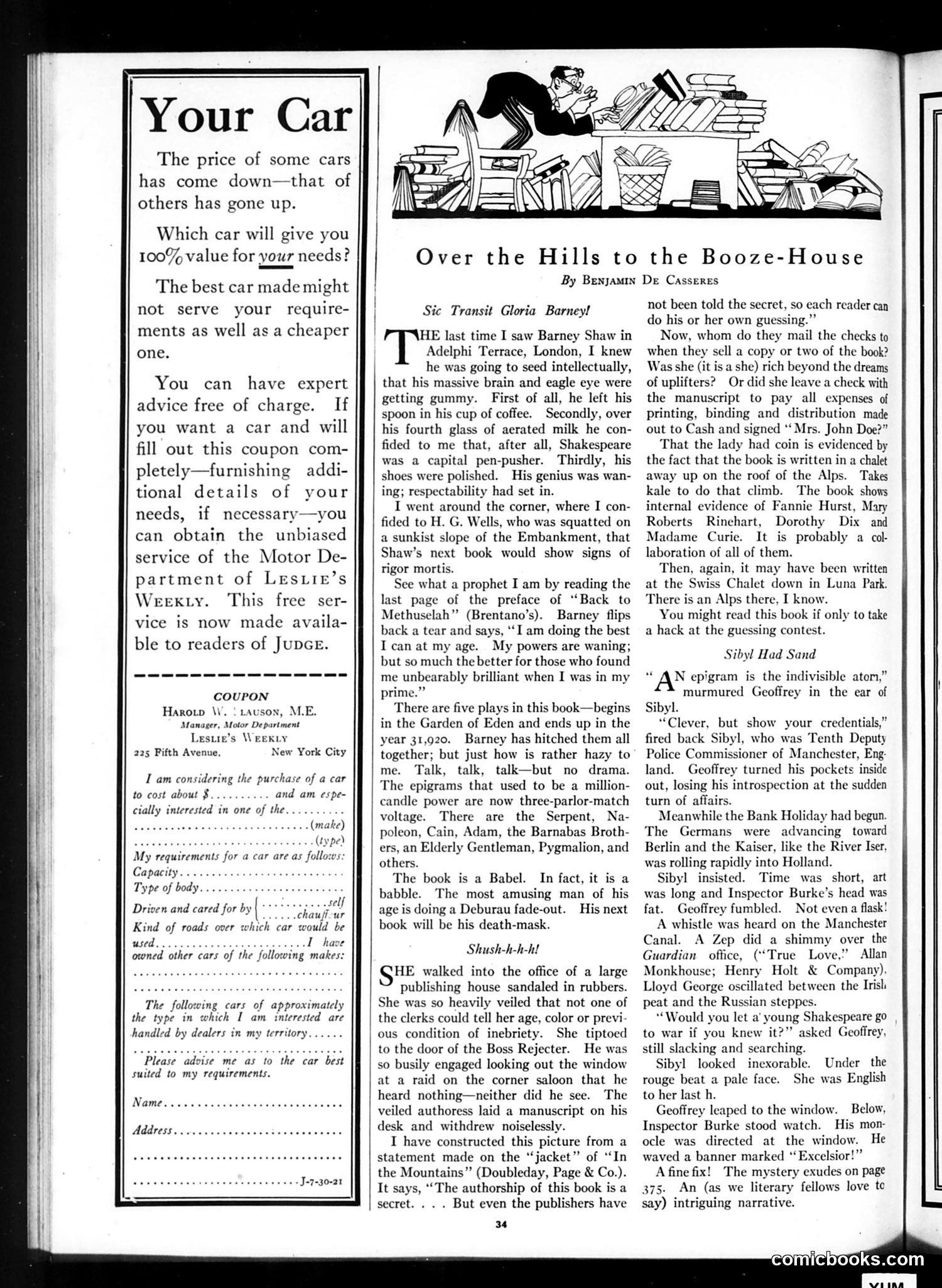
This page combines **automobile advertising** with **literary satire**. The left side is a car-buying advice coupon from Leslie's Weekly, offering free expert consultation to help readers select vehicles suited to their needs—reflecting 1920s consumer guidance. The right side contains two book reviews by Benjamin De Casseres: 1. **"Sic Transit Gloria Barney!"** mocks George Bernard Shaw's declining powers. De Casseres suggests Shaw is intellectually "seeding" (aging badly), evidenced by slovenly behavior and the new play collection *Back to Methuselah*. He criticizes Shaw's once-brilliant epigrams as now mere "three-parlor-match voltage"—dim compared to their former brilliance. The review treats Shaw's creative decline as inevitable aging. 2. **"Shush-h-h-h!"** reviews a mystery novel, *In the Mountains*, whose authorship is deliberately secret. De Casseres humorously questions the practical problem: how do publishers mail royalty checks to an anonymous author? Both reviews exemplify Judge magazine's satirical tone—irreverent commentary on contemporary cultural figures and publishing absurdities.
This is not a cartoon but an **advertorial essay** — propaganda disguised as editorial content. It uses the old English play "Gammer Gurton's Needle" (about losing a family sewing needle as tragedy) as a metaphor for modern life's "losses" without advertising. The piece argues that advertising deserves credit for making luxuries into necessities and improving daily life over the past fifty years. The final line — "And you miss much when you fail to read it!" — is the actual pitch: readers should pay attention to advertisements because they inform consumers about available products. This reflects **early 20th-century pro-business sentiment** in Judge magazine, using humor and classical references to convince readers that advertising isn't manipulation but rather a beneficial cultural force. It's essentially defending the advertising industry's expanding influence on American consumer culture.
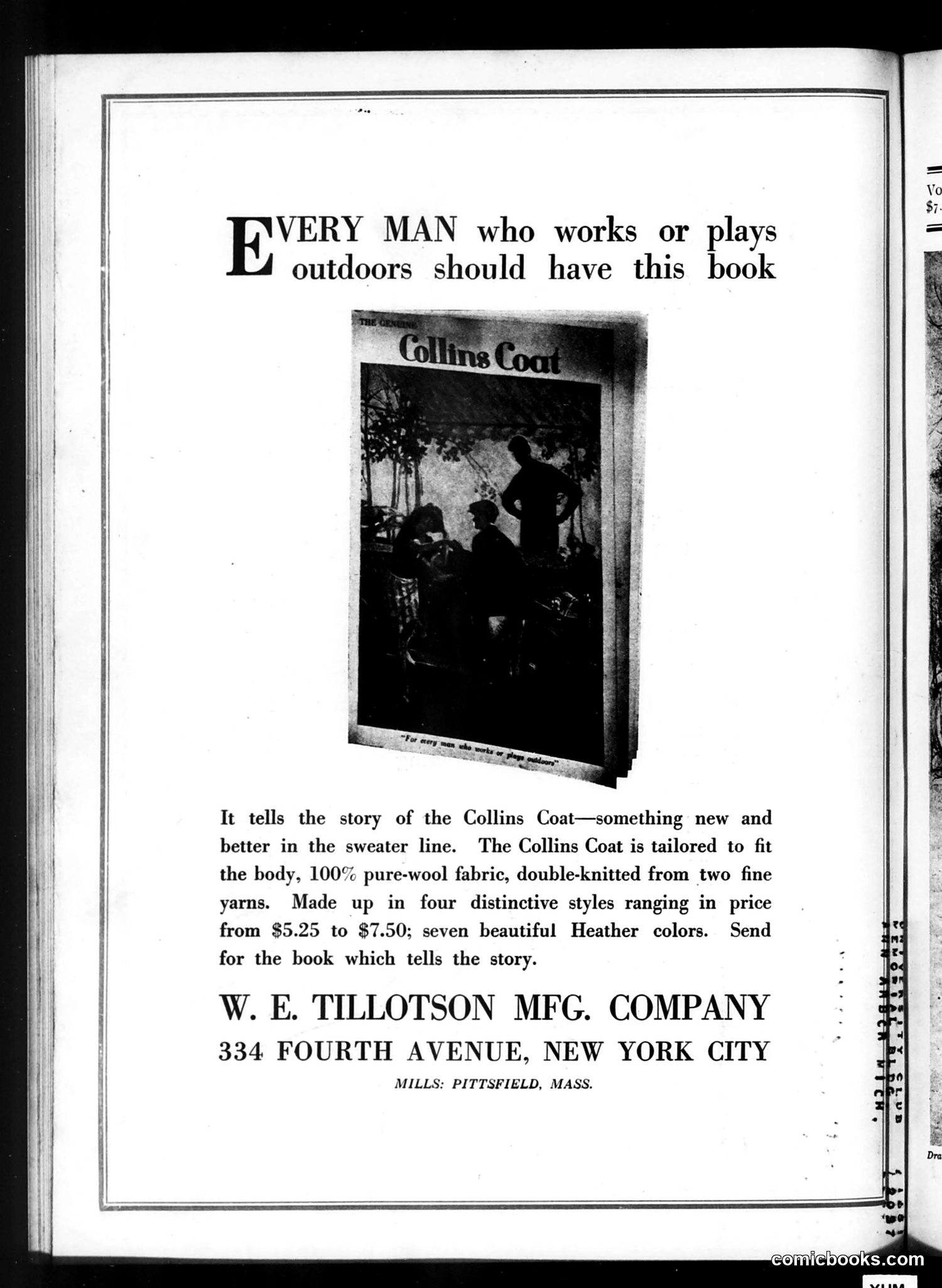
This is **not a political cartoon or satire**—it's a straightforward **advertisement** for the Collins Coat, a wool sweater product manufactured by W. E. Tillotson MFG. Company. The page features a product photo of the coat and marketing copy targeting outdoor workers and recreationalists. The ad emphasizes practical selling points: pure-wool construction, four styles, seven color options, and an affordable price range ($5.25–$7.50). The company invites interested customers to request a promotional booklet. Judge magazine, though primarily known for satirical content, regularly included advertisements. This represents standard commercial messaging from the era, not editorial commentary or humor.