
Judge, 1921-07-30 · page 6 of 36
Judge — July 30, 1921 — page 6: what you’re looking at
What you’re looking at
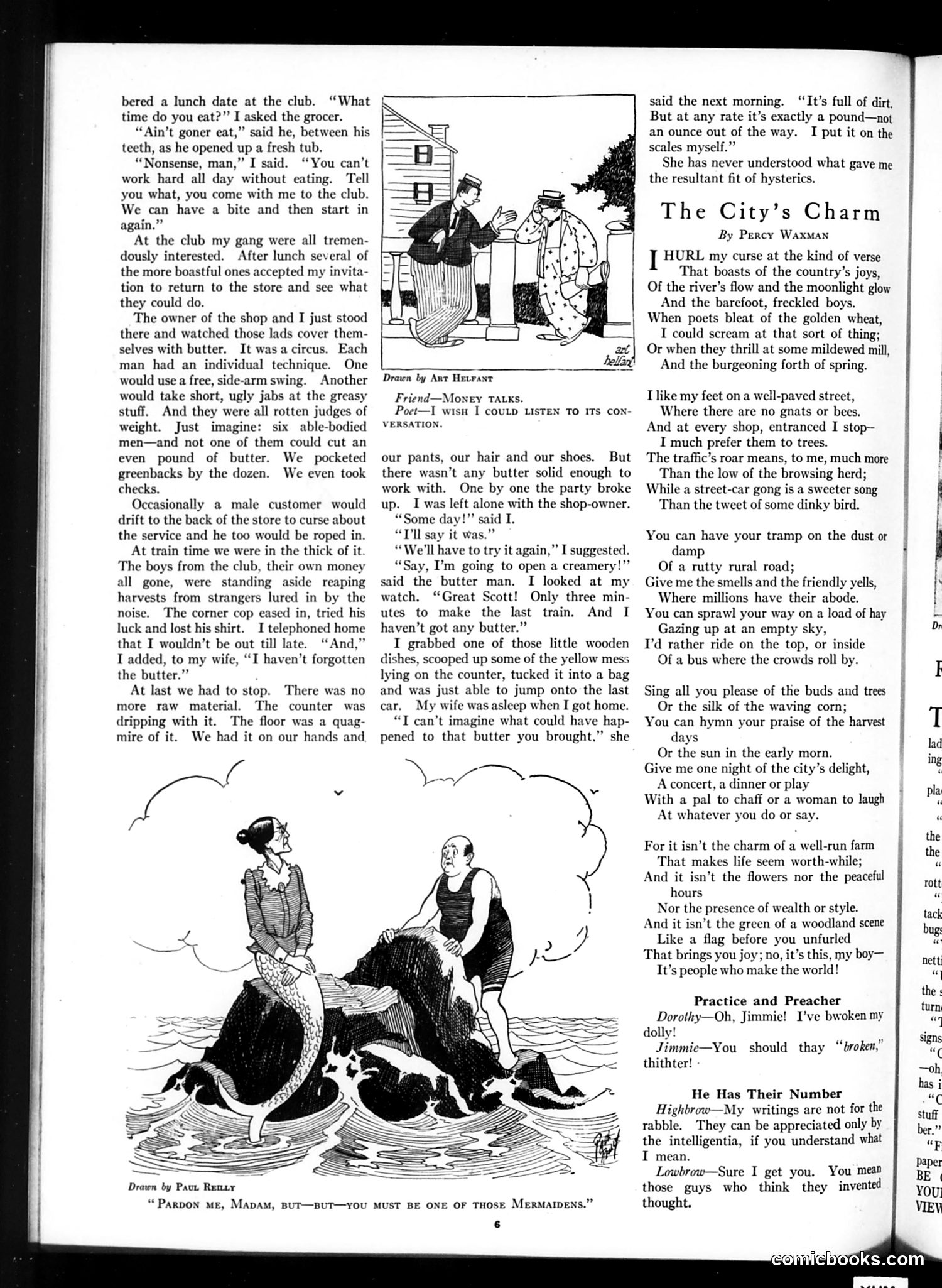
This page contains two distinct pieces: **Top cartoon** (by Art Helfant, titled "Friend—Money Talks"): Shows well-dressed men discussing butter rationing or scarcity, likely referencing post-WWI food shortages or price controls. The humor centers on the absurdity of wealthy men unable to obtain basic groceries despite their means—satirizing how economic restrictions affected even the privileged. **Bottom cartoon** (by Paul Reilly): Two people on a beach with sea creatures. The caption "Pardon me, Madam, but—but—you must be one of those Mermaids" appears to be a pickup-line joke, playing on the woman's appearance or the absurdity of the situation. The right column contains poetry and short humor pieces unrelated to the cartoons. The satire reflects early 20th-century concerns about food scarcity and class divisions.
📄 Transcribed text from this page (OCR, searchable)
Machine-transcribed from the original scan — historical spelling and the odd misread are preserved.
bered a lunch date at the club. “What time do you eat?” I asked the grocer. “Ain’t goner eat,” said he, between his teeth, as he opened up a fresh tub. “Nonsense, man,” I said. ‘You can’t work hard all day without eating. Tell you what, you come with me to the club. We can have a bite and then start in again.” At the club my gang were all tremen- dously interested. After lunch several of the more boastful ones accepted my invita- tion to return to the store and see what they could do. The owner of the shop and I just stood there and watched those lads cover them- selves with butter. It was a circus. Each man had an individual technique. One would use a free, side-arm swing. Another would take short, ugly jabs at the greasy stuff. And they were all rotten judges of weight. Just imagine: six able-bodied men—and not one of them could cut an even pound of butter. We pocketed greenbacks by the dozen. We even took checks. Occasionally a male customer would drift to the back of the store to curse about the service and he too would be roped in. At train time we were in the thick of it The boys from the club, their own money all gone, were standing aside reaping harvests from strangers lured in by the noise. The corner cop eased in, tried his luck and lost his shirt. I telephoned home that I wouldn’t be out till late. “And,” I added, to my wife, “I haven’t forgotten the butter.” At last we had to stop. There was no more raw material. The counter was dripping with it. The floor was a quag- mire of it. We had it on our hands and Drawn by Pact Reniy “Parpon ME, MapAM, BUT—BUT—YOU MUST BE ONE OF THOSE MERMAIDENS.” Drawn by Ant Hevrant Friend—Money TALKs. Poet—I wisn I couLD LISTEN TO ITS CON- VERSATION. our pants, our hair and our shoes. But there wasn’t any butter solid enough to work with. One by one the party broke up. I was left alone with the shop-owner. “Some day!” said I. “T'll say it was.” “We'll have to try it again,” I suggested. “Say, I’m going to open a creamery!” said the butter man. I looked at my watch. “Great Scott! Only three min- utes to make the last train. And I haven’t got any butter.” I grabbed one of those little wooden dishes, scooped up some of the yellow mess lying on the counter, tucked it into a bag and was just able to jump onto the last car. My wife was asleep when I got home. “T can’t imagine what could have hap- pened to that butter you brought,” she Saag 6 said the next morning. “It’s full of dirt, But at any rate it’s exactly a pound—not an ounce out of the way. I put it on the scales myself.” She has never understood what gave me the resultant fit of hysterics. The City’s Charm By Percy Waxman HURL my curse at the kind of verse That boasts of the country’s joys, Of the river’s flow and the moonlight glow And the barefoot, freckled boys. When poets bleat of the golden wheat, I could scream at that sort of thing; Or when they thrill at some mildewed mill, And the burgeoning forth of spring. I like my feet on a well-paved street, Where there are no gnats or bees. And at every shop, entranced I stop— I much prefer them to trees. The traffic’s roar means, to me, much more Than the low of the browsing herd; While a street-car gong is a sweeter song Than the tweet of some dinky bird. You can have your tramp on the dust or damp j Of a rutty rural road; Give me the smells and the friendly yells, Where millions have their abode. You can sprawl your way on a load of hay Gazing up at an empty sk I'd rather ride on the top, or inside Of a bus where the crowds roll by. Sing all you please of the buds aud trees Or the silk of the waving corn; You can hymn your praise of the harvest days Or the sun in the early morn. Give me one night of the city’s delight, A concert, a dinner or play With a pal to chaff or a woman to laugh At whatever you do or say. For it isn’t the charm of a well-run farm That makes life seem worth-while; And it isn’t the flowers nor the peaceful hours Nor the presence of wealth or style. And it isn’t the green of a woodland scene Like a flag before you unfurled That brings you joy; no, it’s this, my boy— It’s people who make the world! Practice and Preacher Dorothy—Oh, Jimmie! I’ve bwoken my dolly! , Jimmie—You should thay “broken, thithter! He Has Their Number Highbrow—My writings are not for the rabble. They can be appreciated only by the intelligentia, if you understand what I mean. Lowbrow—Sure I get you. You mead those guys who think they invented thought. — Dr