
Judge, 1921-07-30 · page 26 of 36
Judge — July 30, 1921 — page 26: what you’re looking at
What you’re looking at
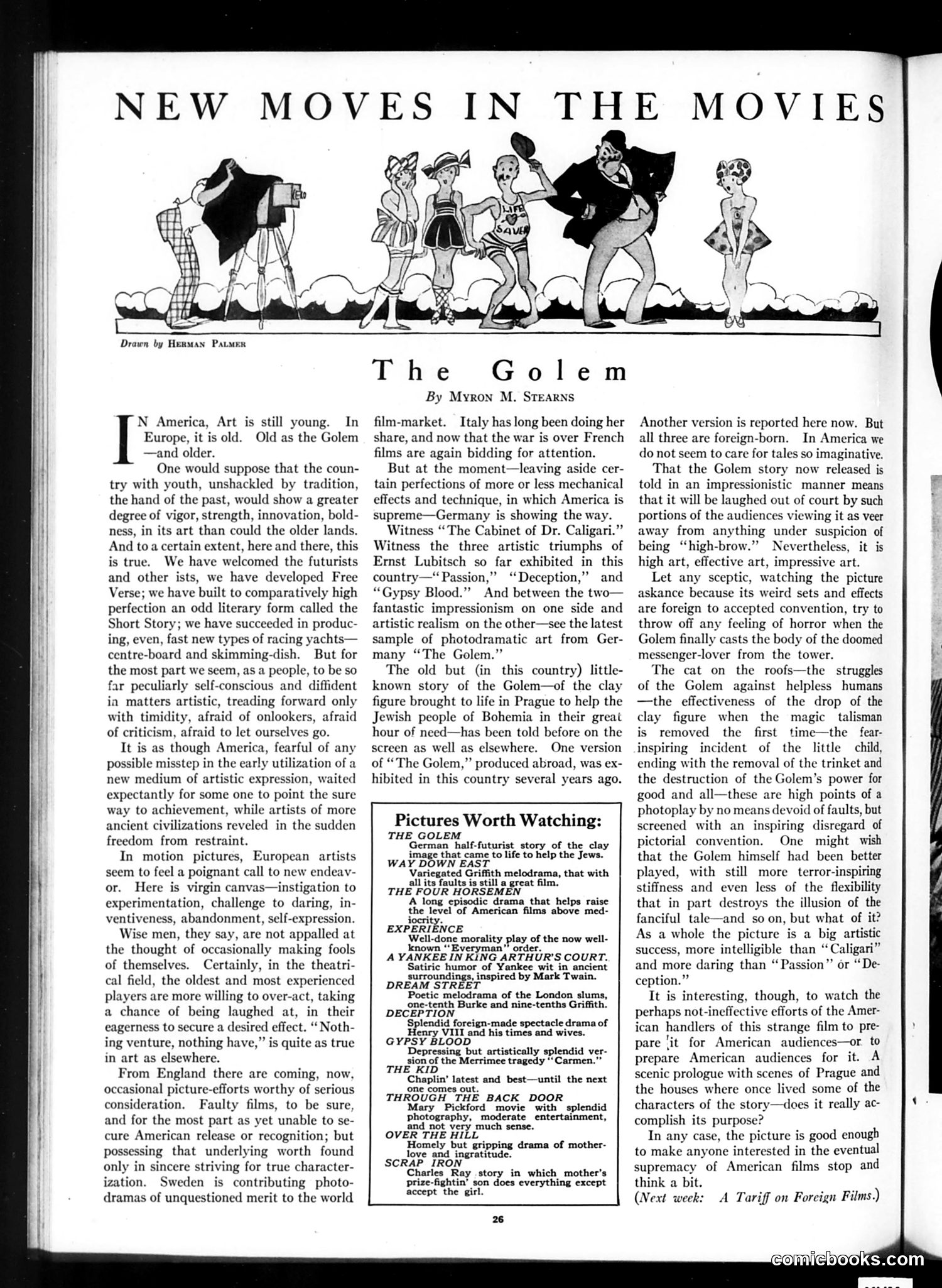
This page analyzes German cinema's artistic superiority over American film. The author argues that America, despite its youth and freedom from tradition, approaches art timidly and awaits European guidance. Germany leads the way, exemplified by "The Cabinet of Dr. Caligari" and Ernst Lubitsch's films, blending "fantastic impressionism" with artistic realism. The featured film, "The Golem," adapts a Jewish legend about a clay figure magically brought to life in Prague to protect persecuted Jews. The accompanying cartoon (drawn by Herman Palmer) satirizes various film genres and artistic movements of the era—showing different character types representing cinema's evolving styles. The article criticizes American filmmakers for lacking boldness and artistic risk-taking compared to their European counterparts, particularly Germans, who embrace experimentation and reject timid convention.
📄 Transcribed text from this page (OCR, searchable)
Machine-transcribed from the original scan — historical spelling and the odd misread are preserved.
NEW MOVES IN THE MOVIES Drawn by Hexmay Patwen America, Art is still young. In Europe, it is old. Old as the Golem —and older. One would suppose that the coun- try with youth, unshackled by tradition, the hand of the past, would show a greater degree of vigor, strength, innovation, bold- ness, in its art than could the older lands. And toa certain extent, here and there, this is true. We have welcomed the futurists and other ists, we have developed Free Verse; we have built to comparatively high perfection an odd literary form called the Short Story; we have succeeded in produc- ing, even, fast new types of racing yachts— centre-board and skimming-dish. But for the most part we seem, as a people, to be so far peculiarly self-conscious and diffident in matters artistic, treading forward only with timidity, afraid of onlookers, afraid of criticism, afraid to let ourselves go. It is as though America, fearful of any possible misstep in the early utilization of a new medium of artistic expression, waited expectantly for some one to point the sure way to achievement, while artists of more ancient civilizations reveled in the sudden freedom from restraint. In motion pictures, European artists seem to feel a poignant call to new endeav- or. Here is virgin canvas—instigation to experimentation, challenge to daring, in- ventiveness, abandonment, self-expression. Wise men, they say, are not appalled at the thought of occasionally ing fools of themselves. Certainly, in the theatri- cal field, the oldest and most experienced players are more willing to over-act, taking a chance of being laughed at, in their eagerness to secure a desired effect. “‘ Noth- ing venture, nothing have,” is quite as true in art as elsewhere. From England there are coming, now, occasional picture-efforts worthy of serious consideration. Faulty films, to be sure, and for the most part as yet unable to se- cure American release or recognition; but possessing that underlying worth found only in sincere striving for true character- ization. Sweden is contributing photo- dramas of unquestioned merit to the world The Golem By Myron M. Stearns film-market. Italy has long been doing her share, and now that the war is over French films are again bidding for attention. But at the moment—leaving aside cer- tain perfections of more or less mechanical effects and technique, in which America is supreme—Germany is showing the way. Witness “The Cabinet of Dr. Caligari.” Witness the three artistic triumphs of Ernst Lubitsch so far exhibited in this country—‘ Passion,” “Deception,” and “Gypsy Blood.” And between the two— fantastic impressionism on one side and artistic realism on the other—see the latest sample of photodramatic art from Ger- many “The Golem.” The old but (in this country) little- known story of the Golem—of the clay figure brought to life in Prague to help the Jewish people of Bohemia in their great hour of need—has been told before on the screen as well as elsewhere. One version of “The Golem,” produced abroad, was ex- hibited in this country several years ago. Pictures Worth Watching: THE GOLEM German half-futurist story of the clay image that came to life to help the Jews. WAY DOWN EAST Variegated Griffith melodrama, that with all its faults is still a great film. THE FOUR HORSEMEN A long episodic drama that helps raise the level of American films above med- iocrity. EXPERIENCE Well-done morality play of the now well- wn ‘ Everyman” order. A YANKEE IN KING ARTHUR'S COURT. Satiric humor of Yankee wit in ancient surroundings, inspired by Mark Twain. DREAM STREET Poetic melodrama of the London slums, one-tenth Burke and nine-tenths Griffith. DECEPTION Splendid foreign-made spectacle drama of Henry VIII and his times and wives. GYPSY BLOOD Depressing but artistically splendid ver- sion of the Merrimee tragedy “Carmen.” THE KID Chaplin’ latest and best—until the next one comes ou! THROUGH THE BACK DOOR Mary Pickford movie with splendid photography, moderate entertainment, not very much sense. OVER THE HILL Homely but gripping drama of mother- love and ingratitude. SCRAP IRON Charles Ray story in which mother's prize-fightin’ son does everything except accept the girl. Another version is reported here now. But all three are foreign-born. In America we do not seem to care for tales so imaginative. That the Golem story now released is told in an impressionistic manner means that it will be laughed out of court by such portions of the audiences viewing it as veer away from anything under suspicion of being “high-brow.”” Nevertheless, it is high art, effective art, impressive art. Let any sceptic, watching the picture askance because its weird sets and effects are foreign to accepted convention, try to throw off any feeling of horror when the Golem finally casts the body of the doomed messenger-lover from the tower. The cat on the roofs—the struggles of the Golem against helpless humans —the effectiveness of the drop of the clay figure when the magic talisman is removed the first time—the fear- inspiring incident of the little child, ending with the removal of the trinket and the destruction of the Golem’s power for good and all—these are high points of a photoplay by no means devoid of faults, but screened with an inspiring disregard of pictorial convention. One might wish that the Golem himself had been better played, with still more terror-inspiring stiffness and even less of the flexibility that in part destroys the illusion of the fanciful tale—and so on, but what of it? As a whole the picture is a big artistic success, more intelligible than ‘“Caligari” and more daring than “Passion” or “De- ception.” It is interesting, though, to watch the perhaps not-ineffective efforts of the Amer- ican handlers of this strange film to pre- pare it for American audiences—or to prepare American audiences for it. A scenic prologue with scenes of Prague and the houses where once lived some of the characters of the story—dees it really ac- complish its purpose? In any case, the picture is good enough to make anyone interested in the eventual supremacy of American films stop and think a bit. (Next week: A Tariff on Foreign Films.)