
Judge, 1921-07-30 · page 20 of 36
Judge — July 30, 1921 — page 20: what you’re looking at
What you’re looking at
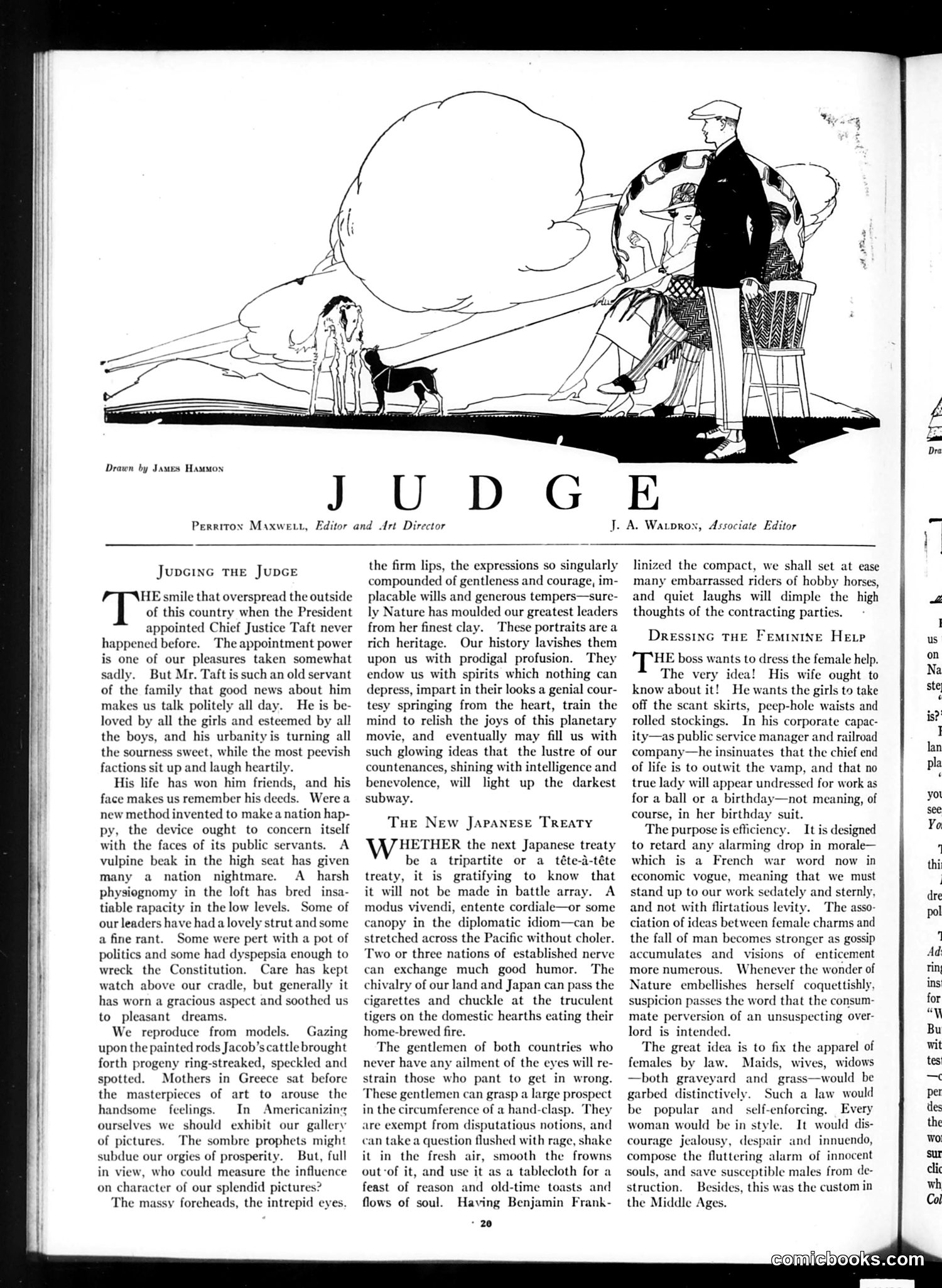
This page contains three distinct pieces from Judge magazine: **"Judging the Judge"** celebrates President Taft's appointment as Chief Justice. The article praises his pleasant appearance and character, arguing that leaders' physical features and demeanor influence national morale and character. **The cartoon at top** (drawn by James Hammon) appears to illustrate this theme, showing well-dressed figures—likely representing Taft and associates—in a formal setting. **"The New Japanese Treaty"** discusses diplomatic negotiations with Japan in optimistic, humorous terms. It suggests that gentlemen of "established nerve" can conduct business with good humor and restraint, avoiding conflict through diplomacy rather than military action. **"Dressing the Feminine Help"** is a brief social satire about a boss wanting to dictate female employees' clothing—his wife objects to this presumption of authority. The overall tone reflects early 20th-century American confidence in leadership, diplomacy, and social order, with satire directed at minor workplace absurdities rather than serious political critique.
📄 Transcribed text from this page (OCR, searchable)
Machine-transcribed from the original scan — historical spelling and the odd misread are preserved.
Drawn by Jases Hamaon Perrtton Maxweut, Sditor and Art Director JUDGE J. A. Watprox, Associate Editor JupGinG THE JUDGE HE smile that overspread the outside of this country when the President appointed Chief Justice Taft never happened before. The appointment power is one of our pleasures taken somewhat sadly. But Mr. Taft is such an old servant of the family that good news about him makes us talk politely all day. He is be- loved by all the girls and esteemed by all the boys, and his urbanity is turning all the sourness sweet, while the most peevish factions sit up and laugh heartily. His life has won him friends, and his face makes us remember his deeds. Were a new method invented to make a nation hap- py, the device ought to concern itself with the faces of its public servants. A vulpine beak in the high seat has given many a nation nightmare. A harsh physiognomy in the loft has bred insa- city in the low levels. Some of s have hada lovely strut and some a fine rant. Some were pert with a pot of politics and some had dyspepsia enough to wreck the Constitution. Care has kept watch above our cradle, but generally it has worn a gracious aspect and soothed us to pleasant dreams. We reproduce from models. Gazing upon the painted rods Jacob’s cattle brought forth progeny ring-streaked, speckled and spotted. Mothers in Greece s: the masterpieces of art to arous handsome feelings. In Americani. ourselves we should exhibit our gallery of pictures. The sombre prophets might subdue our orgies of prosperity. But, full in view, who could measure the influence on character of our splendid pictures? The massy foreheads, the intrepid eyes. the firm lips, the expressions so singularly compounded of gentleness and courage, im- placable wills and generous tempers—sure- ly Nature has moulded our greatest leaders from her finest clay. These portraits are a rich heritage. Our history lavishes them upon us with prodigal profusion. They endow us with spirits which nothing can depress, impart in their looks a genial cour- tesy springing from the heart, train the mind to relish the joys of this planetary movie, and eventually may fill us with such glowing ideas that the lustre of our countenances, shining with intelligence and benevolence, will light up the darkest subway. Tue New Japanese TREATY WHETHER the next Japanese treaty be a tripartite or a téte-d-téte treaty, it is gratifying to know that it will not be made in battle array. A modus vivendi, entente cordiale—or some canopy in the diplomatic idiom—can be stretched across the Pacific without choler. Two or three nations of established nerve can exchange much good humor. The chivalry of our land and Japan can pass the cigarettes and chuckle at the truculent tigers on the domestic hearths eating their home-brewed fire. The gentlemen of both countries who never have any ailment of the eyes will re- strain those who pant to get in wrong. These gentlemen can grasp a large prospect in the circumference of a hand-clasp. They are exempt from disputatious notions, and can take a question flushed with rage, shake it in the fresh air, smooth the frowns out-of it, and use it as a tablecloth for a feast of reason and old-time toasts and flows of soul. Having Benjamin Frank- linized the compact, we shall set at ease many embarrassed riders of hobby horses, and quiet laughs will dimple the high thoughts of the contracting parties. Dre ‘HE boss wants to dress the female help. The very idea! His wife ought to know about it! He wants the girls to take off the scant skirts, peep-hole waists and rolled stockings. In his corporate capac- ity—as public service manager and railroad company—he insinuates that the chief end of life is to outwit the vamp, and that no true lady will appear undressed for work as for a ball or a birthday—not meaning, of course, in her birthday suit. The purpose is efficiency. It is designed to retard any alarming drop in morale— which is a French war word now in economic vogue, meaning that we must stand up to our work sedately and sternly, and not with flirtatious levity. The asso- ciation of ideas between female charms and the fall of man becomes stronger as gossip accumulates and visions of enticement more numerous. Whenever the wonder of Nature embellishes herself coquettishly, suspicion passes the word that the consum- mate perversion of an unsuspecting over- lord is intended. The great idea is to fix the apparel of females by Maids, wives, widows —both grav and grass—would be garbed distinctively. Such a law would be popular and_ self-enforcing. Every woman would be in style. It would dis- courage jealousy, despair and innuendo, compose the fluttering alarm of innocent souls, and save susceptible males from de- struction. Besides, this was the custom in the Middle Ages. THE Feminine Hep