
Judge, 1921-07-30 · page 8 of 36
Judge — July 30, 1921 — page 8: what you’re looking at
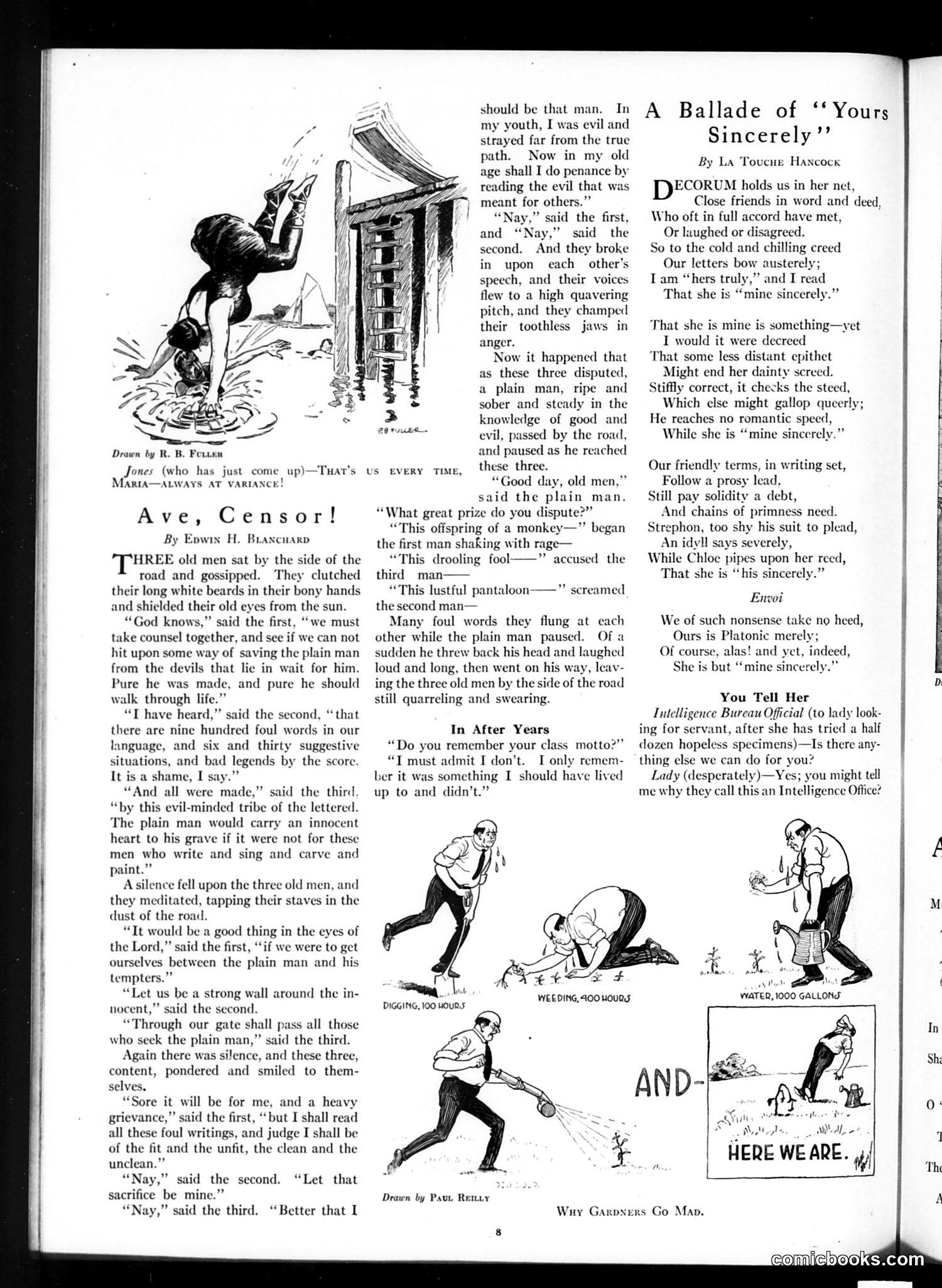
What you’re looking at
The main story mocks self-appointed moral guardians. Three elderly men—representing censors or moral crusaders—sit debating how to protect "the plain man" from corrupting influences: foul language, suggestive situations, and immoral art. They eagerly volunteer to read all "evil writings" themselves as penance, arguing over who should bear this burden. The satire's point: their overwrought concern is absurd. When an actual plain man passes by, he simply laughs at their quarreling and continues unbothered—suggesting that ordinary people don't need protection from the things censors obsess over. The cartoon attacks censorship movements of the era that sought to suppress "immoral" literature and art. Judge's perspective: censors are self-righteous busybodies whose concern for public morality masks prurient interest in the very material they condemn, while regular people are sensible enough to ignore such crusades.
📄 Transcribed text from this page (OCR, searchable)
Machine-transcribed from the original scan — historical spelling and the odd misread are preserved.
Drawn by R. B. Ferien Jones (who has just come up)—Tuat’s us EVERY MArIA—ALWAYS AT VARIANCE! Ave, Censor! By Epwix H. Brancuarp 'HREE old men sat by the side of the road and gossipped. They clutched their long white beards in their bony hands and shielded their old eyes from the sun. “God knows,” said the first, “we must take counsel together, and see if we can not hit upon some way of saving the plain man from the devils that lie in wait for him. Pure he was made, and pure he should walk through life.” “T have heard,” said the second, “that there are nine hundred foul words in our language, and six and thirty suggestive situations, and legends by the score. It is a shame, I say.” “And all were made,” said the third “by this evil-minded tribe of the lettered. The plain man would carry an innocent heart to his grave if it were not for these men who write and sing and carve and paint.” Asilence fell upon the three old men, and they meditated, tapping their staves in the dust of the road. “Tt would be a good thing in the eyes of id the first, “if we were to get s between the plain man and his tempters.”” “Let us be a strong wall around the in- nocent,” said the second. “Through our gate shall pass all those who seek the plain man,” said the third. Again there was silence, and these three, content, pondered and smiled to them- selves, “Sore it will be for me, and a heavy grievance,” said the first, ‘‘but I shall read all these foul writings, and judge I shall be of the fit and the unfit, the clean and the unclean.” “Nay,” said the second. sacrifice be mine.” “Nay,” said the third, “Better that I “Let that should be that man. In my youth, I was evil and strayed far from the true path. Now in my old age shall I do penance by reading the evil that was meant for others.” “Nay,” said the first, and “Nay,” said the second. And they broke in upon each other’s speech, and their voices flew to a high quavering pitch, and they champed their toothless jaws in anger. Now it happened that as these three disputed, a plain man, ripe and sober and steady in the knowledge of good and , passed by the road, and paused as he reached these three. “Good day, old men,” said the plain man. “What great prize do you dispute?” “This offspring of a monkey—’’ began the first man shaking with rage— “This drooling fool * accused the third =man— “This lustful pantaloon—” the second man— Many foul words they flung at each other while the plain man paused. Of a sudden he threw back his head and laughed loud and long, then went on his way, leav- ing the three old men by the side of the road still quarreling and swearing. TIME, screamed In After Years “Do you remember your class motto?” “T must admit I don’t. I only remem- ber it was something I should have lived up to and didn’t.” Drawn by Paut Retry A Ballade of ‘‘ Yours Sincerely’”’ By La Toucne Hancock ECORUM holds us in her net, Close friends in word and deed, Who oft in full accord have met, Or laughed or disagreed. So to the cold and chilling creed Our letters bow austerely; Tam “hers truly,” and I read That she is “mine sincerely.” That she is mine is something—yet I would it were decreed That some less distant epithet Might end her dainty screed. Stiffly correct, it checks the steed. Which else might gallop queet He reaches no romantic speed, While she is “mine sincerely.” Our friendly terms, in writing set, Follow a prosy lead, Still pay solidity a debt, And chains of primness need. Strephon, too shy his suit to plead, An idyll severely, While Chloe pipes upon her reed, That she is “his sincerely.” Envoi We of such nonsense take no heed, Ours is Platonic merely; Of course, alas! and yet, indeed, She is but “mine sincerely.” You Tell Her Intelligence Bureau Official (to lady look- ing for servant, after she has tried a half dozen hopeless specimens)—Is there any- thing else we can do for you? Lady (desperately)—Yes; you might tell me why they call this an Intelligence Office? NAL). ANAL - HERE WE ARE. P| Way Garpvers Go Map.