
Judge, 1921-07-30 · page 24 of 36
Judge — July 30, 1921 — page 24: what you’re looking at
What you’re looking at
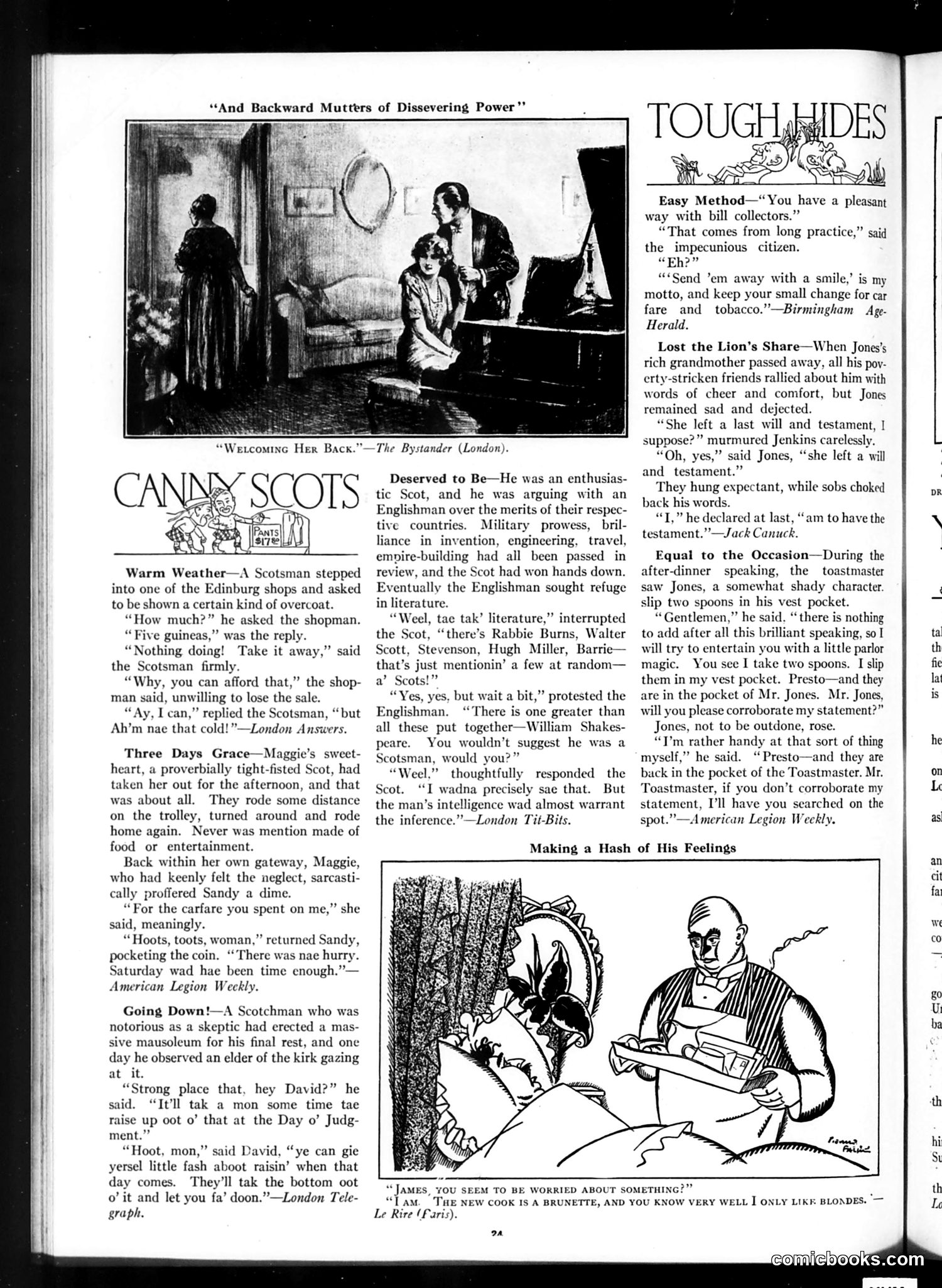
This page from Judge magazine contains several short humorous anecdotes stereotyping Scottish frugality and skepticism—a common theme in early 20th-century Anglo-American humor. **The jokes** mock Scots as cheap (refusing a coat he can afford), ungrateful (the boyfriend Sandy), and irreverent (the skeptic building an elaborate mausoleum). The "Deserved to Be" anecdote has a Scottish character argue that Shakespeare was Scottish based on his intelligence—a humorous reversal of English literary pride. **The bottom cartoon** titled "Making a Hash of His Feelings" shows a man catching another stealing spoons, then turning the theft into a magic trick to avoid embarrassment—satirizing social pretense and quick thinking. **Context**: These pieces reflect period attitudes about national character traits used for comedic effect. The Scottish stereotype emphasizing miserliness and cunning was standard entertainment fare in this era's humor magazines, appealing to contemporary English and American audiences through ethnic stereotyping.
📄 Transcribed text from this page (OCR, searchable)
Machine-transcribed from the original scan — historical spelling and the odd misread are preserved.
“And Backward Mutters of Dissevering Power’’ Warm Weather—A Scotsman stepped into one of the Edinburg shops and asked to be shown a certain kind of overcoat. “How much?” he asked the shopman. “Five guineas,” was the reply. “Nothing doing! Take it away,” said the Scotsman firmly. “Why, you can afford that,” the shop- man said, unwilling to lose the sale. “Ay, I can,” replied the Scotsman, “but Ah’m nae that cold!”"—London Answers. Three Days Grace—Maggie’s sweet- heart, a proverbially tight-fisted Scot, had taken her out for the afternoon, and that was about all. They rode some distance on the trolley, turned around and rode home again. Never was mention made of food or entertainment. Back within her own gateway, Maggie, who had keenly felt the neglect, sarcasti- cally proffered Sandy a dime. “For the carfare you spent on me,” she said, meaningly. “Hoots, toots, woman,” returned Sandy, pocketing the coin. ‘‘There was nae hurry. Saturday wad hae been time enough.”— American Legion Weekly. Going Down!—A Scotchman who was notorious as a skeptic had erected a mas- sive mausoleum for his final rest, and one day he observed an elder of the kirk gazing at it. “Strong place that, hey David?” he said. “It'll tak a mon some time tae raise up oot o’ that at the Day o’ Judg- ment.” “Hoot, mon,” said David, “ye can gie yersel little fash aboot raisin’ when that day comes. They’ll tak the bottom oot o’ it and let you fa’ doon.”—London Tele- graph, Bystander (London). Deserved to Be—He was an enthusias- tic Scot, and he was arguing with an Englishman over the merits of their respec- tive countries. Military prowess, bril- liance in invention, engineering, travel, empire-building had all been passed in review, and the Scot had won hands down. Eventually the Englishman sought refuge in literature. “Weel, tae tak’ literature,” interrupted the Scot, “there’s Rabbie Burns, Walter Scott, Stevenson, Hugh Miller, Barrie— that’s just mentionin’ a few at random— a’ Scots!” “Yes, yes, but wait a bit,” protested the Englishman. “There is one greate all these put together—William peare. You wouldn’t suggest he was a Scotsman, would you?” “Weel.” thoughtfully responded the Scot. ‘I wadna precisely sae that. But the man’s intelligence wad almost warrant the inference.”—London Tit-Bits. Making a Hash Easy Method—“ You have a pleasant way with bill collectors.” “That comes from long practice,” said the impecunious citizen. “Eh?” “*Send ’em away with a smile,’ is my motto, and keep your small change for car fare and tobacco.”—Birmingham Age. Herald. Lost the Lion’s Share—When Jones's rich grandmother passed away, all his poy- erty-stricken friends rallied about him with words of cheer and comfort, but Jones remained sad and dejected. She left a last will and testament, | suppose?” murmured Jenkins carelessly, “Oh, yes,” said Jones, ‘‘she left a will and testament.” They hung expectant, while sobs choked back his words. “T,” he declared at last, “‘am to have the testament.” —Jack Canuck. Equal to the Occasion—During the after-dinner speaking, the toastmaster saw Jones, a somewhat shady character. slip two spoons in his vest pocket. “Gentlemen,” he said. “there is nothing to add after all this brilliant speaking, so I will try to entertain you with a little parlor magic. You see I take two spoons. I slip them in my vest pocket. Presto—and they are in the pocket of Mr. Jones. Mr. Jones, will you please corroborate my statement?” Jones, not to be outdone, rose. “T’m rather handy at that sort of thing myself,” he said. “ Presto—and they are back in the pocket of the Toastmaster. Mr. Toastmaster, if you don’t corroborate my statement, I'll have you searched on the spot.”—A merican Legion Weekly. of His Feelings “Tam. Tae new Le Rire (Faris). an cit fal we