
Judge, 1921-07-30 · page 34 of 36
Judge — July 30, 1921 — page 34: what you’re looking at
What you’re looking at
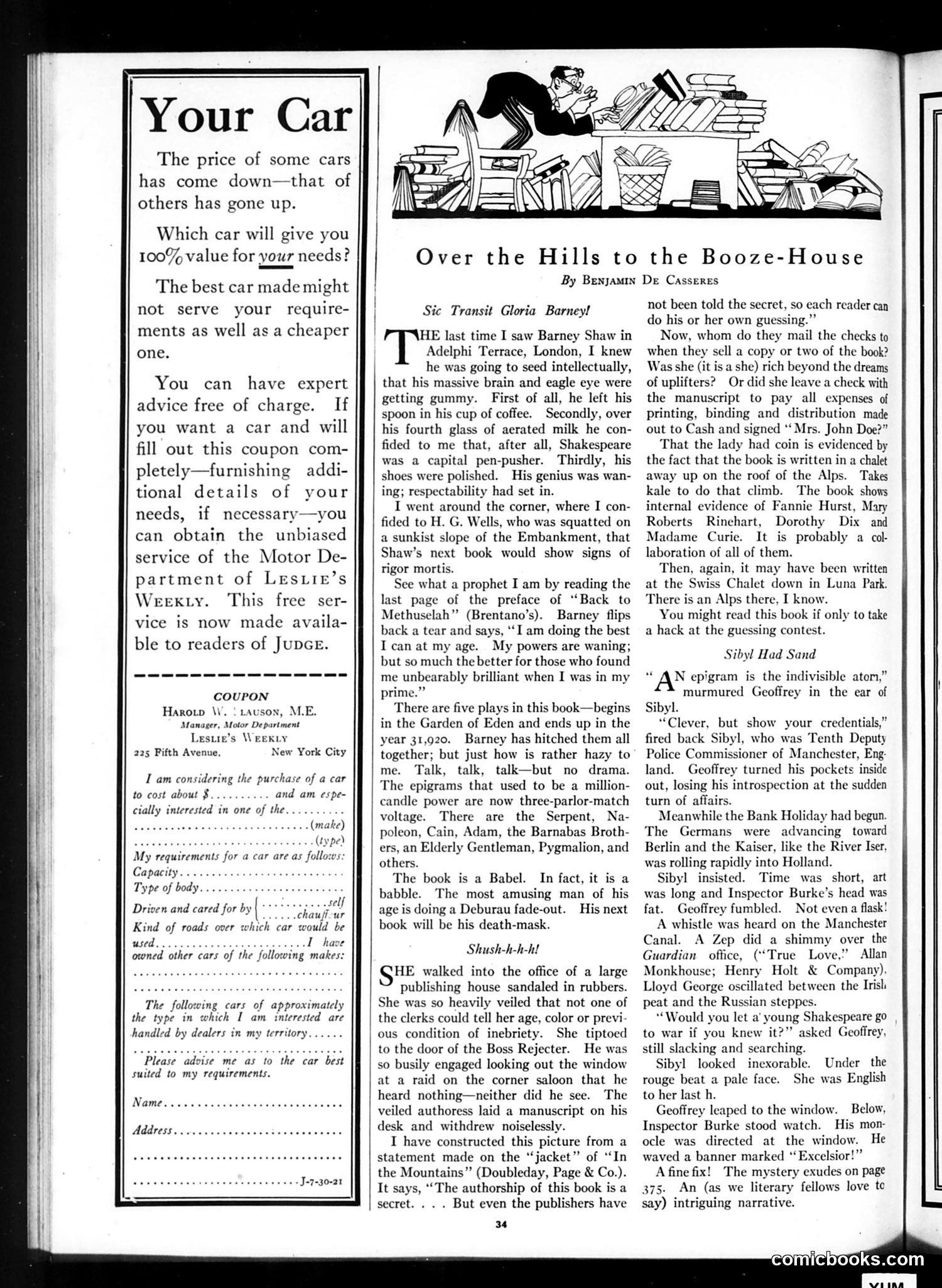
This page combines **automobile advertising** with **literary satire**. The left side is a car-buying advice coupon from Leslie's Weekly, offering free expert consultation to help readers select vehicles suited to their needs—reflecting 1920s consumer guidance. The right side contains two book reviews by Benjamin De Casseres: 1. **"Sic Transit Gloria Barney!"** mocks George Bernard Shaw's declining powers. De Casseres suggests Shaw is intellectually "seeding" (aging badly), evidenced by slovenly behavior and the new play collection *Back to Methuselah*. He criticizes Shaw's once-brilliant epigrams as now mere "three-parlor-match voltage"—dim compared to their former brilliance. The review treats Shaw's creative decline as inevitable aging. 2. **"Shush-h-h-h!"** reviews a mystery novel, *In the Mountains*, whose authorship is deliberately secret. De Casseres humorously questions the practical problem: how do publishers mail royalty checks to an anonymous author? Both reviews exemplify Judge magazine's satirical tone—irreverent commentary on contemporary cultural figures and publishing absurdities.
📄 Transcribed text from this page (OCR, searchable)
Machine-transcribed from the original scan — historical spelling and the odd misread are preserved.
Your Car The price of some cars has come down—that of others has gone up. Which car will give you 100% value for your needs? The best car made might not serve your require- ments as well as a cheaper one. You can have expert advice free of charge. If you want a car and will fill out this coupon com- pletely—furnishing addi- tional details of your needs, if necessary—you can obtain the unbiased service of the Motor De- partment of LEsLIE’s Week Ly. This free ser- vice is now made availa- ble to readers of JuDGE. COUPON Harotp W. ‘ Lauson, M.E. Department WEEKLY 225 Fifth Avenue, New York City 1 am considering the purchase of a car to cost about $.......... and am espe- cially interested in one of the.......... a ) My requirements for a car are as follozos: Capacity.... Type of body Driven and cared for by Kind of roads over . self cee Chauffeur hich car would be The following cars of approximately the type in which I am interested are handled by dealers in my territory suited to my requirements. Name Over the Hills to Sic Transit Gloria Barney! HE last time I saw Barney Shaw in Adelphi Terrace, London, I knew he was going to seed intellectually, that his massive brain and eagle eye were getting gummy. First of all, he left his spoon in his cup of coffee. Secondly, over his fourth glass of aerated milk he con- fided to me that, after all, Shakespeare was a capital pen-pusher. Thirdly, his shoes were polished. His genius was wan- ing; respectability had set in. I went around the corner, where I con- fided to H. G. Wells, who was squatted on a sunkist slope of the Embankment, that Shaw’s next book would show signs of rigor mortis. See what a prophet I am by reading the last page of the preface of “Back to Methuselah” (Brentano's). Barney flips back a tear and says, “I am doing the best I can at my age. My powers are waning; but so much the better for those who found me unbearably brilliant when I was in my prime.” There are five plays in this book—begins in the Garden of Eden and ends up in the year 31,920. Barney has hitched them all together; but just how is rather hazy to me. Talk, talk, talk—but no drama. The epigrams that used to be a million- candle power are now three-parlor-match voltage. There are the Serpent, Na- poleon, Cain, Adam, the Barnabas Broth- ers, an Elderly Gentleman, Pygmalion, and others. The book is a Babel. In fact, it is a babble. The most amusing man of his age is doing a Deburau fade-out. His next book will be his death-mask. Shush-h-h-h! SHE walked into the office of a large publishing house sandaled in rubbers. She was so heavily veiled that not one of the clerks could tell her age, color or previ | ous condition of inebriety. She tiptoed to the door of the Boss Rejecter. He was so busily engaged looking out the window at a raid on the corner saloon that he heard nothing—neither did he see. The | veiled authoress laid a manuscript on his desk and withdrew noiselessly. I have constructed this picture from a statement made on the “jacket” of “In the Mountains” (Doubleday, Page & Co.). It says, ‘‘The authorship of this book is a | secret. . . . But even the publishers have 34 the Booze-House By Benjamin De Casseres not been told the secret, so each reader can do his or her own guessing.” Now, whom do they mail the checks to when they sell a copy or two of the book? Was she (it is a she) rich beyond the dreams of uplifters? Or did she leave a check with the manuscript to pay all expenses of printing, binding and distribution made out to Cash and signed ‘‘ Mrs. John Doe?” That the lady had coin is evidenced by the fact that the book is written in a chalet away up on the roof of the Alps. Takes kale to do that climb. The book shows internal evidence of Fannie Hurst, Mary Roberts Rinehart, Dorothy Dix and Madame Curie. It is probably a col- laboration of all of them. Then, again, it may have been written at the iss Chalet down in Luna Park. The n Alps there, I know. You might read this book if only to take a hack at the guessing contest. Sibyl Had Sand “ AN epigram is the indivisible atom,” murmured Geoffrey in the ear of Siby “Clever, but show your credentials,” fired back Sibyl, who was Tenth Deputy Police Commissioner of Manchester, Eng- land. out, losing hi: turn of affairs. Meanwhile the Bank Holiday had begun. The Germans were advancing toward Berlin and the Kaiser, like the River Iser, was rolling rapidly into Holland. Sibyl insisted. Time was short, art was long and Inspector Burke's head was fat. Geoffrey fumbled. Not even a flask! A whistle was heard on the Manchester Canal. A Zep did a shimm Guardian office, (‘True Lo Monkhouse; Henry Holt & Company). Lloyd George oscillated between the Irish peat and the Russian steppes. “Would you let a’ young Shakespeare go asked Geoftrey, trospection at the sudden inexorable. Under the Sibyl looked She was English rouge beat a pale face. to her last h. Geoffrey leaped to the window. Below, Inspector Burke stood watch. His mon- ocle was directed at the window. He waved a banner marked “Excelsior!” A fine fix! The mystery exudes on page 375. An (as we literary fellows love te say) intriguing narrative. icbooks.com