
Judge, 1921-07-30 · page 13 of 36
Judge — July 30, 1921 — page 13: what you’re looking at
What you’re looking at
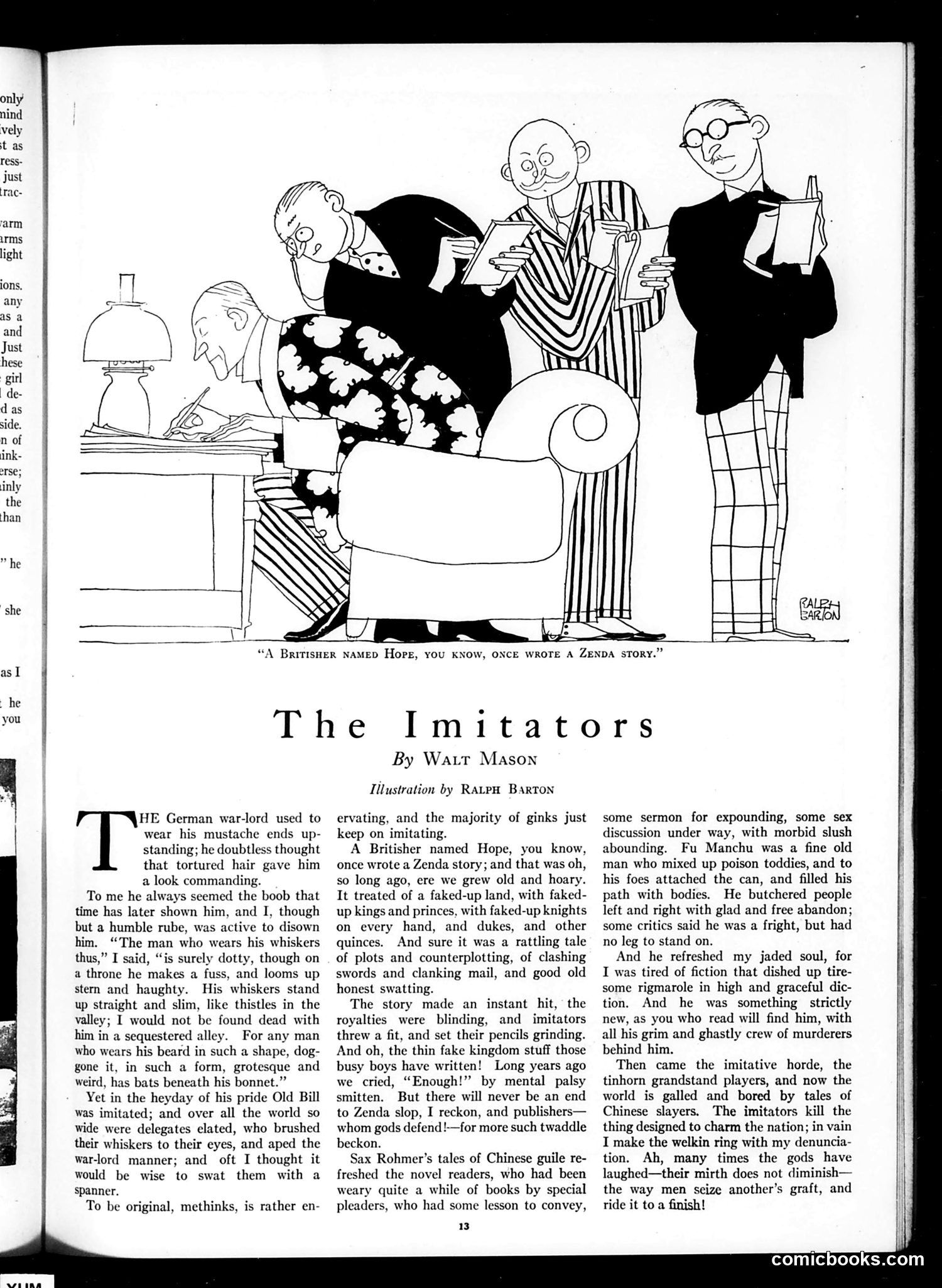
**The Cartoon:** The illustration shows five men in business attire discussing literature around a desk with a lamp. The caption references "a Britisher named Hope" who wrote a "Zenda story." **The Satire's Target:** Mason criticizes widespread literary imitation. He uses two examples: 1. **Anthony Hope's "The Prisoner of Zenda"** (1894)—a popular adventure novel set in a fictional European kingdom that spawned countless inferior imitators. 2. **Sax Rohmer's "Fu Manchu" series**—exotic tales of a Chinese villain that similarly inspired derivative works. **The Point:** Mason argues that original, entertaining works inspire mediocre copycats who exploit the formula until readers tire of the entire genre. He laments how imitators "kill the thing designed to charm the nation" by milking successful concepts dry. **Context:** This reflects early 20th-century publishing's boom-and-bust cycles with popular genres, where publishers rushed imitations to market to capitalize on bestsellers—a practice Mason finds aesthetically and morally lazy.
📄 Transcribed text from this page (OCR, searchable)
Machine-transcribed from the original scan — historical spelling and the odd misread are preserved.
‘she as I . he you Aer “A BrivisHeER NAMED Hope, you KNOW, ONCE WROTE A ZENDA sTORY.” The Imitators HE German war-lord used to wear his mustache ends up- standing; he doubtless thought that tortured hair gave him a look commanding. To me he always seemed the boob that time has later shown him, and I, though but a humble rube, was active to disown him. “The man who wears his whiskers thus,” I said, “is surely dotty, though on a throne he makes a fuss, and looms up stern and haughty. His whiskers stand up straight and slim, like thistles in the valley; I would not be found dead with him in a sequestered alley. For any man rs his beard in such a shape, dog- in such a form, grotesque and as bats beneath his bonnet.” Yet in the heyday of his pride Old Bill was imitated; and over all the world so wide were delegates elated, who brushed their whiskers to their eyes, and aped the war-lord manner; and oft I thought it would be wise to swat them with a spanner. To be original, methinks, is rather en- By Watt Mason Illustration by RALPH BARTON ervating, and the majority of ginks just keep on imitating. A Britisher named Hope, you know, once wrote a Zenda story; and that was oh, so long ago, ere we grew old and hoary. It treated of a faked-up land, with faked- up kings and princes, with faked-up knights on every hand, and dukes, and other quinces. And sure it was a rattling tale of plots and counterplotting, of clashing swords and clanking mail, and good old honest swatting. The story made an instant hit, the royalties were blinding, and imitators threw a fit, and set their pencils grinding. And oh, the thin fake kingdom stuff those busy boys have written! Long years ago we cried, “Enough!”” by mental palsy smitten. But there will never be an end to Zenda slop, I reckon, and publishers— whom gods defend !-—for more such twaddle beckon. Sax Rohmer’s tales of Chinese guile re- freshed the novel readers, who had been weary quite a while of books by special pleaders, who had some lesson to convey, 13 some sermon for expounding, some sex discussion under way, with morbid slush abounding. Fu Manchu was a fine old man who mixed up poison toddies, and to his foes attached the can, and filled his path with bodies. He butchered people left and right with glad and free abandon; some critics said he was a fright, but had no leg to stand on. And he refreshed my jaded soul, for I was tired of fiction that dished up tire- some rigmarole in high and graceful dic- tion. And he was something strictly new, as you who read will find him, with all his grim and ghastly crew of murderers behind him. Then came the imitative horde, the tinhorn grandstand players, and now the world is galled and bored by tales of Chinese slayers. The imitators kill the thing designed to charm the nation; in vain I make the welkin ring with my denuncia- tion. Ah, many times the gods have laughed—their mirth does not diminish— the way men seize another’s graft, and ride it to a finish! comicbooks.com