
A complete issue · 36 pages · 1921
Judge — July 2, 1921
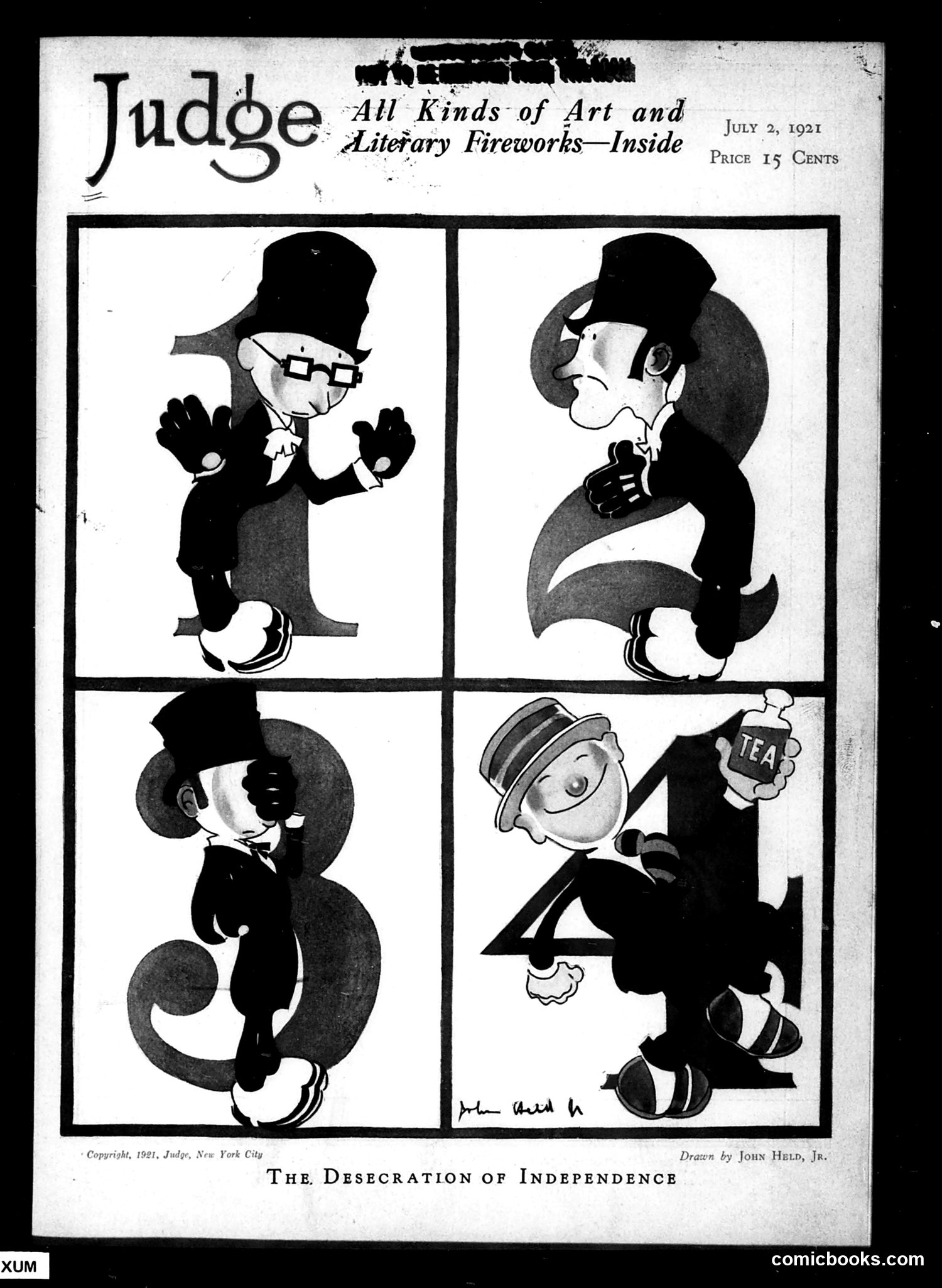
This July 2, 1921 Judge cartoon by John Held Jr. satirizes American political leadership through four panels numbered 1-4, using caricatured figures in top hats. The title "The Desecration of Independence" suggests criticism of how government officials are betraying American independence ideals. The progression appears to show deterioration or abuse of patriotic principles: the first figure seems cheerful, the second troubled, the third appears distressed, and the fourth holds a tea cup—possibly referencing British tea and colonial control. The cartoon likely critiques post-WWI American politics, perhaps targeting specific politicians' policies the magazine opposed. Without clearer identification of the figures, the precise political target remains unclear, though the theme criticizes leadership failures.
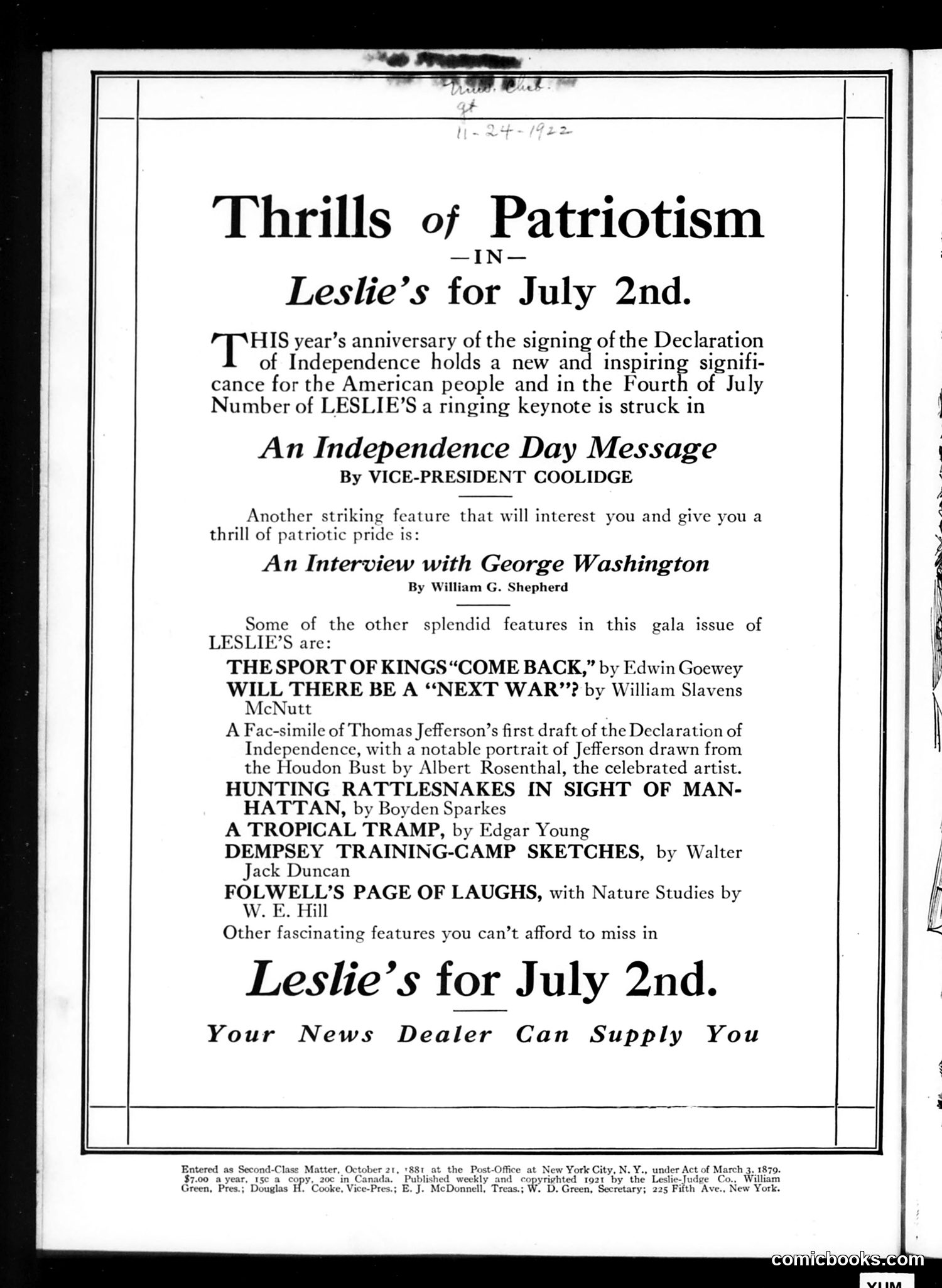
This page is primarily **advertising**, not satirical content. It promotes Leslie's magazine's July 2nd issue, emphasizing patriotic Fourth of July themes. The advertised features include: - An "Independence Day Message" by Vice-President Coolidge - "An Interview with George Washington" by William G. Shepherd - Stories with patriotic titles: "The Sport of Kings 'Come Back'" and "Will There Be a 'Next War'?" - A facsimile of Thomas Jefferson's Declaration of Independence draft - Various other articles on hunting, travel, and humor The page targets readers' patriotic sentiment around Independence Day. No satirical cartoons are visible here—it's a straightforward magazine promotion using patriotic appeals and prominent political figures' names (Coolidge, Washington, Jefferson) to attract buyers through newsdealers.
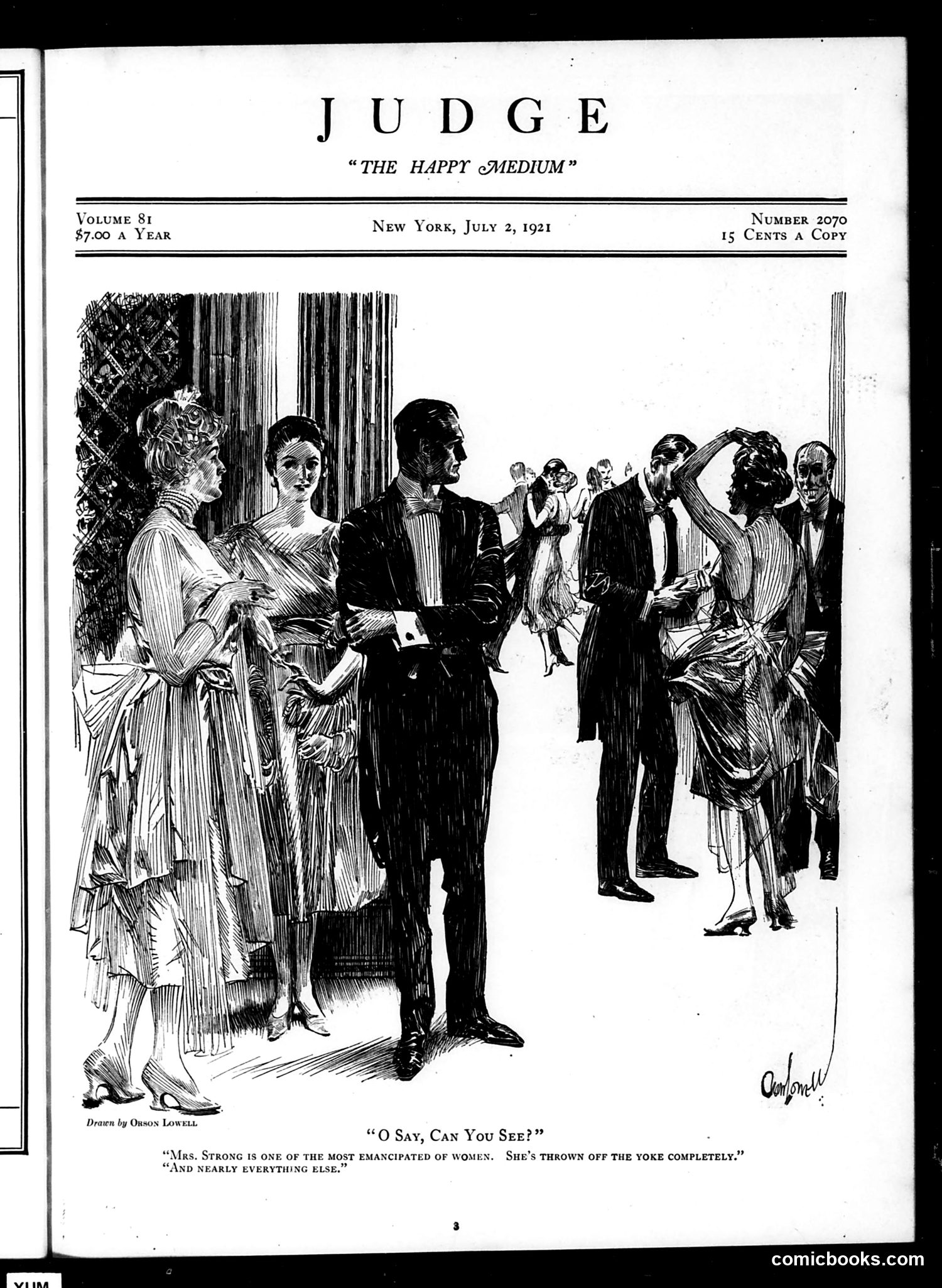
This cartoon satirizes women's voting behavior following the 19th Amendment's ratification (August 1920). The caption "O Say, Can You See?" references the national anthem, while the subtitle describes "Mrs. Strong" as "one of the most emancipated of women" who "throws off the yoke completely" and does "nearly everything else." The scene depicts a formal social gathering where a confident woman in fashionable dress stands prominently among formally-dressed men and women. The satire suggests that newly-enfranchised women were abandoning traditional social conventions along with voting rights—a common contemporary anxiety that women's liberation would extend beyond politics into all social behavior. The cartoon reflects early-1920s ambivalence about women's expanded freedoms.
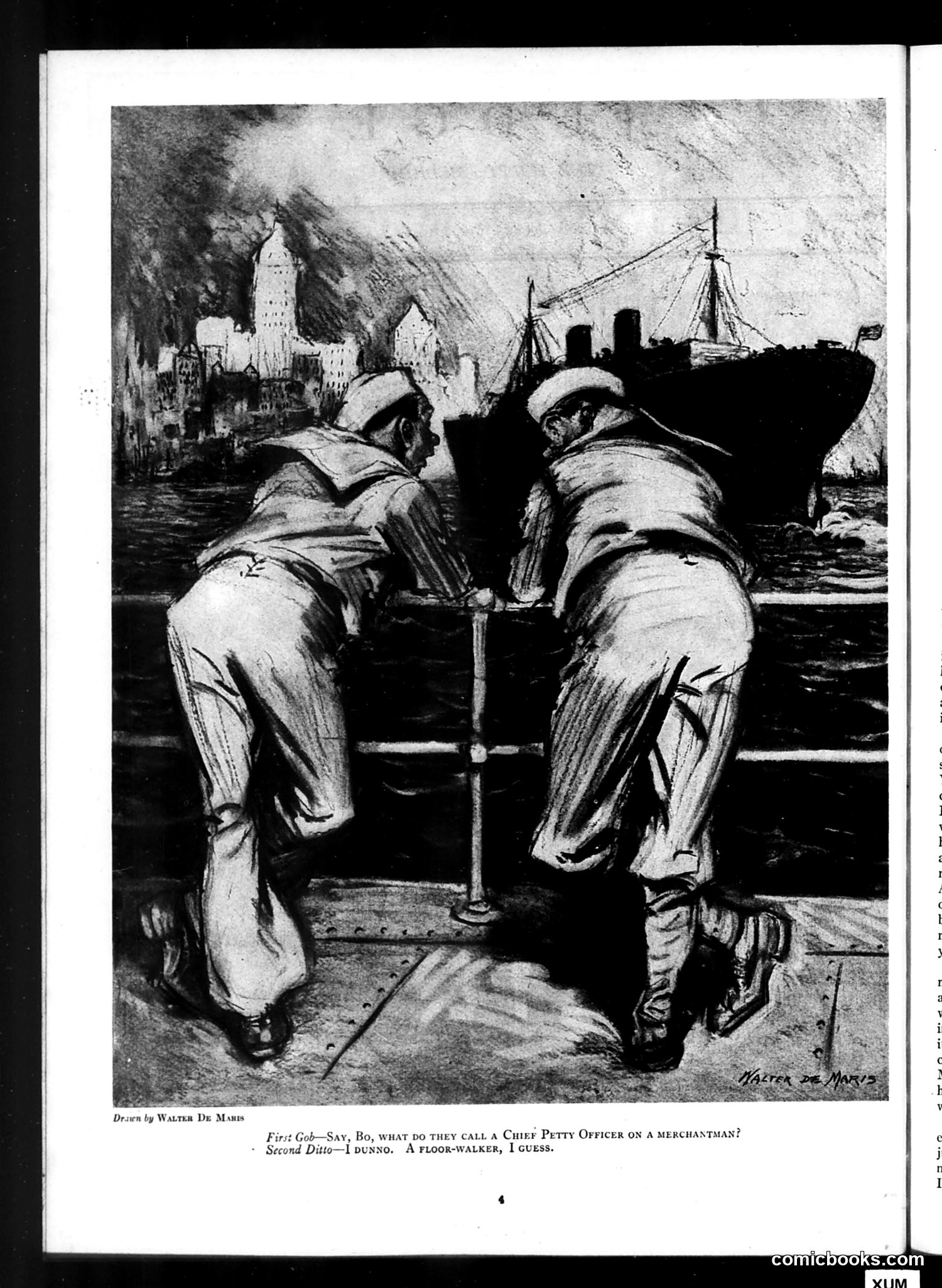
This cartoon depicts two sailors in the foreground observing a merchant ship and city skyline. The dialogue reveals a joke about naval terminology and social class. **The Joke:** The first sailor asks what a "Chief Petty Officer on a merchantman" is called. The second sailor responds "a floor-walker, I guess"—a reference to department store employees who assisted customers on sales floors. **The Satire:** This is a class-based joke comparing merchant marine officers to low-status retail workers, suggesting they lack the prestige or authority of naval officers. The humor relies on the audience understanding the hierarchy distinction between military and merchant marine ranks, and on the contemporary familiarity with "floor-walker" as a recognizable occupation. The artist, Walter De Maris, signed the work in the lower right.
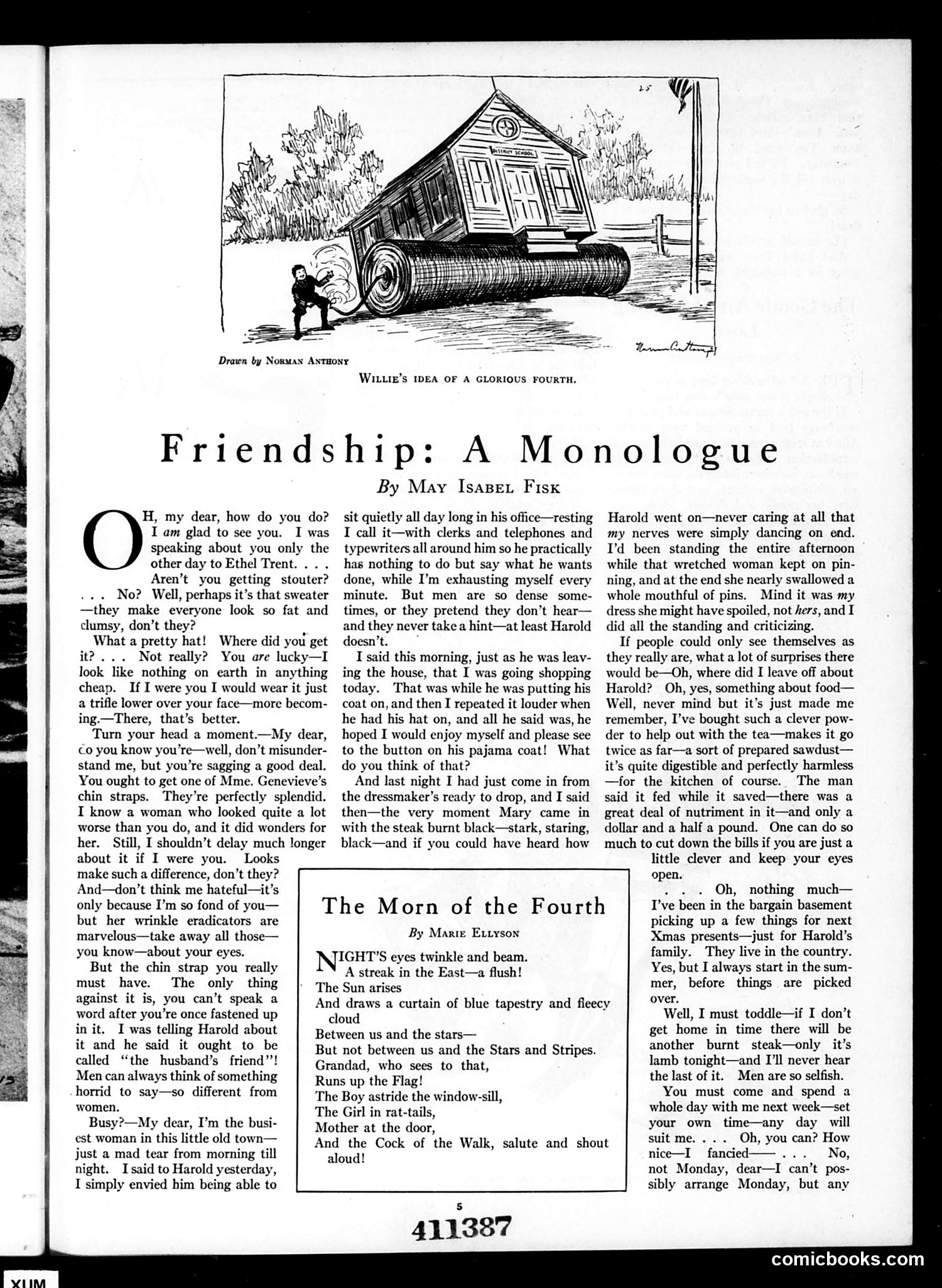
The cartoon at top, titled "Willie's Idea of a Glorious Fourth," depicts a man positioning a small house atop a large firecracker or explosive device—a visual pun on Fourth of July celebrations. The humor satirizes dangerous fireworks practices, showing absurdly reckless behavior as entertainment. Below are two literary pieces: "Friendship: A Monologue" by May Isabel Fisk and "The Morn of the Fourth" by Marie Ellyson. These appear to be humorous social commentary rather than political satire—focusing on domestic life, marital dynamics, and holiday traditions among middle-class Americans. The page primarily showcases Judge's satirical approach to everyday American social customs and relationships rather than addressing specific political events or figures.
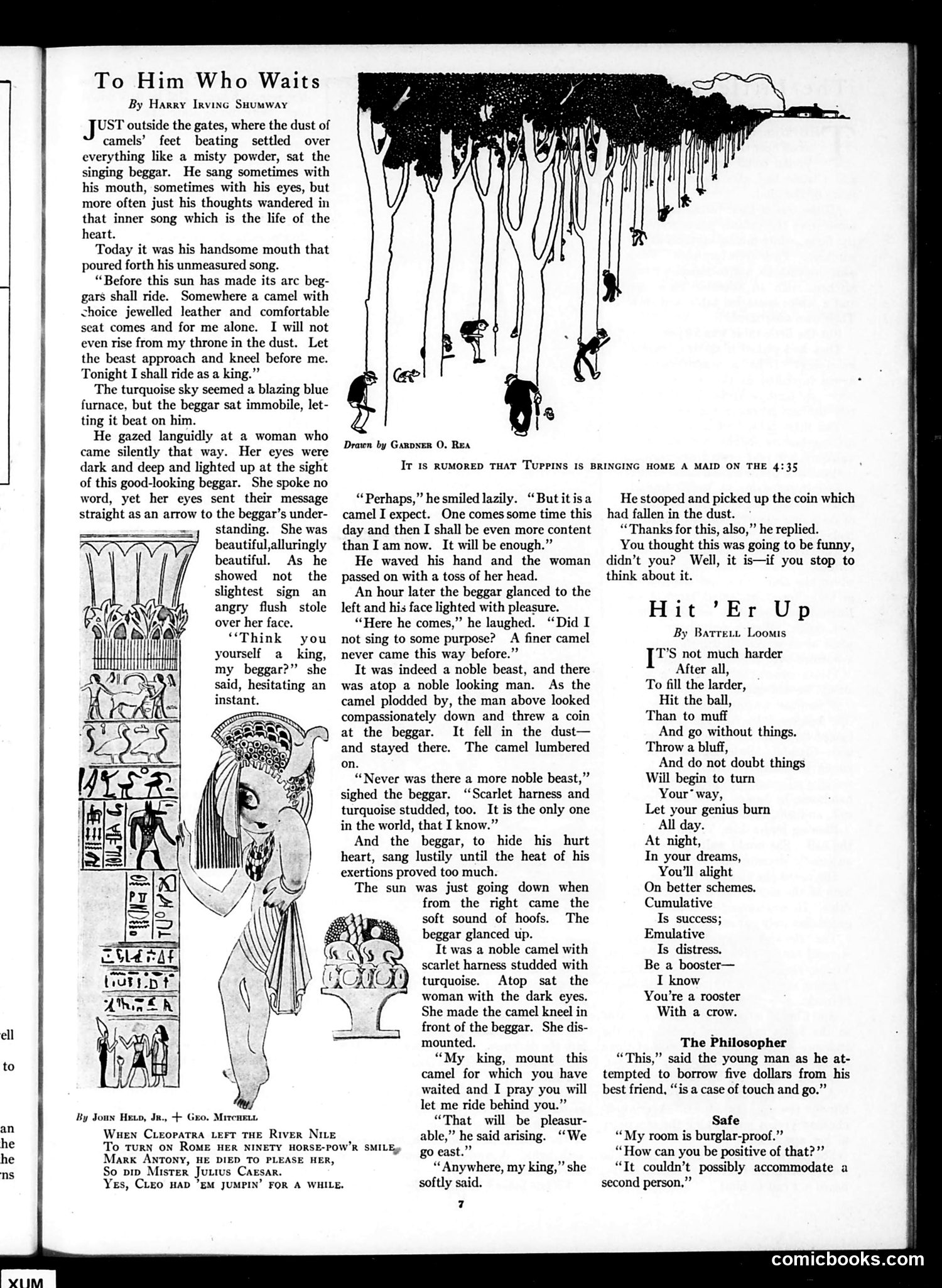
This page contains three separate pieces of fiction and light verse from *Judge* magazine. **"To Him Who Waits"** (main story): A romantic tale set in the Middle East about a beggar who confidently predicts a fine camel will arrive. A woman approaches, but he coldly rejects her advances, waiting for his prophesied camel. When a wealthy man passes on an ornate camel, he throws a coin at the beggar—who initially feels hurt. However, the woman then arrives on that same camel, kneels it before him, and offers to let him ride while she follows. He accepts, and retrieves the discarded coin. The moral: patience and dignity are rewarded. **"Cleopatra" verse** (bottom left): A humorous reference to the historical Cleopatra, noting how her charms caused both Mark Antony and Julius Caesar to die for her—presented as comic exaggeration of female power. **"Hit 'Er Up"** (right column): Motivational verse encouraging optimism and persistent effort ("cumulative success") over pessimism ("emulative distress"). All three pieces are entertainment rather than political satire.
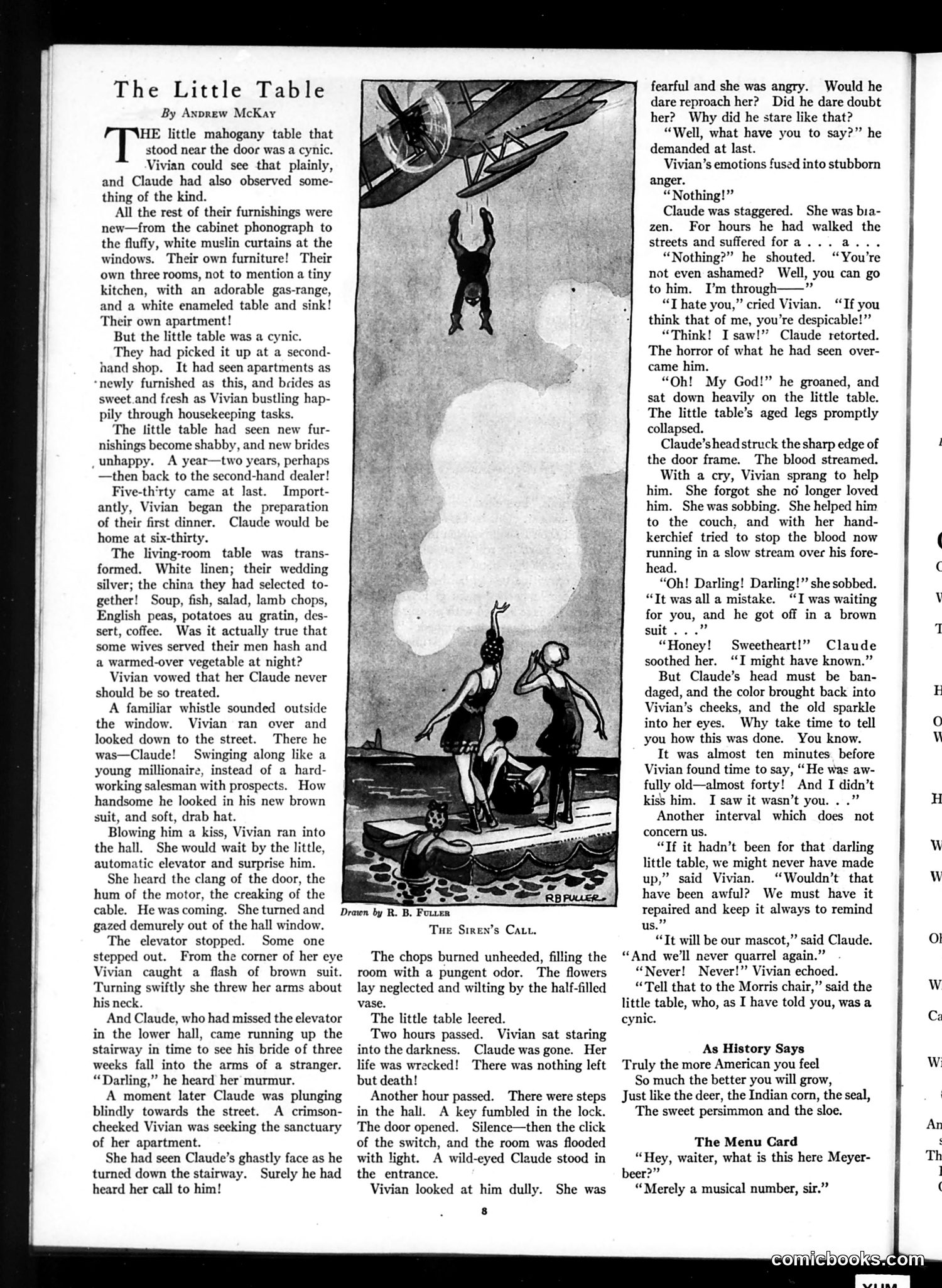
This is a domestic comedy about newlyweds Vivian and Claude. The story hinges on a misunderstanding: Vivian, waiting by an elevator to greet her husband, embraces a stranger by mistake—whom Claude witnesses. The satire targets both the romantic idealism of young married couples and the fragility of trust in marriage. The "cynic" little table—a secondhand piece that has seen marriages fail—serves as sardonic commentary: Vivian had prepared an elaborate first dinner to be the "perfect wife," yet one innocent mistake nearly destroys her marriage. The joke exposes how quickly passion and suspicion override reason. The story likely reflects 1920s-era anxieties about modern urban life, where casual encounters could fuel jealousy and miscommunication between spouses. The resolution (implied but not shown on this page) suggests reconciliation, but the tale mocks both marital insecurity and the performative domesticity young wives attempted.
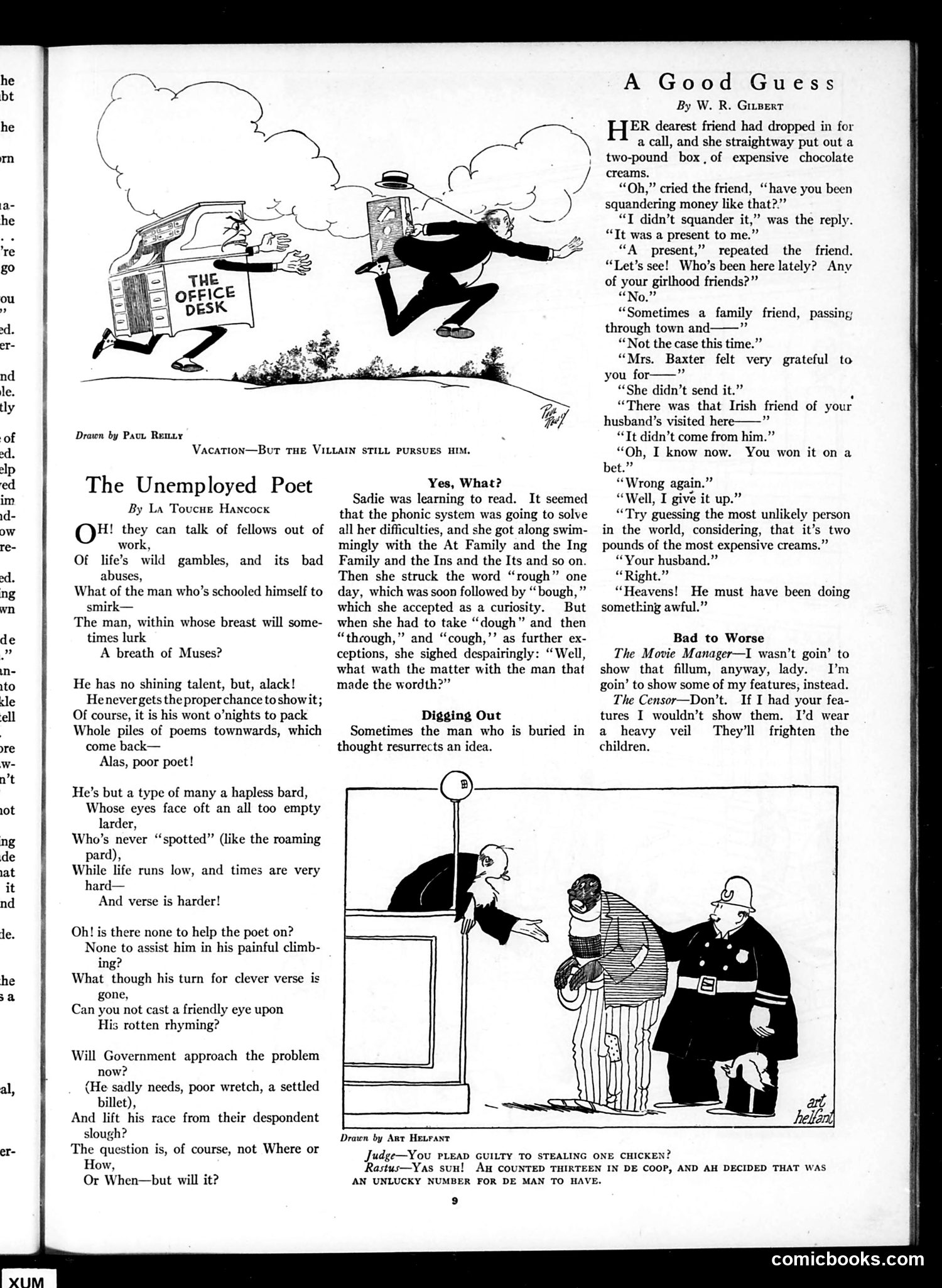
This page contains three distinct pieces of satirical content: **"The Unemployed Poet"** (La Touche Hancock) — A sympathetic poem about an unsuccessful poet struggling during economic hardship, unable to earn money from his work despite effort. It appeals to government for assistance ("Will Government approach the problem now?"), reflecting Depression-era concerns about unemployment and poverty. **"A Good Guess"** (W.R. Gisbert) — A humorous domestic anecdote where a wife receives expensive chocolates. Through elimination, her friend correctly deduces the husband gave them as an apology for misbehavior ("He must have been doing something awful"), playing on marital dynamics. **"Bad to Worse"** and the courtroom cartoon employ ethnic stereotyping common to the era. The "Rastus" character uses exaggerated dialect while explaining he stole a chicken because 13 in the coop was unlucky—humor based on racial caricature rather than actual satire of social issues. The page reflects Judge's mix of social commentary (unemployment), domestic humor, and entertainment relying on now-offensive racial stereotypes typical of early-to-mid 20th century American magazines.
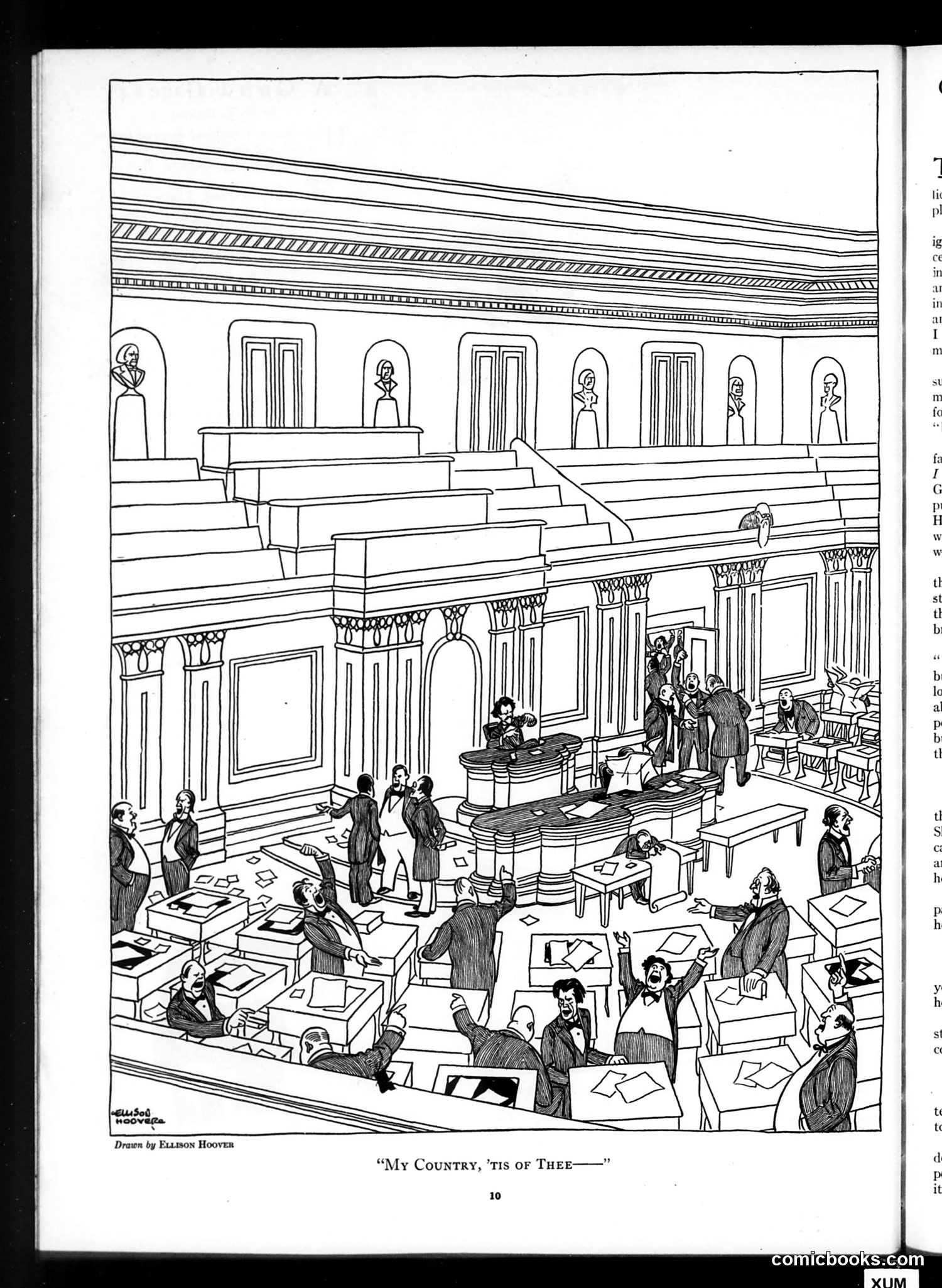
This cartoon by Ellison Hoover depicts the interior of Congress or a legislative chamber in apparent chaos. Dozens of men sit scattered across the floor amid piles of papers and documents, while others stand in conversation or gesture animatedly. The architectural grandeur—with ornate columns, elevated galleries, and formal statuary—contrasts sharply with the disorganized scene below. The satire critiques Congressional dysfunction and disorder. The patriotic song title—celebrating American ideals—is paired with an image of legislative business conducted in seeming disarray, suggesting hypocrisy between American democratic principles and actual governing practices. The masses of papers scattered about likely mock bureaucratic inefficiency or legislative gridlock. Without a visible date, the specific political moment remains unclear.
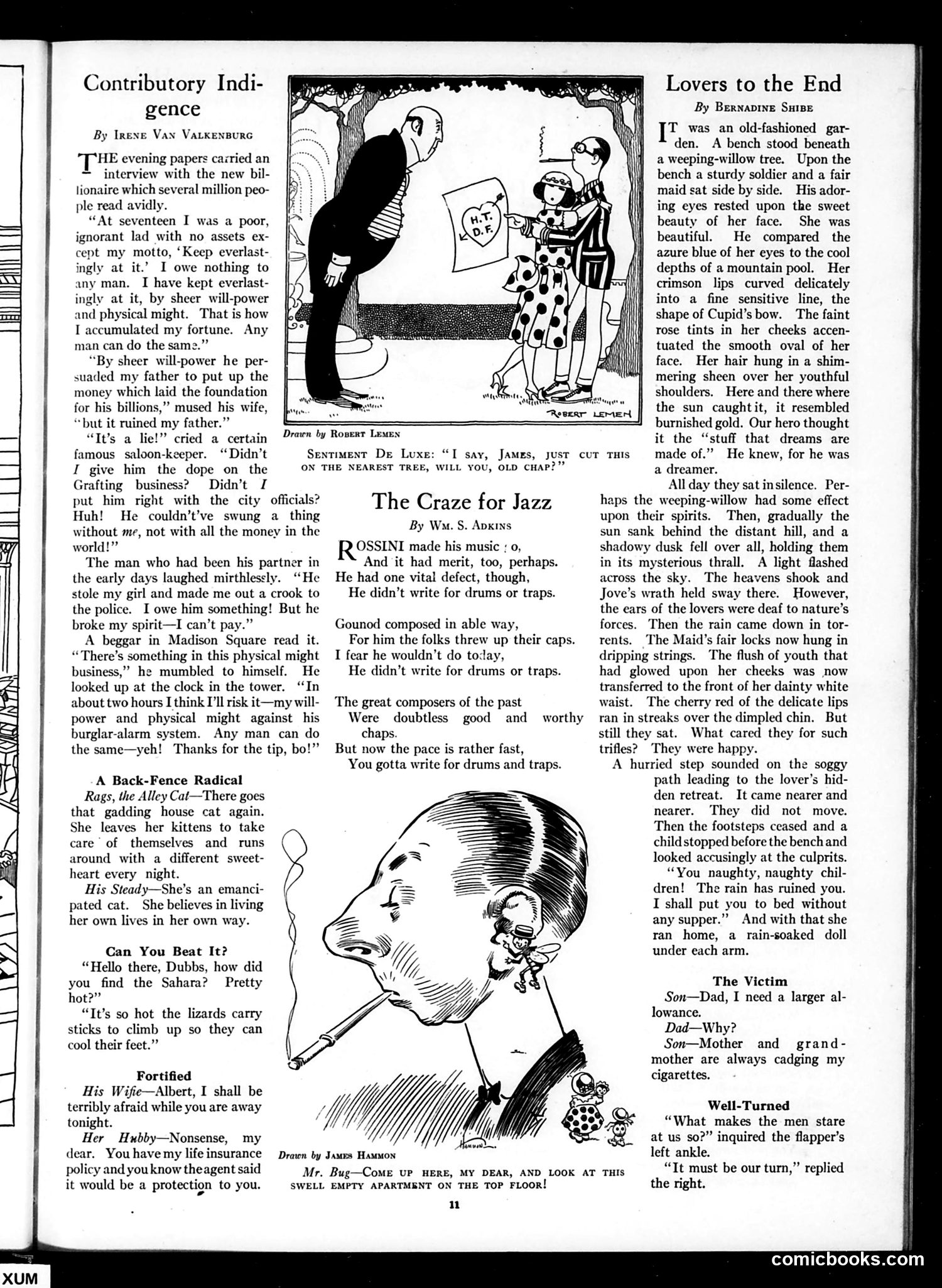
This page contains several satirical pieces typical of early 20th-century American humor: **"Contributory Indigence"** mocks a billionaire's self-made-man narrative. The satire reveals how his success actually depended on others—a father's money, a saloon-keeper's connections, a partner he wronged—undermining his claim of pure will-power. The beggar's response (planning to rob using the same "will-power" philosophy) sharpens the critique: the ideology excuses inequality while ignoring systemic help. **"The Craze for Jazz"** laments modern music's shift toward percussion-heavy jazz over classical composition. It contrasts great composers like Rossini and Gounod with contemporary demands for "drums and traps"—reflecting conservative anxiety about jazz as lowbrow, commercial, and rhythmically primitive. The remaining pieces are light humor: a cat's independence, desert heat jokes, and a wife reassured by life insurance (dark comedy about financial security through her husband's death). The cartoons by Robert Lerner and James Harmon illustrate these pieces with typical period illustration style.
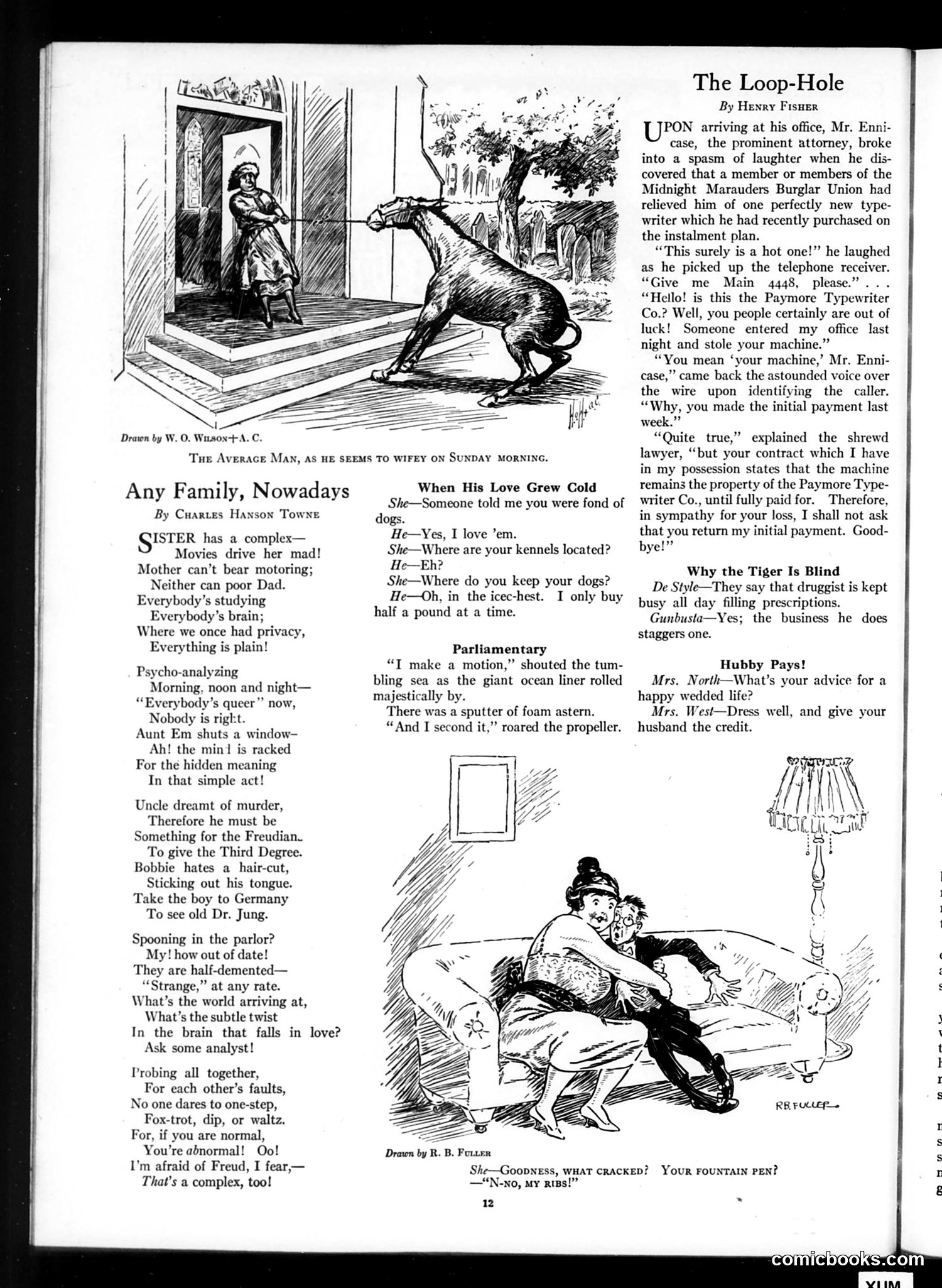
This page from *Judge* magazine contains three satirical pieces mocking early 20th-century social trends: **"Any Family, Nowadays"** (Charles Hanson Towne) ridicules the widespread adoption of Freudian psychology and psychoanalysis in American culture. The poem satirizes families obsessed with analyzing every behavior and dream through a Freudian lens—treating normal activities (spooning, a child disliking haircuts, dancing) as symptoms of psychological disorders. The joke: applying psychological theory to everything renders normal people "abnormal." **"The Loop-Hole"** (Henry Fisher) features an attorney exploiting a contract technicality. A burglar steals his newly-purchased typewriter, but the lawyer avoids reimbursement by pointing out the manufacturer (Paymore Typewriter Co.) still legally owns the machine until fully paid. It satirizes both installment-plan contracts and clever legal maneuvering. **"Hubby Pays!"** offers tongue-in-cheek marital advice: a wife should dress well and let her husband take credit—implying he'll pay for everything anyway. The cartoons throughout are humorous illustrations of domestic life and social situations.
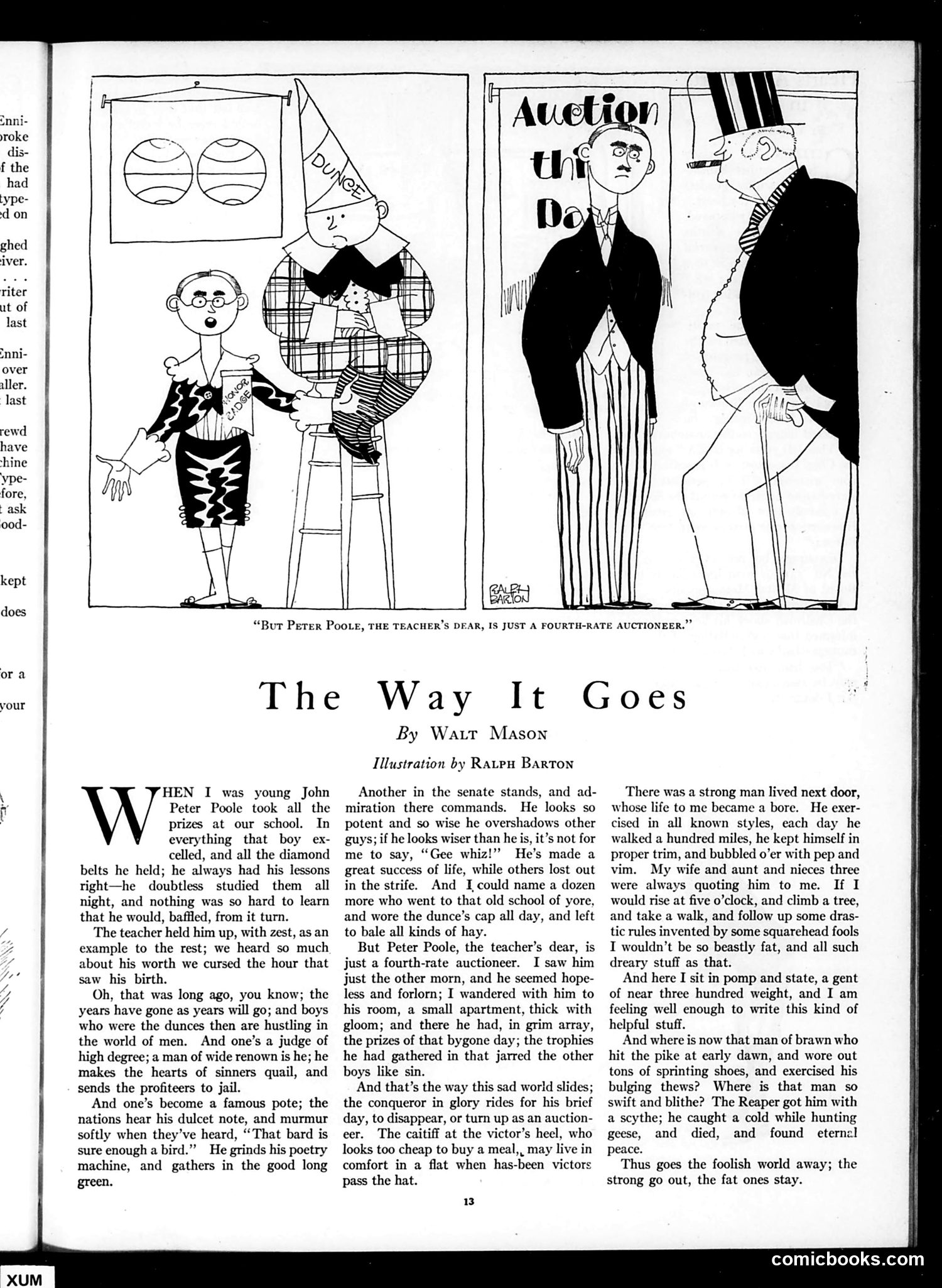
This is a humorous poem with satirical cartoon commentary on life's ironies and reversed fortunes. The top cartoon illustrates the main narrative: Peter Poole was the teacher's star student—a brilliant, prize-winning boy whom others resented. Yet decades later, he's become a "fourth-rate auctioneer," while his former classmates became a judge, a famous poet, and a senator—all successful men. The caption sarcastically notes the irony. Mason's poem extends this theme: exceptional promise doesn't guarantee success, and life's outcomes are unpredictable and often unfair. The accompanying verse satirizes health obsession and physical prowess, noting that a vain strongman neighbor who obsessively exercised eventually died of a cold, while the sedentary narrator thrives in "pomp and state." The overall message: fortune is fickle, hard work doesn't guarantee reward, and the world operates by absurd, contradictory rules—a common theme in Judge's satirical commentary on American life.
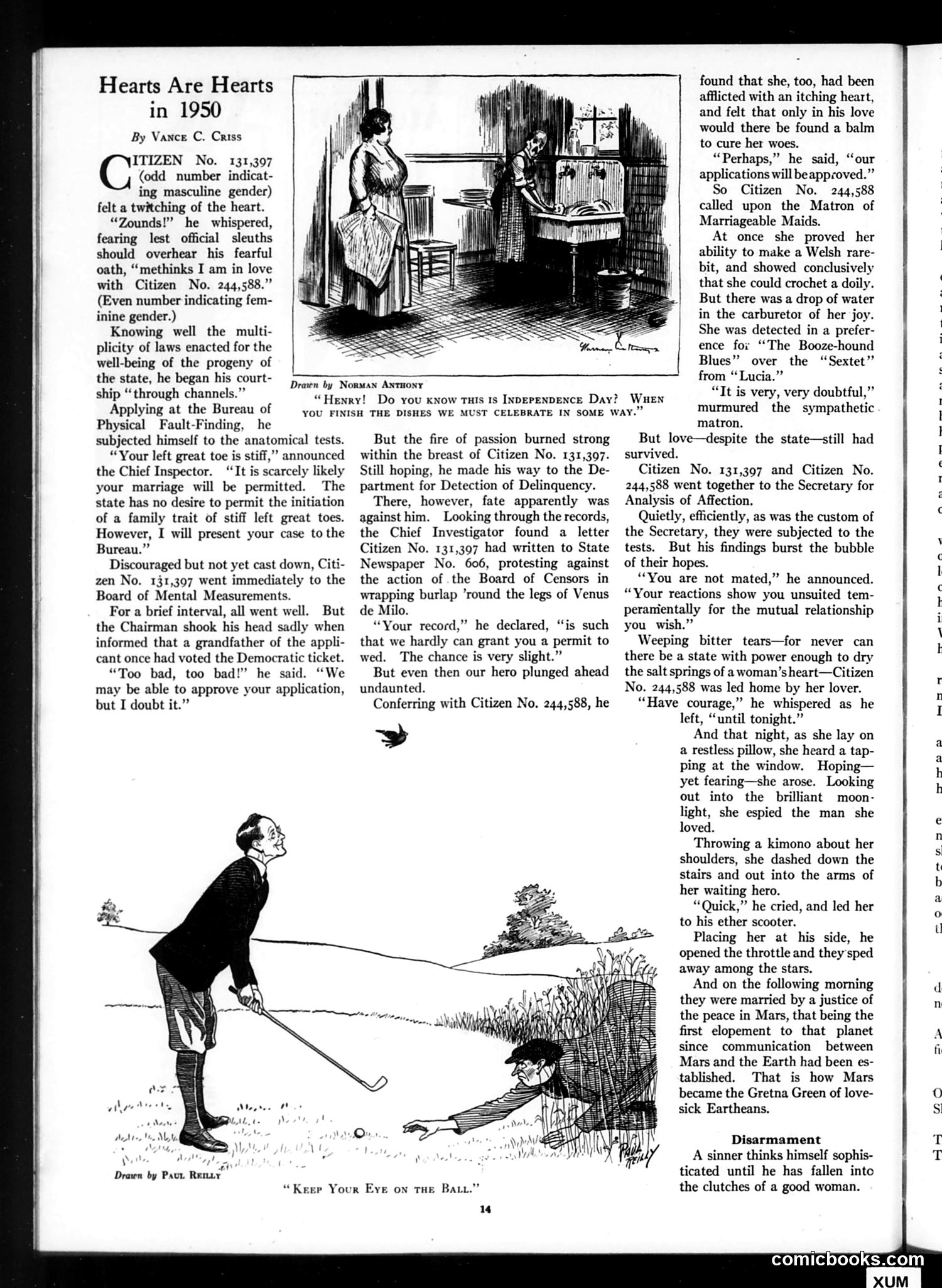
This story satirizes an imagined 1950 dystopia where the state controls even romantic love through excessive bureaucracy and regulation. Two citizens (identified only by numbers) fall in love but must navigate absurd governmental approvals: the Bureau of Physical Fault-Finding rejects the man for a stiff toe; the Board of Mental Measurements objects to his grandfather's Democratic vote; the Department for Detection of Delinquency cites his protest against censoring Venus de Milo's legs. The woman fails tests for preferring "The Booze-hound Blues" to opera. Despite state rejection, they defy authority and elope via scooter to Mars—the story's escapist fantasy ending. The satire targets 1940s anxieties about creeping authoritarianism and governmental overreach into private life. The golf cartoon below, captioned "Keep Your Eye on the Ball," appears unrelated.
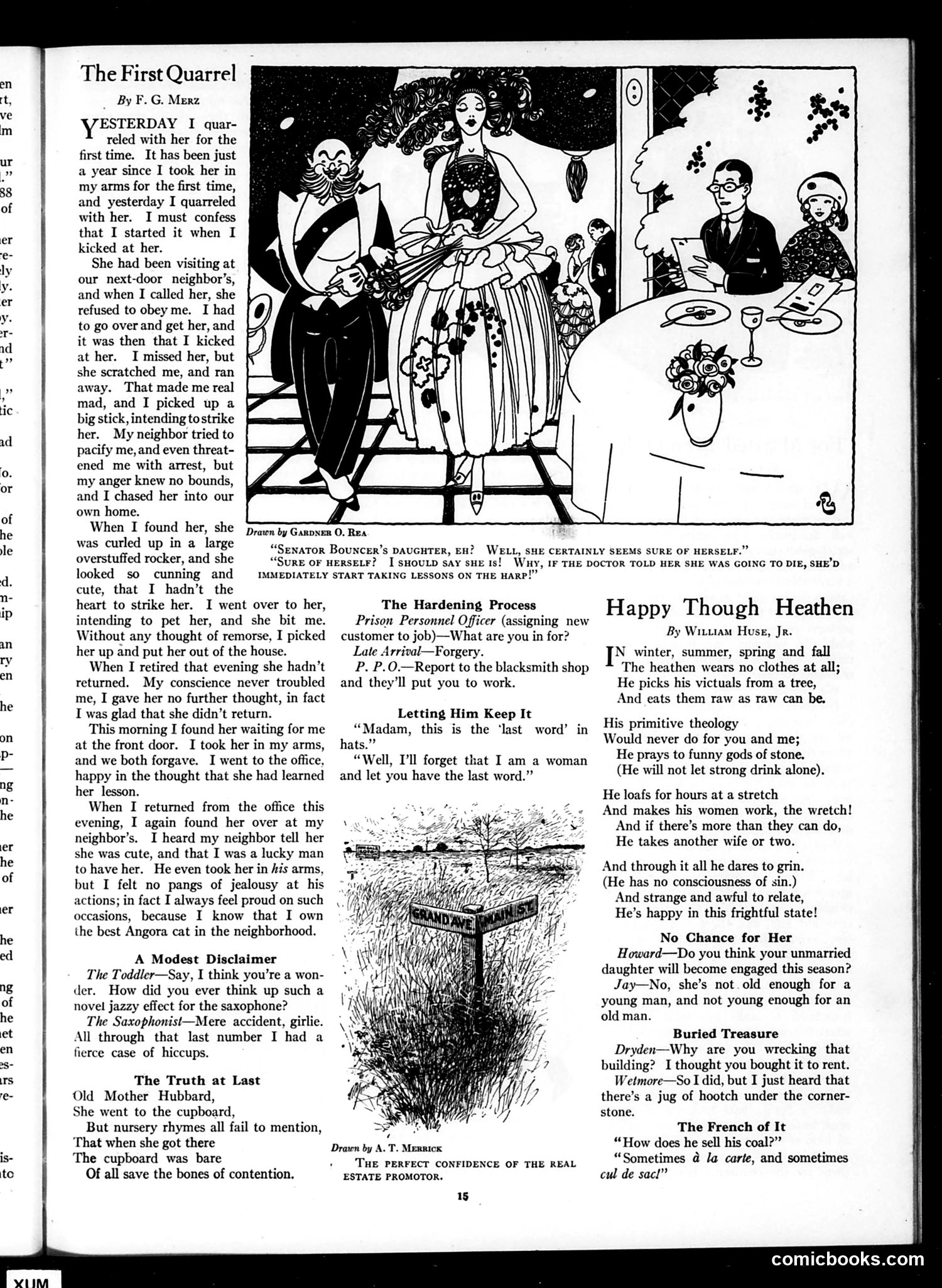
**"The First Quarrel"** (main illustration): This humorous story reveals its twist in the final paragraph—the narrator is describing a quarrel with his pet cat, not a wife. The elaborate domestic drama (kicking, chasing with a stick, reconciliation) becomes absurd comedy when readers learn it concerns an Angora cat. The joke satirizes sentimental relationship narratives popular in magazines. **"Senator Bouncer's Daughter"** (top cartoon): A woman confidently displays herself at what appears to be a social gathering. The joke mocks her supreme self-assurance—the caption suggests she's so confident that even a death sentence wouldn't humble her; she'd immediately take "lessons on the harp" (for heaven). This satirizes the vanity and overconfidence of upper-class women. The other pieces are brief humorous anecdotes about saxophonists with hiccups, nursery rhyme parodies, and hat-shop banter—typical light satire for the era.
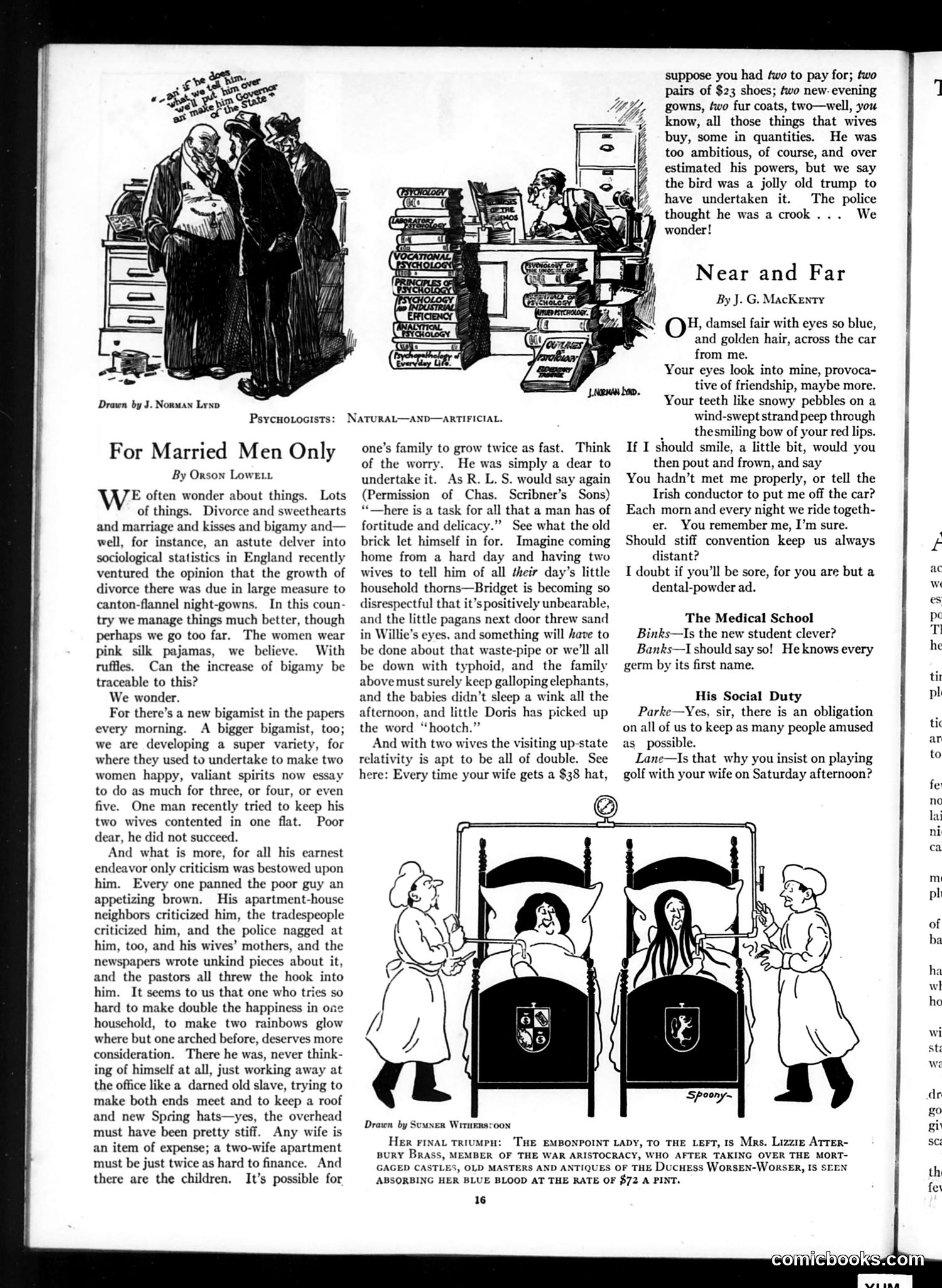
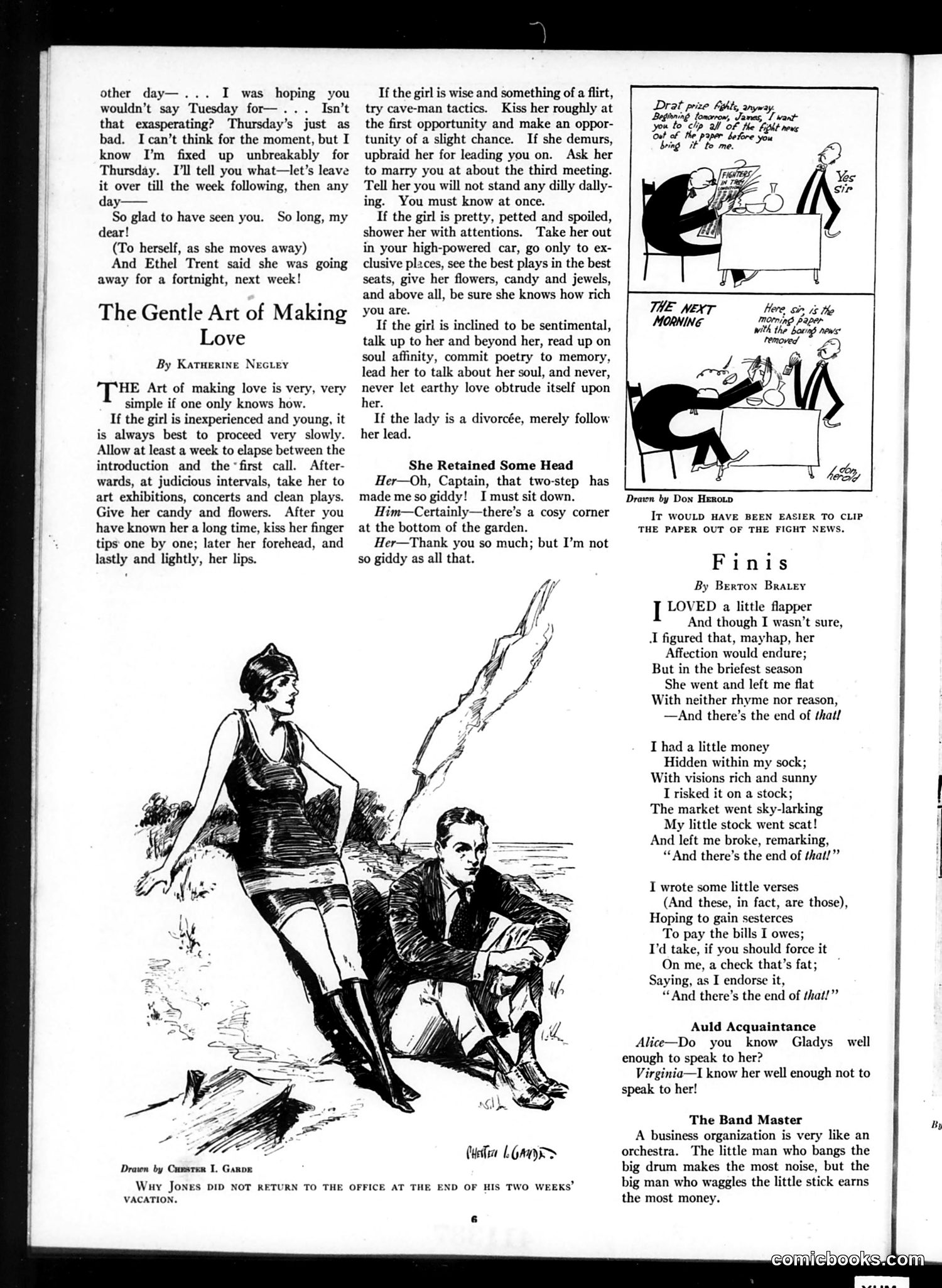
**"For Married Men Only"** is a satirical article mocking men attempting bigamy (maintaining multiple wives). The author uses deliberately absurd logic to "defend" a bigamist who kept two wives in one apartment, arguing he deserves sympathy for the financial and domestic burden. The joke operates through irony: by treating this criminal offense as an understandable economic hardship and praising his "fortitude," Lowell highlights how ridiculous such justifications sound. The accompanying cartoon by J. Norman Lind labeled "Psychologists: Natural—and—Artificial" shows two figures examining a drawer, likely contrasting genuine psychology with fraudulent analysis—perhaps commentary on how society misdiagnoses social problems. **"Near and Far"** is a brief romantic poem about a woman on a streetcar, playing with flirtation and mixed signals. The piece satirizes both contemporary bigamy scandals and the tendency to rationalize criminal behavior through pseudo-sympathetic arguments about male burden.
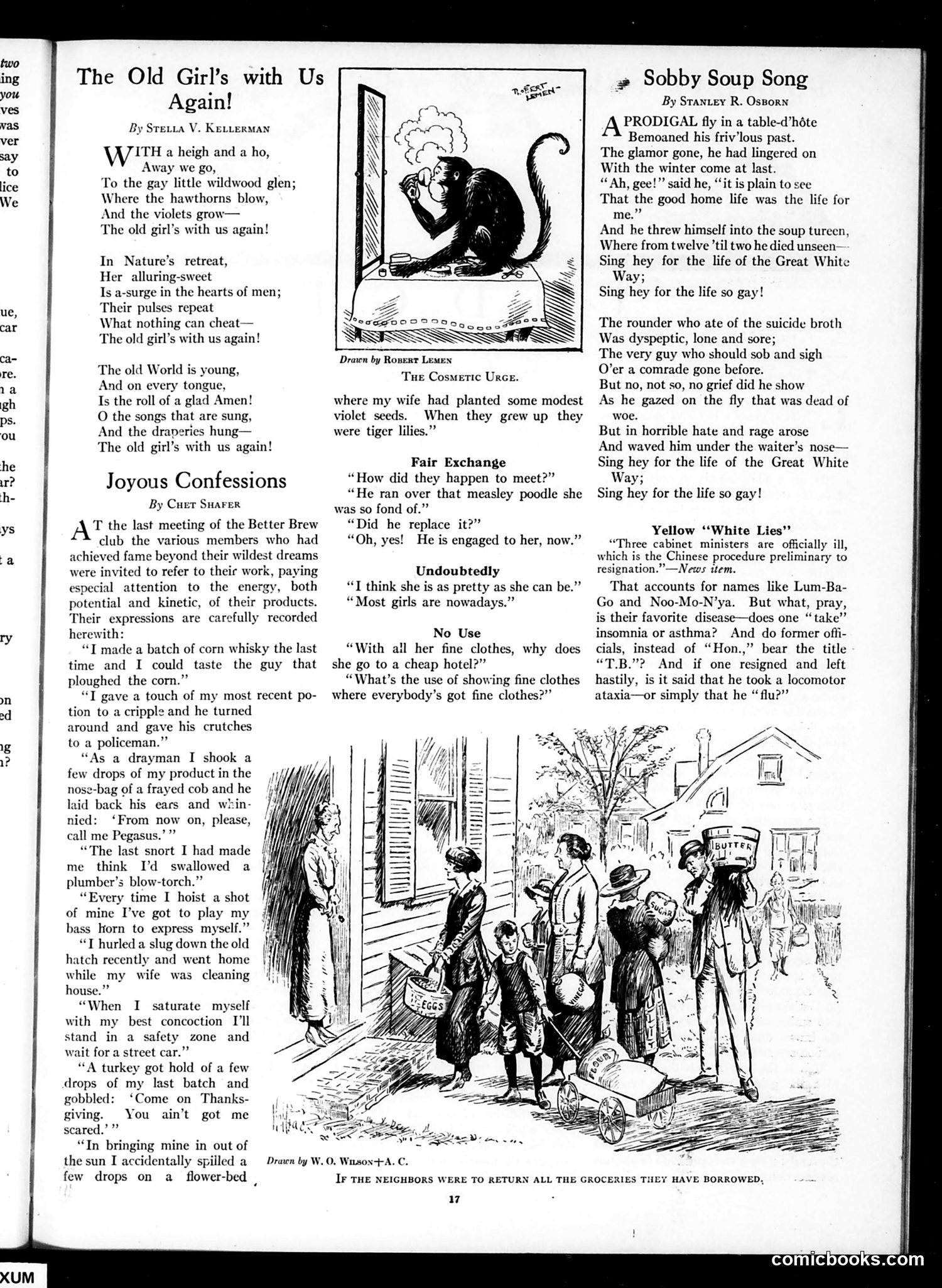
This page from *Judge* magazine contains satirical humor targeting Prohibition-era America. The "Joyous Confessions" section mocks home distillers boasting about their illegal corn whisky production—a direct jab at Prohibition enforcement failures. Each anecdote exaggerates the whisky's potency with absurdist results (a cripple abandoning crutches, a horse becoming verbose). The bottom cartoon illustrates neighbors returning borrowed groceries—satirizing Depression-era hardship and community interdependence through gentle humor about economic desperation. "The Old Girl's with Us Again" appears to be seasonal verse celebrating spring's return. The "Sobby Soup Song" darkly parodies a suicidal fly and an indifferent observer—typical *Judge* shock humor mixing morbidity with cynicism about urban life on Broadway. The brief jokes mock vanity (fine clothes at cheap hotels) and Chinese political corruption (officials feigning illness before resignation). The overall tone: irreverent satire of Prohibition lawlessness, economic struggle, and social hypocrisy—reflecting 1920s-30s anxieties.
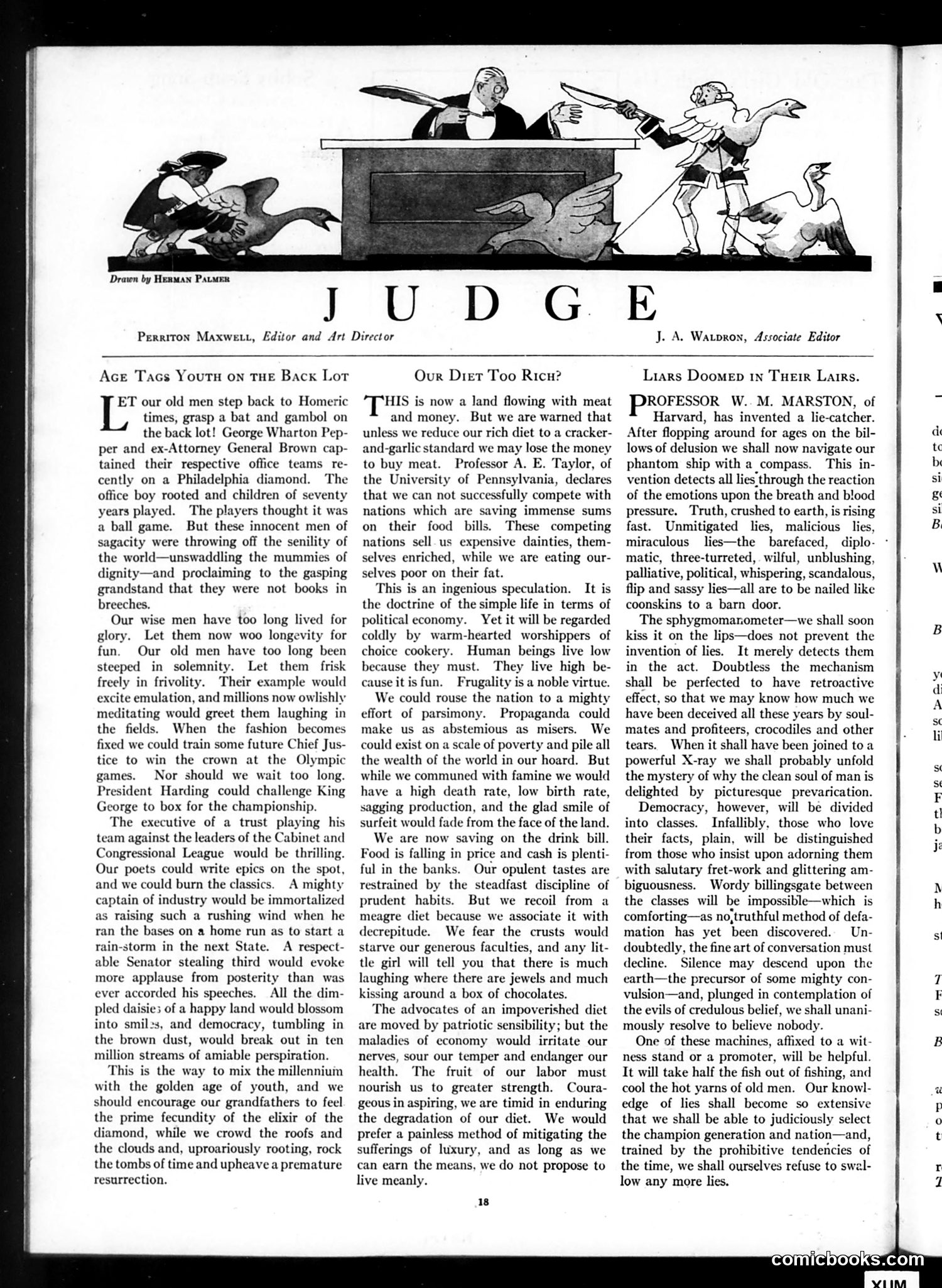
The top cartoon by Herman Palmer depicts a courtroom scene with judges and figures being thrown out or ejected, illustrating the editorial's satirical tone about authority and power. The three essays critique post-WWI American society: **"Age Tags Youth on the Back Lot"** celebrates elderly Philadelphia politicians (George Wharton Pepper and ex-Attorney General Brown) playing baseball together. The author argues that dignified elders should embrace frivolity and recreation—suggesting President Harding should box King George, and senators should steal bases—to inject vitality into American life and inspire the nation toward joy rather than grim solemnity. **"Our Diet Too Rich?"** dismisses warnings that Americans must adopt poverty diets to compete economically with other nations. Professor A.E. Taylor's "political economy" argument is mocked: the author argues that frugality destroys birthrates, production, and national morale. Prosperity and good food are presented as American virtues, not weaknesses. **"Liars Doomed in Their Lairs"** (partially visible) discusses Professor W.M. Marston's "lie-catcher" invention—an early lie detector—predicting it will expose delusion and reveal truth.
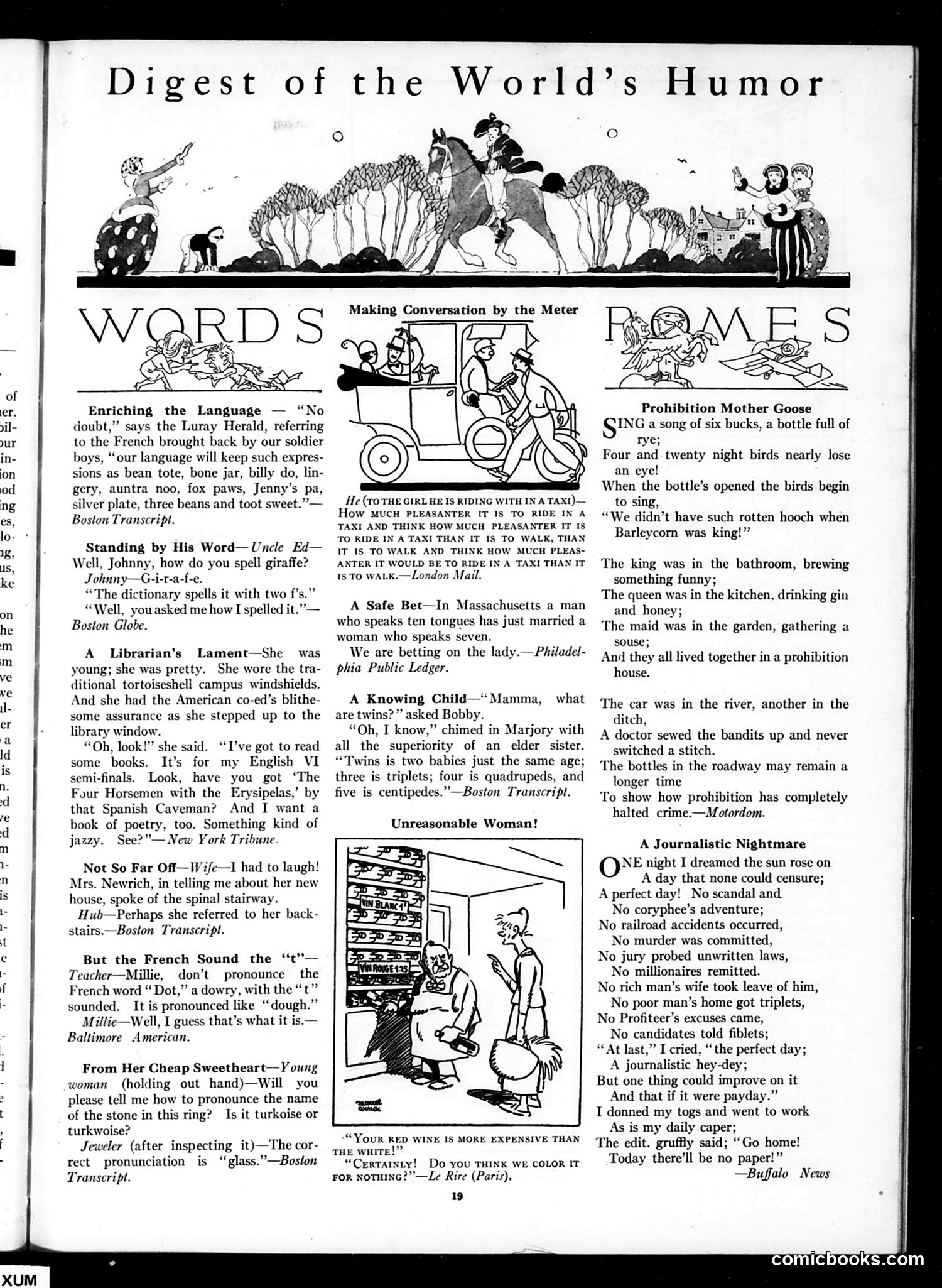
This page from *Judge* magazine collects brief humorous anecdotes and cartoons organized into "Words" and "Romes" sections. The humor relies on wordplay, malapropisms, and social observation typical of early 20th-century American satire. **Key content:** Most items mock linguistic confusion—a librarian requesting books by absurd titles, a woman mispronouncing "twins" as "centipedes," a jeweler sarcastically calling an engagement ring "glass." One cartoon depicts a couple in a taxi overthinking whether riding beats walking. **"Prohibition Mother Goose"** parodies nursery rhymes to satirize Prohibition-era lawlessness: royals brewing illegal alcohol, cars crashing into rivers, doctors stitching up bandits—all while claiming prohibition "halted crime." The bitter irony criticizes Prohibition's actual failure to prevent crime and alcohol consumption. **"A Journalistic Nightmare"** envisions an impossibly scandal-free news day, mocking journalism's dependence on sensationalism and crime reporting—suggesting newspapers cannot function without disasters, scandals, and human tragedy to report.
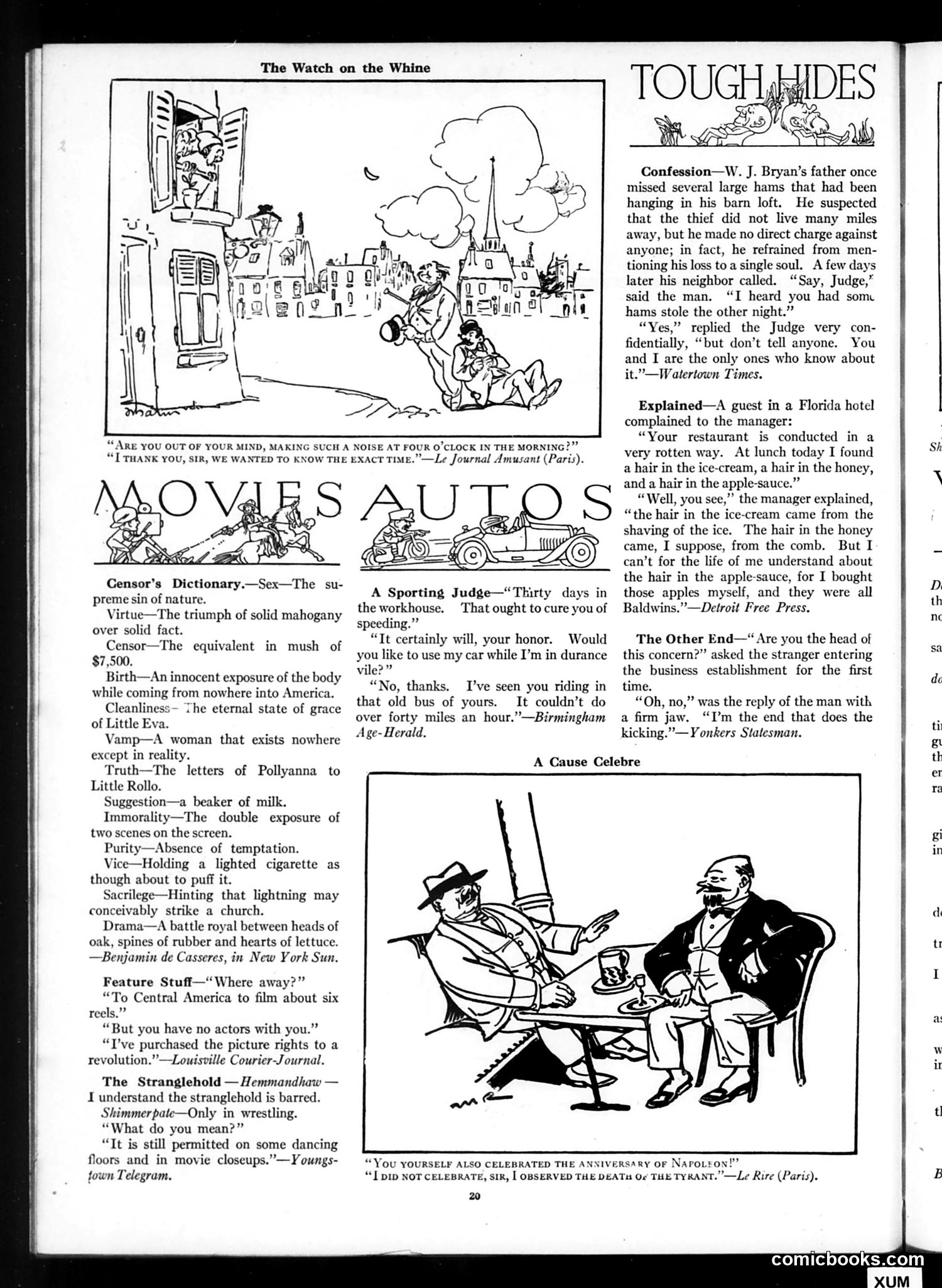
This page from the satirical magazine *Judge* contains humor pieces mocking film censorship and social hypocrisy circa the 1920s. **"The Watch on the Whine"** (top cartoon) depicts a city official complaining about noise from a film studio at 4 a.m., while the studio produces movies—ironic given censors' obsession with controlling "immoral" content. The "Censor's Dictionary" that follows sarcastically defines how movie censors twist language to suppress realistic depictions of life (birth, sex, vice) while permitting obvious substitutes (milk as "suggestion," cigarettes as "vice"). **"A Cause Celebre"** (bottom cartoon) shows two men discussing Napoleon. One claims to have celebrated Napoleon's anniversary; the other corrects him: "I observed the death of the tyrant." This mocks how people frame identical historical events differently based on political viewpoint. The scattered jokes between attack censorship's absurdity, film producers' ethics, and judicial hypocrisy. The overall message critiques how authority figures—censors, judges—speak in euphemisms while enabling the very behaviors they officially condemn.
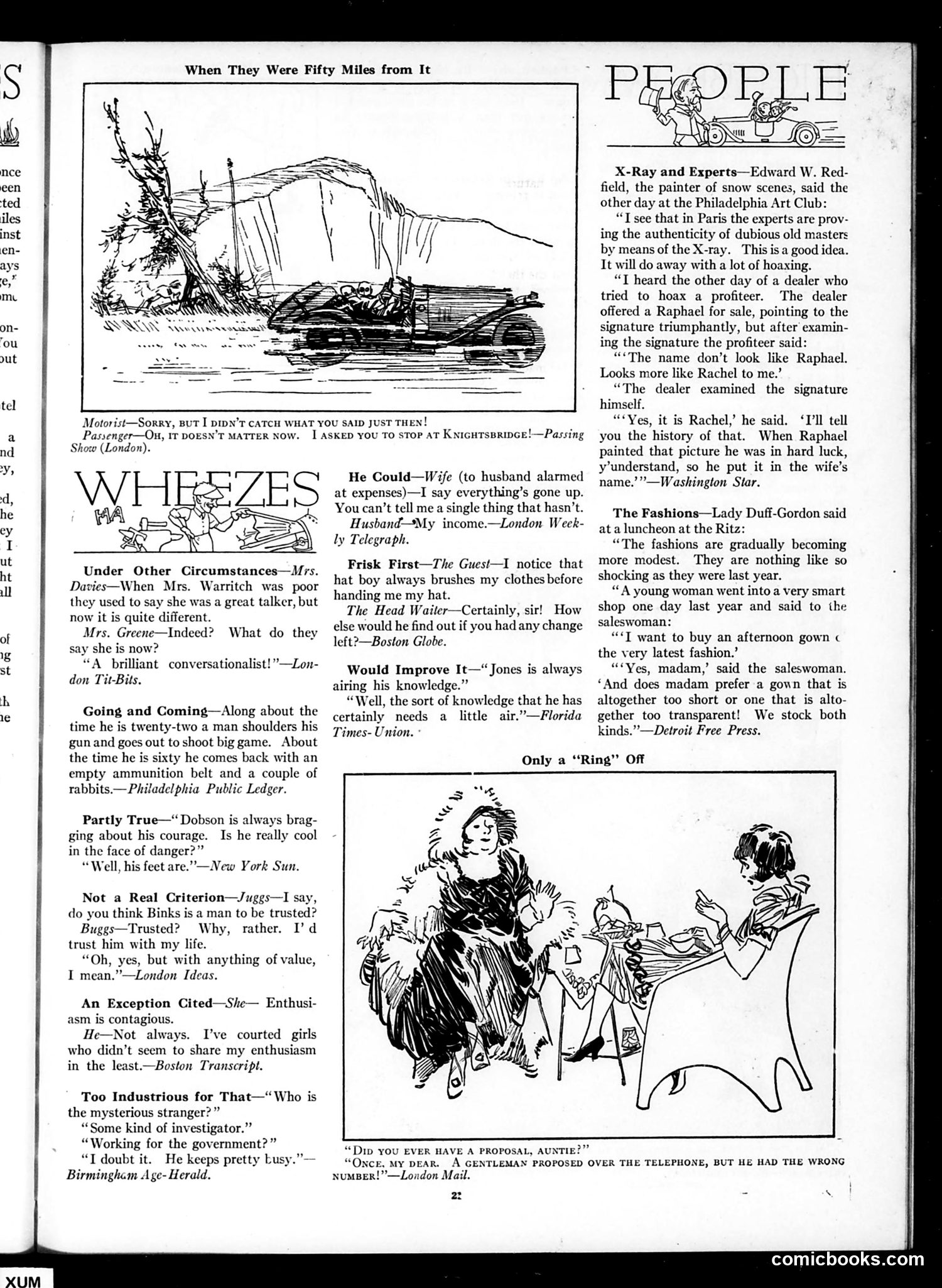
This page contains short humorous anecdotes typical of early 20th-century satirical magazines, plus one illustrated cartoon. **The "Ring" Off cartoon** (bottom) depicts a woman showing a ring to a younger woman, joking that a gentleman once proposed to her over the telephone but dialed the wrong number—implying he meant to propose to someone else. The humor relies on the novelty and awkwardness of telephone proposals, a technology still relatively new and unreliable. **The other items** are brief jokes on various topics: a motorist's loud car making conversation impossible; a formerly talkative poor woman becoming quiet once wealthy (social commentary on status); a man's hunting prowess declining with age; skepticism about trustworthiness; and a hotel waiter using coat-brushing as opportunity to detect loose change from guests. The content reflects period concerns: new technology (automobiles, telephones), class mobility, aging, and servants' ingenuity. The tone is light and observational rather than politically pointed.
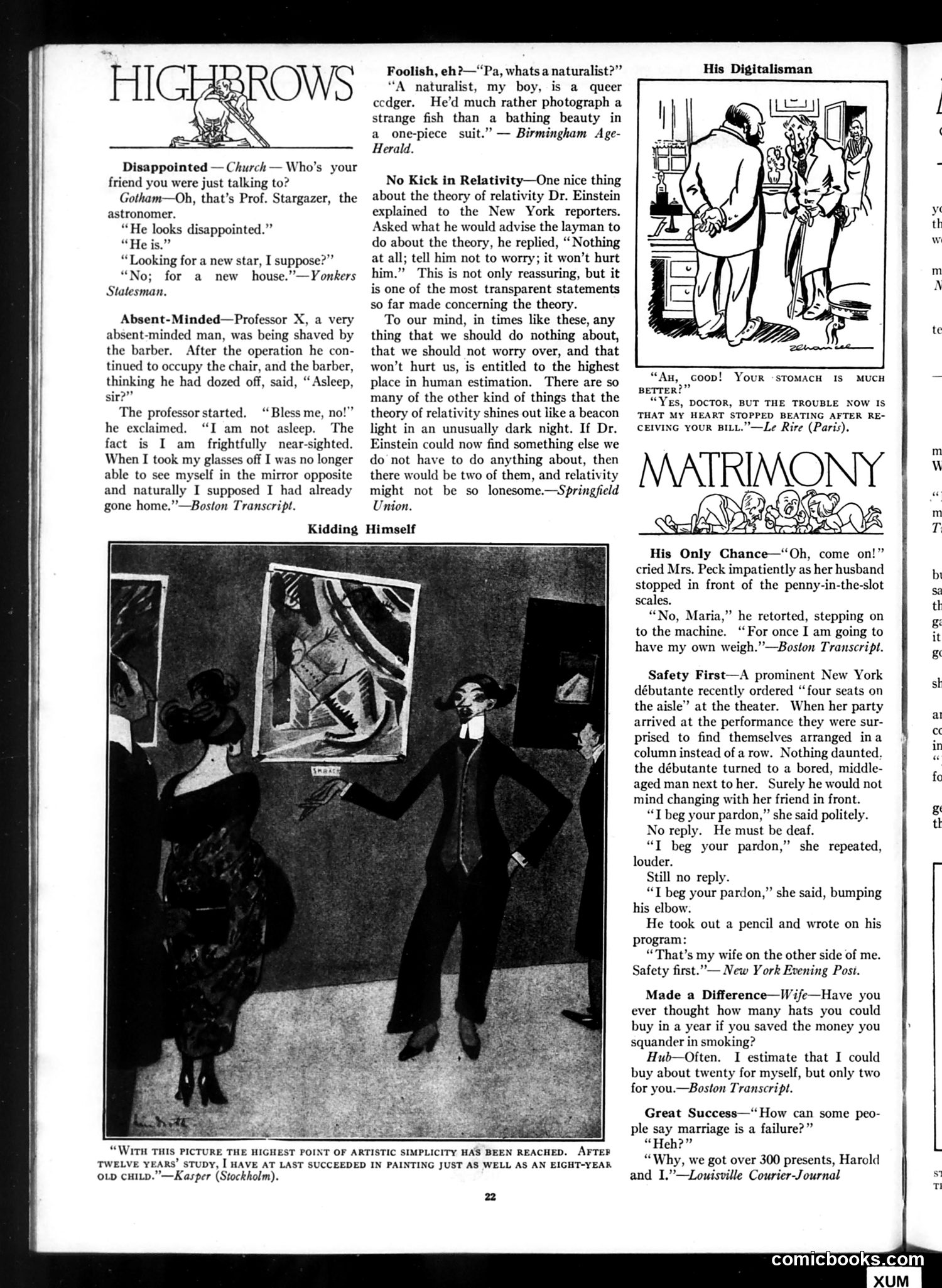
This page contains several brief humorous anecdotes typical of early 20th-century satirical magazines. The main cartoon ("Kidding Himself") shows an artist examining his work beside reference paintings, satirizing delusional self-assessment—after twelve years of study, he believes he's finally painting as well as an eight-year-old child. The text snippets mock various subjects: an astronomer disappointed about housing rather than celestial discovery; a near-sighted professor who removed his glasses during a shave; and definitions of naturalists as men who prefer photographing fish to bathing beauties. Most prominently, several jokes address Einstein's relativity theory, presenting it as reassuringly irrelevant to ordinary people's worries—a contemporary response to complex scientific concepts baffling the public. The remaining anecdotes target marital dynamics, with humor derived from spouses' contrasting priorities and mutual financial criticism—standard Judge fare reflecting early-century American domestic comedy conventions.
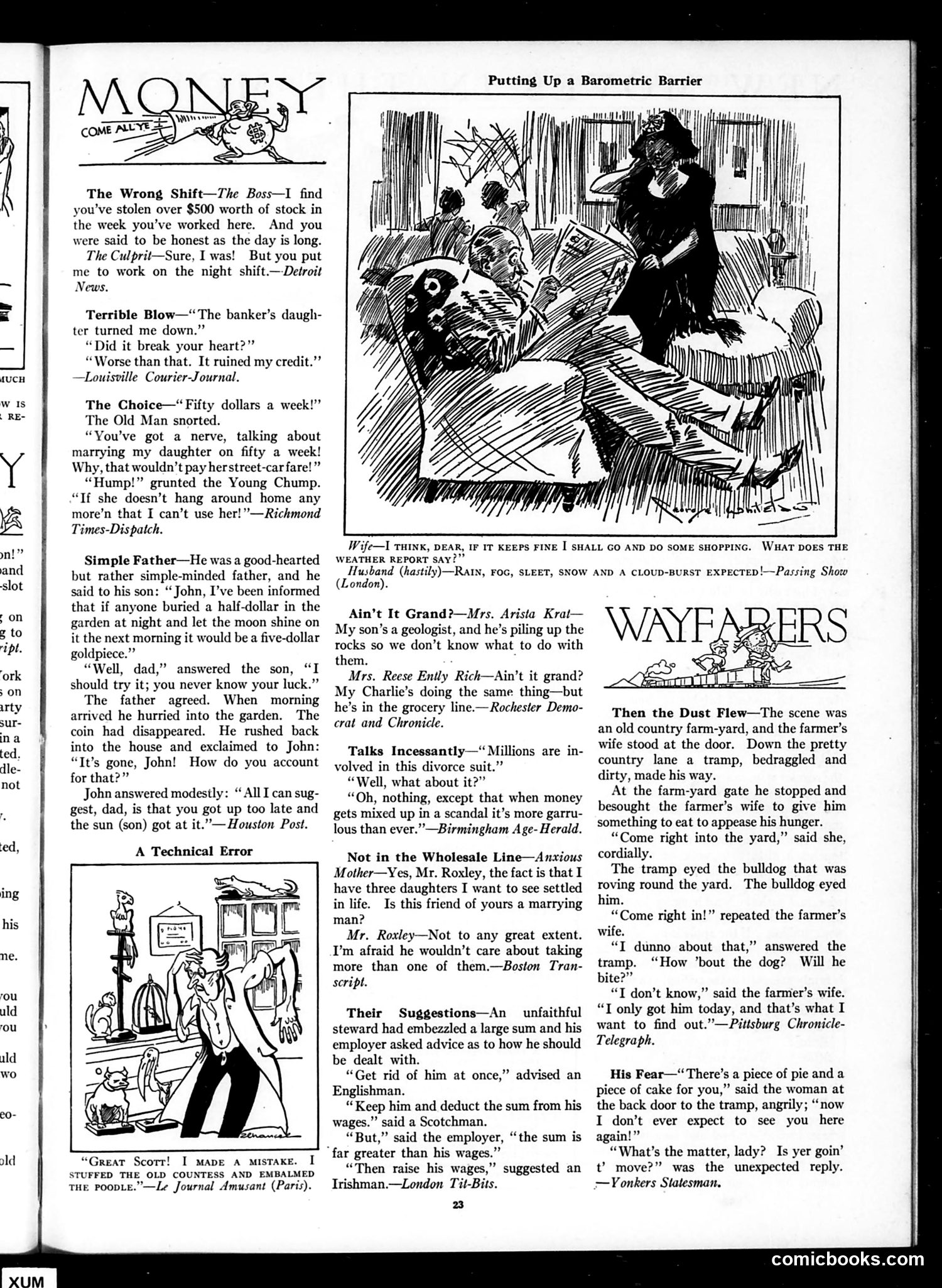
This page contains **humorous anecdotes and cartoons** rather than political satire. The content reflects early 20th-century American attitudes toward class, morality, and domestic life. **Key items:** The **"Wrong Shift"** joke satirizes how environment corrupts character—a supposedly honest worker steals when assigned night shifts, implying moral weakness or desperation. **"Putting Up a Barometric Barrier"** depicts a husband lying about weather forecasts to prevent his wife from shopping, playing on stereotypes about wives' spending habits and marital manipulation. **"Then the Dust Flew"** is a shaggy-dog story about a tramp's encounter with a farmer's uncertain bulldog—the joke relies on suspense and anticlimactic rural humor. Other items mock wealthy pretension ("Ain't It Grand?"), divorce scandals, and Irish/Scottish/English national stereotypes in "Their Suggestions." The cartoons are **social humor** targeting recognizable types (bosses, suitors, stewards, wives) rather than specific political figures or events.
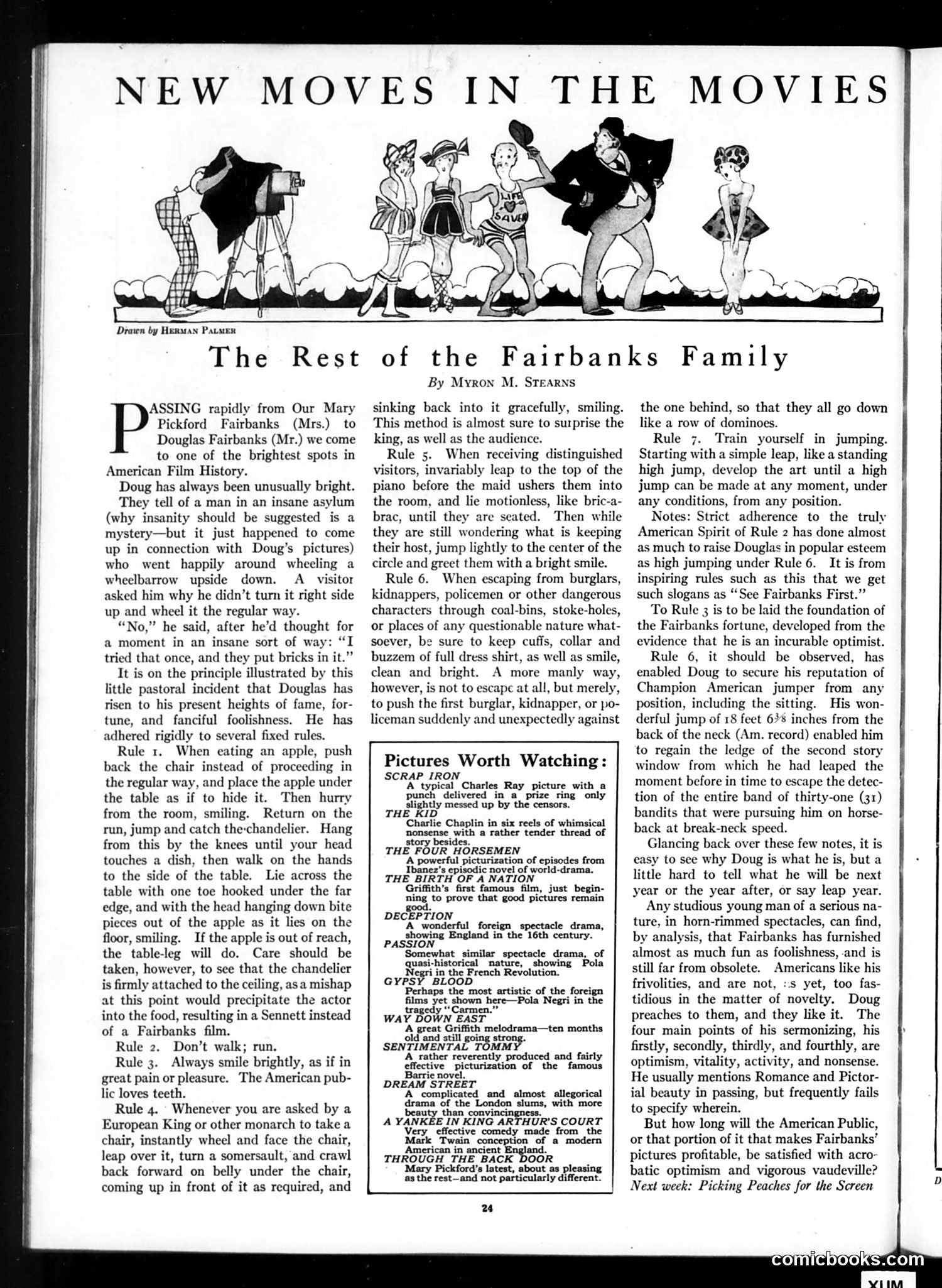
This is a satirical article about Douglas Fairbanks Sr., a major silent film star known for acrobatic stunts and physical comedy. The piece humorously documents six absurd "rules" that supposedly explain Fairbanks' success—each describing increasingly ridiculous physical feats (eating apples while hanging from chandeliers, leaping over chairs, escaping burglars while maintaining formal dress). The satire mocks both Fairbanks' actual stunt-heavy films and the American public's appetite for such spectacle. The opening anecdote about an asylum inmate with an upside-down wheelbarrow suggests that Fairbanks' success comes from rejecting conventional logic—that audiences reward absurdity over practicality. The accompanying illustration shows various film personalities in exaggerated poses. Below are brief reviews of contemporary films, including Chaplin's "The Kid" and Griffith's "The Birth of a Nation," placing this within 1920s film culture.
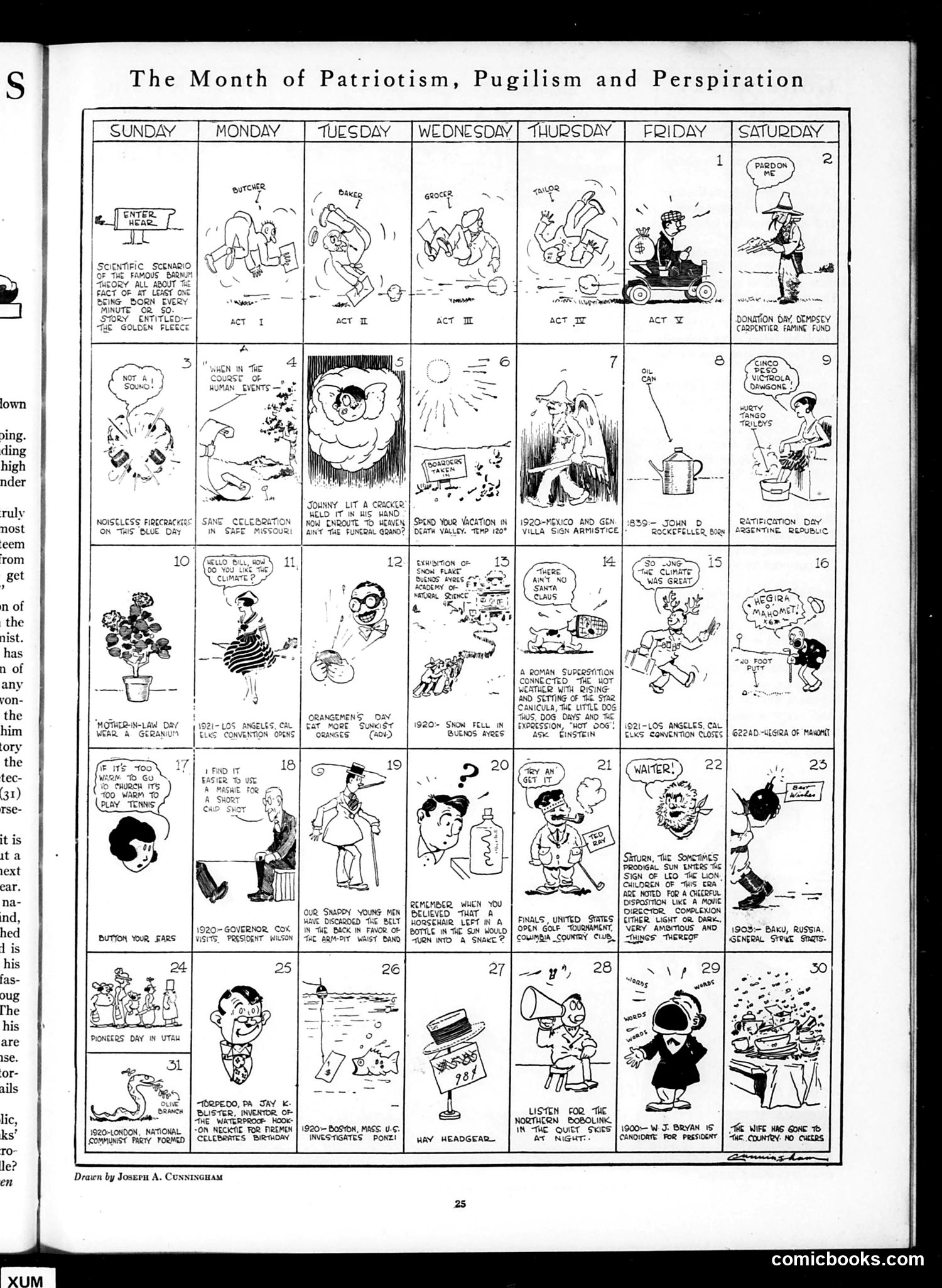
This is a daily comic calendar satirizing American events and figures from 1920. The page mixes topical humor with absurdist jokes: **Key References:** - The Dempsey-Carpentier boxing match (famous 1921 fight, referenced multiple times) - Governor Cox visiting President Wilson (1920 election context) - The Ponzi scheme investigation (Charles Ponzi's famous fraud) - William Jennings Bryan's candidacy - Various arbitrary "historical" dates presented as real events - Social customs (fashion, dating, superstitions) **The Satire:** Judge ridicules American gullibility and fascination with celebrity spectacles—boxing matches, financial schemes, political theater—by treating them alongside invented "facts" (horsehair snakes, fireworks accidents, arbitrary "days"). The title's mention of "pugilism" emphasizes boxing mania. The overall effect mocks contemporary American preoccupations with sensationalism over substance during the Jazz Age. **Artist:** Joseph A. Cunningham
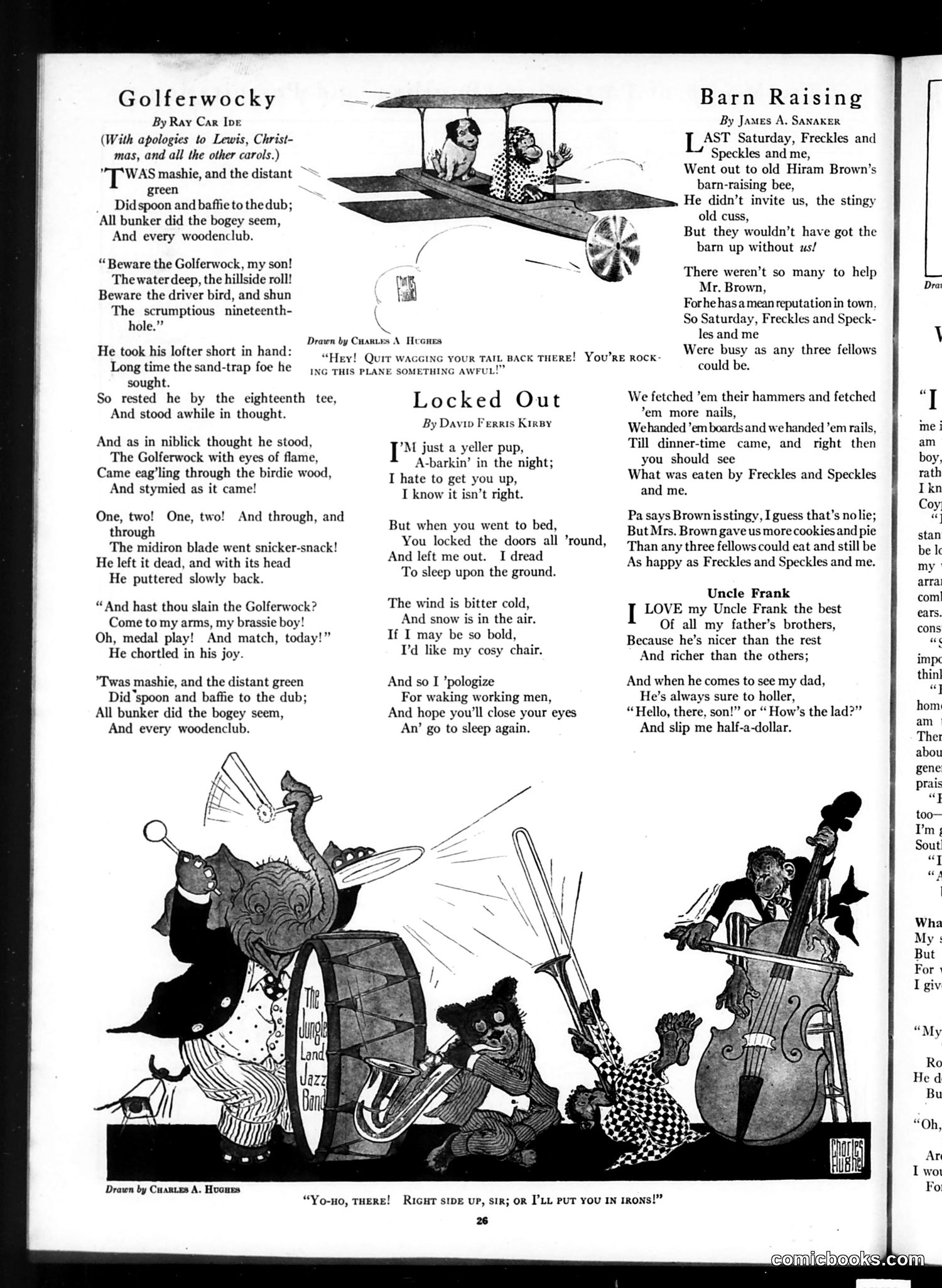
This page contains three humorous poems aimed at early 20th-century readers: **"Golferwocky"** parodies Lewis Carroll's "Jabberwocky," substituting golf terminology (mashie, baffie, niblick, stymie) for Carroll's nonsense words. It mocks golf's pretentious jargon and obsessive culture—popular among the wealthy during this era. **"Locked Out"** presents a sentimental poem from a dog's perspective, locked outside in winter. It's sentimental humor typical of the period, playing on readers' affection for animal tales. **"Barn Raising"** depicts rural American communal cooperation—a barn-raising was a traditional gathering where neighbors helped construct a building. The poem humorously suggests that even an unpopular, stingy neighbor benefits from this generosity, and the boys' reward is food. The cartoons feature exaggerated character designs common to Judge's illustrative style. The overall page reflects Judge's mix of parody, sentimental Americana, and gentle social observation—entertainment for an educated, middle-to-upper-class readership familiar with golf, children's literature, and rural traditions.
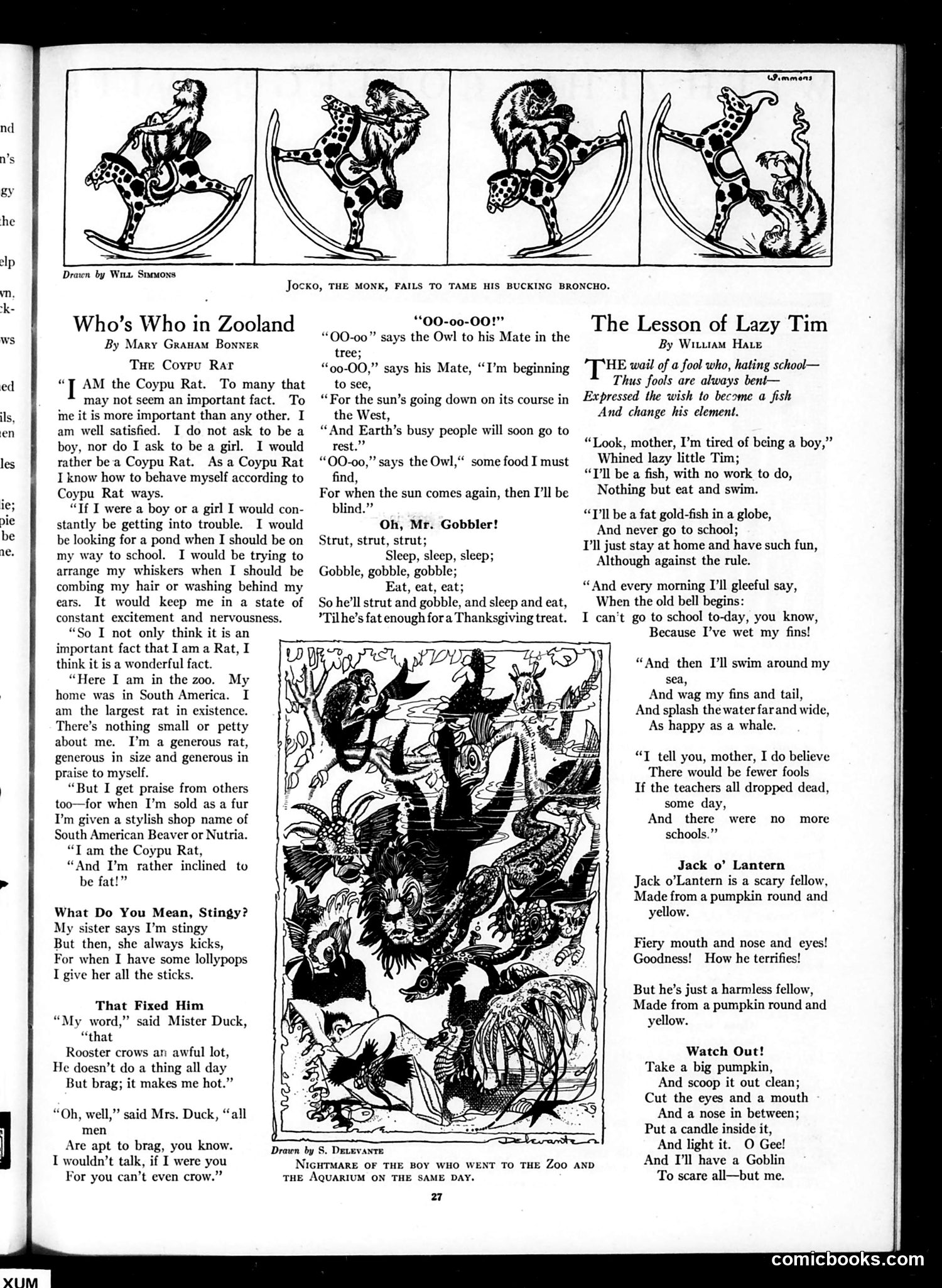
This page contains children's animal fables and humorous verse typical of early 20th-century American magazines. **Top cartoon**: Shows a monk riding a bucking bronco in four sequential panels—a simple visual gag about an animal refusing to be tamed. **Main content**: Three didactic stories with morals for young readers: 1. **"The Coypu Rat"**: A self-satisfied rodent boasts about being content with its identity, satirizing pompous self-satisfaction. 2. **"The Lesson of Lazy Tim"**: Moral tale where a boy wishes to become a fish to escape school, expressing fantasies about avoiding responsibility. The poem ends implicitly warning against such foolish thinking. 3. **"Jack o'Lantern"**: Explains the Halloween pumpkin decoration as harmless despite appearing frightening—likely aimed at easing children's fears. Supporting verses include animal humor ("What Do You Mean, Stingy?" about a duck) and a large illustration labeled "Nightmare of the Boy Who Went to the Zoo and the Aquarium on the Same Day," depicting surreal animal chaos. The page is primarily **entertainment and moral instruction for children**, not political satire.
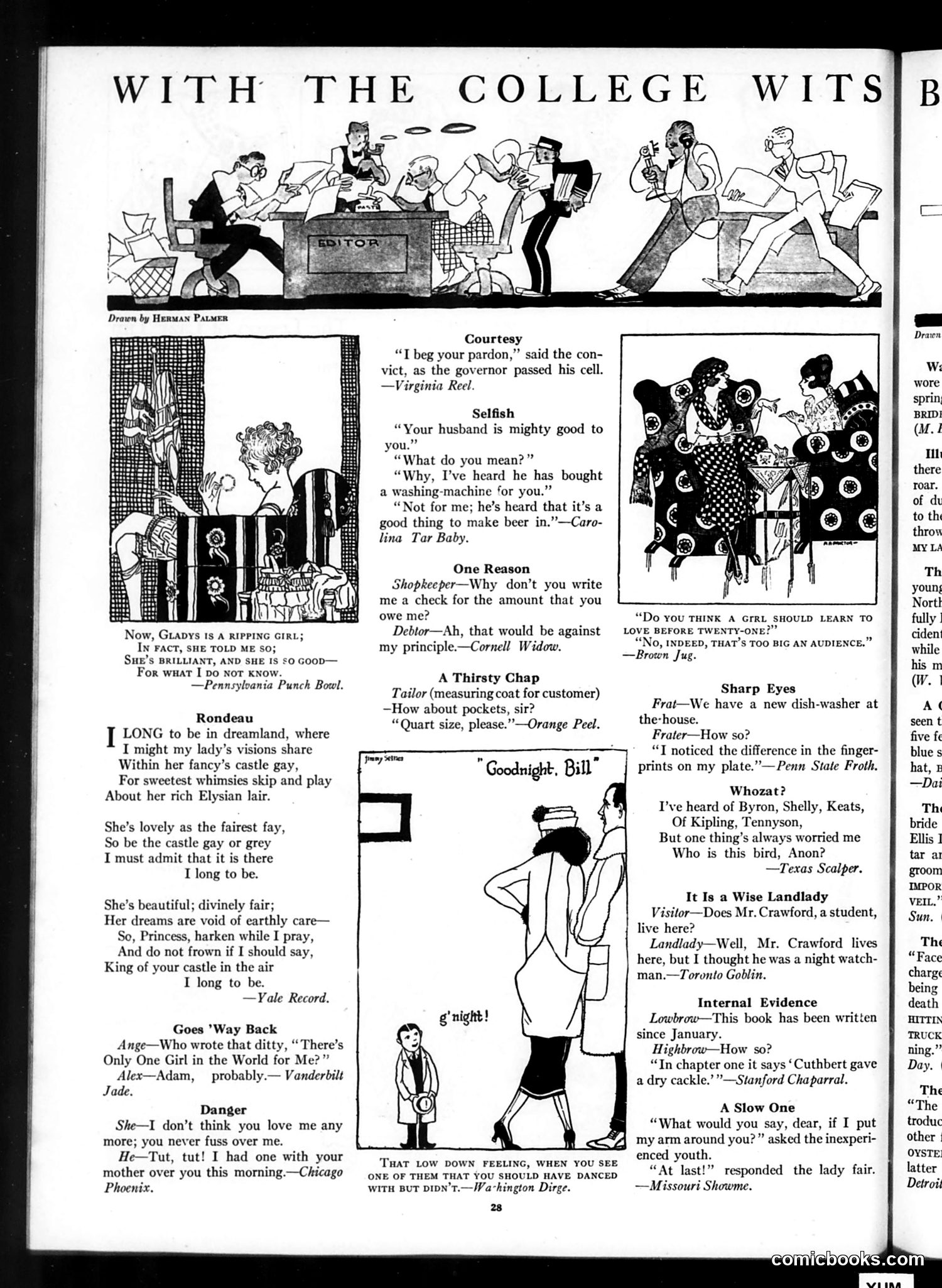
This page collects humorous short jokes and verses sourced from college and university humor publications (Yale Record, Cornell Widow, Penn State Froth, etc.). The content reflects early 20th-century collegiate humor. The jokes target familiar targets: romantic incompetence ("What would you say if I put my arm around you?"), domestic economics (a husband buying a washing machine to make beer in), student poverty (a tailor asking about pocket size; a debtor avoiding checks on principle), and literary pretension (not recognizing the author "Anon"). The top cartoon by Herman Palmer depicts an editorial office chaos—likely satirizing college newspaper operations. The pieces assume an audience of young, educated readers familiar with references to Byron, Keats, and Tennyson, and comfortable with gentle mockery of romantic idealism, student finances, and academic life. The humor is wholesome and domestically focused rather than political.
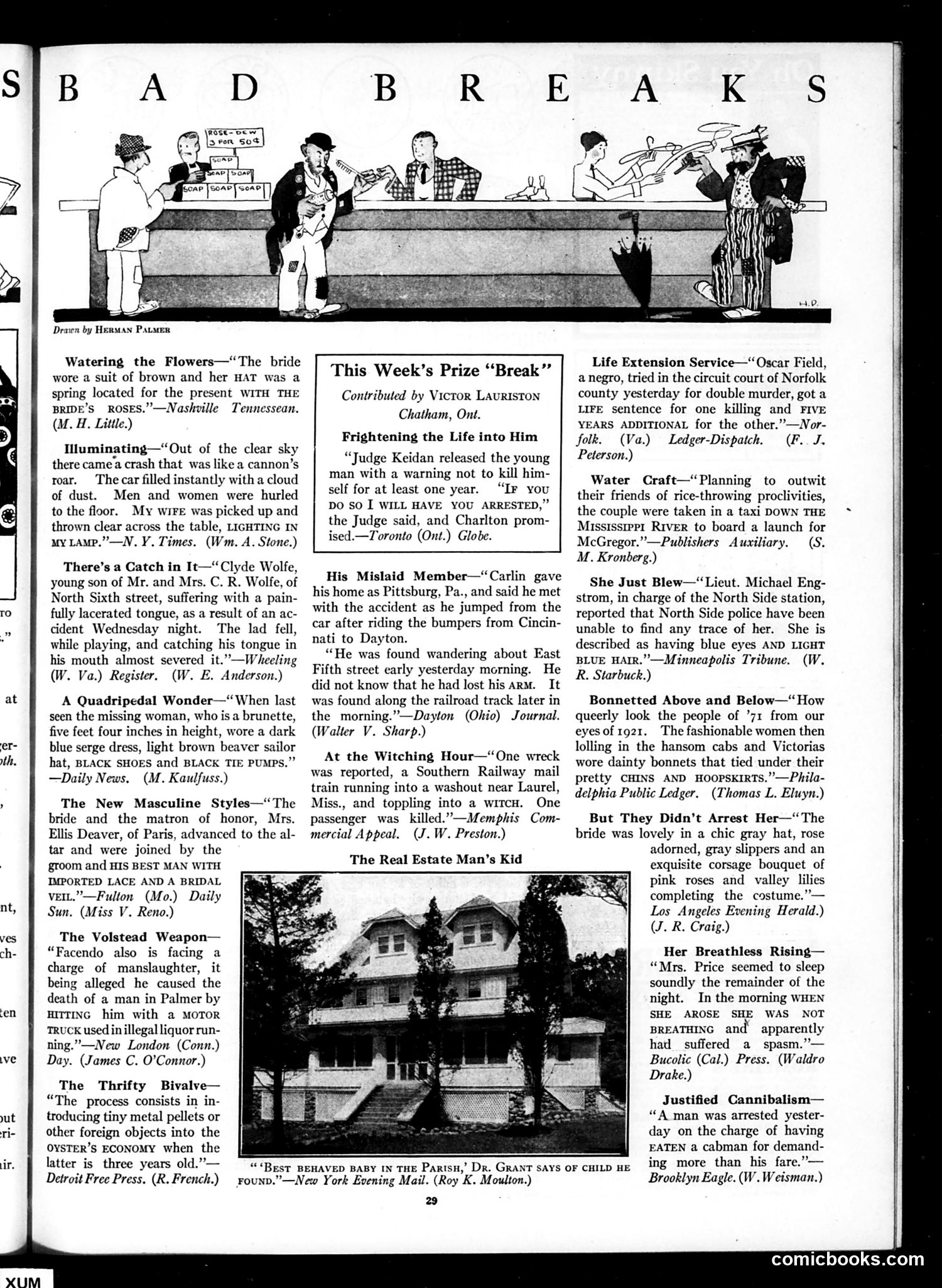
This is a humor column from Judge magazine featuring "breaks"—amusing contradictions or absurdities extracted from newspaper clippings. The top cartoon by Herman Palmer depicts a soda fountain scene, likely satirizing Prohibition-era speakeasies operating under the guise of legitimate businesses. The column collects real newspaper excerpts highlighting unintentional comedy through poor wording or reporting. Examples include: a bride's hat described as a "spring," a judge warning a man not to kill himself (then threatening arrest if he does), a man losing his arm without noticing, and a judge sentencing someone to both "life" and "five years additional"—logically contradictory punishments. The humor derives from newspapers' careless language and absurd juxtapositions. The "prize break" mocks judicial illogic. The feature satirizes American journalism's incompetence while entertaining readers through these verbal mishaps—typical of Judge's mid-century satirical approach.
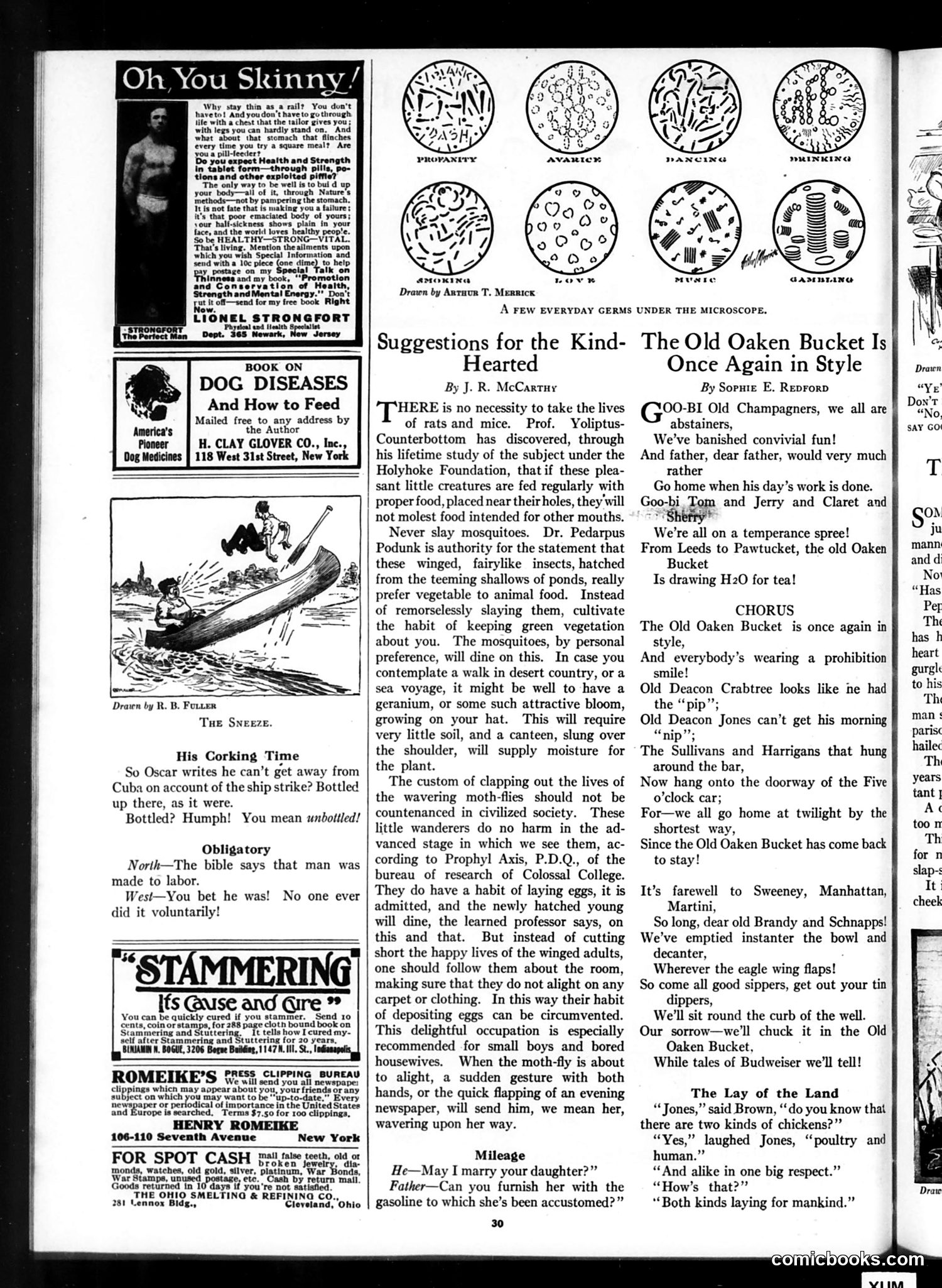
This Judge magazine page primarily contains **advertisements and light humor pieces** rather than political satire. The key elements are: **"Oh You Skinny!"** (top left): A bodybuilding advertisement by Lionel Strongfort, mocking excessively thin men who presumably lacked confidence and proper diet. **"Suggestions for the Kind-Hearted"** (center): A satirical piece gently mocking overly sentimental attitudes. It mocks those who refuse to kill household pests—rats, mosquitoes, and moths—suggesting absurd alternatives like growing geraniums on your hat to distract mosquitoes. This targets upper-class sentimentality and impractical idealism. **"The Old Oaken Bucket Is Once Again in Style"** (right): A humorous poem celebrating a temperance revival, mocking those abandoning alcohol during Prohibition. **Miscellaneous items**: Short gag jokes ("His Corking Time," "Obligatory"), classified ads (dog medicines, press clipping services), and microscopic germ illustrations complete the page. It reflects early 1920s American consumer culture and Prohibition-era attitudes.
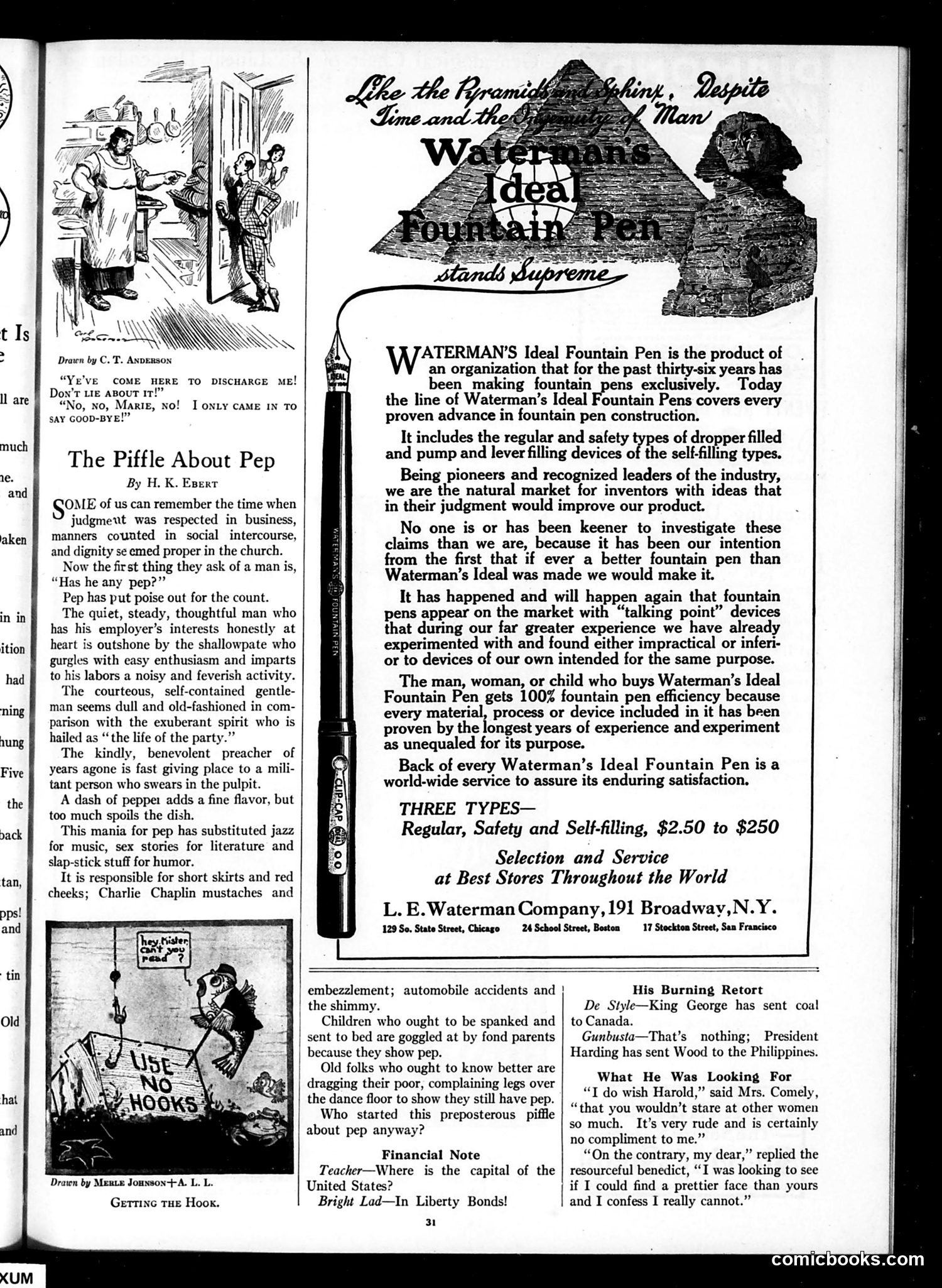
This article by H.K. Ebert critiques the 1920s obsession with "pep"—energetic, enthusiastic behavior that had become culturally valorized. The author argues this emphasis on constant vigor and superficial excitement has displaced older virtues: quiet judgment, dignity, courtesy, and thoughtfulness. Ebert catalogs complaints: pep has replaced refined music with jazz, serious literature with sensational stories, and proper decorum with "slap-stick stuff." He links it to social problems—short skirts, red cheeks, "Charlie Chaplin mustaches," automobile accidents, and the "shimmy" (a provocative dance). Children are indulged rather than disciplined; the elderly exhaust themselves dancing to seem youthful. The accompanying cartoons satirize this excess: one shows someone being fired but misunderstanding a farewell visit; another depicts someone caught on a "hook" (suggesting pep culture traps the foolish). The critique reflects post-WWI anxiety about changing social values and generational conflict—the "modern" 1920s seemed dangerously shallow compared to pre-war standards.
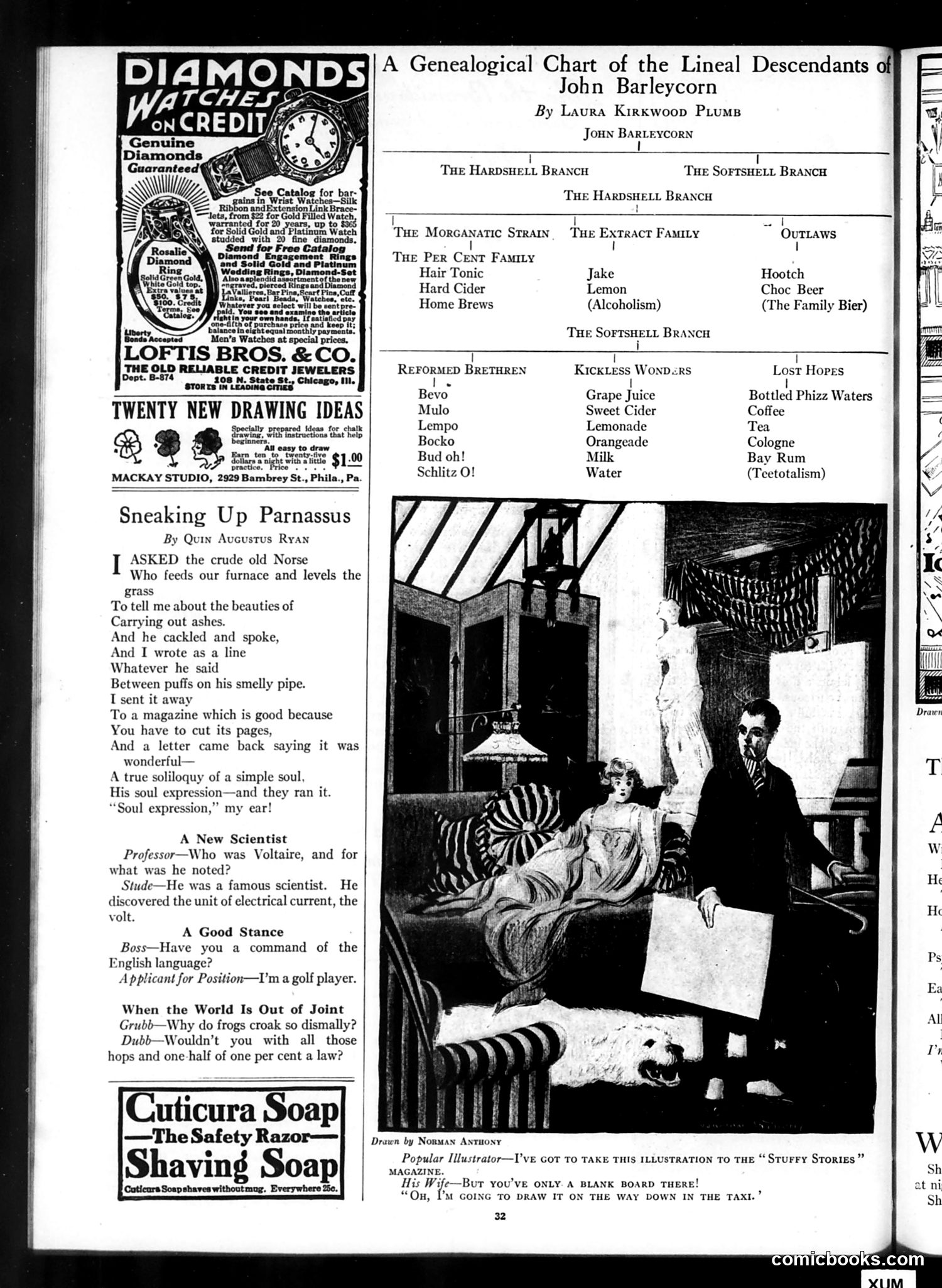
This page contains a satirical genealogical chart titled "A Genealogical Chart of the Lineal Descendants of John Barleycorn"—a personification of alcohol itself. The chart humorously traces alcohol's "family tree" during Prohibition era America, listing various drinks and their categories. The satire works by treating alcohol as if it were a noble family with branches. "John Barleycorn" is the patriarch; drinks branch into "Reformed Brethren" (non-alcoholic substitutes like Bevo, grape juice), "Kickless Wonders," and "Lost Hopes" (alternative beverages), and the "Outlaws" category (illegal drinks like "Hootch" and "Choc Beer"). The joke targets Prohibition's failure: despite legal bans, alcohol persists in various disguised forms. The chart mockingly suggests these substitutes and illegal alternatives represent alcohol's "descendants"—proof that you cannot eliminate drinking, only drive it underground or into creative workarounds.
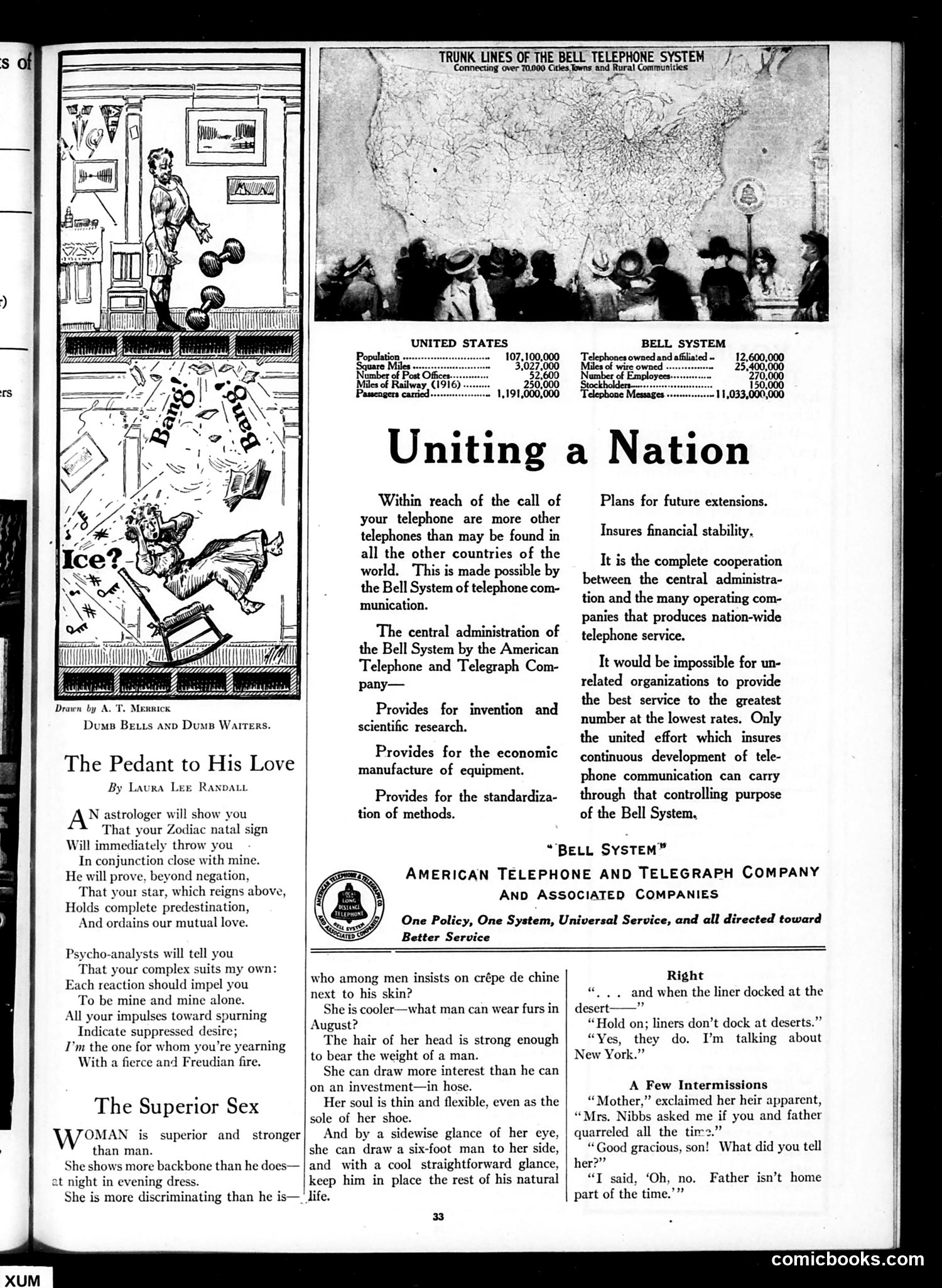
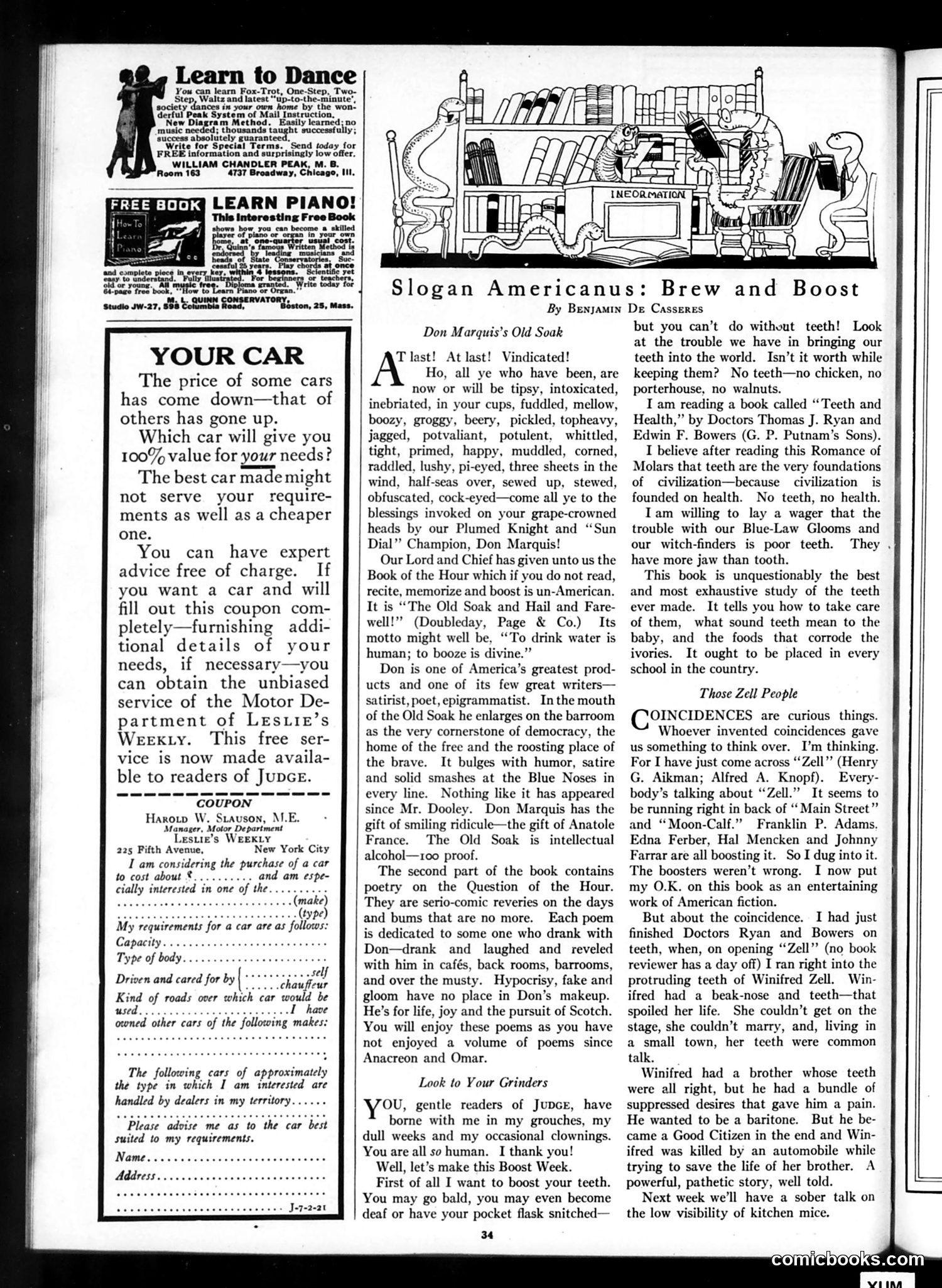
This page contains **advertisements and literary content**, not political cartoons. The main article reviews Don Marquis's book *The Old Soak*, celebrating its satirical portrayal of barroom culture as "the very cornerstone of democracy." The piece uses extensive slang for intoxication (tipsy, boozy, tight, etc.) to humorously endorse drinking—likely written during **Prohibition era** (1920-1933), when alcohol was banned. The review treats the bar as a democratic institution and criticizes "Blue Noses" (temperance advocates), positioning Marquis's work as intellectual rebellion against moral reform movements. The surrounding ads—for dance lessons, piano instruction, and automobile advice—represent typical Judge magazine filler content. The car ad notably offers free "unbiased service" to help readers find best value, suggesting post-WWI economic uncertainty where prices varied unpredictably. The final brief column muses on teeth and coincidence, seemingly unrelated to the main content.
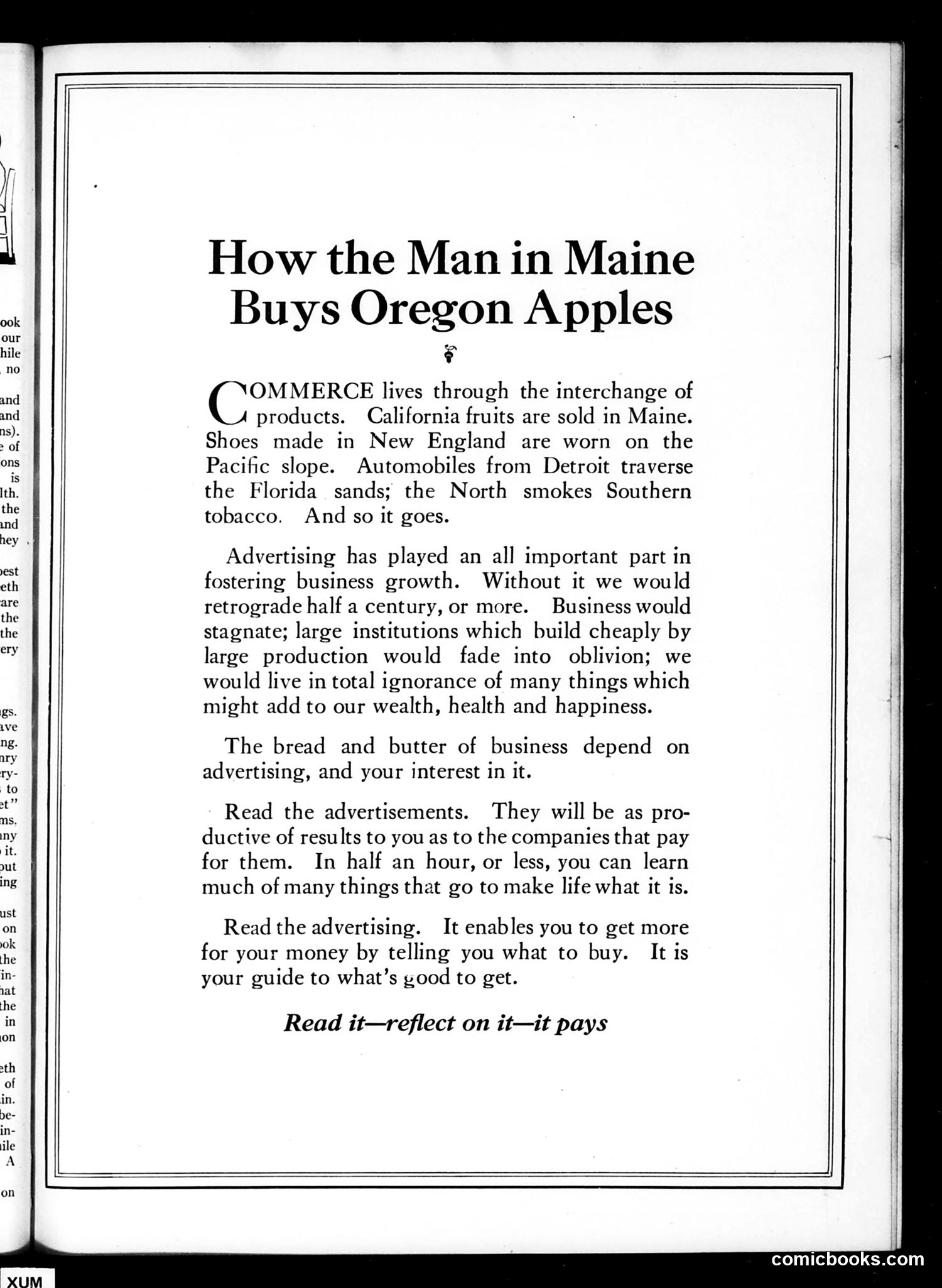
This isn't a cartoon but an **advertorial essay** promoting the value of advertising itself—a meta-advertisement appearing in *Judge* magazine. The title uses a hypothetical example (Maine buying Oregon apples) to illustrate **interstate commerce made possible by advertising**. The piece argues that advertising drives economic growth by connecting producers and consumers across distances. The argument: without advertising, business would "stagnate," large-scale production would collapse, and consumers would remain ignorant of available products. The essay frames reading ads as practically beneficial—claiming readers will learn "much of many things" and get "more for your money" in half an hour. The closing exhortation "Read it—reflect on it—it pays" frames ad-reading as a profitable personal investment, not merely corporate promotion. This reflects **early 20th-century American optimism about consumer capitalism and advertising's civilizing, democratizing role** in distributing goods and information nationally.
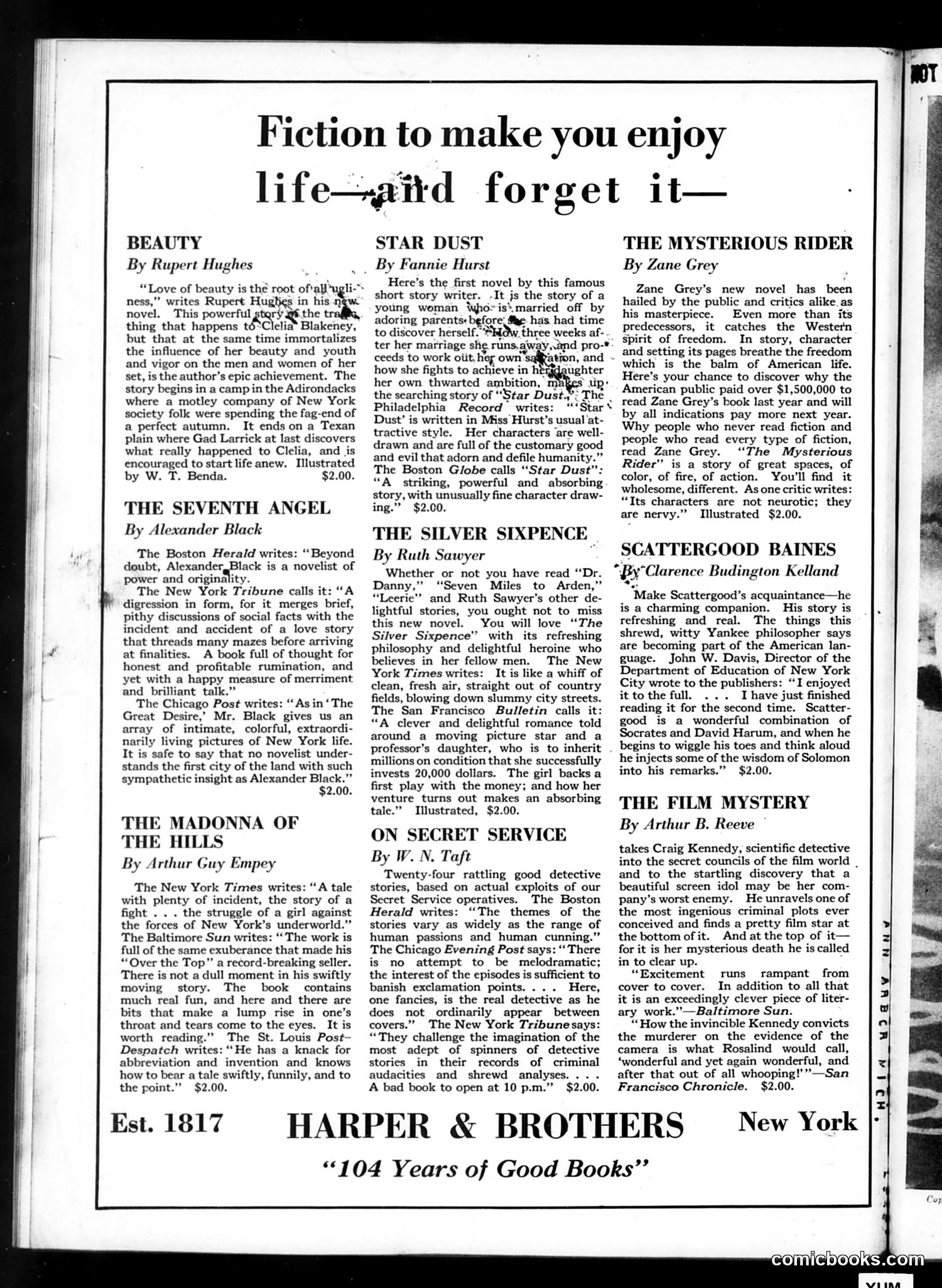
This page is **primarily a book advertisement**, not a political cartoon. It's a Harper & Brothers publisher's advertisement showcasing new fiction titles from approximately the 1910s-1920s era. The page displays six novels with promotional blurbs culled from contemporary newspaper reviews. The books advertised include works by Rupert Hughes, Alexander Black, Arthur Guy Empey, Fannie Hurst, Ruth Sawyer, and others—popular authors of the period. **What's notable for modern readers**: The advertising copy emphasizes escapism ("Fiction to make you enjoy life—and forget it"), reflecting post-WWI desires for entertainment and distraction. Several reviews praise "realism" and "character drawing," showing period literary values. The $2.00 price points indicate these are substantial hardcover novels aimed at middle-class readers. There is **no political satire or cartoon content visible** on this page—it's straightforward commercial advertising typical of Judge magazine's revenue model, placed amid editorial content.