
Judge, 1921-07-02 · page 24 of 36
Judge — July 2, 1921 — page 24: what you’re looking at
What you’re looking at
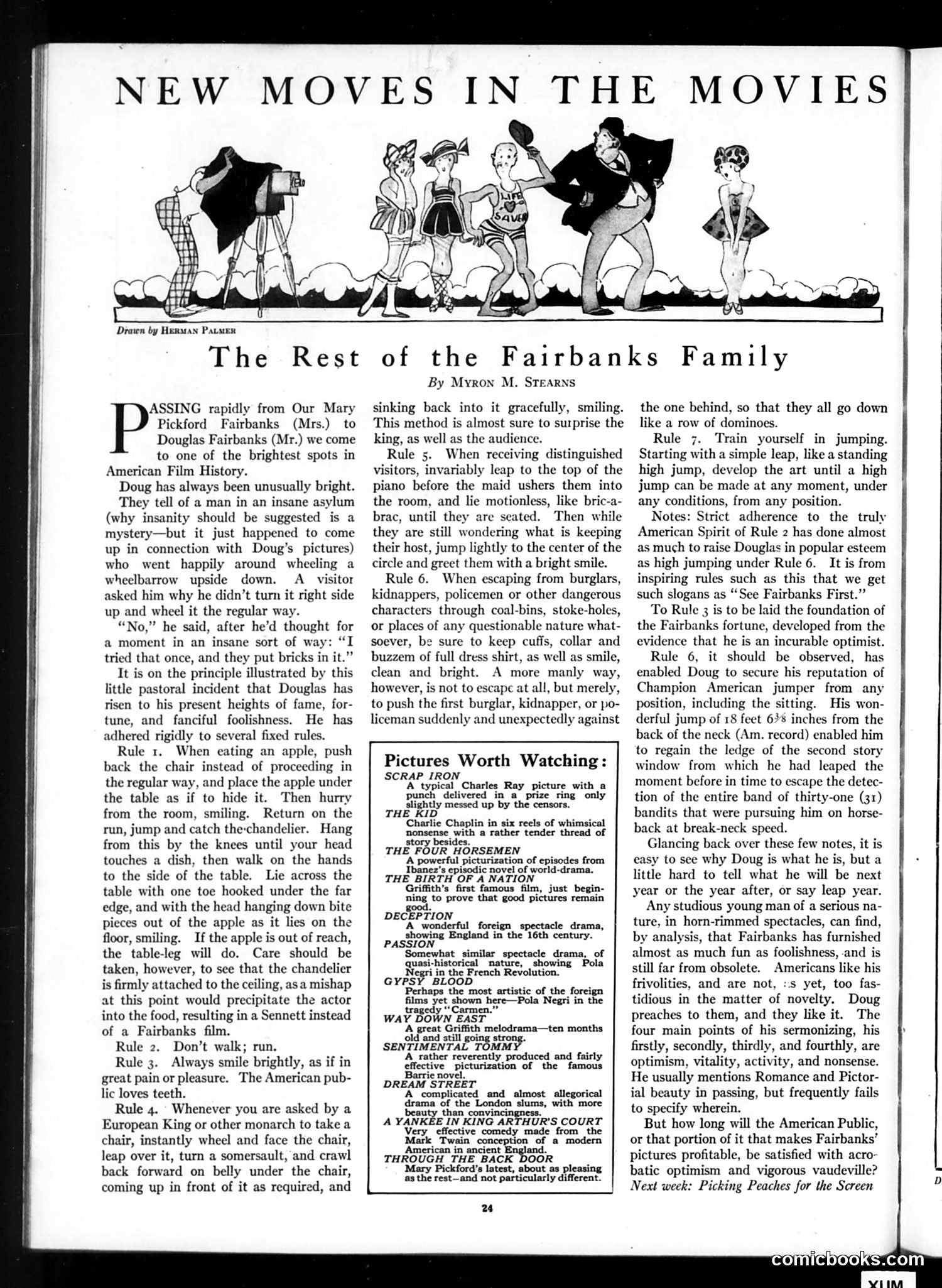
This is a satirical article about Douglas Fairbanks Sr., a major silent film star known for acrobatic stunts and physical comedy. The piece humorously documents six absurd "rules" that supposedly explain Fairbanks' success—each describing increasingly ridiculous physical feats (eating apples while hanging from chandeliers, leaping over chairs, escaping burglars while maintaining formal dress). The satire mocks both Fairbanks' actual stunt-heavy films and the American public's appetite for such spectacle. The opening anecdote about an asylum inmate with an upside-down wheelbarrow suggests that Fairbanks' success comes from rejecting conventional logic—that audiences reward absurdity over practicality. The accompanying illustration shows various film personalities in exaggerated poses. Below are brief reviews of contemporary films, including Chaplin's "The Kid" and Griffith's "The Birth of a Nation," placing this within 1920s film culture.
📄 Transcribed text from this page (OCR, searchable)
Machine-transcribed from the original scan — historical spelling and the odd misread are preserved.
Drawn by Henwan Pacuen The Rest of the Fairbanks Family ASSING rapidly from Our Mary Pickford Fairbanks (Mrs.) to Douglas Fairbanks (Mr.) we come to one of the brightest spots in American Film History. Doug has always been unusually bright. They tell of a man in an insane asylum (why insanity should be suggested is a mystery—but it just happened to come up in connection with Doug’s pictures) who went happily around wheeling a wheelbarrow upside down. A_ visitor asked him why he didn’t turn it right side up and wheel it the regular way. “No,” he said, after he’d thought for a moment in an insane sort of way: “I tried that once, and they put bricks in it.” It is on the principle illustrated by this little pastoral incident that Douglas has risen to his present heights of fame, for- tune, and fanciful foolishness. He has adhered rigidly to several fixed rules. Rule 1. When eating an apple, push back the chair instead of proceeding in the regular way, and place the apple under the table as if to hide it. Then hurry from the room, smiling. Return on the run, jump and catch the:chandelier. Hang from this by the knees until your head touches a dish, then walk on the hands to the side of the table. Lie across the table with one toe hooked under the far edge, and with the head hanging down bite pieces out of the apple as it lies on the floor, smiling. If the apple is out of reach, the table-leg will do. Care should be taken, however, to see that the chandelier is firmly attached to the ceiling, as a mishap at this point would precipitate the actor into the food, resulting in a Sennett instead of a Fairbanks film. Rule 2. Don’t walk; run. Rule 3. Always smile brightly, as if in great pain or pleasure. The American pub- lic loves teeth. Rule 4. Whenever you are asked by a European King or other monarch to take a chair, instantly wheel and face the chair, leap over it, turn a somersault, and crawl back forward on belly under the chair, coming up in front of it as required, and By Myron M. STEARNS sinking back into it gracefully, smiling. This method is almost sure to surprise the king, as well as the audience. Rule 5. When receiving distinguished visitors, invariably leap to the top of the piano before the maid ushers them into the room, and lie motionless, like bric-a- brac, until they are seated. Then while they are still wondering what is keeping their host, jump lightly to the center of the circle and greet them with a bright smile. Rule 6. When escaping from burglars, kidnappers, policemen or other dangerous characters through coal-bins, stoke-holes, or places of any questionable nature what- soever, be sure to keep cufis, collar and buzzem of full dress shirt, as well as smile, clean and bright. A more manly way, however, is not to escapc at all, but merely, to push the first burglar, kidnapper, or po- liceman suddenly and unexpectedly against Pictures Worth Watching: SCRAP IRON A typical Charles Ray picture with a punch delivered in a prize ring only slightly messed up by the censors. THE KID Charlie Chaplin in six reels of whimsical Ronsense ‘with a rather tender thread of story beside THE FOUR. HORSEMEN ‘A powerful picturization of episodes from banez's episodic novel of world-drama. THE BIRTH OF A NATION Griffith’s first famous film, just begin- ning to prove that good pictures remain good. DECEPTION £ wonderful foreign spectacle drama, showing England in the 16th century. PASSION Somewhat similar spectacle drama, of quasi-historical nature, showing Pola Negri in the French Revolution. GYPSY BLOOD Perhaps the most artistic of the foreign fins yet, shown here—Pola Negri in the ragedy “Carmen.” WAY DOWN EAST A great Griffith melodrama—ten months old and still goi SENTIMENTAL Te A_rather Averently Mroduced and fairly effective picturization of the famous Barrie novel. DREAM STREET A complicated and almost allegorical ane Of the London alums, with more A YANKEE IN KING ARTHUR'S COURT Very effective comedy made from the Mark Twain conception of a modern erican in ancient THROUGH THE BACK DOOR Mary Pickford’s latest, about as pleasing as the rest—and not particularly different. the one behind, so that they all go down like a row of dominoes. Rule 7. Train yourself in jumping. Starting with a simple leap, like a standing high jump, develop the art until a high jump can be made at any moment, under any conditions, from any position. Notes: Strict adherence to the truly American Spirit of Rule 2 has done almost as much to raise Douglas in popular esteem as high jumping under Rule 6. It is from inspiring rules such as this that we get such slogans as “See Fairbanks First.” To Rule 3 is to be laid the foundation of the Fairbanks fortune, developed from the evidence that he is an incurable optimist. Rule 6, it should be observed, has enabled Doug to secure his reputation of Champion American jumper from any position, including the sitting. His won- derful jump of 18 feet 638 inches from the back of the neck (Am. record) enabled him to regain the ledge of the second story window from which he had leaped the moment before in time to escape the detec- tion of the entire band of thirty-one (31) bandits that were pursuing him on horse- back at break-neck speed. Glancing back over these few notes, it is easy to see why Doug is what he is, but a little hard to tell what he will be next year or the year after, or say leap year. Any studious young man of a serious na- ture, in horn-rimmed spectacles, can find, by analysis, that Fairbanks has furnished almost as much fun as foolishness, and is still far from obsolete. Americans like his frivolities, and are not, :s yet, too fas- tidious in the matter of novelty. Doug preaches to them, and they like it. The four main points of his sermonizing, his firstly, secondly, thirdly, and fourthly, are optimism, vitality, activity, and nonsense. He usually mentions Romance and Pictor- ial beauty in passing, but frequently fails to specify wherein. But how long will the American Public, or that portion of it that makes Fairbanks’ pictures profitable, be satisfied with acro- batic optimism and vigorous vaudeville? Next week: Picking Peaches for the Screen