
Judge, 1921-07-02 · page 9 of 36
Judge — July 2, 1921 — page 9: what you’re looking at
What you’re looking at
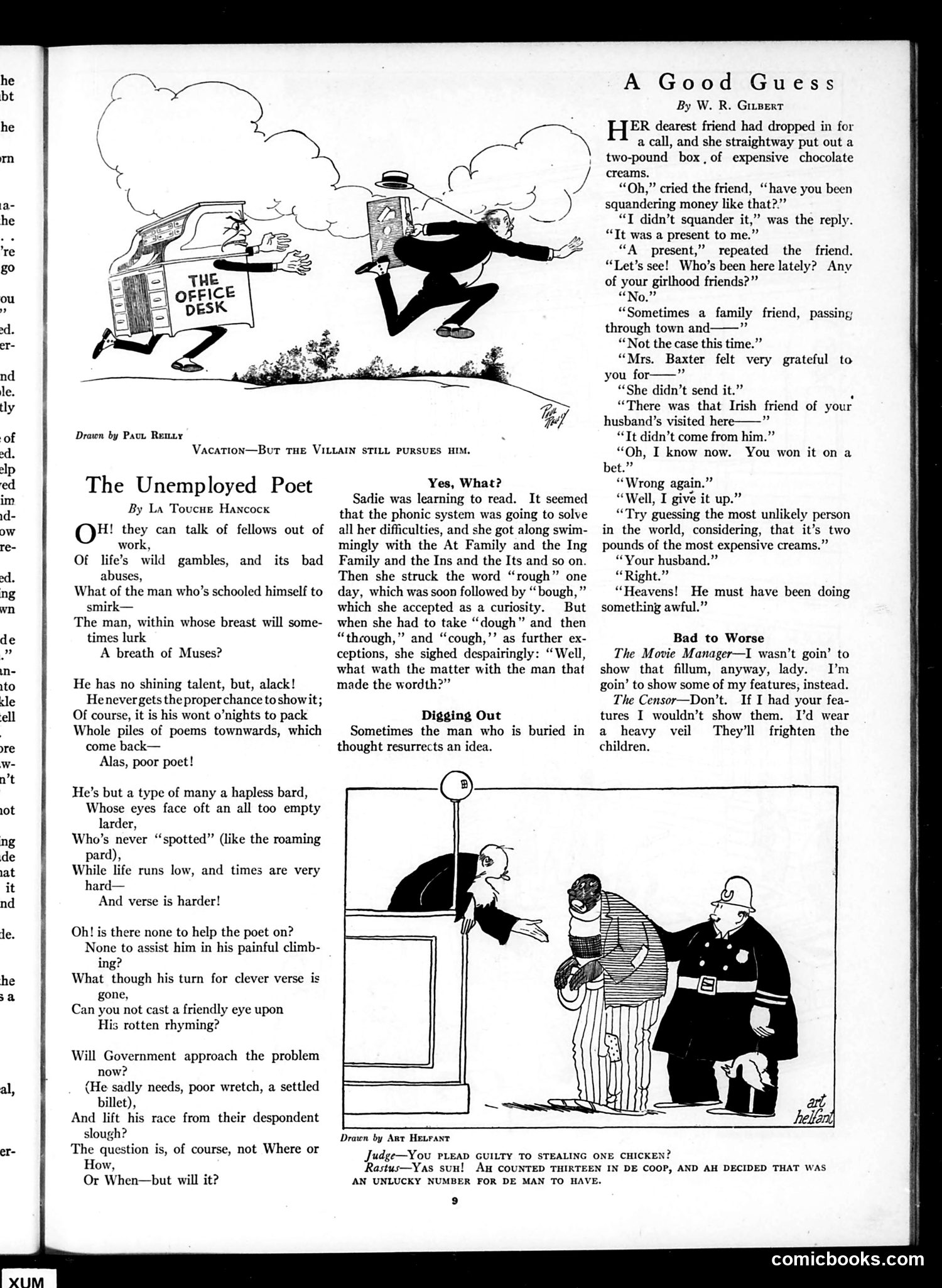
This page contains three distinct pieces of satirical content: **"The Unemployed Poet"** (La Touche Hancock) — A sympathetic poem about an unsuccessful poet struggling during economic hardship, unable to earn money from his work despite effort. It appeals to government for assistance ("Will Government approach the problem now?"), reflecting Depression-era concerns about unemployment and poverty. **"A Good Guess"** (W.R. Gisbert) — A humorous domestic anecdote where a wife receives expensive chocolates. Through elimination, her friend correctly deduces the husband gave them as an apology for misbehavior ("He must have been doing something awful"), playing on marital dynamics. **"Bad to Worse"** and the courtroom cartoon employ ethnic stereotyping common to the era. The "Rastus" character uses exaggerated dialect while explaining he stole a chicken because 13 in the coop was unlucky—humor based on racial caricature rather than actual satire of social issues. The page reflects Judge's mix of social commentary (unemployment), domestic humor, and entertainment relying on now-offensive racial stereotypes typical of early-to-mid 20th century American magazines.
📄 Transcribed text from this page (OCR, searchable)
Machine-transcribed from the original scan — historical spelling and the odd misread are preserved.
he bt he m a- at Drawn by Paut Rewiy Vacation—But THE VILLAIN STILL PURSUES HIM. The Unemployed Poet By La Toucue Hancock O#! they can talk of fellows out of work, OF life’s wild abuses, What of the man who’s schooled himself to smirk— The man, within whose breast will some- times lurk A breath of Muses? gambles, and its bad He has no shining talent, but, alack! Henever gets the proper chance to showit; Of course, it is his wont o’nights to pack Whole piles of poems townwards, which come back— Alas, poor poet! He’s but a type of many a hapless bard, Whose eyes face oft an all too empty larder, Who’s never “spotted” (like the roaming pard), While life runs low, and times are very hard— And verse is harder! Oh! is there none to help the poet on? None to assist him in his painful climb- ing? What though his turn for clever verse is gone, Can you not cast a friendly eye upon His rotten rhyming? Will Government approach the problem now? (He sadly needs, poor wretch, a settled billet), And lift his race from their despondent slough? The question is, of course, not Where or How, Or When—but will it? Yes, What? Sadie was learning to read. It seemed that the phonic system was going to solve all her difficulties, and she got along swim- mingly with the At Family and the Ing Family and the Ins and the Its and so on. Then she struck the word “rough” one day, which was soon followed by “bough,” which she accepted as a curiosity. But when she had to take “dough” and then “through,” and “cough,’’ as further ex- ceptions, she sighed despairingly: “Well, what wath the matter with the man that made the wordth?” Digging Out Sometimes the man who is buried in thought resurrects an idea. A Good Guess By W. R. Gisert ER dearest friend had dropped in for a call, and she straightway put out a two-pound box, of expensive chocolate creams. “Oh,” cried the friend, “have you been squandering money like that?.” “T didn’t squander it,” was the reply. “Tt was a present to me.” “A present,” repeated the friend. “Let’s see! Who’s been here lately? Any of your girlhood friends?” “No.” “Sometimes a family friend, passing through town and: 2 “Not the case this time.” “Mrs. Baxter felt very grateful to you for—” “She didn’t send it.” ‘ “There was that Irish friend of your husband’s visited here——” “Tt didn’t come from him.” “Oh, I know now. You won it on a bet.” “Wrong again.” “Well, I give it up.” “Try guessing the most unlikely person in the world, considering, that it’s two pounds of the most expensive creams.” “Your husband.” “Right.” “Heavens! He must have been doing something awful.” Bad to Worse The Movie Manager—I wasn’t goin’ to show that fillum, anyway, lady. I’m goin’ to show some of my features, instead. The Censor—Don’t. If I had your fea- tures I wouldn’t show them. I’d wear a heavy veil They'll frighten the children. Drawn by Ant Heuraxt Judge—You PLEAD GUILTY TO STEALING ONE CHICKEN? Rastus—Yas sun! Au COUNTED THIRTEEN IN DE COOP, AND AH DECIDED THAT WAS AN UNLUCKY NUMBER FOR DE MAN TO HAVE. comicbooks.com