
Judge, 1921-07-02 · page 18 of 36
Judge — July 2, 1921 — page 18: what you’re looking at
What you’re looking at
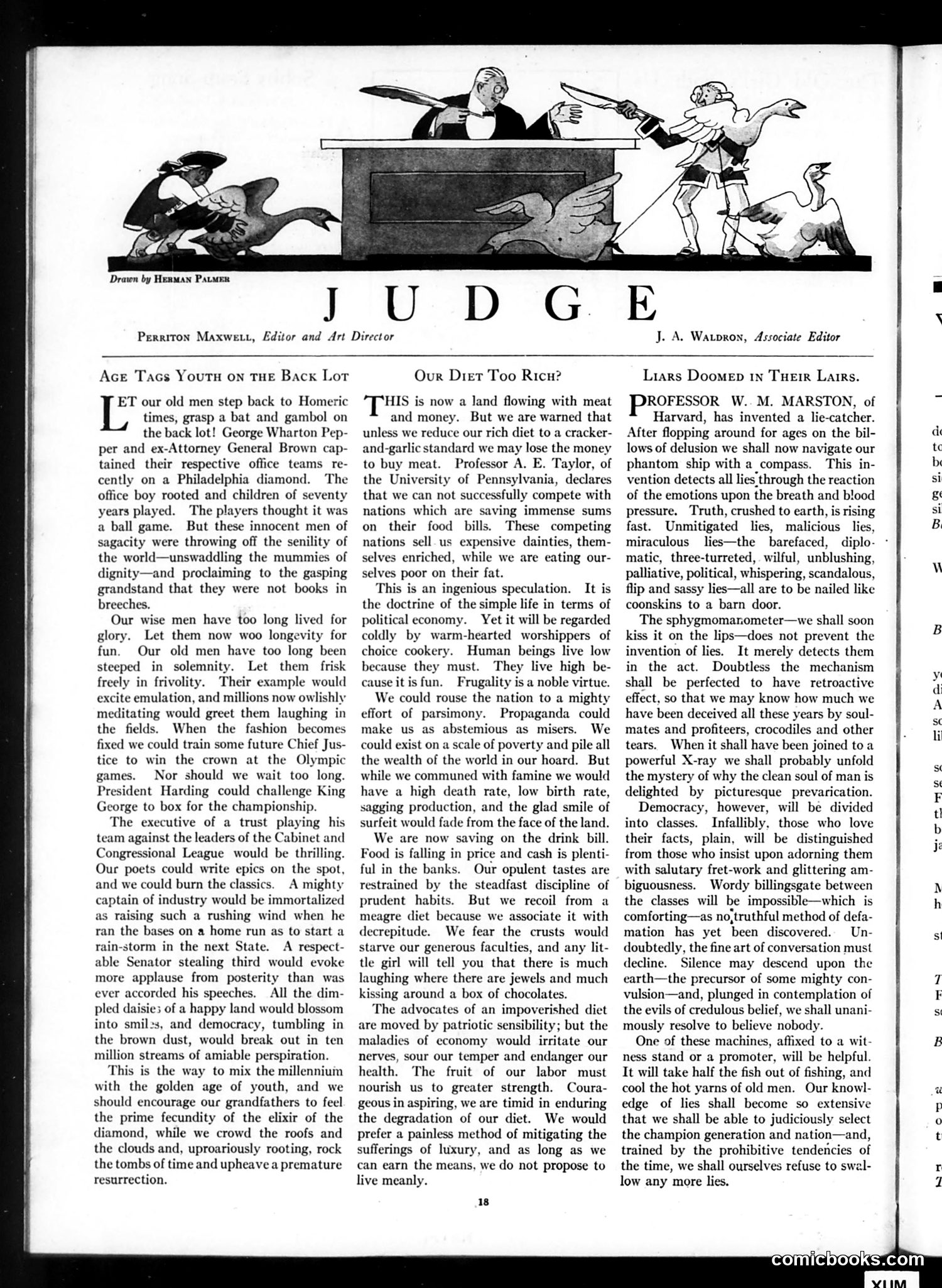
The top cartoon by Herman Palmer depicts a courtroom scene with judges and figures being thrown out or ejected, illustrating the editorial's satirical tone about authority and power. The three essays critique post-WWI American society: **"Age Tags Youth on the Back Lot"** celebrates elderly Philadelphia politicians (George Wharton Pepper and ex-Attorney General Brown) playing baseball together. The author argues that dignified elders should embrace frivolity and recreation—suggesting President Harding should box King George, and senators should steal bases—to inject vitality into American life and inspire the nation toward joy rather than grim solemnity. **"Our Diet Too Rich?"** dismisses warnings that Americans must adopt poverty diets to compete economically with other nations. Professor A.E. Taylor's "political economy" argument is mocked: the author argues that frugality destroys birthrates, production, and national morale. Prosperity and good food are presented as American virtues, not weaknesses. **"Liars Doomed in Their Lairs"** (partially visible) discusses Professor W.M. Marston's "lie-catcher" invention—an early lie detector—predicting it will expose delusion and reveal truth.
📄 Transcribed text from this page (OCR, searchable)
Machine-transcribed from the original scan — historical spelling and the odd misread are preserved.
Drawn by Henman Patmen JUDGE Perriton Maxwett, Editor and Art Director J. A. Watpron, Associate Editor Ace Tacs Youtu on THE Back Lor ET our old men step back to Homeric LE times, grasp a bat and gambol on the back lot! George Wharton Pep- per and ex-Attorney General Brown cap- tained their respective office teams re- cently on a Philadelphia diamond. The office boy rooted and children of seventy years played. The players thought it was a ball game. But these innocent men of sagacity were throwing off the senility of the world—unswaddling the mummies of dignity—and proclaiming to the gasping grandstand that they were not books in breeches. Our wise men have too long lived for glory. Let them now woo longevity for fun. Our old men have too long been steeped in solemnity. Let them frisk freely in frivolity. Their example would excite emulation, and millions now owlishly meditating would greet them laughing in the fields. When the fashion becomes fixed we could train some future Chief Jus- tice to win the crown at the Olympic games. Nor should we wait too long. President Harding could challenge King George to box for the championship. The executive of a trust playing his team against the leaders of the Cabinet and Congressional League would be thrilling. Our poets could write epics on the spot, and we could burn the classics. A mighty captain of industry would be immortalized as raising such a rushing wind when he ran the bases on a home run as to start a rain-storm in the next State. A respect- able Senator stealing third would evoke more applause from posterity than was ever accorded his speeches. All the dim- pled daisies of a happy land would blossom into smiles, and democracy, tumbling in the brown dust, would break out in ten million streams of amiable perspiration. This is the way to mix the millennium with the golden age of youth, and we should encourage our grandfathers to feel the prime fecundity of the elixir of the diamond, while we crowd the roofs and the clouds and, uproariously rooting, rock the tombs of time and upheave a premature resurrection. Our Diet Too Ricu? ‘THs is now a land flowing with meat and money. But we are warned that unless we reduce our rich diet to a cracker- and-garlic standard we may lose the money to buy meat. Professor A. E. Taylor, of the University of Pennsylvania, declares that we can not successfully compete with nations which are saving immense sums on their food bil These competing nations sell. us expensive dainties, them- selves enriched, while we are eating our- selves poor on their fat. This is an ingenious speculation. It is the doctrine of the simple life in terms of political economy. Yet it will be regarded coldly by warm-hearted worshippers of Human beings live low e they must. They live high be- cause it isfun. Frugality is a noble virtue. We could rouse the nation to a mighty effort of parsimony. Propaganda could make us as abstemious as misers. We could exist on a scale of poverty and pile all the wealth of the world in our hoard. But while we communed with famine we would have a high death rate, low birth rate, sagging production, and the glad smile of surfeit would fade from the face of the land. We are now saving on the drink bill. Food is falling in price and cash is plenti- ful in the banks. Our opulent tastes are restrained by the steadfast discipline of prudent habits. But we recoil from a meagre diet because we associate it with decrepitude. We fear the crusts would starve our generous faculties, and any lit- tle girl will tell you that there is much laughing where there are jewels and much kissing around a box of chocolates. The advocates of an impoverished diet are moved by patriotic sensibility; but the maladies of economy would irritate our nerves, sour our temper and endanger our health. The fruit of our labor must nourish us to greater strength. Coura- geous in aspiring, we are timid in enduring the degradation of our diet. We would prefer a painless method of mitigating the sufferings of luxury, and as long as we can earn the means, we do not propose to live meanly. 18 Liars Doomep 1n Tuer Lars. ROFESSOR W..M. MARSTON, of Harvard, has invented a lie-catcher. After flopping around for ages on the bil- lows of delusion we shall now navigate our phantom ship with a compass. This in- vention detects all lies/through the reaction of the emotions upon the breath and blood pressure. Truth, crushed to earth, is rising fast. Unmitigated lies, malicious lies, miraculous lies—the barefaced, diplo- matic, three-turreted, wilful, unblushing, palliative, political, whispering, scandalous, flip and sassy lies—all are to be nailed like coonskins to a barn door. The sphygmomarometer—we shall soon kiss it on the lips—does not prevent the invention of lies. It merely detects them in the act. Doubtless the mechanism shall be perfected to have retroactive effect, so that we may know how much we have been deceived all these years by soul- mates and profiteers, crocodiles and other tears. When it shall have been joined toa powerful X-ray we shall probably unfold the mystery of why the clean soul of man is delighted by picturesque prevarication. Democracy, however, will be divided into classes. Infallibly, those who love their facts, plain, will be distinguished from those who insist upon adorning them with salutary fret-work and glittering am- biguousness. Wordy billingsgate between the classes will be impossible—which is comforting—as no;truthful method of defa- mation has yet been discovered. Un- doubtedly, the fine art of conversation must decline. Silence may descend upon the earth—the precursor of some mighty con- vulsion—and, plunged in contemplation of the evils of credulous belief, we shall unani- mously resolve to believe nobody. One of these machines, affixed to a wit- ness stand or a promoter, will be helpful. It will take half the fish out of fishing, and cool the hot yarns of old men. Our knowl- edge of lies shall become so extensive that we shall be able to judiciously select the champion generation and nation—and, trained by the prohibitive tendencies of the time, we shall ourselves refuse to swal- low any more lies.