
A complete issue · 36 pages · 1920
Judge — May 15, 1920
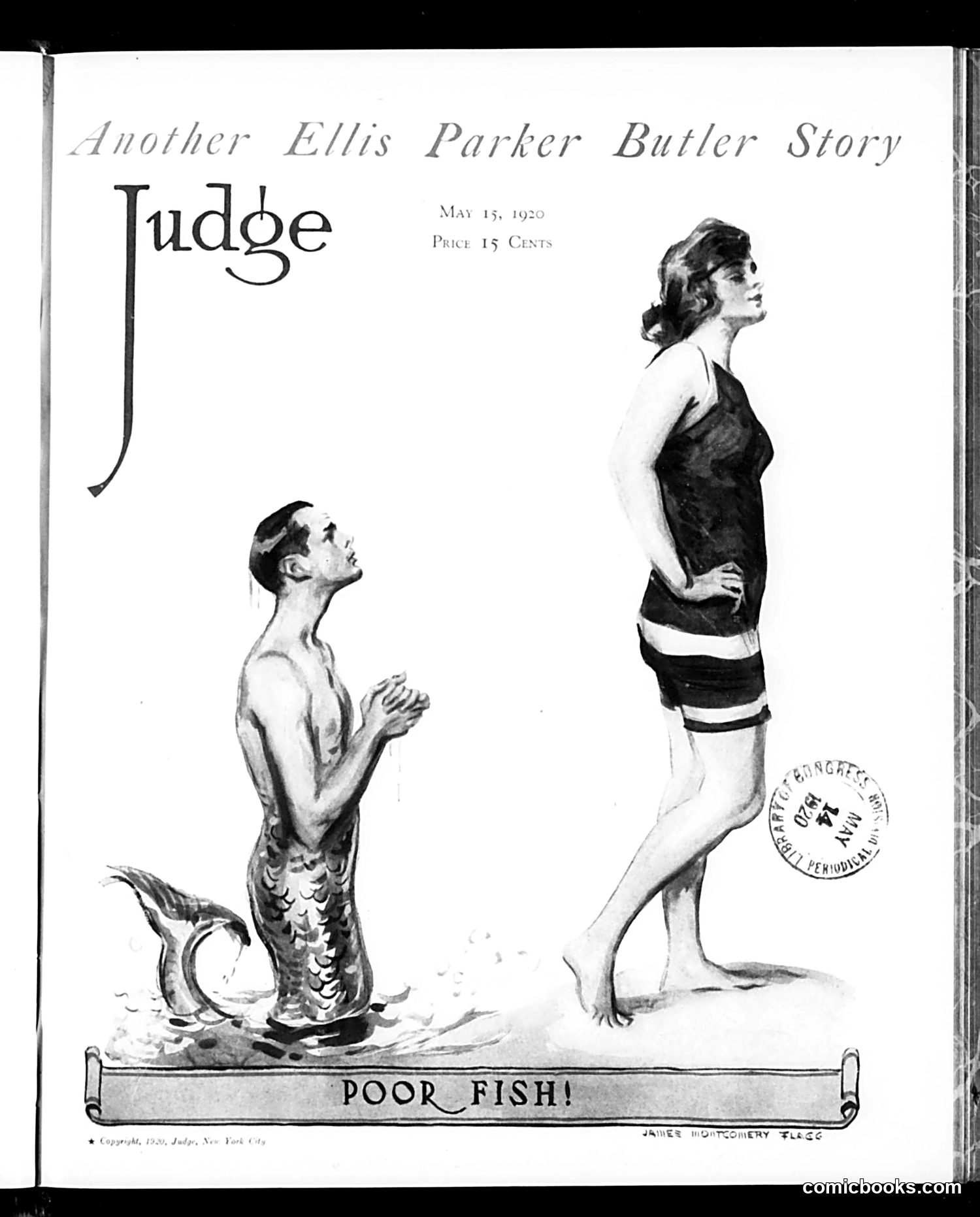
This cartoon by Ellis Parker Butler illustrates a transformation or contrast between two figures. On the left, a merman or fish-man kneels pleadingly; on the right, the same creature appears as a woman in a bathing suit. The caption "Poor Fish!" suggests satire about the transition. The likely reference is to evolution or perhaps the popular "missing link" debates of the era. However, without additional context about specific 1920 events or personalities, the precise satirical target remains unclear. It may mock scientific theories, gender transformation, or a specific public figure or scandal of that moment. The bathing suit attire suggests commentary on changing social norms around women's fashion and bodies in the 1920s.

This page is **not a cartoon or satire** — it's a straightforward **advertisement** for Pennsylvania Vacuum Cup Cord Tires, manufactured by Pennsylvania Rubber Co. in Jeannette, Pennsylvania. The image shows a tire's tread pattern in close-up. The ad's key claim is that the "Vacuum Cup Tread is GUARANTEED not to skid on wet, slippery pavements," addressing a practical safety concern for early automotive drivers. The text emphasizes standardized pricing and warranty coverage (5,000-9,000 miles depending on tire type). The company lists factory branches and agencies across the United States and Canada, with an export department in New York City. This represents typical early 20th-century tire advertising focused on safety innovation and distribution networks.
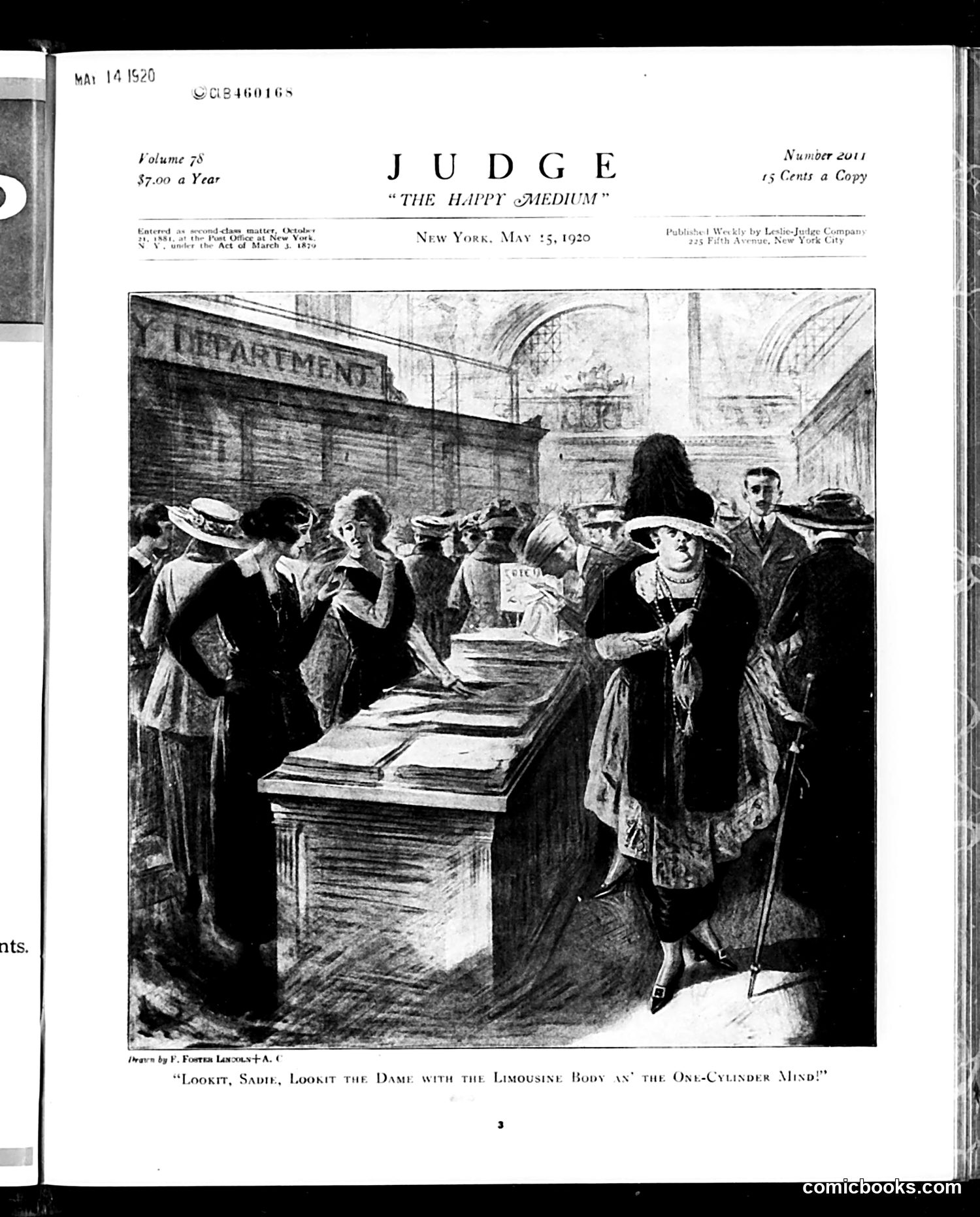
This illustration satirizes the purchase of automobiles by wealthy women. The caption reads: "Lookit, Sadie, Lookit the Dame with the Limousine Body in' the One-Cylinder Mind!" The cartoon depicts a well-dressed woman in a hat and fur stole examining a car at what appears to be a dealership or showroom, while onlookers (including a character apparently named "Sadie") mock her. The satire suggests that this fashionable woman is foolishly buying an expensive, luxury automobile ("limousine body") despite lacking the intelligence ("one-cylinder mind") to operate or appreciate it properly. This reflects 1920s anxieties about women's newfound economic independence and consumer power following World War I and the approaching suffrage amendment.
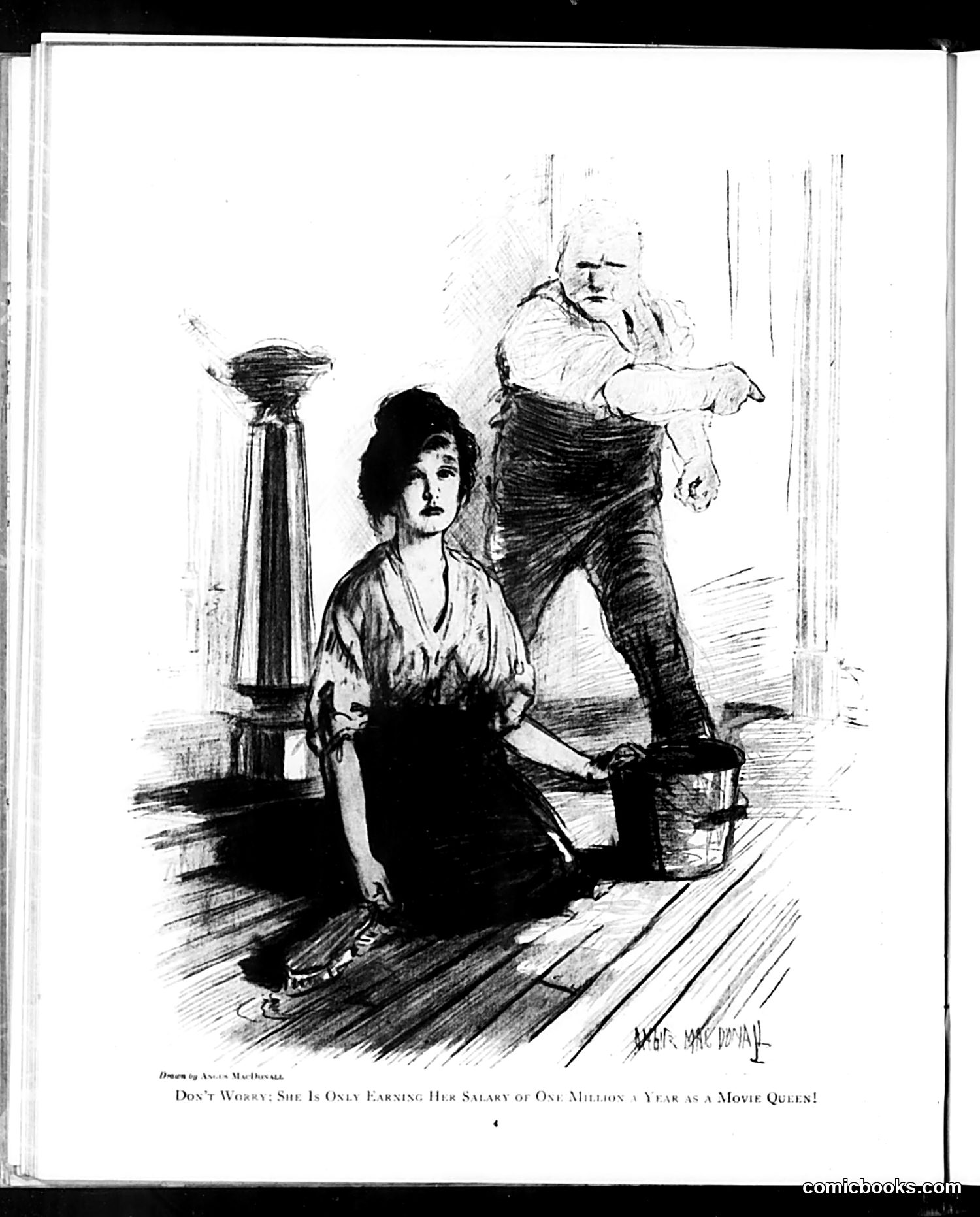
This Judge magazine cartoon satirizes Hollywood's exorbitant salaries during the silent film era. The drawing shows a woman (likely a movie actress or "movie queen") kneeling while a man in formal dress stands behind her, appearing dismissive or condescending. The caption reads: "Don't Worry; She Is Only Earning Her Salary of One Million a Year as a Movie Queen!" The satire targets the perceived absurdity of million-dollar annual salaries paid to film actresses—astronomical sums for the period. By depicting the actress in a submissive, degrading posture while earning such vast wealth, the cartoon mocks both the excessive compensation and the power dynamics of Hollywood's studio system. The joke suggests that despite their enormous pay, actresses remained subservient to studio interests and male authority figures.
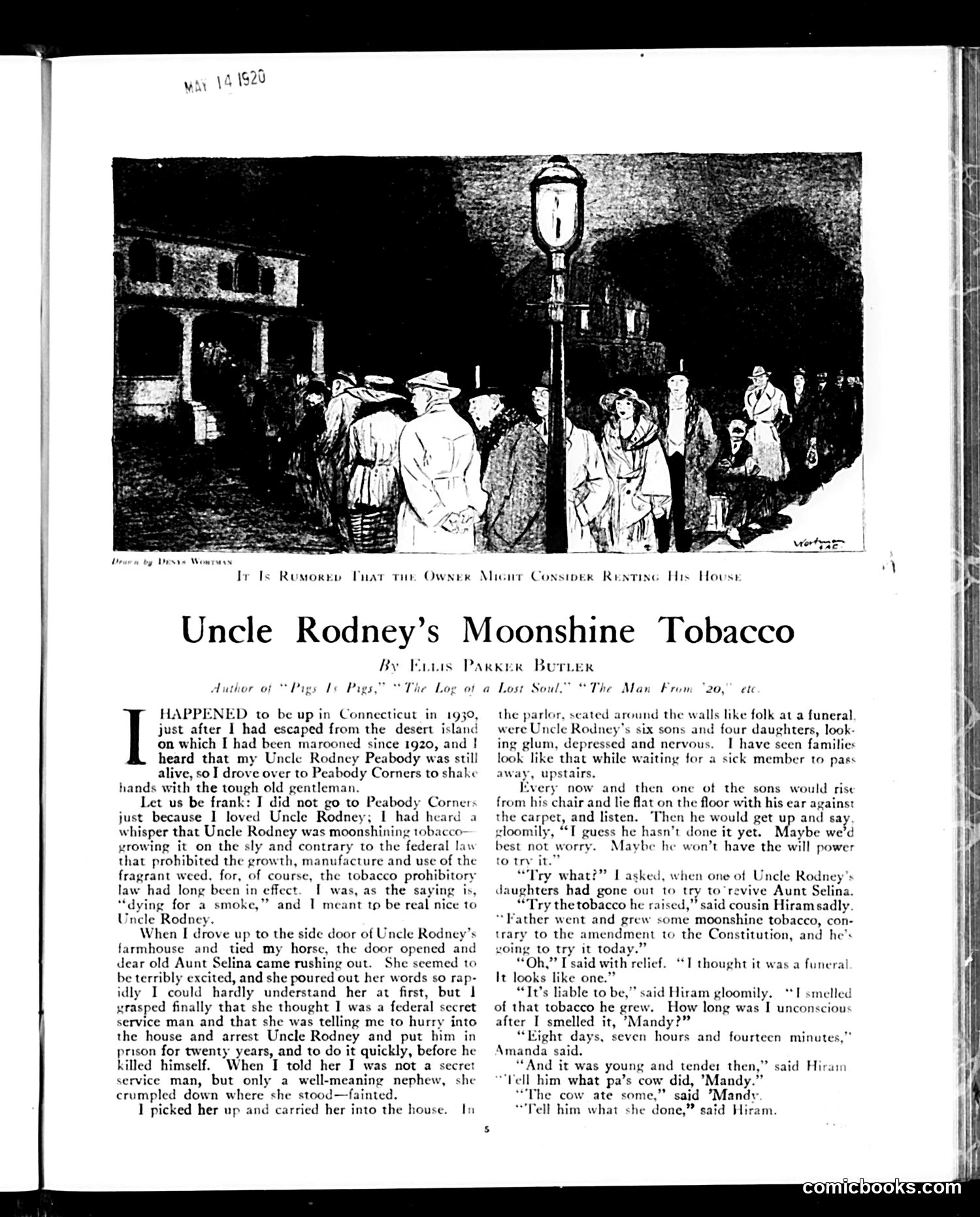
This page primarily contains a short story titled "Uncle Rodney's Moonshine Tobacco" by Ellis Parker Butler, rather than political satire. The illustration at top shows a street scene with numerous figures gathered around a street lamp at night, captioned "It Is Rumored That the Owner Might Consider Resting His House." The story itself concerns Uncle Rodney Peabody, who illegally grows tobacco in Connecticut during Prohibition (the 1920s). The narrative humorously explores the tension between federal alcohol prohibition laws and tobacco cultivation, with family members discussing Uncle Rodney's contraband farming activities. The cartoon appears to be narrative illustration accompanying the story rather than political commentary. Judge magazine here functions as a fiction publication rather than solely as political satire.
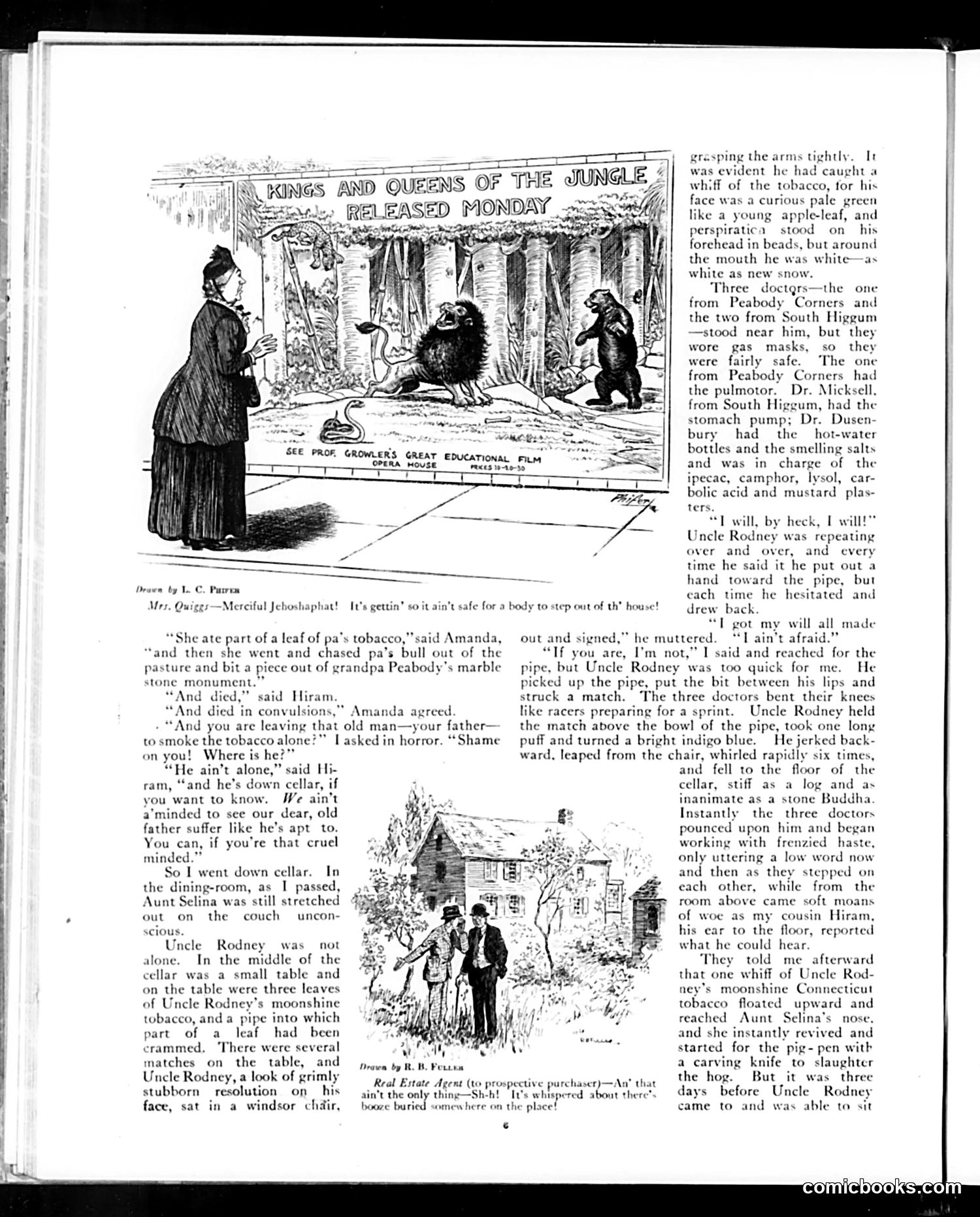
The top cartoon satirizes a film promotion. A woman stands outside a theater showing "Kings and Queens of the Jungle—Released Monday," a Prof. Growlers educational film. Inside the window display, primates are arranged like theatrical performers. The satire mocks both the film industry's promotional tactics and the era's fascination with exotic animal attractions presented as "educational" entertainment. The main story below concerns Uncle Rodney's near-fatal encounter with a pipe: he nearly died attempting to smoke it after a whiff of tobacco made him ill. Three doctors (wearing gas masks for protection) revive him. The narrative satirizes either prohibition-era sensitivities or contemporary temperance movements by exaggerating the dangers of tobacco use and the comic desperation of a man attempting vice.
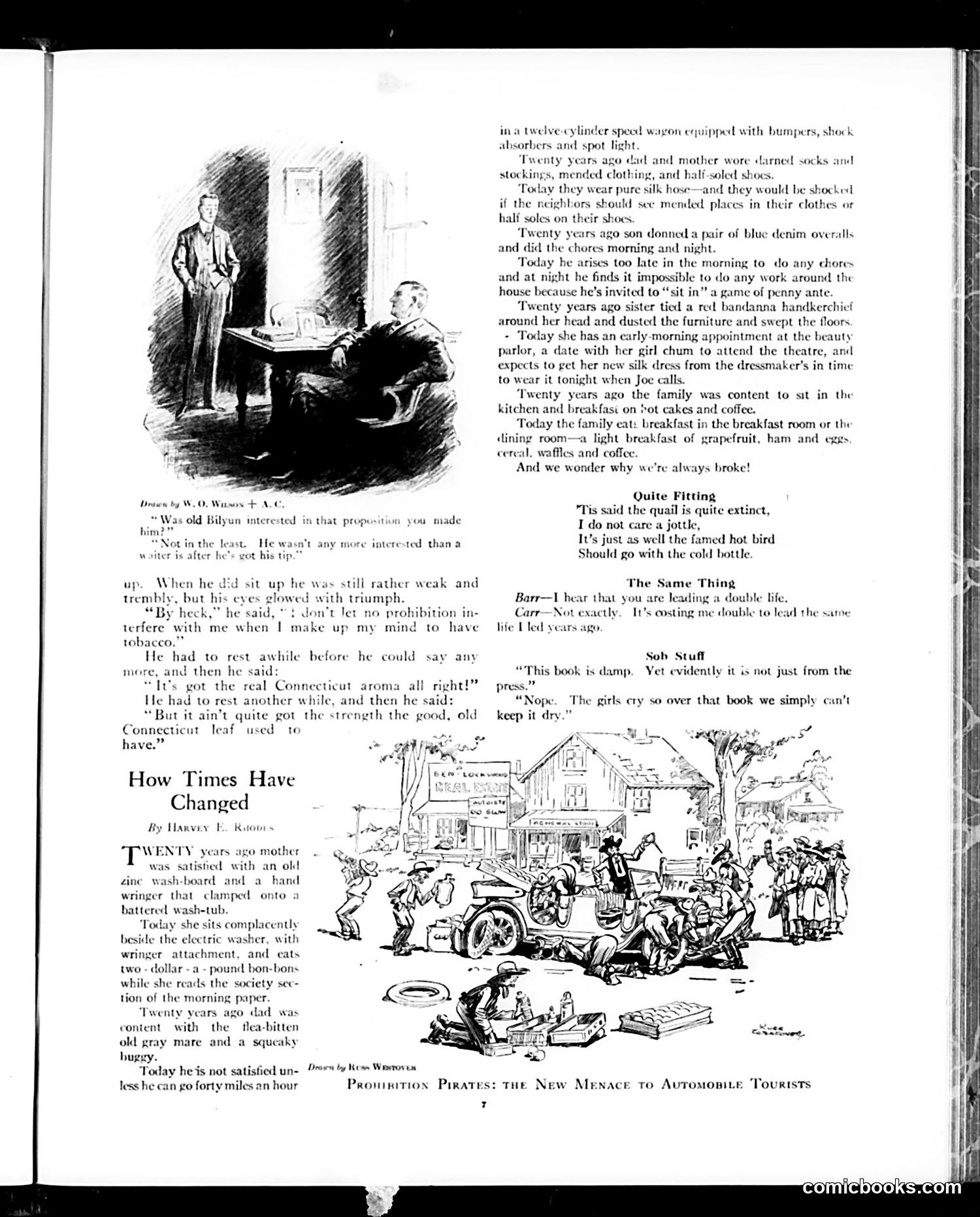
This page satirizes **early 20th-century consumer culture and changing social expectations**. The main article by Harvey Riggs contrasts family life "twenty years ago" with the present day, documenting how modern conveniences and leisure aspirations have created financial pressure rather than comfort. The satire targets: - **Wives**: Once satisfied with manual labor (washboards), now expecting electric appliances while consuming expensive luxuries - **Husbands**: Demanding expensive automobiles (twelve-cylinder speed wagons) instead of modest buggies - **Children**: Sons avoiding chores through entertainment; daughters prioritizing beauty parlors and theater over household duties - **Overall message**: Technology and rising consumer expectations have made families perpetually "broke" despite labor-saving devices meant to improve their lives The cartoon below ("Prohibition Pirates") appears to mock alcohol prohibition enforcement. The humor stems from depicting how modernization and social change have ironically worsened financial security rather than improving it—a critique of unchecked consumerism and status-seeking behavior.
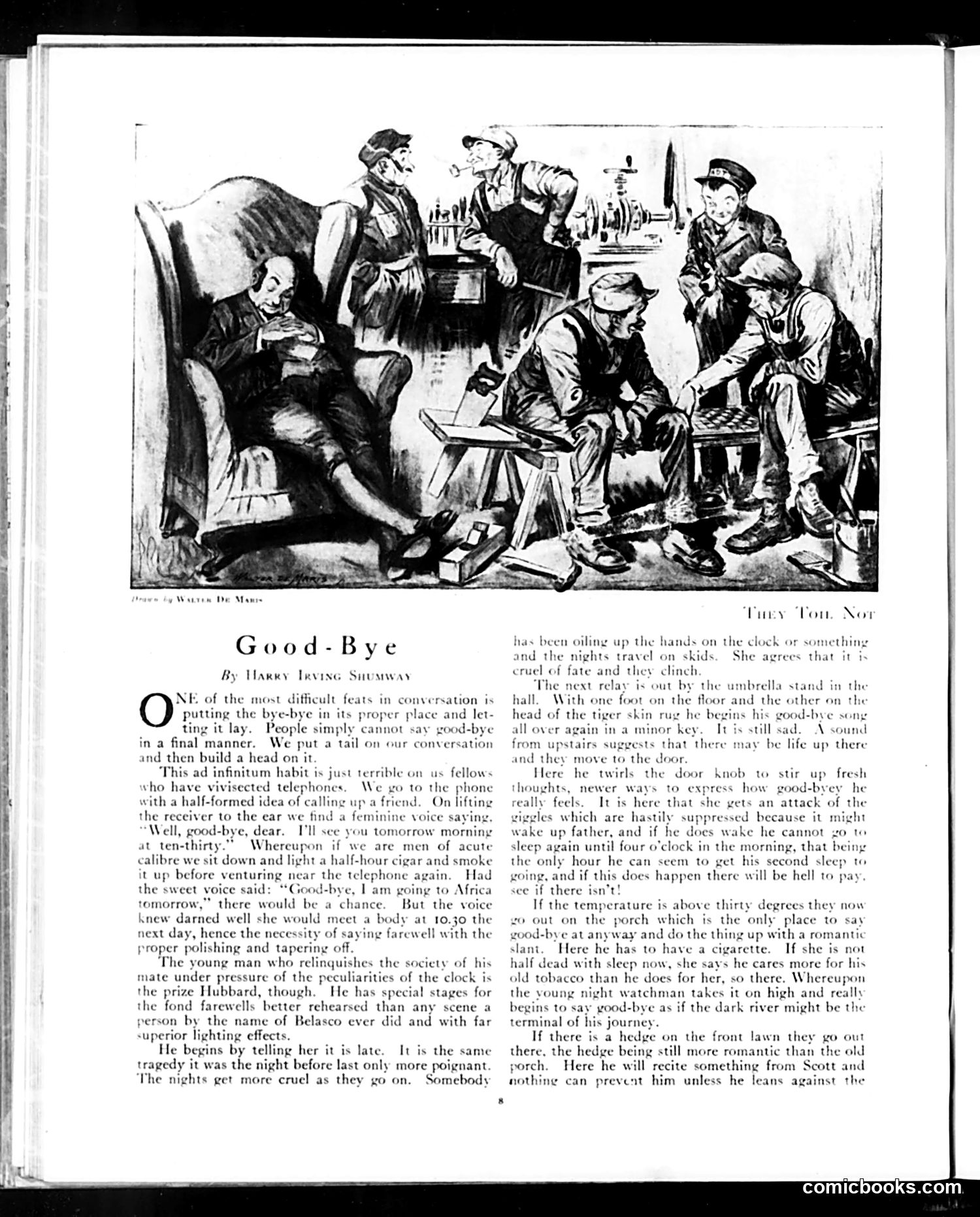
This is a humorous essay with accompanying illustration satirizing the modern difficulty of saying goodbye—particularly between courting couples. The piece mocks how people (especially young men courting women) cannot end conversations decisively, instead adding multiple "false endings" that drag on indefinitely. The essay catalogs the stages of an elaborate goodbye: the initial phone farewell, the "sad song" by the umbrella stand, the porch scene requiring cigarettes, and romantic recitations from literature. The illustration depicts several figures in what appears to be an interior setting—likely representing the various awkward stages described: men in hats lingering, a woman seated, and various poses suggesting the prolonged, repetitive nature of the goodbye ritual. The satire targets contemporary courtship conventions and the emotional theatricality young men employ to extend romantic moments, while also poking fun at the genuine difficulty both parties have in achieving actual separation. It's essentially early 20th-century commentary on relationship awkwardness.
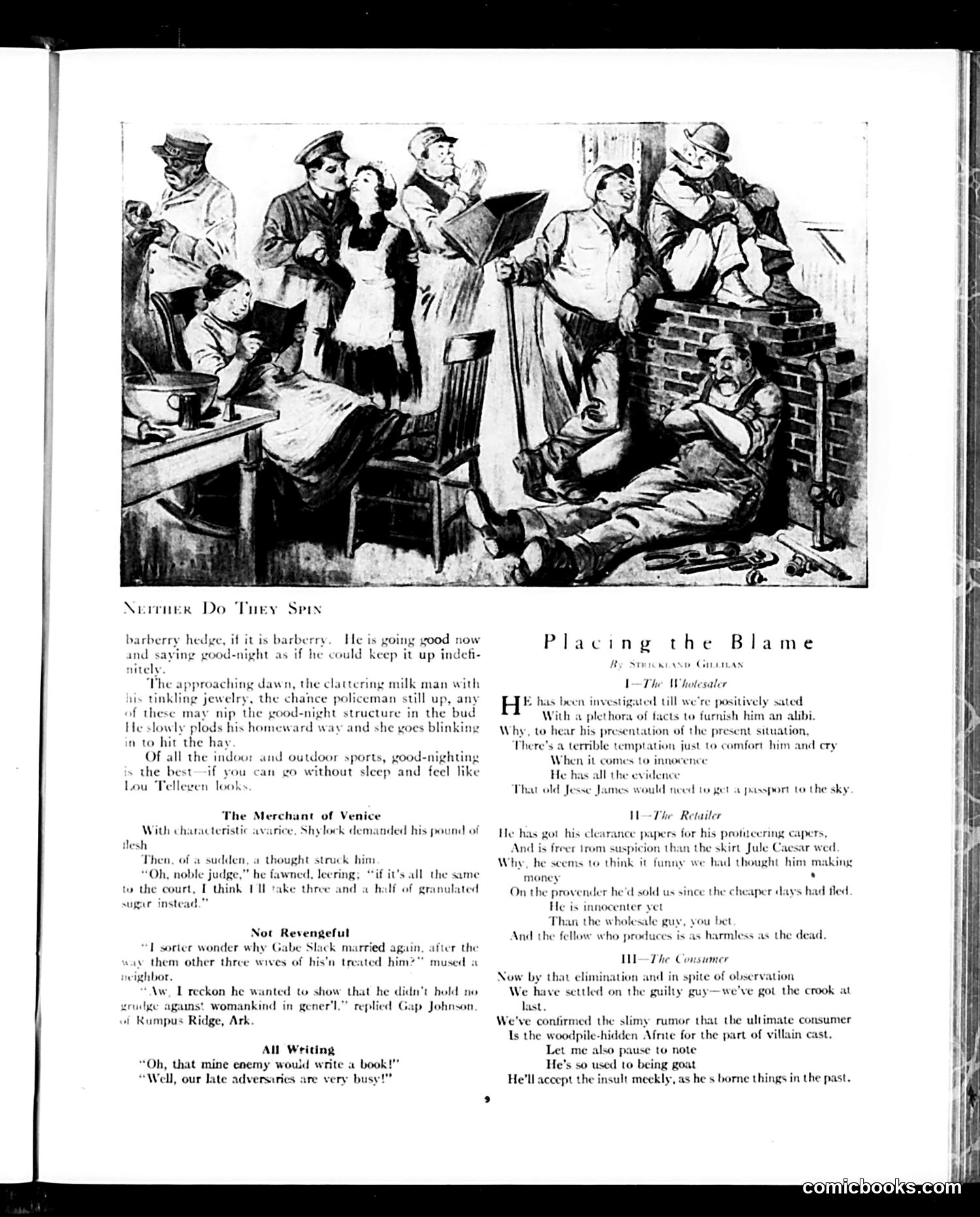
This satirical piece critiques how responsibility for wartime profiteering and inflation gets deflected through the supply chain. The cartoon illustrates three parties blaming each other for high prices: 1. **The Wholesaler** claims innocence—he merely sold goods at market rates 2. **The Retailer** points to the wholesaler's inflated prices 3. **The Consumer** (depicted as a working-class person, possibly Black, based on the term "Afmte") becomes the scapegoat The satire's bitter conclusion: society blames the powerless consumer for accepting exploitation rather than holding profiteers accountable. The final stanza suggests the consumer, accustomed to mistreatment, passively accepts blame he doesn't deserve. This likely addresses post-WWI or wartime inflation dynamics, where middlemen profited while common people bore economic hardship—a classic deflection of responsibility from powerful to powerless.
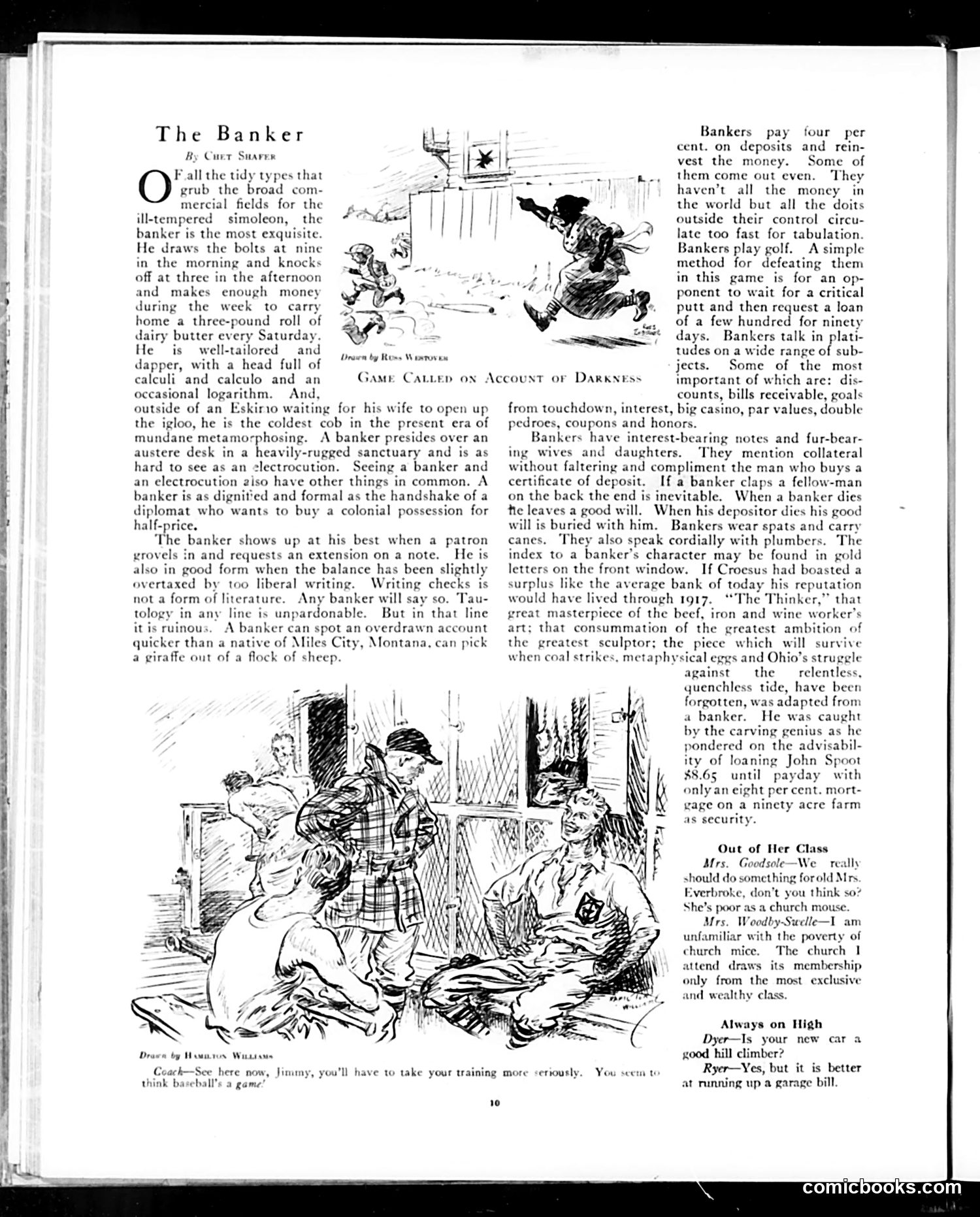
This article satirizes bankers as a professional class through exaggerated character portrayal. The author (Curt Suarez) mocks bankers as: **The Type**: Dignified, cold, meticulous men who work minimal hours (9 a.m. to 3 p.m.) yet accumulate substantial wealth through conservative financial practices—paying 4% on deposits while reinvesting for profit. **The Satire**: Bankers are portrayed as emotionally detached ("coldest cob"), obsessed with obscure financial terminology, and mercilessly exploitative. The humor emphasizes their power: they can instantly detect overdrafts, demand collateral without hesitation, and leave "good wills" that die with them while their depositors' good intentions are "buried." **Key Jokes**: A banker's best moment is when someone begs for loan extension; golf opponents should interrupt critical putts with loan requests; bankers' character can be judged by gold letters on their windows. The cartoon illustrations appear to show bankers in their element—one labeled "Game Called on Account of Darkness" depicts banking as sport. The overall message critiques banker arrogance and financial dominance during the early 20th century.
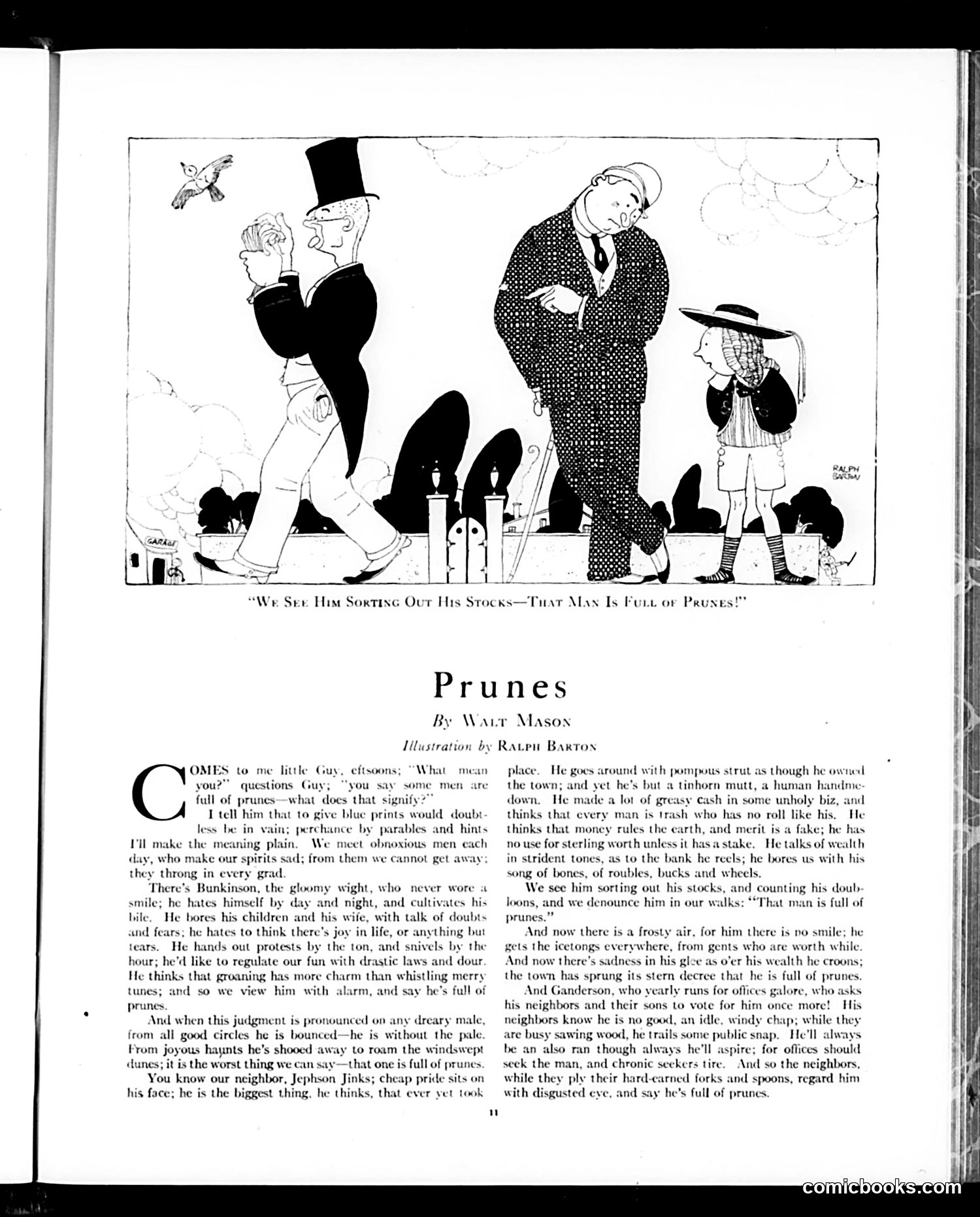
This is a humorous moral essay illustrated with a cartoon. "Full of prunes" is period slang meaning someone is full of complaints, negativity, or hot air—likely referencing prunes' well-known laxative properties. The piece catalogs three types of objectionable men: 1. **Bunkinson**: A perpetually gloomy pessimist who complains constantly and tries to regulate others' fun with restrictive laws. 2. **Jephson Jinks**: A newly wealthy social climber with "cheap pride" who boasts about his money and dismisses anyone without wealth, despite his own lowly origins ("tinhorn mutt, a human hand-me-down"). 3. **Ganderson**: A perpetual office-seeker who chases political positions he doesn't deserve while his hardworking neighbors build real lives. The cartoon depicts society literally ejecting these men—"sorting out his stocks"—for their tiresome, disagreeable natures. The satire suggests that character and temperament matter more than wealth or ambition; complainers, snobs, and chronic failures become social pariahs.
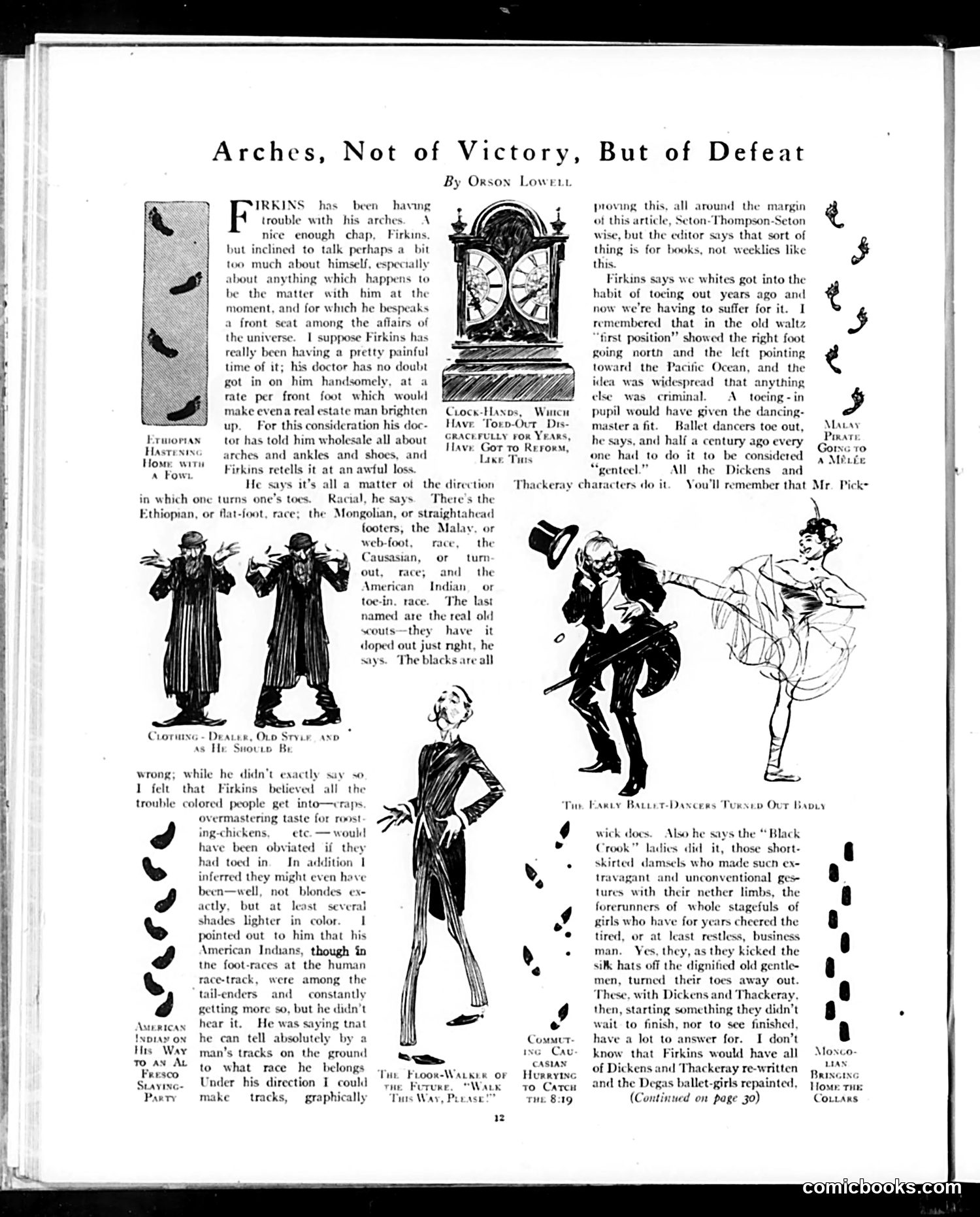
This satirical essay by Oswin Lowell mocks a character named Firkins who obsessively discusses his foot problems and theories about racial foot structure. Firkins claims different races have naturally different foot postures—Ethiopians "flat-foot," Mongolians "straight-ahead," Americans "toe-in"—and theorizes that Black Americans' social troubles stem from their foot positioning rather than systemic factors. Lowell's satire exposes the absurdity of such pseudo-scientific racial theories by having Firkins apply them everywhere: he claims the "Black Crook" dancers' success came from their toe-out posture, and that past generations suffered because they adopted unnatural stances. The cartoons illustrate various foot positions and "types," accompanying Lowell's ridicule of Firkins' self-absorbed hypochondria and his attempt to explain racial differences through trivial physical traits—a transparent mockery of early 20th-century racist pseudoscience that attributed social inequality to biological rather than social causes.
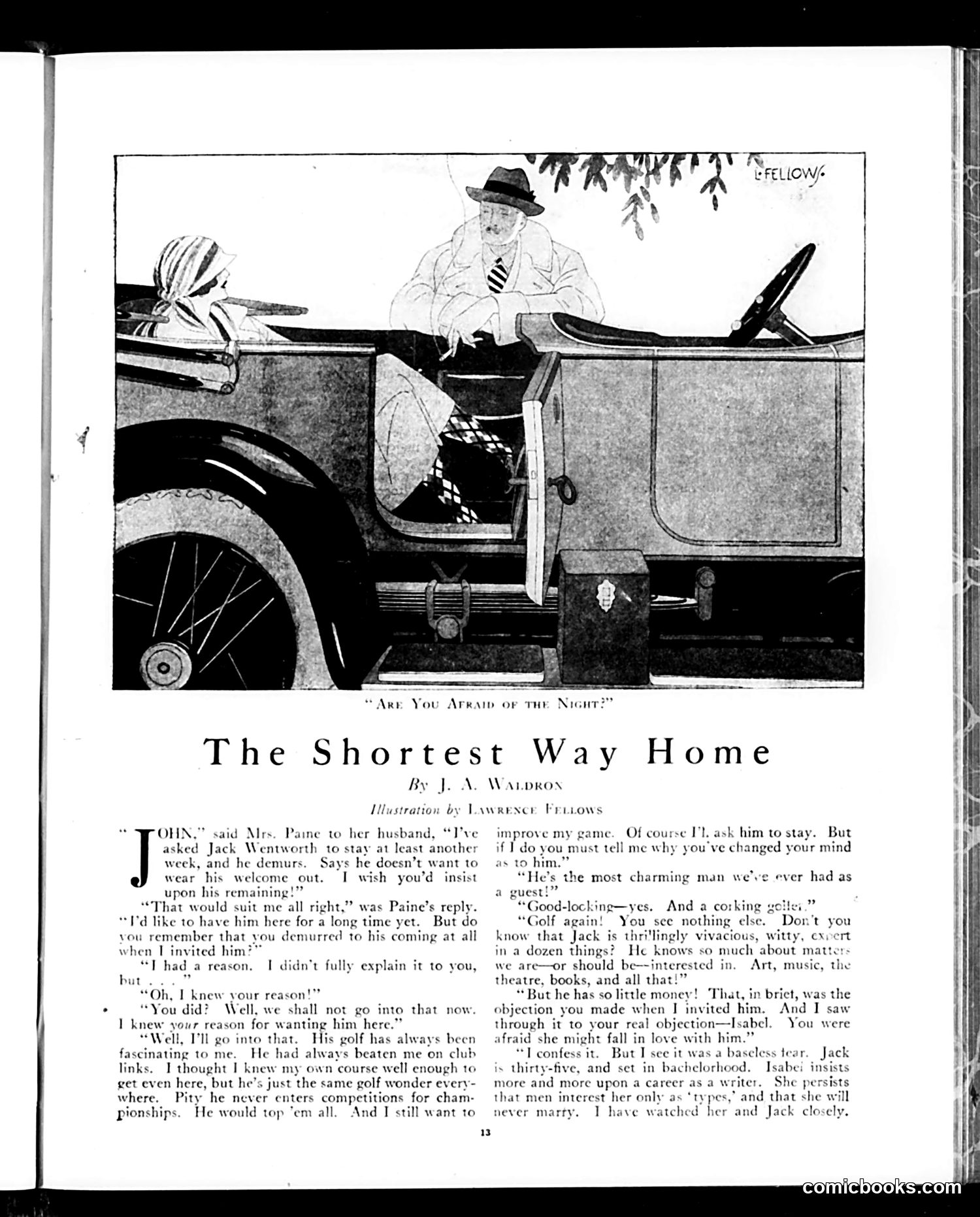
This is a domestic comedy story illustrated by Lawrence Fellows. The narrative concerns Mr. Paine's reluctance to invite his friend Jack Wentworth to stay, despite his wife's insistence. The setup plays on a common early-20th-century social anxiety: a husband fears his charming houseguest will seduce his daughter Isabel. Mrs. Paine initially objects to Jack's poverty; Mr. Paine suspects she actually fears romantic entanglement between Jack and Isabel. The irony—and the joke's resolution—is that Jack, now thirty-five and a confirmed bachelor, interests Isabel only as a "type" for her writing ambitions. She has no romantic interest in him. Mr. Paine's protective anxiety proves baseless. The cartoon illustration shows the characters in a period automobile, visualizing the social situation. The humor derives from the gap between parental worry and actual circumstance—a relatable domestic theme for Judge's middle-class readership.
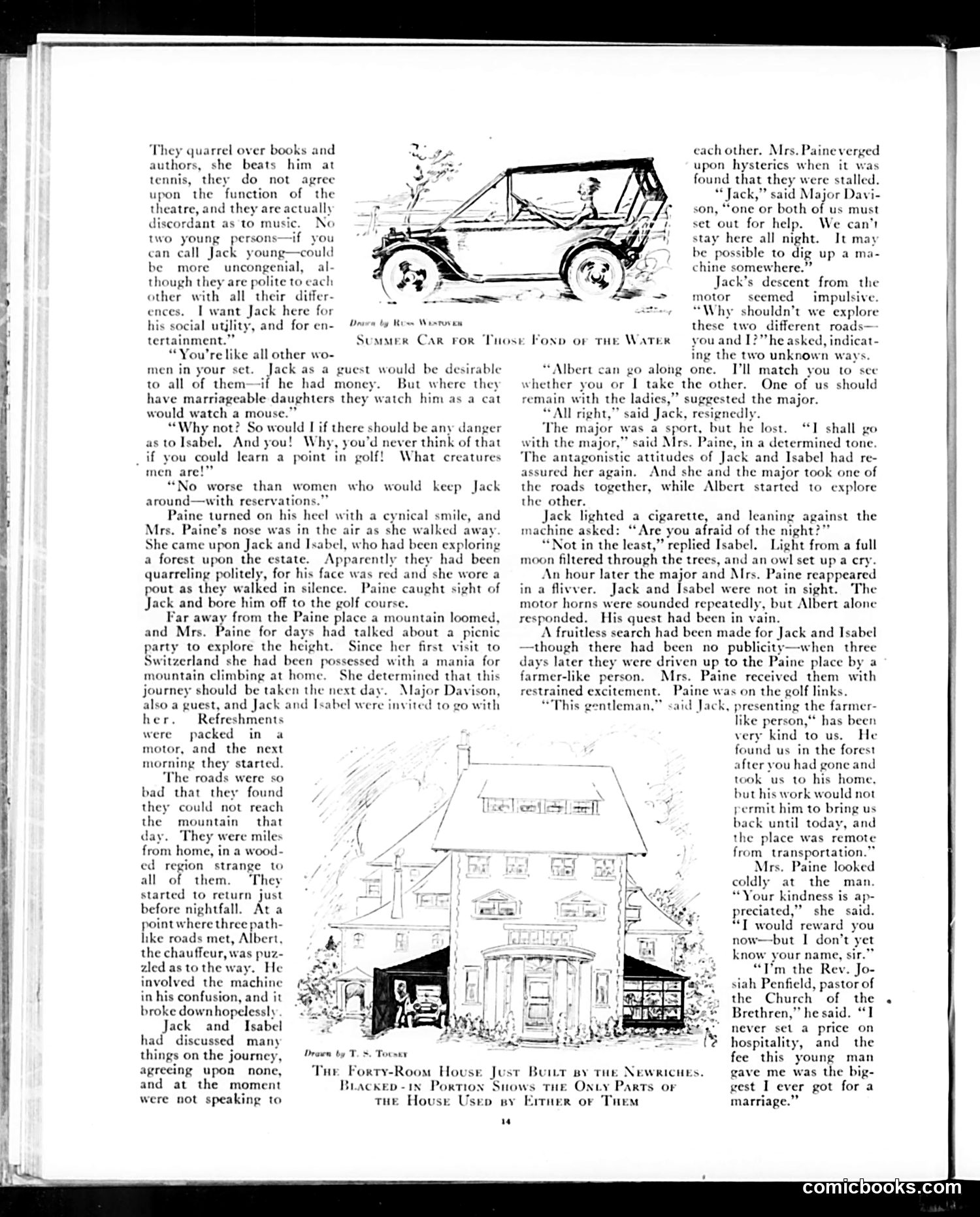
This appears to be a romantic comedy story rather than political satire. The narrative follows Jack and Isabel, two young people from wealthy families who are fundamentally incompatible—they disagree about books, sports, and the arts. Mrs. Paine, a society matron, worries Jack may marry her daughter Isabel and scrutinizes him accordingly. The plot's irony: when a motor car breaks down during a mountain picnic outing, Jack and Isabel are left alone while others seek help. The story implies their forced isolation together may change their relationship—a common romantic comedy trope of the era. The accompanying illustrations show a period automobile and a large "forty-room house" belonging to the wealthy Newriches family, emphasizing the upper-class setting. The satire is gentle social commentary on wealthy society's marriage concerns and young people's mismatched courtships, rather than political criticism.
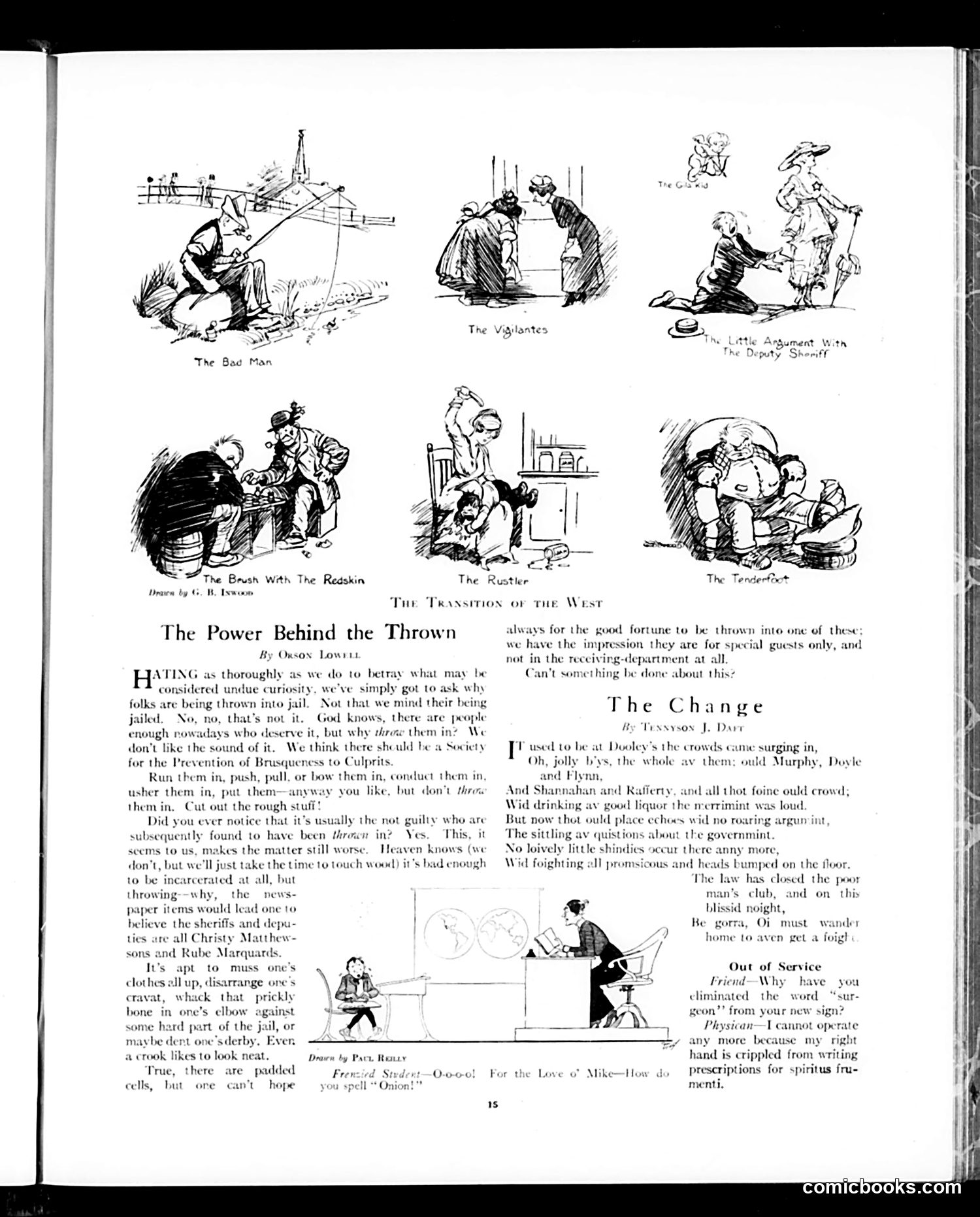
This page contains political and social satire from Judge magazine: **"The Power Behind the Thrown"** (Lowell) criticizes police brutality. The essay complains that suspects are "thrown into jail" roughly—arrested with unnecessary force—particularly when they're later found innocent. The author argues this damages their appearance and dignity, sarcastically suggesting a "Society for the Prevention of Brusqueness to Culprits." The accompanying cartoon (Resley) shows rough handling during arrest. **"The Change"** (Dart) laments Prohibition's impact on Irish-American social life. The poem nostalgically recalls a working-class bar ("Doc's") where Irish immigrants (Murphy, Doyle, Flynn, Shannahan, Rafferty) once gathered for drinking and rowdy camaraderie. Now it's closed by law, replaced by government discussions—the "merry" culture destroyed. **"Out of Service"** (small joke) is a pun: a physician can no longer write prescriptions because his hand is crippled from writing prescriptions for alcohol ("spiritus frumenti"), likely a Prohibition-era joke about doctors fraudulently prescribing medicinal whiskey. The page reflects early 20th-century concerns about police conduct and Prohibition's social consequences.
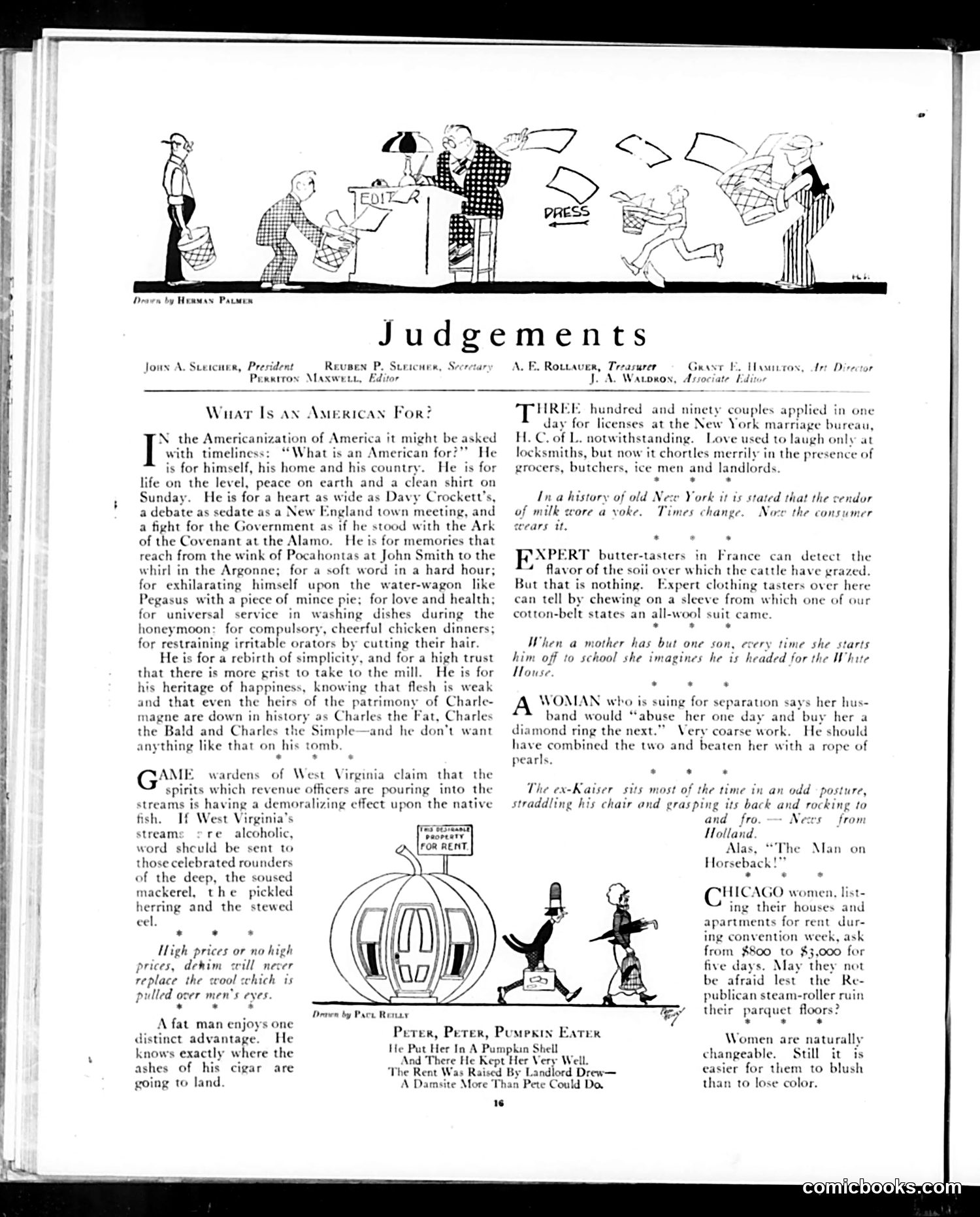
This page from *Judge* magazine contains satirical commentary on American life, circa early 20th century (appears pre-1920s based on references). **Main Content:** The lead editorial "What Is an American For?" offers idealized yet gently mocking definitions of American values—patriotism, domestic simplicity, and moral rectitude—while poking fun at grandiose historical references. **Satirical Vignettes:** - **West Virginia fish**: Jokes that bootleggers' alcohol runoff is corrupting native fish, as if the streams themselves were alcoholic—a Prohibition-era reference. - **Marriage licenses**: Mocks post-WWI inflation ("H.C. of L." = High Cost of Living) by noting 390 couples married despite economic hardship. - **Butter tasters**: Contrasts European expertise with American deception (fake wool suits). - **Chicago landlords**: During a political convention, landlords exploit renters with inflated prices; Republicans' "steam-roller" (campaign machinery) might damage fancy floors—political commentary masked as humor. The cartoons by Herman Palmer and Paul Relly provide visual gags supporting these social critiques, typical of *Judge*'s satirical approach to contemporary American issues.
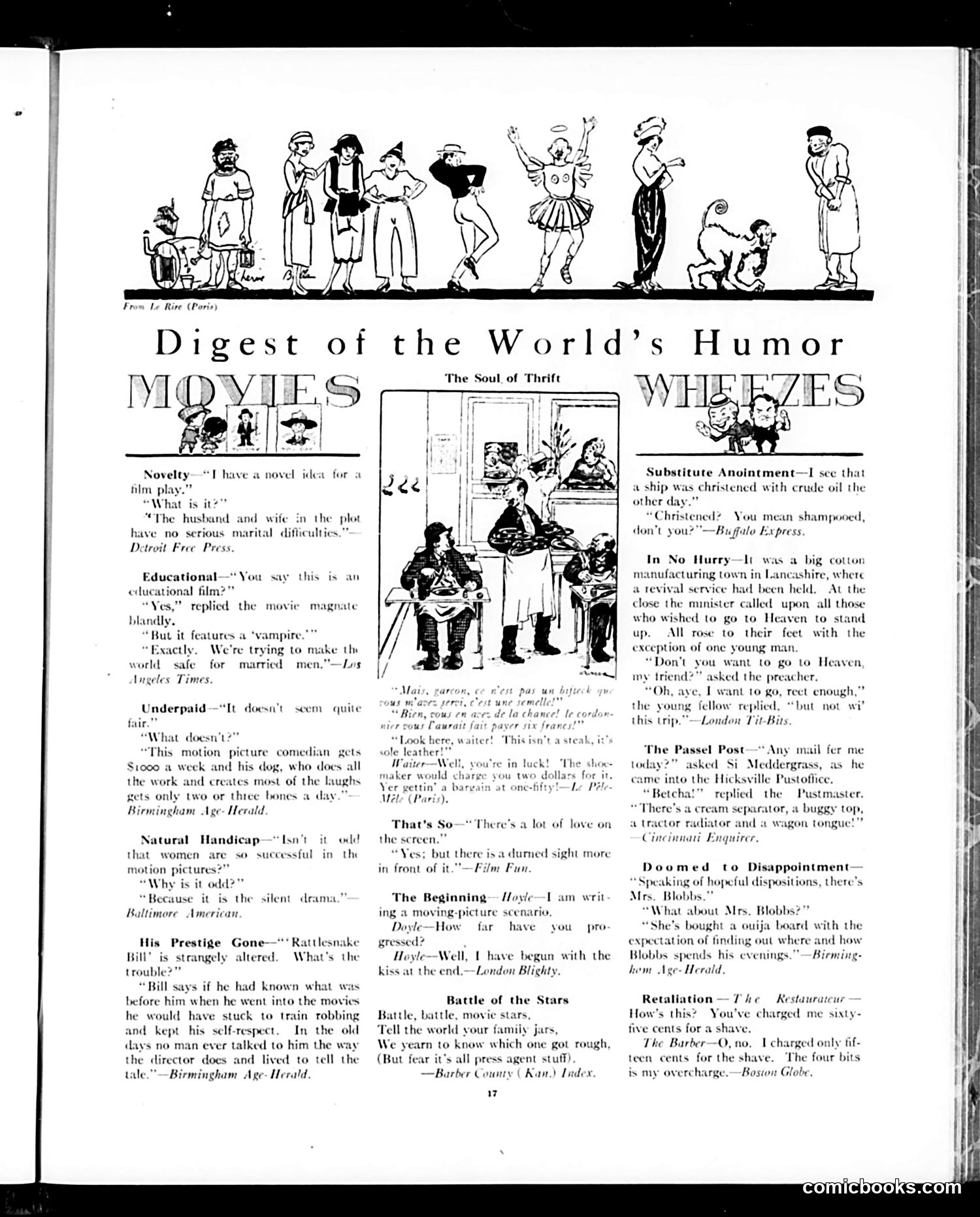
This page collects brief humorous anecdotes about early cinema and everyday life, organized by topic. The cartoons and jokes satirize: **Film Industry Critiques**: The "Novelty" and "Educational" jokes mock Hollywood's absurd premises—films where married couples have *no* problems, or "educational" films featuring vampires. The "Underpaid" joke contrasts a comedian's $1,000 weekly salary against his dog getting only bones, despite the dog doing most of the actual comedic work—satirizing Hollywood's wage disparities and that silent film comedy relied heavily on physical performance. **Silent Film Paradoxes**: The "Natural Handicap" joke notes women succeed in silent pictures precisely *because* they can't talk—a backhanded compliment to female performers. **Social Commentary**: Other jokes mock thrift, revival preachers, and domestic unhappiness through period-appropriate working-class characters and regional dialect humor typical of the era. The page reflects 1920s skepticism about cinema's artistic merit and Hollywood's commercial logic.
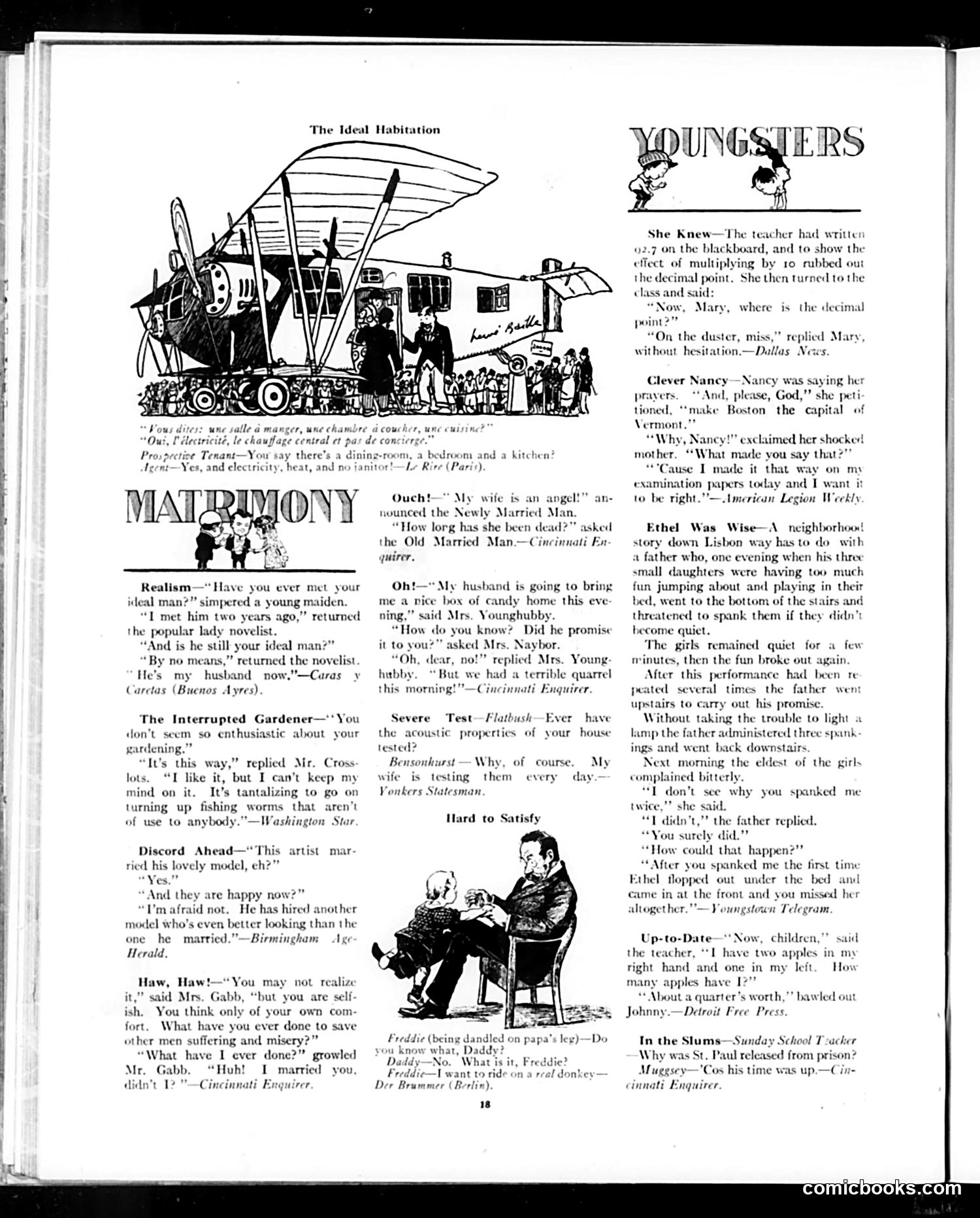
This page is a **collection of short humorous anecdotes** typical of early 20th-century satirical publications. The cartoons target common domestic frustrations and social hypocrisies of the era. Key jokes lampoon: marriage disappointment (the novelist's "ideal man" becomes flawed once wed); gender dynamics (the selfish husband joke); and class expectations (the schoolyard wisecracks). **"The Ideal Habitation"** cartoon depicts a futuristic apartment building—reflecting contemporary anxieties about modern urban living and technological conveniences. The French caption suggests discussion of amenities like dining rooms and janitor services. The humor relies on predictable payoffs: the wife described as an "angel" is presumed dead; quarreling couples reconcile via candy. **For modern readers**: These jokes encode now-dated assumptions—that marriage inevitably disappoints, that working-class families are inherently comedic, and that children's casual irreverence is entertainingly shocking. The comedy assumes reader familiarity with *specific newspapers' recurring joke formats*—these are reprinted from Cincinnati Enquirer, Washington Star, etc. The overall effect is mild domestic satire reflecting middle-class anxieties of approximately 1910-1920.
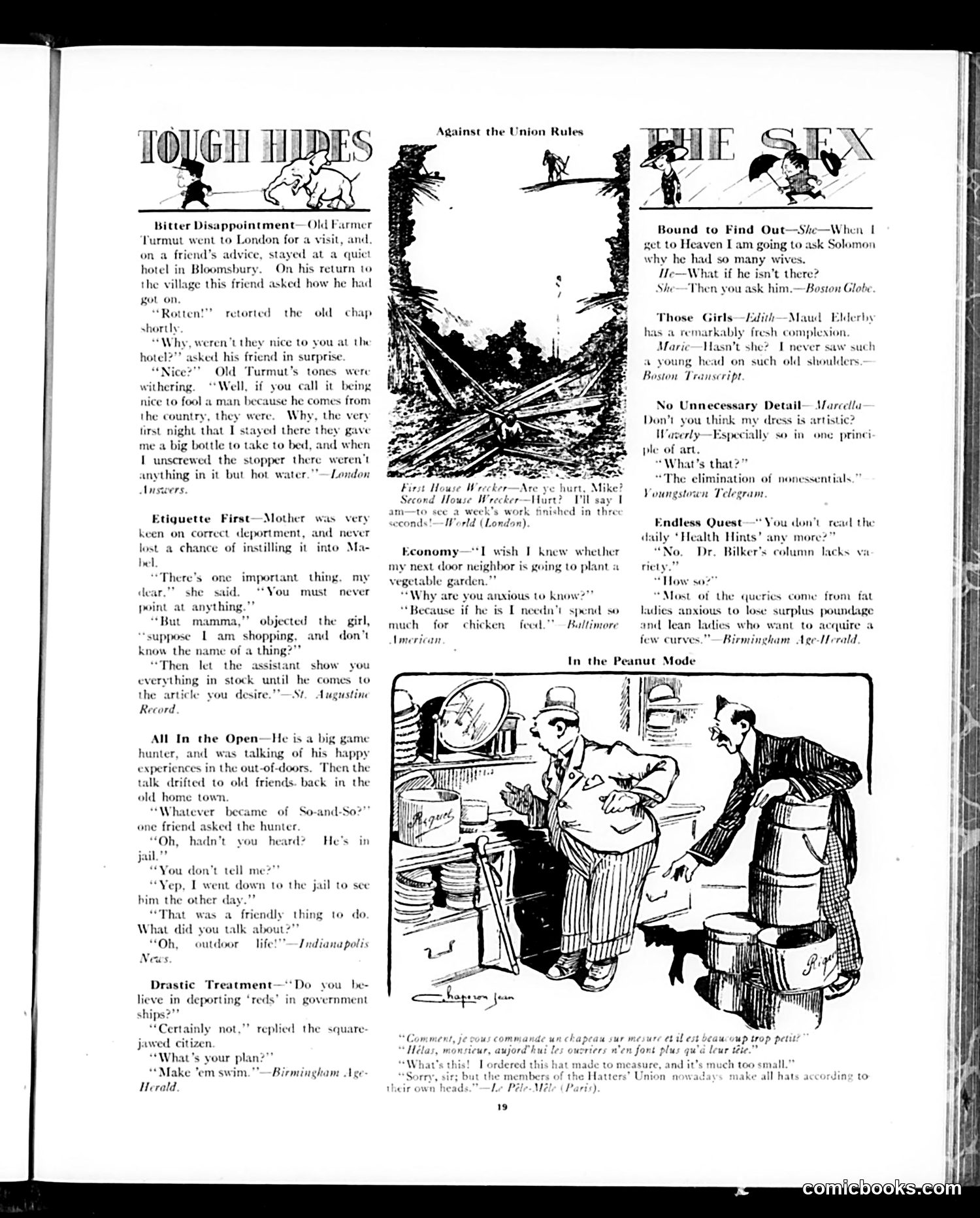
This page from Judge contains multiple short humor columns and one cartoon ("In the Peanut Mode"). The columns are brief jokes about everyday life and manners, typical of Judge's style. Topics include: a rural farmer disappointed by a London hotel's hot-water bottle, a mother's strict etiquette rules, a hunter visiting a jailed friend, and someone's proposal to handle "reds" (communists/radicals) by making them swim—reflecting early 20th-century anti-communist sentiment. The cartoon depicts men in a hat factory apparently measuring someone's head. The caption references the Hatters' Union enforcing regulations—likely satirizing labor union rules as impractical or absurd, particularly regarding standardized hat measurements. The page mostly lacks overt political messaging; it's domestic humor reflecting period anxieties about labor unions, immigration, femininity, and rural-versus-urban life.
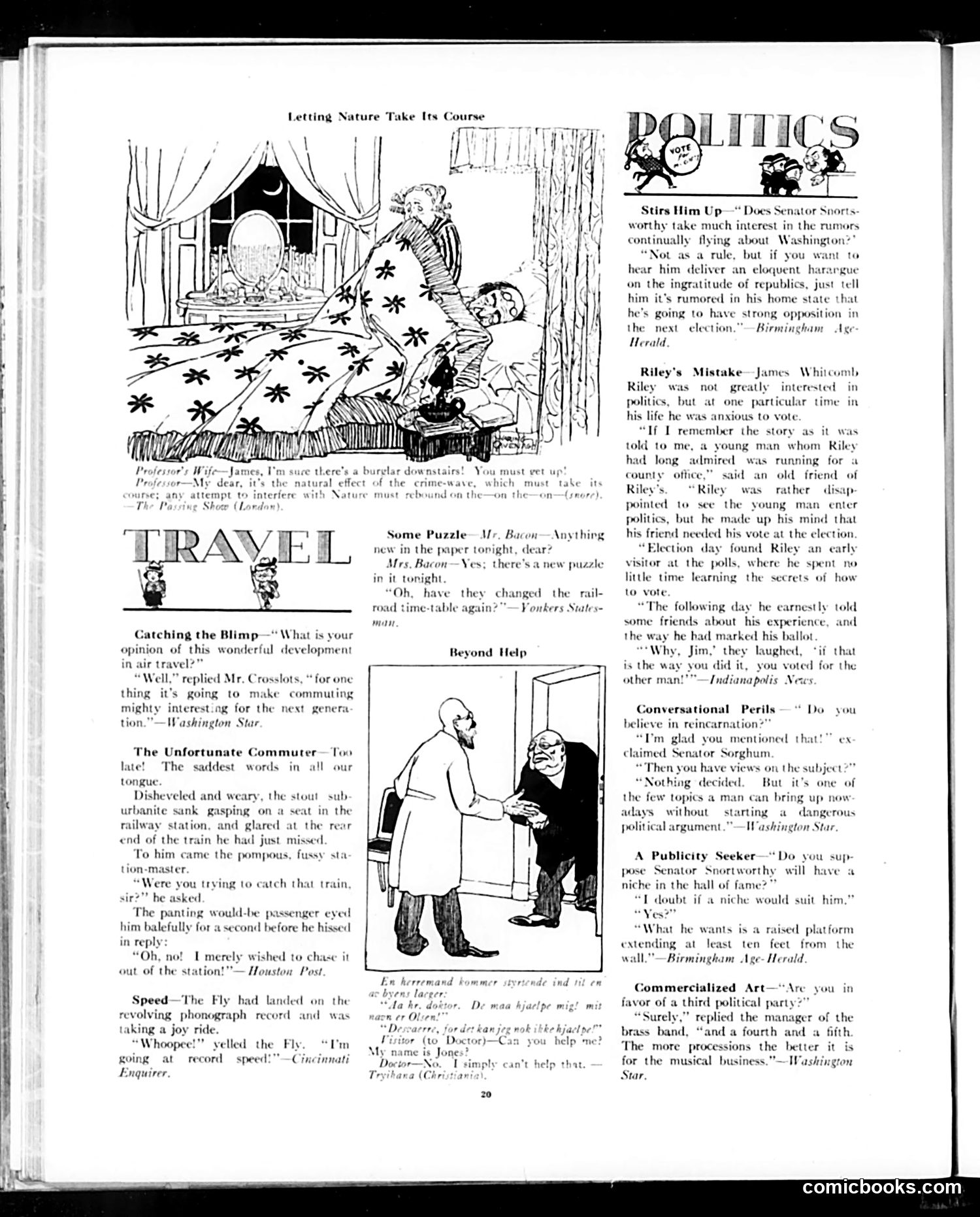
This page from *Judge* magazine contains several brief satirical pieces about early 20th-century American politics and social life: **Main cartoons:** 1. **"Letting Nature Take Its Course"** (top): A domestic scene where a woman sits by a window while a man lies in bed—likely satirizing the era's concerns about air travel (blimps) disrupting traditional life. 2. **"Beyond Help"** (center): A cartoon showing two men in conversation, illustrating a joke about an older man struggling to understand voting procedures—a reference to James Whitcomb Riley, a famous Indiana poet who allegedly voted incorrectly despite good intentions. **Satirical snippets** mock politicians (Senator Snortworthy, Senator Sorghum) for self-promotion and their predictable behavior around election rumors; joke about commuter frustrations with trains; and pun on commercialism in politics (a brass band manager supporting multiple political parties for profit). The humor relies on recognizing contemporary political figures and 1920s-era social anxieties about technology and modern life.
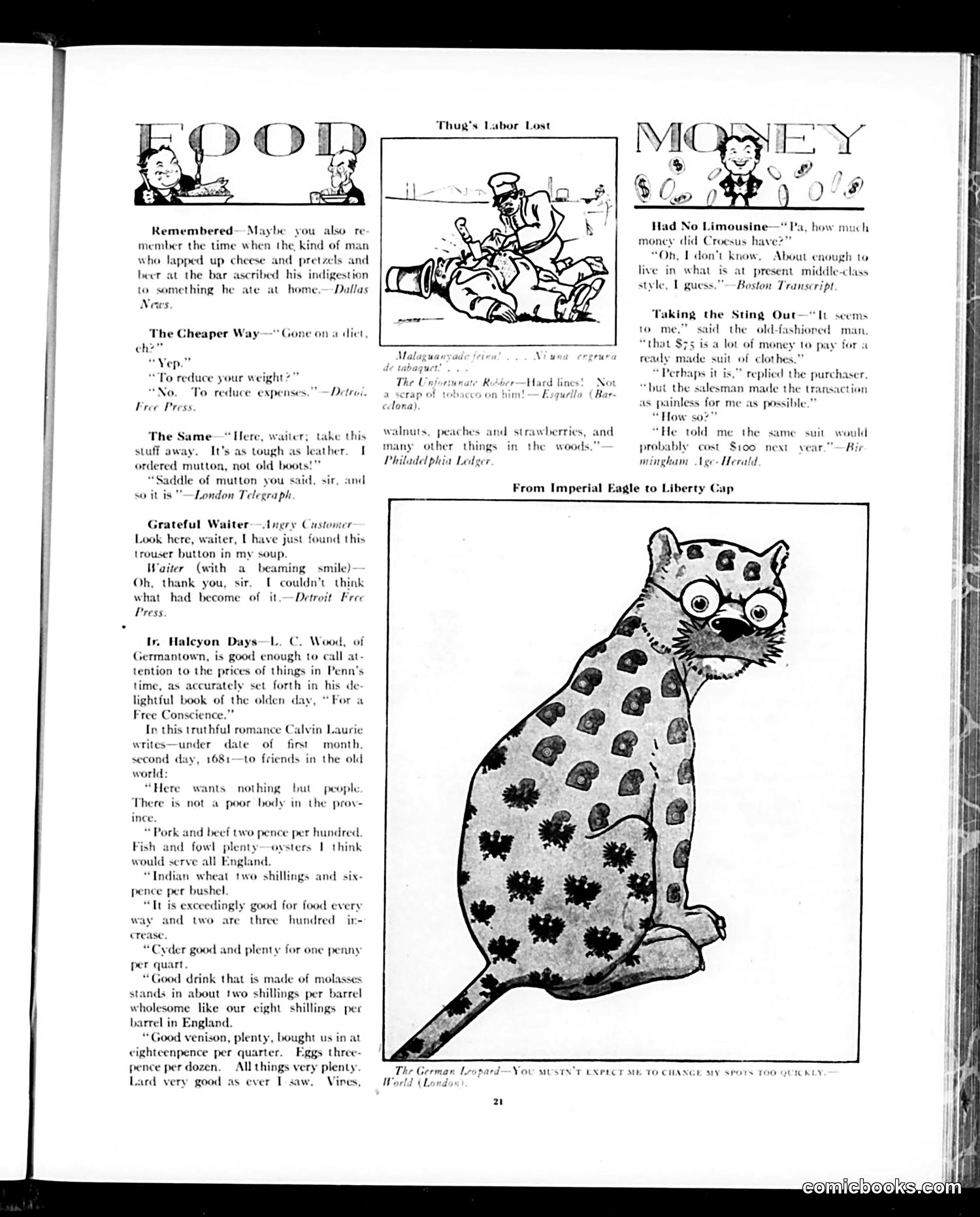
This page contains several brief humorous anecdotes about dining and consumer spending, typical of Judge's satirical humor circa early 20th century. **"Thug's Labor Lost"** mocks working-class men who blamed their indigestion on home cooking rather than acknowledging their bar habits (cheap cheese, pretzels, beer). **The dining jokes** satirize restaurant culture: customers complaining about tough meat, finding a button in soup (the waiter claims he'd been searching for it). These mock both pretentious diners and careless waiters. **"In Halcyon Days"** nostalgically references William Penn's Pennsylvania colony, contrasting historical abundance and low prices with contemporary costs—a common theme lamenting modern inflation and economic anxiety. **"Had No Limousine"** and **"Taking the Sting Out"** joke about middle-class aspirations: a man lacking wealth but adopting luxury habits; another rationalizing an expensive suit purchase by assuming next year's prices will be higher. The **German Leopard cartoon** (bottom right) appears unrelated—likely a separate feature with its own caption about constancy. Overall, the page reflects working and middle-class economic anxieties and consumer culture of the era.
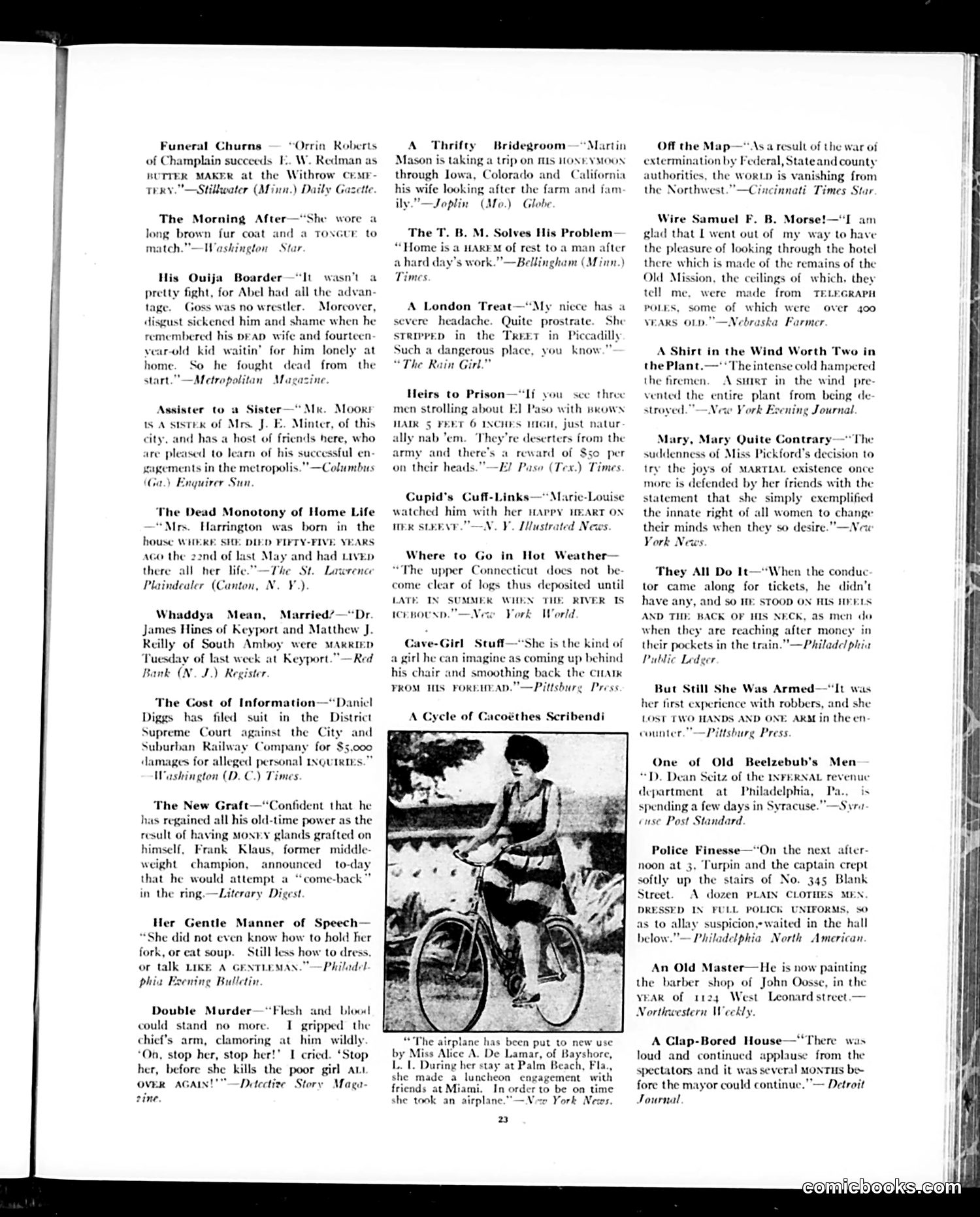
This page from *Judge* magazine contains no political cartoons, only text-based humor. It's a collection of brief, ironic observations sourced from newspapers, satirizing unintentional absurdities in journalism. Examples include: - **"Funeral Churns"**: A funeral director named "Roberts succeeds" another—the word choice creates dark humor about succession. - **"Her Gentle Manner of Speech"**: Mocking a woman's lack of refinement by listing her social failures. - **"Whaddya Mean Married?"**: Poking fun at awkwardly-phrased wedding announcements. - **"The New Graft"**: Ridiculing boxer Frank Klaus's faith in a fad "monkey gland" grafting procedure purported to restore youth/vigor. The humor relies on *Judge's* editors highlighting unconscious ironies and questionable grammar from small-town newspapers, satirizing both journalistic quality and American social pretensions of the era.
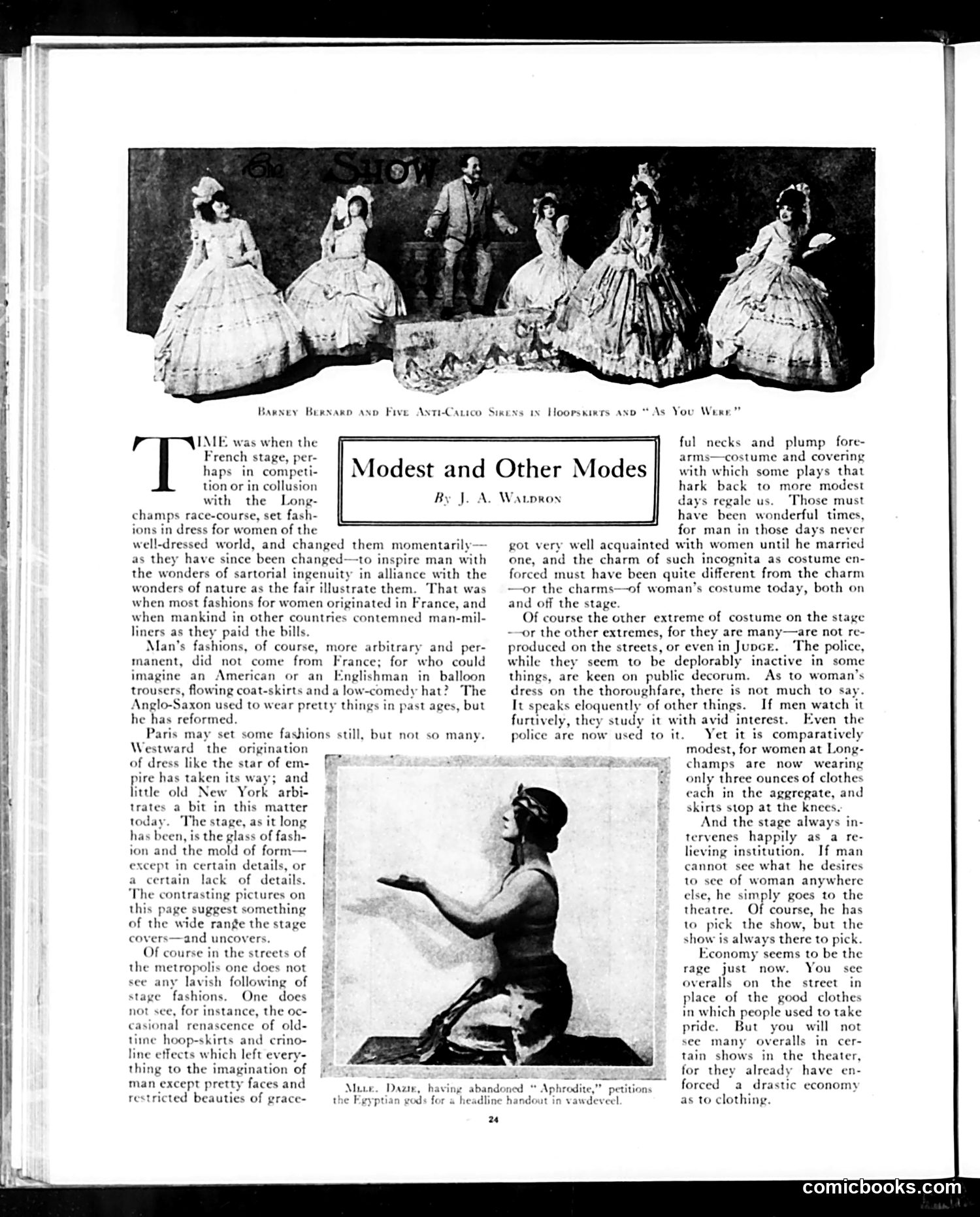
This article by J.A. Waldron discusses fashion trends and their relationship to theater versus street wear. The top photograph shows performers from a Barney Bernard production in elaborate period costumes with hoopskirts from "As You Were"—a theatrical production. The satire contrasts theatrical costume extremes with real-world fashion restraint. Waldron argues that while the French stage once dictated women's fashion globally, New York now sets trends. However, the public doesn't actually adopt these theatrical styles—the police enforce "public decorum" that prevents women from wearing the scanty or elaborate costumes seen on stage. The joke is pointed: working-class men wear economical overalls on streets, yet theater remains the one place where women still display elaborate dress. Waldron suggests theater serves as a socially acceptable outlet for displaying female bodies that street fashion increasingly conceals. The article mocks both theater's role as fantasy and society's contradictory prudishness about women's actual clothing versus theatrical display.
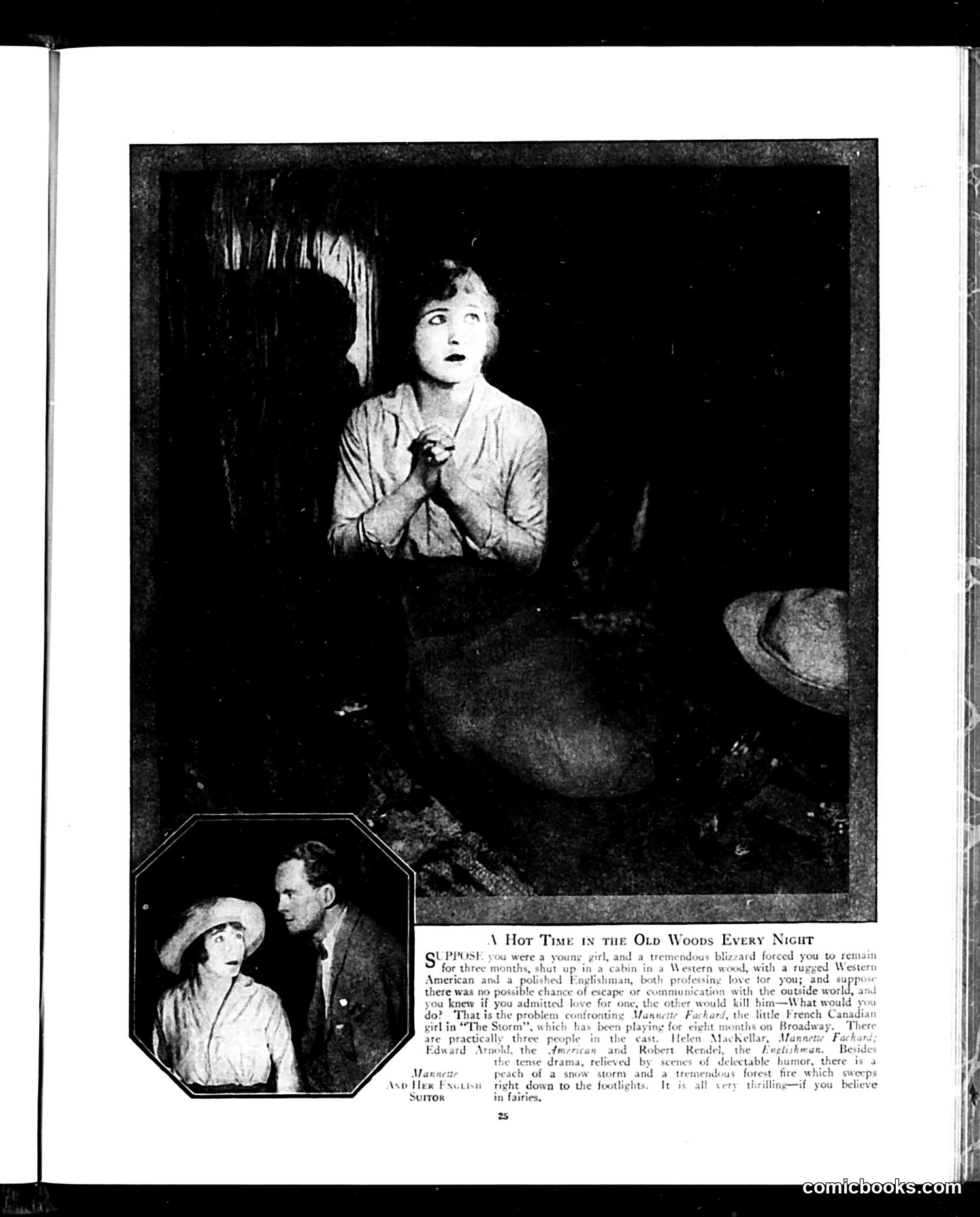
This page contains a theatrical advertisement or review for a Broadway production called "The Storm," featuring French-Canadian actress Maude Farat in the lead role. The main image shows her character—a young girl trapped in a cabin during a blizzard in a Western setting. The smaller inset photo shows two other cast members. The text presents a melodramatic premise: the protagonist must choose between remaining isolated for three months or risking escape through dangerous conditions. The tagline "A Hot Time in the Old Woods Every Night" suggests the production emphasizes thrilling, romantic drama. This appears to be standard theatrical promotion from Judge magazine rather than political satire. The "fairies" reference in the OCR'd text likely indicates magical or fantastical elements in the plot, though the text is too corrupted to confirm details with certainty.
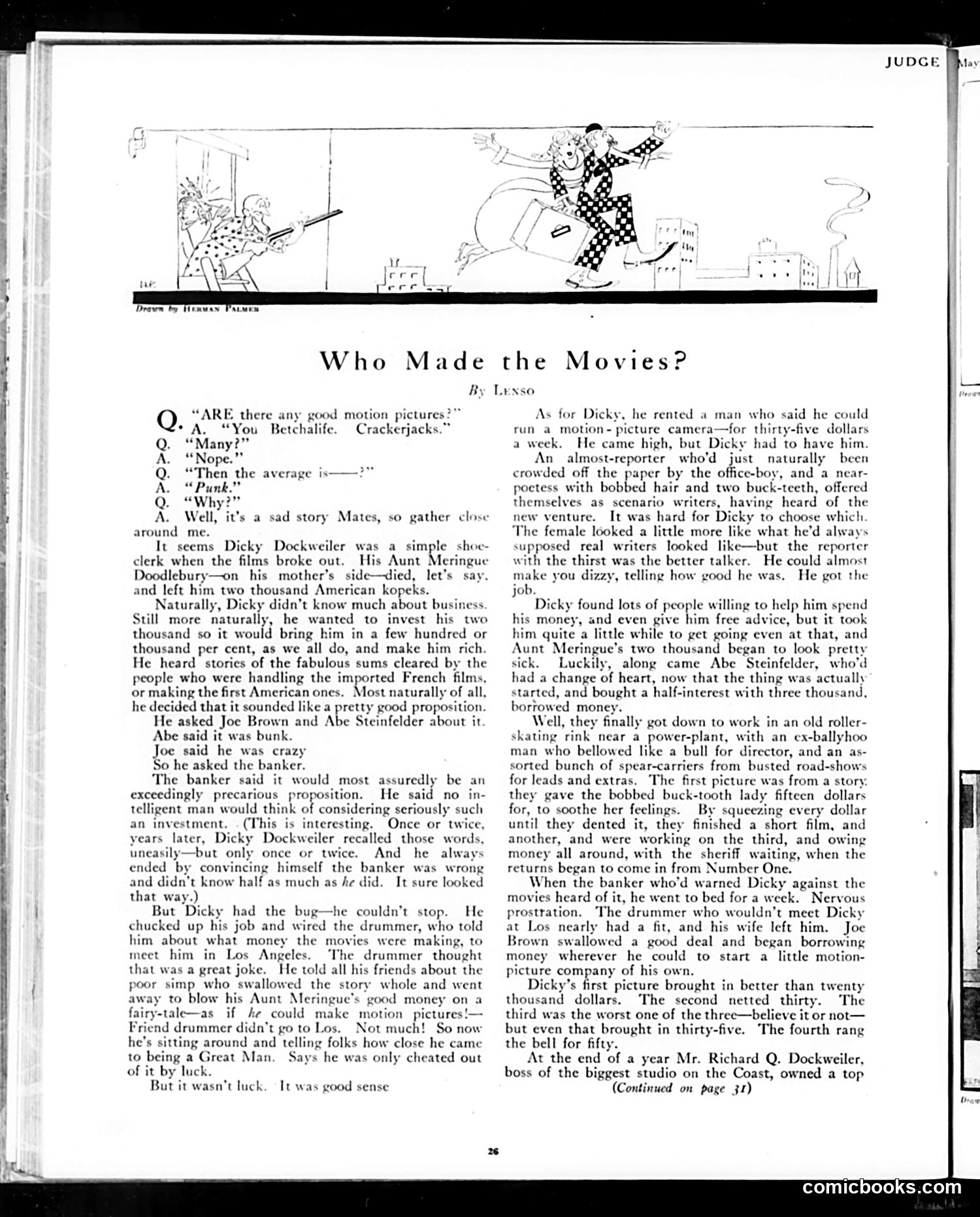
This article satirizes the early motion picture industry's explosive growth and the get-rich-quick schemes it inspired. The cartoon (drawn by Herman Palmer) depicts a charlatan filmmaker in checkered clothing, representing the fraudulent or incompetent operators flooding the nascent film business. The story follows Dicky Dockweiler, an everyman shoe clerk who inherits modest money and ignores sensible advice to invest in moviemaking. Despite bankers and friends warning against it, he pursues the venture, hiring incompetent staff: a cameraman at inflated wages, a rejected newspaper reporter as screenwriter, and casting aspiring actresses for pittance. The satire highlights the industry's chaos—amateur operators, shady financing, exploitation of workers, and people's willingness to throw money at an unproven medium simply because others had profited. The article mocks both the dreamers and the industry's opportunism, ultimately suggesting some succeed despite incompetence through luck rather than merit.
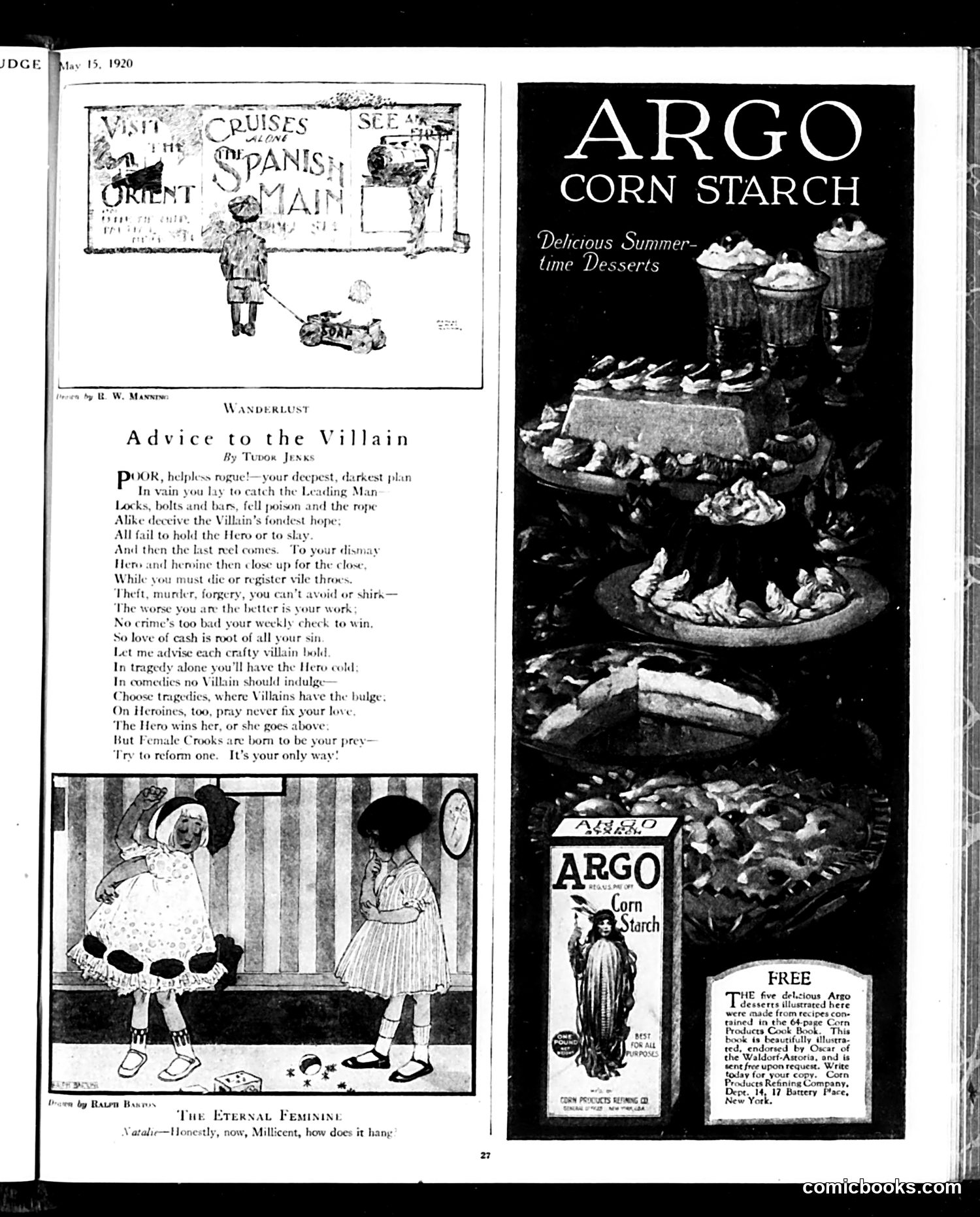
This page contains two unrelated items: **Left side:** A humorous article by Turok Jenks offering cynical "advice" to villains in theatrical melodramas and early cinema. It satirizes the predictable formula of popular entertainment: villains always lose, heroes always win, and reform is only possible for female criminals (who exist to be the villain's "prey"). The accompanying illustration shows an interaction between women, with a caption joke about how something "hangs." The satire mocks both melodrama conventions and the era's gender assumptions. **Right side:** An Argo Corn Starch advertisement promoting "delicious summertime desserts," featuring product photography and an offer for a free recipe booklet endorsed by "Oscar of the Waldorf-Astoria." These sections share no thematic connection—typical of magazine layout from this period.
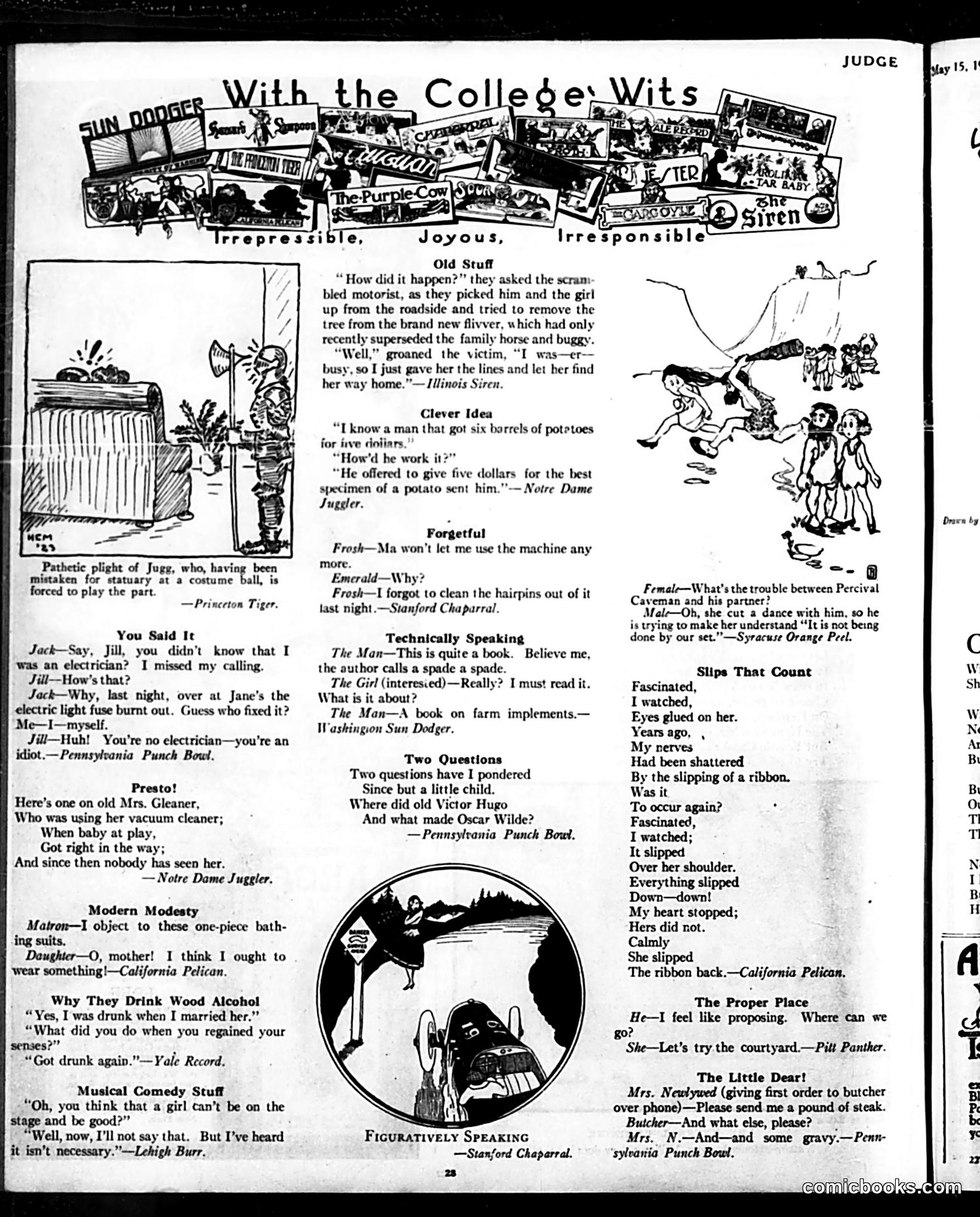
This page collects brief jokes and witticisms from college humor magazines of the era (Princeton Tiger, Yale Record, Stanford Chaparral, etc.). The humor reflects 1920s college life and social attitudes: **Key themes:** - **Gender dynamics**: Women as romantic interests; humor about bathing suits and "modern modesty" - **Technology**: Automobiles ("flivvers"), vacuum cleaners, electric lights—still novel enough to joke about - **Courtship rituals**: Proposals, dancing, social propriety ("not being done by our set") - **Prohibition era**: Jokes about drinking wood alcohol (dangerous bootleg liquor) **The cartoons** mock everyday situations: a statue mistaken for a costume-ball attendee, a vacuum cleaner accident (darkly implying harm to a baby), automotive mishaps. **Overall tone**: Light, often cynical about relationships and modern life. The humor assumes college-educated, urban readers familiar with current consumer goods and social conventions. Much relies on double entendres and mild irreverence toward authority.
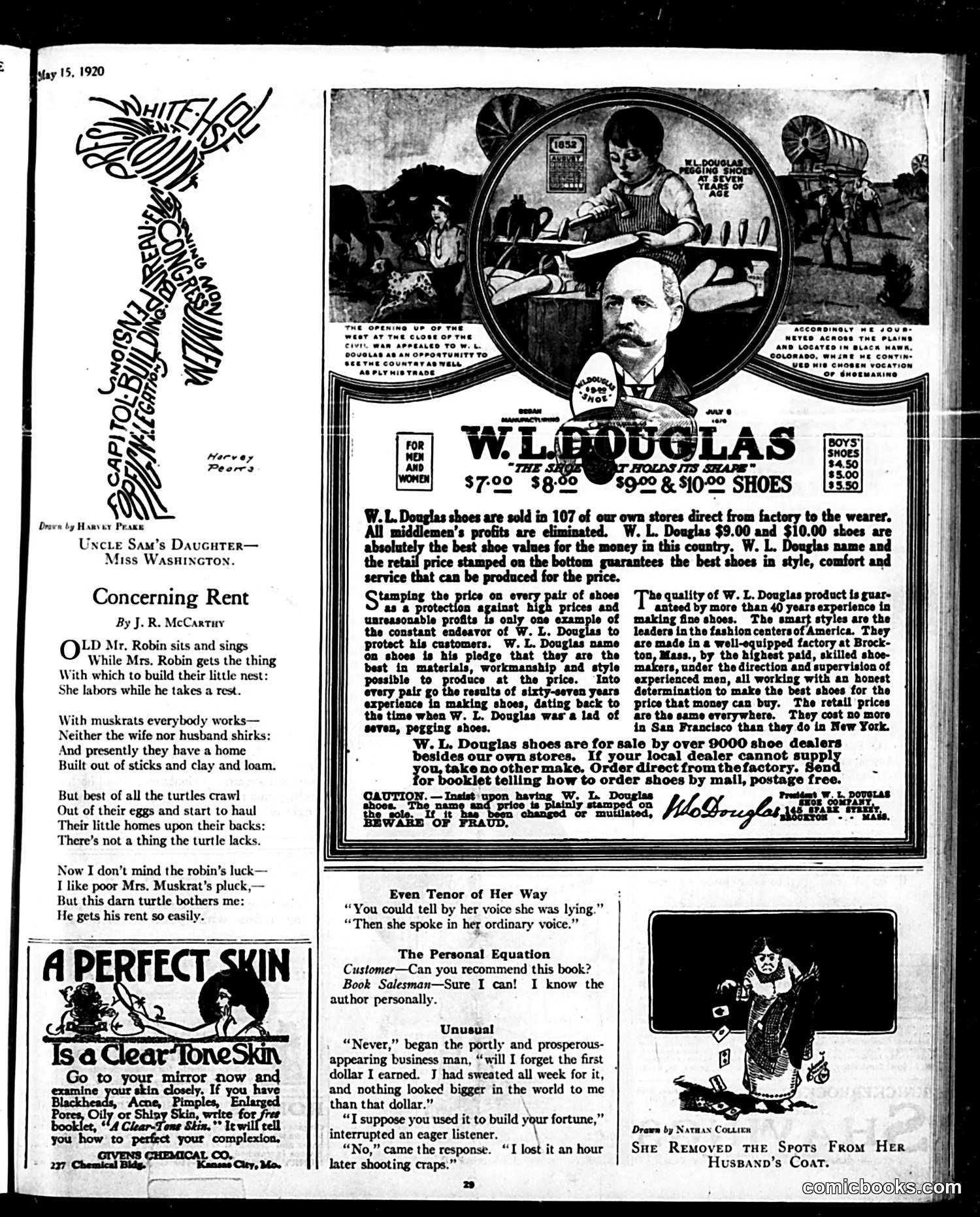
This page contains several distinct pieces: **Left side:** A poem titled "Uncle Sam's Daughter—Miss Washington" by Harvey Pearse, illustrated with a decorative initial letter. The poem "Concerning Rent" by J.R. McCarthy uses animal metaphors (robins, muskrats, turtles) to compare how different creatures obtain shelter, apparently as social commentary on human housing and labor. **Center:** A large W.L. Douglas shoe advertisement featuring a man's portrait and circular vignettes showing shoe manufacturing. This is primarily commercial content promoting direct factory-to-consumer sales. **Right side:** Several brief humor pieces including "Even Tenor of Her Way" (a joke about a woman's dishonesty), "The Personal Equation" (about a book salesman), and "Unusual" (about a businessman's first dollar lost gambling). The final item, "She Removed the Spots From Her Husband's Coat," appears to be a caption for an illustration by Nathan Collier. The page is primarily advertising with occasional light satirical humor interspersed—typical of Judge magazine's format mixing commerce and social commentary.
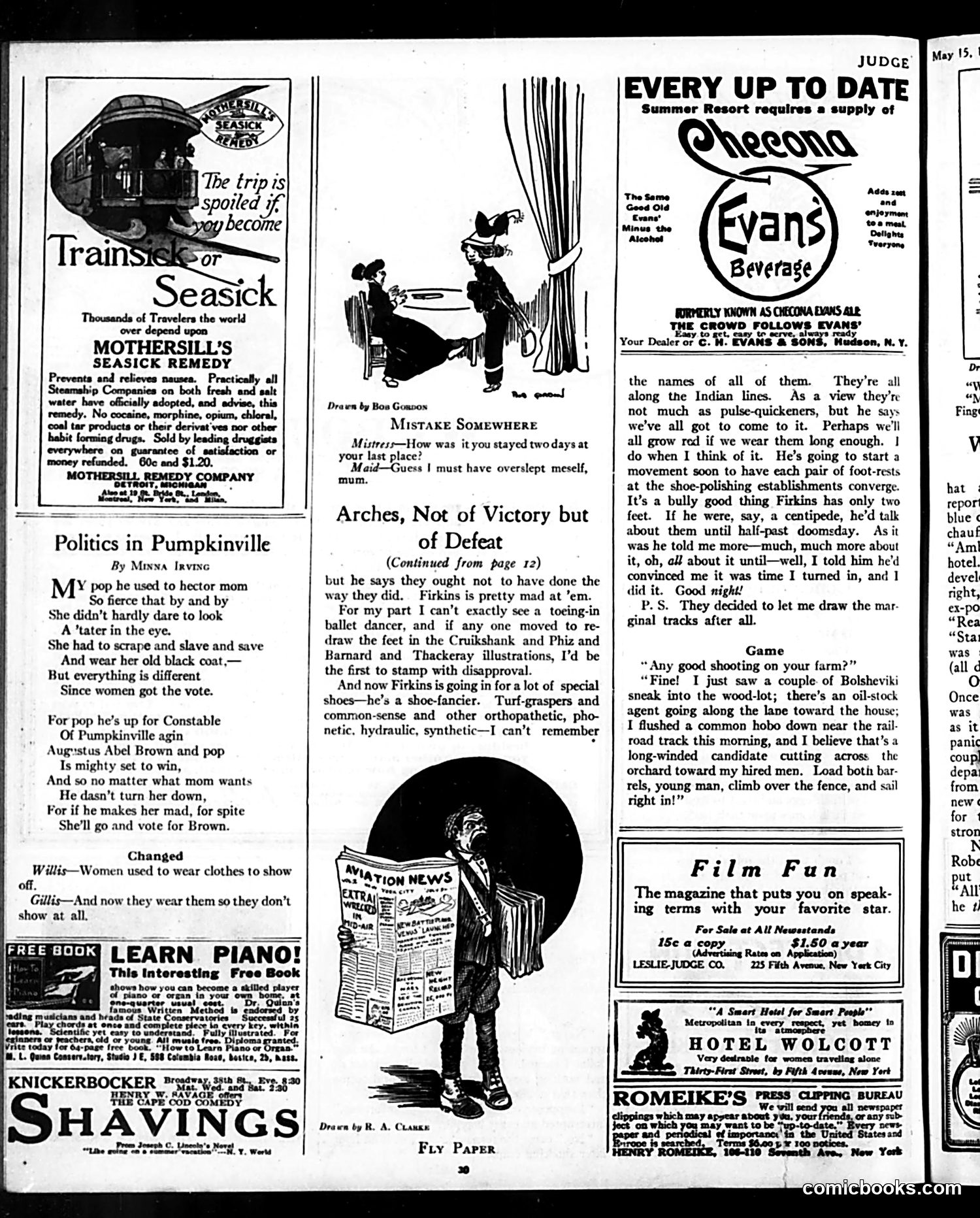
**This page contains three distinct cartoons and satirical pieces:** 1. **"Politics in Pumpkinville"** — A poem satirizing women's newfound voting power (likely post-1920 suffrage). The joke: a henpecked farmer can no longer ignore his wife's preferences because she can now threaten to vote for his political rival. This mocks both the perceived weakness of men and celebrates women's newly-gained political leverage. 2. **"Mistake Somewhere"** — A brief joke about a maid claiming she "overslept" at her previous employer's house after two days. The implied scandal (likely an affair) relies on readers understanding the maid's real reason for staying. 3. **"Arches, Not of Victory but of Defeat"** — A humorous story about an obsessive shoe fanatic named Firkins who endlessly discusses specialized footwear designs. The satire targets pedantic hobbyists who bore others with technical minutiae. The surrounding advertisements promote period products (seasickness remedy, piano lessons, hotel accommodations), typical of early-20th-century Judge magazine content.
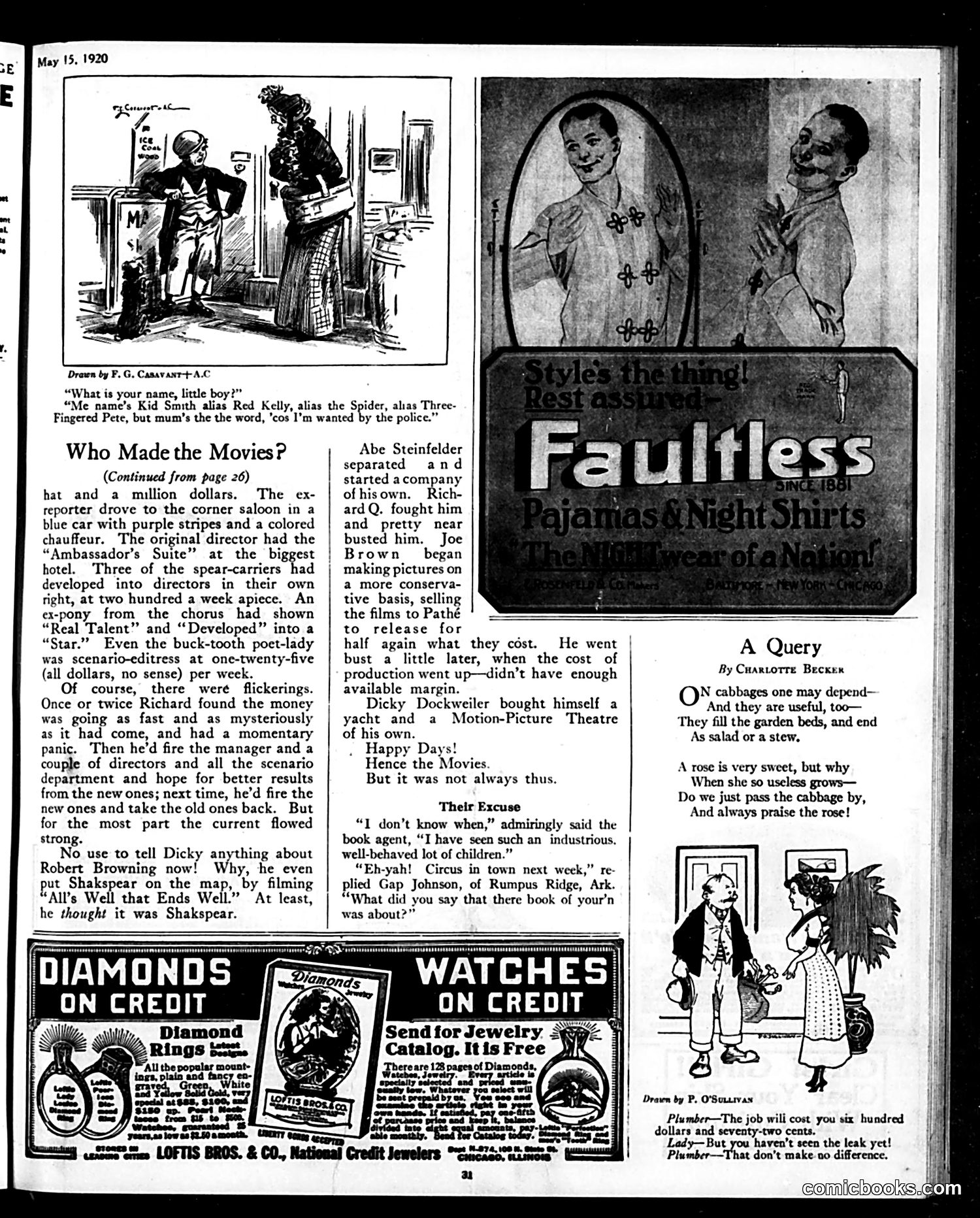
**Left Cartoon (by Casavant):** A street urchin claims multiple criminal aliases—Kid Smith, Red Kelly, the Spider, Three-Fingered Pete—but insists his mother keep quiet "cos I'm wanted by the police." The joke satirizes turn-of-the-century street gangs and child criminality in urban America, likely referencing real notorious child criminals of the era. **"Who Made the Movies?" Article:** This continues a satirical piece about early film industry excess. It mocks how quickly fortunes were made and lost in the chaotic 1920s movie business, with directors, extras, and bit players suddenly becoming wealthy and self-important. The specific jabs at "Robert Browning" and Shakespeare references mock filmmakers' pretensions to cultural sophistication while lacking education. **Right Cartoon (by O'Sullivan):** A plumber quotes an absurdly high price ($600.72) without examining the problem, claiming the cost "don't make no difference" whether he's identified the leak. This attacks dishonest tradecraft and working-class fraud. **"A Query":** A short poem sardonically questions why roses are praised despite uselessness, while practical cabbages are ignored—likely social commentary on valuing beauty over utility.
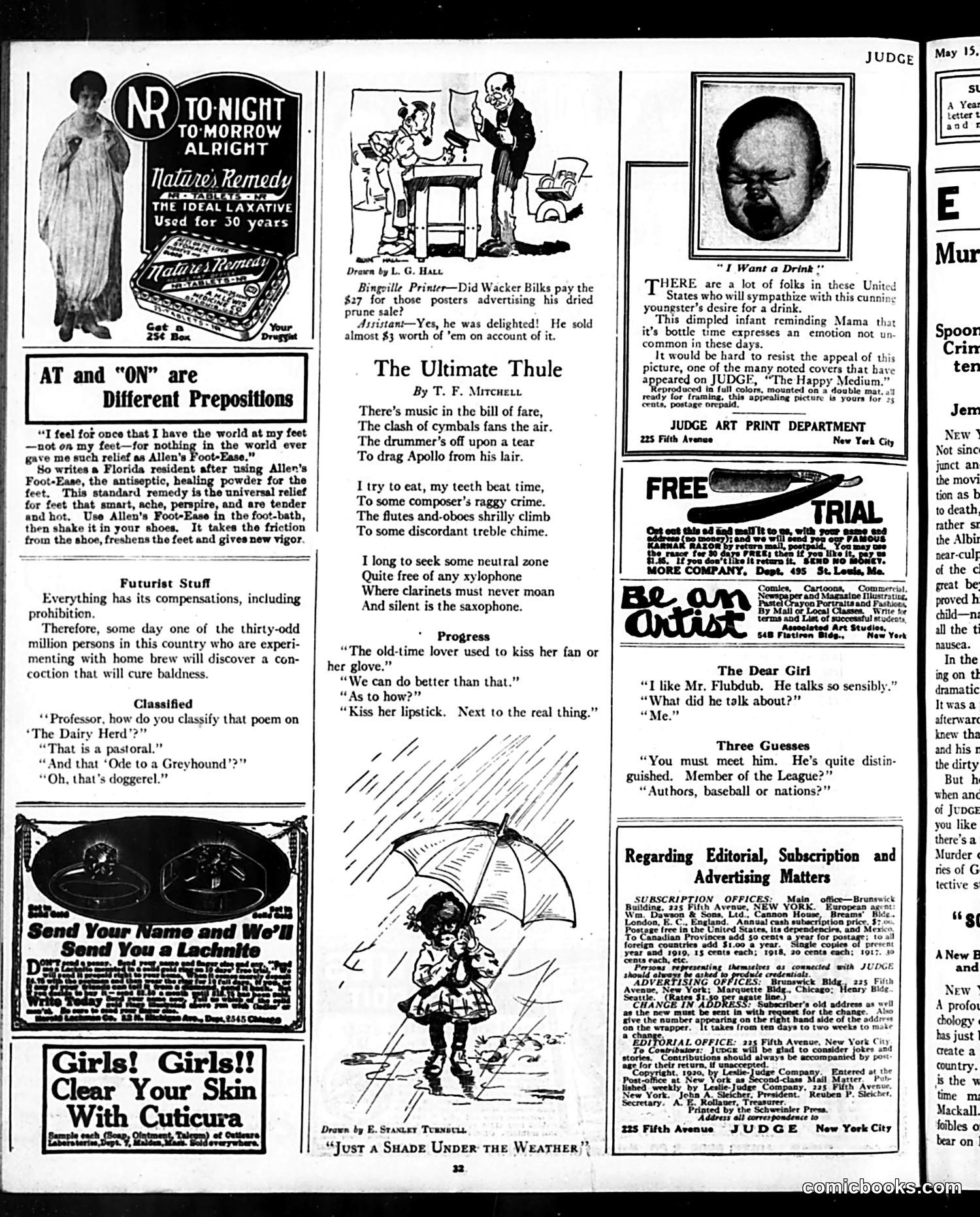
This page mixes advertisements, humor columns, and satirical cartoons typical of Judge magazine's format. **Key Content:** The cartoons mock contemporary life: One depicts a printer's employee noting that advertising "worked"—the client sold $3 worth of dried prunes after paying $27 for posters, satirizing ineffective advertising. Another shows a child demanding a bottle from mother, captioned "I Want a Drink," referencing Prohibition-era anxiety about alcohol deprivation. **Social Context:** The page reflects early-20th-century America during or shortly after Prohibition (1920-1933). Multiple jokes reference "home brew" experimentation and alcohol cravings, indicating widespread frustration with the alcohol ban. **Humor Style:** Other pieces employ wordplay ("AT" vs. "ON" are different prepositions) and classify poems absurdly ("Ode to a Greyhound" as "doggerel"). A poem satirizes restaurant dining where loud orchestral music prevents eating. The advertisements for foot powder, skin cream, and laxatives reflect contemporary remedies and consumer culture of the era.
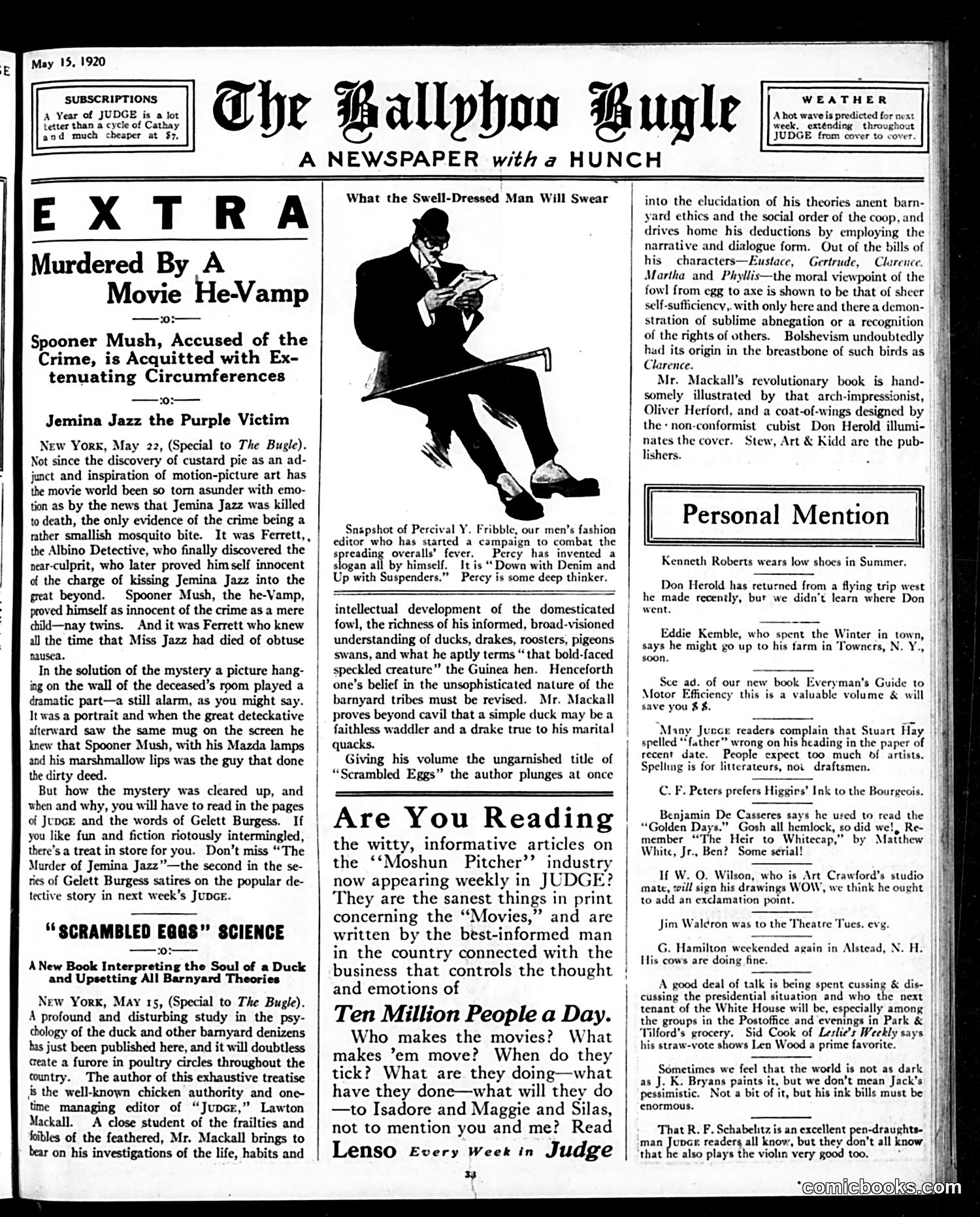
This page mocks silent-film melodrama and detective fiction through a fake newspaper article. "The Murder of Jemina Jazz" parodies overwrought movie plots: a woman dies from a mosquito bite, yet detectives treat it as a major crime. The "he-Vamp" (male seducer) character satirizes Hollywood's theatrical villain archetypes. The humor lies in the absurd seriousness applied to trivial evidence—a portrait becomes a "still alarm" (pun on photography stills). The accompanying cartoon shows a fashionably dressed man reading, mocking men's fashion obsessions of the era. The page also advertises Gelett Burgess's serialized satires and promotes Judge's regular features on the film industry. The overall thrust: Judge ridicules both Hollywood's sensationalism and 1920s consumer culture's pretensions. The fake "Ballyhoo Bugle" masthead reinforces that entertainment news is mere hype.
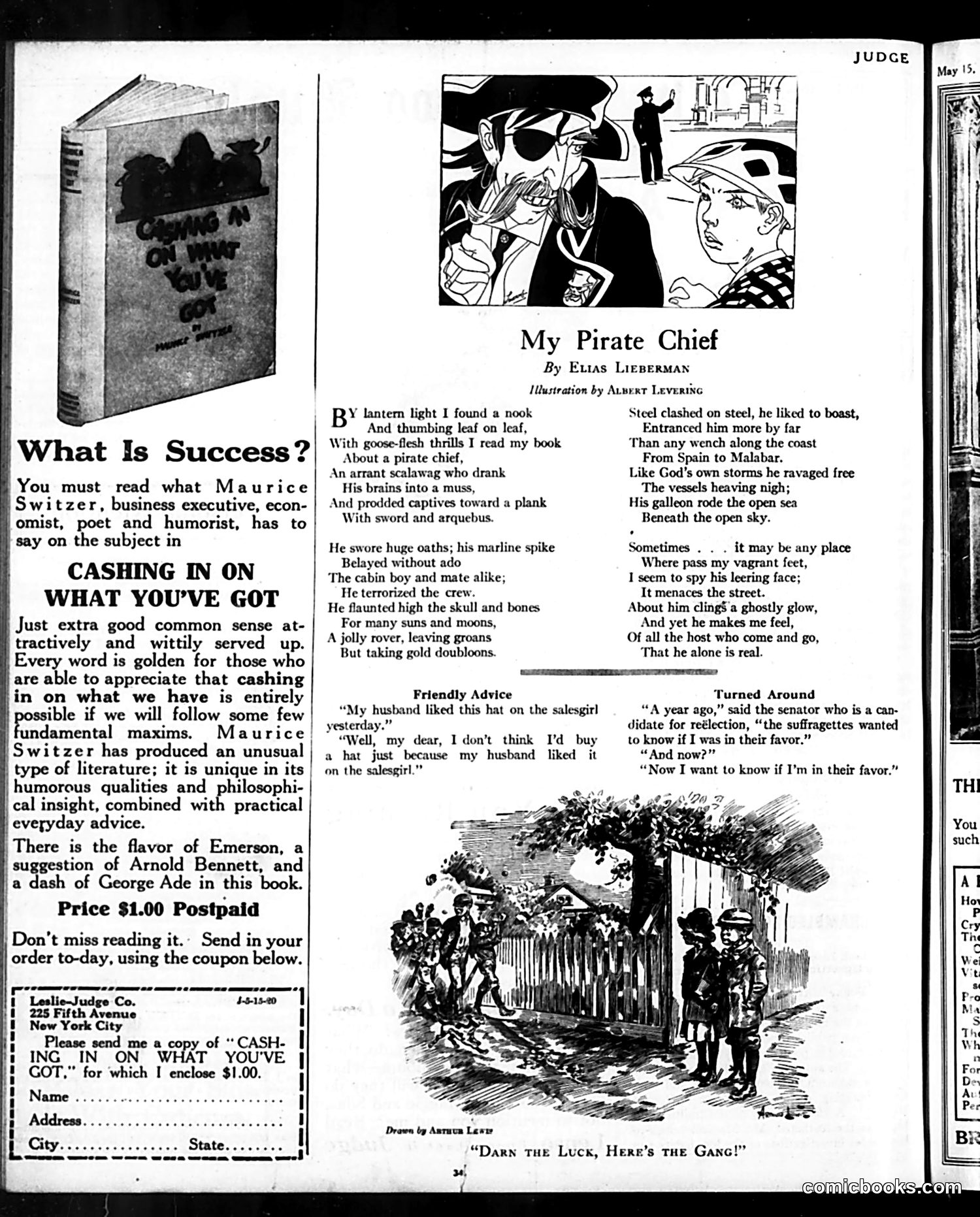
This page mixes advertisement and literary content. The left side advertises Maurice Switzer's business book "Cashing In On What You've Got," positioning it as practical wisdom combining Emerson-like philosophy with everyday advice. The main content features "My Pirate Chief," a romantic poem by Elias Lieberman about a swashbuckling pirate who haunts the narrator's imagination—presenting adventure and lawlessness as somehow more "real" than ordinary life. Below are three brief humor pieces: "Friendly Advice" mocks a wife's fashion logic (buying a hat because her husband liked it on a salesgirl); "Turned Around" satirizes a politician's convenient flip-flop on women's suffrage, changing from opposing suffragettes to courting their favor for reelection; and an illustration captioned "Darn the Luck, Here's the Gang!" (text unclear without seeing the full joke). The page reflects early 20th-century preoccupations: business self-improvement, romantic escapism, marital domestic humor, and political opportunism regarding women's rights.
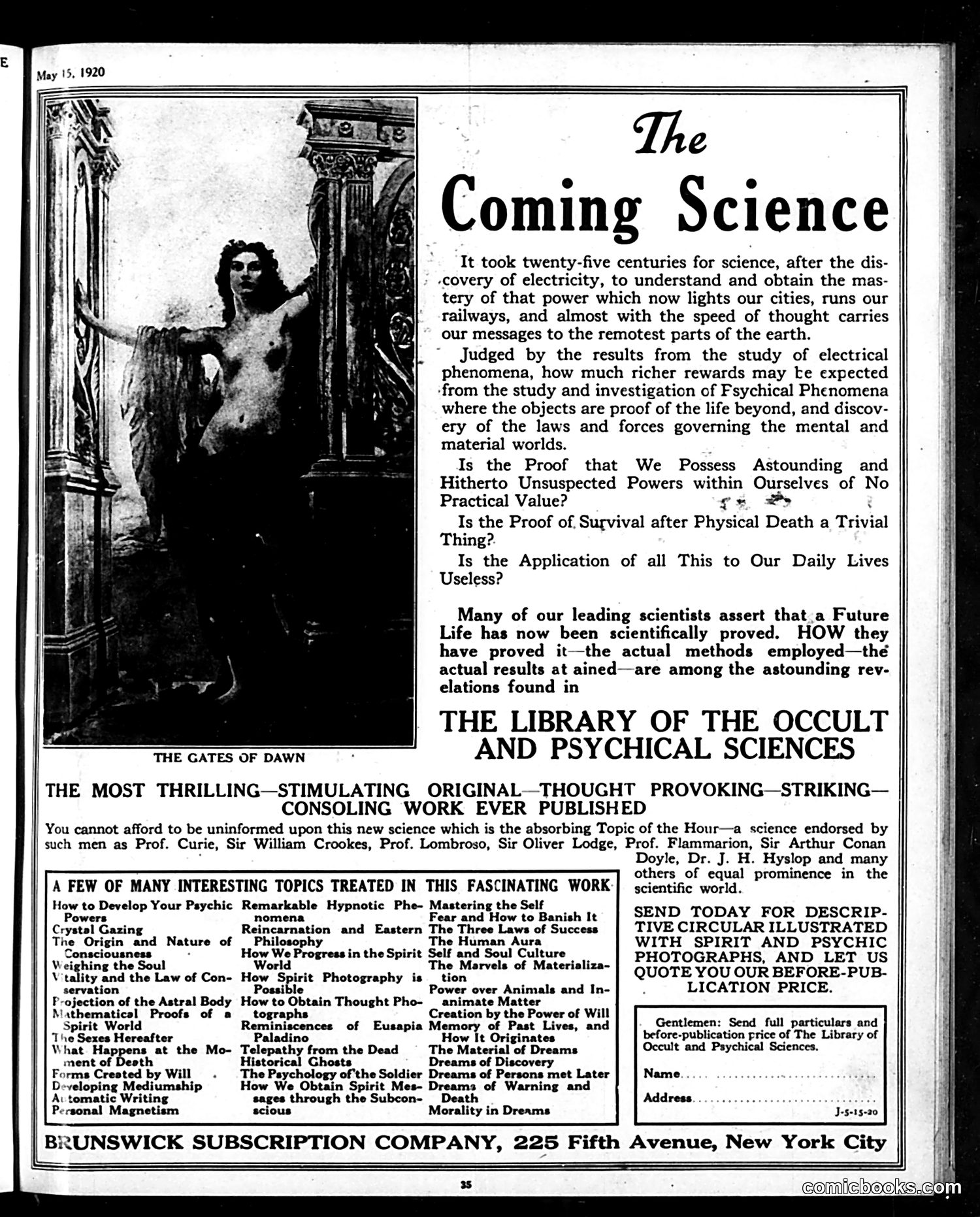
This page is primarily a full-page advertisement, not political satire. It promotes "The Library of the Occult and Psychical Sciences," marketed to Judge readers as serious scientific inquiry. The ad argues that just as electricity took centuries to master, psychical phenomena—spiritualism, mediumship, ghost photography—deserve rigorous study. It claims "leading scientists" (naming real figures like Sir Arthur Conan Doyle) have scientifically proven an afterlife and that readers possess untapped mental powers. The accompanying illustration, "The Gates of Dawn," depicts a ghostly female figure in classical dress, reinforcing the spiritualist aesthetic. **Context for modern readers**: This reflects the early 20th-century spiritualism craze, when séances and psychic claims attracted educated, affluent audiences. By appearing in Judge alongside satire, the ad suggests spiritualism had mainstream cultural legitimacy—even among sophisticated readers—before scientific skepticism marginalized such beliefs.
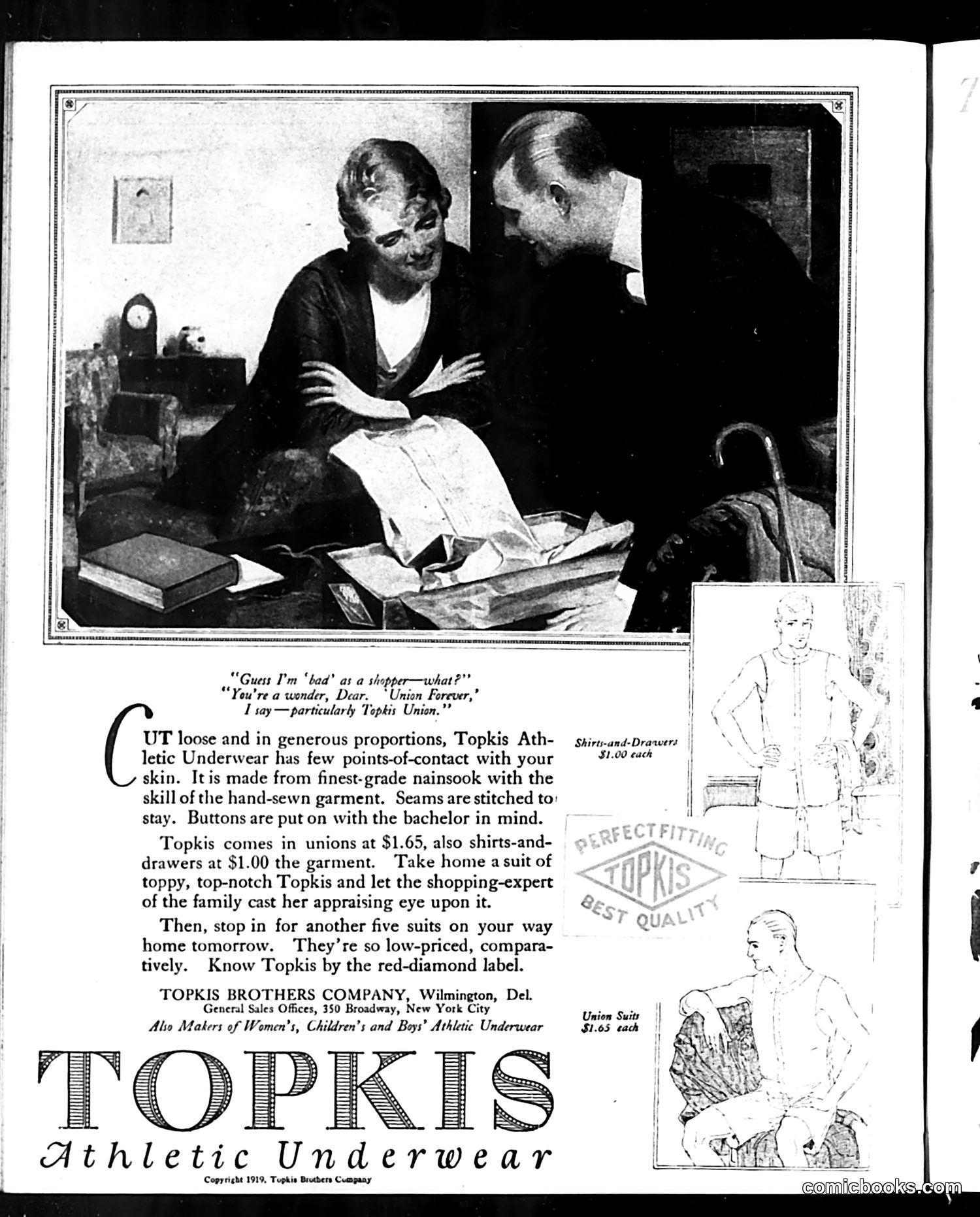
This is primarily a **Topkis Athletic Underwear advertisement**, not political satire. The small illustration at the top depicts a domestic scene where a woman shows her husband underwear she's purchased, with his approving response praising her as a "shopper" and endorsing "Topkis Union." The humor relies on a pun: the husband's enthusiastic declaration of support for "Union"—likely referencing labor unions or patriotic unity (the ad notes the 1919 copyright, post-WWI)—is actually praise for the "union suit" (one-piece underwear). The joke plays on double meaning: his wife interprets his pro-union sentiment as approval of her shopping choice. The advertisement emphasizes quality construction (hand-sewn, durable seams), affordability, and appeals to the "shopping-expert" woman of the household as the decision-maker. The accompanying product sketches show the garments available. This is typical 1910s-20s advertising rhetoric targeting middle-class consumers.