
Judge, 1920-05-15 · page 5 of 36
Judge — May 15, 1920 — page 5: what you’re looking at
What you’re looking at
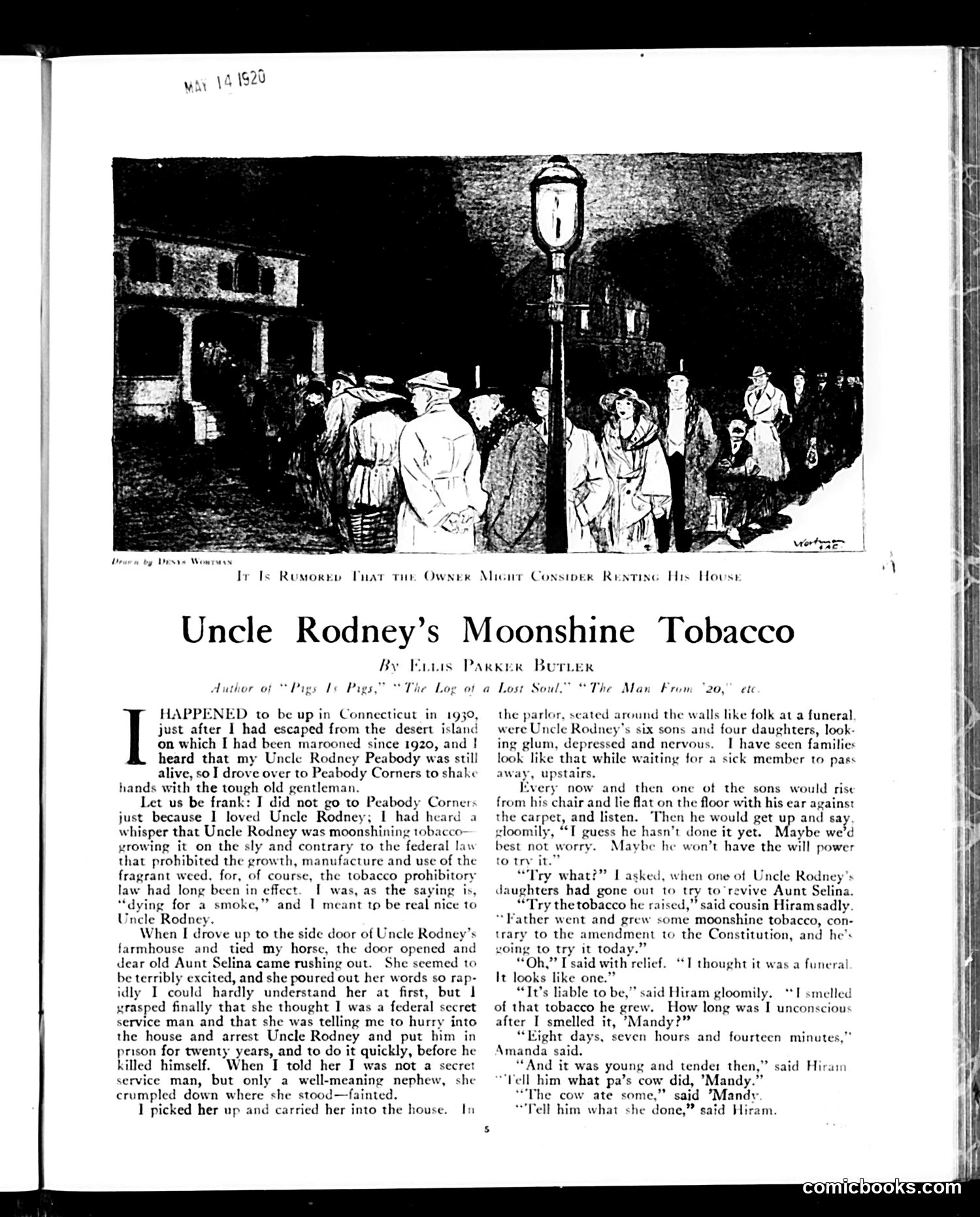
This page primarily contains a short story titled "Uncle Rodney's Moonshine Tobacco" by Ellis Parker Butler, rather than political satire. The illustration at top shows a street scene with numerous figures gathered around a street lamp at night, captioned "It Is Rumored That the Owner Might Consider Resting His House." The story itself concerns Uncle Rodney Peabody, who illegally grows tobacco in Connecticut during Prohibition (the 1920s). The narrative humorously explores the tension between federal alcohol prohibition laws and tobacco cultivation, with family members discussing Uncle Rodney's contraband farming activities. The cartoon appears to be narrative illustration accompanying the story rather than political commentary. Judge magazine here functions as a fiction publication rather than solely as political satire.
📄 Transcribed text from this page (OCR, searchable)
Machine-transcribed from the original scan — historical spelling and the odd misread are preserved.
+ Woes Viat Ir Is Rumorep Owner Micur Consipek Rentine His Houst Uncle Rodney’s Moonshine Tobacco Enis PARKER “Pigs Ie Pigs, HAPP. “D to be up in Connecticut in 1930. just after 1 had escaped from the desert island on which [ had been marooned since 1920, and } heard that my Uncle Rodney Peabody was still alive, so I drove over to Peabody Corners to shake hands with the tough old gentleman. Let us be frank: I did not go to Peabody Corners just because I loved Uncle Rodney; I had heard whisper that Uncle Rodney was moonshining tobacco- growing it on the sly and contrary to the federal law that prohibited the growth, manufacture and use of the fragrant weed, for, of course, the tobacco prohibitory law had long been in effect. I was, as the saying is, “dying for a smoke,” and 1 meant tp be real nice to Uncle Rodney. When I drove up to the side door of Uncle Rodney’s farmhouse and tied my horse, the door opened and dear old Aunt Selina came rushing out. She seemed to be terribly excited, and she poured out her words so rap- idly I could hardly understand her at first, but | xrasped finally that she thought I was a federal secret service man and that she was telling me to hurry into the house and arrest Uncle Rodney and put him in prison for twenty years, and to do it quickly, before he killed himself. When I told her I was not a secret service man, but only a well-meaning nephew, she crumpled down where she stood—fainted. 1 picked her up and carried her into the house. In of a Lost Soul” ° The ButLer Man From ‘20,° ete the parlor, seated around the walls like folk at a funeral were Uncle Rodney's six sons and four daughters, look- ing glum, depressed and nervous. I have scen families look like that while waiting for a sick member to pass away, upstairs. Ievery now and then one of the sons would rise from his chair and lie flat on the floor with his ear against the carpet, and listen. Then he would get up and say. gloomily, “I guess he hasn’t done it yet. Maybe we'd best not worry. Maybe he won’t have the will power to try it.” “Try what?” I asked, when one of Uncle Rodney's daughters had gone out to try to‘revive Aunt Selina. “Try the tobacco he raised,” said cousin Hiramsadly * Father went and grew some moonshine tobacco, con- trary to the amendment to the Constitution, and he’s g to try it tod. “Oh,” T'said It looks like one.” “It’s liable to be,” said Hiram gloomily. of that tobacco he grew. How long after I smelled it, Mandy?” “Eight days, seven hours and fourteen minutes,” Amanda said. “And it was young and tender then,” “Vell him what pa’s cow did, Mandy.” ‘he cow ate some,” said "Mandy “Tell him what she done,” said Hiram. Pt, “T thought it was a funera I smelled was I unconscious said Hirain