
Judge, 1920-05-15 · page 10 of 36
Judge — May 15, 1920 — page 10: what you’re looking at
What you’re looking at
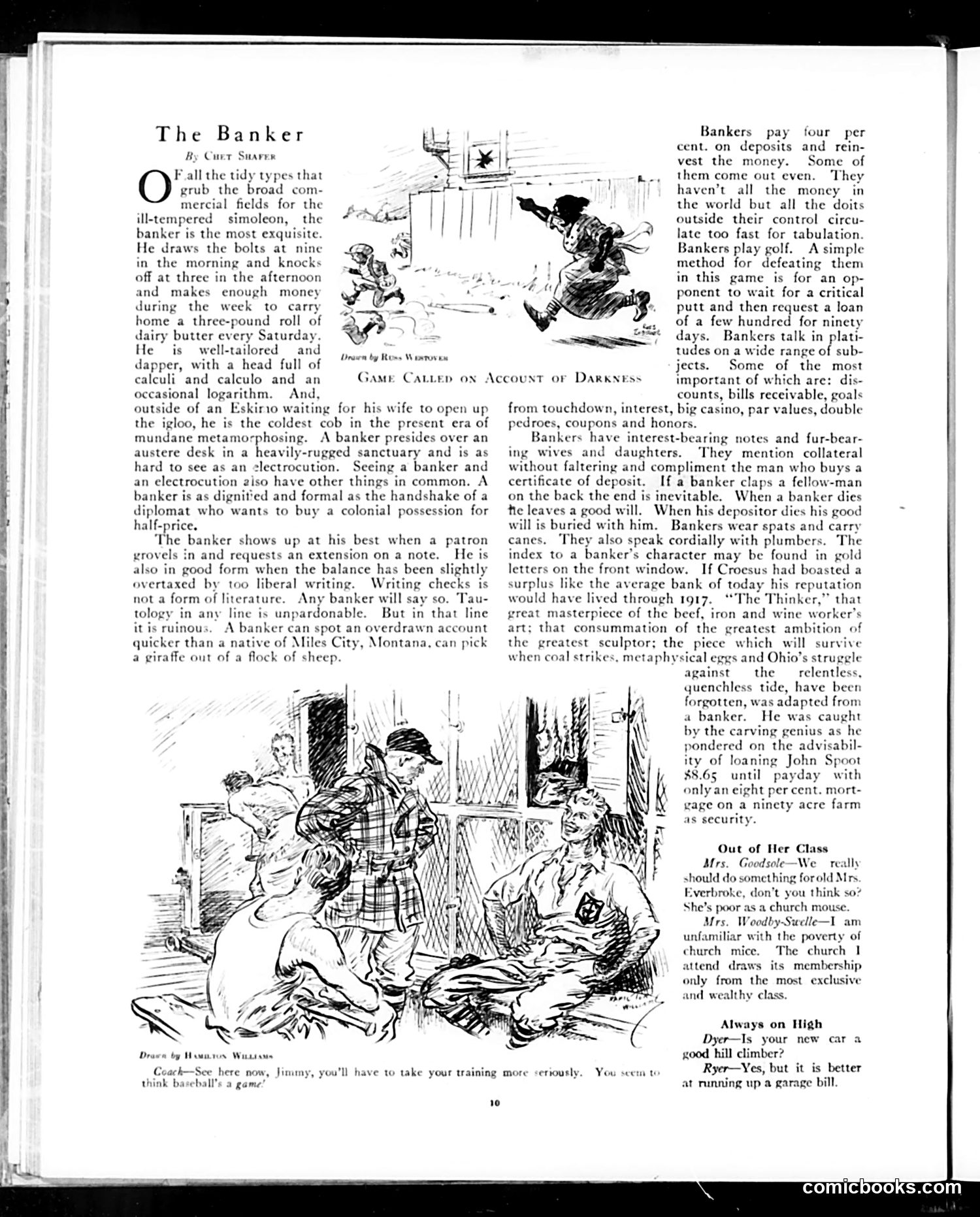
This article satirizes bankers as a professional class through exaggerated character portrayal. The author (Curt Suarez) mocks bankers as: **The Type**: Dignified, cold, meticulous men who work minimal hours (9 a.m. to 3 p.m.) yet accumulate substantial wealth through conservative financial practices—paying 4% on deposits while reinvesting for profit. **The Satire**: Bankers are portrayed as emotionally detached ("coldest cob"), obsessed with obscure financial terminology, and mercilessly exploitative. The humor emphasizes their power: they can instantly detect overdrafts, demand collateral without hesitation, and leave "good wills" that die with them while their depositors' good intentions are "buried." **Key Jokes**: A banker's best moment is when someone begs for loan extension; golf opponents should interrupt critical putts with loan requests; bankers' character can be judged by gold letters on their windows. The cartoon illustrations appear to show bankers in their element—one labeled "Game Called on Account of Darkness" depicts banking as sport. The overall message critiques banker arrogance and financial dominance during the early 20th century.
📄 Transcribed text from this page (OCR, searchable)
Machine-transcribed from the original scan — historical spelling and the odd misread are preserved.
ee Be ee ee SS eee eee ee } The Banker By Cunt Suarer F all the tidy types that rub the broad com- mercial fields for the ill-tempered simoleon, the banker is the most exquisite. He draws the bolts at nine in the morning and knocks off at three in the afternoon and makes enough money during the week to carry home a three-pound roll of dairy butter every Saturday. He is well-tailored and dapper, with a head full of Draen by Ross Wextovinn calculi and calculo and an Game Catirep ox Account or Darkness occasional logarithm. And, outside of an Eskirio waiting for his wife to open up the igloo, he is the coldest cob in the present era of mundane metamorphosing. A banker presides over an austere desk in a heavily-rugged sanctuary and is as hard to see as an electrocution. Seeing a banker and an electrocution 2iso have other things in common. A banker is as dignitied and formal as the handshake of a diplomat who wants to buy a colonial possession for half-price. ‘The banker shows up at his best when a patron grovels in and requests an extension on a note. He is also in good form when the balance has been slightly overtaxed by too liberal writing. Writing checks is not a form of literature. Any banker will say so. Tau- tology in any line is unpardonable. But in that line it is ruinous. A banker can spot an overdrawn account quicker than a native of Miles City, Montana, can pick a giraffe out of a flock of sheep. Bankers pay four per cent. on deposits and rein- vest the money. Some of them come out even. They haven’t all the money in the world but all the doits outside their control circu- late too fast for tabulation. Bankers play golf. A simple method for defeating them in this game is for an op- ponent to wait for a critical putt and then request a loan of a few hundred for ninety days. Bankers talk in plati- tudes on a wide range of sub- jects. Some of the most important of which are: dis- counts, bills receivable, goals from touchdown, interest, big casino, par values, double pedroes, coupons and honors. Bankers have interest-bearing notes and fur-bear- ing wives and daughters. They mention collateral without faltering and compliment the man who buys a certificate of deposit. If a banker claps a fellow-man on the back the end is inevitable. When a banker dies tie leaves a good will. When his depositor dies his good will is buried with him. Bankers wear spats and carry canes. They also speak cordially with plumbers. The index to a banker’s character may be found in gold letters on the front window. If Croesus had boasted a surplus like the average bank of today his reputation would have lived through 1917. “The Thinker,” that great masterpiece of the beef, iron and wine worker’s art; that consummation of the greatest ambition of the greatest sculptor; the piece which will survive when coal strikes, metaphysical eggs and Ohio’s struggle against the relentless, quenchless tide, have been forgotten, was adapted from a banker. He was caught by the carving genius as he pondered on the advisabil- ity of loaning John Spoot $8.65 until payday with only an eight per cent. mort- gage on a ninety acre farm as security. Out of Her Class Mrs. Goodsole—We really should do something for old Mrs. Everbroke, don’t you think so? She’s poor as a church mouse. Mrs. Woodby-Swelle—I_ am unfamiliar with the poverty of church mice. he church 1 attend draws its membership only from the most exclusive and wealthy class. Always on High Dyer—Is your new car a good hill climber? Ryer—Yes, but it better at running up a garage bill.