
Judge, 1920-05-15 · page 24 of 36
Judge — May 15, 1920 — page 24: what you’re looking at
What you’re looking at
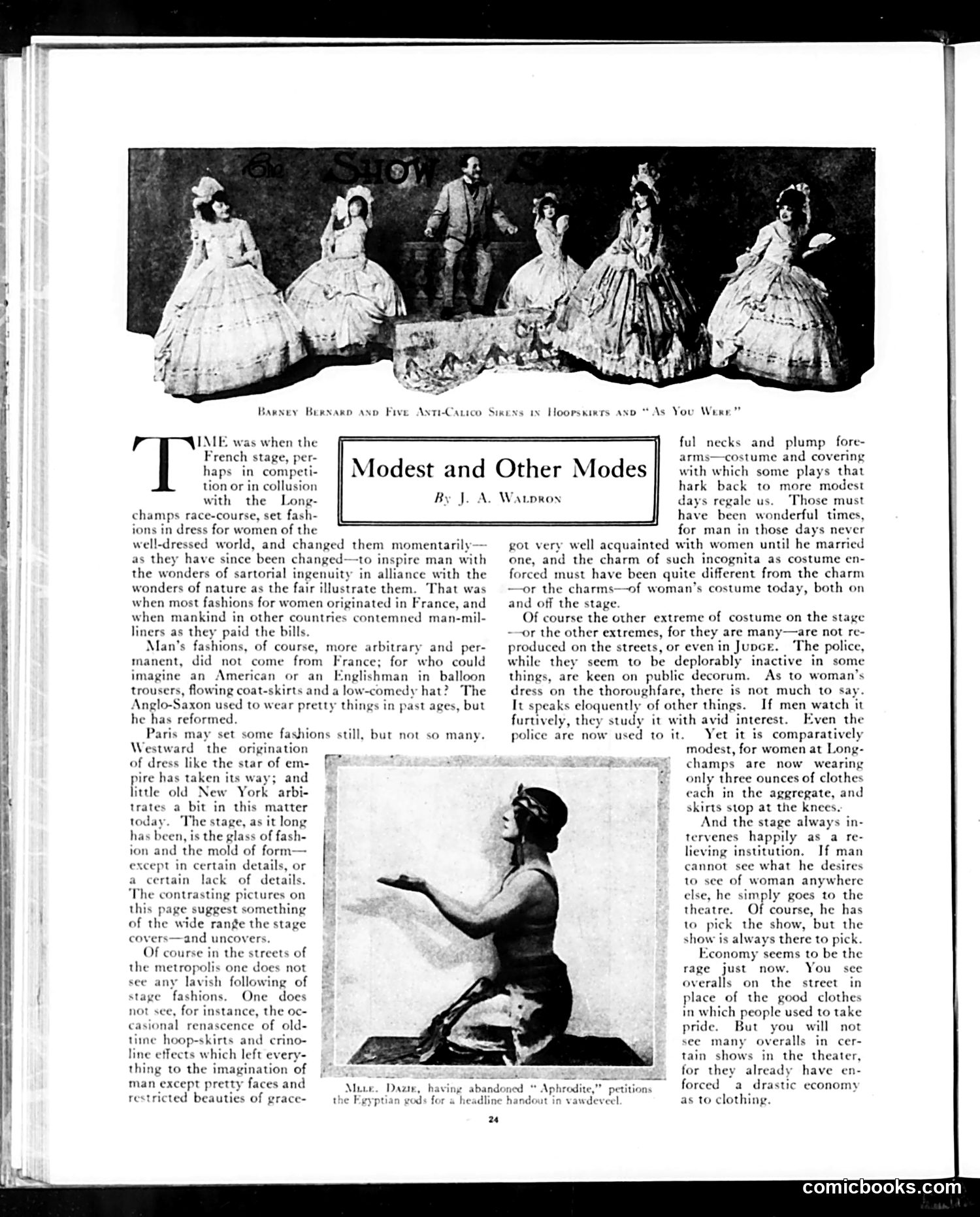
This article by J.A. Waldron discusses fashion trends and their relationship to theater versus street wear. The top photograph shows performers from a Barney Bernard production in elaborate period costumes with hoopskirts from "As You Were"—a theatrical production. The satire contrasts theatrical costume extremes with real-world fashion restraint. Waldron argues that while the French stage once dictated women's fashion globally, New York now sets trends. However, the public doesn't actually adopt these theatrical styles—the police enforce "public decorum" that prevents women from wearing the scanty or elaborate costumes seen on stage. The joke is pointed: working-class men wear economical overalls on streets, yet theater remains the one place where women still display elaborate dress. Waldron suggests theater serves as a socially acceptable outlet for displaying female bodies that street fashion increasingly conceals. The article mocks both theater's role as fantasy and society's contradictory prudishness about women's actual clothing versus theatrical display.
📄 Transcribed text from this page (OCR, searchable)
Machine-transcribed from the original scan — historical spelling and the odd misread are preserved.
Bawxey Berxxaro axo Five Axti-Catico Sixers ix Hoorsximrs axo “As You Weer” IME was when the French stage, per- haps in competi- tion or in collusion champs race-course, set fash- ions in dress for women of the well-dressed world, and changed them momentarily— as they have since been changed—to inspire man with the wonders of sartorial ingenuity in alliance with the wonders of nature as the fair illustrate them. That was when most fashions for women originated in France, and when mankind in other countries contemned man-mil- liners as they paid the bills. Man’s fashions, of course, more arbitrary and per- manent, did not come from France; for who could imagine an American or an Englishman in balloon trousers, flowing coat-skirts and a low-comedy hat? The Anglo-Saxon used to wear pretty things in past ages, but he has reformed. Paris may set some fashions still, but not so many Westward the origination . of dress like the star of em- z ‘ pire has taken its way; and little old New York arbi- trates a bit in this matter today. The stage, as it long has been, is the glass of fash- ion and the mold of form- cept in certain details, or a certain lack of details. | The contrasting pictures on | this page suggest something of the wide range the stage covers—and uncovers. Of course in the streets of the metropolis one does not see any lavish following of stage fashions. One does t see, for instance, the oc- casional renascence of old- tine hoop-skirts and crino- line effects which left every- thing to the imagination of man except pretty faces and Mute. Daur ‘i restricted beauties of grace- the Egy ads for a headli Modest and Other Modes with the Long- Ry J. A. Watpros having abandoned Fry ful necks and plump fore- arms—costume and covering with which some plays that hark back to more modest days regale us. Those must have been wonderful times, for man in those days never got very well acquainted with women until he married one, and the charm of such incognita as costume en- forced must have been quite different from the charm —or the charms—of woman’s costume today, both on and off the stage Of course the other extreme of costume on the stage ~-or the other extremes, for they are many—are not re- produced on the streets, or even in Jupcr. The police, while they seem to be deplorably inactive in some things, are keen on public decorum. As to woman’s dress on the thoroughfare, there is not much to say. It speaks eloquently of other things. If men watch it furtively, they study it with avid interest. Even the police are now used to it. Yet it is comparatively modest, for women at Long: champs are now wearing < only three ounces of clothes each in the aggregate, and skirts stop at the knees, And the stage always in- tervenes happily as a re- lieving institution. If man cannot see what he desires to see of woman anywhere else, he simply goes to the theatre. Of course, he has to pick the show, but the show is always there to pick. Economy seems to be the rage just now. You see overalls on the street in place of the good clothes in which people used to take pride. But you will not see many overalls in cer- tain shows in the theater, for they already have en- forced a drastic economy as to clothing. comicbooks.com