
Judge, 1920-05-15 · page 26 of 36
Judge — May 15, 1920 — page 26: what you’re looking at
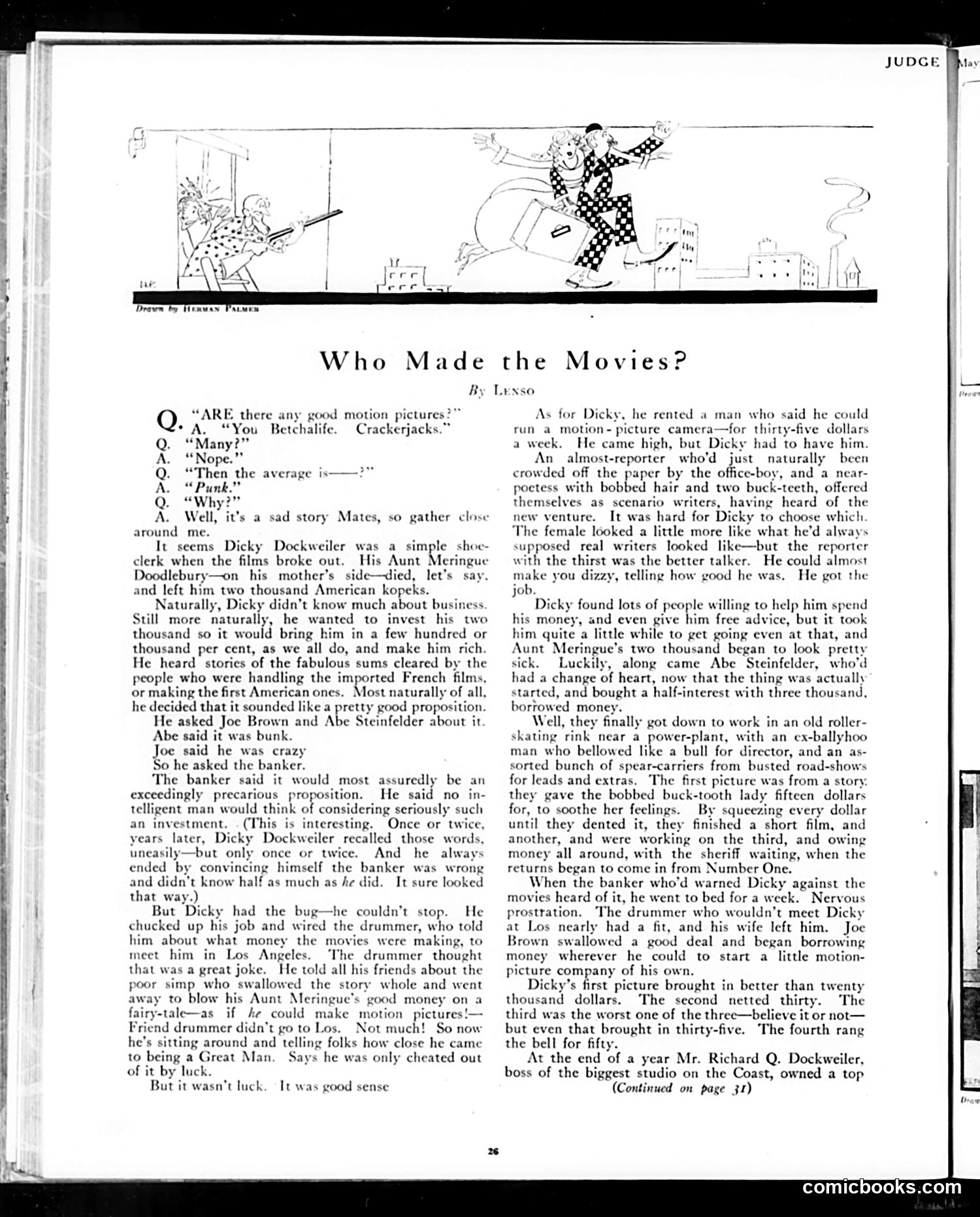
What you’re looking at
This article satirizes the early motion picture industry's explosive growth and the get-rich-quick schemes it inspired. The cartoon (drawn by Herman Palmer) depicts a charlatan filmmaker in checkered clothing, representing the fraudulent or incompetent operators flooding the nascent film business. The story follows Dicky Dockweiler, an everyman shoe clerk who inherits modest money and ignores sensible advice to invest in moviemaking. Despite bankers and friends warning against it, he pursues the venture, hiring incompetent staff: a cameraman at inflated wages, a rejected newspaper reporter as screenwriter, and casting aspiring actresses for pittance. The satire highlights the industry's chaos—amateur operators, shady financing, exploitation of workers, and people's willingness to throw money at an unproven medium simply because others had profited. The article mocks both the dreamers and the industry's opportunism, ultimately suggesting some succeed despite incompetence through luck rather than merit.
📄 Transcribed text from this page (OCR, searchable)
Machine-transcribed from the original scan — historical spelling and the odd misread are preserved.
pat SS. aw SSS LC nee eee eeeeEEyeeEeEe———eeEeEeEeEeEeEeEeEeEyEEeEeEeEeEEe—_—eEEeeeEes Who Made By Q “ARE there any good motion pictur * A. “You Betchalife. Crackerjacks. Q. “Many?” A. “Nope.” Q. “Then A. “Punk Q. “Why A. Well, it’s a sad story Mates, so gather close around me. It seems Dicky Dockweiler was a simple shoe- clerk when the films broke out. His Aunt Meringue Doodlebury—on his mother’s side—died, let’s say. and left him two thousand American kopeks. Naturally, Dicky didn’t know much about business Still more naturally, he wanted to invest his two thousand so it would bring him in a few hundred or thousand per cent, as we all do, and make him rich. He heard stories of the fabulous sums cleared by the people who were handling the imported French films, or making the first American ones. Most naturally of all, he decided that it sounded like a pretty good proposition. He asked Joe Brown and Abe Steinfelder about it Abe said it was bunk. Joe said he was crazy So he asked the banker. The banker said it would most assuredly be an exceedingly precarious proposition. He said no in- telligent man would think of considering seriously such an investment. . (This is interesting. Once or twice, years later, Dicky Dockweiler recalled those words, uneasily—but only once or twice. And he always ended by convincing himself the banker was wrong and didn’t know half as much as he did. It sure looked that way.) But Dicky had the bug—he couldn't stop. He chucked up his job and wired the drummer, who told him about what money the movies were making, to meet him in Los Angeles. The drummer thought that was a great joke. He told all his friends about the poor simp who swallowed the story whole and went away to blow his Aunt Meringue’s good money on a iry-tale—as if he could make motion pictures!— end drummer didn’t go to Los. Not much! So now he’s sitting around and telling folks how close he came to being a Great Man. Says he was only cheated out of it by luck. But it wasn’t luck. It was good sense the Movies? Lenso As for Dicky, he rented a man who said he could run a motion- picture camera—for thirty-five dollars a week. He came high, but Dicky had to have him. An almost-reporter who'd just naturally been crowded off the paper by the office-boy, and a near- poetess with bobbed hair and two buck-teeth, offered themselves as scenario writers, having heard of the new venture. It was hard for Dicky to choose which The female looked a little more like what he’d always supposed real writers looked like—but the reporter with the thirst was the better talker. He could almost make you d telling how good he was. He got the job. Dicky found lots of people willing to help him spend his money, and even give him free advice, but it took him quite a little while to get going even at that, and Aunt Meringue’s two thousand began to look pretty sick. Luckily, along came Abe Steinfelder, who'd had a change of heart, now that the thing was actually started, and bought a half-interest with three thousand, borrowed money. Well, they finally got down to work in an old roller- skating rink near a power-plant, with an ex-ballyhoo man who bellowed like a bull for director, and an as- sorted bunch of spear-carriers from busted road-shows for leads and extras. The first picture was from a story: they gave the bobbed buck-tooth lady fifteen dollars for, to soothe her feelings. By squeezing every dollar until they dented it, they finished a short film, and another, and were working on the third, and owing money all around, with the sheriff waiting, when the returns began to come in from Number One. When the banker who'd warned Dicky against the movies heard of it, he went to bed for a week. Nervous prostration. The drummer who wouldn’t meet Dicky at Los nearly had a fit, and his wife left him. Joe Brown swallowed a good deal and began borrowing money wherever he could to start a little motion- picture company of his own. Dicky’s first picture brought in better than twenty thousand dollars. The second netted thirty. The third was the worst one of the three—believe it or not— but even that brought in thirty-five. The fourth rang the bell for fifty. At the end of a year Mr. Richard Q. Dockweiler, boss of the biggest studio on the Coast, owned a top (Continued on page 31) comicbooks.com