
Judge, 1920-05-15 · page 13 of 36
Judge — May 15, 1920 — page 13: what you’re looking at
What you’re looking at
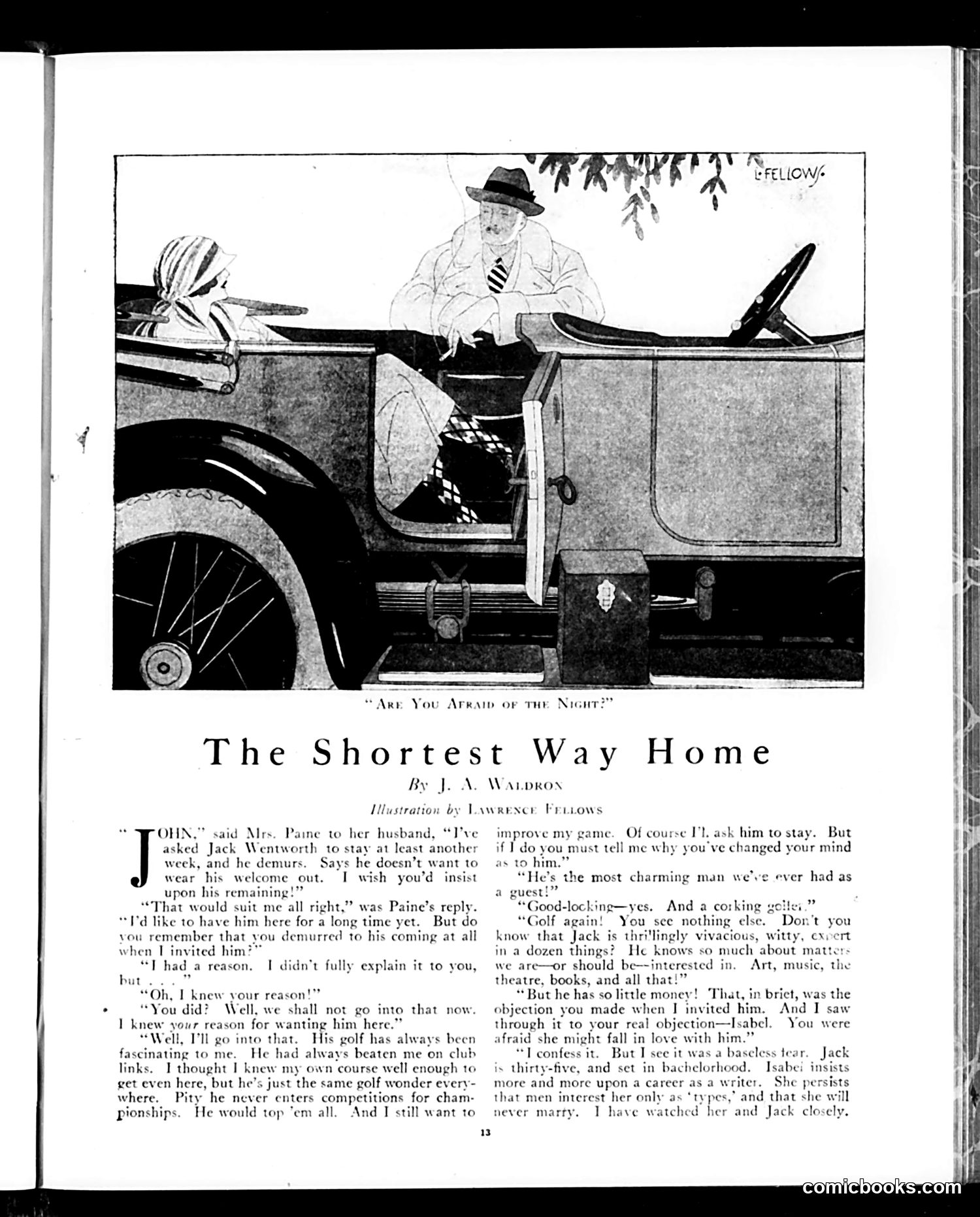
This is a domestic comedy story illustrated by Lawrence Fellows. The narrative concerns Mr. Paine's reluctance to invite his friend Jack Wentworth to stay, despite his wife's insistence. The setup plays on a common early-20th-century social anxiety: a husband fears his charming houseguest will seduce his daughter Isabel. Mrs. Paine initially objects to Jack's poverty; Mr. Paine suspects she actually fears romantic entanglement between Jack and Isabel. The irony—and the joke's resolution—is that Jack, now thirty-five and a confirmed bachelor, interests Isabel only as a "type" for her writing ambitions. She has no romantic interest in him. Mr. Paine's protective anxiety proves baseless. The cartoon illustration shows the characters in a period automobile, visualizing the social situation. The humor derives from the gap between parental worry and actual circumstance—a relatable domestic theme for Judge's middle-class readership.
📄 Transcribed text from this page (OCR, searchable)
Machine-transcribed from the original scan — historical spelling and the odd misread are preserved.
ee OHN,” said Mrs asked Jack Wentworth to stay at | k, and he demurs. we “Are You Arraip or THE Nicur? q & LFELIOW> The Shortest Way Home wear his welcome out. upon his remainin: Paine to her husband, Says h By A WALDRON Iustration by Lawrence FriLows I've t another doesn’t want to I wish you’d insist “That would suit me all right,” was Paine’s reply. “I'd like to have him here for a long time yet. you remember that you demurred to his coming at all when I invited him “T had a reason. “Oh, I knew your ri 1 on But do I didn’t fully explain it to you, “You did? Well, we shall not go into that now. I] knew your reason for wanting him here.” “Well, I'll go into that. fascinating to me. His golf has always been He had always beaten me on club links. I thought I knew my own course well enough to get even here, but he’s just the same golf wonder every- where. Pity he never enters competitions for cham- pionships. He would top ‘em all And J still want to improve my game. Of course I’. ask him to stay. But if ] do you must tell me why you've changed your mind as to him.” “He's the most charming man we've ever had as a guest!” “Good-locking—yes. And a corking g “Golf again! You see nothing else. Don't you know that Jack is thri'lingly vivacious, witty, expert in a dozen things? He knows so much about matter: we are—or should be—interested in. Art, music, the theatre, books, and all that!” But he has so little money! That, in briet, was the objection you made when I invited him. And I saw through it to your real objection—Isabel. You were afraid she might fall in love with him.” I confess it. But I see it was a baseless tear. Jack ty-five, and set in bachelorhood. Isabei insists id more upon a career asa writer. She pe that men interest her only as ‘types,’ and that she will never marty. I have watched her and Jack closely. ” ists 13