
A complete issue · 36 pages · 1920
Judge — April 3, 1920
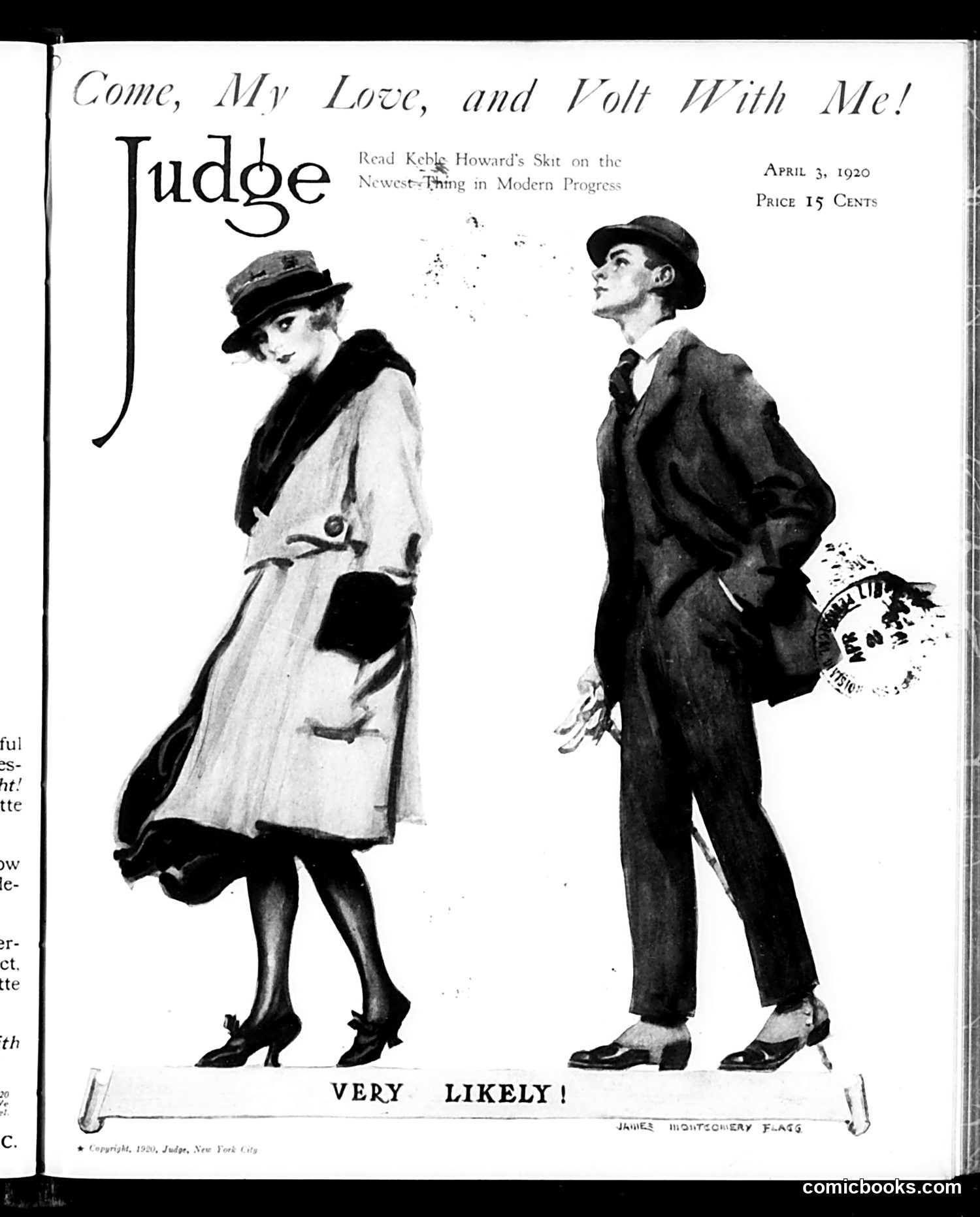
This cover satirizes romantic courtship customs of the era. Two figures are shown with the caption "VERY LIKELY!" beneath them—a woman in a light coat with fur collar and hat, gazing away coyly, and a man in a dark suit holding flowers, looking at her expectantly. The headline "Come, My Love, and Volt With Me!" appears to reference a dance or social activity (possibly "volt" is a dance move, though the OCR may be unclear). The satire suggests that this romantic scenario—a man offering flowers and requesting the woman's company—was an extremely common, predictable courtship ritual of 1920s dating conventions. The joke relies on the audience recognizing this as stereotypical romantic behavior.
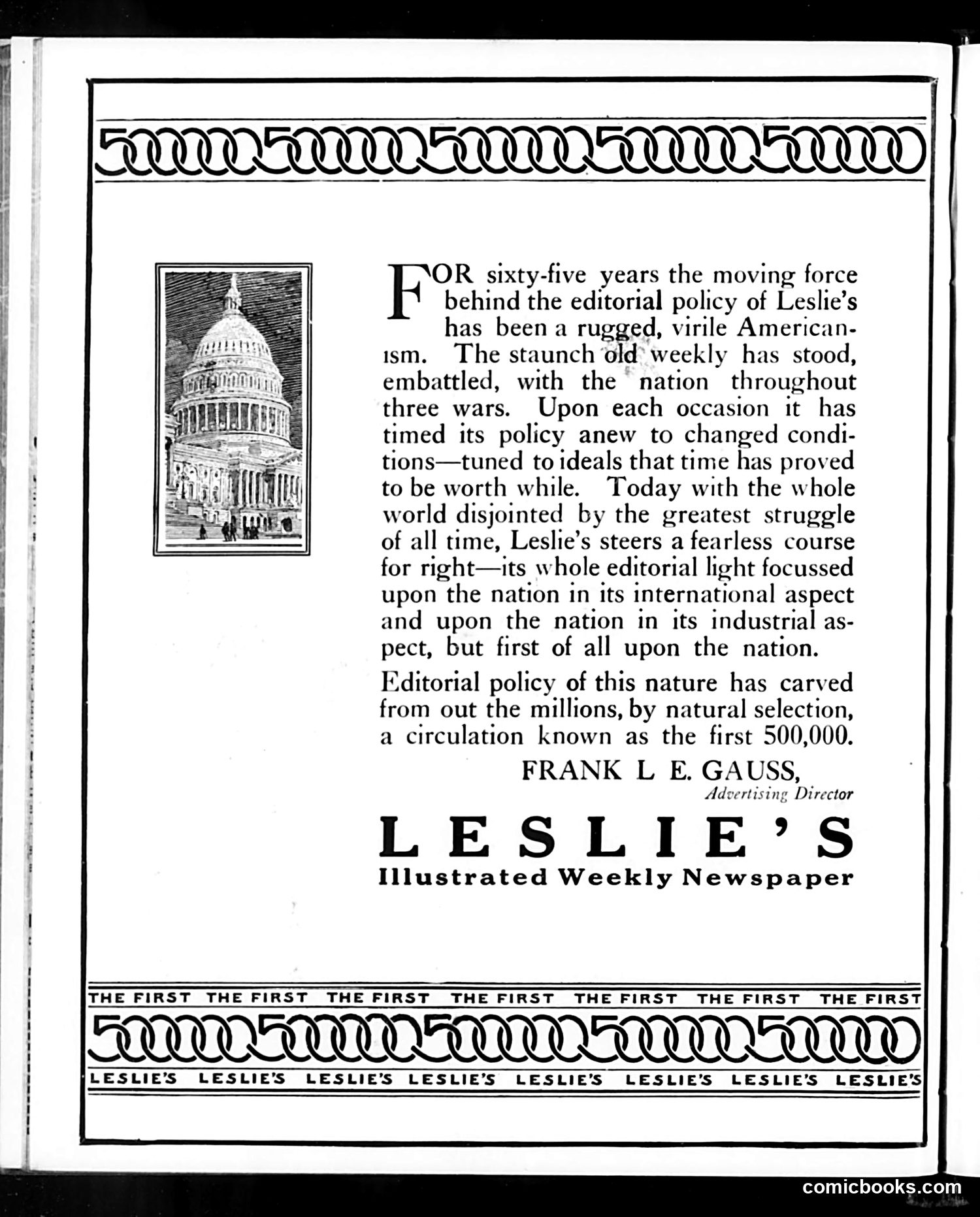
This page is primarily **advertising**, not satire or political cartoon. It's a full-page ad for Leslie's Illustrated Weekly Newspaper, signed by Frank L.E. Gauss, Advertising Director. The ad features the U.S. Capitol building as its visual anchor and emphasizes Leslie's 65-year editorial history of "rugged, virile Americanism" through three wars. The copy claims Leslie's maintains fearless editorial independence focused on national interests—both international and industrial. The key sales pitch: Leslie's editorial policy has built a circulation of "the first 500,000," implying this represents the magazine's most desirable, select readership. The decorative borders reading "THE FIRST" and "LESLIE'S" reinforce brand identity rather than deliver satire.
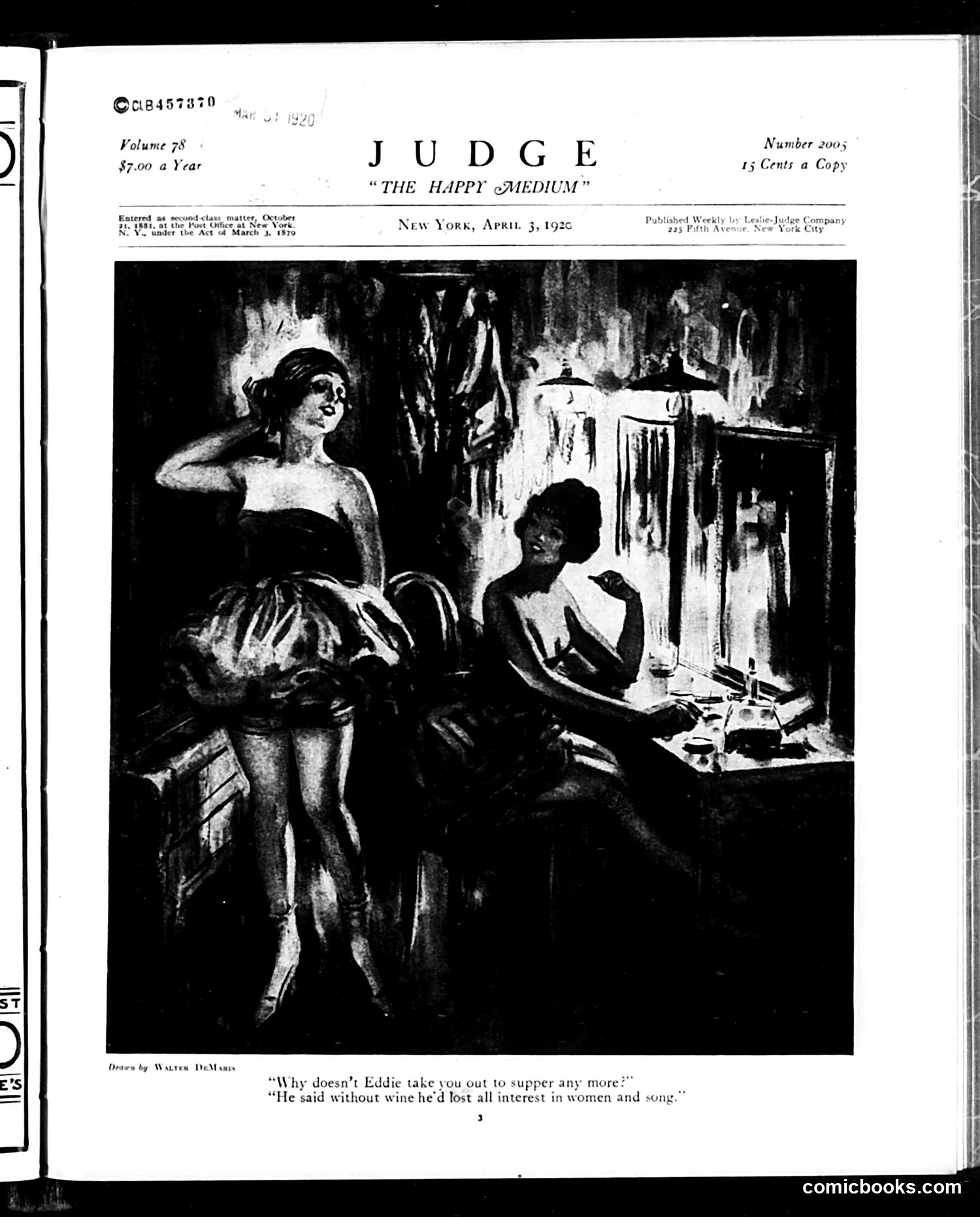
This is a single-panel cartoon from Judge magazine (April 3, 1926) drawn by Waiter DeMaris. It depicts two women in a bedroom setting—one standing in an evening gown, one seated at a vanity mirror—in what appears to be a commentary on changing social mores during the 1920s. The dialogue reveals the joke's point: one woman asks why "Eddie" no longer takes her out to supper, and the other responds that he said "without wine he'd lost all interest in women and song." This satirizes Prohibition's impact on dating culture. The cartoon mocks how the ban on alcohol supposedly eliminated men's romantic interest, suggesting the era's social life and courtship had become dependent on illegal drinking. It's social commentary on the unintended consequences of Prohibition policy.
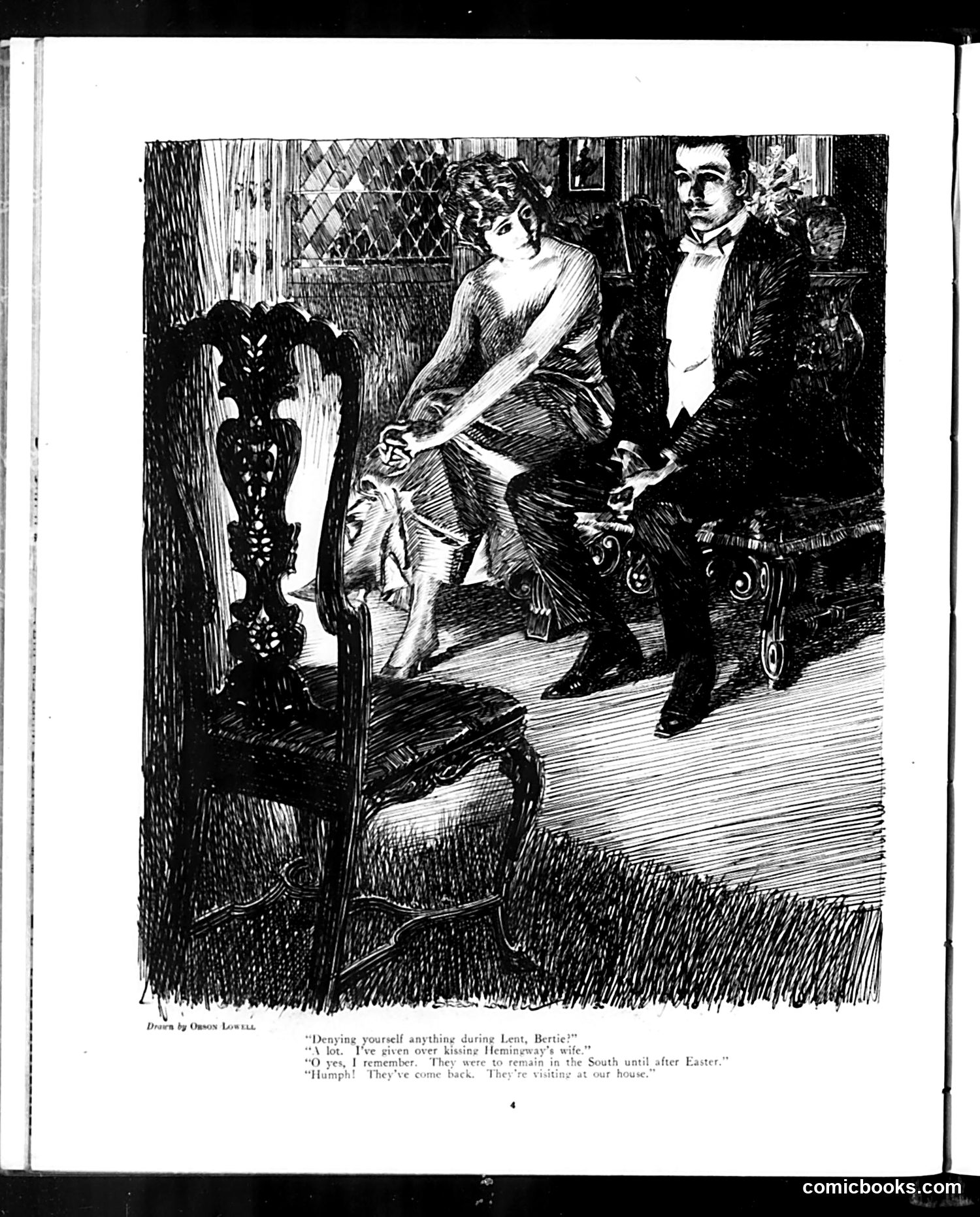
This illustration depicts an elegant interior scene with two figures in formal dress conversing near ornate furniture. The dialogue references "Hemingway's wife" and mentions giving up "kissing" during Lent, followed by the couple's return from the South after Easter. The satire appears to target Ernest Hemingway and his spouse, likely playing on contemporary gossip about their relationship or lifestyle. The Lenten sacrifice reference—jokingly suggesting the wife was given up like a religious observance—suggests marital infidelity or separation rumors circulating in high society. The mention of remaining in the South until Easter implies social absence from New York circles. Without additional context about the specific date and Hemingway's biographical circumstances during this period, the precise scandal remains unclear, but the cartoon mocks aristocratic social pretenses and marital instability among the literary elite.
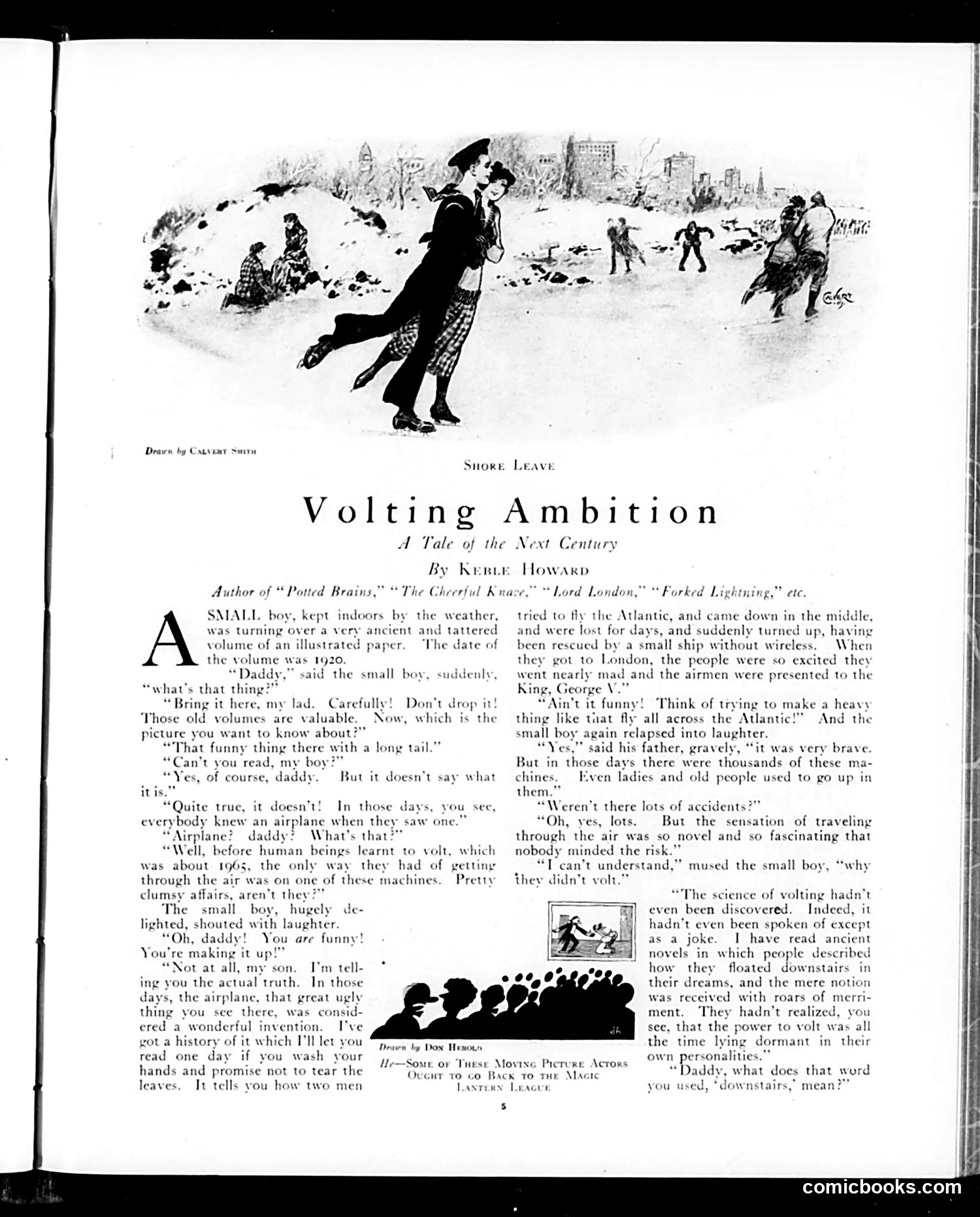
This story by Keble Howard satirizes early aviation enthusiasm. The narrative concerns a small boy who wants to "volt" (fly) across the Atlantic—a feat considered impossible in the early 20th century when airplanes were nascent technology. The satire mocks both the boy's naive ambition and contemporary debates about aviation's feasibility. The father's skepticism reflects realistic concerns: early aircraft were indeed unreliable, crashes were common, and transatlantic flight seemed fantastical. The illustrations show people ice-skating and flying side-by-side, visually equating these activities—suggesting that powered human flight was as fantastical as skating in mid-air. The story uses the child's innocence to gently ridicule the era's aviation dreamers while acknowledging the genuine innovation occurring around 1920.
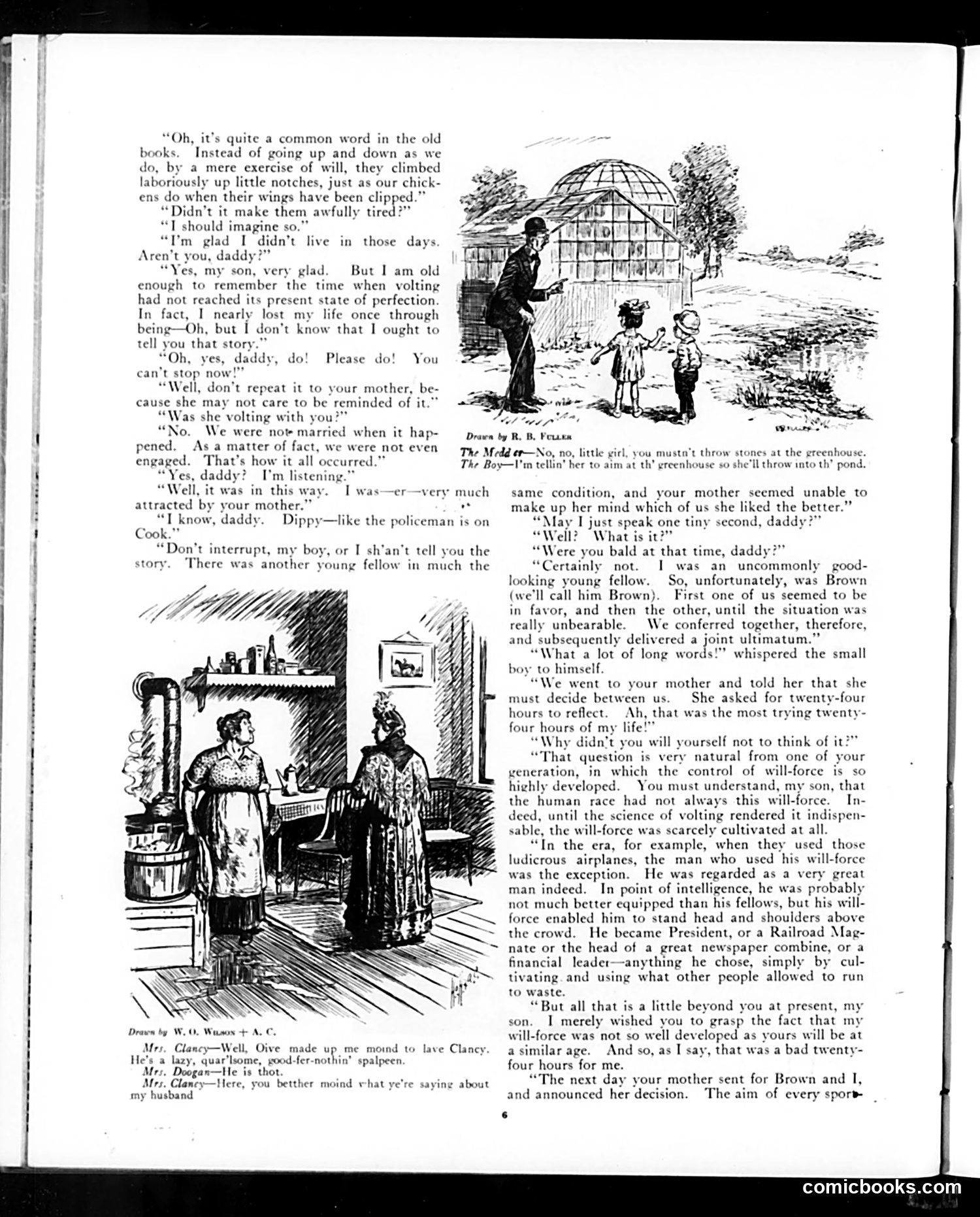
This page contains a domestic narrative rather than political satire. The story discusses "volting" (courtship/dating), with a father explaining to his son how men formerly competed for women's attention through displays of will-force and determination—using an airplane example where one man's superior will-power made him a leader (President, Railroad Magnate, or financial leader). The illustrated scenes show a Victorian-era domestic interior and a greenhouse encounter. The text suggests the father is advising his son that developing strong will-power young will serve him well in adulthood, using his own experience choosing between two suitors as an example. This appears to be social commentary on character-building and masculine self-discipline rather than political satire, typical of Judge's mixed content approach combining humor with moral instruction.
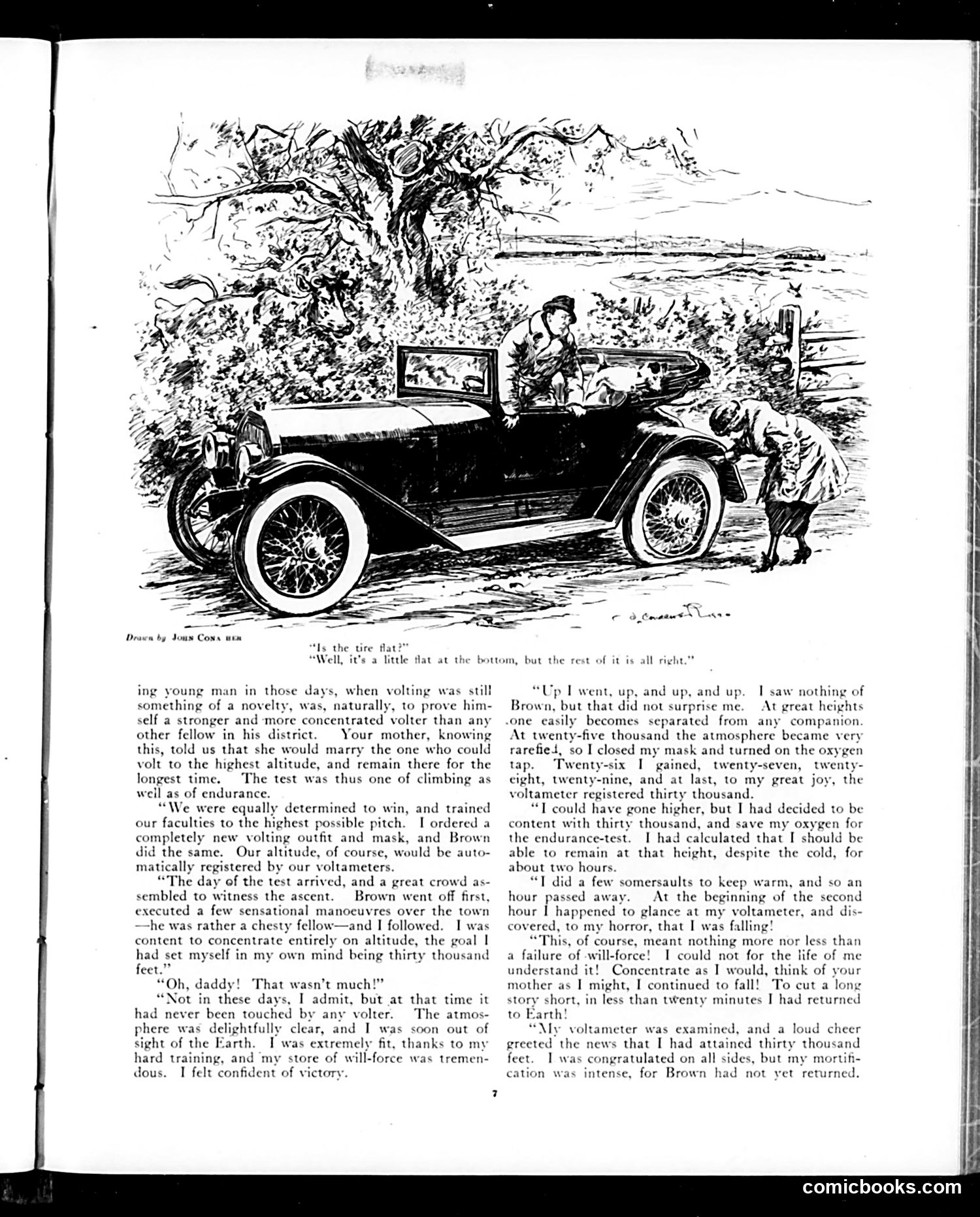
This appears to be a science-fiction story (not political satire) from *Judge* magazine, illustrated with a vintage automobile scene. The narrative describes competitive "volting"—apparently a fictional early-20th-century sport involving altitude achievement through mental willpower, measured by "voltameters." The humor derives from treating this invented activity as legitimate competitive sport, complete with training regimens, equipment, and spectators. The narrator achieves his goal of 30,000 feet but mysteriously loses altitude despite concentrated effort—a failure of "will-force." The opening illustration shows a period automobile (unrelated to the text), likely from an advertisement or separate article. The satire targets the era's enthusiasm for novel technologies and competitions while humorously exploring themes of competitive masculinity and the limits of human endurance through pseudo-scientific means.
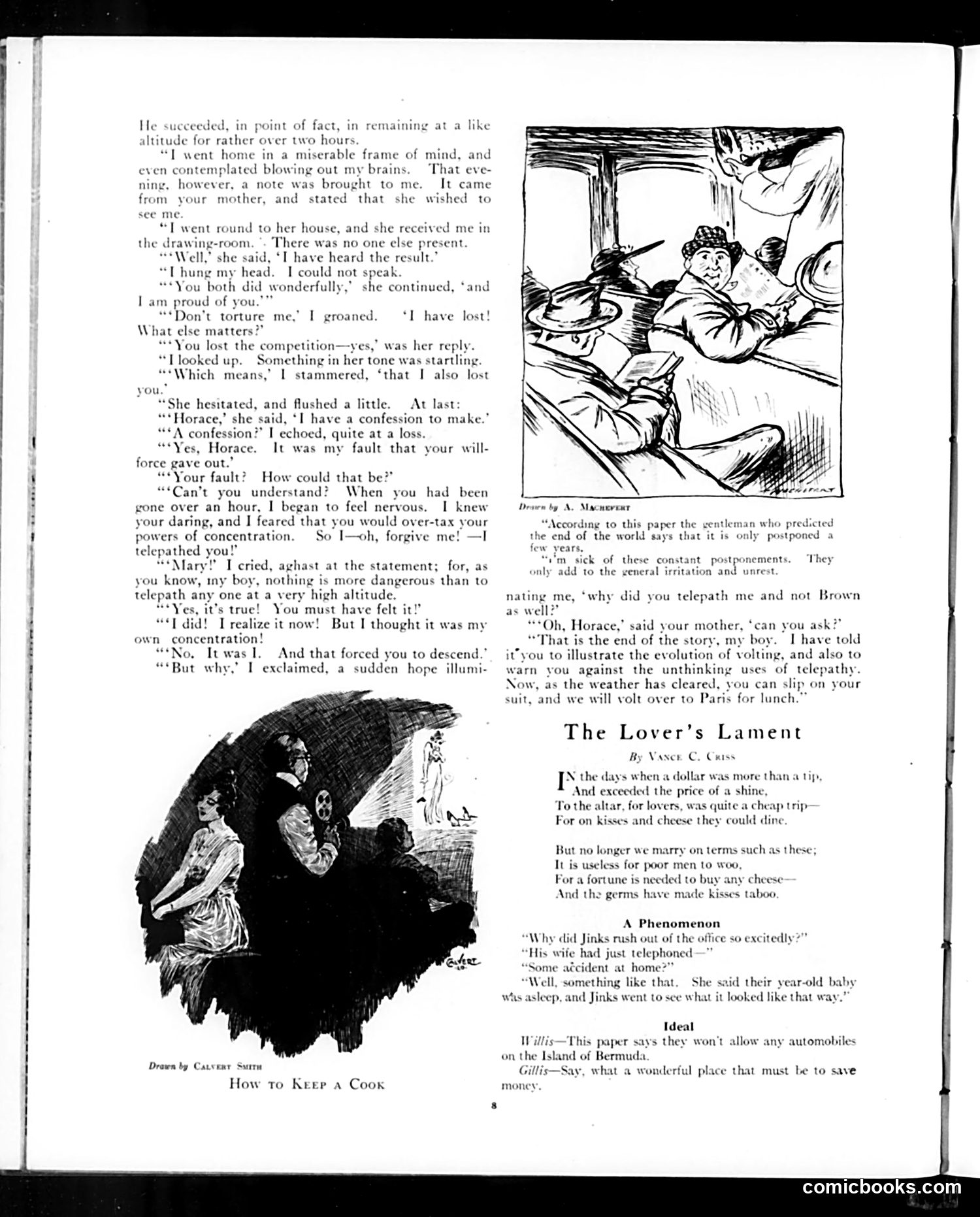
This page contains multiple satirical pieces reflecting early 20th-century concerns: **Main Narrative (top):** A romantic story about a man who fails an endurance competition at high altitude. The twist—his beloved mother's telepathic interference caused his failure—satirizes the era's fascination with psychic powers as a pseudo-scientific explanation. The casual mention of "volting over to Paris for lunch" mocks the period's breathless anticipation of miraculous future technologies. **"The Lover's Lament":** A poem lamenting economic hardship and modern anxieties. It contrasts past affordability of courtship with present poverty, while referencing contemporary hygiene concerns ("germs have made kisses taboo")—likely alluding to public health campaigns of the era. **"A Phenomenon":** A brief joke about a man rushing home because his wife telephoned about their sleeping baby—mocking new communication technology's disruption of workplace normalcy. **"Ideal":** A humorous note praising Bermuda's automobile ban as money-saving—satirizing automobile culture's expense and prevalence.
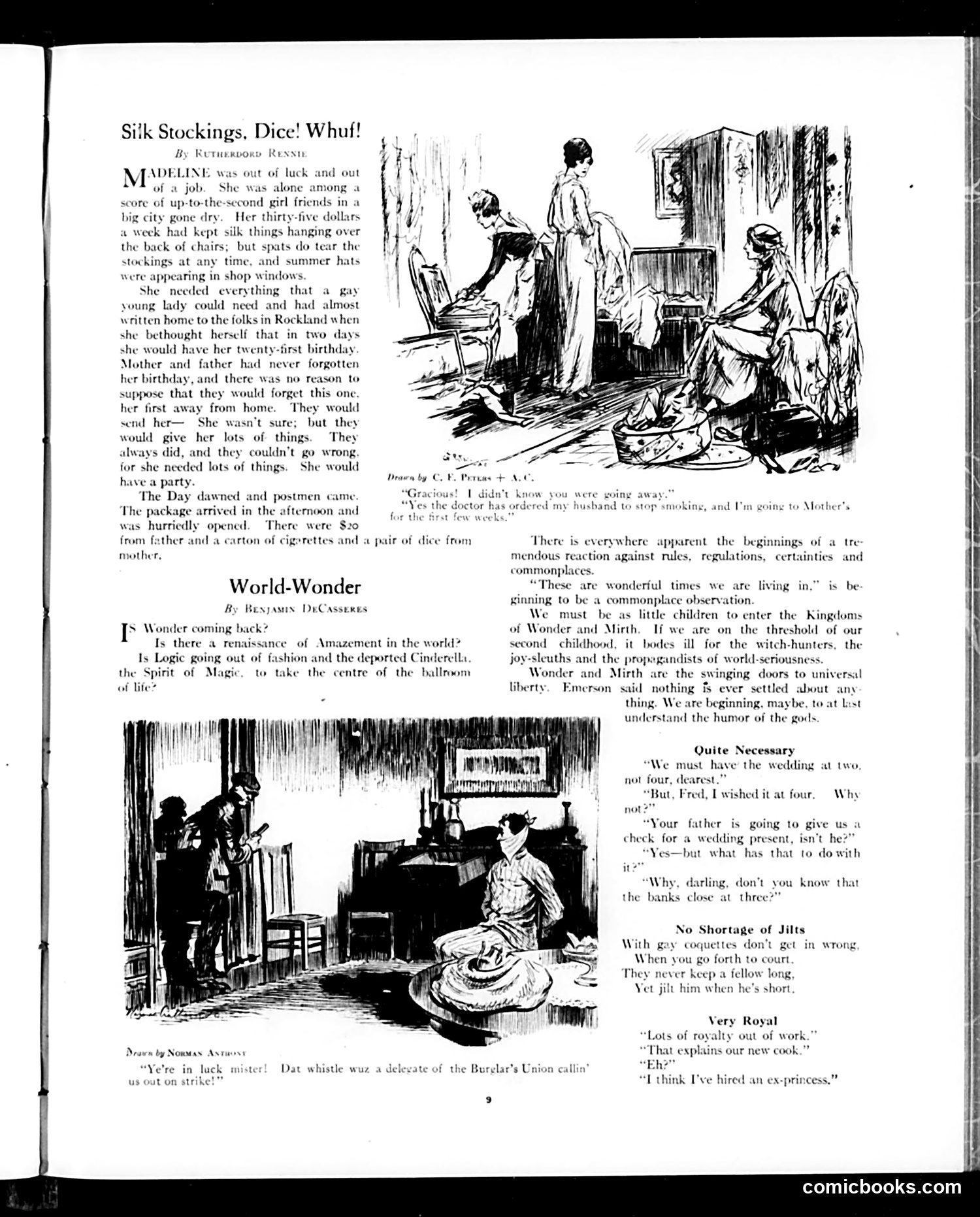
This page contains three satirical pieces reflecting post-Prohibition Era anxieties: **"Silk Stockings, Dice! Whuf!"** mocks a young unemployed woman expecting birthday money from her parents. The joke: they send her cigarettes and *dice*—symbols of vice and gambling—rather than practical gifts. This satirizes the cultural shock of the 1920s "New Woman" openly engaging in formerly scandalous behaviors (smoking, gambling) that parents couldn't prevent. **"World-Wonder"** celebrates the collapse of Victorian moral certainties, praising the new embrace of imagination over rigid rules—a direct commentary on generational rebellion against Prohibition and traditional constraints. The **three short joke pieces** satirize modern economic chaos: a wedding scheduled by bank closing hours, women who jilt poor suitors, and hiring an "ex-princess" as a cook—all reflecting Depression-era class instability and role reversals. The cartoons' loose, energetic drawings by Norman Anthony and C.F. Peters match the anarchic, anti-establishment tone.
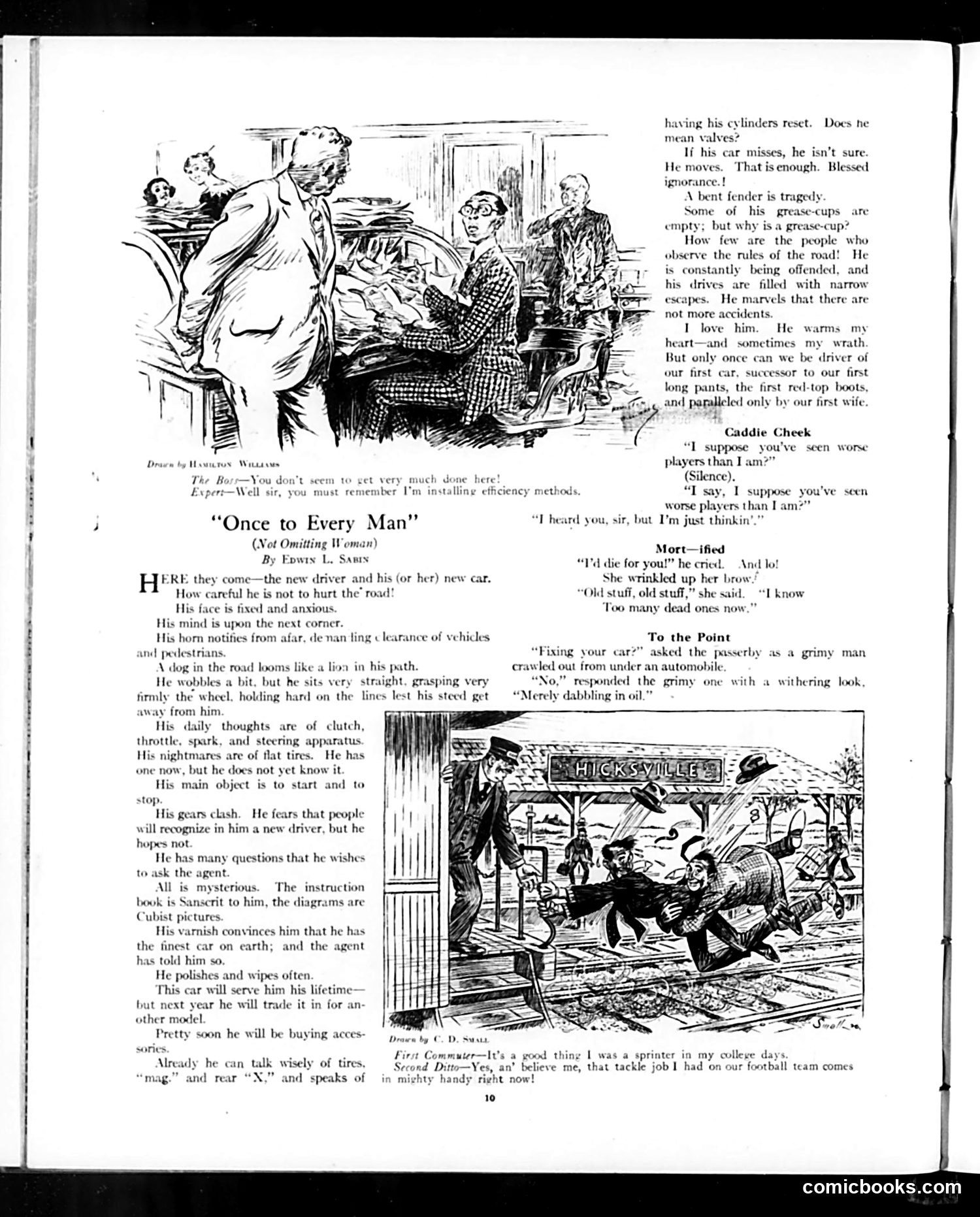
This page presents early-20th-century automotive humor satirizing the new car owner experience. **"Once to Every Man"** (main feature) mocks the anxiety of first-time drivers. The narrative depicts a nervous new motorist obsessively worried about mechanics (clutch, throttle, spark plugs, flat tires) while simultaneously convinced his car is "the finest on earth." The satire targets the contradiction: he's terrified of damaging the road yet oblivious to actual dangers; he'll trade this car next year despite treating it like a lifetime possession. The joke captures early-automobile culture's mix of pride, mechanical ignorance, and superstitious reverence toward motorized transport. **The smaller cartoons** ("Caddie Cheek," "Mortified," "To the Point") offer brief quips about golf, romance, and automotive maintenance—standard magazine filler humor of the era. The page reflects a specific historical moment when automobile ownership was becoming middle-class but drivers remained mechanically illiterate and socially anxious about this new technology.
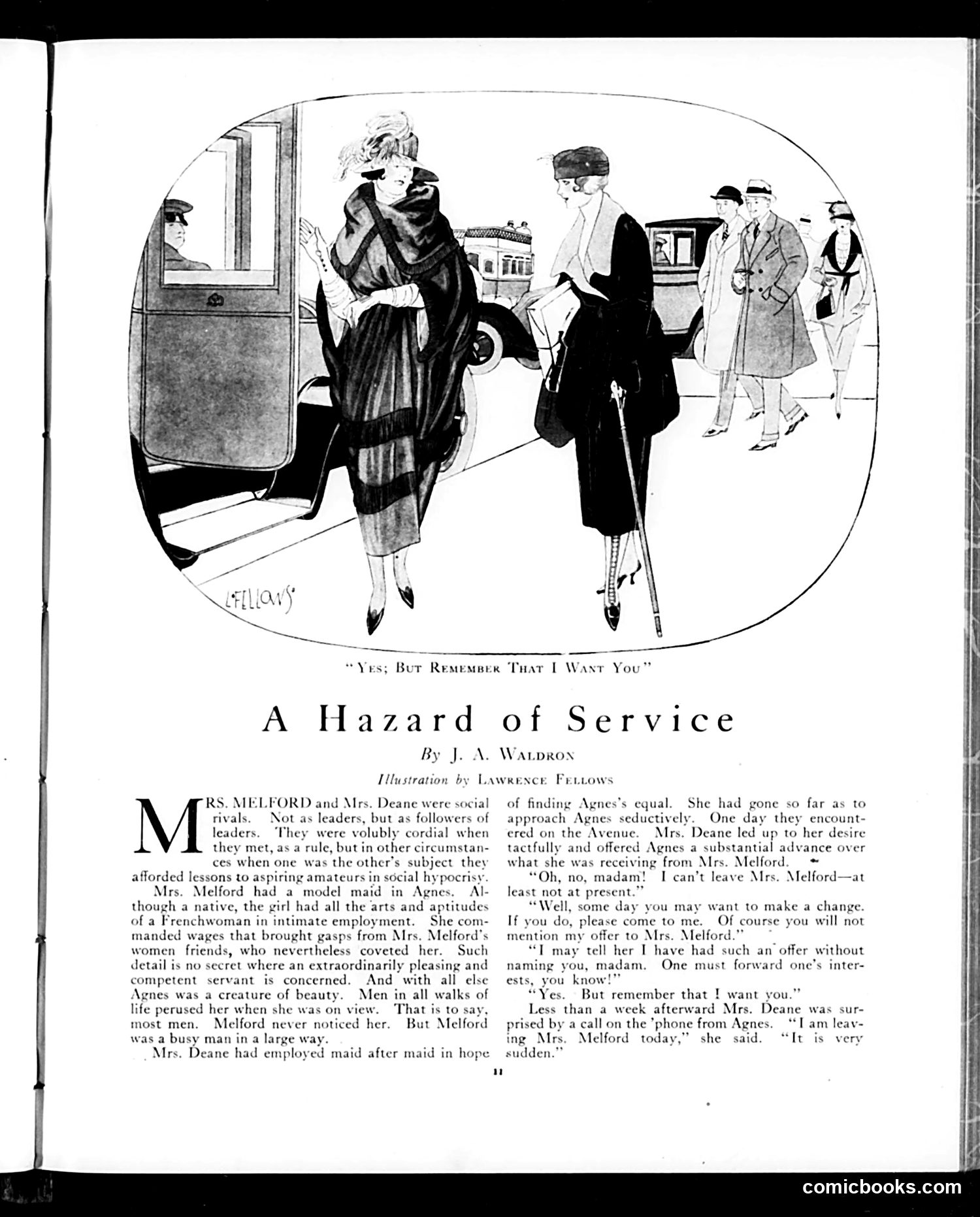
This is a short story illustration (not political satire) about social dynamics among wealthy women. Mrs. Melford and Mrs. Deane are social rivals who maintain surface cordiality while harboring competitive feelings. The story centers on Agnes, Mrs. Melford's exceptionally skilled and beautiful French maid, whom Mrs. Deane covets. When Mrs. Deane encounters Agnes on the street, she attempts to recruit her with a higher wage, cautioning Agnes not to mention the offer to Mrs. Melford. The cartoon depicts this street encounter—showing the two women in fashionable 1920s attire, with onlookers visible. The satire targets the hypocrisy of wealthy women who publicly maintain friendships while privately scheming to one-up each other, even over domestic help. The "hazard of service" appears to be that valuable servants become objects of social competition and manipulation among status-conscious employers.
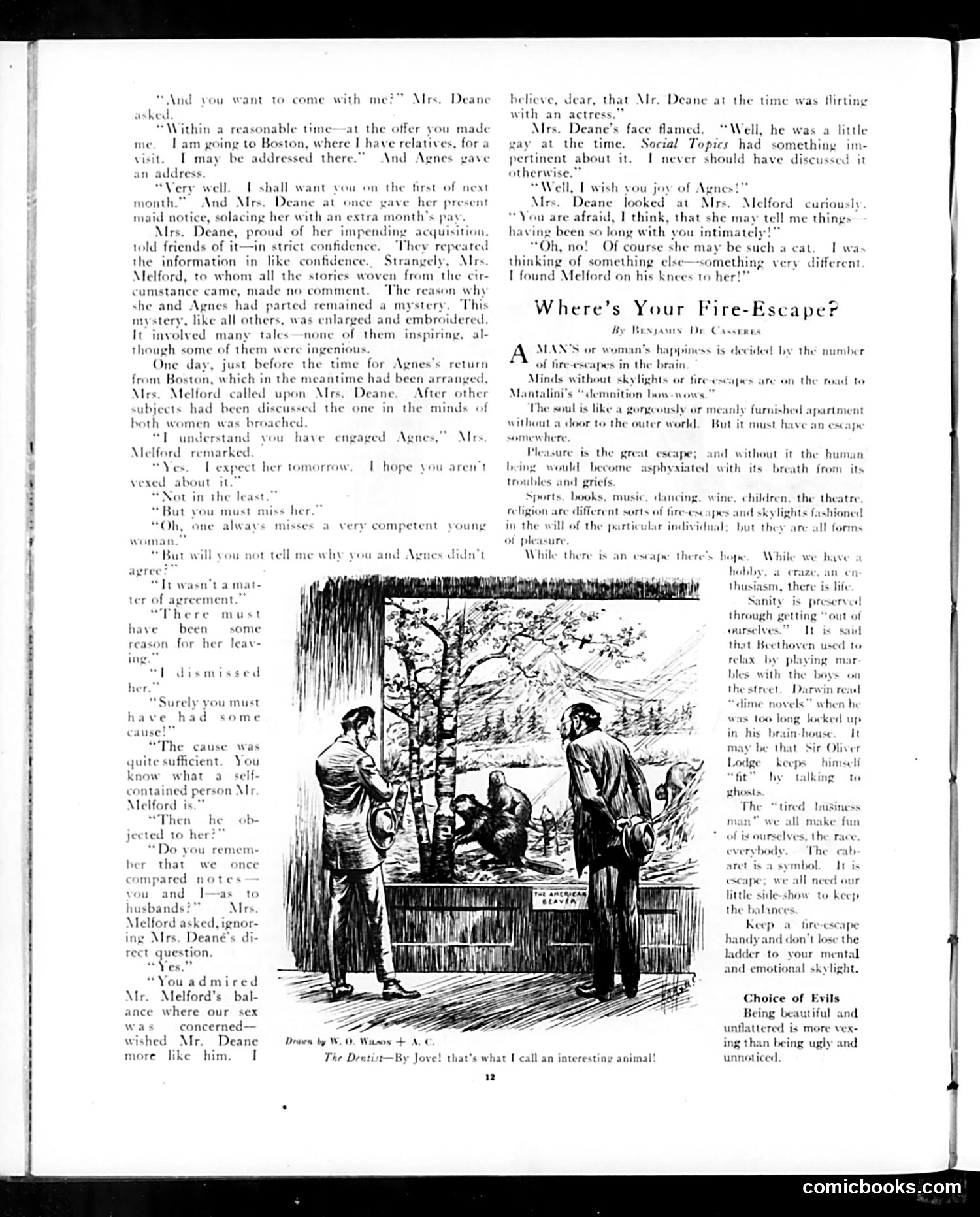
This page contains two distinct pieces from an early 20th-century American satirical magazine: **Left Column - Short Story Excerpt:** A domestic drama about Mrs. Deane hiring a new maid named Agnes. Mrs. Melford visits to warn Mrs. Deane that Agnes may reveal embarrassing secrets—specifically that Mrs. Deane once discussed her husband Mr. Deane's flirtation with an actress. The satire targets women's gossip and social reputation anxiety: secrets spread through "strict confidence," and servants become repositories of damaging information that could harm a woman's social standing. **Right Column - Essay "Where's Your Fire-Escape?":** An essay arguing that mental/emotional outlets ("fire-escapes") are essential for sanity. The author advocates hobbies, sports, theatre, and entertainment as psychological necessities. References Beethoven playing marbles and Darwin reading "dime novels" as examples of how even great minds need mental relief from their work. **Overall Context:** The page satirizes Victorian/Edwardian middle-class anxieties about social propriety and household management while promoting progressive ideas about mental health and leisure's necessity.
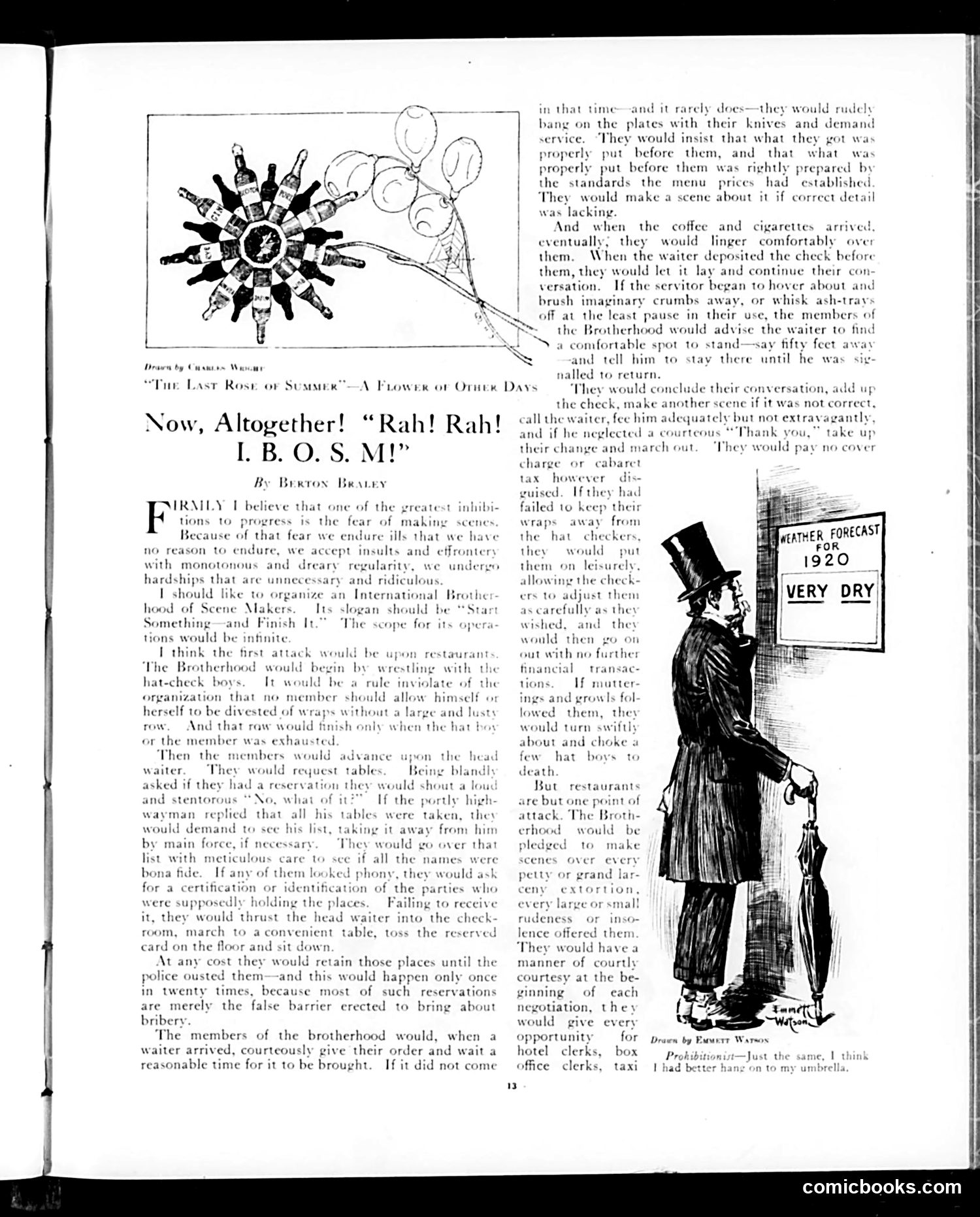
This page presents Berton Braley's satirical essay proposing an "International Brotherhood of Scene Makers" to combat social passivity. The piece mocks Americans' fear of confrontation in everyday situations—particularly in restaurants. **The Satire:** Braley ironically advocates organizing citizens to aggressively demand proper service and respect from waiters, hat-check attendants, and other service workers. The humor lies in the absurdity of his "solutions": loudly banging plates with knives, physically seizing reserved tables, and threatening staff with choreographed rudeness. **The Point:** The essay criticizes how Americans tolerate poor service and disrespect rather than make "scenes." Braley suggests this passivity enables exploitation by establishments and workers. The illustration shows a woman with an umbrella next to a "Weather Forecast for 1920—Very Dry" sign, possibly suggesting dry wit complements the article's dry humor. **Context:** Published in Judge (a satirical magazine), this reflects 1920s frustrations with service industry etiquette and class dynamics, using exaggeration to expose how fear of social embarrassment allows bad behavior to persist.
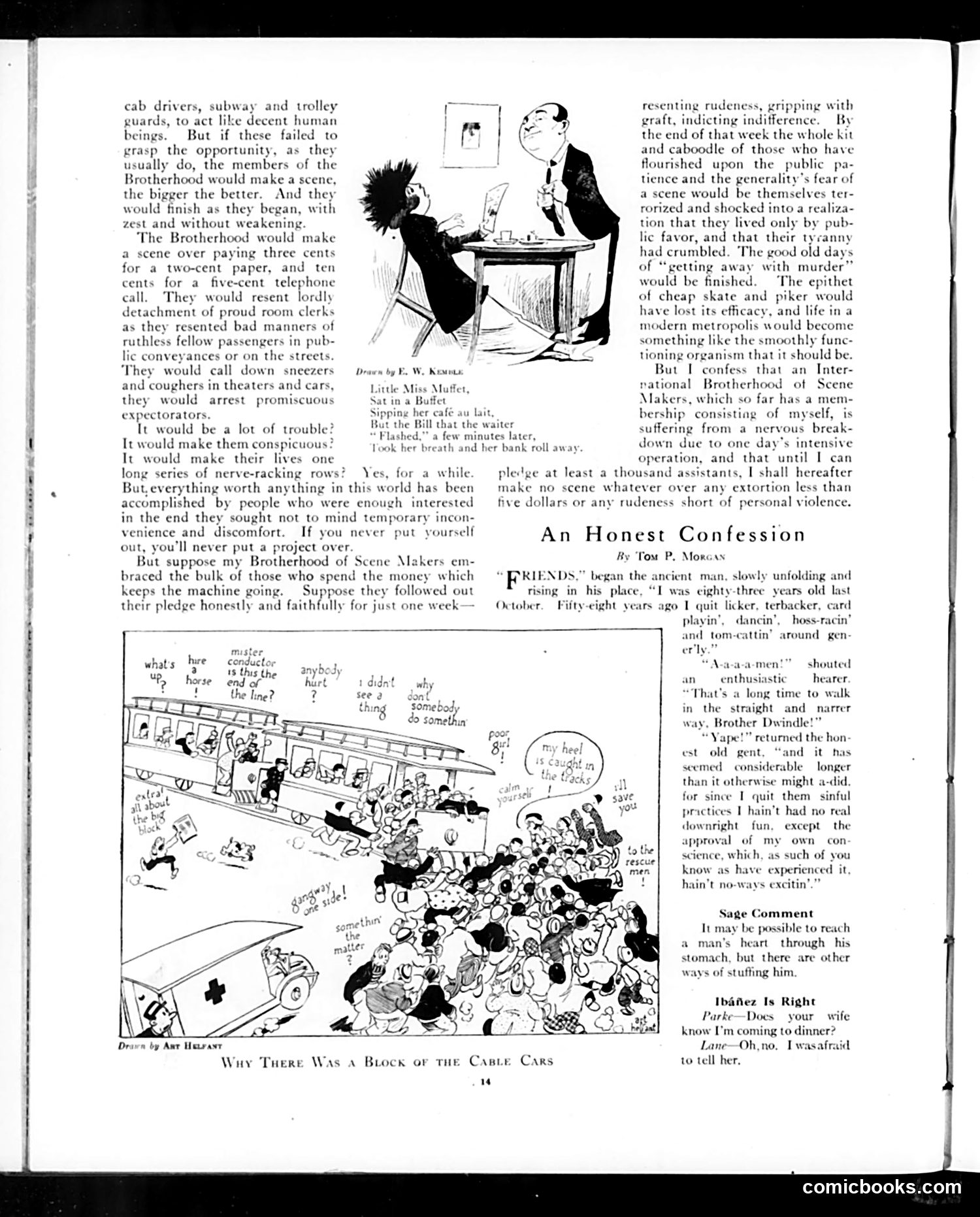
This page contains three satirical pieces about social reform and human nature: **"Why There Was a Block of the Cable Cars"** (bottom cartoon by Art Heleary): A chaotic scene depicting a crowded cable car jam. The satire proposes an "International Brotherhood of Scene Makers"—ordinary citizens who would publicly protest minor injustices (rude service, overcharging) to shame corrupt operators into honesty. The joke: the author admits his "Brotherhood" consists only of himself, broken down from one day of complaints, now only willing to protest extortions over five dollars. **"An Honest Confession"** (top right): An elderly man testifies he quit drinking, gambling, and carousing 58 years ago. The satire's point: virtue brings only self-approval—no actual enjoyment—suggesting morality is its own hollow reward. **"Ibáñez Is Right"** (bottom right): A husband won't tell his wife about dinner plans, fearing her reaction. A joke about marital fear rather than social commentary. The page satirizes both social reformers' idealism and conventional morality as impractical or joyless.
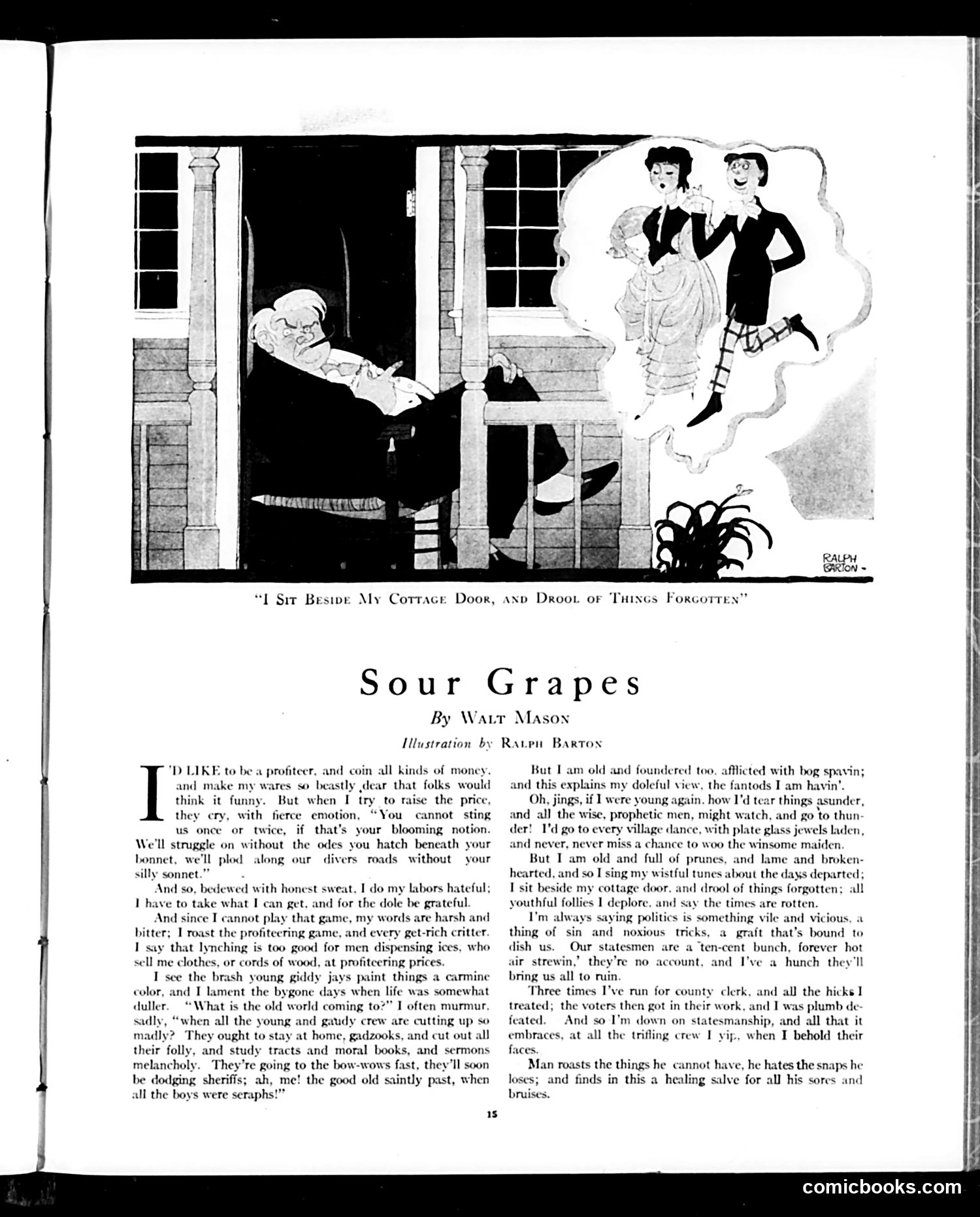
This page contains an illustration and satirical poem by Walt Mason attacking a bitter, aging curmudgeon who complains about modern life while masking his real failures. **The Cartoon:** Shows an old man sitting alone at his cottage door, daydreaming of two young, fashionable women. The caption quotes him romanticizing his solitude. **The Satire:** The poem reveals the man's hypocrisy. He claims moral superiority—denouncing profiteering, youth's frivolity, and political corruption—but Mason exposes this as sour grapes. The old man has failed at business, lost elections, and now bitter and broken-hearted, he condemns what he cannot have or achieve. **The Point:** Mason's final lines make the message explicit: people attack things they've lost or failed at, using moral outrage as a salve for personal disappointment. The illustration of the man's fantasy contrasts his lonely reality with his romanticized past, emphasizing how nostalgia and resentment distort his worldview.
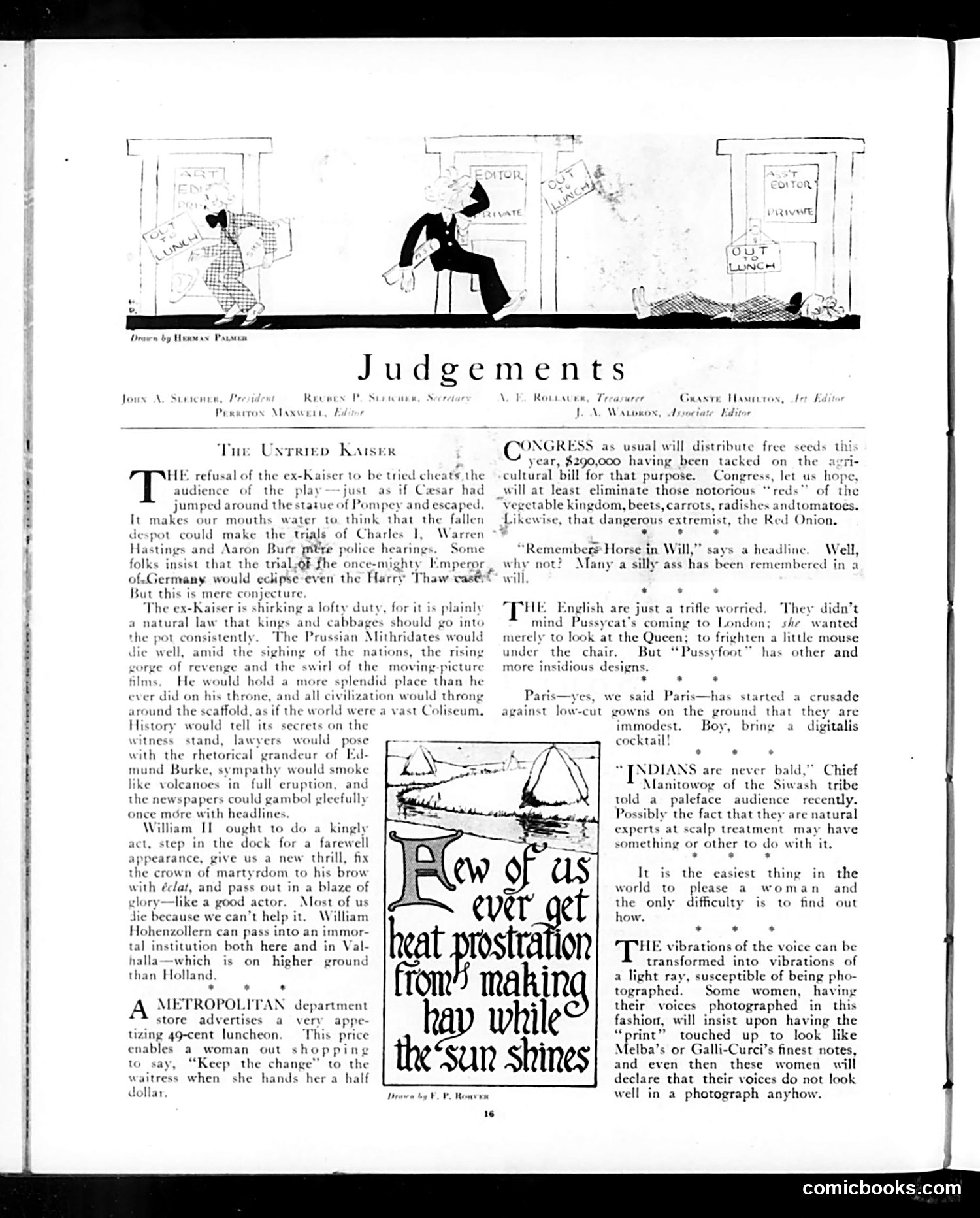
This page from *Judge* magazine contains several brief satirical commentaries on contemporary issues: **"The Untried Kaiser"** argues that former German Emperor Wilhelm II should stand trial for war crimes. The satire suggests that refusing trial cheats the public of dramatic justice—comparing it to famous trials (Charles I, Aaron Burr, Harry Thaw). The piece mocks Wilhelm for avoiding "a lofty duty," suggesting he should face execution with theatrical dignity like "a good actor" rather than escape accountability. **Additional brief items mock:** - Congress distributing free agricultural seeds while ignoring "dangerous" vegetables like beets and radishes (likely a joke about socialist "Reds") - English anxiety over "Pussyfoot" (unclear reference, possibly William Jennings Bryan's temperance crusade) - A Paris crusade against low-cut dresses as "immodest" - Native Americans' natural hair retention - Women's vanity about photographed voices The cartoons at top and center provide visual gags supporting these written quips. The humor targets social pretension, political evasion, and contemporary anxieties.
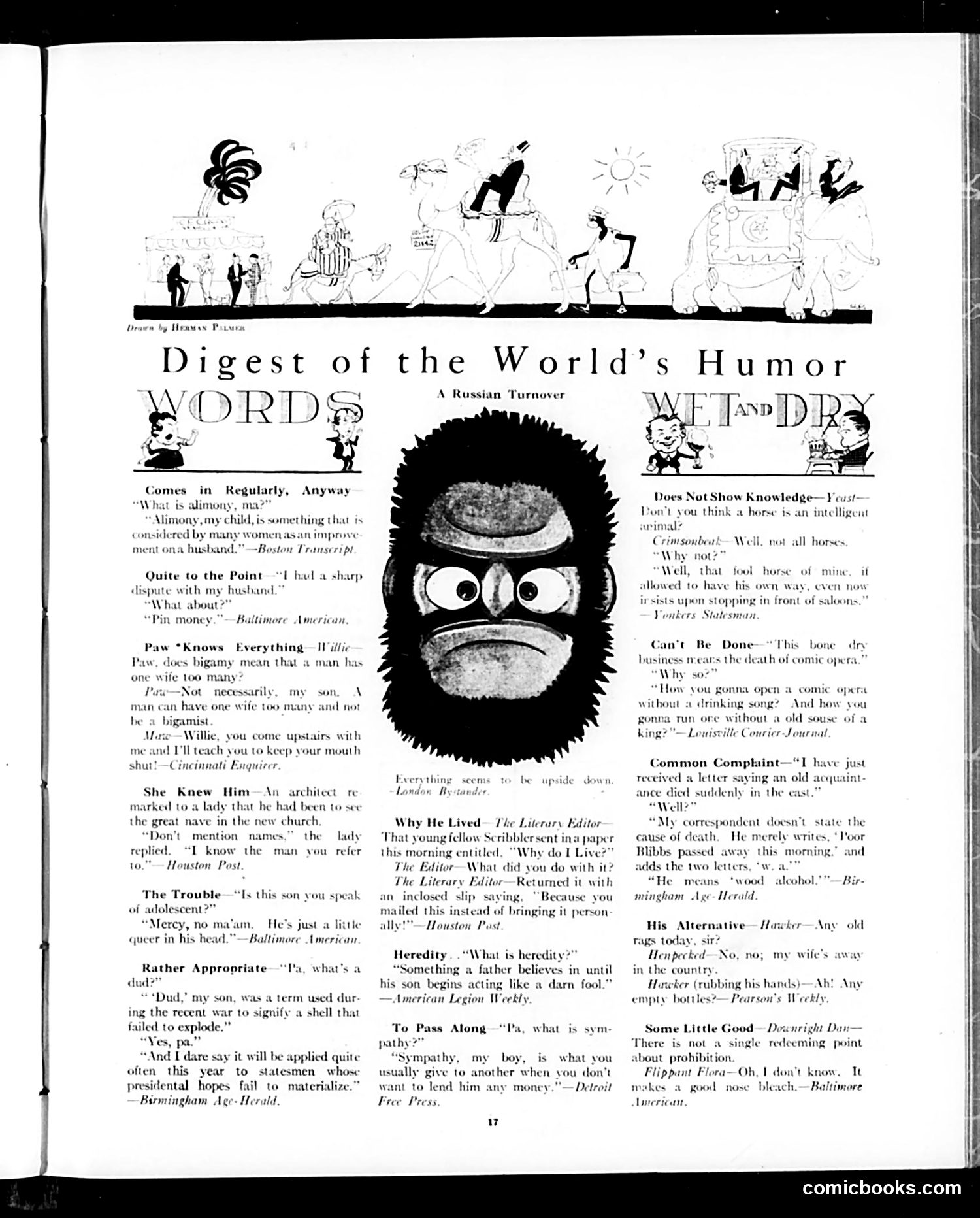
This page collects short humorous anecdotes from various newspapers, organized under two sections: "Words" (left) and "Wet and Dry" (right), with a decorative mask illustration at center. The jokes reflect early 20th-century American social anxieties: **marital discord** (alimony, "pin money"), **gender relations** (wives controlling husbands), and **Prohibition**. The "Wet and Dry" section satirizes the alcohol ban through jokes about its cultural impacts—particularly the death of comic opera without drinking songs and attempts to find alternative uses for prohibited liquor. The mask at center, labeled "A Russian Turnover," likely references post-1917 Bolshevik upheaval, suggesting social inversion ("everything upside down"). The page functions as a humor digest, reprinting jokes credited to newspapers nationwide, rather than original editorial cartooning. The satire targets contemporary domestic life and Prohibition's unpopular enforcement.
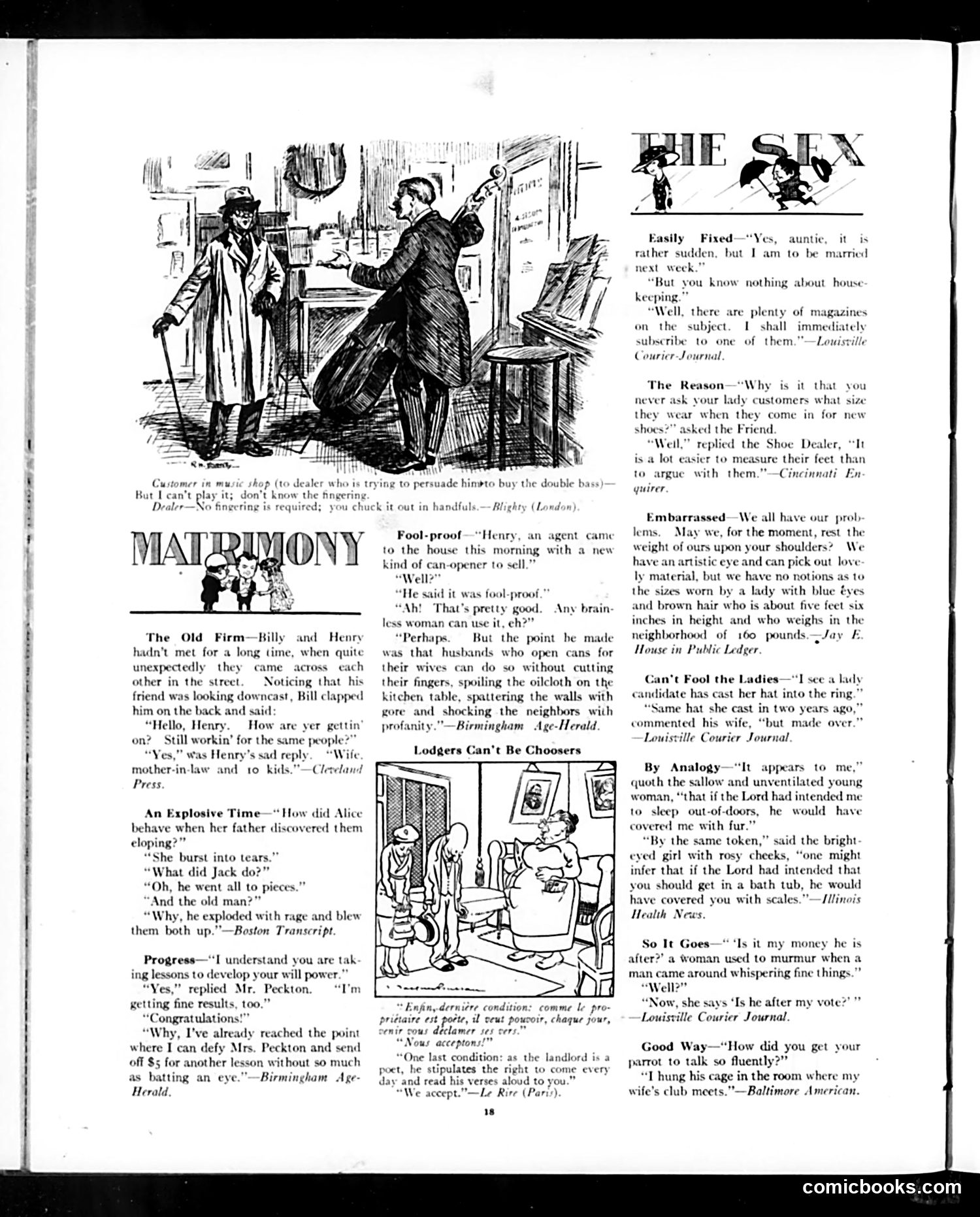
This page contains **short humorous anecdotes** rather than political cartoons, reflecting early 20th-century domestic comedy. The jokes target common marital and social frustrations: **Key themes:** - **Marriage complaints**: "The Old Firm" jokes about a man working to support wife, mother-in-law, and children—depicting matrimony as financial burden - **Gender stereotypes**: Women portrayed as irrational ("easier to measure feet than argue"), materialistic ("Is it my money?"), and incompetent at housekeeping - **Domestic absurdity**: A husband's "progress" is defying his wife to pay for willpower lessons; a parrot learns to talk from exposure to women's club meetings (implying constant chatter) **The humor** relies on wife-as-nag tropes and complaints about female irrationality—typical of early 1900s magazine satire. One cartoon shows lodgers negotiating with a landlord who demands poetry readings daily. The material is **period-specific workplace and marital satire** with little lasting political significance, aimed at middle-class male readers.
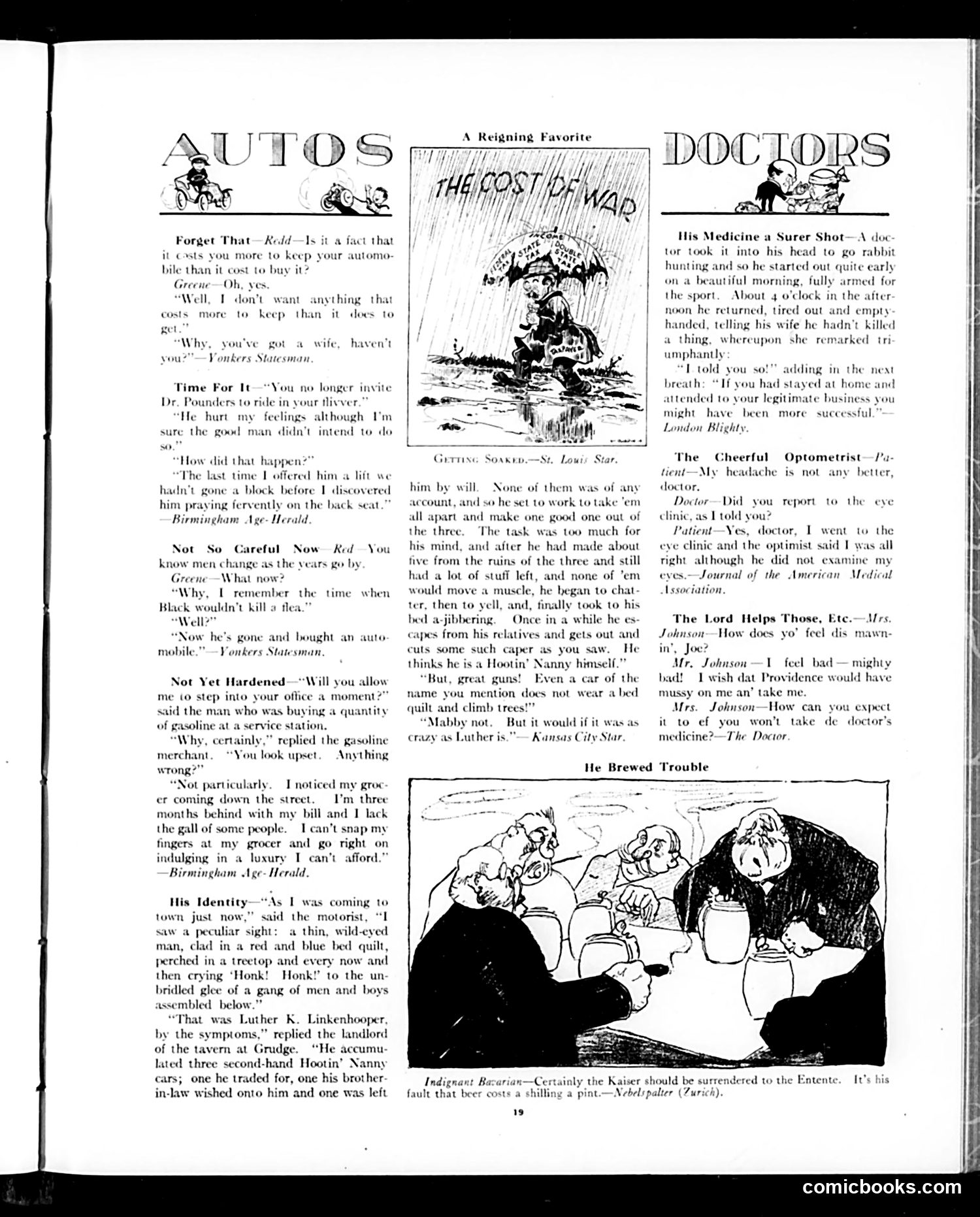
This page from *Judge* contains several short humorous anecdotes about early automobiles and their social impact, plus a doctor-themed cartoon. **"Autos" section:** The jokes satirize how owning a car has become financially burdensome—it costs more to maintain than to purchase. The humor lies in the contradiction that people buy cars for convenience yet find them economically ruinous. One anecdote depicts a grocer's customer so embarrassed about debt that he won't face the grocer, yet indulges in expensive gasoline. Another mocks a man who obsessively tried to assemble one working car from three broken ones, ultimately went mad, and now dresses in a quilt yelling "Honk! Honk!" **"Doctors" section:** Includes brief medical humor—a doctor's wife sarcastically notes his rabbit hunting failure proves he should stick to medicine; an eye clinic patient visits but doesn't follow up; and a sick man asks Providence for relief while refusing medicine. **Bottom cartoon ("He Brewed Trouble"):** Depicts men drinking beer, captioned that the Kaiser should surrender because beer costs a shilling a pint—likely WWI-era satire on German breweries or wartime complaints.
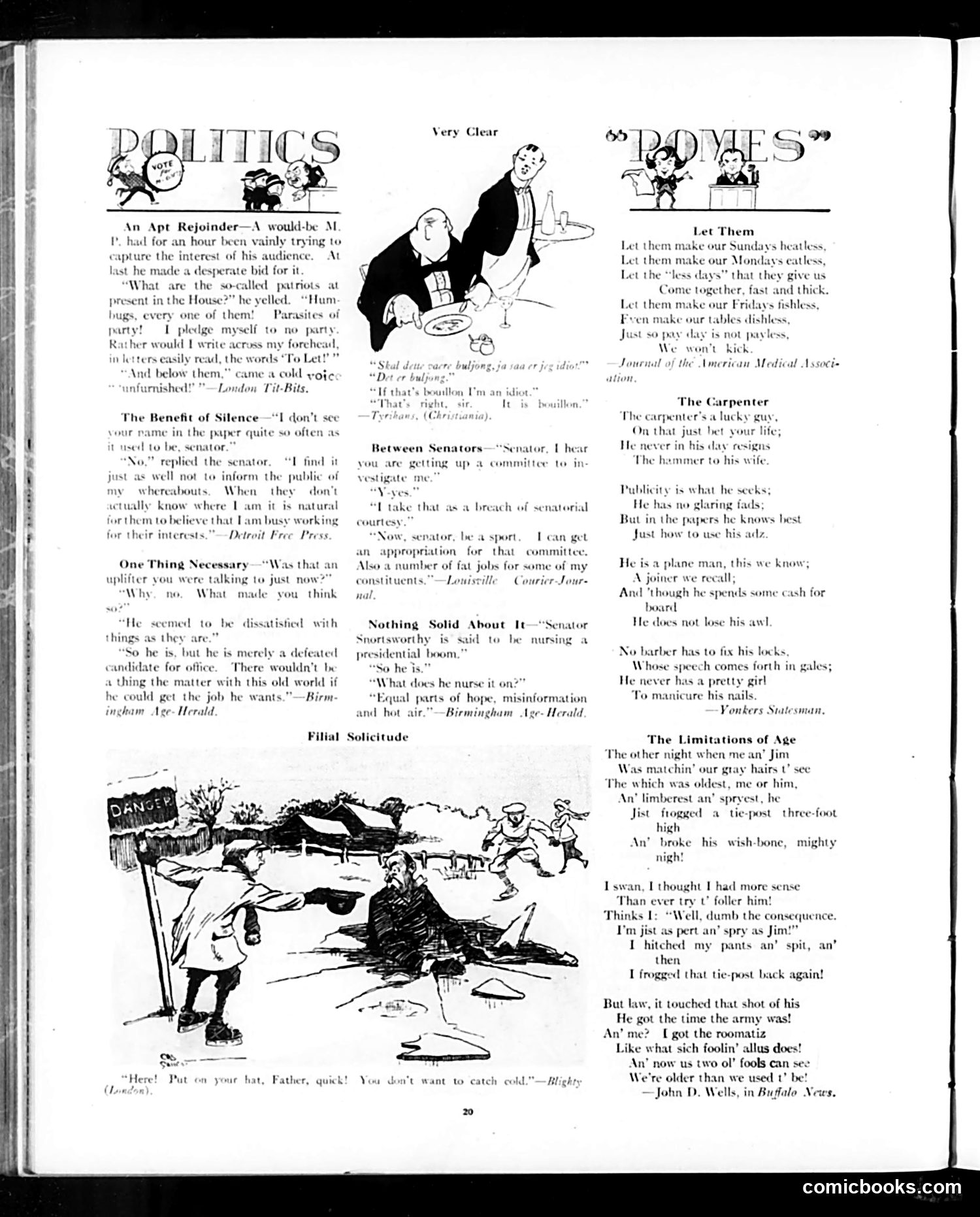
This page from *Judge* magazine contains satirical political commentary and humorous verse typical of early 20th-century American satire. **Political Content:** The "Between Senators" section mocks Senate corruption, depicting a senator casually offering "fat jobs" in exchange for dropping an investigation—satirizing how legislators used committee positions as patronage. **Social Satire:** "Nothing Solid About It" ridicules Senator Snortsworthy's presidential ambitions built on "hope, misinformation and hot air"—a timeless critique of hollow political campaigns. **General Humor:** The remaining pieces are lighter: "The Benefit of Silence" jokes about senators avoiding publicity to escape scrutiny; "The Carpenter" is a pun-filled poem celebrating a tradesman's practical virtues; "The Limitations of Age" humorously depicts two aging men competitively proving their vigor, with comical consequences. The cartoons reinforce these themes visually. The overall message critiques legislative corruption and political pretense while celebrating common-sense practicality over political ambition.
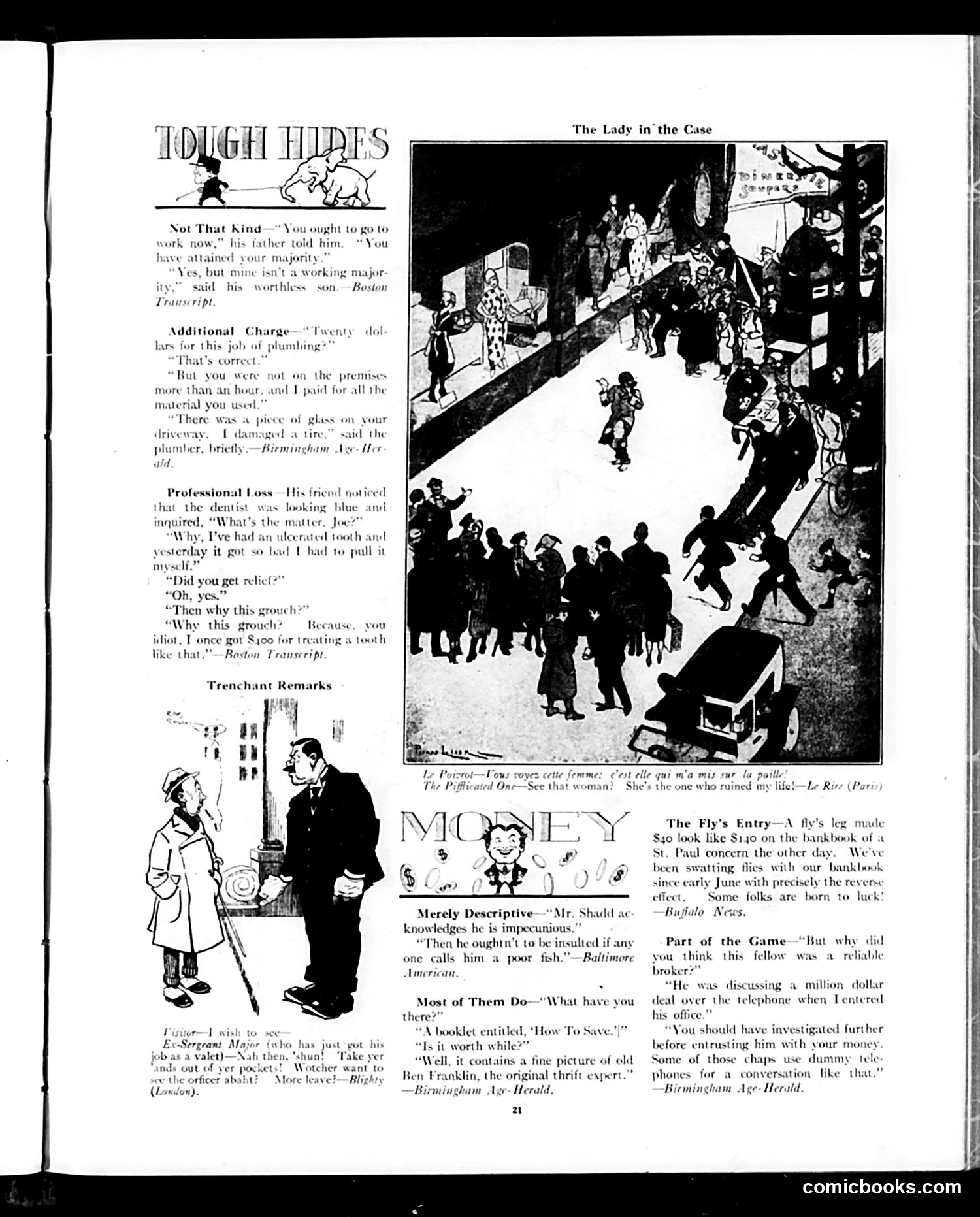
This page contains six brief satirical jokes typical of early 20th-century American humor magazines: **"Not That Kind"** mocks a worthless son who claims he's reached "majority" (adulthood) without actually maturing. **"Additional Charge"** satirizes a plumber's inflated bill for minimal work—a timeless complaint about tradespeople's pricing. **"Professional Loss"** jokes about a dentist's regret: he extracted his own tooth to avoid pain, losing the $200 fee he'd normally charge. **"Trenchant Remarks"** (untranslated French caption) appears to reference a woman causing financial ruin. **"The Fly's Entry"** humorously suggests an accountant's error—a fly landing on a ledger made $40 appear as $140—while the writer laments their own bad luck. **"Part of the Game"** warns against trusting brokers discussing million-dollar deals by phone, suggesting they use fake telephone conversations to appear legitimate. The humor targets common social anxieties: incompetence, fraud, financial loss, and unreliable professionals.
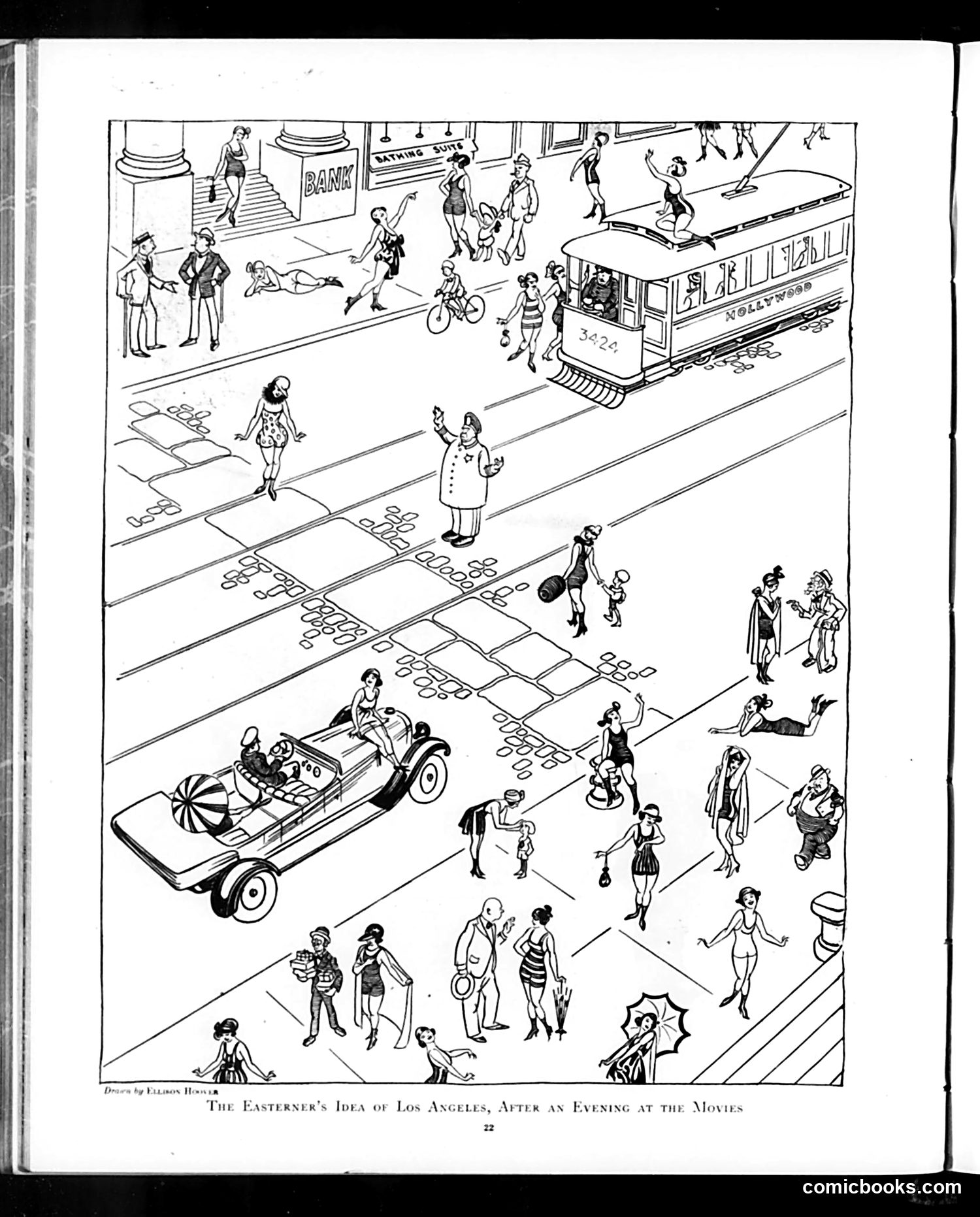
This is a satirical illustration titled "The Easterner's Idea of Los Angeles, After an Evening at the Movies." The cartoon mocks how Eastern Americans—people from back East—imagined Los Angeles based on Hollywood movies they'd seen. The scene depicts an exaggerated, chaotic street scene featuring: - A racing car with an open cockpit - A trolley/streetcar labeled "Hollywood" - People in swimwear and beach attire - Acrobats and performers - Generally outlandish, theatrical activity The satire suggests that Eastern viewers had wildly unrealistic expectations of LA life—imagining it as a constant spectacle of danger, glamour, athletic excess, and entertainment. It's mocking both the exaggerated nature of Hollywood films and the gullibility of audiences who took such portrayals literally. The joke hinges on the contrast between actual city life and cinema's fantastical depictions.
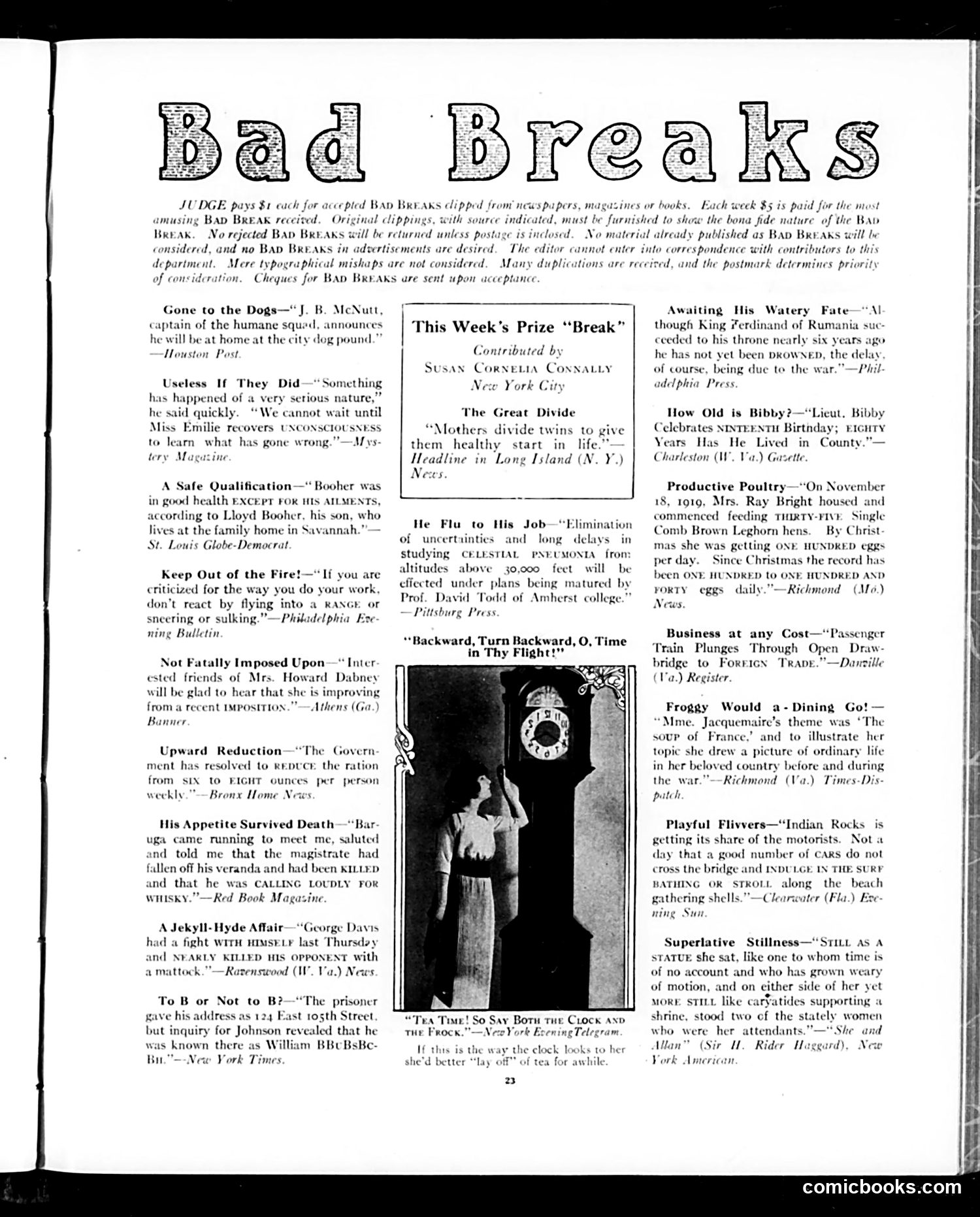
This page is part of Judge magazine's "Bad Breaks" humor column—a reader-submission feature highlighting unintentional comic errors from newspapers and magazines (mostly typos and malapropisms). The cartoonist's central feature shows a woman gesturing at a clock with the caption about "Tea Time" and "laying off"—likely illustrating one of the submitted bad breaks about an absurd headline regarding mothers dividing twins or celestial pneumonia studies. The humor relies entirely on **unintentional logical contradictions**: a magistrate killed but "calling loudly for whisky," a prisoner known by multiple names, mothers "dividing" twins, 30-year-old Lieutenant Bibby who has "lived" 80 years. These aren't political satires but rather gentle mockery of editorial carelessness. The "prize break" credited to Susan Cornelia Connally concerns mothers dividing twins to give them "healthy start in life"—the absurdist contradiction being the punchline. This is primarily a **humor-of-errors feature** rather than political commentary, entertaining readers by exposing newspaper blunders.
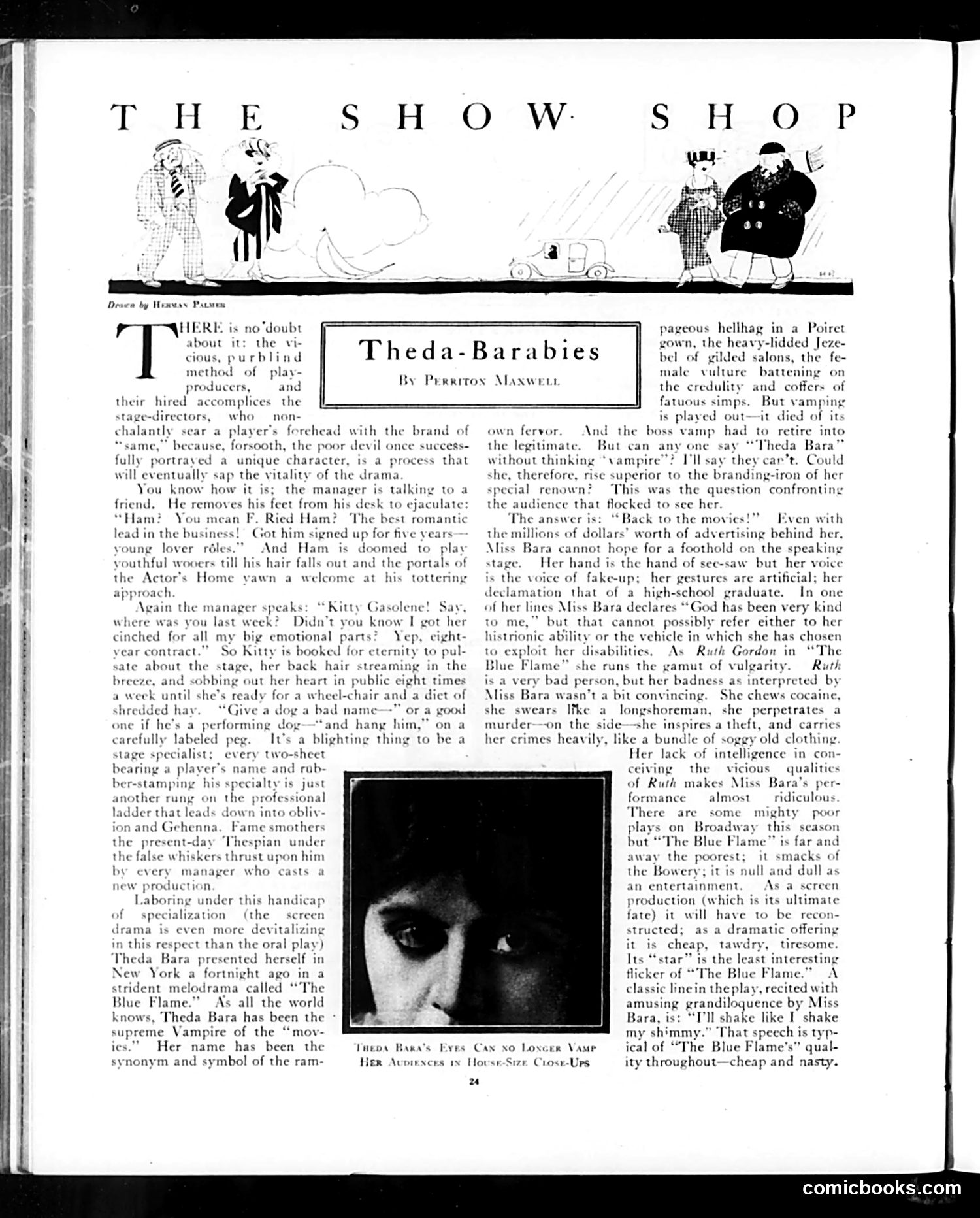
The header cartoon satirizes theatrical casting practices, showing managers and producers as comedic figures alongside stylishly dressed actors and actresses. The article "Theda-Barabies" by Perriton Maxwell critiques how film stars struggle when transitioning to live theater. Theda Bara, famous as a "vampire" character in silent movies, attempted to perform in a Broadway melodrama called "The Blue Flame." Maxwell's satire argues that Bara's success was entirely dependent on the film medium and her established screen persona. On stage, she fails—her voice is artificial, gestures unconvincing, and her acting ability (or lack thereof) becomes obvious without cinematic enhancement. The critic claims her performance as the morally corrupt character Ruth is "almost ridiculous," lacking genuine understanding of the vicious qualities required. The piece mocks how producers typecast actors into repetitive roles until their careers become stale, trapping them in single identities. Bara's attempt to transcend her "vampire" branding demonstrates that some performers cannot adapt beyond their manufactured screen image.
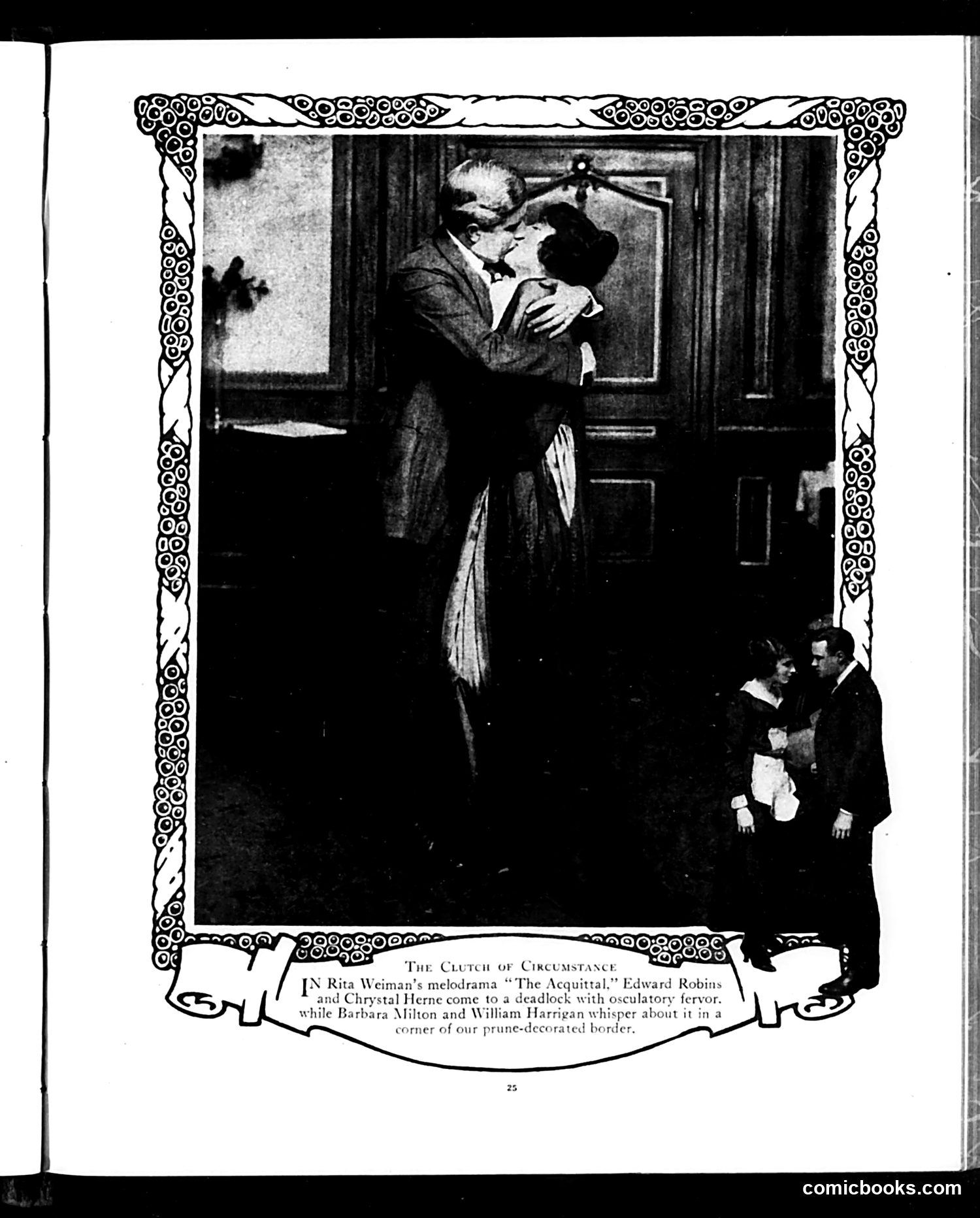
This appears to be a scene from Rita Weiman's melodrama "The Acquittal." The caption references four actors: Edward Robins, Chrystal Herne, Barbara Milton, and William Harrigan. The image shows two men in formal dress—one holding a woman in an embrace while another couple whispers in a corner. The title "The Clutch of Circumstance" is the joke: the scene depicts a romantic or compromising moment that, taken out of context, appears scandalous. The satire likely mocks melodramatic theater conventions where circumstantial evidence or misunderstandings drive overwrought plots. Judge is poking fun at the theatrical tendency to create dramatic tension through misinterpretation—hence the whispered gossip in the corner suggesting scandal where perhaps none exists. The ornate border emphasizes the theatrical artificiality of the scene.
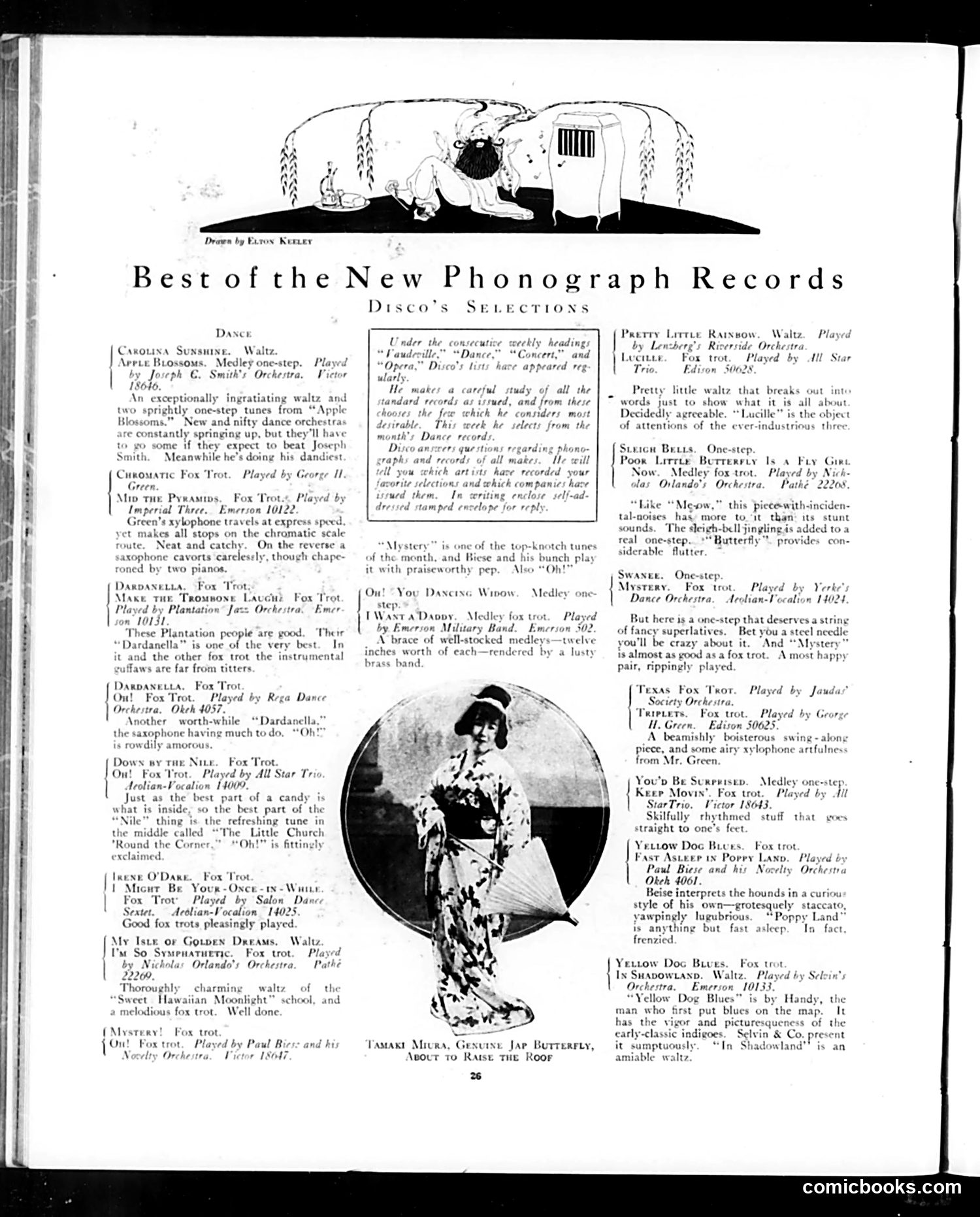
This page is a **record review section**, not political satire. It features Disco's selections of phonograph recordings available for purchase, primarily dance music from the early 1920s era. The illustration shows a **stylized woman in Asian dress** (likely meant to evoke "exotic" appeal), appearing to dance or perform—common imagery used in the Jazz Age to market entertainment records to American consumers. The reviews recommend popular dance numbers: fox trots, waltzes, and one-steps performed by orchestras like Emerson, Victor, and Okeh labels. Notable artists mentioned include Paul Biese and Nicholas Orlando. **For modern readers**: This reflects 1920s consumer culture during the phonograph boom, when recorded music was a new luxury good. The exotic imagery and focus on "hot" dance music reflect period attitudes toward entertainment. The page essentially functions as **advertising disguised as editorial content**—typical of entertainment magazines of this era.
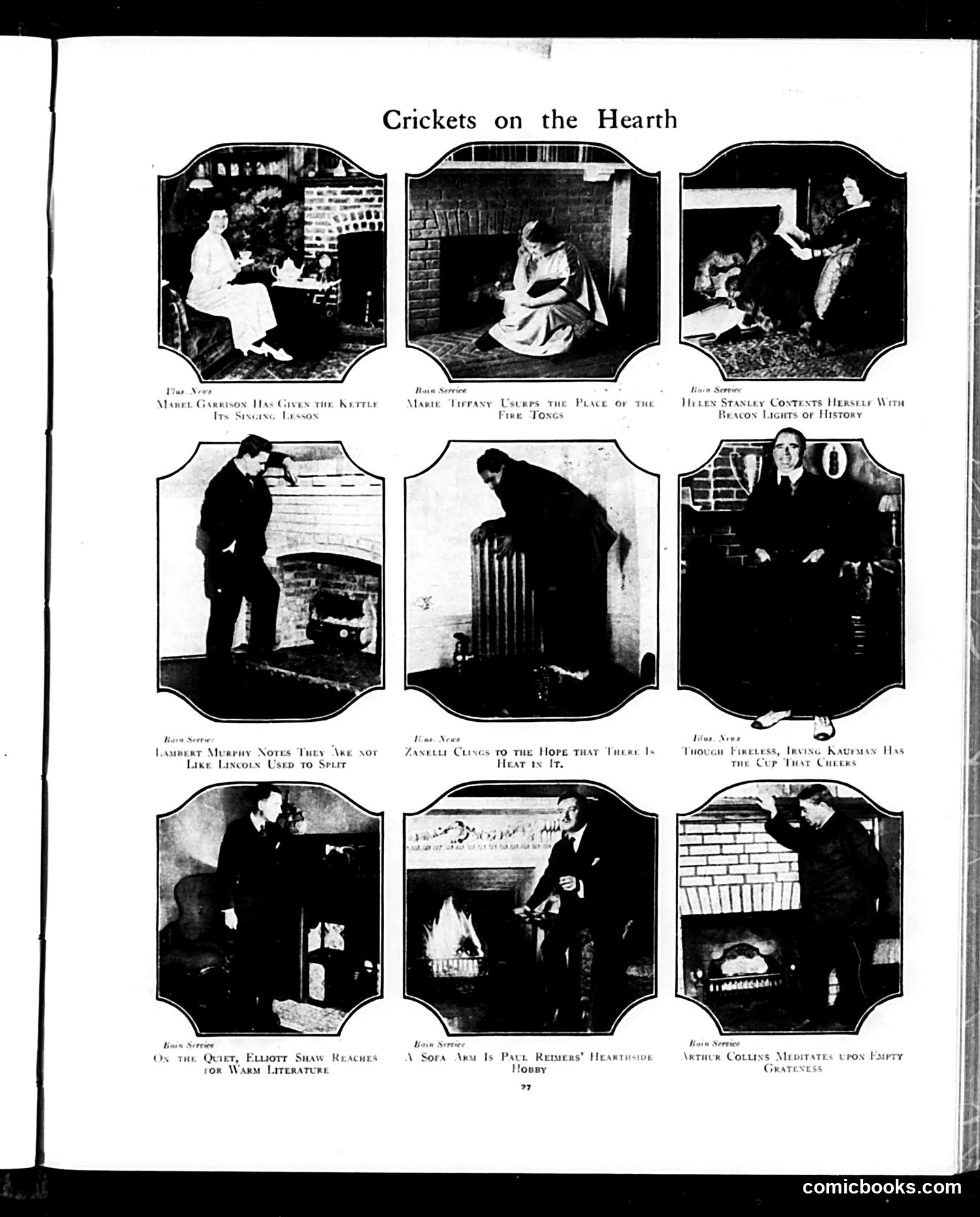
This page presents nine domestic vignettes satirizing winter hearth activities and cozy home life. The title references Dickens's sentimental tale, establishing a framework for gentle domestic humor. The sketches depict various figures engaged in fireside pastimes: women singing, tending fires, and reading; men warming themselves and pursuing intellectual activities. References appear to include contemporary political or literary figures (though OCR errors obscure some names—possibly "Manet Garrison," "Elliott Shaw," "Paul Reiders"), shown engaged in mundane or absurd domestic situations. The satire likely mocks the romanticized notion of wholesome hearth life, perhaps critiquing how public figures present themselves as refined, cultured, or virtuous when relaxing at home. The juxtaposition of dignified names with foolish or trivial activities creates the humor. Without clearer text or historical context, the specific satirical targets remain unclear, but the overall thrust appears to be deflating pretension through domestic comedy.
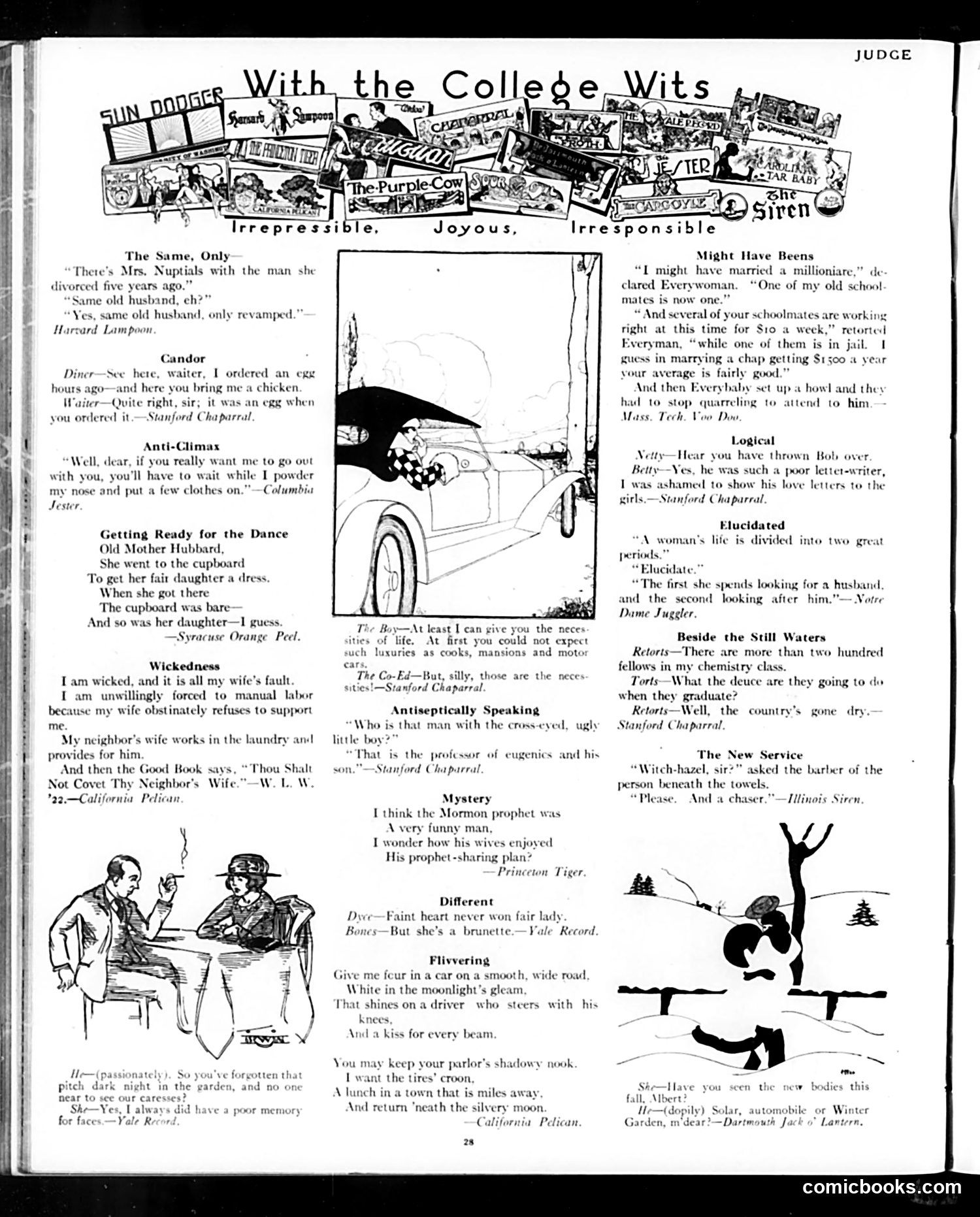
This is a collection of brief jokes and humorous quips from various college humor magazines (Harvard Lampoon, Stanford Chaparral, Yale Record, etc.), reprinted in Judge. The page satirizes contemporary social attitudes circa 1920s America. Key themes include: **Marriage & Gender**: Multiple jokes mock wives, divorce, and domestic dynamics—men complain about supporting wives who refuse to work; women are depicted as vain and materialistic ("powdering noses"). **Class Commentary**: A co-ed's expectations of luxury (cooks, mansions) are presented as absurd; a "Witch-hazel" joke references Prohibition's end with a "chaser" (drinking alcohol). **Eugenics Reference**: One joke identifies a professor and "cross-eyed, ugly" boy as teaching eugenics—reflecting the disturbing pseudo-science then considered respectable. **Youth Culture**: "Flivvering" celebrates car dating and necking in automobiles—contemporary moral panic about young people's freedom. The cartoons (two small illustrations) depict casual social scenes matching the lighthearted tone.
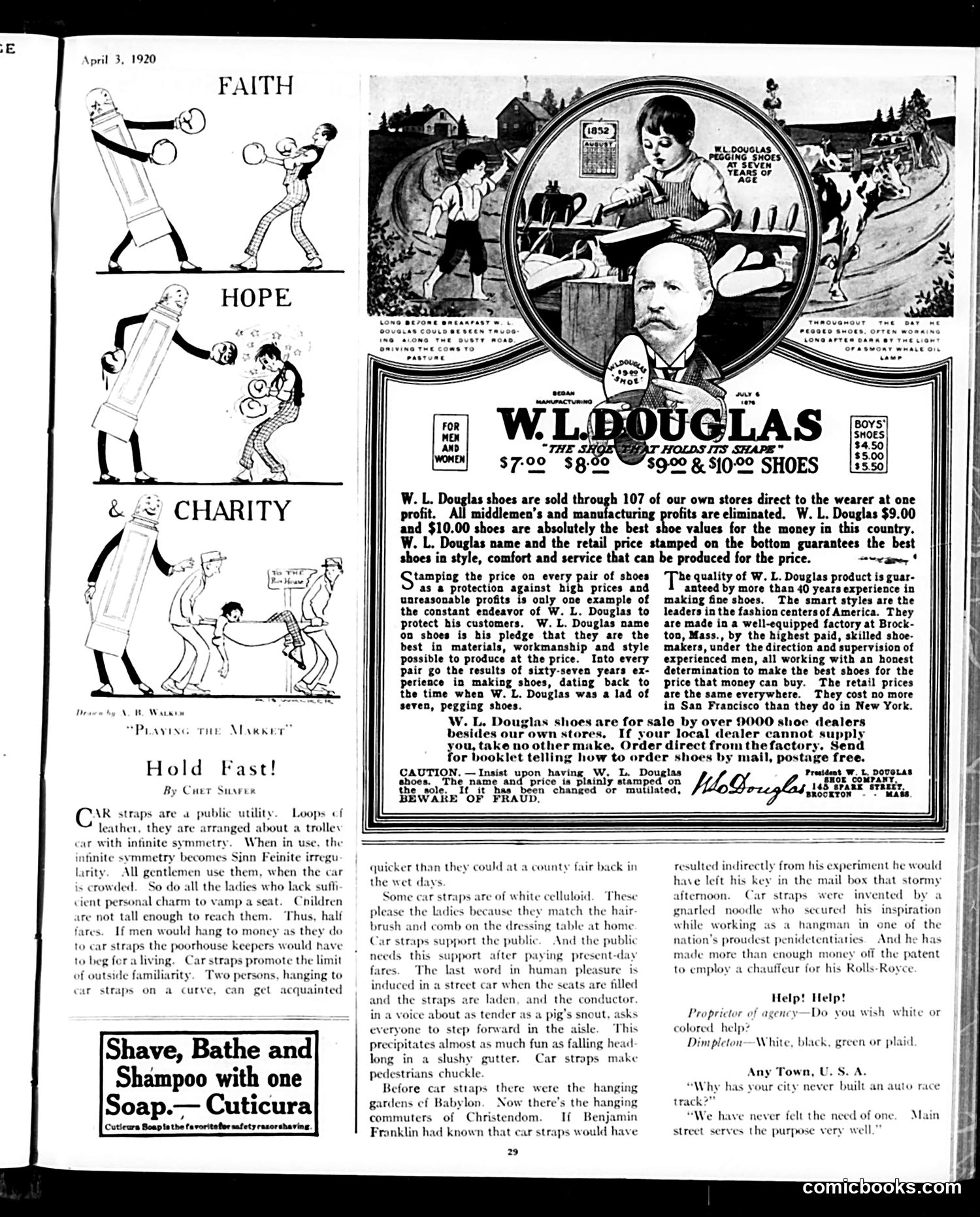
The left cartoon by A.P. Waters, titled "Playing the Market," uses three panels labeled FAITH, HOPE, and CHARITY to satirize stock market speculation. Each shows a figure juggling money or balls while catching/dropping objects—a visual metaphor for the recklessness and precariousness of financial gambling. The reference to "Sinn Féin" in the text suggests contemporary political instability bleeding into economic anxiety. The accompanying article "Hold Fast!" by Chet Shafer humorously celebrates streetcar handholds as democratic equalizers—shared public utility that forces social intimacy. The satire mocks both trolley crowding and Americans' obsession with money by comparing those who cling to car straps to misers clutching their finances. The remainder of the page consists primarily of a **W.L. Douglas shoe advertisement**, not editorial content. This lengthy ad emphasizes direct factory-to-consumer sales bypassing middlemen, using price-stamping as consumer protection against inflated retail markups—reflecting early 20th-century Progressive Era concerns about corporate profit margins and fair pricing.
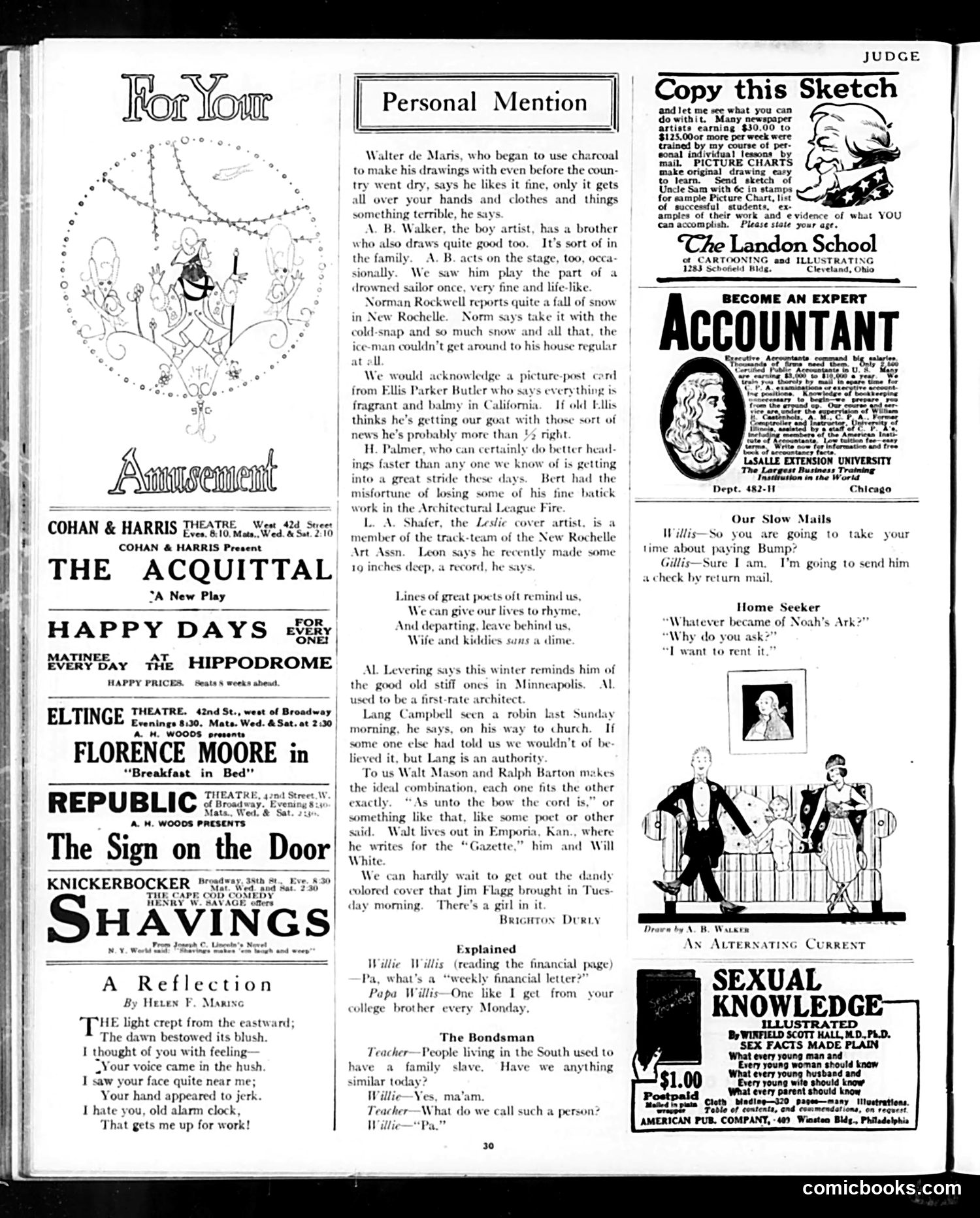
This is primarily an **advertising and entertainment page** from Judge magazine, with minimal political content. The page features: **Theater Advertisements**: Multiple Broadway show listings (The Acquittal, Happy Days, The Sign on the Door, Shavings) represent typical early 20th-century theatrical promotion. **"Personal Mention" Column**: Gossip about cartoonists and illustrators—Walter de Maris, A.B. Walker, Norman Rockwell, Ellis Parker Butler—establishing Judge's insider status within the artistic community. **"A Reflection" Poem**: A light humorous verse about resenting an alarm clock, representative of the magazine's gentle domestic humor. **Advertisements**: Including correspondence schools for accounting and cartooning, and a "Sexual Knowledge" pamphlet—typical period educational marketing. The page lacks significant political satire or social commentary. It's primarily a magazine section mixing entertainment gossip with period advertising, reflecting Judge's role as a publication for urban, educated readers interested in theater and illustration.
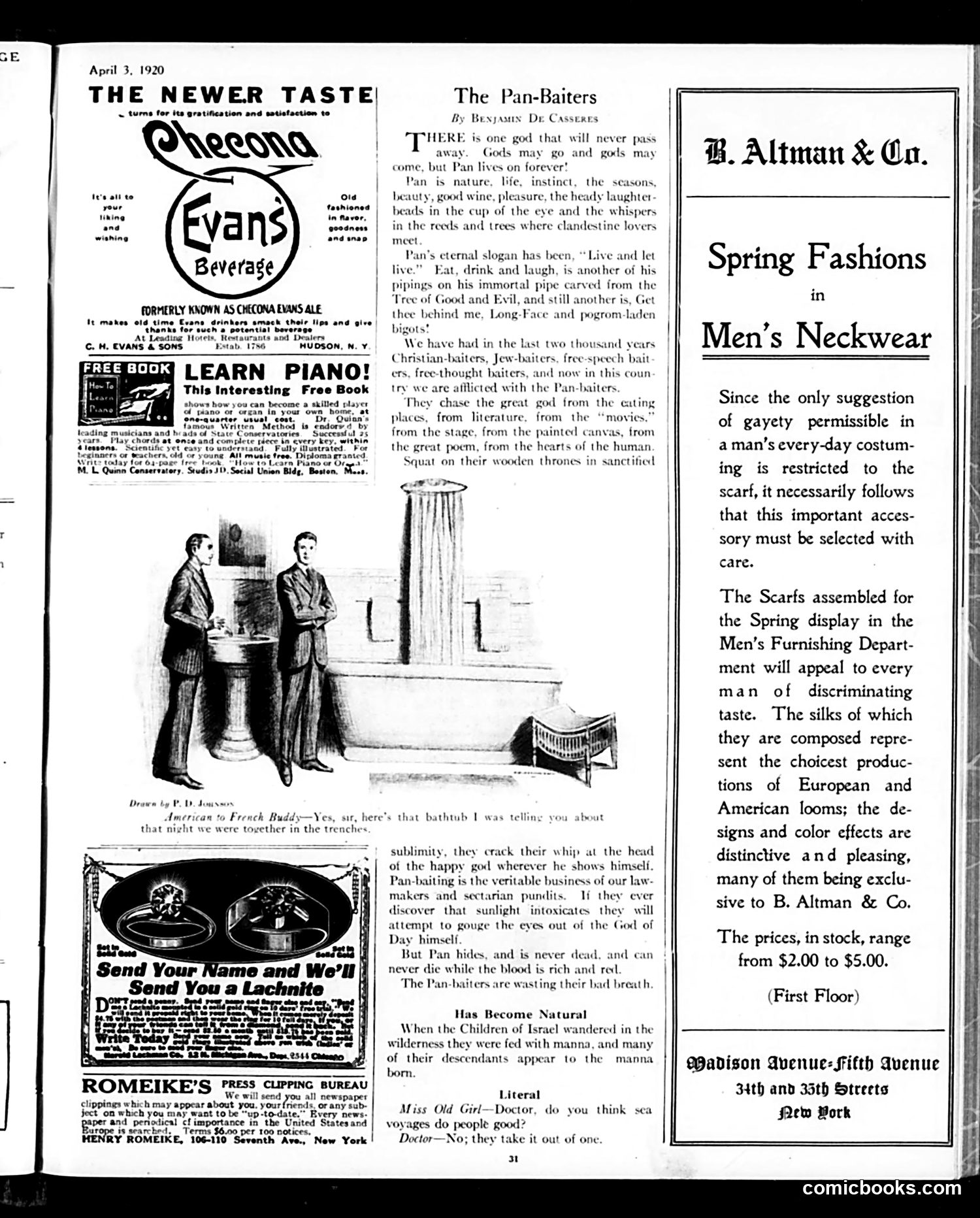
This page from *Judge* (April 3, 1920) contains primarily **advertisements and a satirical essay**, not a traditional political cartoon. The main literary piece, "The Pan-Baiters" by Benjamin De Casseres, is a **cultural critique**. It defends Pan (the mythological god of nature, pleasure, and revelry) against what the author calls "Pan-baiters"—likely referring to **Prohibition advocates and moral censors** who were actively suppressing drinking, entertainment, and artistic expression in post-WWI America. The essay ironically praises Pan's philosophy ("Live and let live") while lamenting that contemporary "law-makers and sectarian pundits" are driving pleasure and freedom from American life. The cartoon illustration shows two men discussing a bathtub—a visual joke about **Prohibition-era bathtub gin**, the illegal alcohol Americans produced at home after the 18th Amendment passed (January 1920). The piece reflects anxieties about government overreach and cultural puritanism during the early Prohibition era, presenting libertine values as under siege by moralistic authorities.
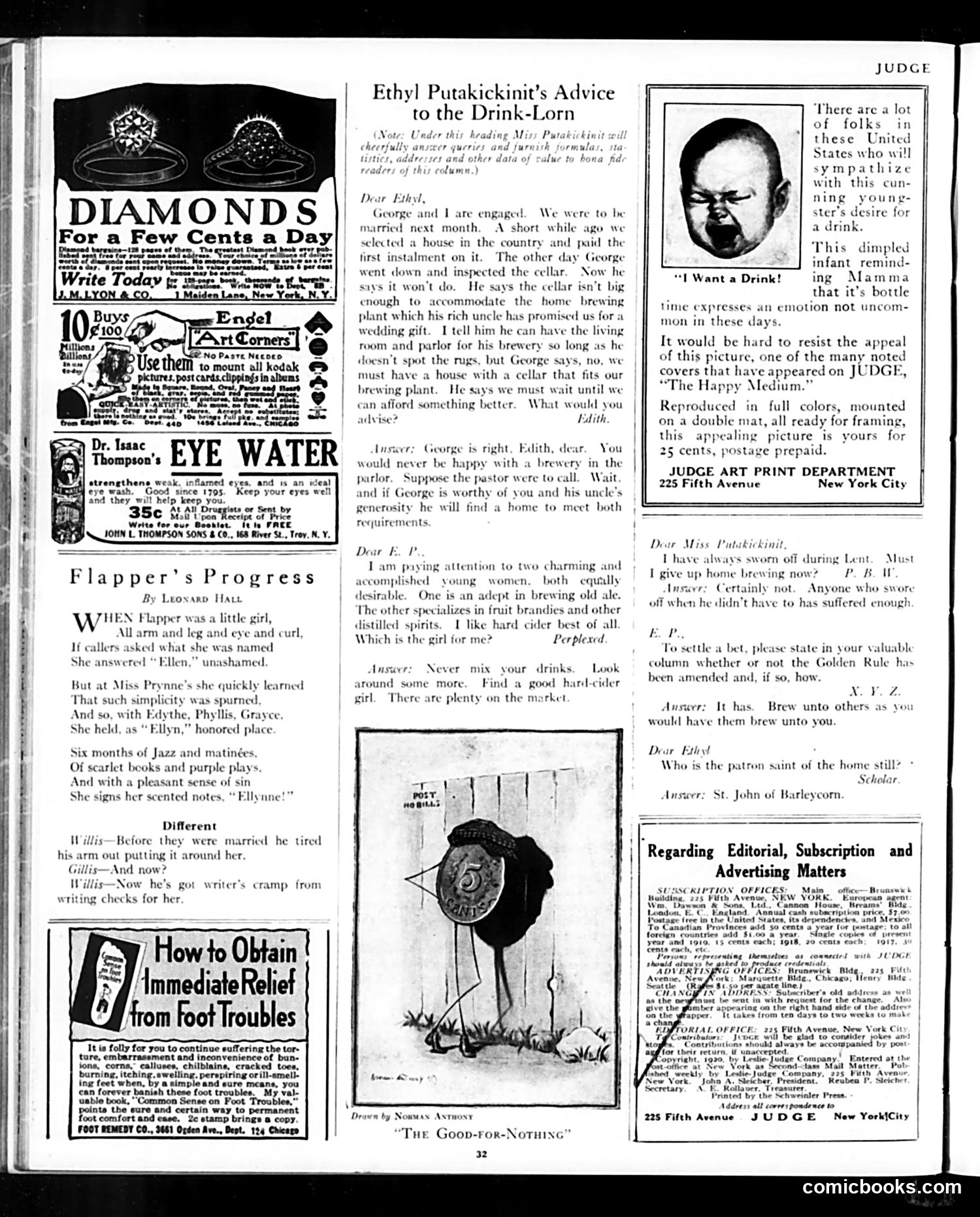
This page from the satirical magazine **Judge** primarily contains **advertisements and advice columns** rather than political cartoons. The main content is "Ethyl Putakickinit's Advice to the Drink-Lorn," a humorous advice column addressing Prohibition-era concerns. The column offers tongue-in-cheek guidance to readers anxious about home brewing during the alcohol ban. References to "brewery," "hard cider," and "brewing old ale" are clearly coded language addressing illegal alcohol production—a major source of public anxiety and black-market activity during Prohibition. The cartoon "The Good-for-Nothing" (by Norman Anthony) depicts a baby demanding a bottle, which the accompanying text notes resonates with readers' desires for alcohol during Prohibition. The "Flapper's Progress" poem satirizes 1920s youth culture, showing how a simple girl named Ellen adopts an affected persona as "Ellyn" upon entering fashionable society. The remaining content consists of vintage advertisements for diamonds, eye water, foot remedies, and Kodak accessories—typical period advertising with no satirical content.
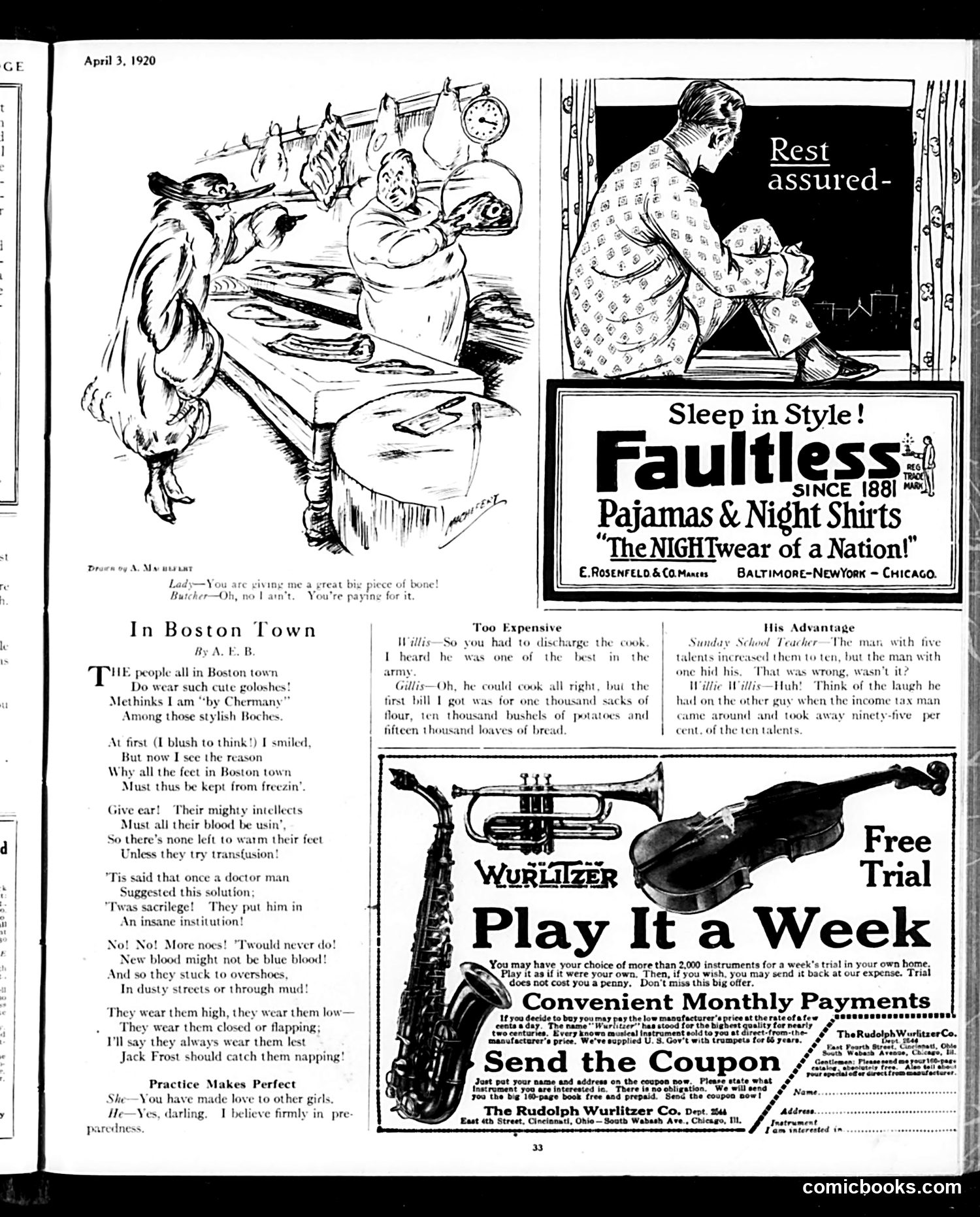
This page combines satirical poetry with period advertisements. ## "In Boston Town" Cartoon/Poem The cartoon depicts Bostonians wearing excessive galoshes (rubber overshoes). The satire mocks Boston's intellectual pretensions: the poem suggests these stylish people wear such heavy boots because their "mighty intellects" require so much blood that none remains to warm their feet. References to "Chermany" and "Boches" (German slurs from WWI) mock Boston society as Germanic or unpatriotic in their affectations. The poem includes absurdist jabs—a doctor's sensible suggestion of blood transfusion is rejected as threatening "blue blood" (aristocratic purity). The joke satirizes Boston's class consciousness and intellectual vanity during the post-WWI period. ## Supporting Content The page also includes brief humorous dialogues ("Too Expensive," "His Advantage," "Practice Makes Perfect") and period advertisements for Faultless pajamas and Wurlitzer musical instruments offering free trials.
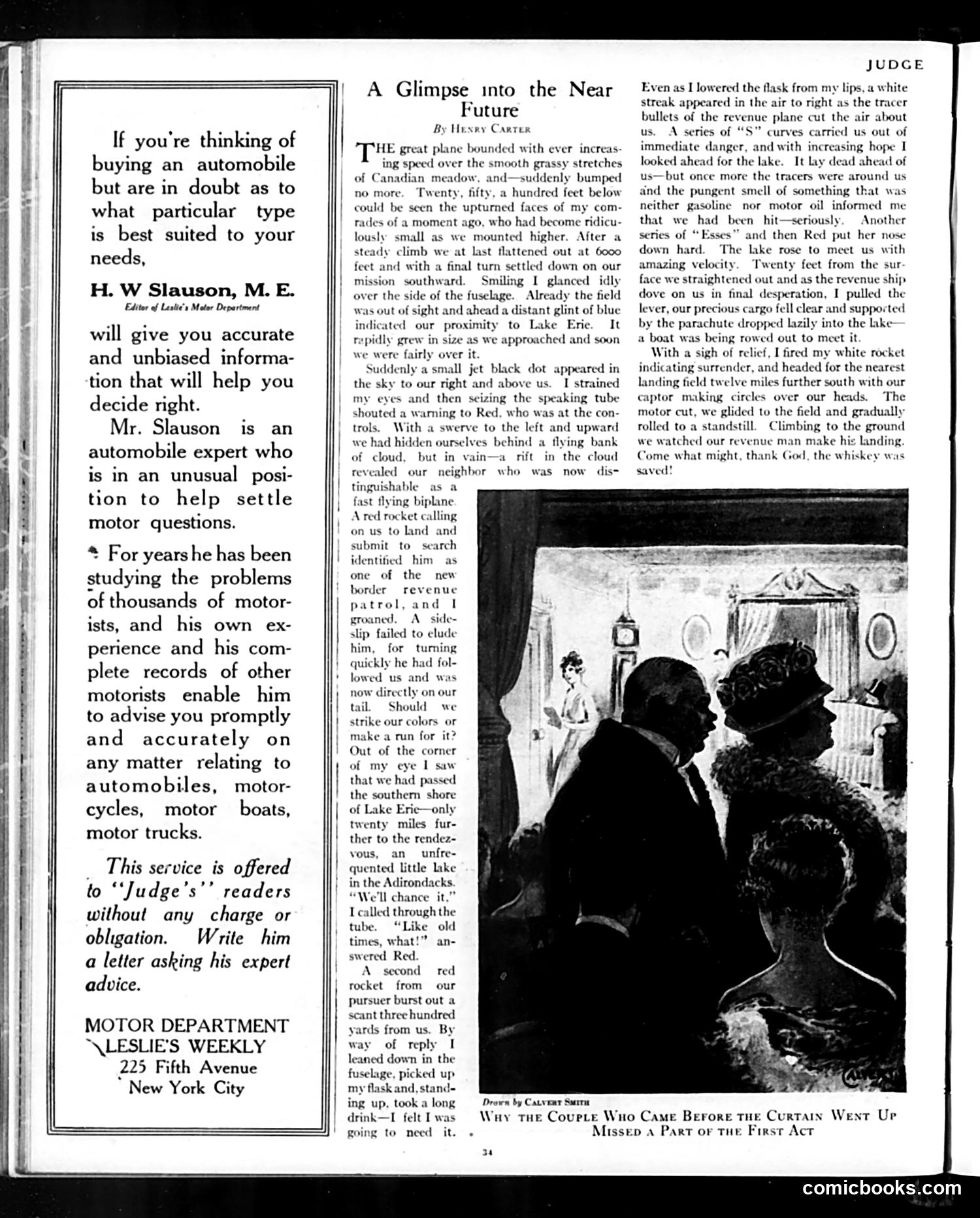
This page contains two separate pieces: **Left side:** An advertisement for Judge magazine's motor advice column, offering free automotive expertise from H.W. Slauson. **Right side:** A short story titled "A Glimpse into the Near Future" by Henry Canter, illustrated by Calvert Smith. The narrative depicts an airplane pilot smuggling contraband (implied to be alcohol, given the flask reference) across the U.S.-Canadian border while evading a "border revenue patrol" plane. The pilot successfully drops his cargo by parachute into a lake to avoid capture. **The satire:** This story satirizes **Prohibition-era smuggling**. Published when alcohol was illegal in the U.S. (1920-1933), the tale treats illegal liquor smuggling as an adventurous game—"like old times"—mocking both the smugglers' casual defiance and the government's enforcement efforts. The "near future" framing suggests the author viewed such aerial contraband runs as an inevitable development of aviation technology.
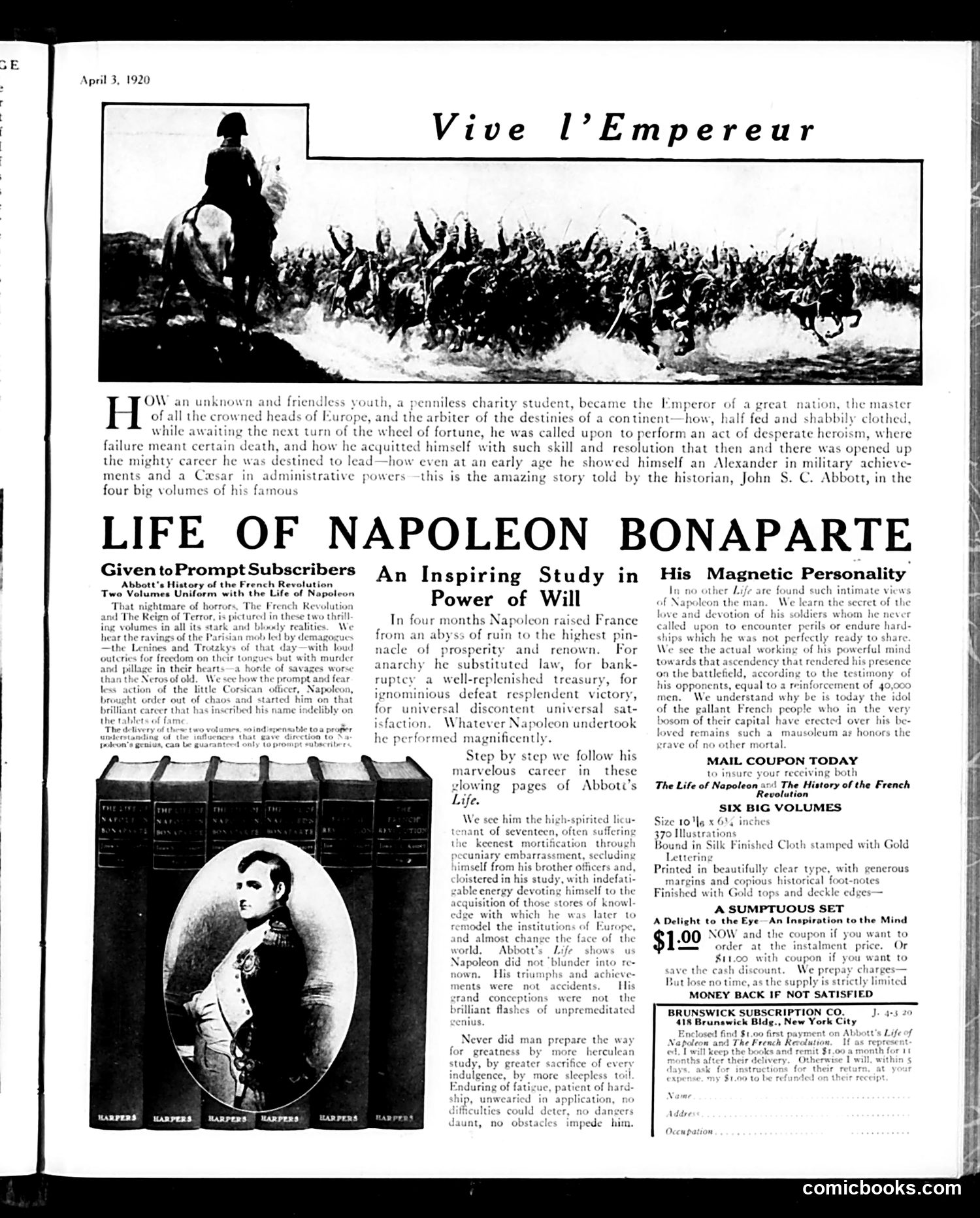
This is primarily **advertising content**, not satire. The page promotes a multi-volume biography of Napoleon Bonaparte by historian John S.C. Abbott, published by Brunswick Subscription Co. The single illustration shows Napoleon on horseback addressing troops, with the French motto "Vive l'Empereur" (Long Live the Emperor) — a straightforward heroic depiction, not mockery. The text presents Napoleon as an inspiring figure: a poor student who became a military and administrative genius through willpower, transforming France from chaos to prosperity. It emphasizes his magnetic personality and power of will. **Historical context:** Published April 1920, just after World War I ended, this reflects American admiration for Napoleon as a military strategist and strong leader. There is no apparent satire here—Judge magazine is simply running a book advertisement presenting Napoleon reverentially rather than critically. The "mail coupon" at bottom was standard for subscription-based book sales of this era.
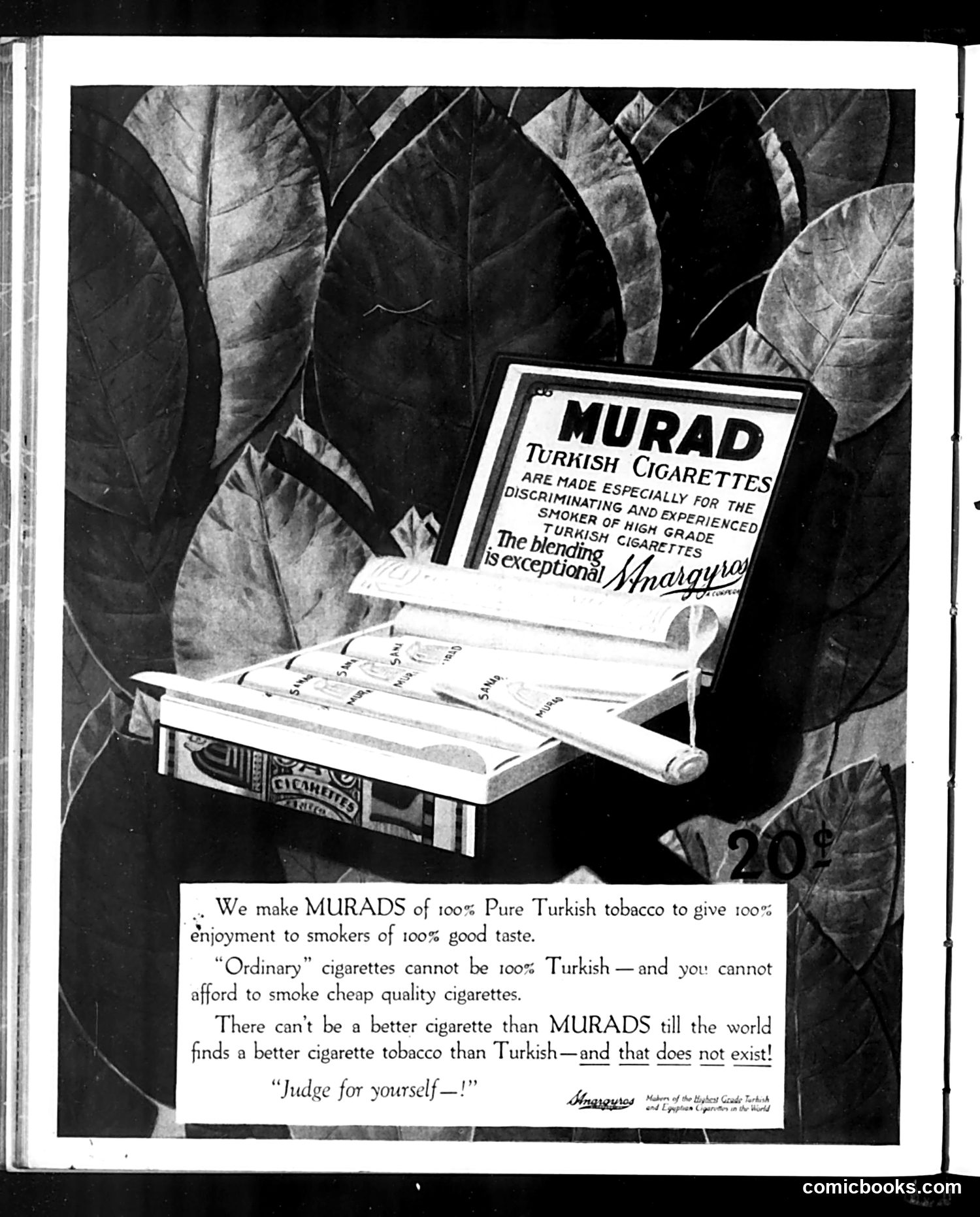
This is a **cigarette advertisement**, not satire or political commentary. It advertises Murad Turkish cigarettes, positioning them as premium products made from "100% Pure Turkish tobacco." The ad's rhetorical strategy—repeated use of "100%"—emphasizes purity and quality while implying that competitors cut corners. The copy directly challenges consumers to choose between affordable cheap cigarettes or quality Turkish tobacco, implying Murads occupy the superior position. The leaf backdrop and open cigarette package serve as visual product display. This represents typical early-20th-century tobacco advertising before health warnings, targeting "smokers of 100% good taste" as aspirational consumers.