
Judge, 1920-04-03 · page 6 of 36
Judge — April 3, 1920 — page 6: what you’re looking at
What you’re looking at
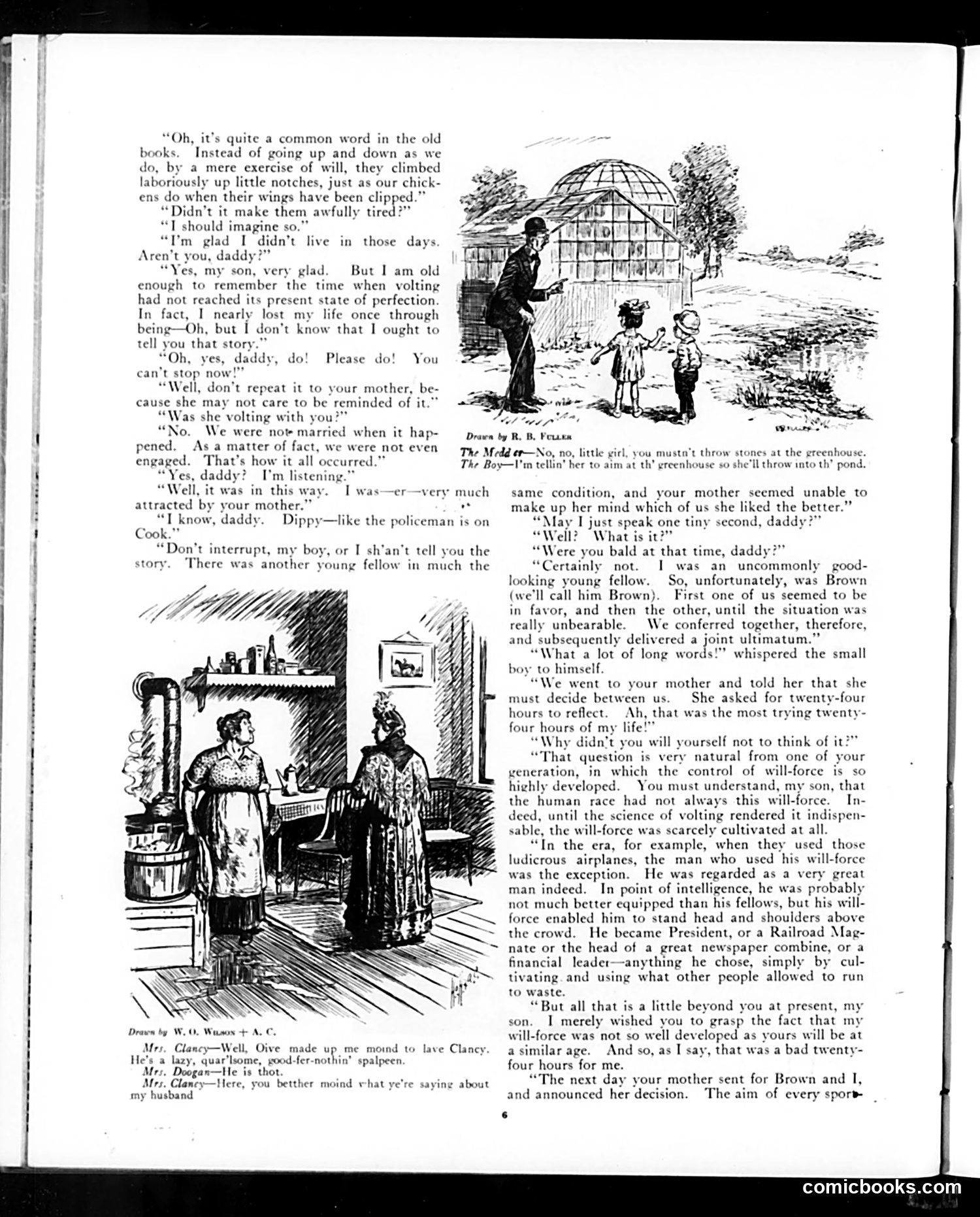
This page contains a domestic narrative rather than political satire. The story discusses "volting" (courtship/dating), with a father explaining to his son how men formerly competed for women's attention through displays of will-force and determination—using an airplane example where one man's superior will-power made him a leader (President, Railroad Magnate, or financial leader). The illustrated scenes show a Victorian-era domestic interior and a greenhouse encounter. The text suggests the father is advising his son that developing strong will-power young will serve him well in adulthood, using his own experience choosing between two suitors as an example. This appears to be social commentary on character-building and masculine self-discipline rather than political satire, typical of Judge's mixed content approach combining humor with moral instruction.
📄 Transcribed text from this page (OCR, searchable)
Machine-transcribed from the original scan — historical spelling and the odd misread are preserved.
OO a “Oh, it’s quite a common word in the old books. Instead of going up and down as we do, by a mere exercise of will, they climbed laboriously up little notches, just as our chick- ens do when their wings have been clipped.” “Didn't it make them awfully tired?” I should imagine so.” “I’m glad I didn’t live in those days Aren’t you, daddy?” “Yes, my son, very glad. But I am old enough to remember the time when volting had not reached its present state of perfection. In fact, I nearly lost my life once through being—Oh, but I don’t know that I ought to tell you that story.” “Oh, yes, daddy, do! Please do! You can’t stop now “Well, don’t repeat it to your mother, be- cause she may not care to be reminded of it.” “Was she volting with you? “No. We were not married when it hap- pened. As a matter of fact, we were not even engaged. That's how it all occurred.” “Yes, daddy? I'm listening.” “Well, it was in this way. I was—er—very much attracted by your mother.” " “IT know, daddy. Dippy—like the policeman is on Cook.” “Don’t interrupt, my boy, or I sh’an’t tell you the story. There was another young fellow in much the S SSSA (RS | GSS by W.O, Warsow + ALC, Mrs. Clancy—Well, Oive made up me moind to lave Clancy. He's a lazy, quar'lsome, good-fer-nothin’ spalpeen Mrs, Doogan—He is thot. Mrs. Clancy—Here, you betther moind what ye’! my husband e saying about 2 xen ths Sy erase Drawn by R. B. Foues The Medd erp—No, no, little girl, you mustn't throw stones at the greenhouse. The Boy—I'm tellin’ her to aim at th’ grcenhouse so she'll throw into th’ pond. same condition, and your mother seemed unable to make up her mind which of us she liked the better.” “May I just speak one tiny second, daddy?” “Well? What is it?” “Were you bald at that time, dadd} “Certainly not. I was an uncommonly good- looking young fellow. So, unfortunately, was Brown (we'll call him Brown). First one of us seemed to be in favor, and then the other, until the situation was really unbearable. We conferred together, therefore, and subsequently delivered a joint ultimatum.” “What a lot of long words!” whispered the small boy to himself. “We went to your mother and told her that she must decide between us. She asked for twenty-four hours to reflect. Ah, that was the most trying twenty- four hours of my life!” “Why didn’t you will yourself not to think of it “That question is very natural from one of your generation, in which the control of will-force is so highly developed. You must understand, my son, that the human race had not always this will-force. In- deed, until the science of volting rendered it indispen- sable, the will-force was scarcely cultivated at all. “In the era, for example, when they used those ludicrous airplanes, the man who used his will-force was the exception. He was regarded as a very great man indeed. In point of intelligence, he was probably not much better equipped than his fellows, but his wi force enabled him to stand head and shoulders above the crowd. He became President, or a Railroad Mag- nate or the head of a great newspaper combine, or a financial leader—anything he chose, simply by cul- tivating. and using what other people allowed to run to waste. “But all that is a little beyond you at present, my son. I merely wished you to grasp the fact that my will-force was not so well developed as yours will be at a similar age. And so, as I say, that was a bad twenty- four hours for me. “The next day your mother sent for Brown and I, and announced her decision. The aim of every spor 6 comicbooks.com