
Judge, 1920-04-03 · page 8 of 36
Judge — April 3, 1920 — page 8: what you’re looking at
What you’re looking at
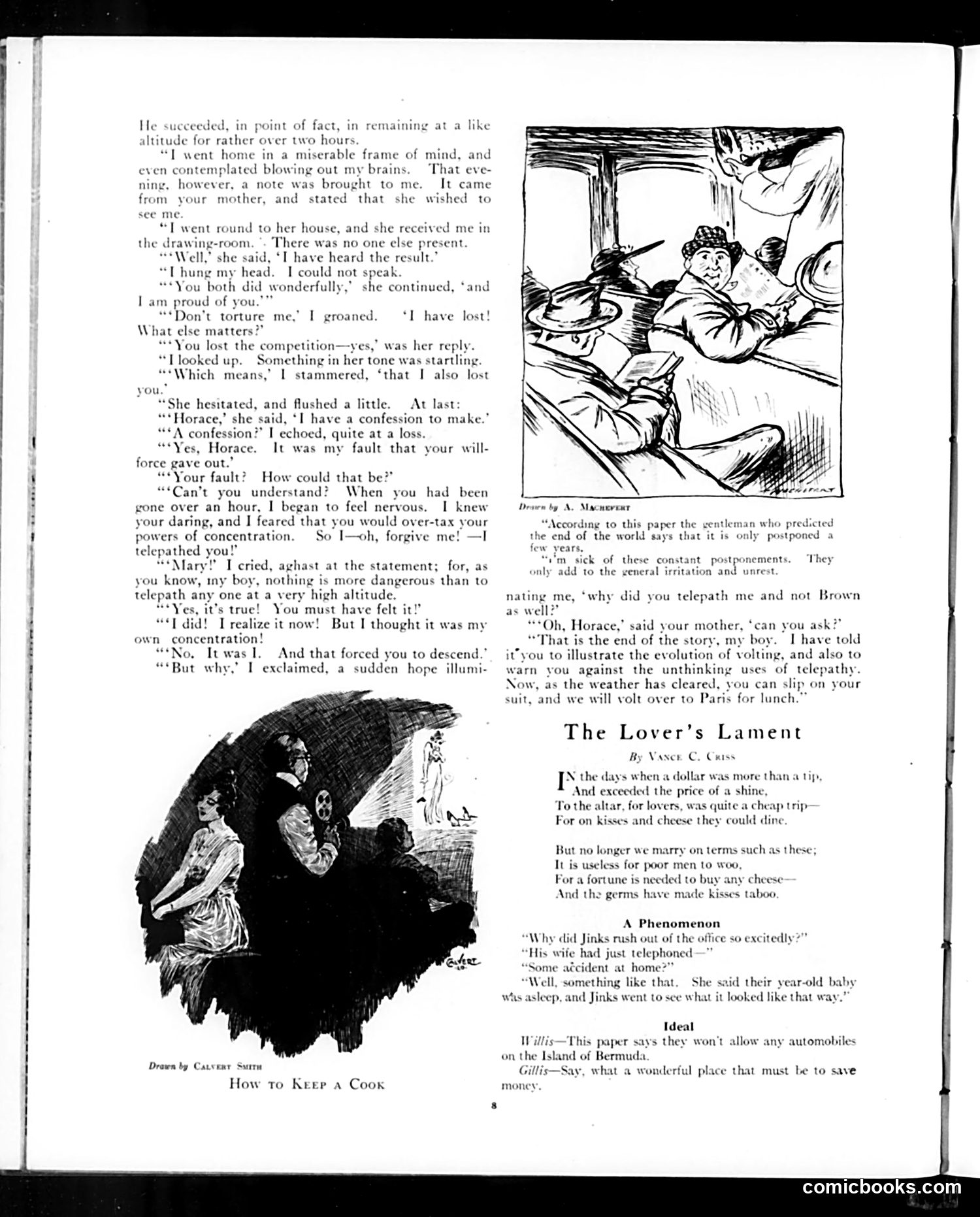
This page contains multiple satirical pieces reflecting early 20th-century concerns: **Main Narrative (top):** A romantic story about a man who fails an endurance competition at high altitude. The twist—his beloved mother's telepathic interference caused his failure—satirizes the era's fascination with psychic powers as a pseudo-scientific explanation. The casual mention of "volting over to Paris for lunch" mocks the period's breathless anticipation of miraculous future technologies. **"The Lover's Lament":** A poem lamenting economic hardship and modern anxieties. It contrasts past affordability of courtship with present poverty, while referencing contemporary hygiene concerns ("germs have made kisses taboo")—likely alluding to public health campaigns of the era. **"A Phenomenon":** A brief joke about a man rushing home because his wife telephoned about their sleeping baby—mocking new communication technology's disruption of workplace normalcy. **"Ideal":** A humorous note praising Bermuda's automobile ban as money-saving—satirizing automobile culture's expense and prevalence.
📄 Transcribed text from this page (OCR, searchable)
Machine-transcribed from the original scan — historical spelling and the odd misread are preserved.
—, I ee tt rn ne vie tee a like He succeeded, in point of fact, in altitude for rather over two hours “T went home in a miserable frame of mind, and even contemplated blowing out my brains. That eve- however, a note was brought to me. It came m your mother, and stated that she wished to nin see me. “T went round to her house, and she received me in the drawing-room. °- There was no one ¢ yresent. “*Well,’ she said, ‘IT have heard the result.’ “T hung my head. I could not speak “*You both did wonderfully,’ she continued m proud of you.’ “*Don't torture me,” I groaned. ‘I have lost! What else matters?’ You lost the competition—yes,’ was her reply. “Tlooked up. Something in her tone was startling. “*Which means,’ | stammered, ‘that I also lost you.” “She hesitated, and flushed a little. At last: Horace,’ she said, ‘I have a confession to make.” “*A confession?’ I echoed, quite at a loss. “*Yes, Horace. It was my fault that your will- force gave out.’ “*Your fault?) How could that be?’ “*Can’t you understand? When you had been gone over an hour, I began to feel nervous. I knew Deven by S. Macnerear your daring, and I feared that you would over-tax your According to this paper the gentle powers of concentration. » I—oh, forgive me! —I the end of the world says that it is w years. ‘and n who predicted ly postponed a telepathed you!” ; you know, my boy, nothing is more dangerous than to z= ii ee telepath any one at a very high altitude. nating me, ‘why did you telepath me and not Brown You must have felt it! as well? “*T did! [realize it now! But I thought it was my “*Oh, Horace,’ said your mother, * } own concentration! hat is the end of the story, my boy. I have told o. Itwas]. And that forced you to descend.’ it”you to illustrate the evolution of volting, and also to “*But why,’ [ exclaimed, a sudden hope illumi- warn you against the unthinking uses of telepathy. Now, as the weather has cleared, you can slip on your suit, and we will volt over to Paris for lunch.” The Lover’s Lament By Vascr C. Criss “*Yes, it’s true n you ask?” N the days when a dollar was more than a tip, And exceeded the price of a shine, To the altar, for lovers, was quite a cheap trip For on kisses and cheese they could dine But no longer we marry on terms such as the It is useless for poor men to woo. For a fortune is needed to buy any cheese And the germs have mad kisses taboo. A Phenomenon “Why did Jinks rush out of the office so excitedly?” “His wife had just telephoned “Some aécident at home?” “Well, something like that, She said their year-old baby was asleep, and Jinks went to sce what it looked like that way,” Ideal Willis—This paper says they won't allow any automobiles on the Island of Bermuda Gillis—Say, what a wonderful place that must be to save How to Keer a Coox money Drawn by Cauvent Surman comicbooks.com