
Judge, 1920-04-03 · page 24 of 36
Judge — April 3, 1920 — page 24: what you’re looking at
What you’re looking at
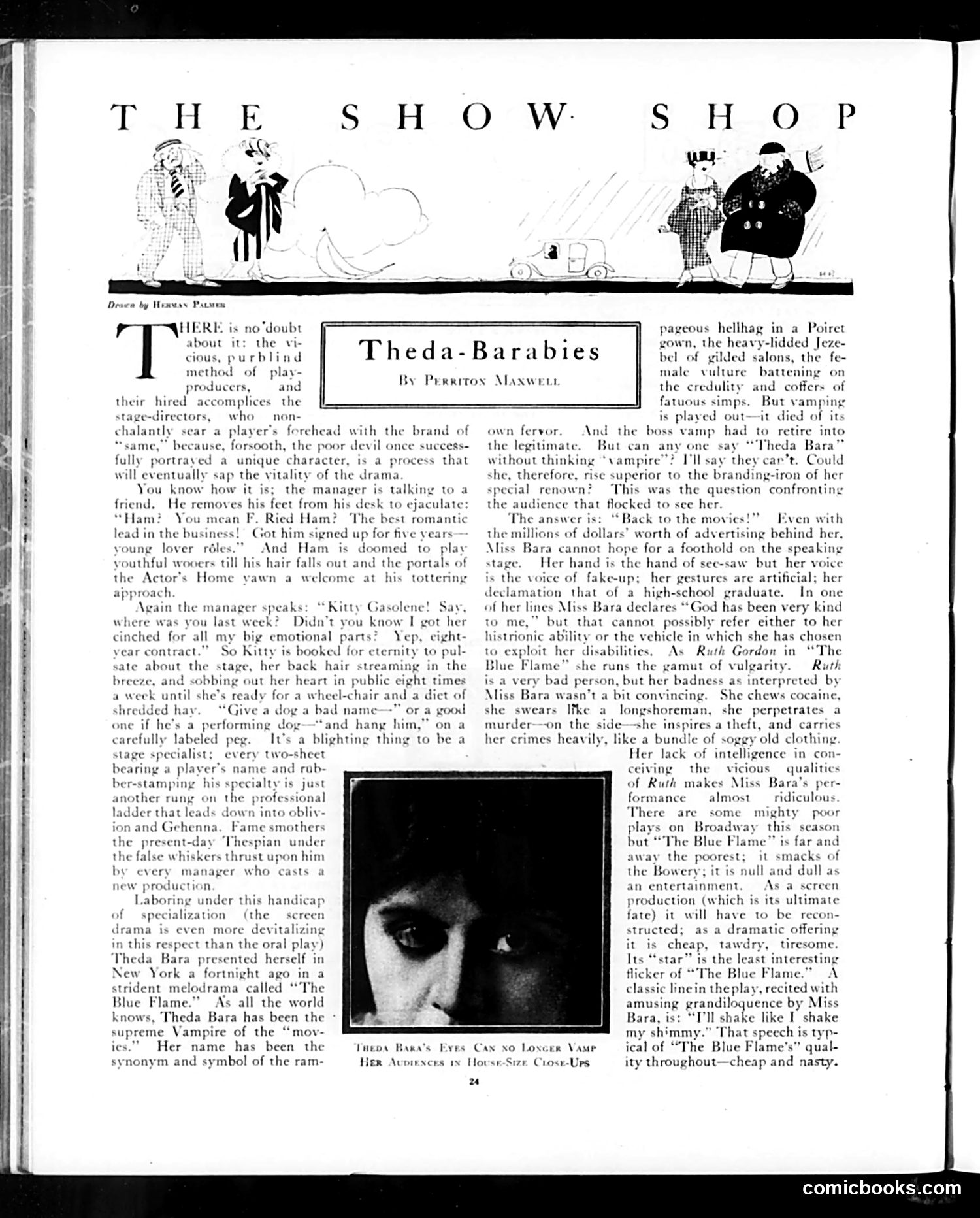
The header cartoon satirizes theatrical casting practices, showing managers and producers as comedic figures alongside stylishly dressed actors and actresses. The article "Theda-Barabies" by Perriton Maxwell critiques how film stars struggle when transitioning to live theater. Theda Bara, famous as a "vampire" character in silent movies, attempted to perform in a Broadway melodrama called "The Blue Flame." Maxwell's satire argues that Bara's success was entirely dependent on the film medium and her established screen persona. On stage, she fails—her voice is artificial, gestures unconvincing, and her acting ability (or lack thereof) becomes obvious without cinematic enhancement. The critic claims her performance as the morally corrupt character Ruth is "almost ridiculous," lacking genuine understanding of the vicious qualities required. The piece mocks how producers typecast actors into repetitive roles until their careers become stale, trapping them in single identities. Bara's attempt to transcend her "vampire" branding demonstrates that some performers cannot adapt beyond their manufactured screen image.
📄 Transcribed text from this page (OCR, searchable)
Machine-transcribed from the original scan — historical spelling and the odd misread are preserved.
MAS Patan HERE is no‘doubt about it: the vi- cious, purblind method of play- producers, and accomplices the Deven by W By their hirec Theda-Barabies Perriton Maxwets pageous hellhag in a Poiret gown, the heavy-lidded Jeze- bel of gilded salons, the fe- male vulture battening on the credulity and coffers of fatuous simps. But vamping stage-directors, who non- chalantly sear a player's ferehe “same,” because, forsooth, the poor devil once success- fully portrayed a unique character, is a process that will eventually sap the vitality of the drama You know how it is; the manager is talking to a friend. He removes his feet from his desk to ejaculate: “Ham? Ried Ham? The t romantic lead in the business! Got him signed up for five years young lover And Ham doomed to play youthful wooers till his hair falls out and the portals of the Actor’s Home yawn a his tottering approach Again the nage was you last week? d with the brand ¢ : mean rest roles.” is welcome a speaks: “Kitty Gasolene! Say, where Didn't you know I got her cinched for all my big emotional parts? Yep, cight- year contract.” So Kitty is booked for eternity to pul- sate about the stage, her back hair streaming in the breeze, and sobbing out her heart in public eight times a week until she’s ready for a wheel-chair and a diet of Jed hay. Give a dog a bad name—” or a good one if he’s a performing dog—‘and hang him,” on a carefully labeled peg. It’s a blighting thing to be a every sta two-sheet bearing a player's name and rab- ber-stampit is just another rung on the professional ladder that leads down into obliv- ion and Gehenna. Fame smothers the present-day ‘Thespian under the false whiskers thrust upon him b who ve specialist; his specialty i every manager casts a ion Laboring under this } the ma i more devitalizi this respect than the oral play) Theda Bara presented herself in New York a fortnight ago in a strident melodra called “The Blue Flame.” As all the world knows, Theda Bara has been the supreme Vampire of the “mov- ies.” Her name has been the synonym and symbol of the ram- produc dicap screen specialization even Tuepa Bara’s Eves C fier Aupiexces is House-Sive czy is played out—it died of its And the boss vamp had to retire into But can any one say “Theda Ba vampire’? I'll say they can’t. Could own fervor. the legitimate without thinking she, therefore, rise superior to the branding-iron of her special renown? ‘This was the question confronting the audience that flocked to sce her ‘The answer is: “Back to the movies! Even with the millions of dollars’ worth of advertising behind her, Miss Bara cannot hope for a foothold on the speaking sta Her hand is the hand of see-saw but her voice is the voice of fake-up: her gestures are artificial; her declamation that high-school graduate. In one of her lines Miss Bara declares “God has been very kind to me,” but that cannot possibly refer either to her histrionic ability or the vehicle in which she has chosen » exploit her disabilities. As Ruth Gordon in “The Blue Flame” she runs the gamut of vulgarity. Ruth is a very bad person, but her badness as interpreted by Miss Bara wasn’t a bit convincing. She chews cocaine, she swears Ifke longshoreman, she perpetrates murder—on the side—she inspires a theft, and carries her crimes heavily, like a bundle of soggy old clothir Her lack of intelligence in con- ceiving the vicious qualities of Ruth makes Miss Bara’s p formance — almost ridiculous There are mighty plays on Broadway this season but “The Blue Flame” is far and away the poorest; it smacks of the Bowery; it is null and dull as an entertainment As a sereen production (which is its ultimate fate) it will have to be structed; as a dramatic offering it is cheap, tawdry, tiresome. Its “star” ts the least interesting flicker of “The Blue Flame.” A classic linein the play, recited with amusing grandiloquence by Miss Bara, i I'll shake like I shake my shimmy.” That speech is typ- ical of “The Blue Flame’s” qual- ity throughout—cheap and nasty. of a some poor recon- AN No Love Cros comicbooks.com