
Judge, 1920-04-03 · page 7 of 36
Judge — April 3, 1920 — page 7: what you’re looking at
What you’re looking at
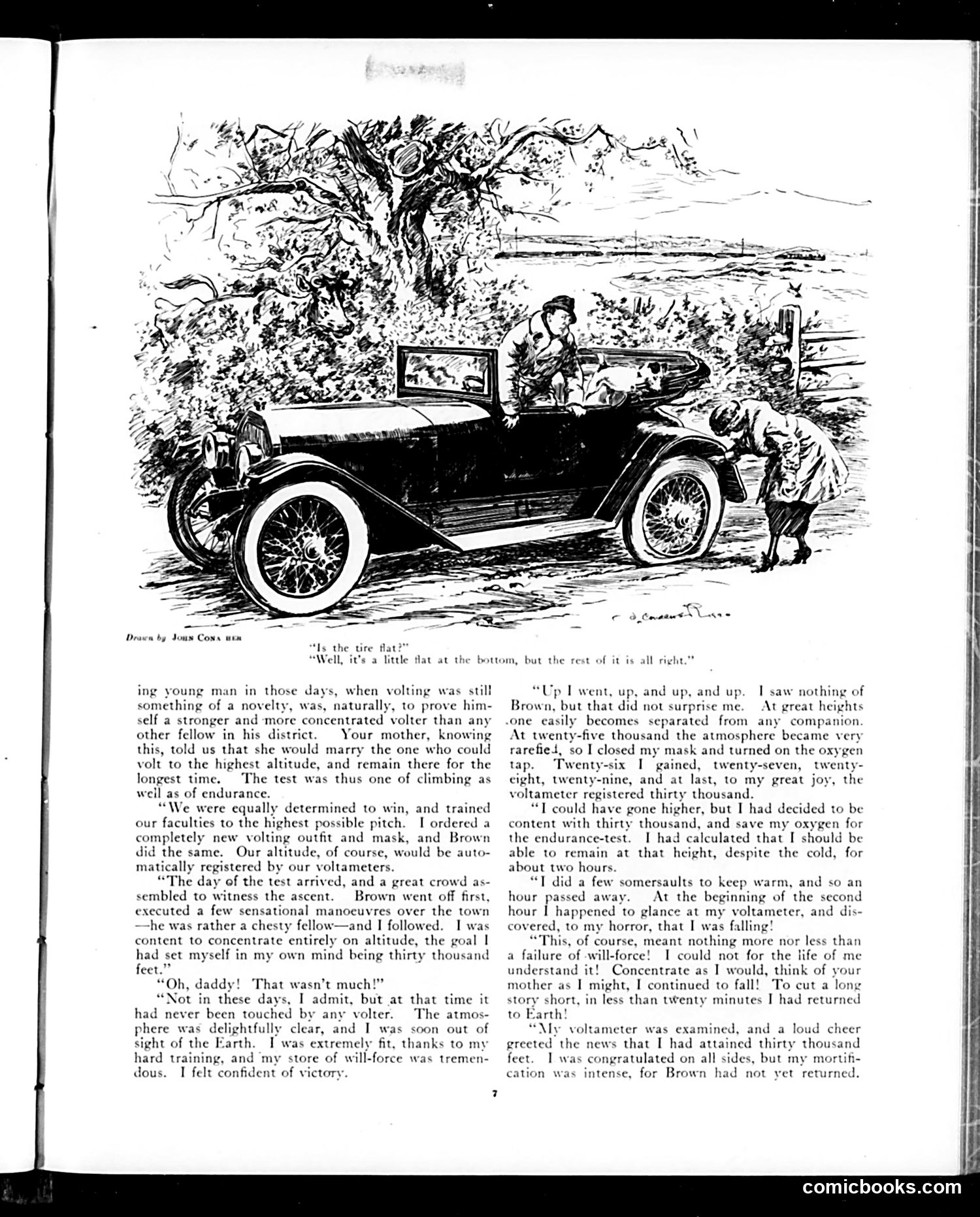
This appears to be a science-fiction story (not political satire) from *Judge* magazine, illustrated with a vintage automobile scene. The narrative describes competitive "volting"—apparently a fictional early-20th-century sport involving altitude achievement through mental willpower, measured by "voltameters." The humor derives from treating this invented activity as legitimate competitive sport, complete with training regimens, equipment, and spectators. The narrator achieves his goal of 30,000 feet but mysteriously loses altitude despite concentrated effort—a failure of "will-force." The opening illustration shows a period automobile (unrelated to the text), likely from an advertisement or separate article. The satire targets the era's enthusiasm for novel technologies and competitions while humorously exploring themes of competitive masculinity and the limits of human endurance through pseudo-scientific means.
📄 Transcribed text from this page (OCR, searchable)
Machine-transcribed from the original scan — historical spelling and the odd misread are preserved.
Deven by Jous Cons wen “Well, it's a little tat at the ing young man in those days, when volting was still something of a novelty, was, naturally, to prove him- self a stronger and more concentrated volter than any other fellow in his district. |Your mother, knowing this, told us that she would marry the one who could volt to the highest altitude, and remain there for the longest time, The test was thus one of climbing as | as of endurance. “We were equally determined to win, and trained our faculties to the highest possible pitch. I ordered a completely new volting outfit and mask, and Brown did the same. Our altitude, of course, would be auto- matically registered by our voltameter: “The day of the test arrived, and a great crowd as- sembled to witness the ascent. Brown went off first, executed a few sensational manocuvres over the town —he was rather a chesty fellow—and I followed. I was content to concentrate entirely on altitude, the goal | had set myself in my own mind being thirty thousand feet.” “Oh, daddy! That wasn’t much! “Not in these days, I admit, but at that time it had never been touched by any volter. The atmos- phere was delightfully clear, and I was soon out of sight of the Earth. I was extremely fit, thanks to my hard training, and my store of will-force was tremen- dous. I felt confident of victory. bottom, but the rest of it is all right.” “Up TL went, up, and up, and up. 1 saw nothing of Brown, but that did not surprise me. At great heights one easily becomes separated from any companion. At twenty-five thousand the atmosphere became very rarefiet, so I closed my mask and turned on the oxygen tap. Twenty-six I gained, twenty-seven, twenty- eight, twenty-nine, and at last, to my great joy, the voltameter registered thirty thousand. “T could have gone higher, but I had decided to be content with thirty thousand, and save my oxygen for the endurance-test. I had calculated that I should be able to remain at that height, despite the cold, for about two hours. “T did a few somersaults to keep warm, and so an hour passed away. At the beginning of the second hour | happened to glance at my voltameter, and dis- covered, to my horror, that I was falling! his, of course, meant nothing more nor less than a failure of -will-fore I could not for the life of me understand it! Concentrate as I would, think of your mother as I might, I continued to fall! To cut a long story short, in less than twenty minutes I had returned to Earth! My voltameter was examined, and a loud cheer greeted the news that [ had attained thirty thousand feet. 1 was congratulated on all sides, but my mortifi- cation was intense, for Brown had not yet returned. comicbooks.com