
A complete issue · 32 pages · 1918
Judge — September 14, 1918
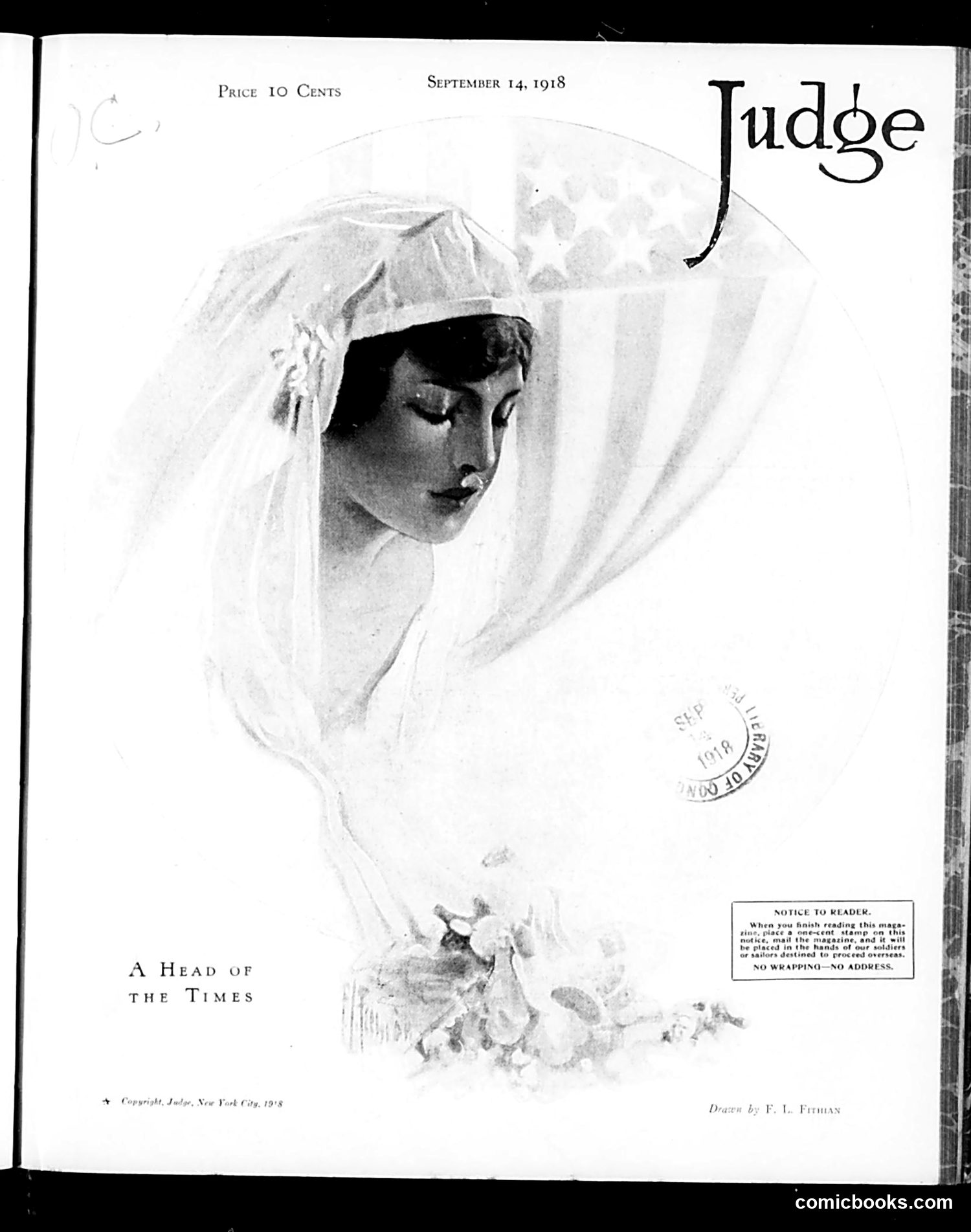
This is the cover of *Judge* magazine from September 14, 1918, featuring an illustration titled "A Head of the Times" drawn by F.L. Fidman. The image shows a woman's face in profile, draped in flowing white fabric that resembles both a veil and what appears to be bandaging or medical wrapping. Given the 1918 date—near the end of World War I and during the Spanish Flu pandemic—"Head of the Times" likely references either wartime sacrifice (nurses, bereaved families) or the flu crisis affecting the nation. The ethereal, somewhat melancholic quality suggests loss or hardship. The specific identity of the woman depicted is unclear from the image alone, though she may represent an allegorical figure of contemporary American experience rather than a specific individual.
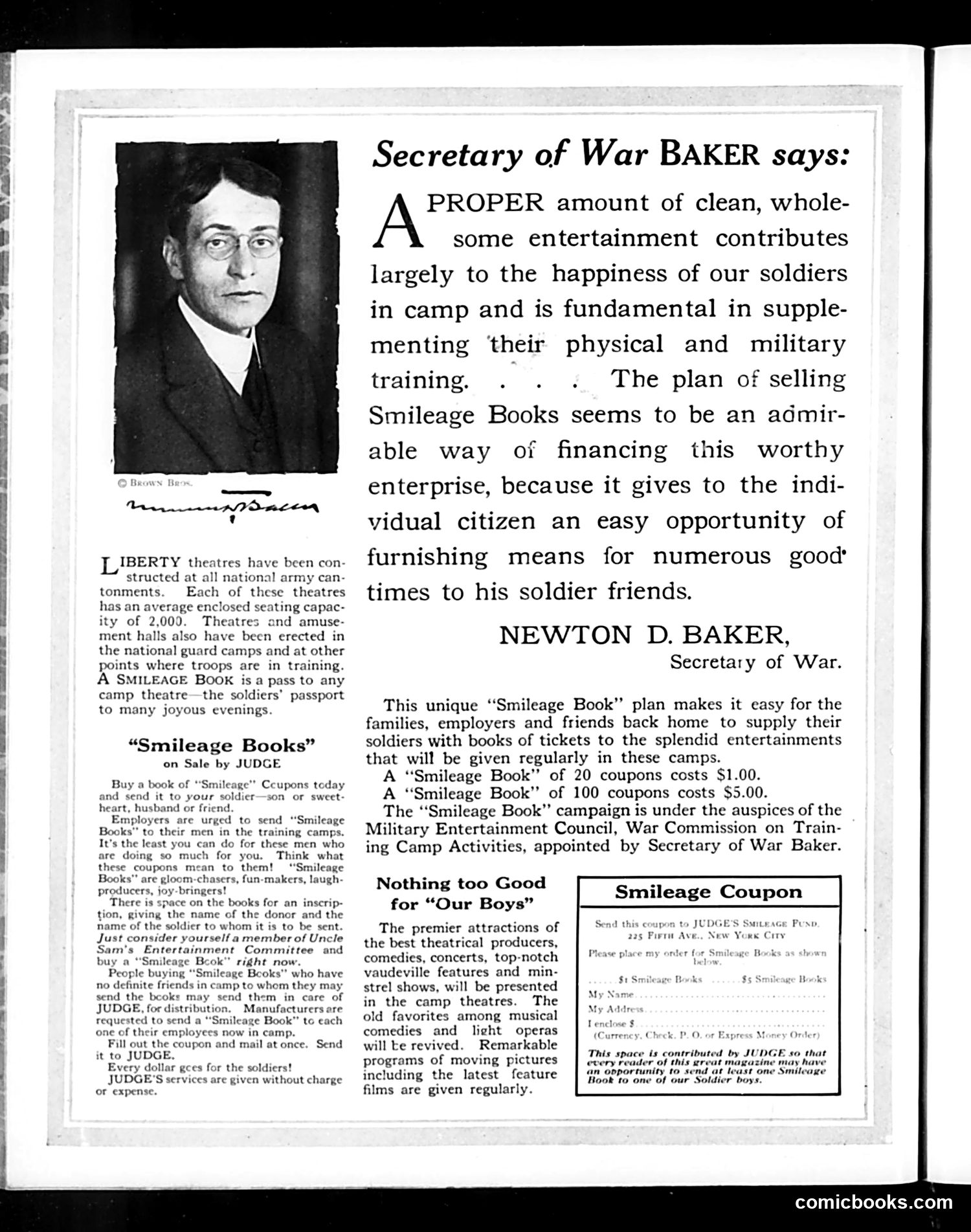
This page is primarily **advocacy advertising**, not satire. It features Secretary of War Newton D. Baker endorsing "Smileage Books"—coupon booklets (20 coupons for $1.00, 100 for $5.00) that citizens could purchase and send to soldiers in training camps for theatre entertainment. Baker's quoted statement frames entertainment as essential to soldier morale and military readiness. The "Smileage Book" scheme positioned civilian participation as patriotic support for troops. The left sidebar announces Liberty theatres nationwide have been equipped with 2,000-seat capacities and now accept Smileage coupons as admission passes. **This is wartime propaganda/fundraising**, not political satire—encouraging Americans to monetarily support soldier entertainment through Judge's distribution network, presented with official government endorsement.
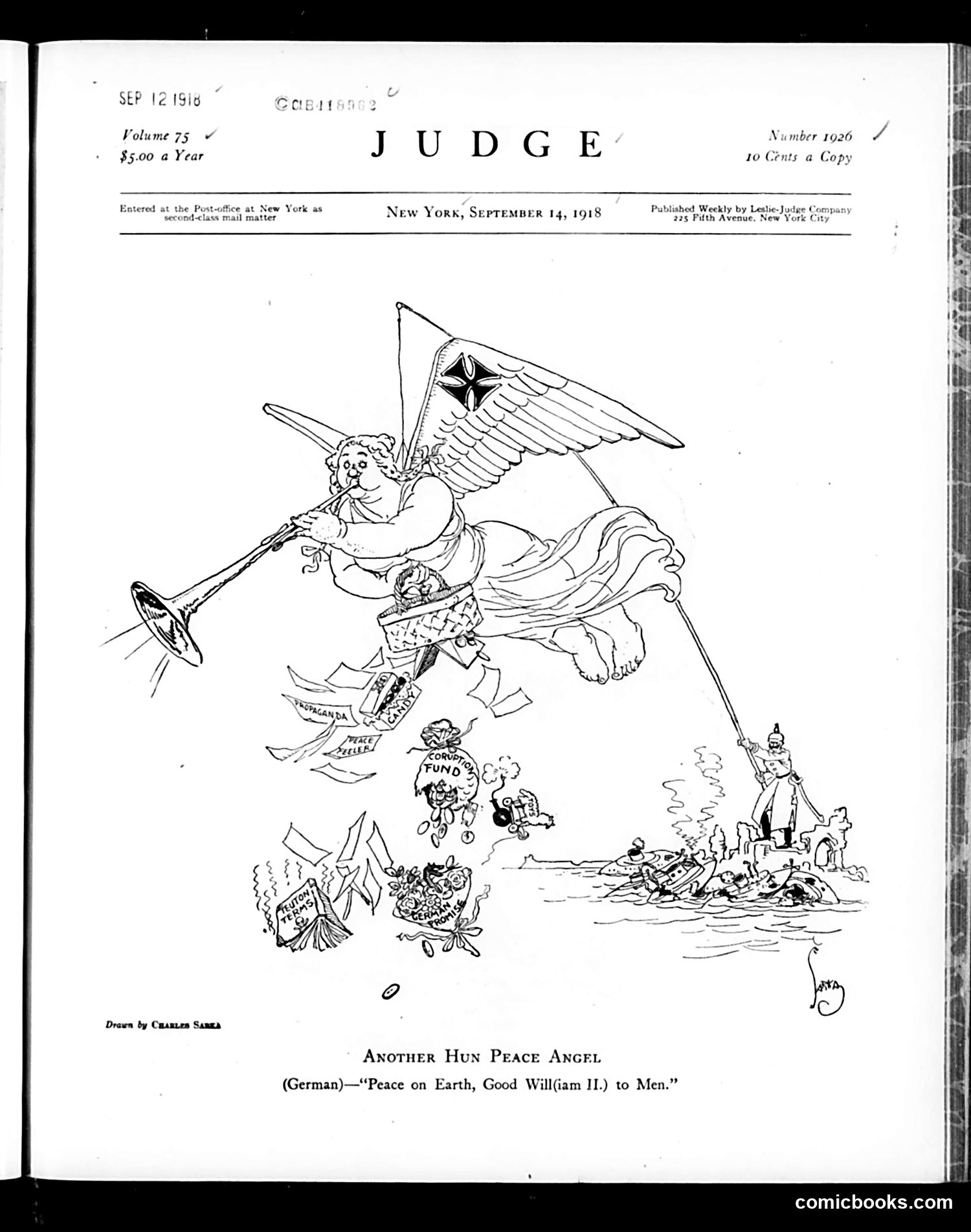
This September 1918 cartoon satirizes Germany's insincere peace overtures near World War I's end. An angel figure (representing Germany's "peace" proposal) descends with a trumpet, but the imagery reveals the deception: scattered below are instruments of war—weapons, destruction, and suffering labeled with references to German aggression (terms like "Lusitania" appear, likely referencing the 1915 sinking). On the right, an Allied soldier or leader stands amid devastation, seemingly skeptical of this "peace" offer. The cartoon's title mocks the German propaganda of offering peace while their actions contradicted it. "Hun" was dehumanizing wartime slang for Germans. The angel's false benevolence masks continued militarism—the core satirical point being that Germany's peace proposals were propaganda, not genuine.
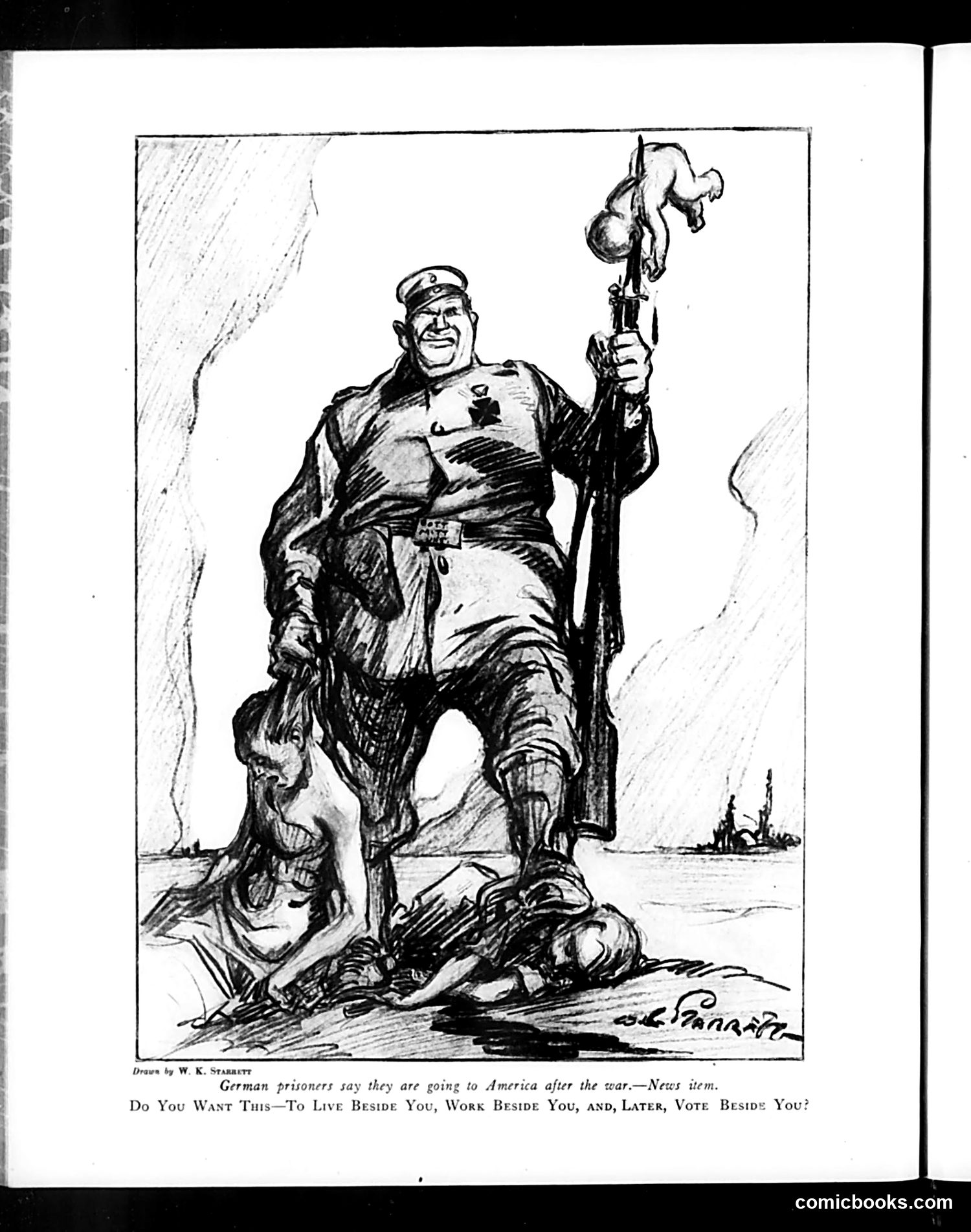
This post-World War I cartoon by W.K. Starrett depicts an American soldier standing triumphantly over defeated German prisoners. The caption reports that German POWs claim they'll emigrate to America after the war, then poses a provocative question: "Do You Want THIS—To Live Beside You, Work Beside You, and, Later, Vote Beside You?" The satire targets anti-immigrant and anti-German sentiment of the immediate postwar period. It appeals to American anxieties about German immigration and assimilation, suggesting that welcoming German immigrants poses a social and political threat. The image weaponizes the war's outcome to argue against German immigration—a significant policy debate in 1920s America as immigration restrictions were being debated in Congress.
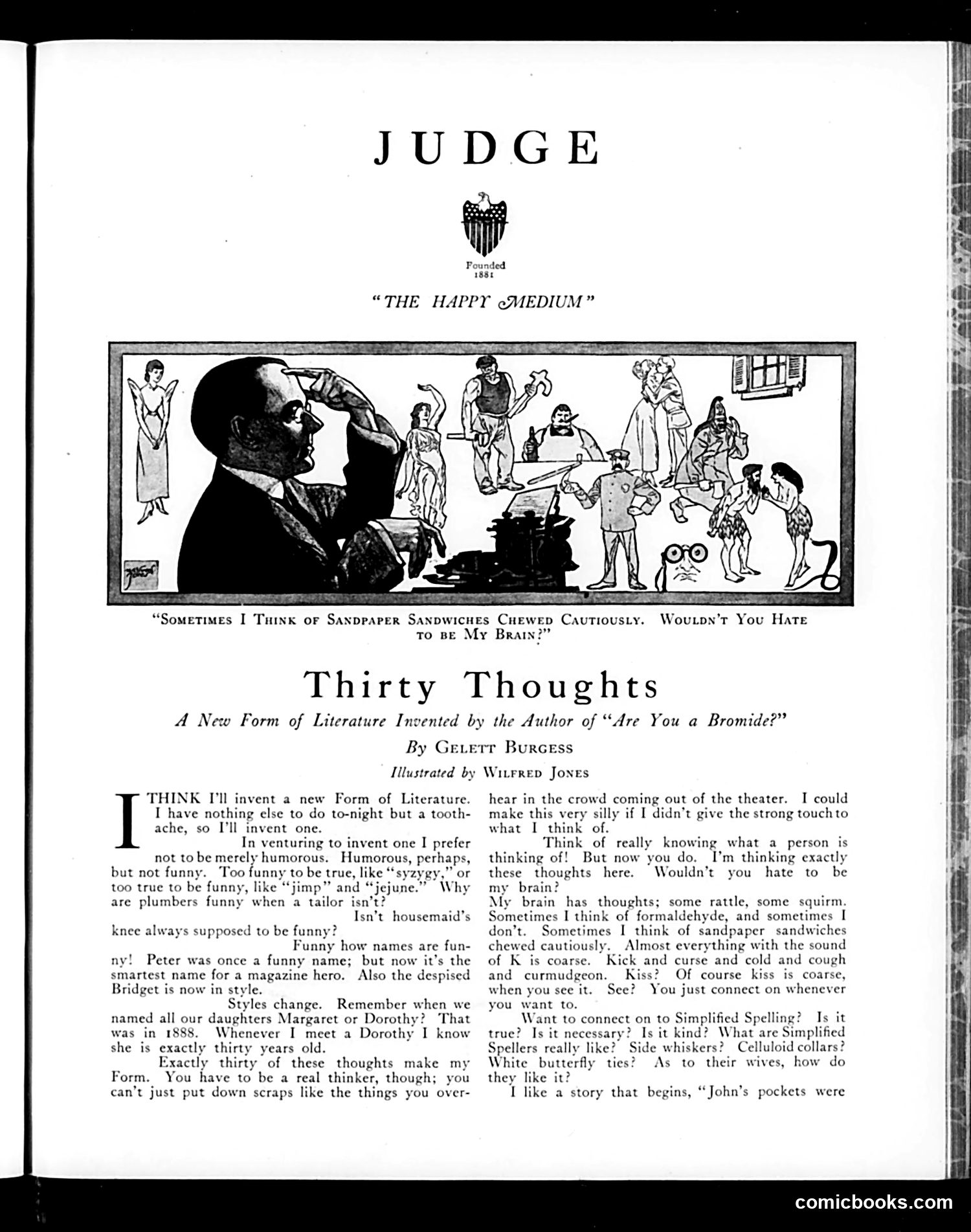
This page from Judge magazine features "Thirty Thoughts," a literary column by Gelett Burgess (author of "Are You a Bromide?"), illustrated by Wilfred Jones. The cartoon at top shows a silhouetted man in profile observing various people and activities—apparently representing the author observing human behavior to mine for his observations. The caption quotes him reflecting on trivial thoughts: "Sometimes I think of sandpaper sandwiches chewed cautiously. Wouldn't you hate to be my brain?" The accompanying essay explains Burgess's literary innovation: brief, disconnected observations about everyday absurdities (funny names, tailors, daughters named Dorothy, simplified spelling debates, fashion details). Rather than conventional narrative, these "thirty thoughts" capture the scattered, associative nature of actual human thinking—a proto-modernist technique treating mundane mental wandering as legitimate literary subject matter.
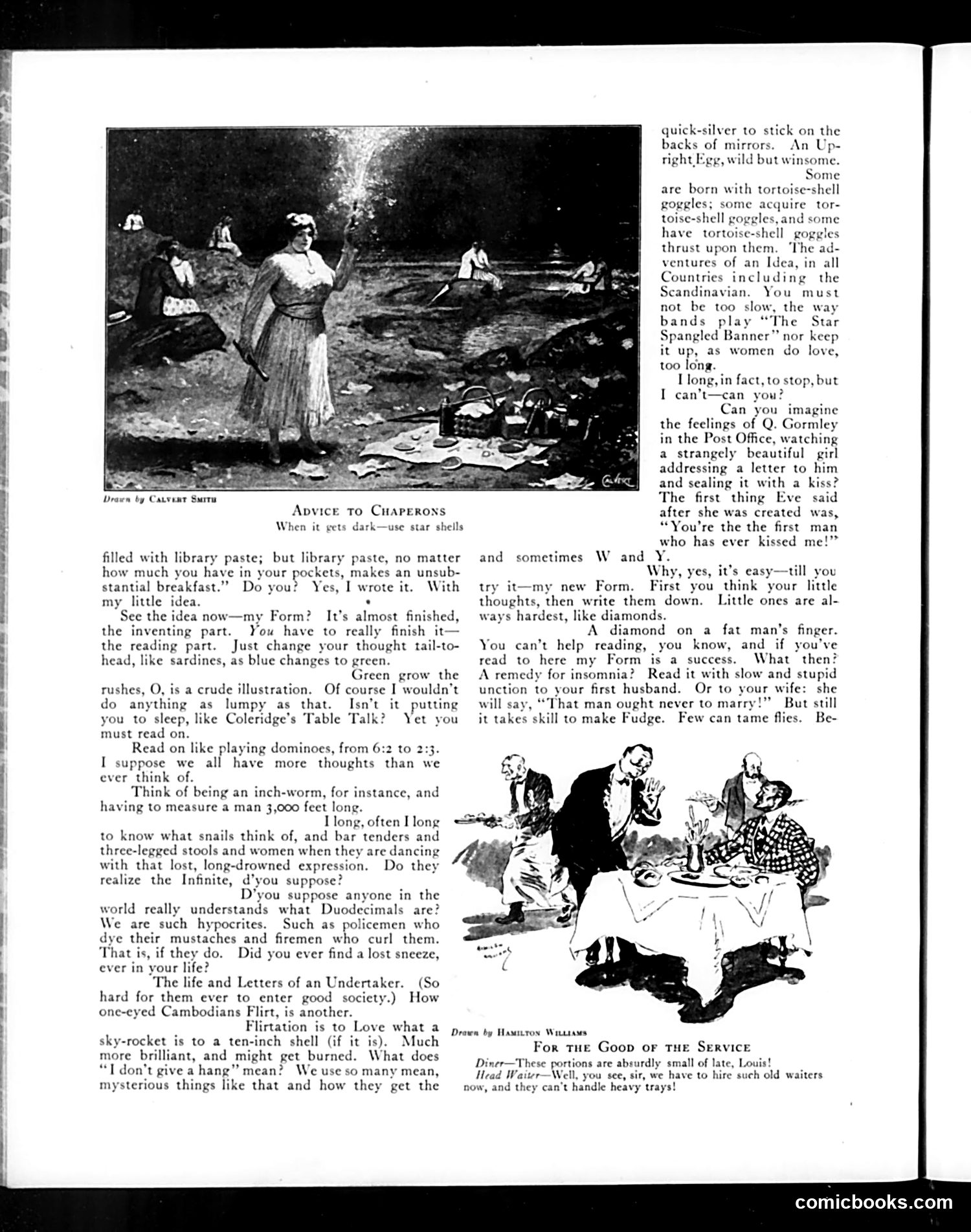
**Top Image: "Advice to Chaperons"** This depicts a chaperoned outdoor social gathering, likely referencing early 20th-century courtship customs. The satire criticizes chaperones' ineffectiveness at preventing romantic interaction—the caption notes chaperones arrive "when it gets dark—one star shells / filled with library paste." The joke suggests chaperones are incompetent obstacles to young romance, appearing only after meaningful moments have already occurred. **Bottom Image: "For the Good of the Service"** This cartoon shows what appears to be hotel staff or waiters at a dining table. The caption mentions "Head Waiter" complaining about hiring elderly workers who "can't handle heavy trays," suggesting commentary on workplace efficiency and age discrimination in service industries during this era. Both pieces employ gentle social satire typical of Judge's era.
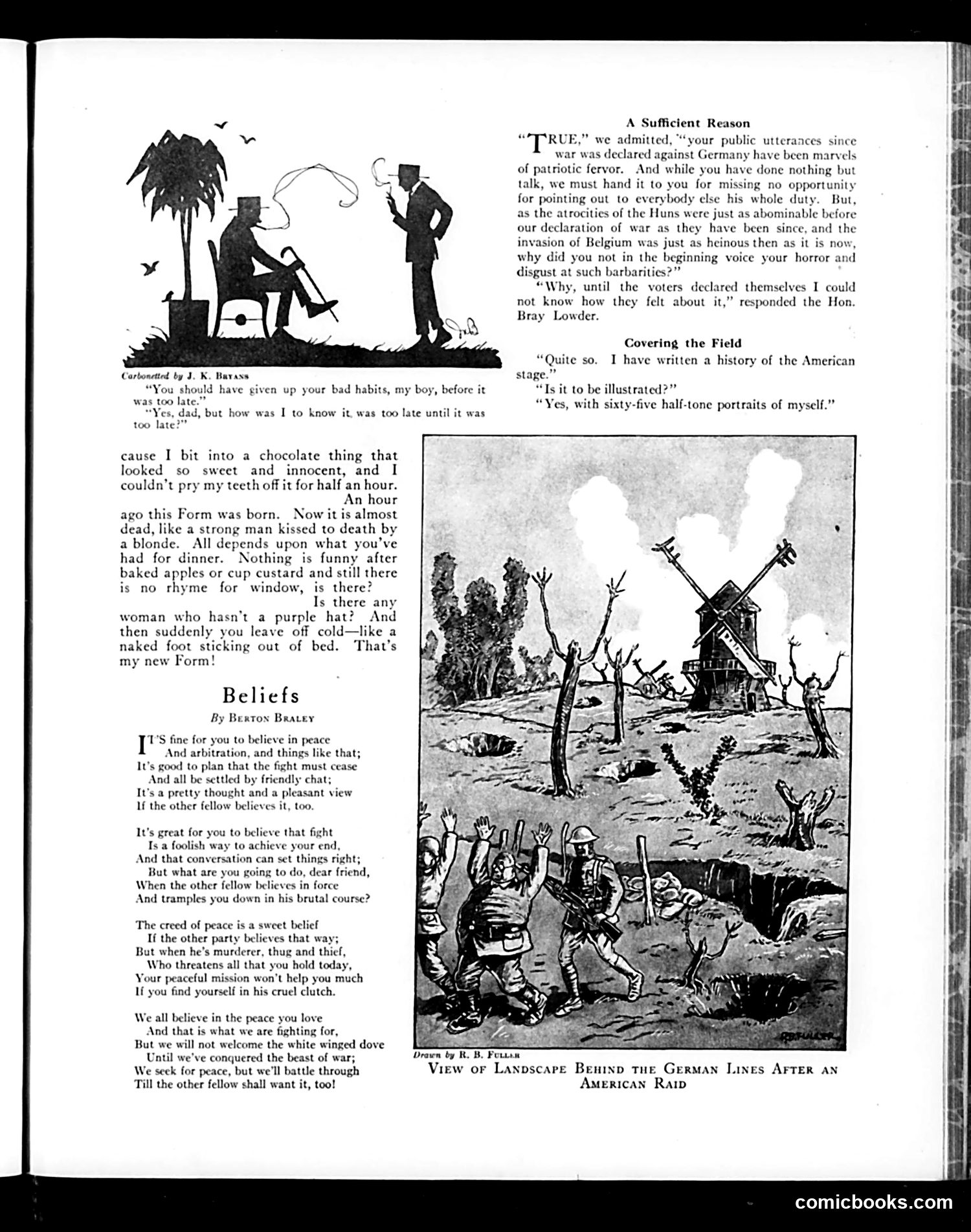
**Top Cartoon ("A Sufficient Reason"):** Features "Hon. Bray Lowder," a politician criticized for only voicing opposition to German atrocities *after* America entered WWI. The satire mocks his opportunism—he claimed ignorance of public sentiment beforehand, suggesting politicians wait for voter approval before taking moral stances. This ridicules those who spoke against German actions only when politically convenient. **"Beliefs" Poem (Berton Braley):** A direct rebuttal to pacifists, arguing that believing in peace is naive when facing an aggressor who "believes in force." Written during WWI, it justifies American military intervention against Germany, framing pacifism as ineffective against tyranny. The poem counters the argument that diplomacy could have prevented war. **Landscape Illustration:** Depicts devastation behind German lines following an American raid—destroyed buildings, barren trees, trenches. This serves as visual propaganda supporting the war effort by showing American military effectiveness and German destruction. The page collectively argues for American WWI participation against pacifist sentiment.
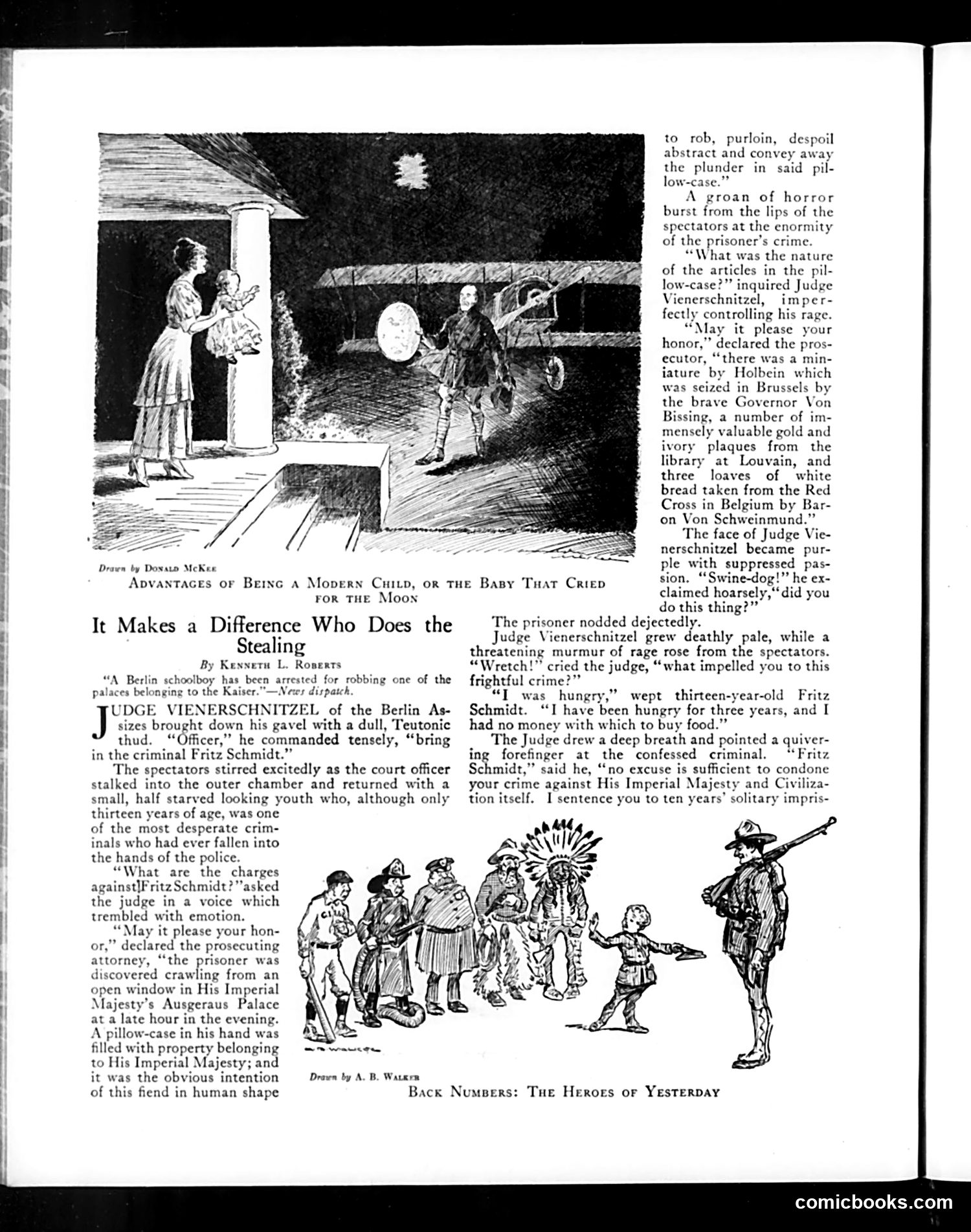
This satirical story mocks German military authority during WWI. Judge Vienerschnitzel presides over a Berlin court where thirteen-year-old Fritz Schmidt faces harsh punishment for stealing from the Kaiser's palace—items that ironically include artworks and supplies themselves stolen by German forces from occupied Belgium and France (Governor Von Bissing's seizures in Brussels, artifacts from Louvain library, Red Cross bread). The satire's point: the judge condemns the starving boy's desperation theft while the German military loots entire nations with impunity. The title emphasizes the hypocrisy—*who* steals determines justice. A child stealing bread to survive faces ten years imprisonment, while occupying officers strip conquered territories unpunished. The story exposes the moral bankruptcy of German militarism and the arbitrary nature of "justice" under imperial rule.
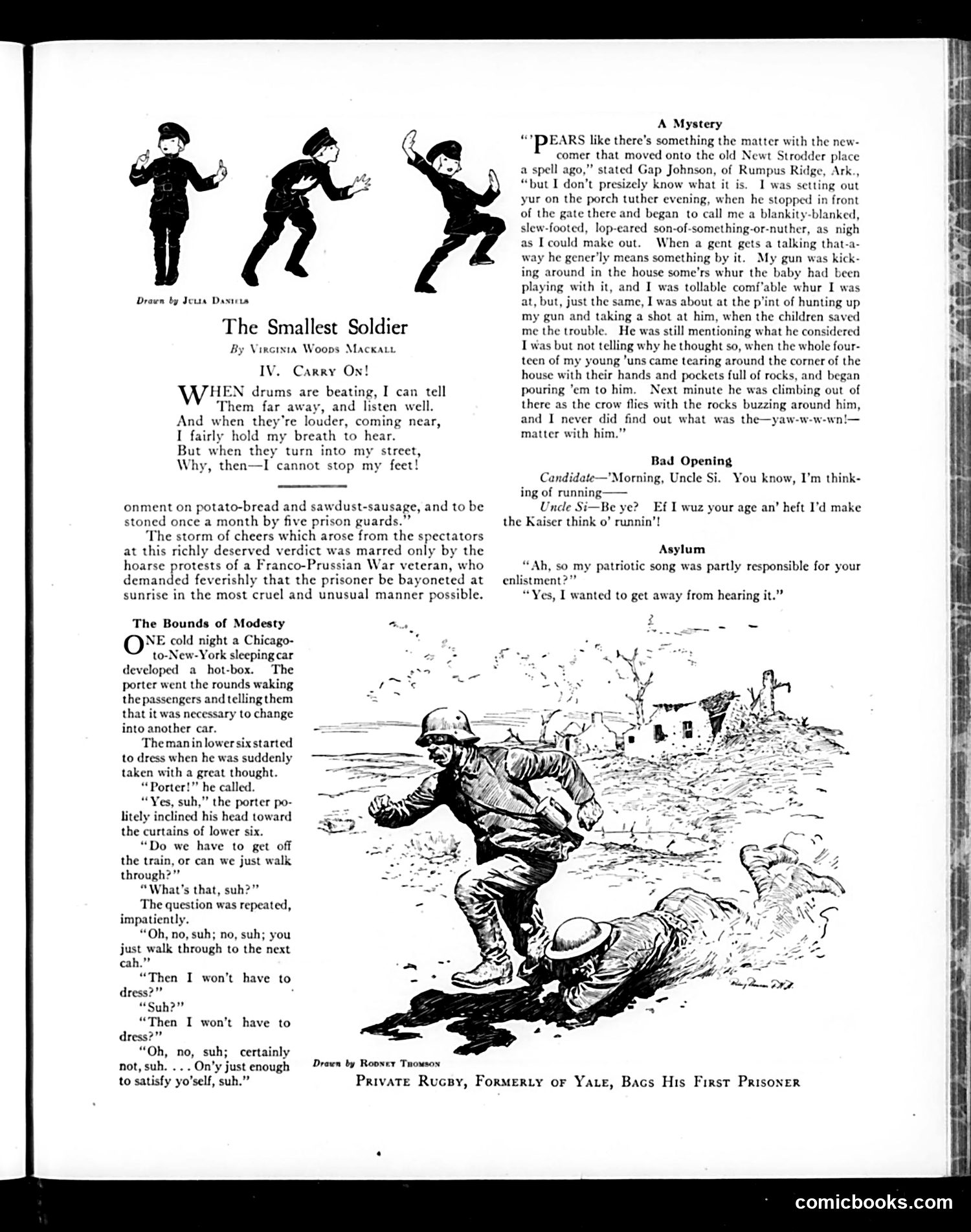
This Judge magazine page contains three distinct pieces of humor: **"The Smallest Soldier"** (top): A poem-illustrated story about a child excited by military drums, reflecting early-20th-century attitudes toward children and warfare during what appears to be WWI era. **"The Bounds of Modesty"** (middle): A sleeping-car anecdote playing on Victorian embarrassment about undressing. A passenger asks if he must get dressed to move between train cars—the humor lies in his concern about propriety and the porter's bemused responses. **"A Mystery" and "Bad Opening"** (right): Rural dialect humor. The first depicts backwoods conflict (a newcomer curses at Gap Johnson; children pelt him with rocks). The second shows a political candidate approaching Uncle Si, who suggests the young man should be running *from* the Kaiser instead—wartime political satire. The large illustration shows a WWI soldier capturing a prisoner, captioned as "Private Rugby, Formerly of Yale." The overall page reflects early-WWI American popular attitudes: military enthusiasm, class-based humor, and rural stereotypes common to the era.
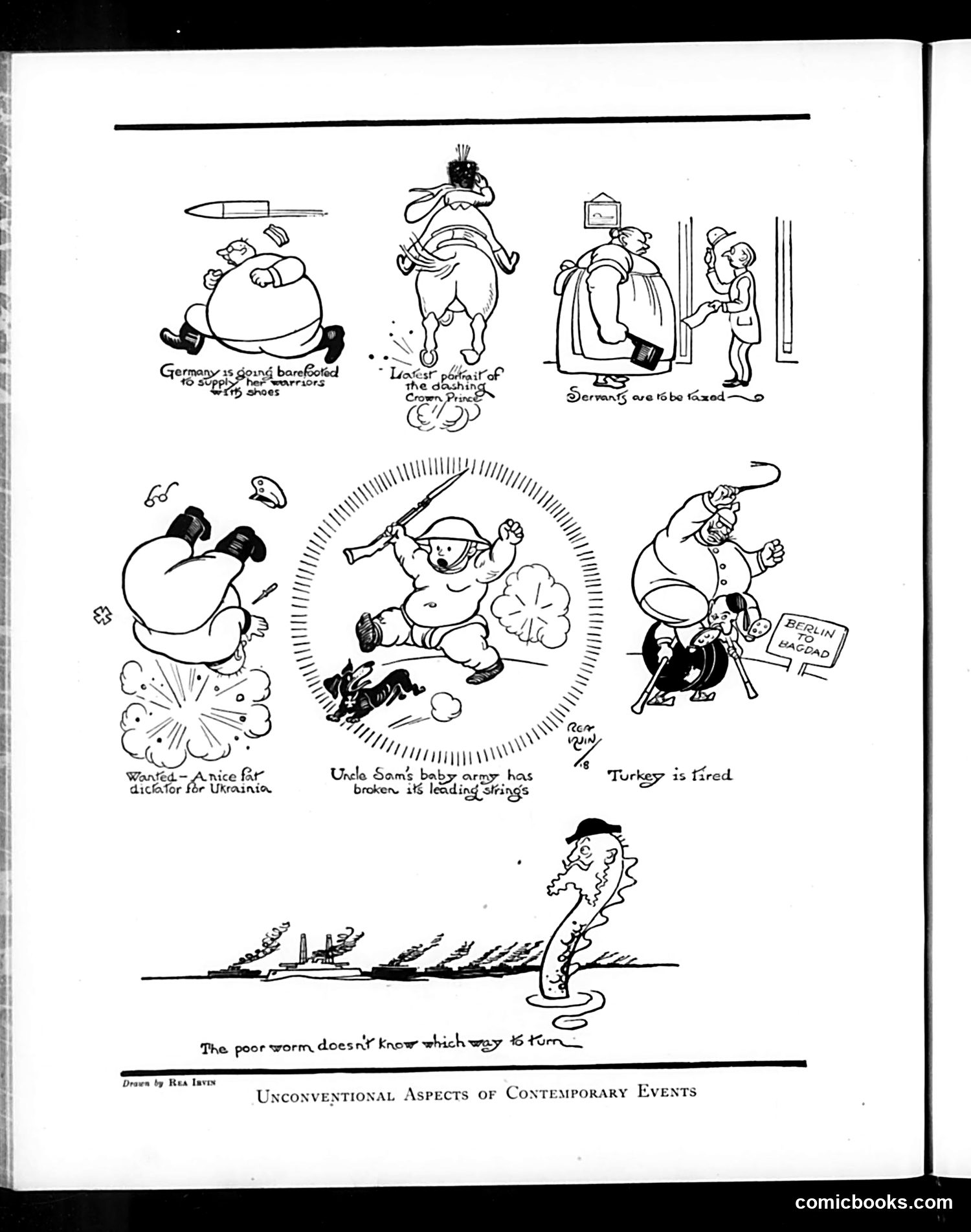
This WWI-era Judge magazine page satirizes Allied nations' wartime struggles through caricatured figures representing Germany, Austria-Hungary ("Crown Prince"), Serbia, Ukraine, and Turkey. Each panel depicts a specific crisis: - Germany lacks shoes and supplies - Austria-Hungary's military leadership is failing ("broken leading strings") - Serbia faces occupation/taxation - Ukraine needs authoritarian governance (satirizing instability) - Turkey's alliance is collapsing ("fired") The bottom panel shows a worm unable to distinguish between competing destructive forces—likely representing neutral nations or civilians caught amid warring powers. The cartoons mock Allied vulnerabilities and war's chaos through exaggerated, crude caricature—standard Judge satire technique. The title emphasizes these are unconventional, absurd consequences of modern industrial warfare. The artist is Rea Irvin (credited at bottom).
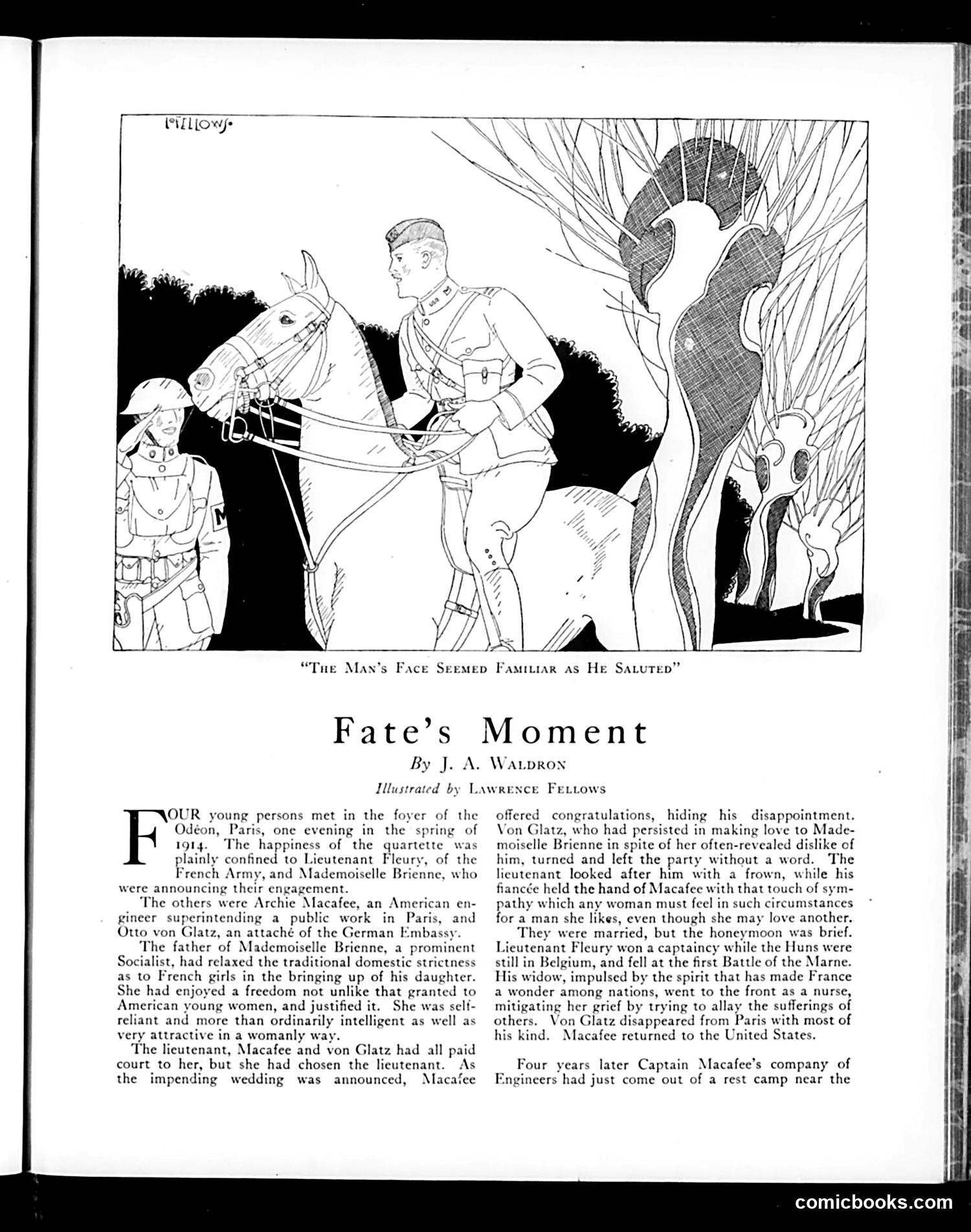
This is a WWI-era romantic drama by J.A. Waldron, not political satire. The illustrated story, set in Paris spring 1914, depicts four characters: Lieutenant Fleury (French Army), Mademoiselle Brienne (his fiancée), American engineer Archie Macafee, and Otto von Glatz (German Embassy attaché). The narrative establishes dramatic irony through competing romantic interests—all three men court Brienne, but she chooses Fleury. Von Glatz's resentful exit foreshadows later developments. The story then jumps forward: Fleury dies at the Battle of the Marne; Brienne becomes a nurse; Von Glatz disappears; and Macafee returns to America, later reappearing as a Captain. The "fate's moment" likely refers to how wartime reshuffles romantic outcomes. This reads as sentimental wartime fiction rather than satire—using personal relationships to explore how WWI disrupted civilian life.
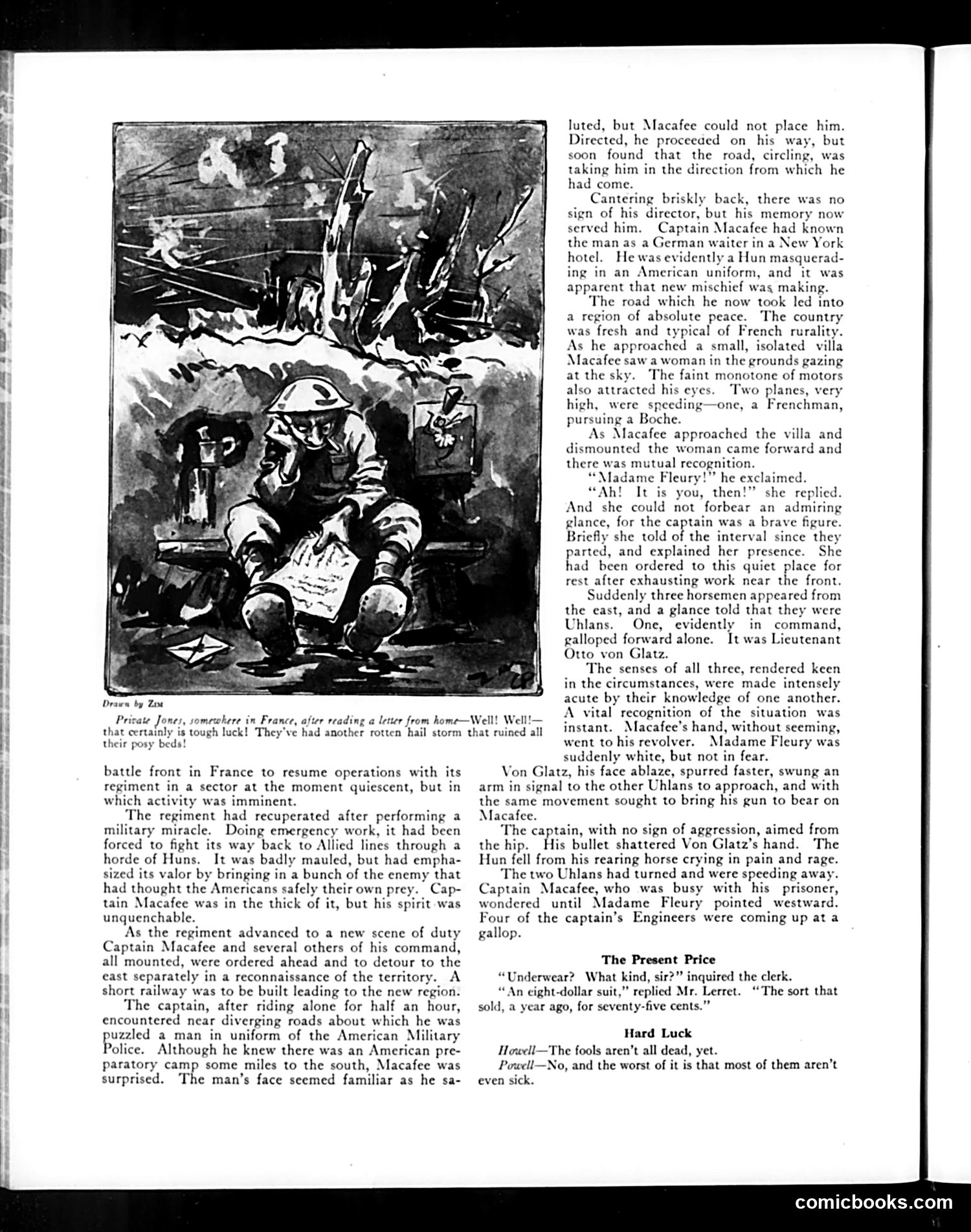
This page contains two distinct pieces of WWI-era content: **The Cartoon (top):** A brief satirical joke about a soldier receiving mail from home. The humor is that while fighting on the Western Front, Private Jones receives a letter describing his family's trivial domestic problem—a hailstorm damaged their flower beds. The joke mocks the disconnect between soldiers' life-or-death experiences in France and the petty concerns of the home front. **The Story (main text):** An adventure narrative about Captain Macafee encountering a German spy (posing as an American Military Policeman, revealed to be a waiter he knew from New York). The captain then meets an old acquaintance, Madame Fleury, at a French villa, where they're attacked by German Uhlans (cavalry). Macafee shoots the attacking officer, Von Glatz, and is rescued by American Engineers arriving opportunely. This appears to be patriotic wartime fiction emphasizing American bravery and vigilance against German deception and aggression.
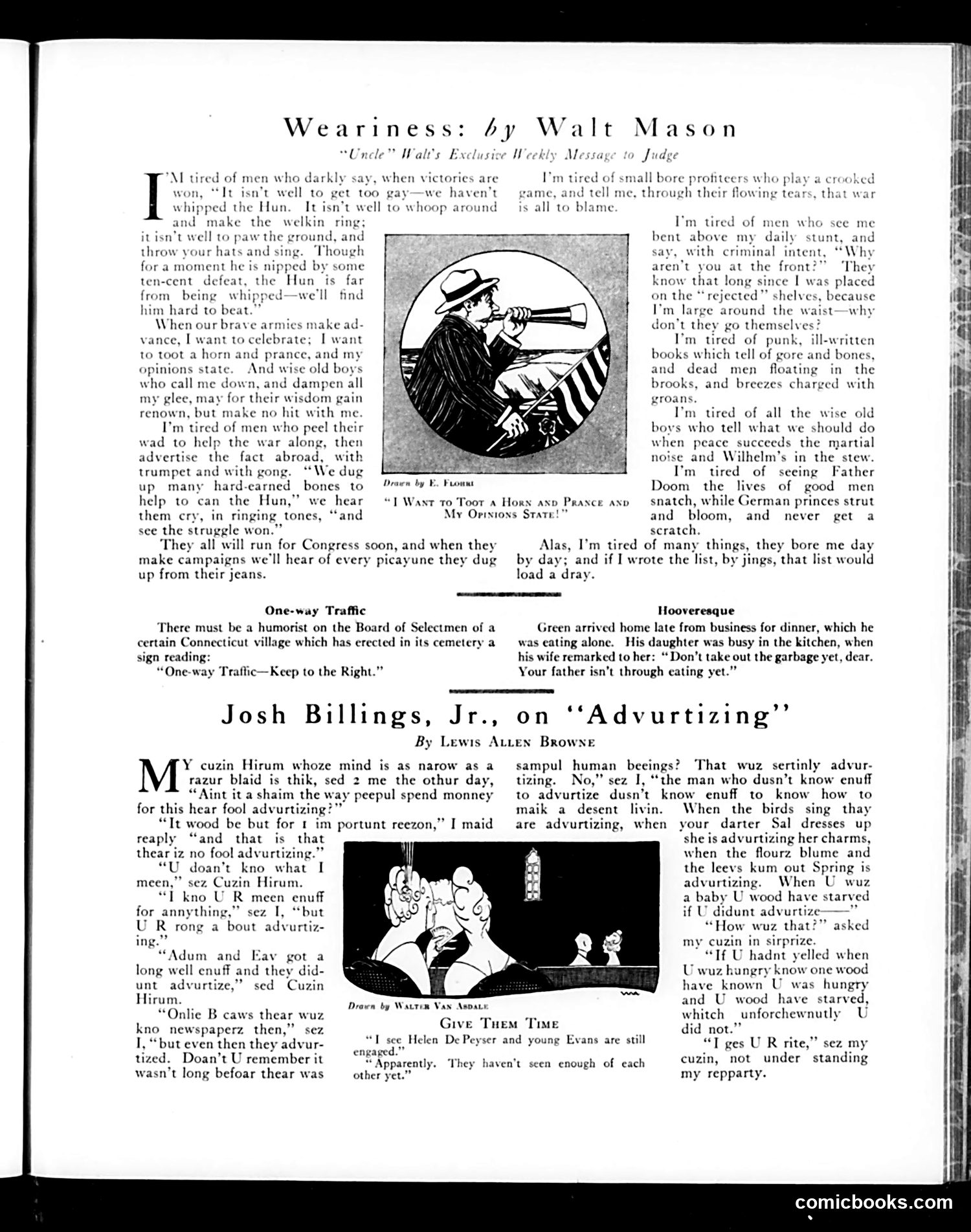
This page from Judge contains anti-war satire and humor pieces, likely from WWI era (references to "the Hun" and Wilhelm suggest German conflict). **"Weariness" by Walt Mason** is the main piece—a poem criticizing war profiteers and self-promoters. Mason laments men who "peel their wad to help the war" then advertise their contributions "with trumpet and with gong," planning to "run for Congress soon" and campaign on their donated pennies ("picayune"). He's also tired of cheap war literature, armchair generals offering peace advice, and people questioning why he isn't at the front (he was apparently rejected for service due to his size). **"One-way Traffic"** is a brief joke about a Connecticut cemetery sign reading "Keep to the Right"—dark humor about the finality of death. **"Josh Billings, Jr., on 'Advurtizing'"** uses deliberately misspelled dialect humor (a period convention) to argue that all advertising, even ancient examples, serves a purpose—dismissing his cousin's complaint that advertising is foolish. The cartoons illustrate these pieces with period-appropriate drawings.
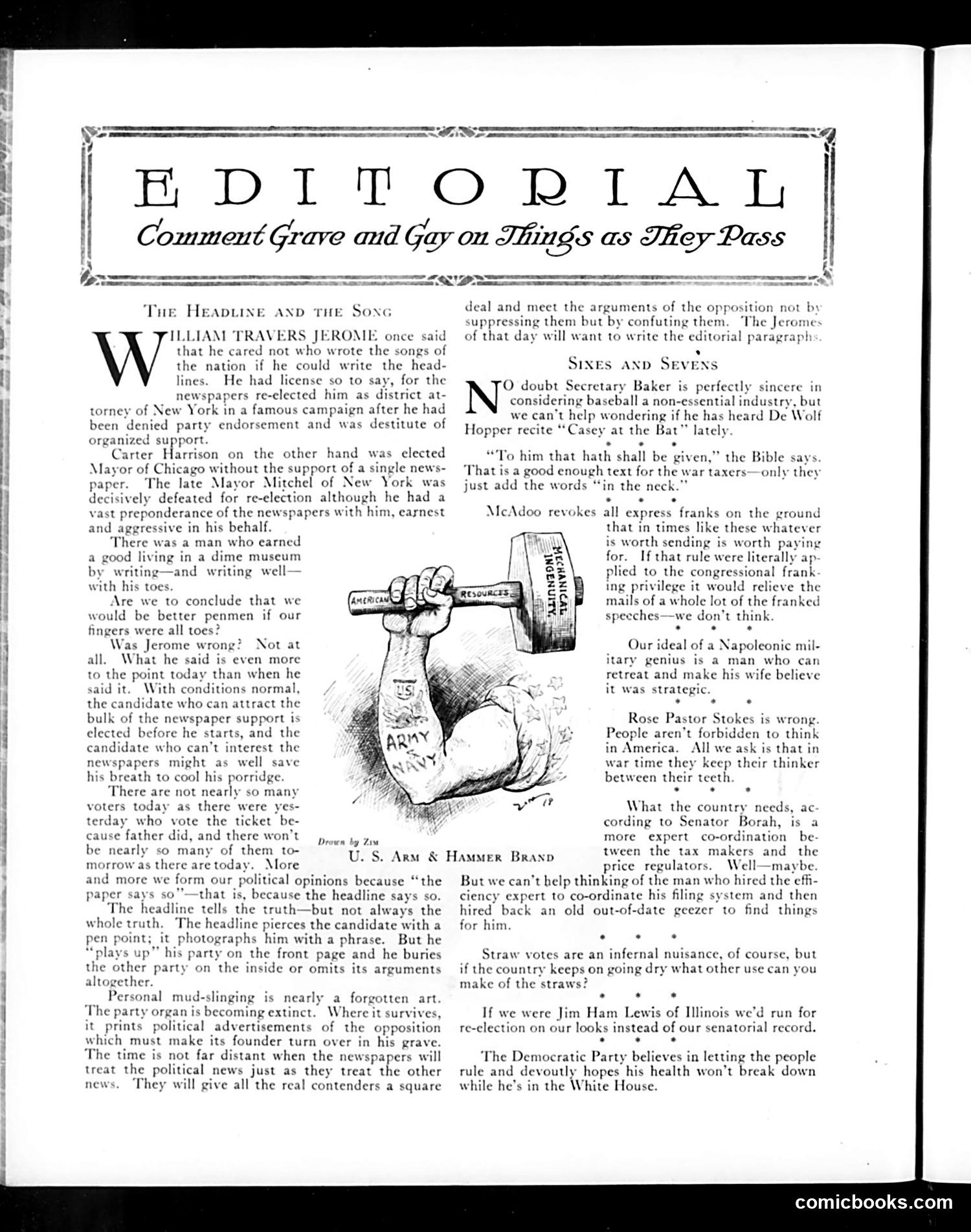
This editorial page satirizes newspaper influence on politics and wartime governance. The central cartoon depicts a muscular arm labeled "U.S. Army & Hammer Brand" wielding a hammer marked "American Resources"—mocking Secretary Baker's classification of baseball as "non-essential" during WWI. The left column critiques how newspaper headlines, rather than substantive arguments, determine elections. It argues that candidates supported by major papers win regardless of merit, citing examples like William Travers Jerome and Carter Harrison. The right column contains quick political jabs: mocking Secretary McAdoo's censorship of congressional mailing privileges; criticizing Rose Pastor Stokes (a socialist activist) for speaking against the war; and sarcastically endorsing Senator Borah's call for "expert coordination" between tax-makers and price regulators—implying bureaucratic inefficiency. The overall tone reflects early WWI-era concerns about government overreach and media manipulation of public opinion.
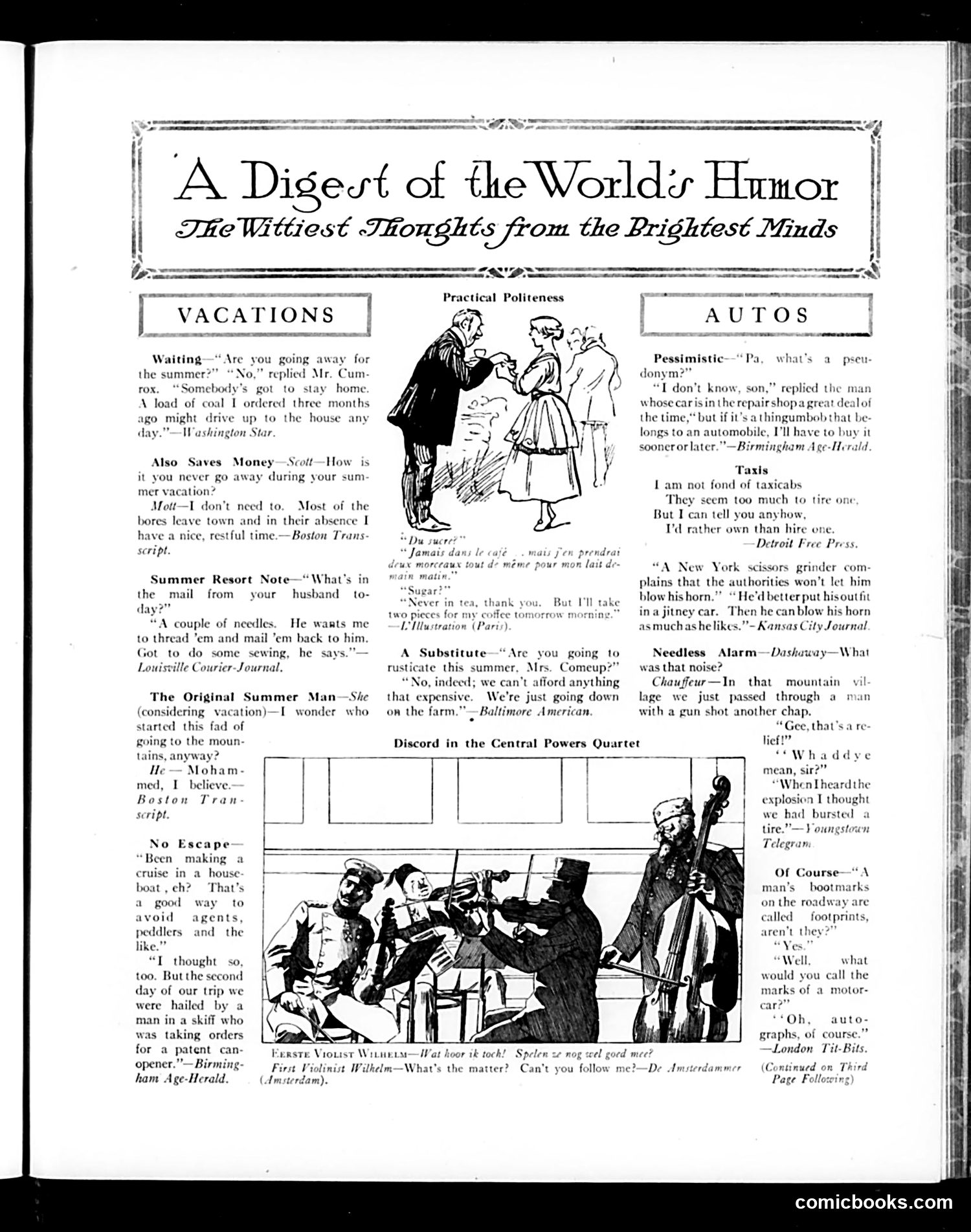
This page collects short humorous anecdotes organized by topic (Vacations, Autos, Taxis). The humor relies on early 20th-century domestic and social anxieties: **Vacations section** satirizes middle-class summer travel—staying home to await delayed coal deliveries, wives' boredom at resorts, couples economizing by visiting farms instead of resorts. **Autos section** mocks automobile ownership frustrations: cars perpetually in repair shops, the novelty of "horns" (automobile horns were recent), confusion over automotive terminology. **The central cartoon** titled "Discord in the Central Powers Quartet" depicts musicians in conflict, likely referencing tensions between Austro-Hungarian and German allies during World War I (the caption references "Eerste Violinist Withelm" and Dutch, suggesting European tensions). **Taxis/other items** joke about taxicab fatigue, mountain gun violence, and wordplay about "footprints" versus "automobile marks." The page is primarily **humorous social commentary** rather than political satire, reflecting contemporary irritations with modern conveniences and vacation culture.
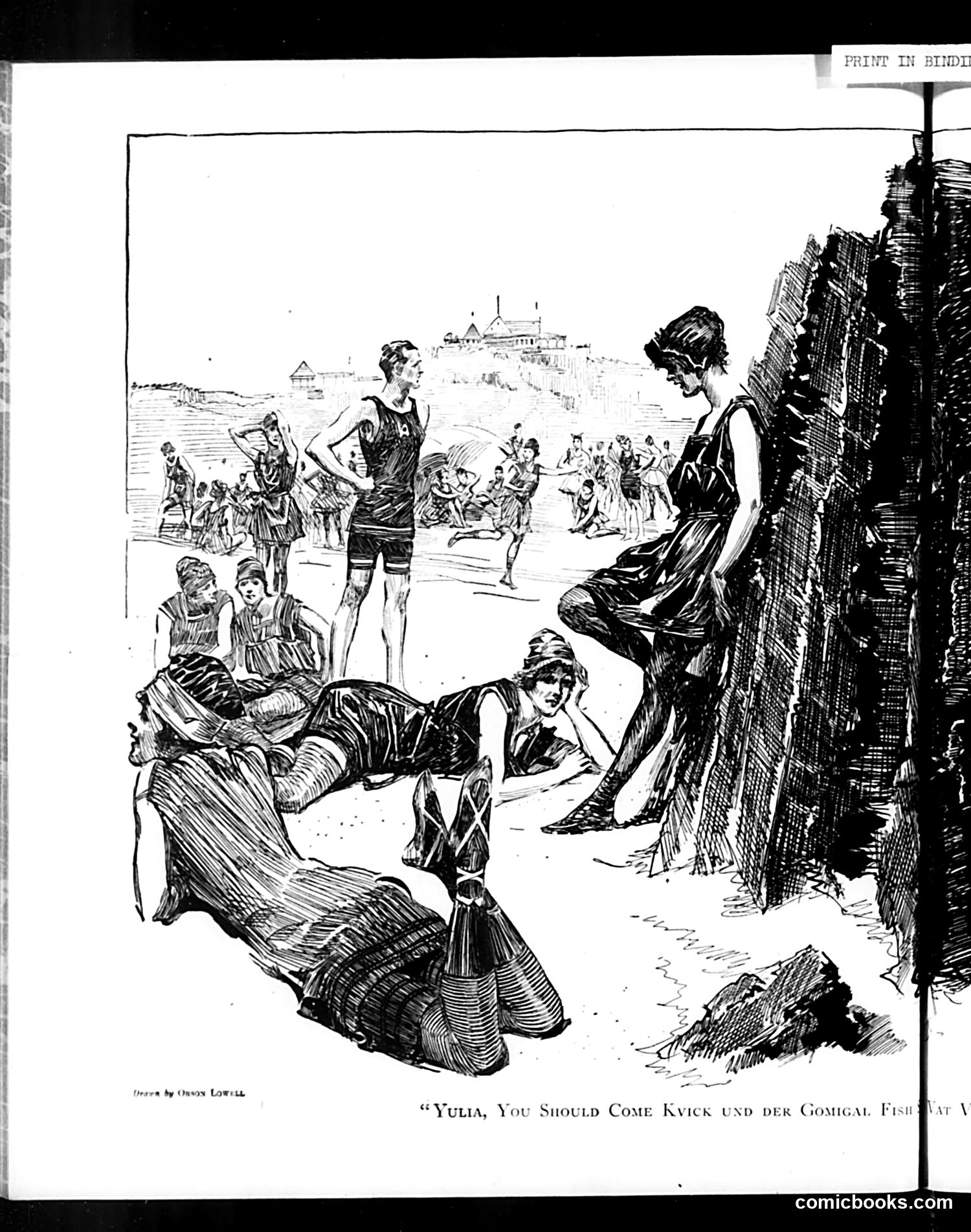
This is an illustration by Orson Lowell depicting a beach scene. The caption reads "Yulia, You Should Come Kvick und der Gomical Fish" (with intentional comedic misspelling suggesting a German or Eastern European accent). The humor appears to play on ethnic stereotyping through dialect humor—common in early 20th-century American satire. A woman in the foreground reclines dramatically while gesturing toward someone in the water, with other beachgoers visible in the background and a seaside resort or boardwalk visible in the distance. Without additional context about "Yulia" or the specific satirical moment Judge was addressing, the precise political/social reference remains unclear, though the accent-based humor and beach setting suggest it's mocking immigrant speech patterns or behavior—typical of Judge's satirical approach to contemporary social issues.
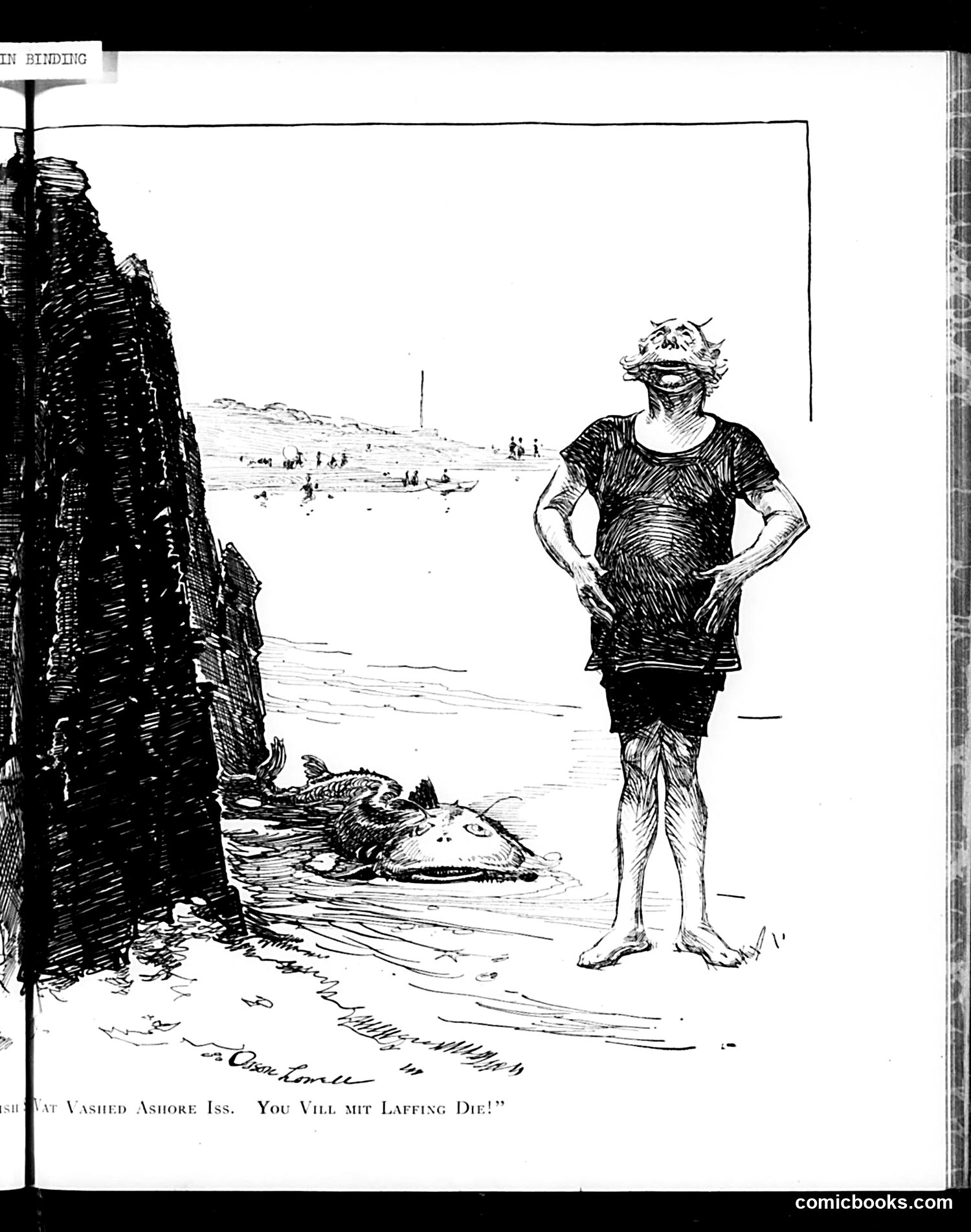
This appears to be a satirical cartoon from *Judge* magazine showing a confrontation at a beach. A figure stands in swimming attire with hands on hips, facing what looks like a large sea creature or debris washed ashore. The caption reads "Var Vashed Ashore Iss. You Vill mit Laffing Die!" — using exaggerated dialect to suggest a German or Eastern European accent. The cartoon likely satirizes either: - German immigrants or German-American tensions (given the dialect humor) - Concerns about "foreign" elements washing up on American shores - Possibly WWI-era anxieties about Germans The specific historical context and identity of the figure remain unclear without additional information, but the crude dialect caricature and confrontational stance indicate ethnic or nationalist satire typical of early 20th-century American humor magazines.
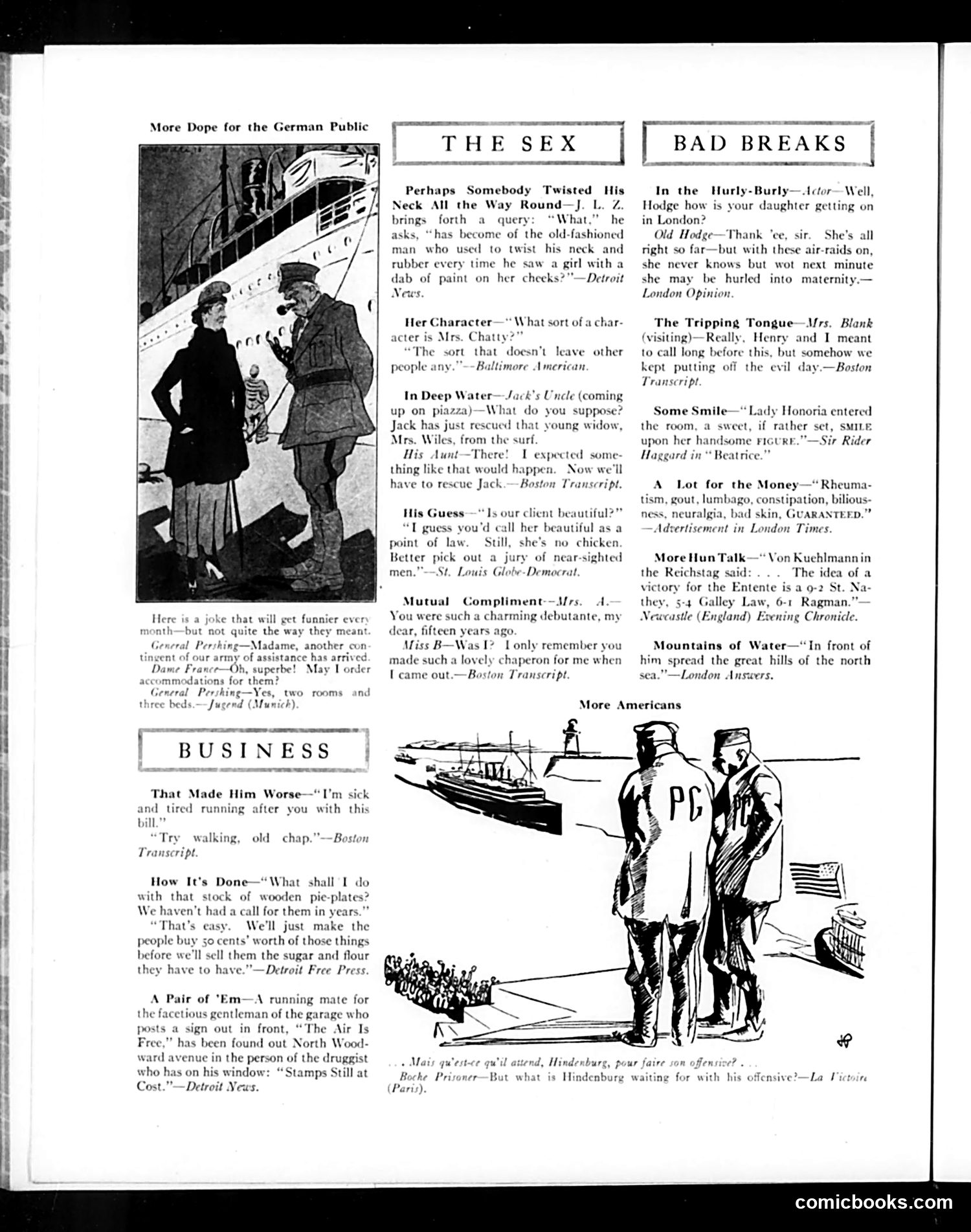
This page from Judge magazine contains satirical commentary on WWI-era America and society. **"More Dope for the German Public"** references General Pershing's arrival in Europe during WWI, suggesting Germans would need more "dope" (encouragement/propaganda) to face American military involvement. **The "Business" section** mocks wartime profiteering and consumer exploitation—selling wooden plates bundled with sugar sales, or charging for stamps "at cost" while actually profiting. **"The Sex" and "Bad Breaks"** sections are humorous anecdotes about social behavior and literary absurdities, unrelated to politics—jokes about flirtatious women, courtship mishaps, and pompous writing. **"More Americans"** shows a cartoon of what appears to be a German prisoner with "PG" (likely "Prisoner of German") markings, mocking German military efforts. The caption references Hindenburg and suggests German military strategy is ineffective. The page blends patriotic WWI commentary with generic humor typical of early-20th-century American magazines.
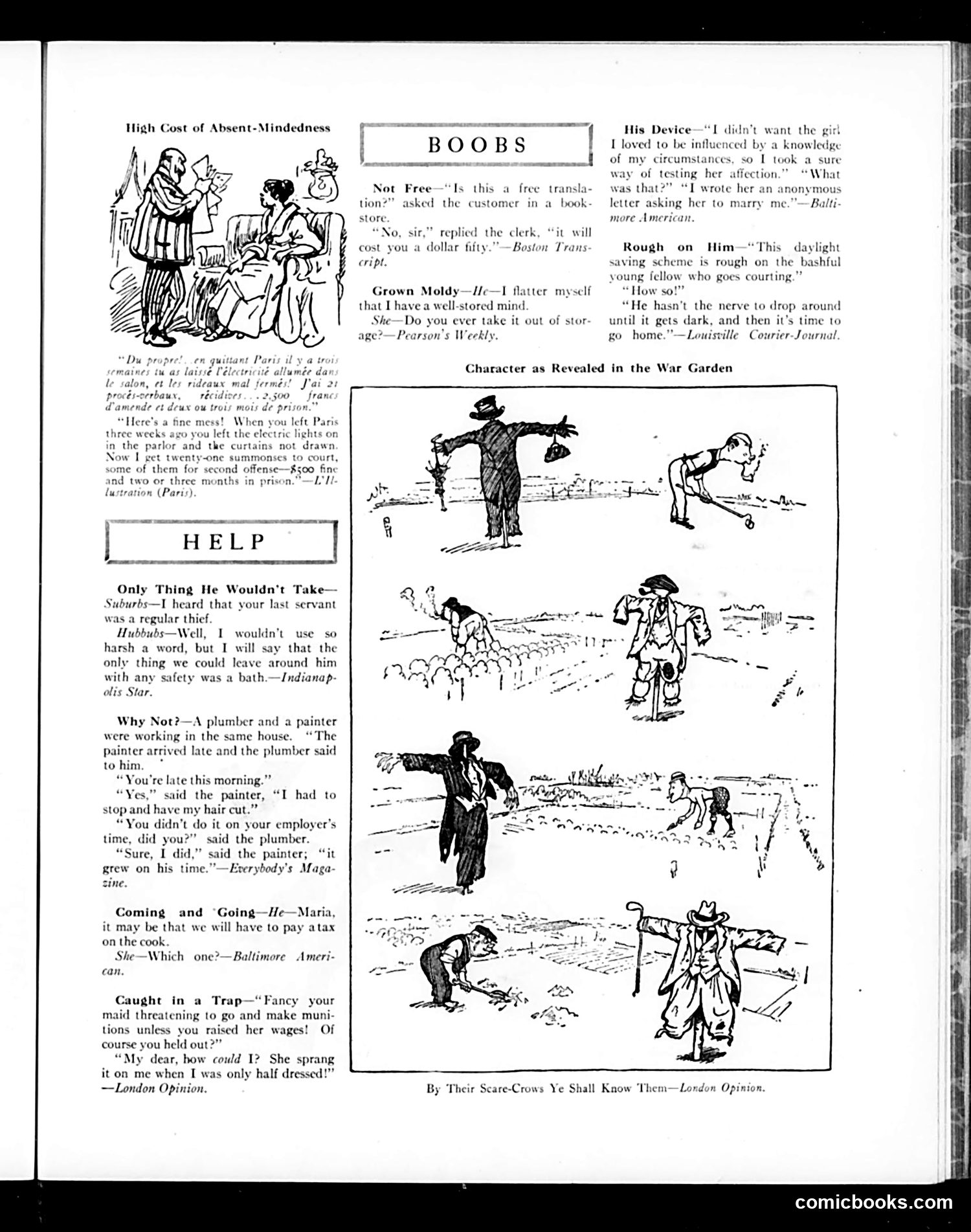
This page contains six brief humorous anecdotes and a central cartoon about wartime vegetable gardens. **The Jokes:** All are light domestic humor typical of early-20th-century magazines—absent-minded hosts leaving lights on in Paris (causing legal fines), servants who steal everything except bathtubs, timing mishaps, and wartime tax anxiety. The humor relies on wordplay and class-conscious situations (servant problems, household help). **The Main Cartoon:** "Character as Revealed in the War Garden" illustrates how people's personalities show through their scarecrow designs. Different figures construct scarecrows in their own images—one lazy/slouching, one military-rigid, one elegant with a cane. The caption suggests wartime vegetable gardens (likely WWI-era rationing) reveal character through how people protect their crops. **Context:** Judge was a weekly satirical magazine; this appears to be wartime content, probably 1917-1918, when American home gardening was encouraged for food security. The scarecrow humor gently satirizes social types through their gardening choices.
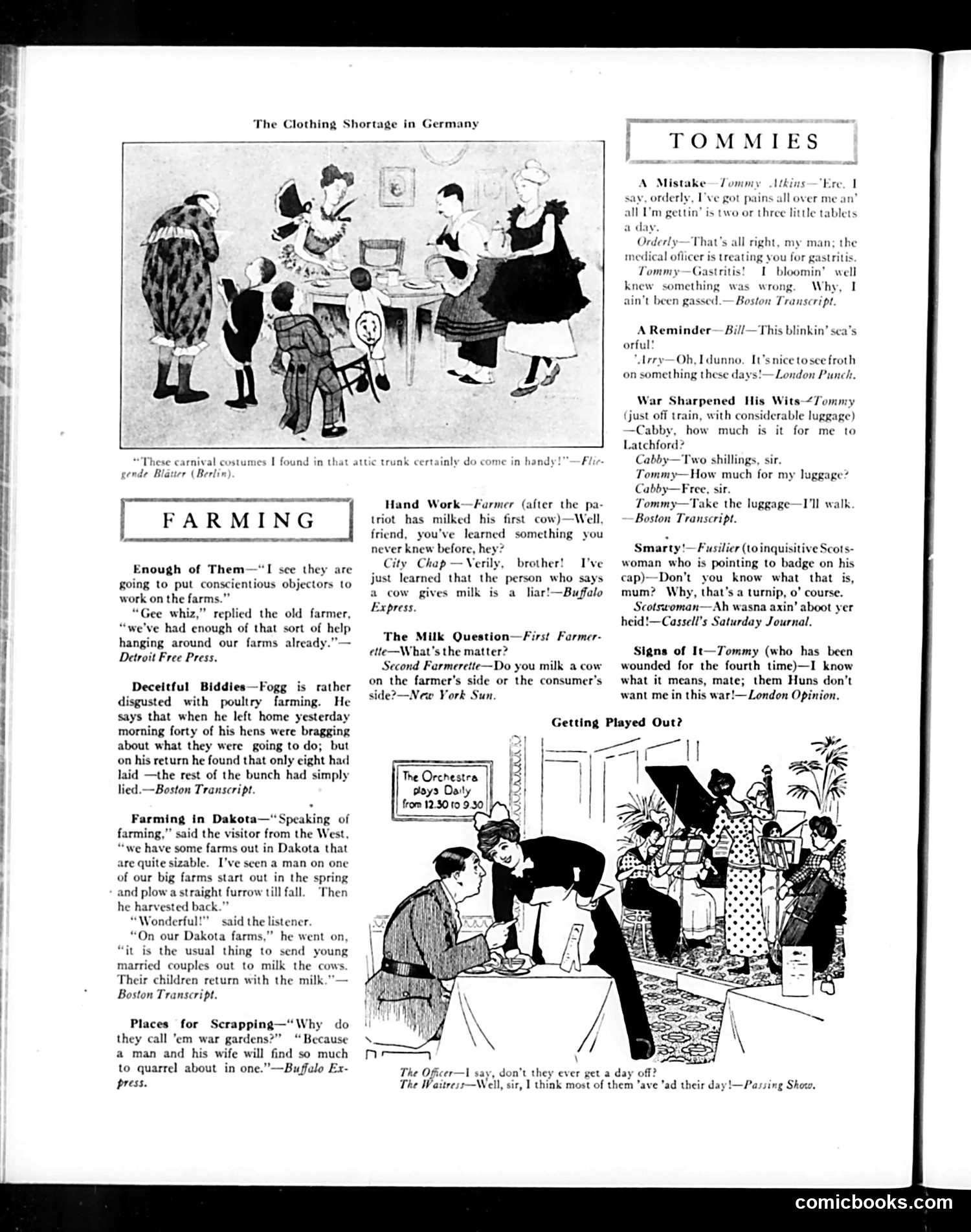
This Judge magazine page contains two separate humor sections from WWI-era America. **"The Clothing Shortage in Germany"** (top-left) is a single cartoon satirizing German wartime deprivation. The caption suggests Germans are reduced to wearing old carnival costumes from attics because of fabric shortages caused by the war. **"Farming" and "Tommies"** sections are collections of short jokes rather than political cartoons. The farming jokes mock conscientious objectors and city people attempting farm work during wartime labor shortages. The "Tommies" section features jokes about British soldiers ("Tommy" being slang for British infantrymen), covering military medical care, trench conditions, and taxi negotiations. The humor is gentle workplace and military comedy typical of wartime publications—poking fun at incompetence, bureaucracy, and the gap between civilians and soldiers, rather than advancing serious political argument. The content reflects American attitudes toward the British war effort and domestic wartime challenges circa 1914-1918.
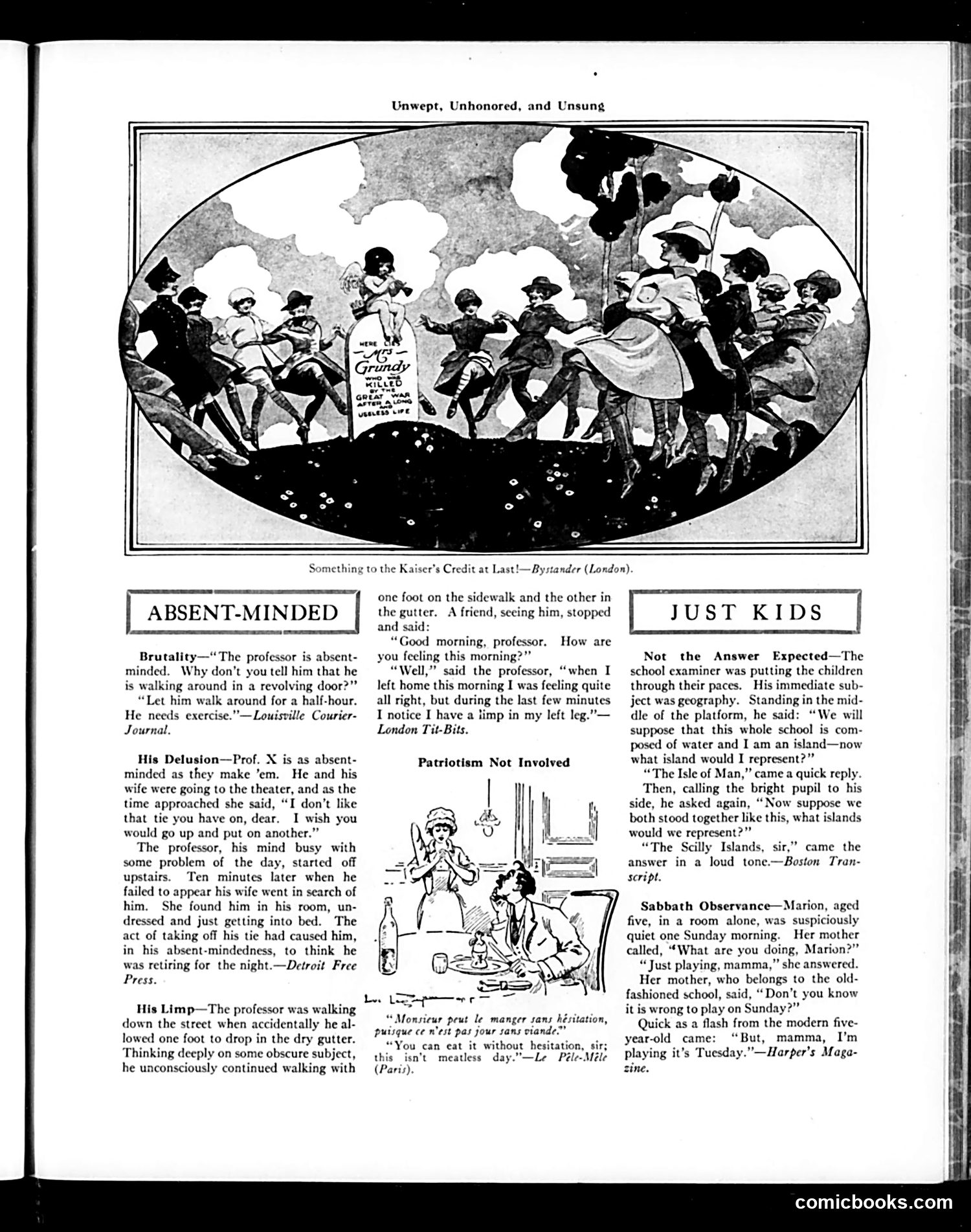
This page from *Judge* magazine contains multiple humor pieces satirizing absent-mindedness and social behavior: **Top cartoon**: Shows various figures gathered around someone labeled "Grundy" in a WWI-era scene. The caption references "the Kaiser's Credit," suggesting it's satirizing German conduct during World War I through the lens of social propriety. **Absent-minded jokes**: Three anecdotes mock professorial absentmindedness—a professor undressing for bed instead of changing ties, and another walking with one foot in a gutter without noticing. These target the stereotype of intellectuals as impractical. **"Patriotism Not Involved"**: A French cartoon about eating meat on a meatless day (likely wartime rationing), joking that there's "no patriotism" in the violation since it's not technically forbidden. **Geography joke**: A schoolmaster asking what island he'd represent gets the insulting answer "Isle of Man." **Sunday observance**: A modern five-year-old cleverly evades her mother's prohibition on Sunday play by claiming she's "playing it's Tuesday"—satirizing how modern children circumvent old-fashioned rules through technicalities.
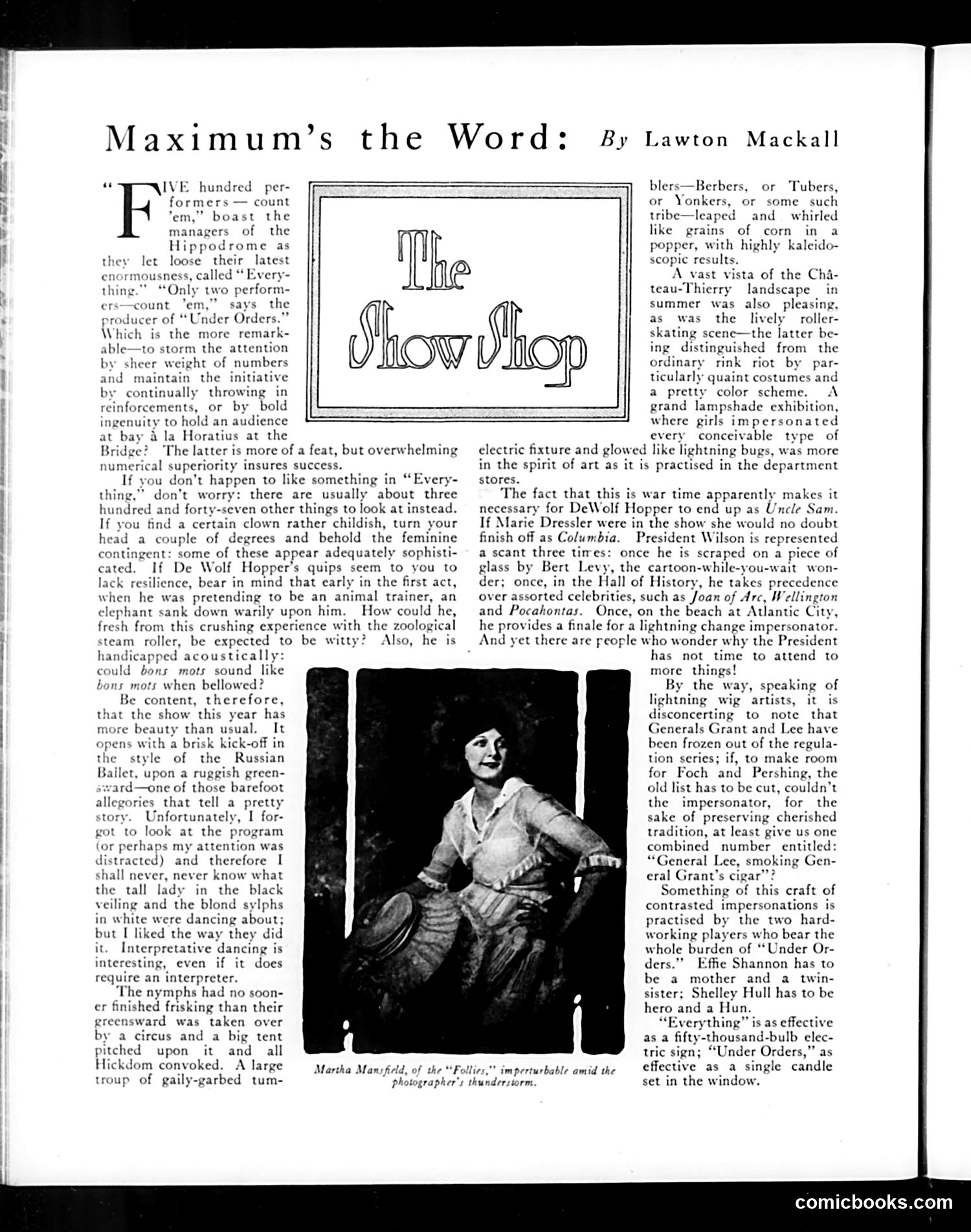
This is a theater review by Lawton Mackall of a spectacular revue called "Everything" at the Hippodrome, contrasting it with a competing show "Under Orders." The critic uses the word "maximum" to praise productions that achieve impact through sheer scale and spectacle rather than subtlety. The review praises "Everything" for its visual grandeur—Russian ballet-style opening, elaborate sets (including a Château-Thierry landscape), and kaleidoscopic effects. A photo shows actress Martha Mansfield, apparently featured in the show. The satire targets wartime patriotism: the critic wryly notes that DeWolf Hopper must end as Uncle Sam, and President Wilson appears repeatedly—scraped onto glass by cartoonist Bert Levy, in the "Hall of History," and as a finale for quick-change impersonations. The tone suggests bemused exhaustion with mandatory patriotic references. The complaint about dropping Generals Grant and Lee to make room for Foch and Pershing reflects wartime shifts in American cultural priorities.
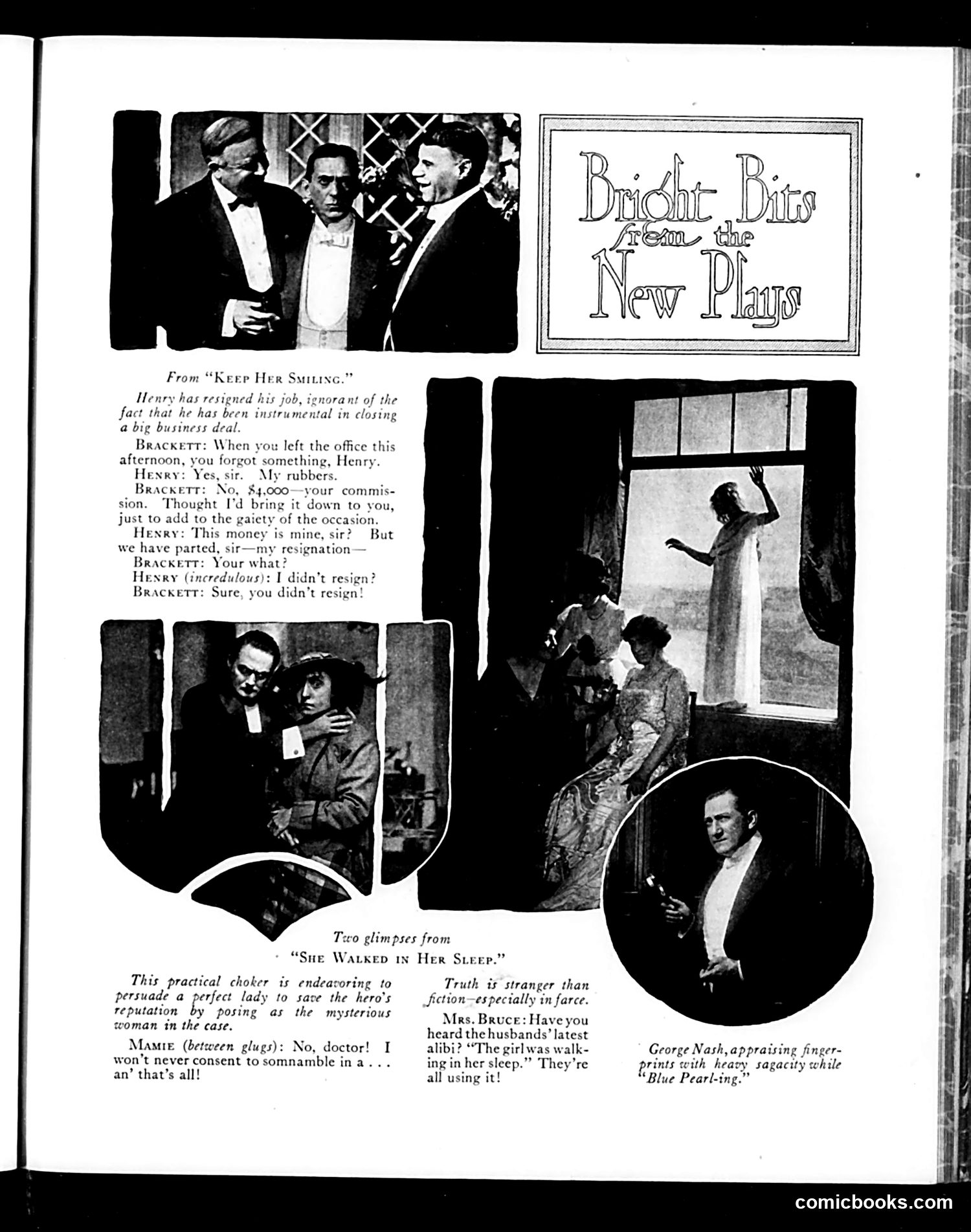
This page presents satirical film reviews from Judge magazine, showcasing scenes from three movies with accompanying comedic commentary. **"Keep Her Smiling"** depicts a farcical misunderstanding: an employee named Henry believes he's resigned after a business deal closes, but his boss Brackett insists he hasn't and tries to give him a $4,000 commission. The humor lies in the confusion and Henry's stubborn misinterpretation. **"She Walked in Her Sleep"** mocks a plot device common to farce films: a woman is being persuaded to pose as a mysterious woman to protect someone's reputation. The satire critiques this implausible scenario, with the character Mamie drunkenly refusing consent. Mrs. Bruce's commentary highlights how husbands were using the "sleepwalking woman" excuse as a convenient alibi—suggesting this plot had become a cliché audiences recognized as absurd. **"Blue Pearl-ing"** features George Nash examining fingerprints with exaggerated seriousness, satirizing melodramatic detective-story conventions in silent films.
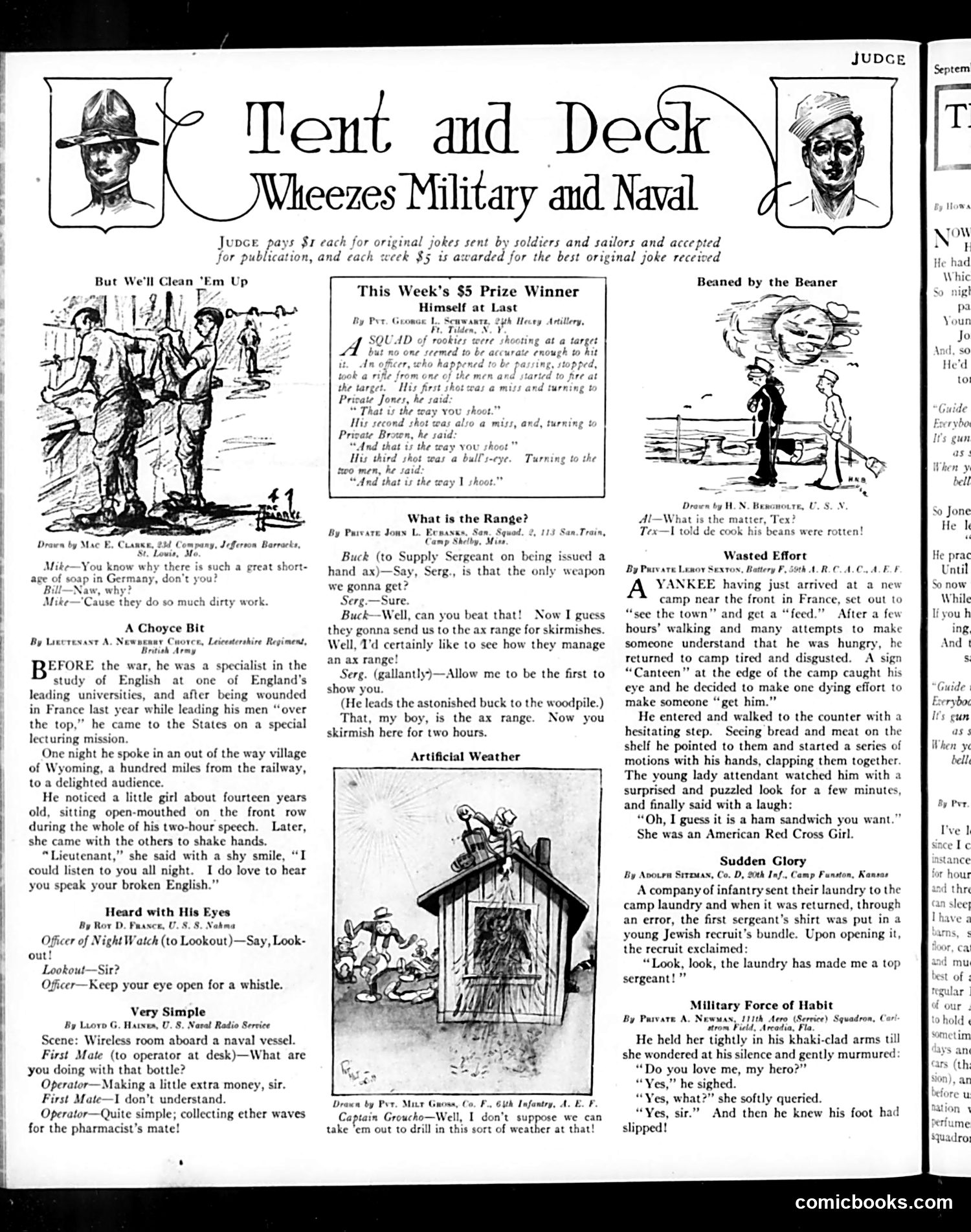
This page collects jokes submitted by soldiers and sailors during World War I, with Judge magazine paying contributors $1 per joke and awarding $5 weekly for the best. The humor targets military life's absurdities: incompetent recruits, supply shortages, bureaucratic confusion, and camp conditions. The jokes mock: - **Recruitment/training**: Rookies missing targets; sergeants assigning absurd tasks (an "ax range") - **Wartime shortages**: Soap scarcity in Germany (a dig at enemy conditions) - **Military hierarchy**: Officers and NCOs portrayed as somewhat dim - **Camp conditions**: Poor food, laundry mishaps, lack of equipment One joke plays on "ether waves" (wireless signals) versus pharmaceutical ether—simple wordplay. Another depicts a British officer charming American civilians with his accent. The humor is gentle, morale-boosting rather than subversive, intended for publication in a mainstream satirical magazine supporting the war effort.
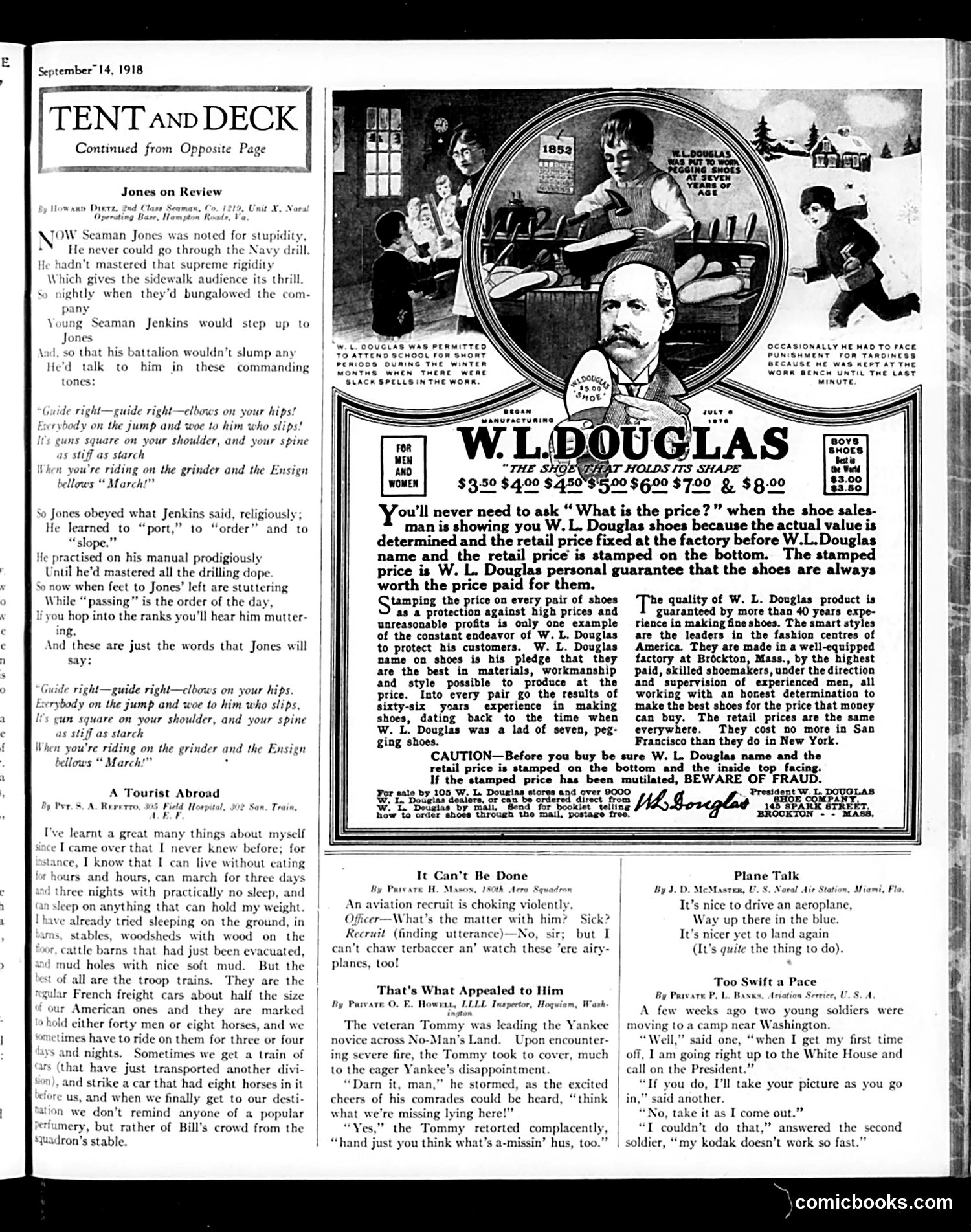
This is a **humorous military sketch** about a Navy recruit named Seaman Jones during World War I (the page is dated September 14, 1918, near war's end). The joke: Jones is famously stupid and can't master Navy drill procedures. His superior, Seaman Jenkins, must constantly bark drill commands at him—"Guide right—guide right—elbows on your hips!"—to keep him in line. The satire mocks both Jones's incompetence and the rigid, repetitive nature of military training itself. The accompanying **W.L. Douglas shoe advertisement** is unrelated commercial content, typical of Judge magazine's revenue model. Below are three brief humorous anecdotes: "It Can't Be Done" (about an aviation recruit), "That's What Appealed to Him" (about a veteran tricking a recruit), and "Plane Talk" and "Too Swift a Pace" (brief soldier jokes). The "Jones" piece satirizes the universal military experience—transforming civilians into soldiers through drilling, discipline, and blind obedience, regardless of individual aptitude.
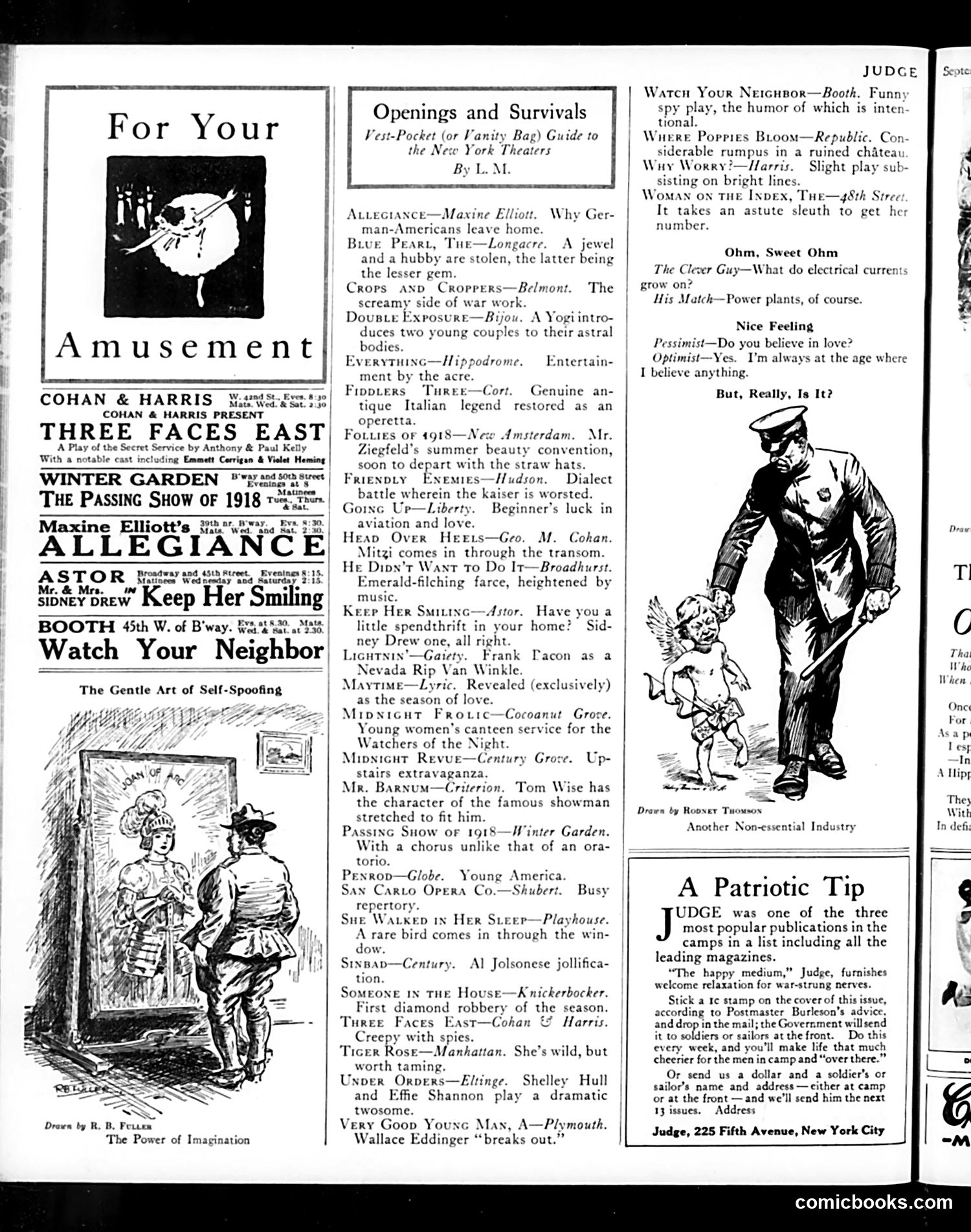
This page from Judge (a pre-WWI American satirical magazine) is primarily **theater listings and advertisements** rather than political satire. The main content is a "Vest-Pocket Guide to New York Theaters" reviewing current Broadway productions. Notable is the **wartime context**: several play titles reference the conflict—"Three Faces East" (Secret Service spy play), "Friendly Enemies" (featuring the Kaiser being defeated), and "Crops and Croppers" (about war work). The cartoon "The Gentle Art of Self-Spoofing" (lower left) appears to humorously depict someone's exaggerated imagination. **The patriotic section** at bottom explicitly promotes sending Judge magazines to soldiers and sailors at the front, endorsed by Postmaster Burleson—a government-sanctioned wartime morale effort. Readers could mail issues for one cent or donate a dollar. The overall page reflects **American WWI-era popular culture**: theatrical entertainment, advertising, and civic duty messaging encouraging support for troops.
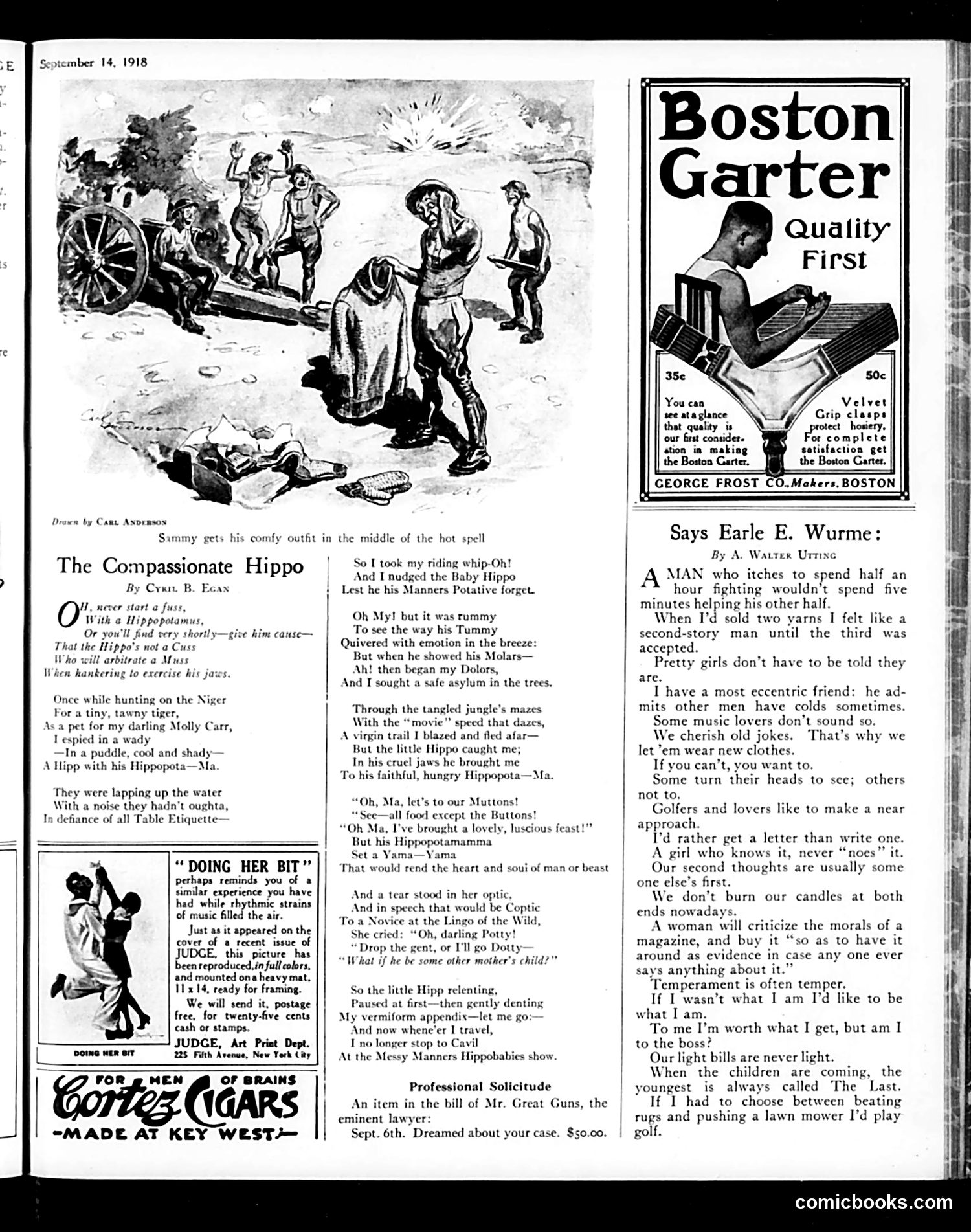
This page contains a lighthearted poem by Cyril B. Egan about a hunter who encounters a hippopotamus family in Africa. The narrator whips a baby hippo for poor manners, prompting the mother hippo to chase him through the jungle. She nearly kills him but ultimately shows mercy when the baby pleads with her—moved by the thought that the man might be "some other mother's child." The satire appears gentle rather than overtly political. Published during World War I's final months, it may carry subtle meaning about restraint and humanity even toward enemies, though this remains speculative. The poem is primarily humorous light verse—playing with comic rhymes ("Hippopota-Ma," "Yama-Yama") and exaggerated adventure tropes common to Judge's entertainment content. The page also includes advertisements and Earle E. Wurme's aphorism column, typical magazine filler of the era.
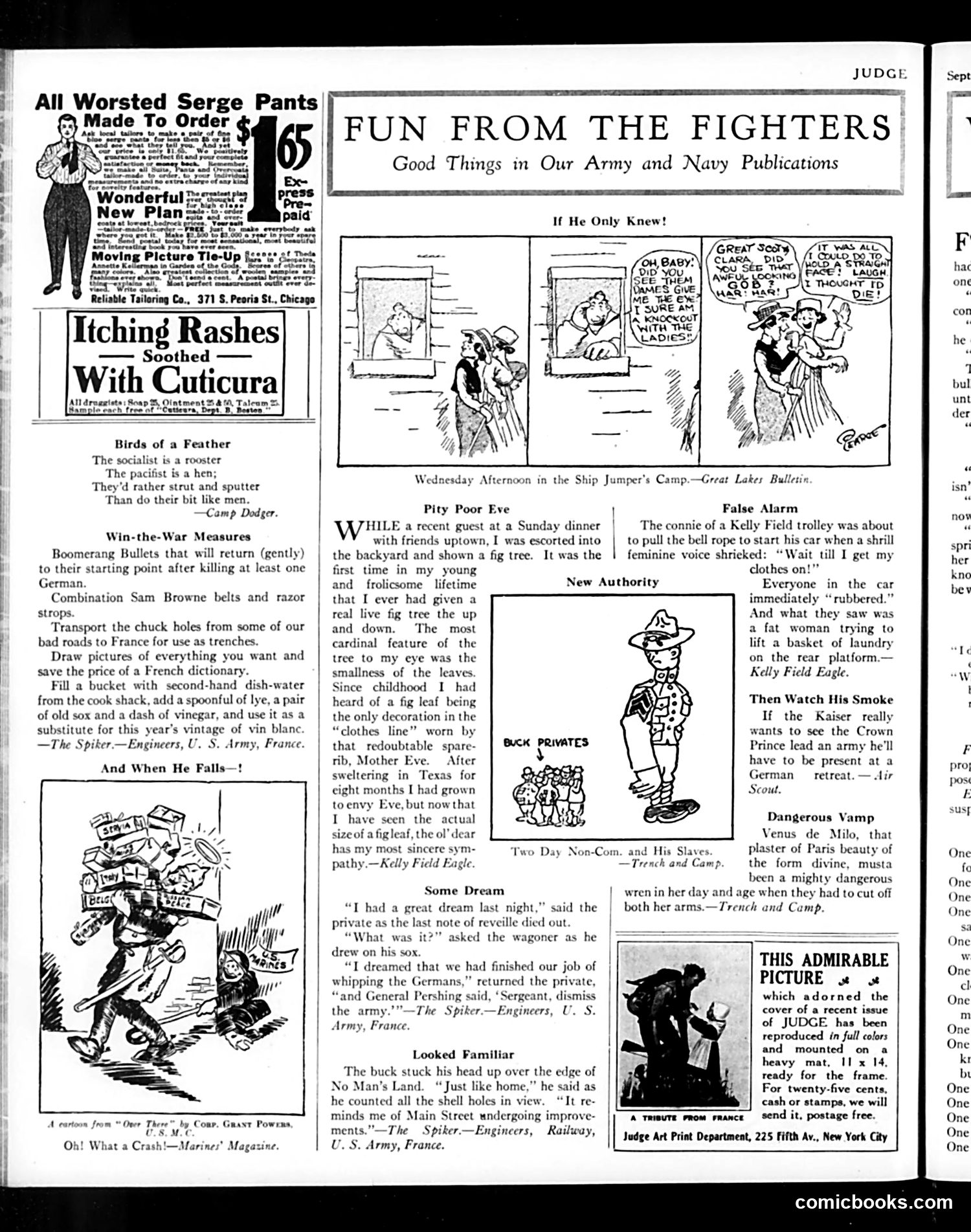
This is a **WWI-era humor page** from Judge magazine featuring jokes and cartoons by American soldiers and military publications. The content reflects early U.S. involvement in World War I. **Key content:** The page collects humorous anecdotes from Army and Navy publications. "Win-the-War Measures" satirizes absurd military logistics (boomerang bullets, using potholes as trenches). "Pity Poor Eve" jokes about fig leaves and the heat of Texas training camps. Multiple pieces mock Army life: soldiers dreaming of victory, comparing shell-cratered battlefields to Main Street road construction, and joking about a new non-commissioned officer abusing his authority. The satirical edge targets both military incompetence and home-front attitudes—particularly a barb at socialists and pacifists as unmanly "roosters and hens." **Context:** These were meant to boost morale while gently mocking military bureaucracy and glorifying soldier resilience. The advertisements for made-to-order pants and rash treatments indicate the page also served practical enlisted men.
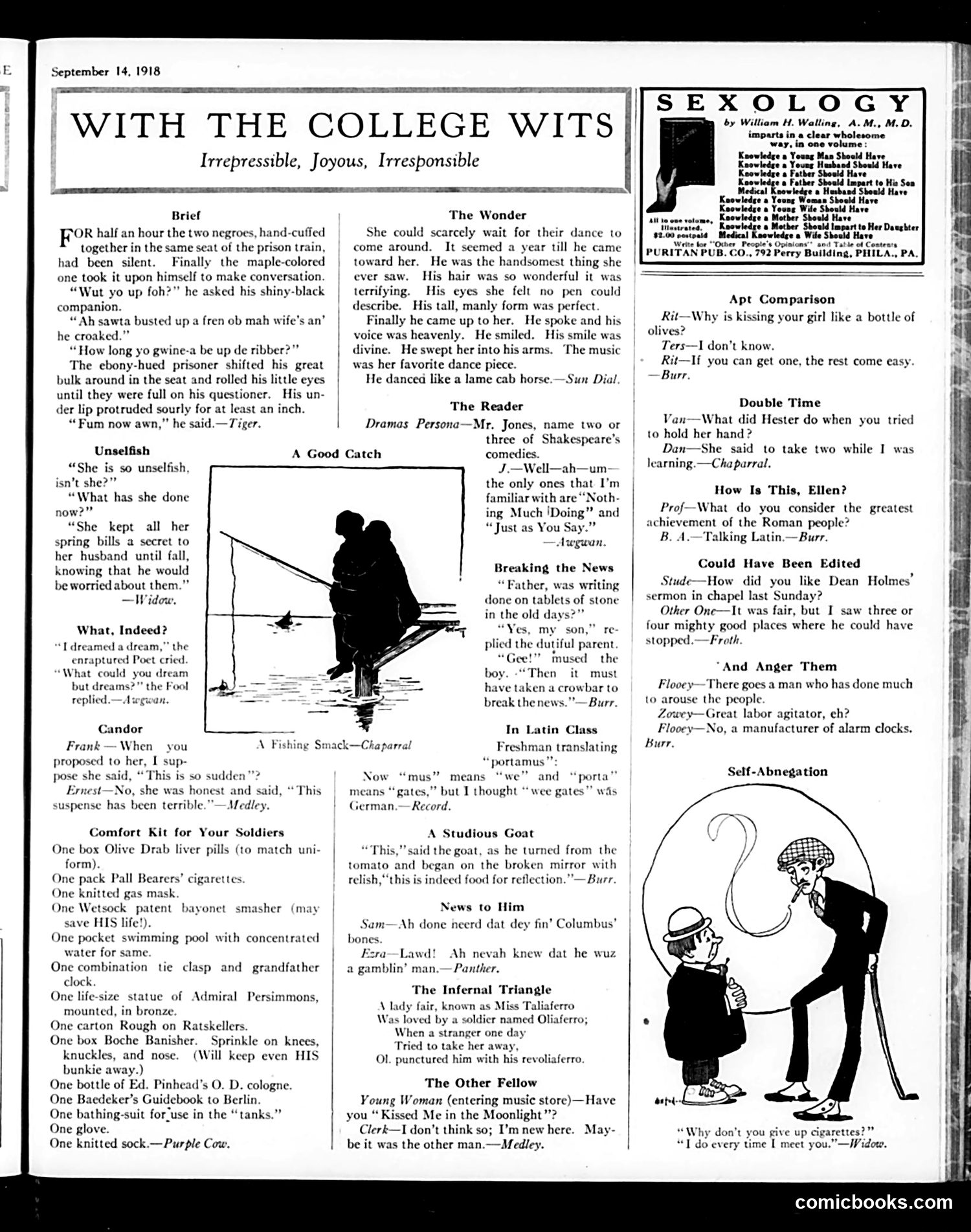
This page collects brief comic sketches from college magazines, typical of Judge's early 20th-century humor. Key elements: **Major Content:** The sketches mock college life and romantic pretension. "The Wonder" satirizes the gap between swooning expectations and reality—a woman idealizes a handsome man only for him to dance "like a lame cab horse." "The Reader" shows a student unable to name Shakespeare plays. "In Latin Class" jokes about a student mishearing Latin (misinterpreting "portamus" as "wee gates"). **Context:** Published September 1918 (near WWI's end), several sketches reference soldiers and military humor—the "Comfort Kit" section mockingly lists absurd items for servicemen, playing on war-supply sentimentality. **Tone:** Gentle, collegiate humor relying on puns, romantic irony, and linguistic mishaps rather than sharp satire. The racial dialect humor reflects period conventions but is notably offensive today. The page represents mainstream American magazine humor of the era: lightweight, youth-oriented, and primarily concerned with courtship and academic misadventures.
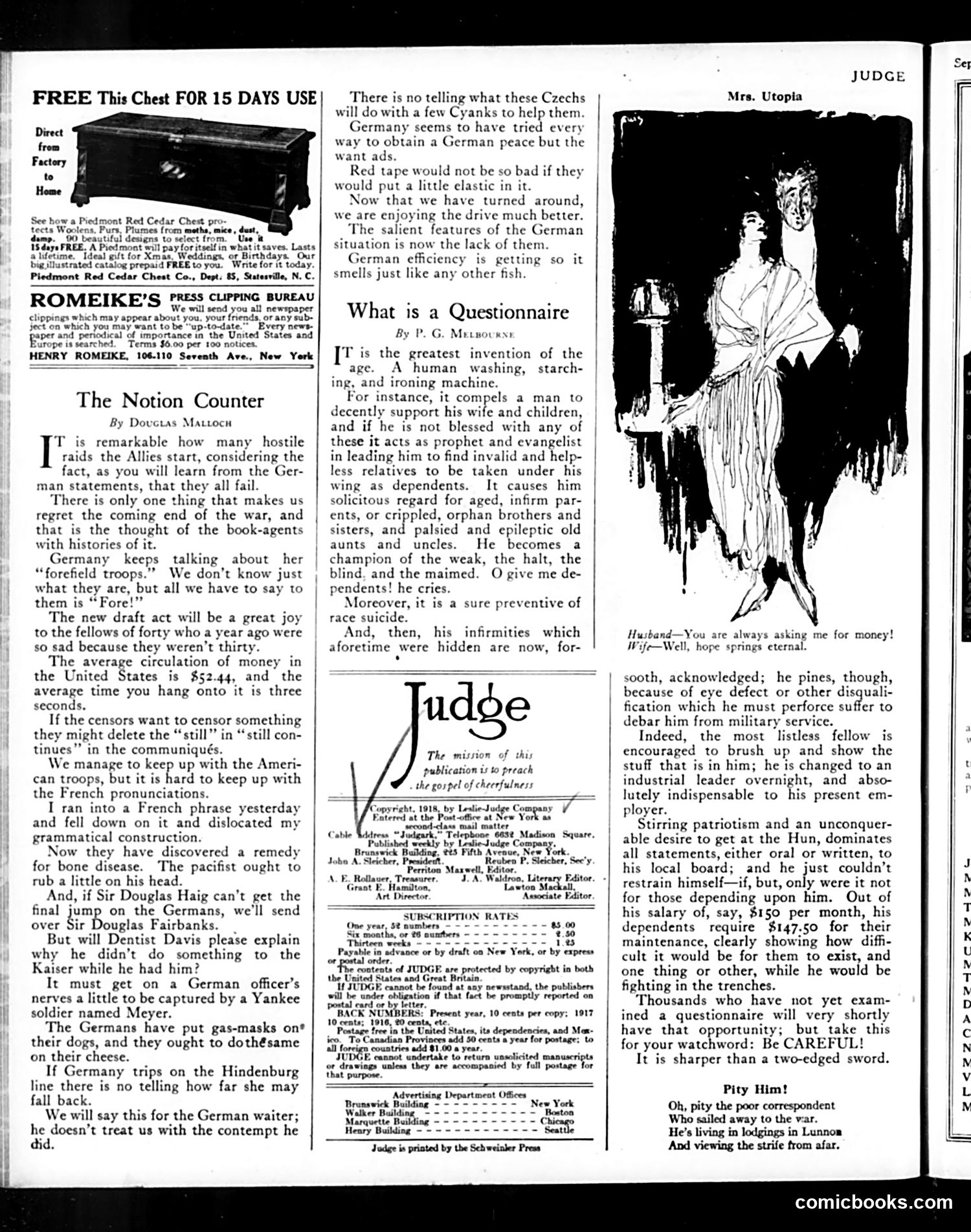
This page contains satirical commentary on World War I-era American life and the war effort, typical of Judge's irreverent humor. **"The Notion Counter"** by Douglas Malloch offers brief, punchy jokes about wartime topics: Allied military failures (according to German claims), the upcoming draft, French language difficulties, and various war-related absurdities. The humor relies on wordplay and contemporary references—the mention of "Sir Douglas Fairbanks" (the famous actor) sending him to fight the Kaiser, or jokes about German efficiency and discipline deteriorating. **"What is a Questionnaire"** by P.G. Wodehouse satirizes government questionnaires (likely military draft or census forms) as devices forcing men to acknowledge financial dependents—wives, children, elderly relatives—making them financially responsible. The piece mocks how such bureaucratic tools manipulate men into admitting their obligations. The page also includes advertisements for a cedar chest and a press clipping service, typical of the era. The illustration labeled "Mrs. Utopia" appears unrelated to the text content.
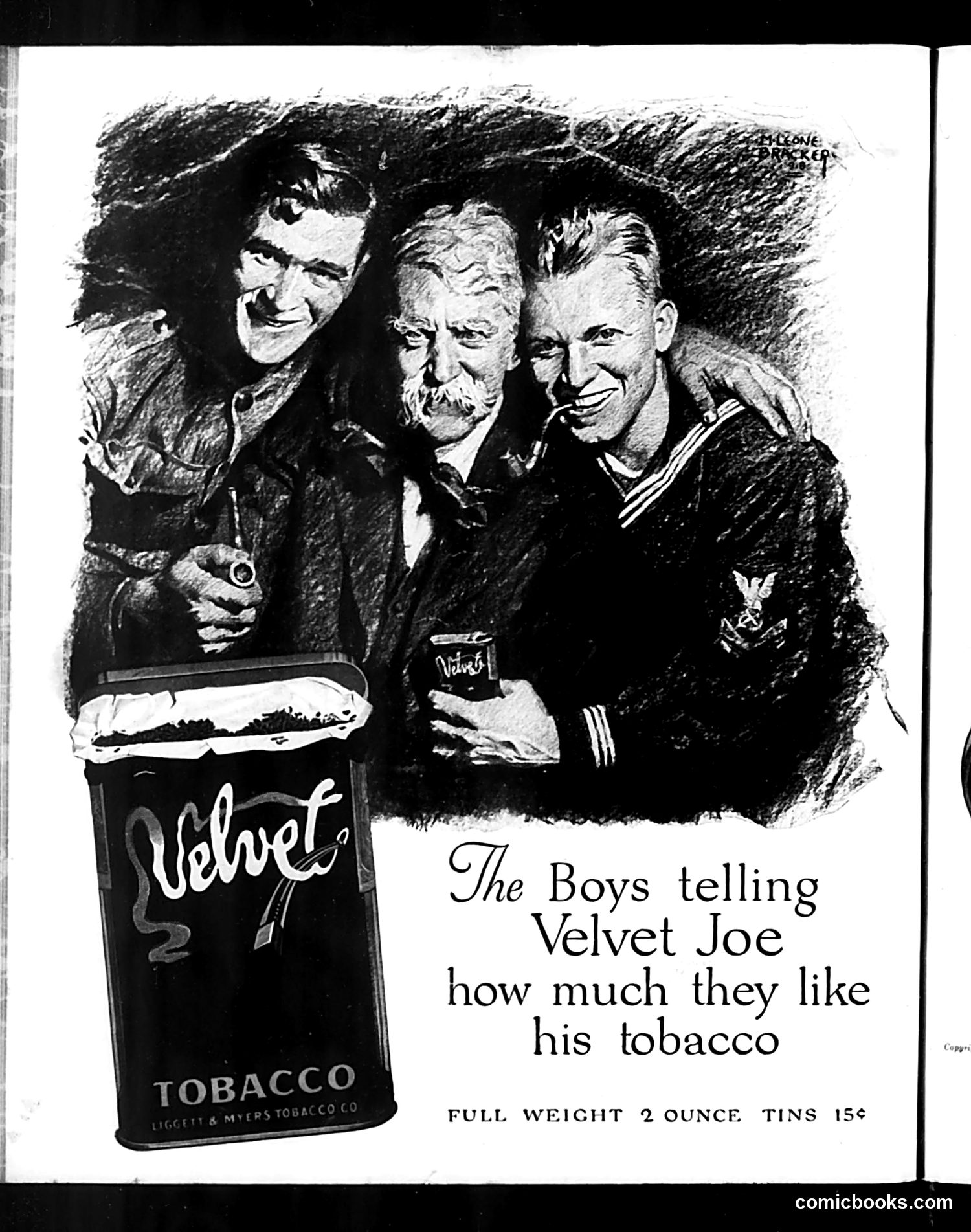
This is a **tobacco advertisement**, not political satire. It depicts three men in military uniforms (likely World War I era, given the styling) enthusiastically endorsing "Velvet Joe" tobacco to each other. The humor relies on the casual, friendly tone—"the boys" casually praising the product as if sharing genuine peer recommendations rather than formal advertising. The military context suggests this ad targeted soldiers, a major consumer demographic for tobacco during wartime. The phrase "Velvet Joe" personifies the product as a friendly character these servicemen trust. The advertisement emphasizes value ("full weight 2 ounce tins 15¢") while using social proof—if soldiers liked it, civilians would too. This represents early 20th-century advertising strategy: associating consumer products with military masculinity and camaraderie.