
Judge, 1918-09-14 · page 8 of 32
Judge — September 14, 1918 — page 8: what you’re looking at
What you’re looking at
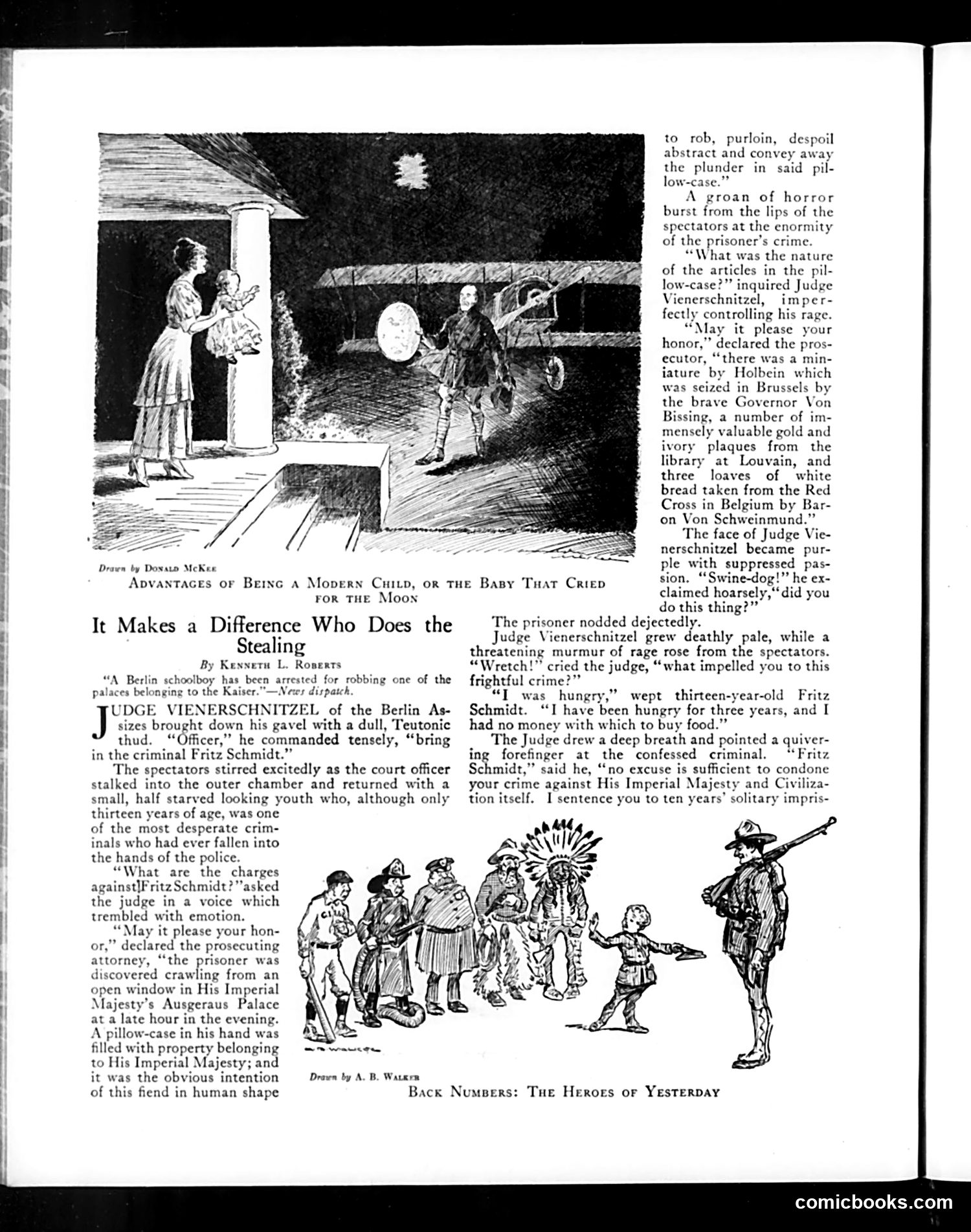
This satirical story mocks German military authority during WWI. Judge Vienerschnitzel presides over a Berlin court where thirteen-year-old Fritz Schmidt faces harsh punishment for stealing from the Kaiser's palace—items that ironically include artworks and supplies themselves stolen by German forces from occupied Belgium and France (Governor Von Bissing's seizures in Brussels, artifacts from Louvain library, Red Cross bread). The satire's point: the judge condemns the starving boy's desperation theft while the German military loots entire nations with impunity. The title emphasizes the hypocrisy—*who* steals determines justice. A child stealing bread to survive faces ten years imprisonment, while occupying officers strip conquered territories unpunished. The story exposes the moral bankruptcy of German militarism and the arbitrary nature of "justice" under imperial rule.
📄 Transcribed text from this page (OCR, searchable)
Machine-transcribed from the original scan — historical spelling and the odd misread are preserved.
-_ // def ES ae ee Se SS, eee coe ——————— Drawn by Doxato McKee Apvantaces or Betnc A Mopern Cuitp, or THE Basy Tuat Crtep FoR THE Moon It Makes a Difference Who Does the Stealing By Kexxetu L. Roserts “A Berlin schoolboy has been arrested for robbing one of the palaces belonging to the Kaiser."—News dispatch. UDGE VIENERSCHNITZEL of the Berlin As- J sizes brought down his gavel with a dull, Teutonic thud. “Officer,” he commanded tensely, “bring in the criminal Fritz Schmidt.” The spectators stirred excitedly as the court officer stalked into the outer chamber and returned with a small, half starved looking youth who, although only thirteen years of age, was one of the most desperate crim- inals who had ever fallen into the hands of the police. “What are the charges against]FritzSchmidt? "asked the judge in a voice which trembled with emotion. “May it please your hon- or,” declared the prosecuting attorney, “the prisoner was discovered crawling from an open window in His Imperial Majesty’s Ausgeraus Palace at a late hour in the evening. A pillow-case in his hand was filled with property belonging to His Imperial Majesty; and it was the obvious intention of this fiend in human shape Drawn by A. B. Watarn Back Numbers: Tue Heroes or YESTERDAY to rob, purloin, despoil abstract and convey away the plunder in said pil- low-case.”” A groan of horror burst from the lips of the spectators at the enormity of the prisoner’s crime. “What was the nature of the articles in the pil- low-case?”’ inquired Judge Vienerschnitzel, imper- fectly controlling his rage. “May it please your honor,” declared the pros- ecutor, “there was a min- iature by Holbein which was seized in Brussels by the brave Governor Von Bissing, a number of im- menscly valuable gold and ivory plaques from the library at Louvain, and three loaves of white bread taken from the Red Cross in Belgium by Bar- on Von Schweinmund.” The face of Judge Vie- nerschnitzel became pur- ple with suppressed pas- sion. “Swine-dog!”’ he ex- claimed hoarsely,‘‘did you do this thing?” The prisoner nodded dejectedly. Judge Vienerschnitzel grew deathly pale, while a threatening murmur of rage rose from the spectators. “Wretch!” cried the judge, “what impelled you to this frightful crime?” “T was hungry,” wept thirteen-year-old Fritz Schmidt. “I have been hungry for three years, and I had no money with which to buy food.” The Judge drew a deep breath and pointed a quiver- ing forefinger at the confessed criminal. ‘‘Fritz Schmidt,” said he, “no excuse is sufficient to condone your crime against His Imperial Majesty and Civ tion itself. I sentence you to ten years’ solitary impris- comicbooks.com