
Judge, 1918-09-14 · page 19 of 32
Judge — September 14, 1918 — page 19: what you’re looking at
What you’re looking at
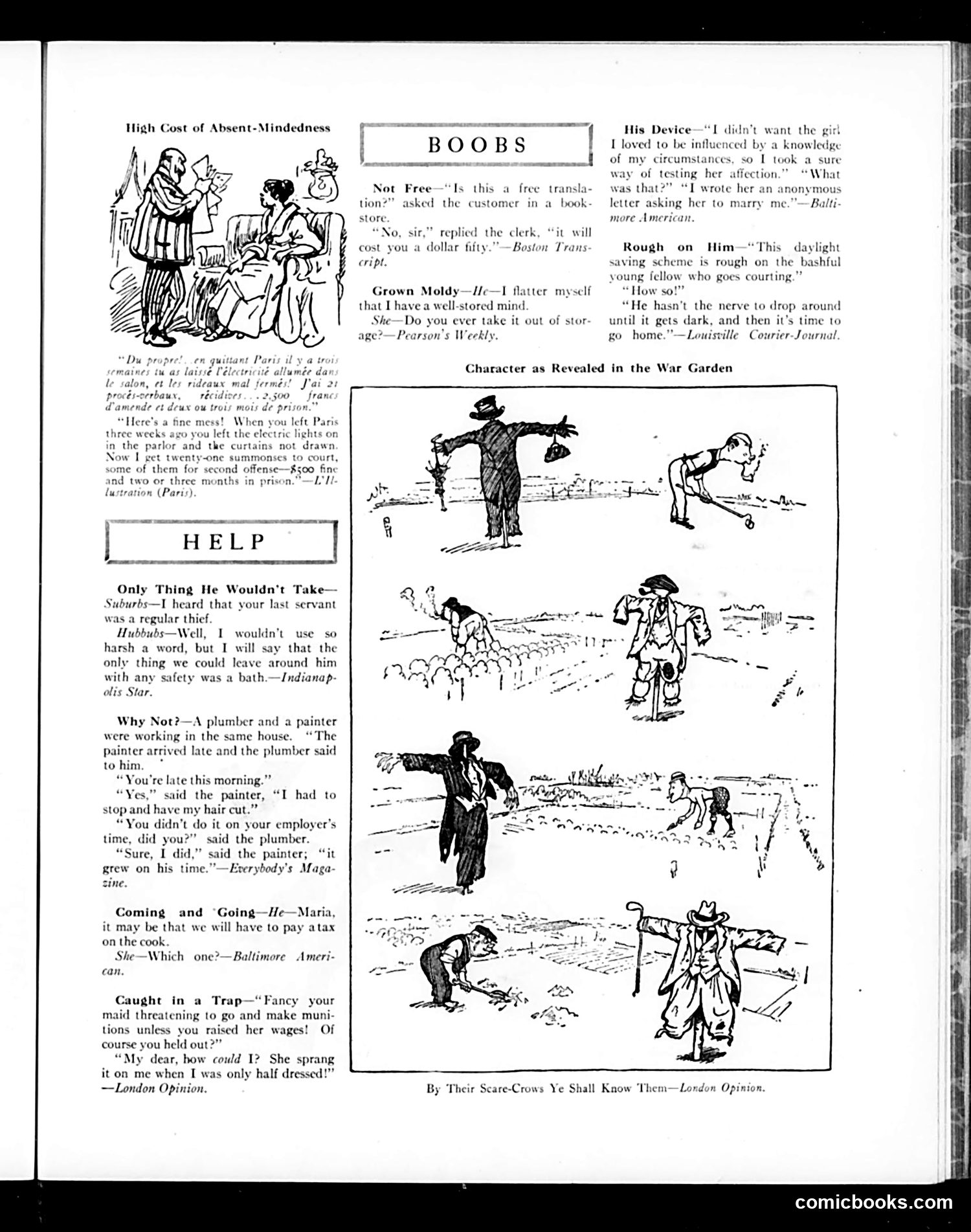
This page contains six brief humorous anecdotes and a central cartoon about wartime vegetable gardens. **The Jokes:** All are light domestic humor typical of early-20th-century magazines—absent-minded hosts leaving lights on in Paris (causing legal fines), servants who steal everything except bathtubs, timing mishaps, and wartime tax anxiety. The humor relies on wordplay and class-conscious situations (servant problems, household help). **The Main Cartoon:** "Character as Revealed in the War Garden" illustrates how people's personalities show through their scarecrow designs. Different figures construct scarecrows in their own images—one lazy/slouching, one military-rigid, one elegant with a cane. The caption suggests wartime vegetable gardens (likely WWI-era rationing) reveal character through how people protect their crops. **Context:** Judge was a weekly satirical magazine; this appears to be wartime content, probably 1917-1918, when American home gardening was encouraged for food security. The scarecrow humor gently satirizes social types through their gardening choices.
📄 Transcribed text from this page (OCR, searchable)
Machine-transcribed from the original scan — historical spelling and the odd misread are preserved.
High Cost of Absent-Mindedness procés-cerbaux, d'amende et deux ow troi “Here's a fine mess! When you left Paris three weeks ago you left the electric | nthe parlor and the curtal Now I get twenty-one sum: some of them for second offense— ind two or three months in pris lustration (Paris). Only Thing He Wouldn't Take— Suburbs—I heard that your last servant was a regular thief Hubbubs—Well, 1 wouldn't use so harsh a word, but I will say that the only thing we could leave around him with any safety was a bath.—Indianap- olis Star. Why Not?—A plumber and a painter were working in the same house. “The painter arrived late and the plumber said to him. “You're late this morning.” “Yes,” said the painter, “I had to stop and have my hair cut.” “You didn’t do it on your employer's time, did you?” said the plumbe said the painter; “it grew on his time.”—Everybody's Maga- sine. Coming and *‘Going—He—Maria, it may be that we will have to pay atax on the cook. She—Which one?—Baltimore can. Ameri- Caught in a Trap—“Fancy your maid threatening to go and make muni- tions unless you raised her wages! Of course you held out?” “My dear, bow could I? She sprang it on me when I was only half dressed!” —London Opinion. Not Free—‘Is this a free transla- tion?” asked the customer in a book- store “No, sir,” cost you a dollar fifty.”” cript. replied the clerk, “it will Boston Trans Grown Moldy—He—I flatter myself that I have a well-stored mind She—Do you ever take it out of stor age?— Pearson's W. His Device—“I didn’t want the girl I loved to be influenced by a knowledge of my circumstances, so I took a. sure way of testing her affection.” “What was that?” “I wrote her an anonymous letter asking her to marry me.”’—Balti- more American, Rough on Him—"This daylight saving scheme is rough on the bashful young fellow who goes courting.” “He hasn't the nerve to drop around until it gets dark, and then it’s time go home.”—Louisville Courier-Journal Character as Revealed in the War Garden By Their Scare-Crows Ye Shall Know ‘Them London Opinion. comicbooks.com