
Judge, 1918-09-14 · page 11 of 32
Judge — September 14, 1918 — page 11: what you’re looking at
What you’re looking at
This is a WWI-era romantic drama by J.A. Waldron, not political satire. The illustrated story, set in Paris spring 1914, depicts four characters: Lieutenant Fleury (French Army), Mademoiselle Brienne (his fiancée), American engineer Archie Macafee, and Otto von Glatz (German Embassy attaché). The narrative establishes dramatic irony through competing romantic interests—all three men court Brienne, but she chooses Fleury. Von Glatz's resentful exit foreshadows later developments. The story then jumps forward: Fleury dies at the Battle of the Marne; Brienne becomes a nurse; Von Glatz disappears; and Macafee returns to America, later reappearing as a Captain. The "fate's moment" likely refers to how wartime reshuffles romantic outcomes. This reads as sentimental wartime fiction rather than satire—using personal relationships to explore how WWI disrupted civilian life.
📄 Transcribed text from this page (OCR, searchable)
Machine-transcribed from the original scan — historical spelling and the odd misread are preserved.
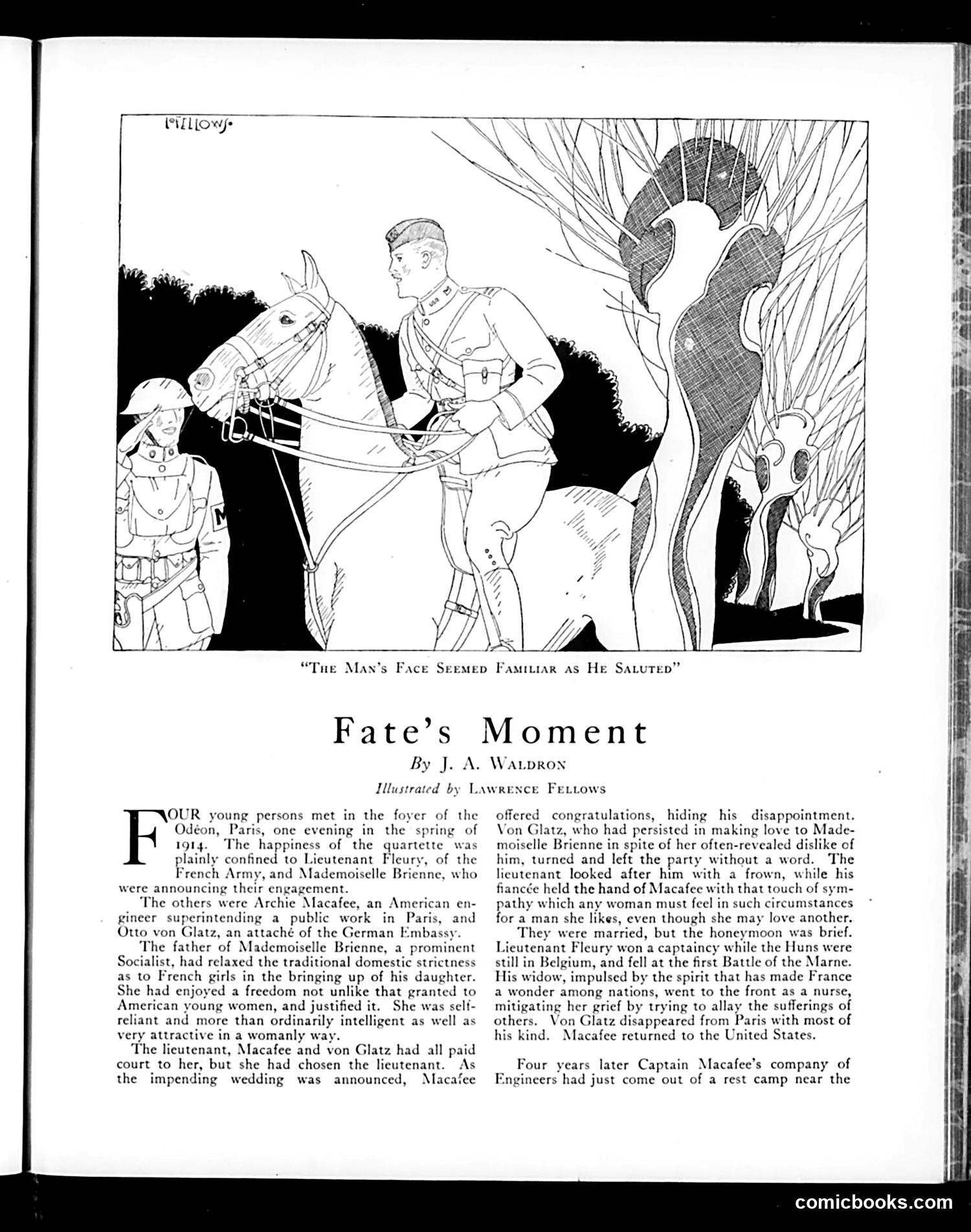
Pillow “The May’s Face Seemep Famittar as He Satutep” Fate’s Moment By J. A. Watpron Illustrated by Lawrence Fettrows OUR young persons met in the foyer of the Odéon, Paris, one evening in the spring of 1914. The happiness of the quartette was plainly confined to Lieutenant Fleury, of the French Army, and Mademoiselle Brienne, who were announcing their engagement. The others were Archie Macafee, an American en- gineer superintending a public work in Paris, and Otto von Glatz, an attaché of the German Embassy. The father of Mademoiselle Brienne, a prominent Socialist, had relaxed the traditional domestic strictness as to French girls in the bringing up of his daughter. She had enjoyed a freedom not unlike that granted to American young women, and justified it. She was self- reliant and more than ordinarily intelligent as well as very attractive in a womanly way. The lieutenant, Macafee and von Glatz had all paid court to her, but she had chosen the lieutenant. As the impending wedding was announced, Macafee offered congratulations, hiding his disappointment. Von Glatz, who had persisted in making love to Made- moiselle Brienne in spite of her often-revealed dislike of him, turned and left the party without a word. The lieutenant looked after him with a frown, while his fiancée held the hand of Macafee with that touch of sym- pathy which any woman must feel in such circumstances for a man she likes, even though she may love another. They were married, but the honeymoon was brief. Lieutenant Fleury won a captaincy while the Huns were still in Belgium, and fell at the first Battle of the Marne. His widow, impulsed by the spirit that has made France a wonder among nations, went to the front as a nurse, mitigating her grief by trying to allay the sufferings of others. Von Glatz disappeared from Paris with most of his kind. Macafee returned to the United States. Four years later Captain Macafee’s company of Engineers had just come out of a rest camp near the comicbooks.com