
Judge, 1918-09-14 · page 12 of 32
Judge — September 14, 1918 — page 12: what you’re looking at
What you’re looking at
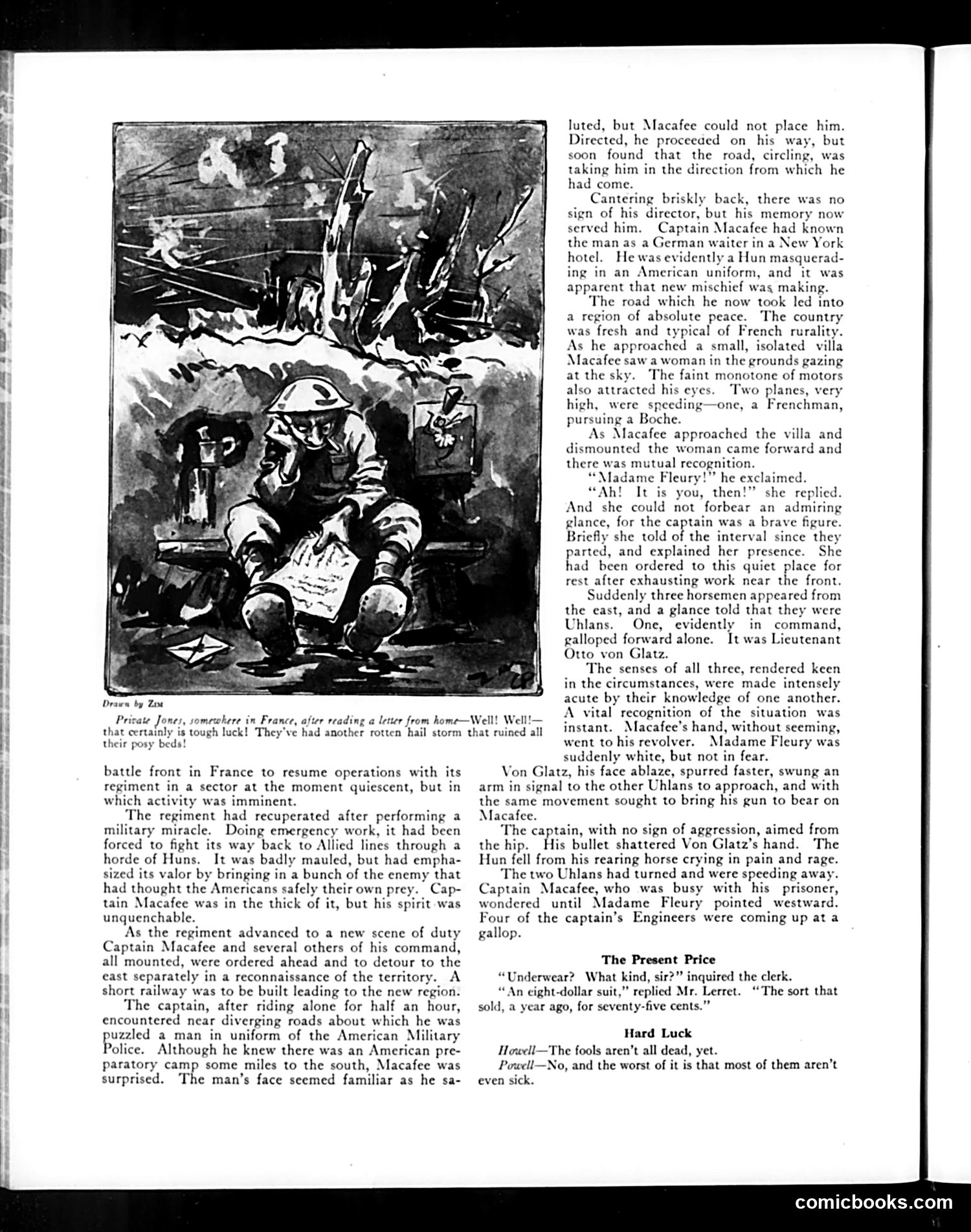
This page contains two distinct pieces of WWI-era content: **The Cartoon (top):** A brief satirical joke about a soldier receiving mail from home. The humor is that while fighting on the Western Front, Private Jones receives a letter describing his family's trivial domestic problem—a hailstorm damaged their flower beds. The joke mocks the disconnect between soldiers' life-or-death experiences in France and the petty concerns of the home front. **The Story (main text):** An adventure narrative about Captain Macafee encountering a German spy (posing as an American Military Policeman, revealed to be a waiter he knew from New York). The captain then meets an old acquaintance, Madame Fleury, at a French villa, where they're attacked by German Uhlans (cavalry). Macafee shoots the attacking officer, Von Glatz, and is rescued by American Engineers arriving opportunely. This appears to be patriotic wartime fiction emphasizing American bravery and vigilance against German deception and aggression.
📄 Transcribed text from this page (OCR, searchable)
Machine-transcribed from the original scan — historical spelling and the odd misread are preserved.
wen by Zim Prisate Jones, somewhere in France, after reading a letter from home—Well! Well!— that certainly is tough luck! They've had another rotten hail storm that ruined all their posy beds! battle front in France to resume operations with its regiment in a sector at the moment quiescent, but in which activity was imminent. The regiment had recuperated after performing a military miracle. Doing emergency work, it had been forced to fight its way back to Allied lines through a horde of Huns. It was badly mauled, but had empha- sized its valor by bringing in a bunch of the enemy that had thought the Americans safely their own prey. Cap- tain Macafee was in the thick of it, but his spirit -was unquenchable. As the regiment advanced to a new scene of duty Captain Macafee and several others of his command, all mounted, were ordered ahead and to detour to the east separately in a reconnaissance of the territory. A short railway was to be built leading to the new region. The captain, after riding alone for half an hour, encountered near diverging roads about which he was puzzled a man in uniform of the American Military Police. Although he knew there was an American pre- paratory camp some miles to the south, Macafee was surprised. The man’s face seemed familiar as he sa- luted, but Macafee could not place him. Directed, he proceeded on his way, but soon found that the road, circling, was taking him in the direction from which he had come. Cantering briskly back, there was no sign of his director, but his memory now served him. Captain Macafee had known the man as a German waiter in a New York hotel. He was evidently a Hun masquerad- ing in an American uniform, and it was apparent that new mischief was making. The road which he now took led into a region of absolute peace. The country was fresh and typical of French rurality. As he approached a small, isolated villa Macafee saw a woman in the grounds gazing at the sky. The faint monotone of motors also attracted his eyes. Two planes, very high, were speeding—one, a Frenchman, pursuing a Boche. As Macafee approached the villa and dismounted the woman came forward and there was mutual recognition. “Madame Fleury!” he exclaimed. “Ah! It is you, then!” she replied. And she could not forbear an admiring glance, for the captain was a brave figure. Briefly she told of the interval since they parted, and explained her presence. She had been ordered to this quiet place for rest after exhausting work near the front. Suddenly three horsemen appeared from the east, and a glance told that they were Uhlans. One, evidently in command, galloped forward alone. It was Lieutenant Otto von Glatz. The senses of all three, rendered keen in the circumstances, were made intensely acute by their knowledge of one another. A vital recognition of the situation was instant. Macafee’s hand, without seeming, went to his revolver. Madame Fleury was suddenly white, but not in fear. Von Glatz, his face ablaze, spurred faster, swung an arm in signal to the other Uhlans to approach, and with the same movement sought to bring his gun to bear on Macafee. The captain, with no sign of aggression, aimed from the hip. His bullet shattered Von Glatz’s hand. The Hun fell from his rearing horse crying in pain and rage. The two Uhlans had turned and were speeding away. Captain Macafee, who was busy with his prisoner, wondered until Madame Fleury pointed westward. Four of the captain’s Engineers were coming up at a gallop. The Present Price “Underwear? What kind, sir?” inquired the clerk. “An eight-dollar suit,” replied Mr. Lerret. ‘‘The sort that sold, a year ago, for seventy-five cents.” Hard Luck Howell—The fools aren’t all dead, yet. Powell—No, and the worst of it is that most of them aren’t even sick. comicbooks.com