
Judge, 1918-09-14 · page 20 of 32
Judge — September 14, 1918 — page 20: what you’re looking at
What you’re looking at
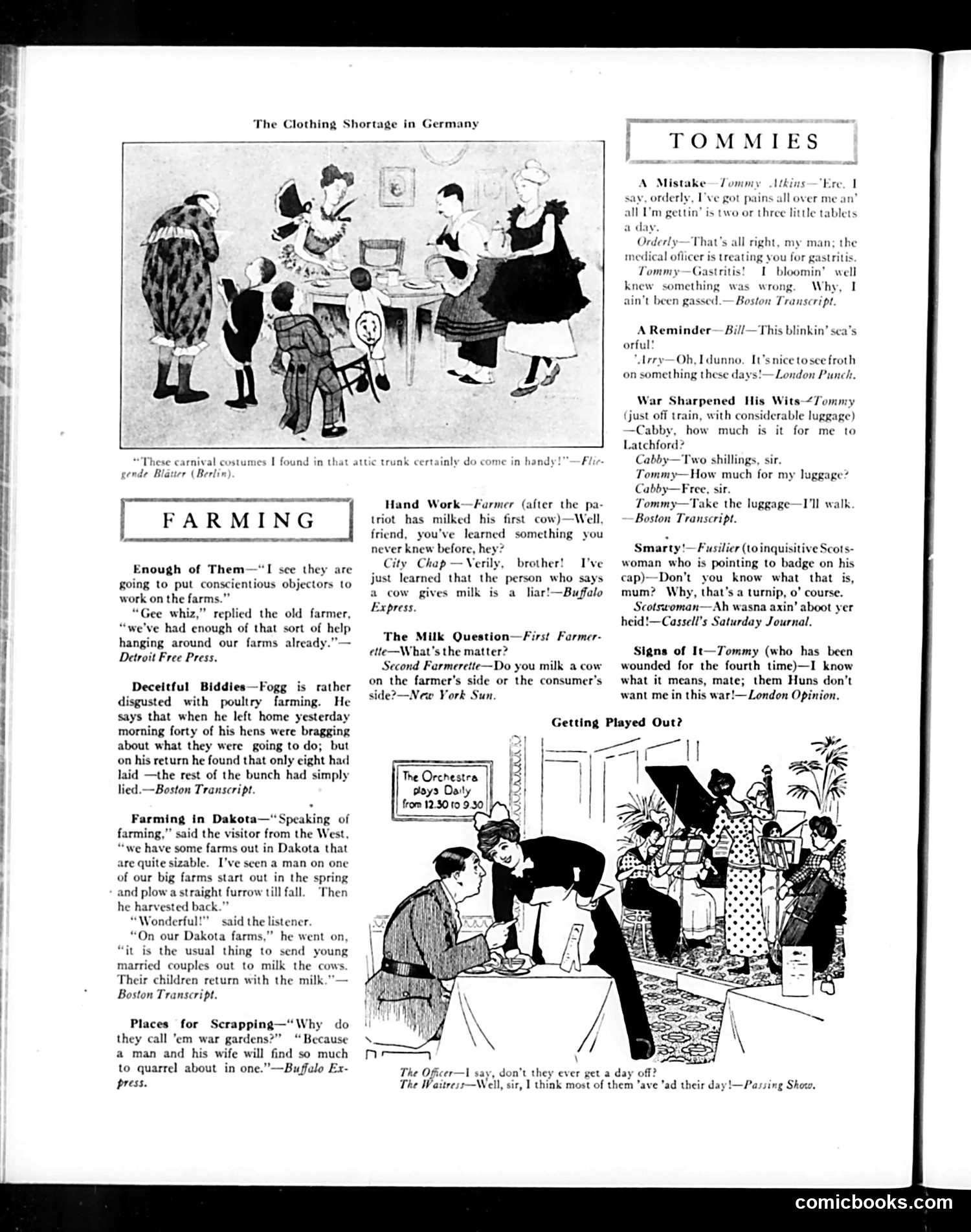
This Judge magazine page contains two separate humor sections from WWI-era America. **"The Clothing Shortage in Germany"** (top-left) is a single cartoon satirizing German wartime deprivation. The caption suggests Germans are reduced to wearing old carnival costumes from attics because of fabric shortages caused by the war. **"Farming" and "Tommies"** sections are collections of short jokes rather than political cartoons. The farming jokes mock conscientious objectors and city people attempting farm work during wartime labor shortages. The "Tommies" section features jokes about British soldiers ("Tommy" being slang for British infantrymen), covering military medical care, trench conditions, and taxi negotiations. The humor is gentle workplace and military comedy typical of wartime publications—poking fun at incompetence, bureaucracy, and the gap between civilians and soldiers, rather than advancing serious political argument. The content reflects American attitudes toward the British war effort and domestic wartime challenges circa 1914-1918.
📄 Transcribed text from this page (OCR, searchable)
Machine-transcribed from the original scan — historical spelling and the odd misread are preserved.
| The Clothing Shortage in Germany “These carnival costumes gende Blaucr (Be j FARMIN Enough of Them—“I sce they are going to put conscientious objectors to work on the farms.” “Gee whiz,” replied the old farmer, “we've had enough of that sort of help hanging around our farms already.” — Detroit Free Press. Deceitful Biddies—Fogg is rather disgusted with poultry farming. He says that when he left home yesterday morning forty of his hens were bragging about what they were going to do; but on his return he found that only eight had laid —the rest of the bunch had simply lied.—Boston Transcript. Farming in Dakota—“ Speaking of farming,” said the visitor from the West, “we have some farms out in Dakota that are quite sizable. I've scen a man on one of our big farms start out in the spring and plow a straight furrow till fall. Then he harvested back.” Vonderful!” said the listener. “On our Dakota farms,” he went on, “it is the usual thing to send young married couples out to milk the cows. Their children return with the milk.”"— Boston Transcript. “Why do “Because Places for Scrappin: they call ‘em war garden: a man and his wife will find so much to quarrel about in one.”—Buffalo Ex- press. I found in that attic trunk certainly do come in handy!"—Flie- Hand Work—Farmer (after the pa- triot has milked his first cow)—Well, friend, you've learned something you never knew before, hey? City Chap —Verily, brother! I've just learned that the person who says a cow gives milk is a liar!—Buffalo Express. The Milk Question—First Farmer- ette—What's the matter? Second Farmerette—Do you milk a cow on the farmer's side or the consumer's side?—New York Sun ' TOMMIES A Mistake—Jommy Athins—'Ere. | say, orderly, I’ve got pains all over mean’ all I'm gettin’ is two or three little tablets a day. Orderly—That’s all right, my man; the medical oflicer is treating you for gastritis Tommy tritis! I bloomin’ well knew something was wrong. Why, I ain't been gassed.— Boston Transcript. A Reminder— Bill—This blinkin’ sea’s orful! *Arry—Oh, I dunno. It’snice tosce froth on something these days!—London Punch, War Sharpened His Wits-“7Tommy (just off train, with considerable luggage) —Cabby, how much is it for me to Latchford? Cabby—Two shillings, sir. Tommy—How much for my luggage? Cabby— . Tommy—Take the luggage—I'll walk Boston Transcript. Smarty !— Fusilier (to inquisitive Scots- woman who is pointing to badge on his cap)—Don’t you know what that is, mum? Why, that’s a turnip, o’ course. Scotswoman—Ah wasna axin’ aboot yer heid!—Cassell’s Saturday Journal. Signs of It—Tommy (who has been wounded for the fourth time)—I know what it means, mate; them Huns don’t want me in this war!—London Opinion. Getting Played Out? Th e Orchester Bays Daily | from 12.30 to 9.30 The Oficer—I say, don't they ever get a day off? The Waitress—Well, sir, | think most of them ’ave ‘ad their day!—Passing Show. comicbooks.com