
A complete issue · 32 pages · 1918
Judge — July 20, 1918
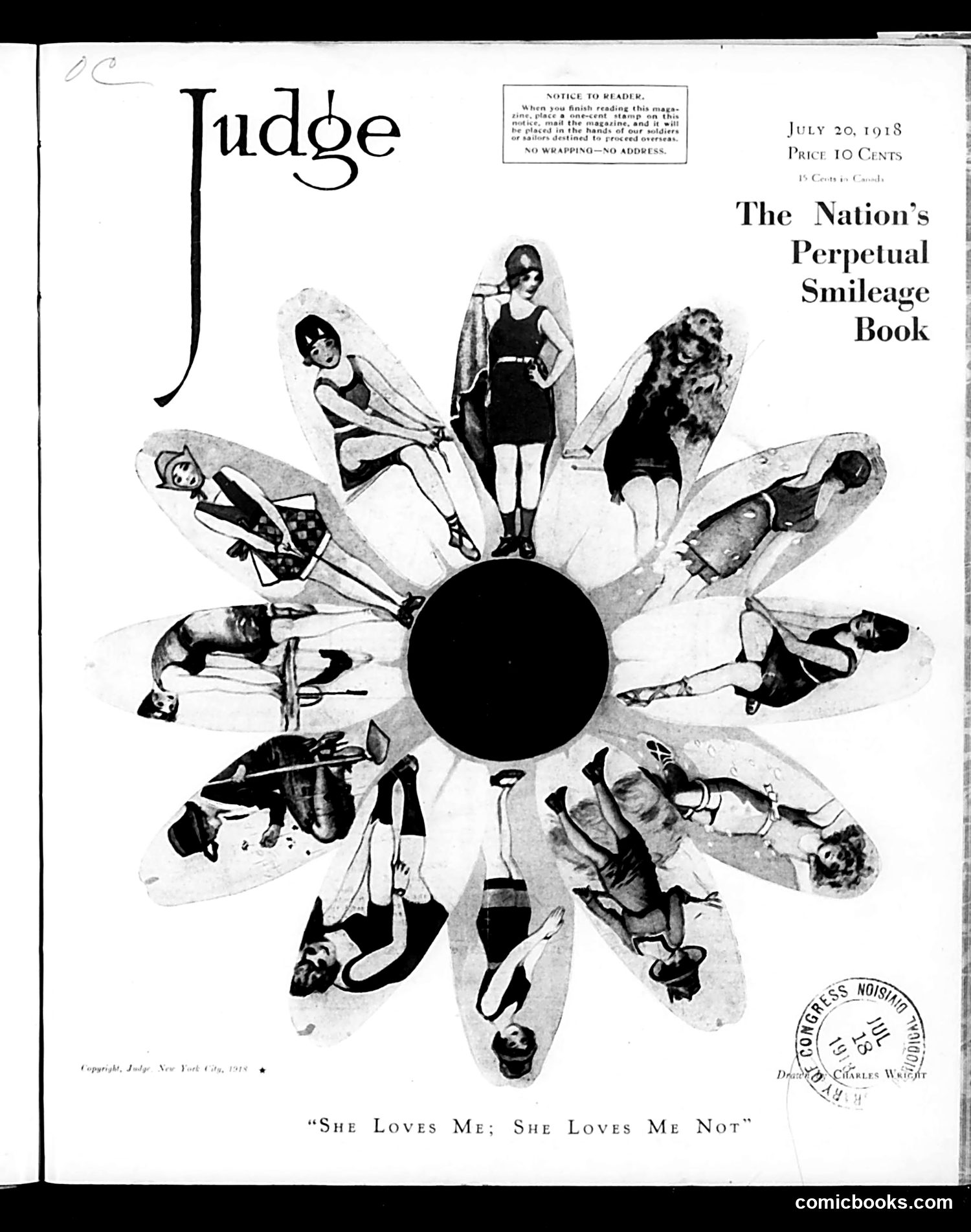
This cover satirizes romantic indecision through the daisy-plucking game "She Loves Me; She Loves Me Not." Twelve young women in 1918 fashions (short skirts, bobbed hair) are arranged in a flower pattern around a black circle, each in different poses suggesting various emotional states or romantic situations. The satire likely targets the social disruption of WWI-era dating customs. With many men overseas, women had increased independence and dating freedom, creating romantic uncertainty. The "perpetual smileage book" subtitle suggests women's changing social roles and expressions were subjects of masculine anxiety or mockery in this period. The design playfully presents feminine romantic ambivalence as a contemporary cultural phenomenon worthy of humorous treatment.
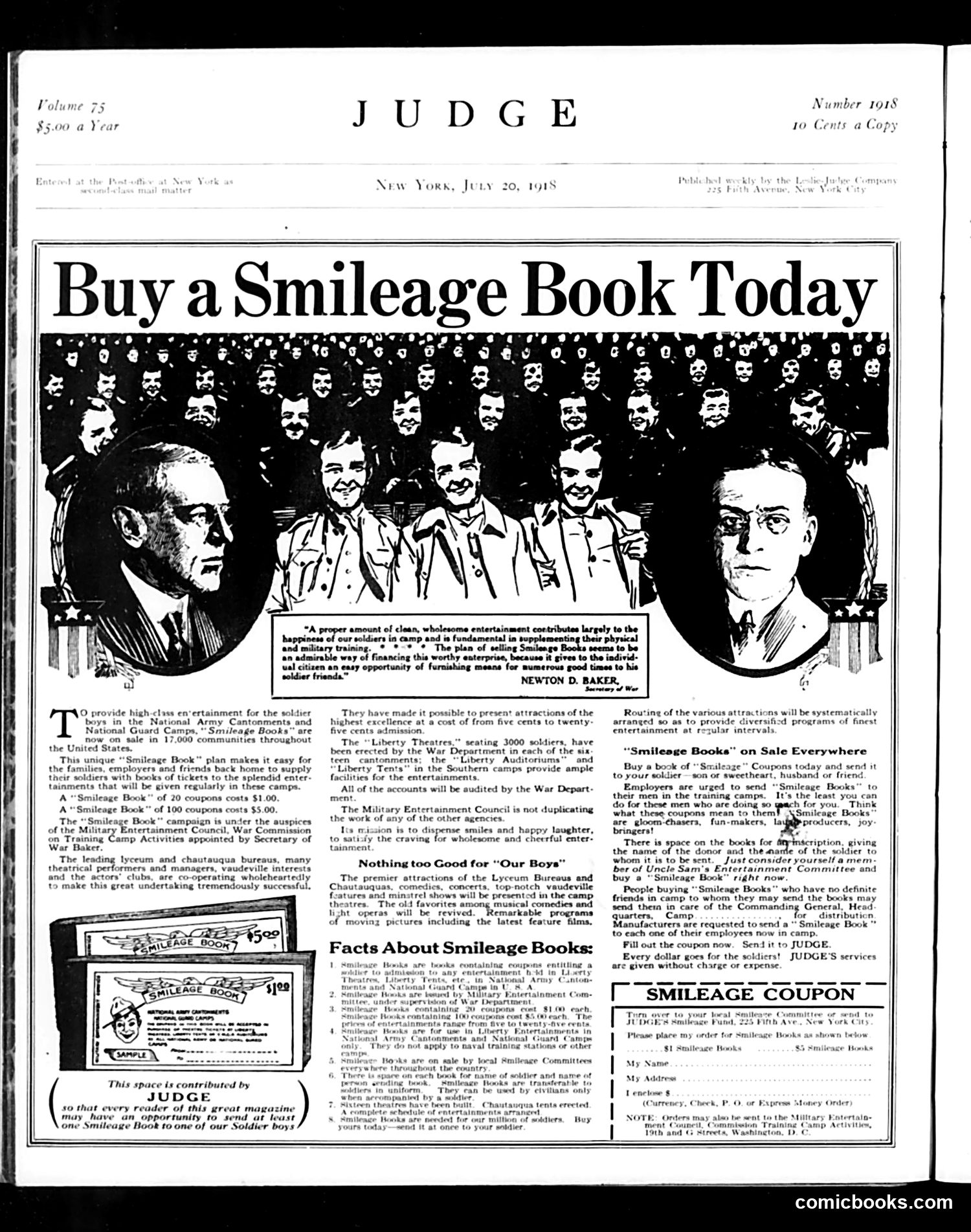
This page is primarily a **wartime fundraising advertisement**, not satire. It promotes "Smileage Books"—coupon booklets designed to finance entertainment for American soldiers in military camps during World War I. The central image shows soldiers smiling alongside two stern-faced men (likely military or government officials). The accompanying text emphasizes that wholesome entertainment is essential to soldier morale and training. Multiple theatrical venues are mentioned as providing performances. A quote attributes the campaign to **Newton D. Baker**, Secretary of War, lending government authority to the effort. The page includes a tear-out coupon encouraging readers to purchase and distribute Smileage Books to support troops. This represents typical WWI-era civilian mobilization for the war effort—using patriotic appeals and humor to raise funds for soldiers' welfare.
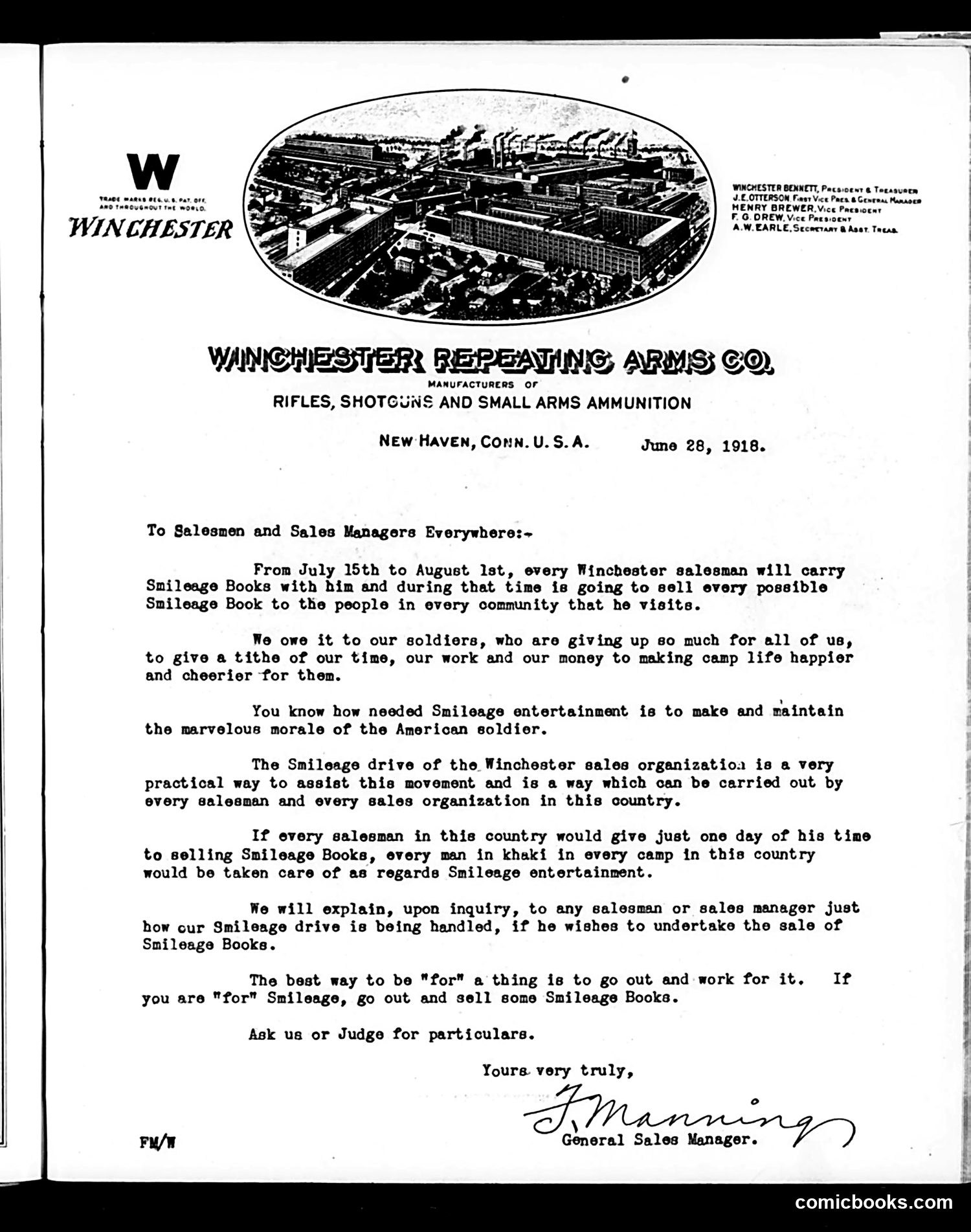
This page is **not a cartoon or satire**—it's a business letter from Winchester Repeating Arms Company (New Haven, Connecticut) dated June 28, 1918. The letter is addressed to salesmen and sales managers, promoting a "Smileage Books" campaign running July 15–August 1. Winchester is requesting salespeople donate one day's earnings to sell these books to soldiers in military camps, framing it as morale support for troops during World War I. The letter argues this is both patriotic duty and good business practice, claiming soldiers need entertainment to maintain morale. It concludes with an appeal for voluntary participation in the fundraising drive. This represents wartime corporate patriotism messaging rather than editorial satire.
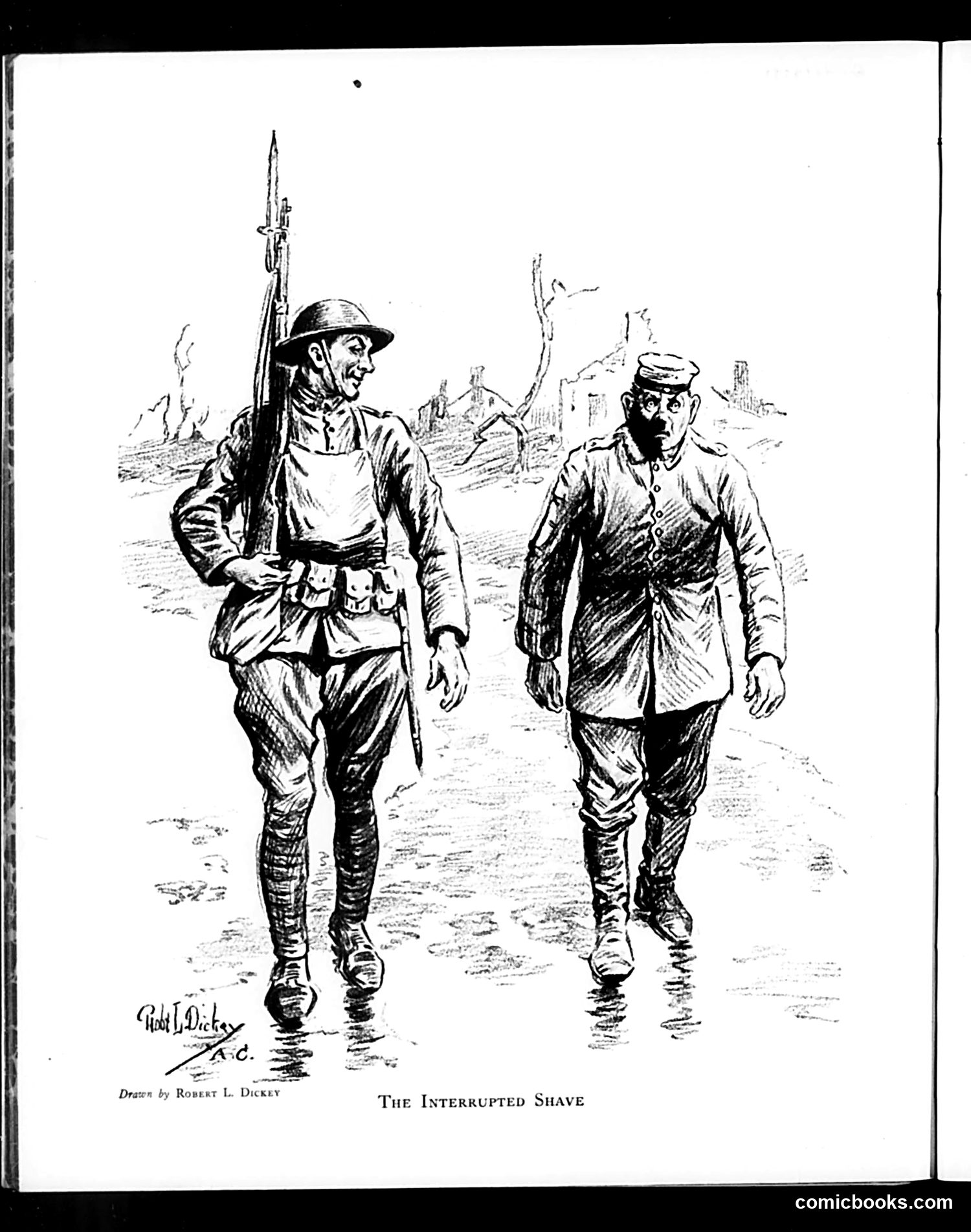
This cartoon by Robert L. Dickey depicts two soldiers in what appears to be a WWI-era trench or battlefield setting. The title "The Interrupted Shave" suggests the dark humor of military life — one soldier is attempting personal grooming despite the dangerous, muddy conditions of active warfare. The juxtaposition of mundane peacetime activity (shaving) with the grim reality of combat (destroyed landscape, military uniforms, weapons) creates the satire. The cartoon likely mocks either the absurdity of maintaining military discipline and appearance standards in horrific battlefield conditions, or comments on soldiers trying to preserve normalcy amid chaos. The figure on the left carries a rifle with bayonet, emphasizing the combat context.
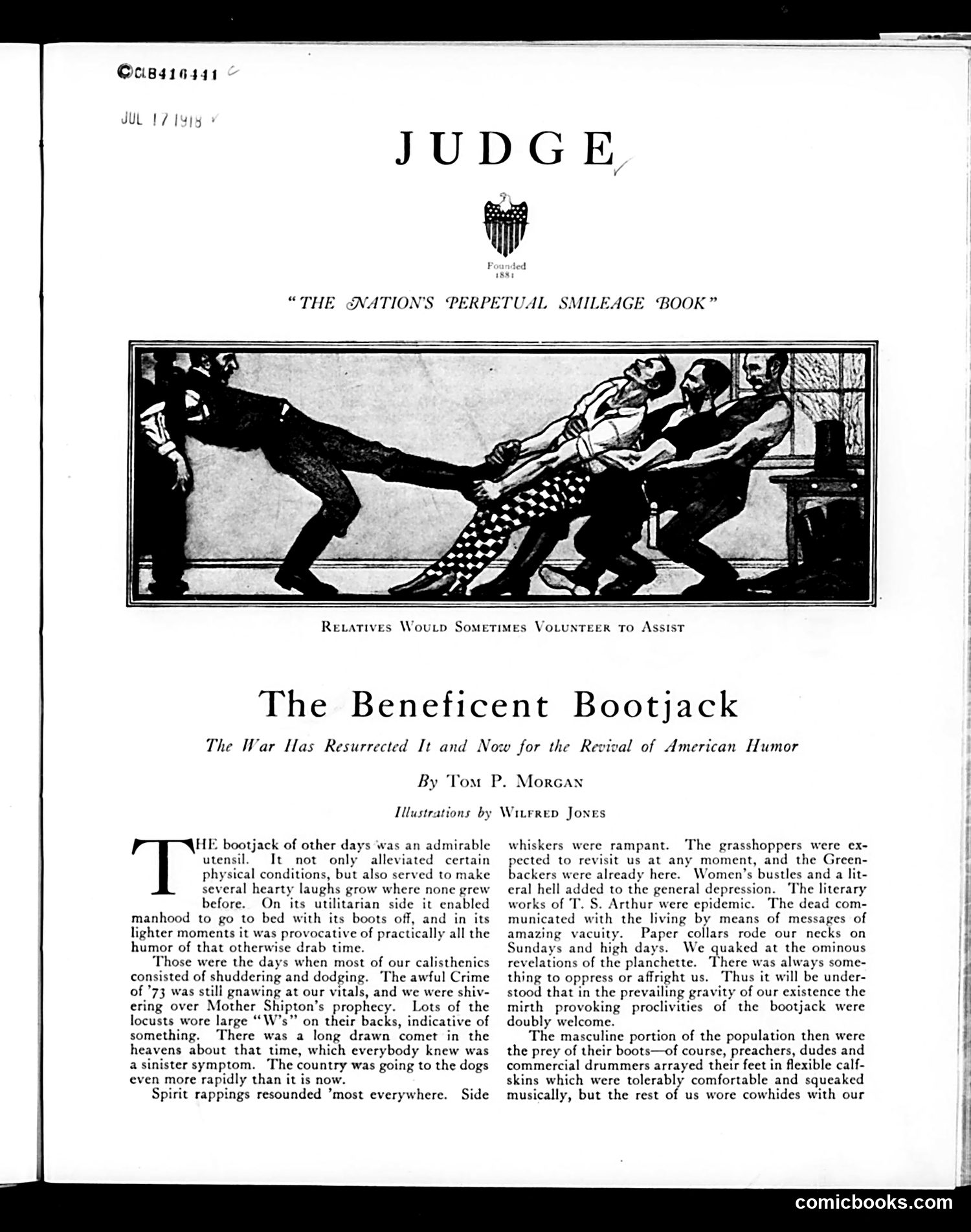
This satirical piece by Tom P. Morgan, illustrated by Wilfred Jones, uses the bootjack (a device for removing boots) as metaphor for humor's restorative social function during wartime. The cartoon depicts multiple figures struggling to pull off a large boot—likely representing collective effort to remove hardship or oppression. The caption states "Relatives Would Sometimes Volunteer to Assist," suggesting humor requires communal participation. Morgan's essay argues that pre-war American humor served important psychological purposes—providing relief from serious conditions and "mirth-provoking proclivities." He claims wartime circumstances have revived this tradition. The bootjack becomes emblematic of extracting society from difficult circumstances through laughter and satire, a recurring Judge magazine function during the World War I era.
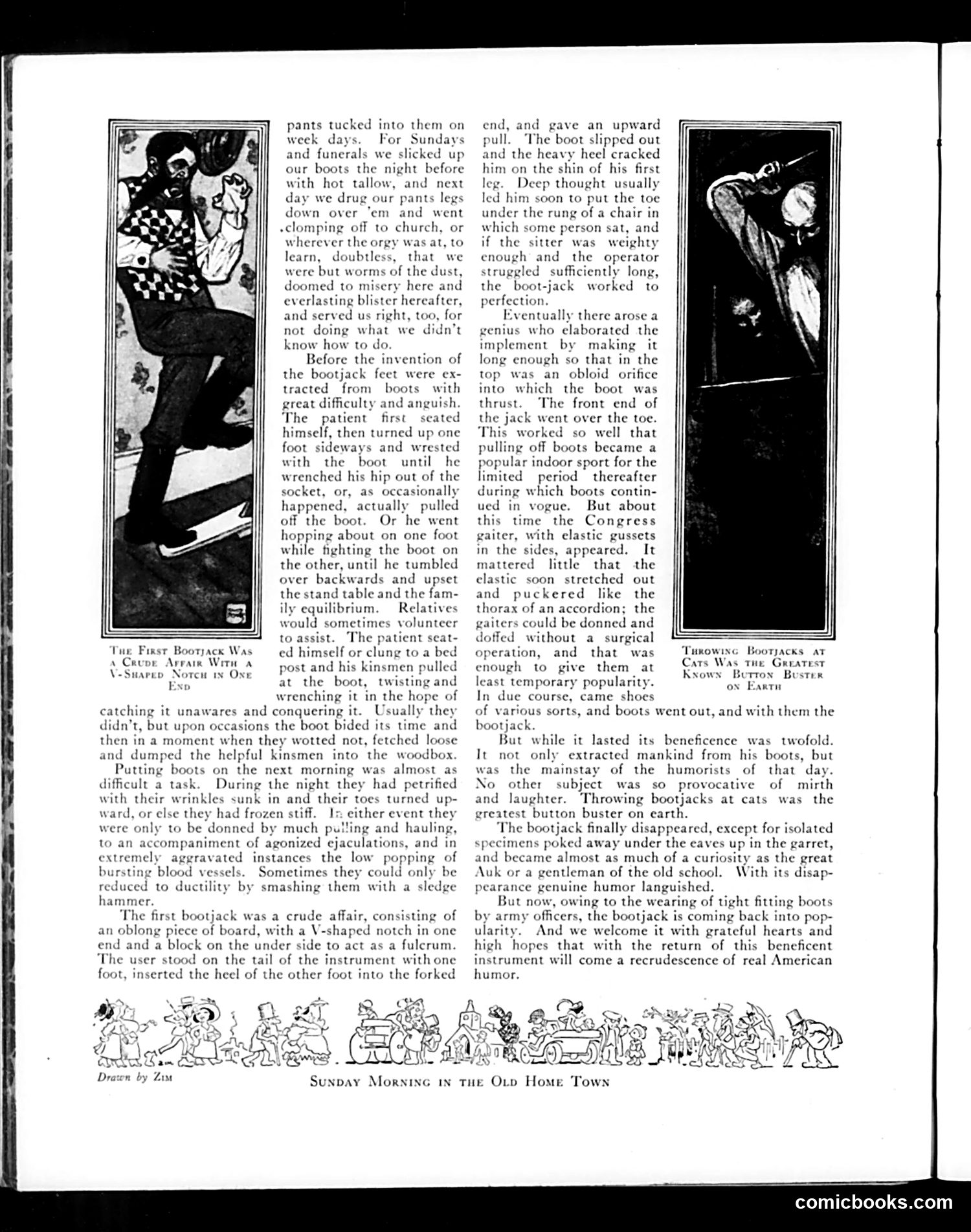
This page satirizes the bootjack—a device for removing boots—as an absurdly complicated solution to a mundane problem. The text describes the evolution from crude methods (wrestling boots off, hopping on one foot) to increasingly elaborate contraptions, culminating in the "Congress gaiter" with elastic gussets. The humor targets American mechanical ingenuity and patent culture: taking a simple task and "inventing" needlessly complex devices to solve it. The illustrations show the bootjack's ridiculous V-shaped design and the awkward contortions required to use it. The closing suggests bootjacks as instruments of "humor" that "extract mankindind from his boots"—mocking both the device's impracticality and Americans' obsession with patenting trivial improvements. The bottom illustration shows ordinary life, contrasting the absurd mechanical focus of the article above.
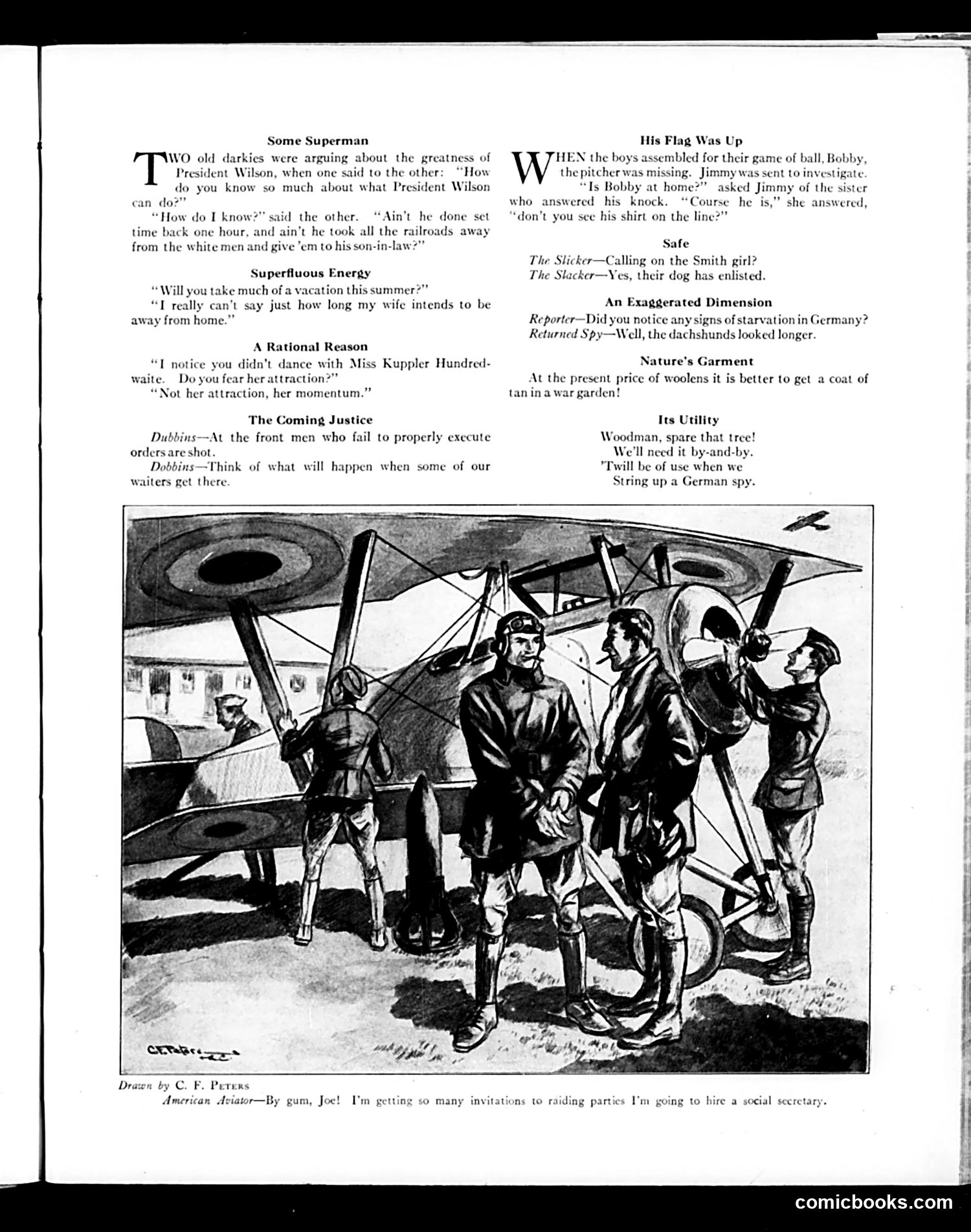
This WWI-era page contains multiple short jokes and one illustrated cartoon, all reflecting American wartime attitudes circa 1917-1918. The jokes mock various targets: President Wilson's railroad nationalization (presented through a racist dialect joke), German hardship (dachshunds appearing "longer" from starvation), pacifists ("slackers"), and anticipated postwar justice (hanging German spies). One joke suggests using trees for executions rather than lumber—dark wartime humor. The central cartoon depicts an American aviator receiving so many bombing raid invitations that he jokes about hiring a social secretary. This reflects the glamorization of aerial combat and pilots as celebrated war heroes. The page's tone combines jingoism, anticipation of German defeat, and casual references to executions and violence. The racist opening joke was unremarkable for 1918 Judge, though offensive by modern standards. Overall, these represent American popular entertainment during active WWI involvement, celebrating American military superiority while mocking enemies and domestic dissenters.
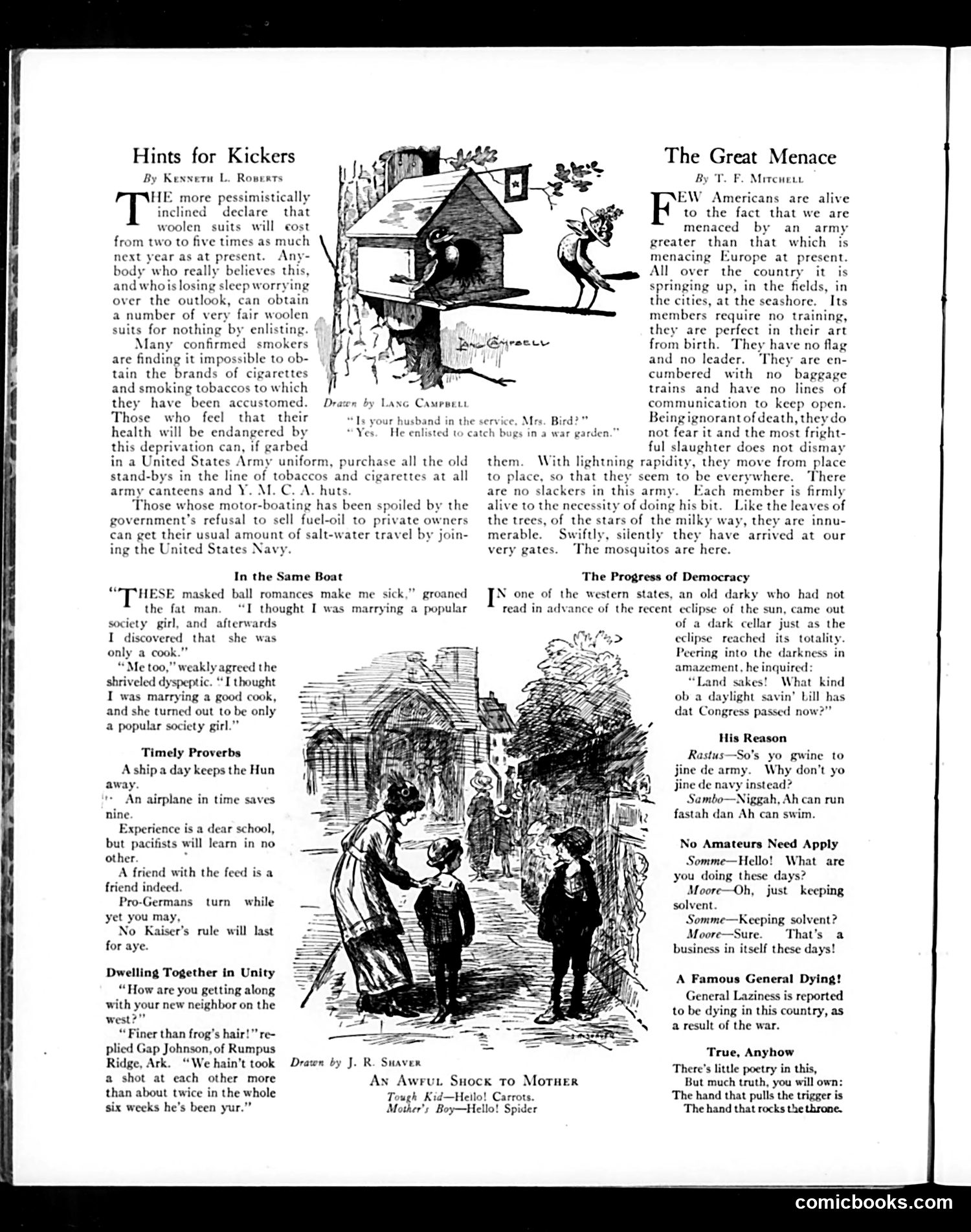
This WWI-era page contains satirical pieces targeting American home-front anxieties and military recruitment. **"Hints for Kickers"** uses dark humor to encourage military enlistment by sarcastically pointing out that soldiers can obtain scarce consumer goods (wool suits, cigarettes, salt-water travel) unavailable to civilians—a jab at wartime shortages and rationing. **"The Great Menace"** is an extended metaphor treating mosquitoes as an invisible enemy army invading America, paralleling actual German threats to Europe. The conceit mocks the militaristic rhetoric surrounding the war. **"In the Same Boat"** satirizes society marriages, suggesting wealthy women marry for status while pretending culinary skills—a class-consciousness joke about female deception. The **"Timely Proverbs"** section includes pro-war messaging ("A ship a day keeps the Hun away") alongside anti-German sentiment ("No Kaiser's rule will last"). Dialect humor throughout reflects period racism, particularly in the "Progress of Democracy" section, which mocks an elderly Black man's confusion about a solar eclipse—condescending commentary on rural/uneducated voters.
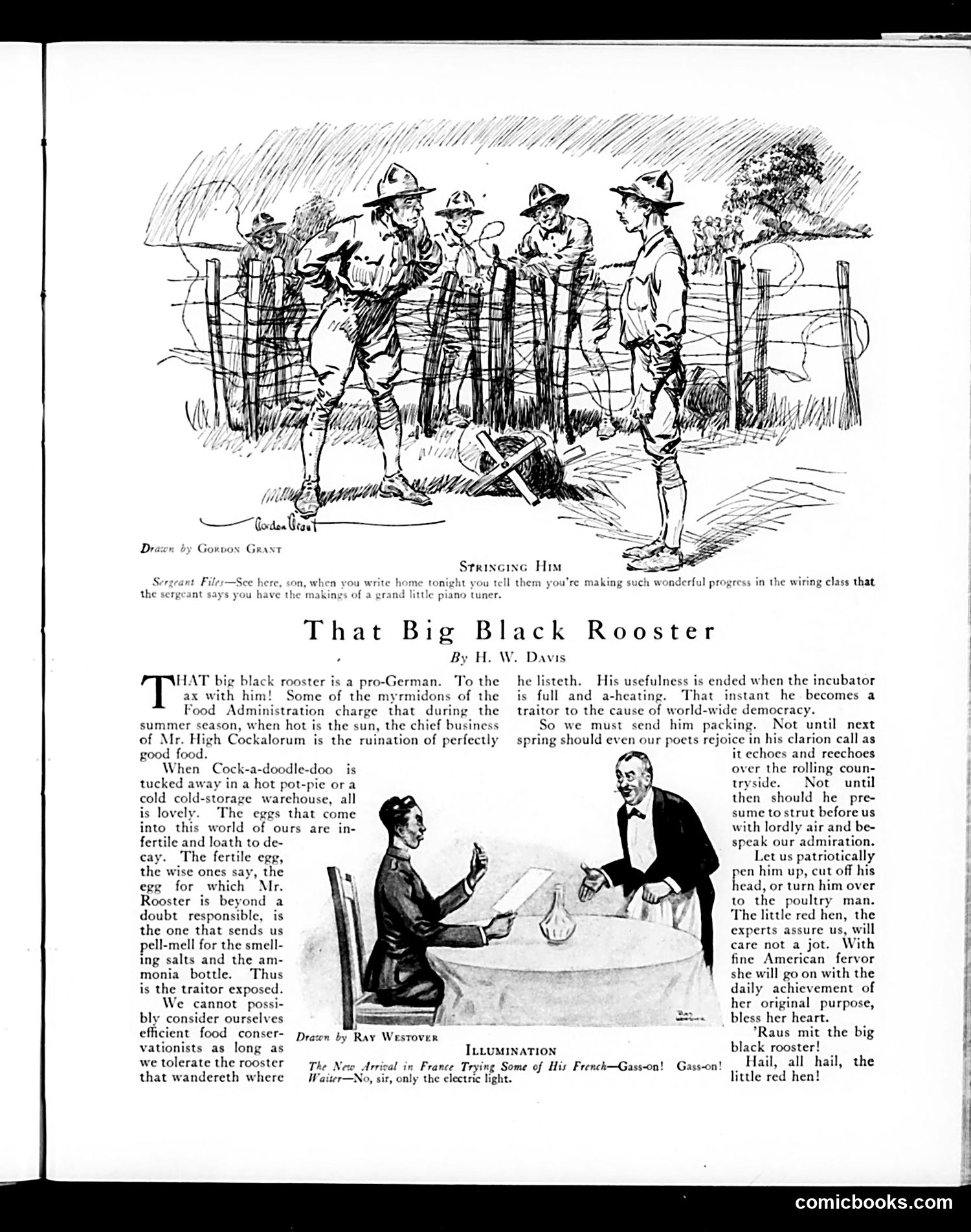
This WWI-era piece uses poultry as political allegory. The "pro-German" black rooster represents Germany or German influence, portrayed as a threat to American food conservation efforts during wartime. The U.S. Food Administration had implemented rationing programs, and the article sarcastically argues that roosters—whose fertile eggs spoil faster than infertile ones—are sabotaging these patriotic efforts. The satire presents eliminating roosters as a patriotic duty ("traitor to the cause of world-wide democracy"), mocking how wartime propaganda could mobilize citizens around minor domestic issues. The "little red hen" represents American agricultural productivity and loyalty. The top cartoon shows soldiers discussing a recruit's "wonderful progress in wiring class," likely referencing military training for WWI service. The lower illustration labeled "Illumination" depicts a Frenchman trying English phrases ("Gas-on!"), poking fun at linguistic confusion between allies.
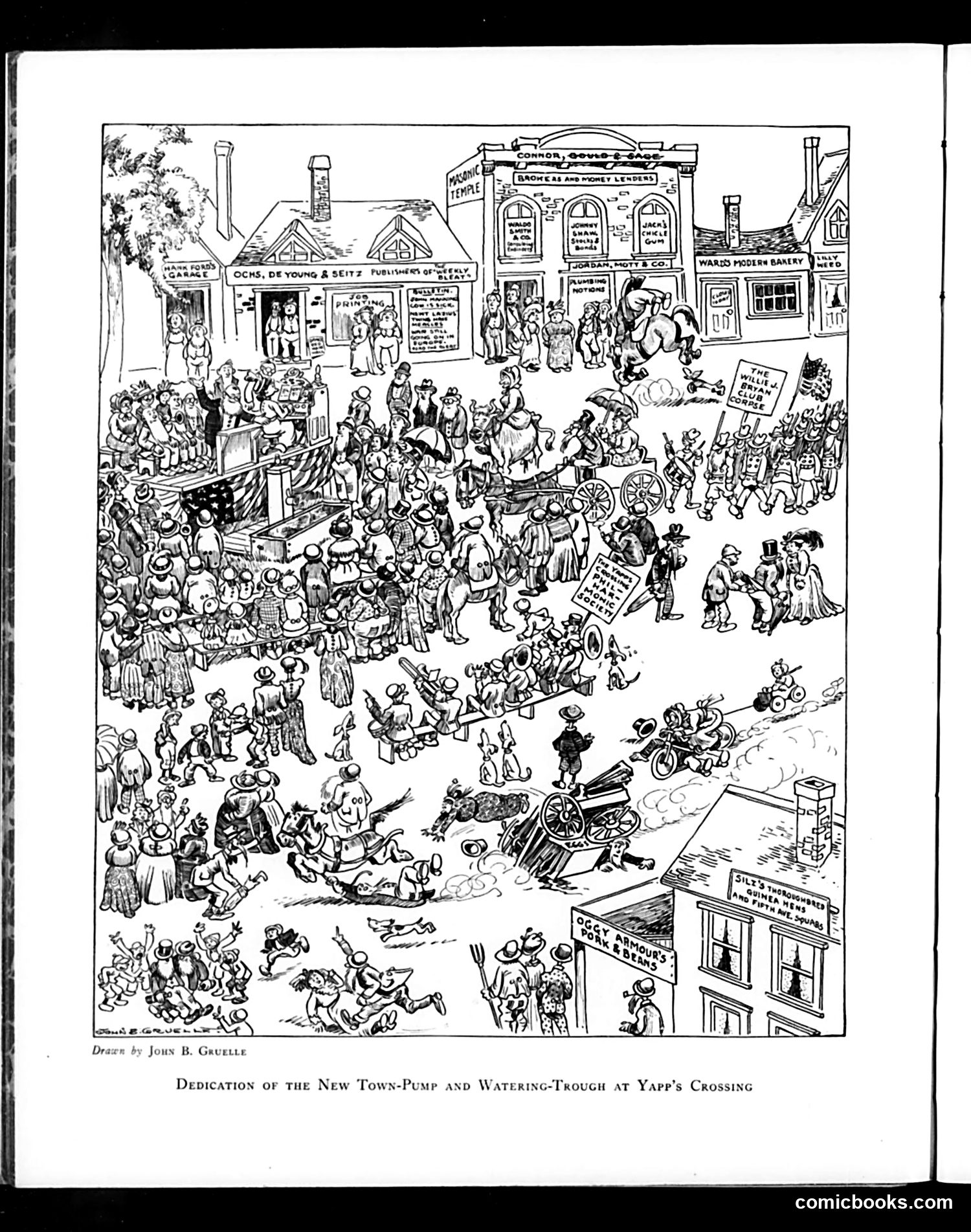
This is a satirical illustration by John B. Gravelle depicting the "Dedication of the New Town-Pump and Watering-Trough at Yapp's Crossing." The cartoon mocks a small-town civic dedication ceremony—a common subject for period satire. The crowded street scene shows townspeople, carriages, and horses gathered around what appears to be a modest public works project. Store fronts line the street (Ward's Modern Bakery visible), and the chaos suggests either incompetence in organizing the event or exaggerated local enthusiasm for a trivial improvement. The humor likely targets provincial American town pride and self-importance—treating a simple water pump installation as a momentous occasion worthy of grand ceremony. This satirizes rural communities' tendency to inflate the significance of minor infrastructure improvements, a recurring theme in Judge magazine's urban-focused mockery of rural/small-town life.
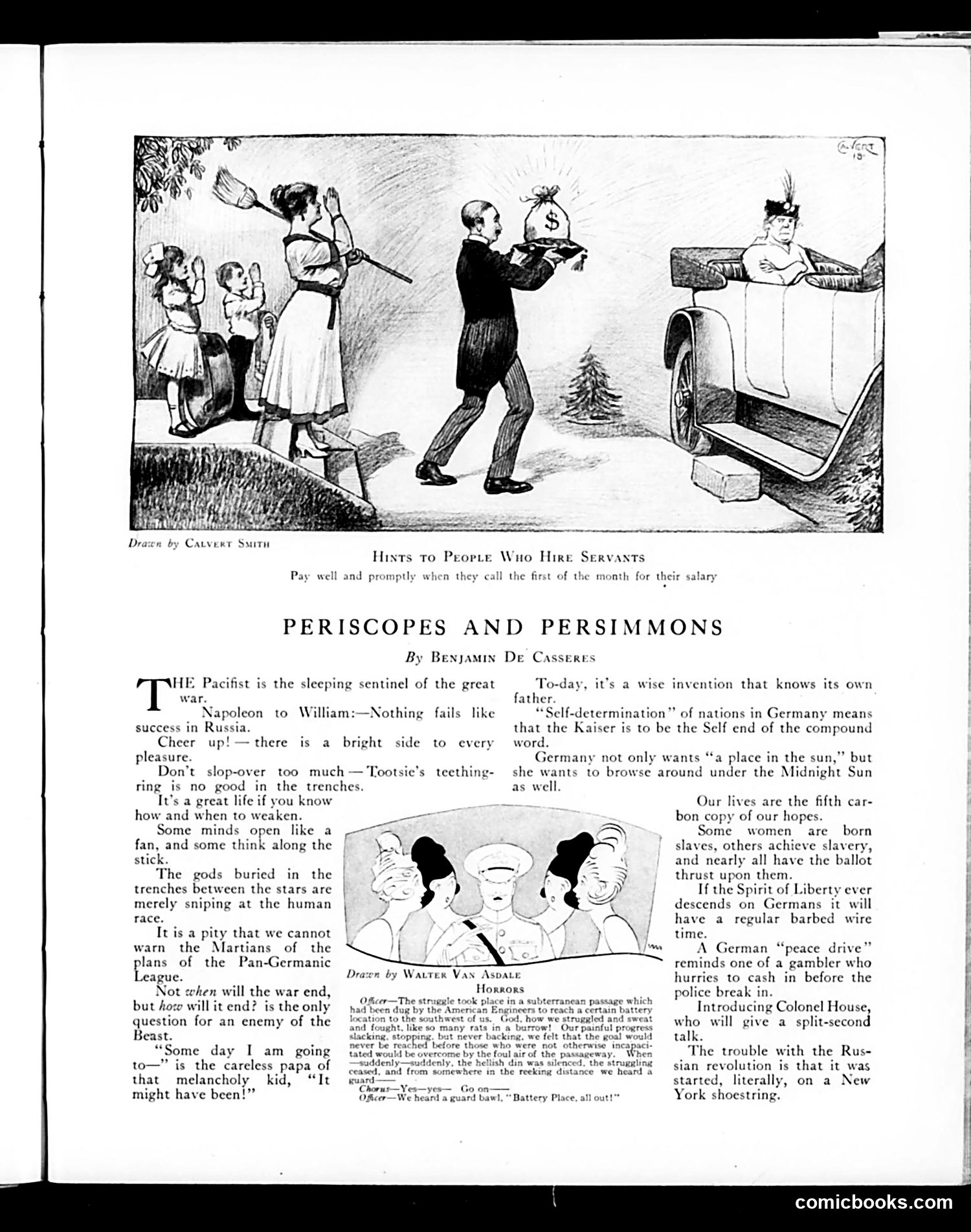
This page from *Judge* magazine contains WWI-era political satire. The top cartoon by Calvert Smith humorously advises employers to pay servants promptly on payday. The main article "Periscopes and Persimmons" by Benjamin De Casseres offers caustic aphorisms about the war. Key targets include: - **Germany's imperial ambitions**: Mocking the Kaiser's "self-determination" rhetoric as merely extending his own dominance, and his desire for global territorial conquest ("place in the sun"). - **American political figures**: "Colonel House" (Woodrow Wilson's advisor) is dismissed as giving meaningless rhetoric. - **The Russian Revolution**: Portrayed as hastily improvised ("started...on a New York shoestring"), suggesting it lacked proper planning or resources. The scattered "Horrors" vignettes appear to be brief wartime anecdotes. Throughout, the tone is darkly cynical about the war's duration and outcome, reflecting American frustration with the conflict's continuation and scale.
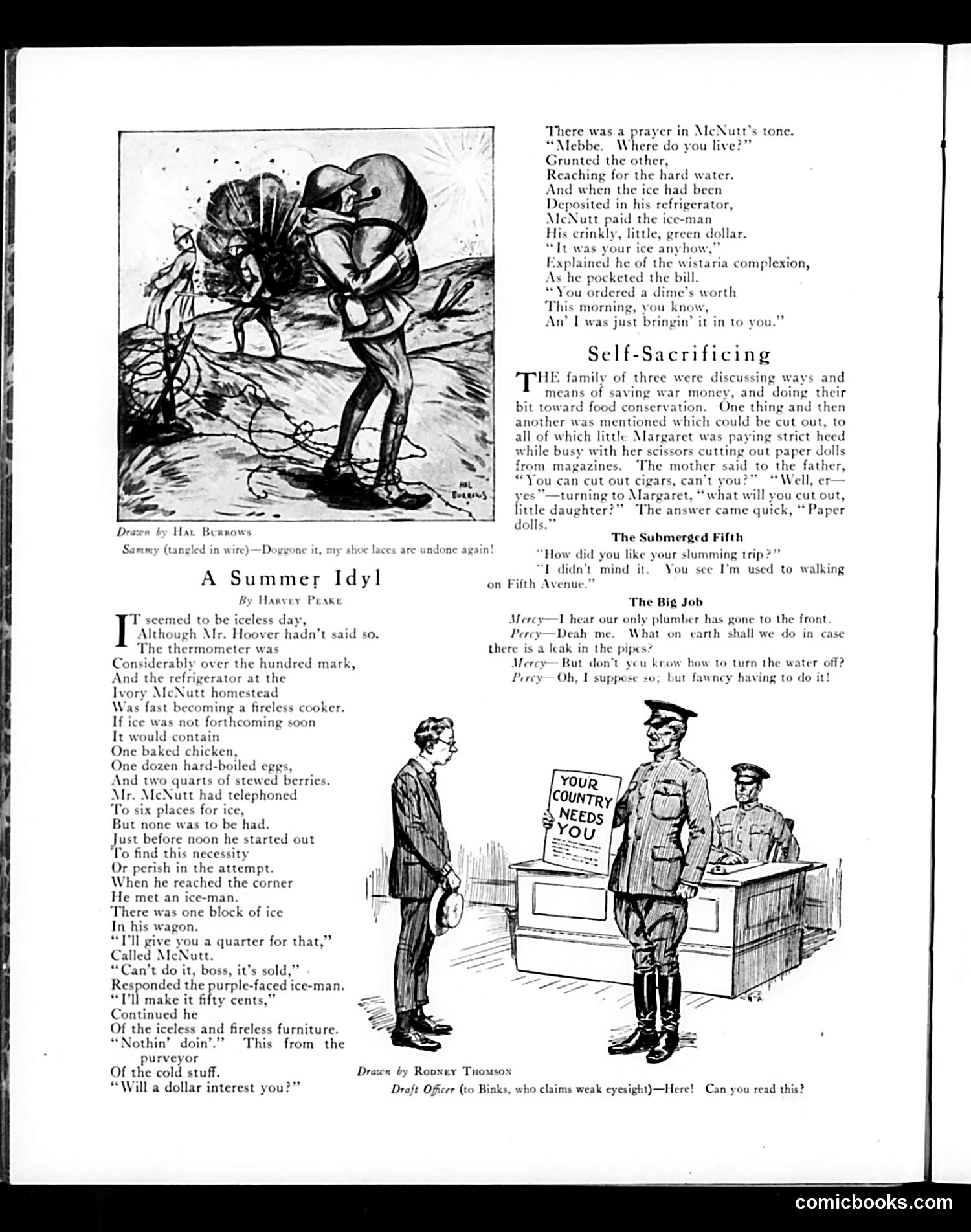
This page contains WWI-era satirical humor reflecting American home-front concerns circa 1917-1918. **"A Summer Idyl"** mocks wartime scarcity: Mr. McNutt desperately seeks ice during a heatwave, eventually paying an ice-man an inflated dollar for a single block—the vendor exploiting shortages for profit. The satire targets both hoarding/profiteering and civilian desperation. **"Self-Sacrificing"** jokes about wartime conservation efforts (referenced to Hoover's food-conservation campaign). A family discusses cutting luxuries; when asked what she'll sacrifice, a daughter says "paper dolls"—humor derived from her innocent misunderstanding of adult sacrifice. **"The Submerged Fifth"** and **"The Big Job"** reference wartime labor shortages: plumbers and essential workers enlisted, leaving civilians unable to perform basic home repairs—suggesting middle-class dependency on working-class services. **"Draft Officer"** cartoon (bottom right) depicts military recruitment/conscription, showing a draftee claiming weak eyesight to avoid service. Overall, these pieces satirize civilian wartime inconveniences, profiteering, and labor shortages.
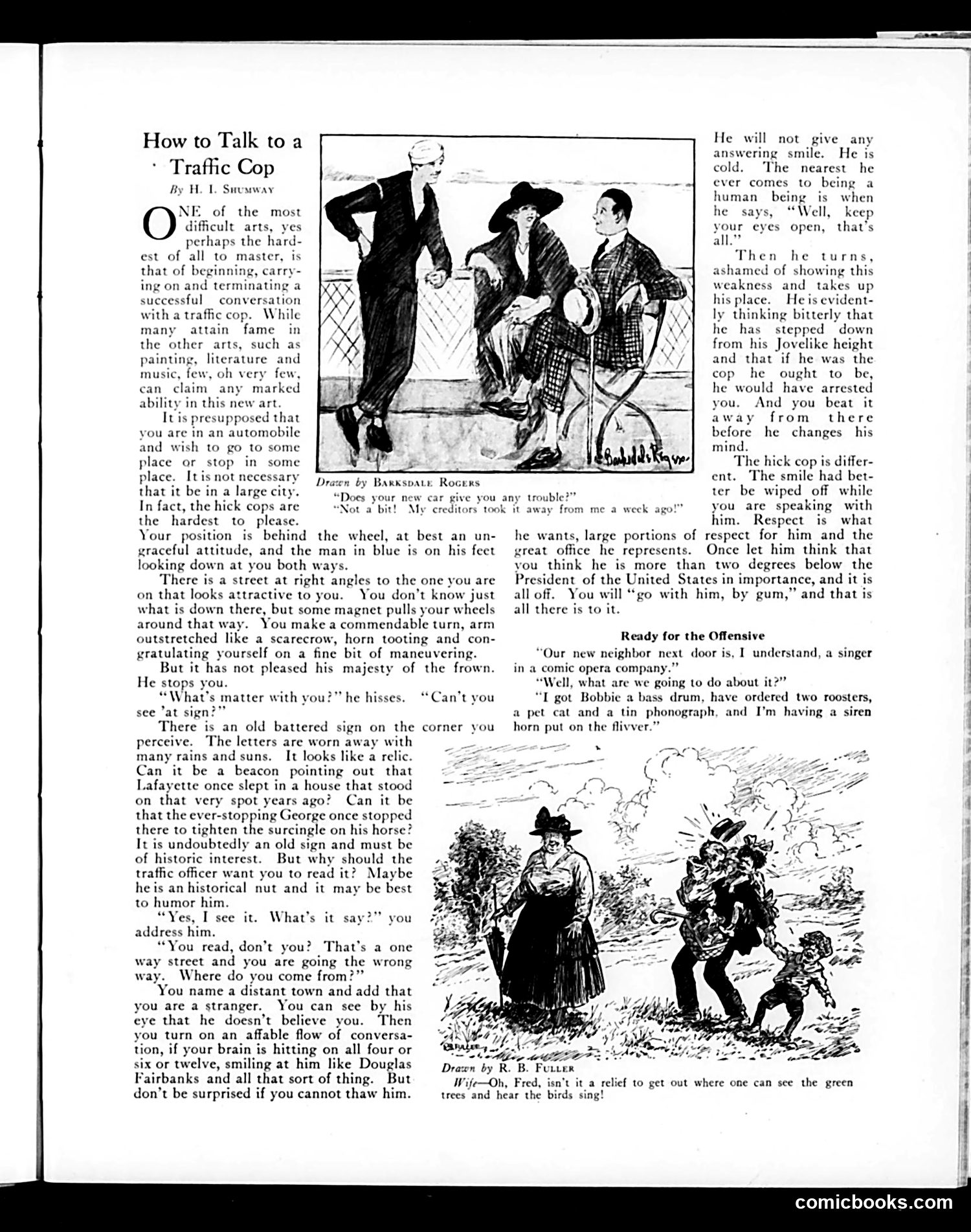
This page from *Judge* magazine satirizes the early automobile era's new phenomenon: traffic police enforcement. **Main Article:** "How to Talk to a Traffic Cop" humorously describes the power dynamic between drivers and officers. The author portrays traffic cops as humorless, authoritarian figures who hold absolute power over motorists. Key satire points include: cops won't smile or show humanity; they demand obedience to worn, illegible street signs; they're suspicious of strangers; and drivers must perform deference (smiling like Douglas Fairbanks) to avoid arrest. The distinction between "hick cops" (rural, requiring extra respect) and urban officers adds class-based humor. **Side Cartoon:** Shows a neighbor preparing retaliatory noise-making (bass drum, roosters, siren) against a new singer neighbor—slapstick humor about urban noise complaints. **Context:** This reflects early 1900s anxieties about new traffic laws, automobile culture, and police authority over previously unrestricted drivers. The condescending tone toward cops reflects class tensions and resentment of regulatory control during rapid modernization.
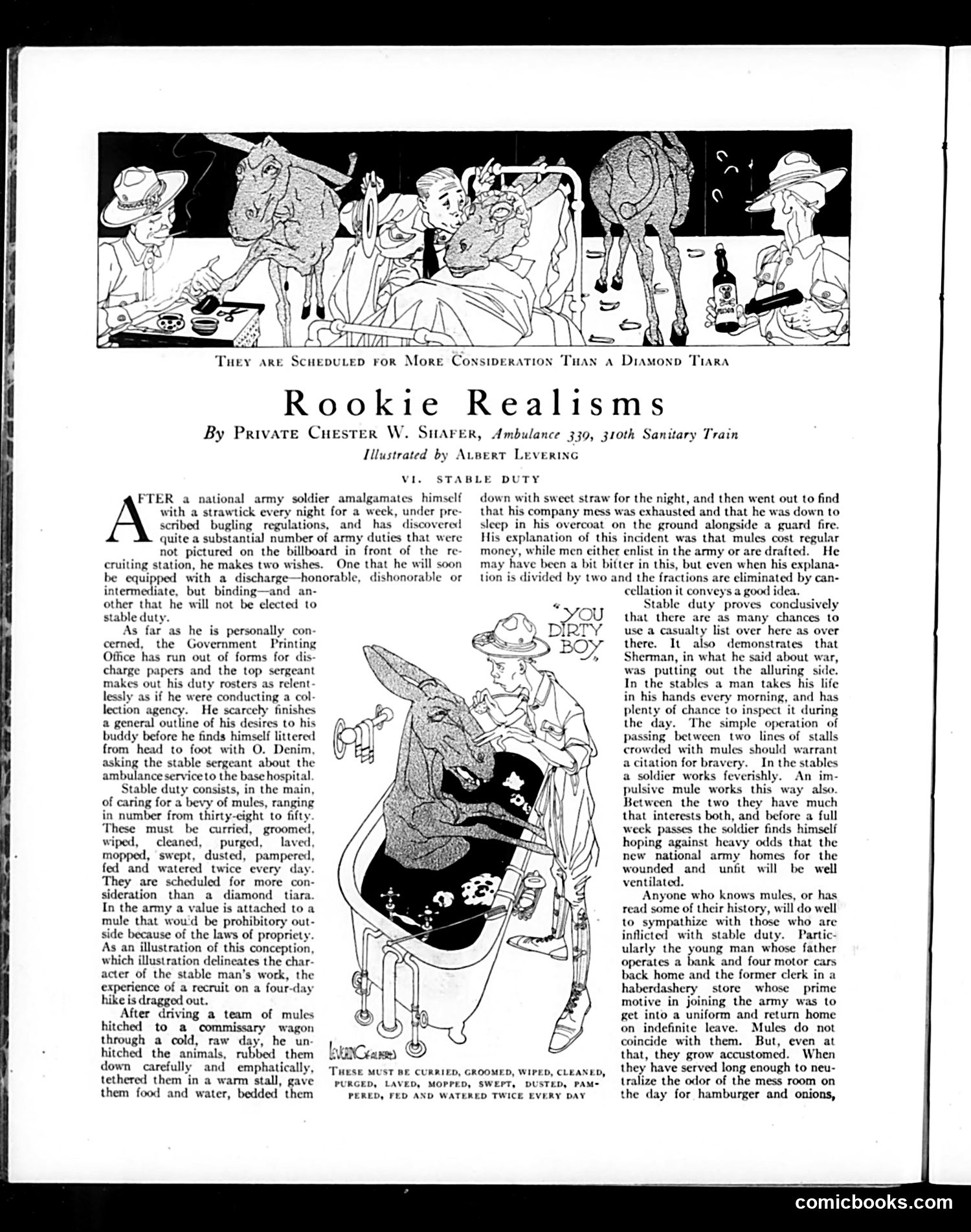
This WWI-era article satirizes the harsh reality of Army life for new recruits, specifically stable duty—caring for military mules. The writer (identified as Private Chester W. Shafer, Ambulance 339, 310th Sanitary Train) uses humor to expose the gap between recruitment propaganda and actual soldiering. The central joke: mules receive far better treatment than soldiers. A recruit must groom, feed, and pamper 30-50 mules twice daily—"scheduled for more consideration than a diamond tiara"—while enlisted men sleep outdoors on the ground. The illustration shows a soldier tending an enormous, demanding mule. Shafer mocks the Army's prioritization (mules cost money; soldiers either enlist or are drafted) and references General Sherman's famous "war is hell" quote, suggesting stable duty proves him right. The satire particularly targets privileged draftees (bankers' sons, clerks) unprepared for such labor, while implying the entire experience is dangerous and degrading.
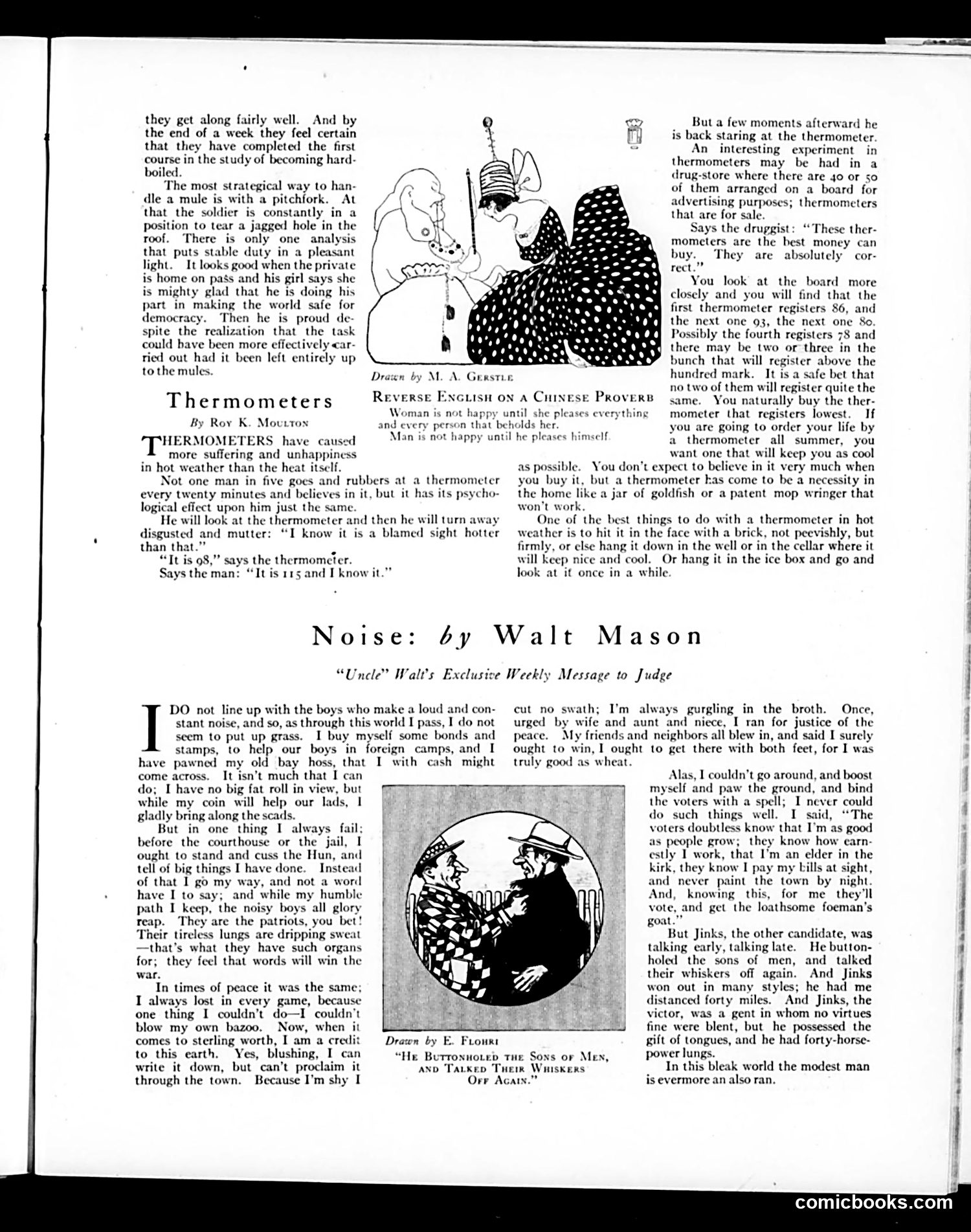
This Judge magazine page contains two main pieces of satirical content: **"Thermometers" by Roy K. Moulton**: A humorous essay mocking human psychology. It describes how people obsessively check thermometers in hot weather, refuse to believe the reading (insisting it's hotter), then immediately check again. The satire extends to drug stores displaying dozens of thermometers showing wildly different temperatures—the joke being that people will buy whichever reads lowest, fooling themselves it will somehow keep them cooler. **"Noise" by Walt Mason**: A poem-essay about a humble, quiet man who supports WWI efforts (buying bonds, pawning possessions to help) but cannot campaign for local office because he lacks the loud, boastful personality politicians need. The accompanying cartoon shows two men talking—likely contrasting a modest candidate with a louder rival. The satire critiques how democratic elections favor noise and self-promotion over quiet virtue and genuine contribution. Both pieces employ Judge's typical early-20th-century approach: gentle, character-based satire of human nature and social behavior rather than partisan politics.
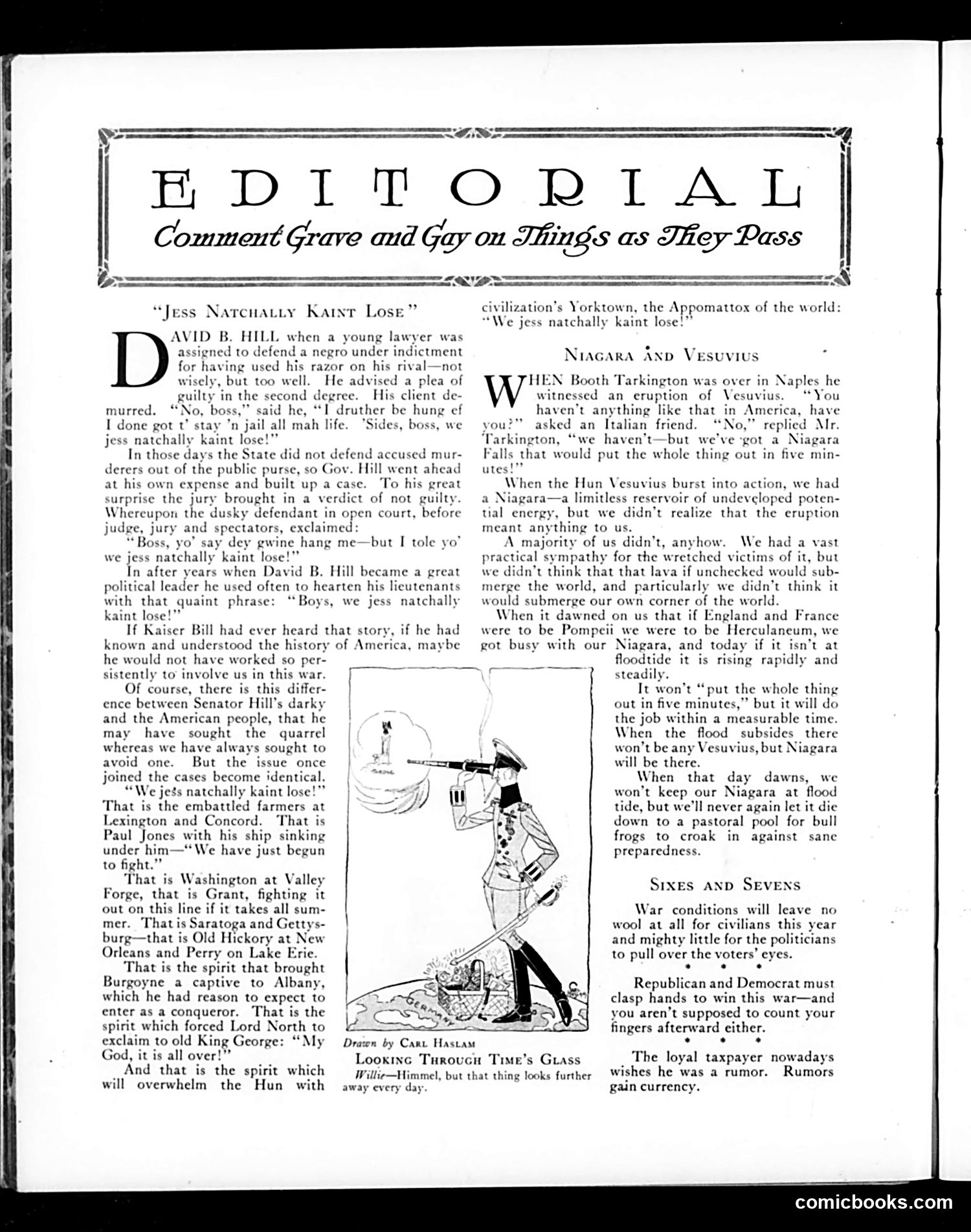
This World War I-era editorial uses historical and contemporary analogies to argue American military commitment is inevitable and justified. **The main cartoon** (drawn by Carl Haslam) depicts Uncle Sam as a figure of overwhelming power—"Niagara Falls" to Germany's "Vesuvius." The joke compares natural forces: just as Niagara dwarfs Mount Vesuvius, American industrial capacity will overwhelm German military might. **The David B. Hill anecdote** establishes the phrase "we jess natchally kaint lose"—a colloquial assertion of confidence. The editorial argues Americans share this same spirit, referencing Revolutionary War battles (Lexington, Valley Forge, Saratoga) and claiming the U.S. has *always* triumphed when fully committed. **The satire's point**: The piece mocks American complacency and reluctance to enter WWI, suggesting we've forgotten our own history of inevitable victory. Once engaged, American resolve—like Niagara's unstoppable flow—will crush Germany. The page reflects 1917-era interventionist propaganda using nationalist mythology and frontier dialect for rhetorical effect.
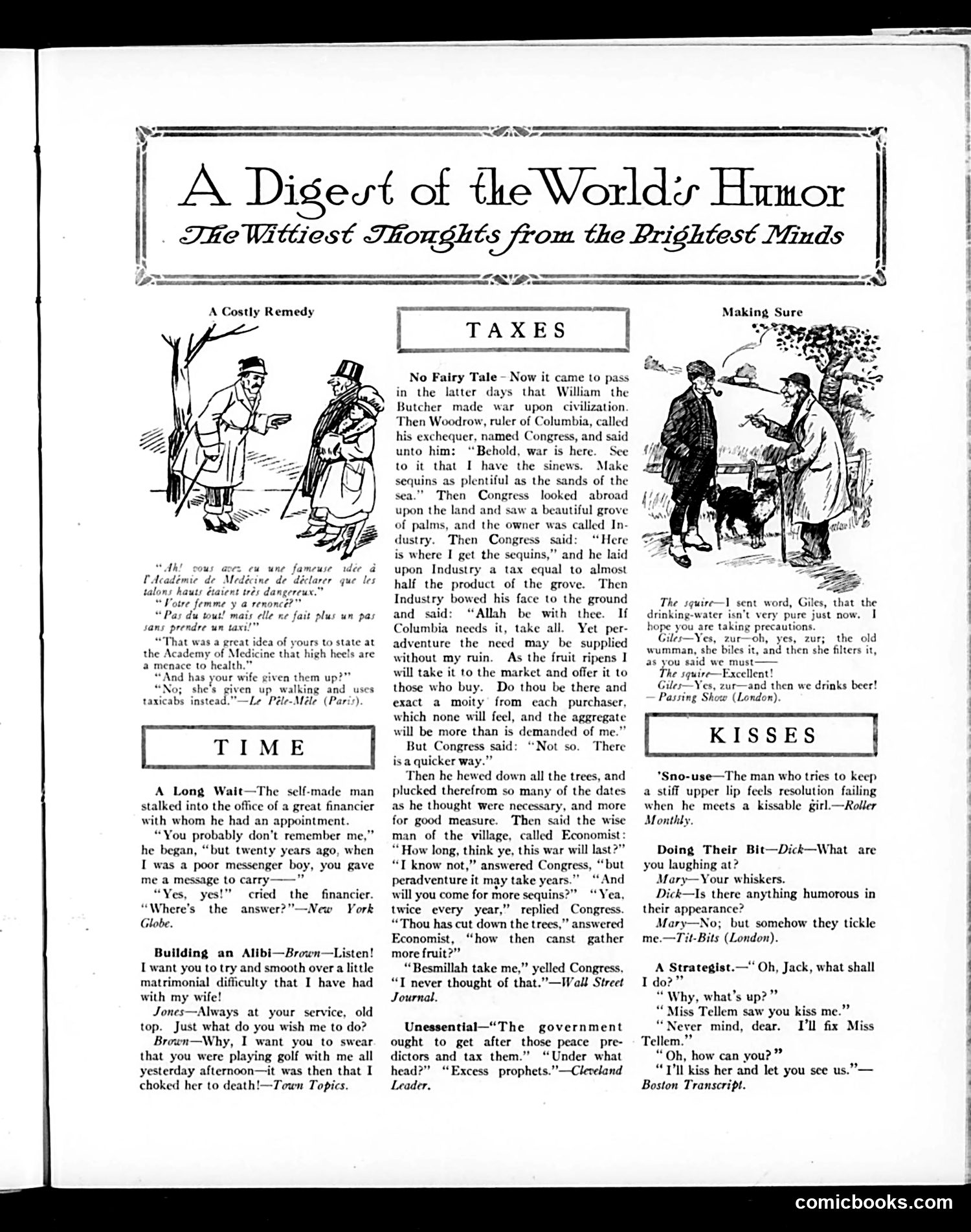
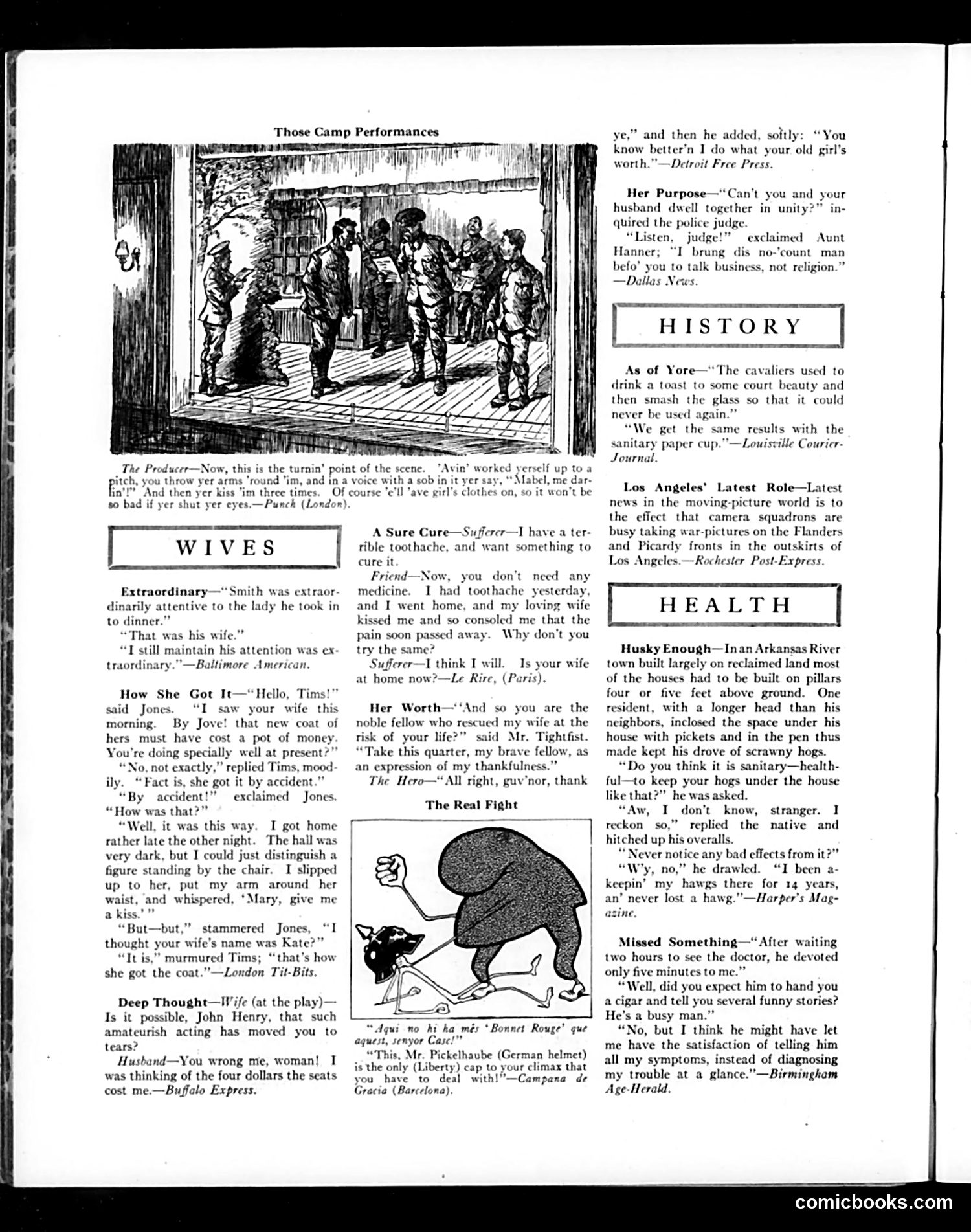
This page contains miscellaneous short humorous pieces typical of Judge's satirical format. The content includes: **"Those Camp Performances"** depicts a theatrical producer directing actors in melodramatic staging—poking fun at overwrought amateur theatrics. **"The Real Fight"** cartoon shows a German helmet ("Pickelhaube") confronting a "Bonnet Rouge" (French revolutionary symbol), captioned about dealing with "your climax." This appears to be WWI-era satire about Franco-German conflict, likely mocking the ideological struggle. The remaining sections ("Wives," "History," "Health") are brief joke columns satirizing domestic life, historical customs, and rural American attitudes toward sanitation. The overall page targets: theatrical pretension, marital comedy (infidelity, materialism), and contemporary war anxieties mixed with nostalgia for older customs. The tone is light, gossipy satire aimed at middle-class readers.
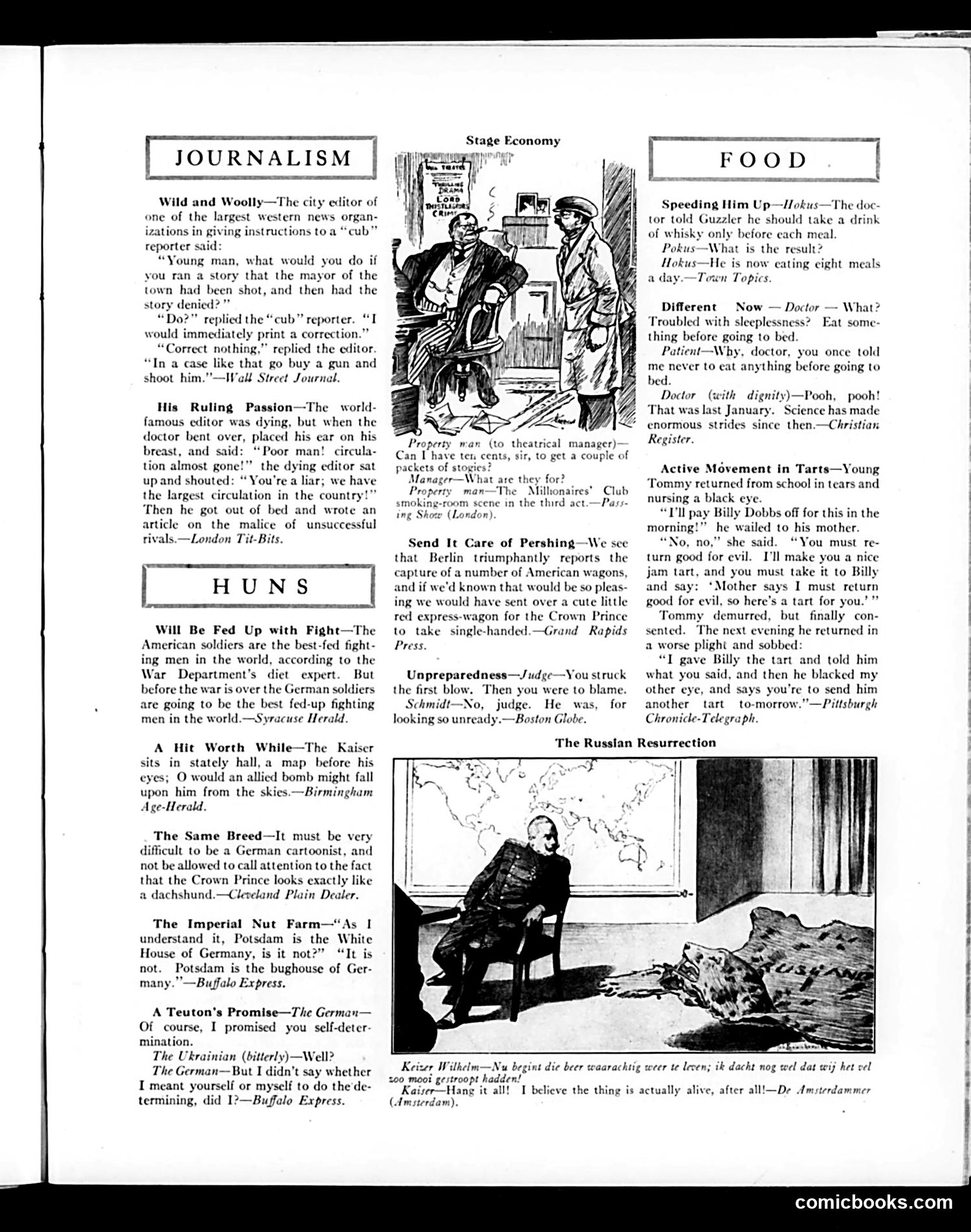
This page collects brief satirical jokes from Judge magazine, likely from 1917-1918, organized by topic. The **Journalism** and **Huns** sections mock German leadership and American war efforts: - Jokes ridicule German leaders (the Kaiser, Crown Prince) as incompetent or absurd - The "Huns" section makes fun of German soldiers and their expected defeat - One joke sarcastically suggests Americans should gift the Crown Prince a toy wagon since Germans celebrate capturing American wagons **The Russian Resurrection** cartoon (bottom) depicts a military figure examining what appears to be a fallen or dead body, likely referencing Russia's exit from WWI after the Bolshevik Revolution and Treaty of Brest-Litovsk (early 1918). The caption in German suggests dark humor about whether Russia is truly "dead" or might resurrect. The **Food** and **Stage Economy** sections are lighter, unrelated domestic humor about eating and theater. This represents typical American wartime propaganda—ridiculing enemy leaders while boosting soldier morale and public support for the war effort.
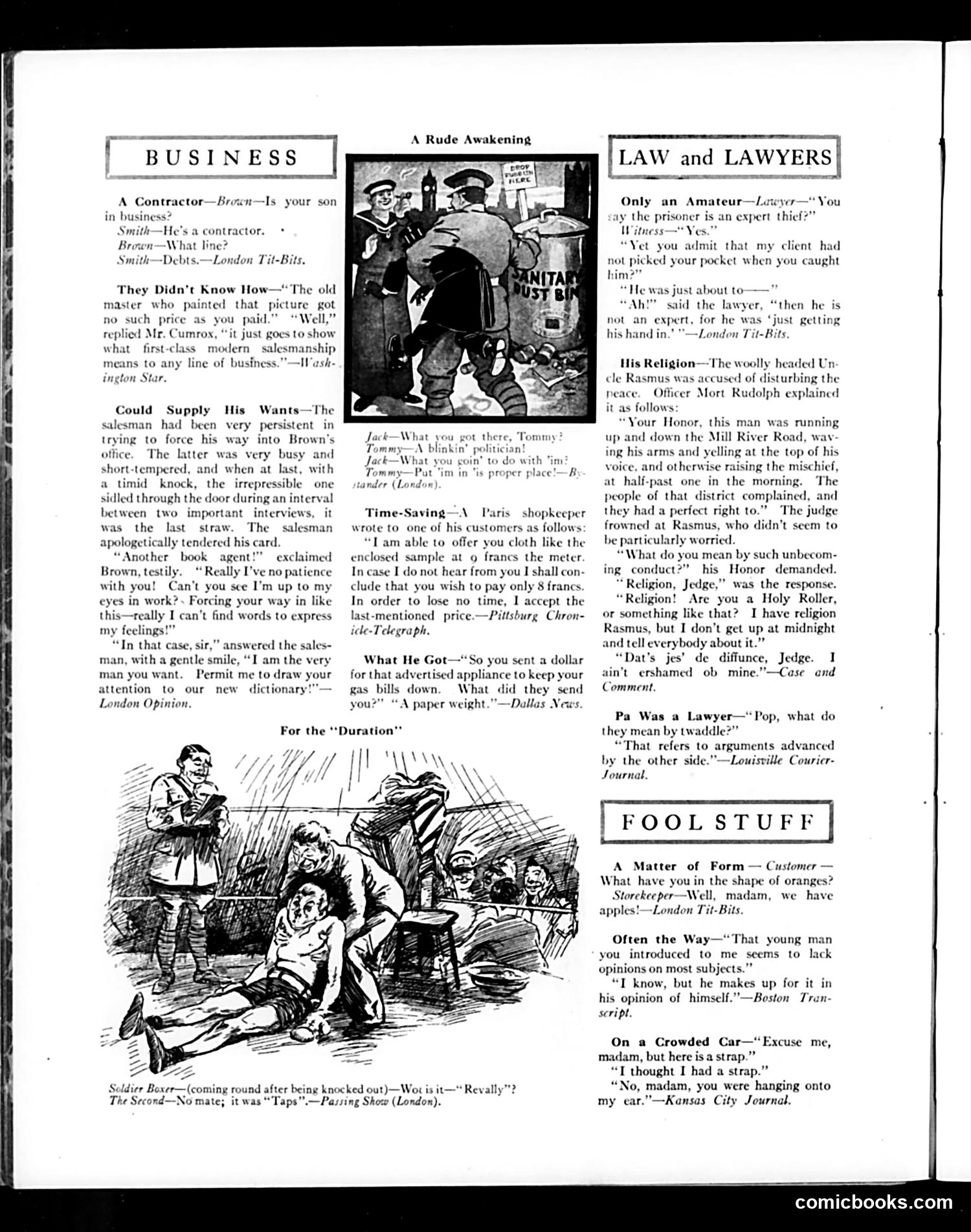
This page from the satirical magazine **Judge** contains three sections of humor pieces reflecting early 20th-century American attitudes: **"A Rude Awakening"** (center cartoon): Shows a policeman confronting a child holding a politician. The joke mocks politicians as objects of ridicule or contempt—treating them as something a child might innocently display, implying they're beneath respect or worthy of public scorn. **Business/Law sections**: These are brief joke collections mocking salesmen's persistence, contractor debt, and lawyers' rhetorical tricks. The "His Religion" piece depicts "Uncle Rasmus," a racist caricature of a Black man, arrested for disturbing the peace; the judge dismisses his religious fervor as excessive. This reflects the era's casual racial stereotyping. **"Fool Stuff"**: Simple wordplay and everyday misunderstandings—a shopkeeper confusing oranges with apples, a woman mistaking a man's ear for a subway strap. Overall, this represents period humor that was mainstream but often contains now-offensive racial caricatures alongside relatively timeless observations about human behavior.
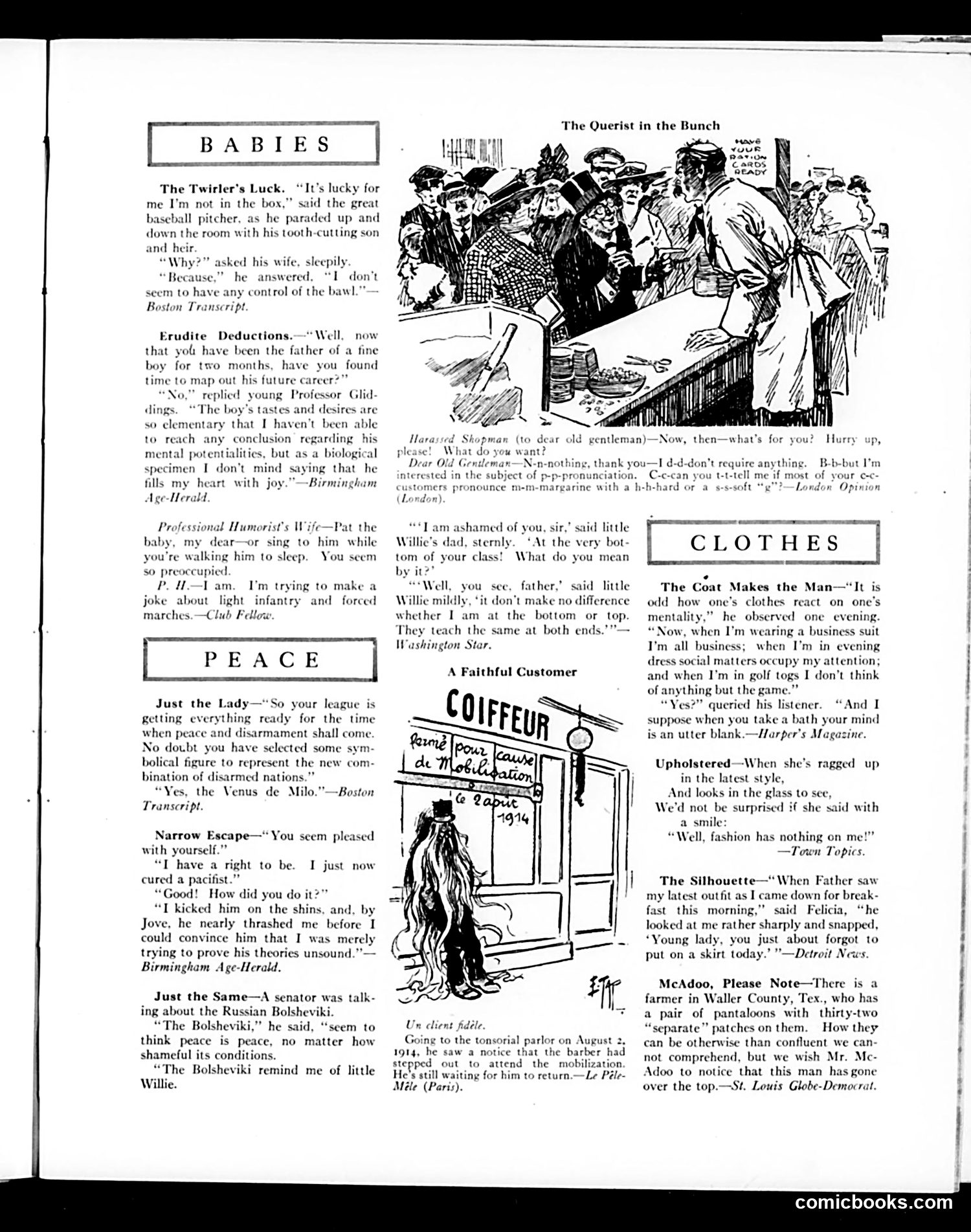
This page from Judge magazine contains short humorous anecdotes organized under three headings: "Babies," "Peace," and "Clothes." The **Babies** section offers domestic humor about new fatherhood and child-rearing, including a baseball pitcher's joke about lacking control (a pun on parenting vs. pitching). The **Peace** section satirizes pacifist movements and the Bolsheviki (Russian communists), likely referencing WWI-era anti-war sentiment. One joke references the Venus de Milo—a symbol of peace without arms—while another mocks pacifists through physical violence, questioning their sincerity. The **Clothes** section uses fashion as a lens for observing human behavior and social pretension. Most notably, "A Faithful Customer" is a **WWI reference**: a Parisian barber "stepped out to attend the mobilization" in August 1914 (France's military conscription upon war's outbreak) and hasn't returned—implying he died in combat or remains conscripted. The customer still waits, making a dark joke about war's permanence. The page reflects American satirical attitudes toward contemporary issues: parenthood, wartime, and social conventions.
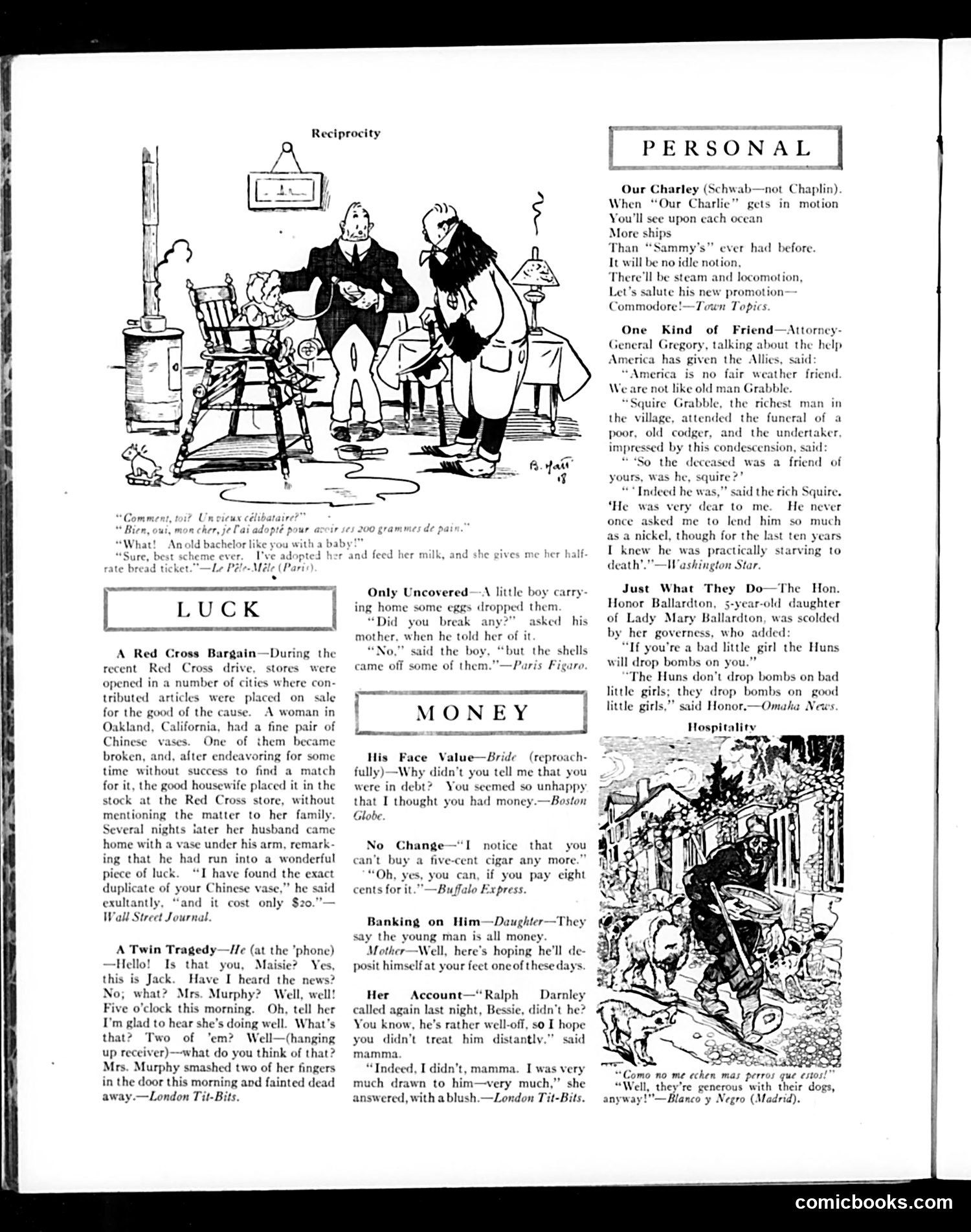
This page contains **short humorous anecdotes and jokes** typical of Judge's "Personal," "Luck," and "Money" sections—not political cartoons. **Key Content:** The top cartoon depicts a domestic scene labeled "Reciprocity," showing a couple with a child, illustrating the reciprocal nature of household relationships (she feeds the child, who gives affection in return). **The jokes** satirize early 20th-century American life: - A woman's broken Chinese vase mysteriously reappears as her husband's "lucky find" from a Red Cross store - A man celebrates news of his neighbor's wife's injury, mishearing "two of 'em" (fingers broken) as successful childbirth - Wartime references: Attorney-General Gregory (WWI era) praised for America's loyalty to Allied causes - Inflation humor: Five-cent cigars now cost eight cents - A reference to "Commodore" Schwab (likely Charles Schwab, industrialist) **The bottom illustration** shows Spanish hospitality, humorously noting hosts are generous with their dogs. These are gentle domestic and social satires typical of Judge's humor—observational rather than overtly political, targeting middle-class American foibles and wartime economic concerns.
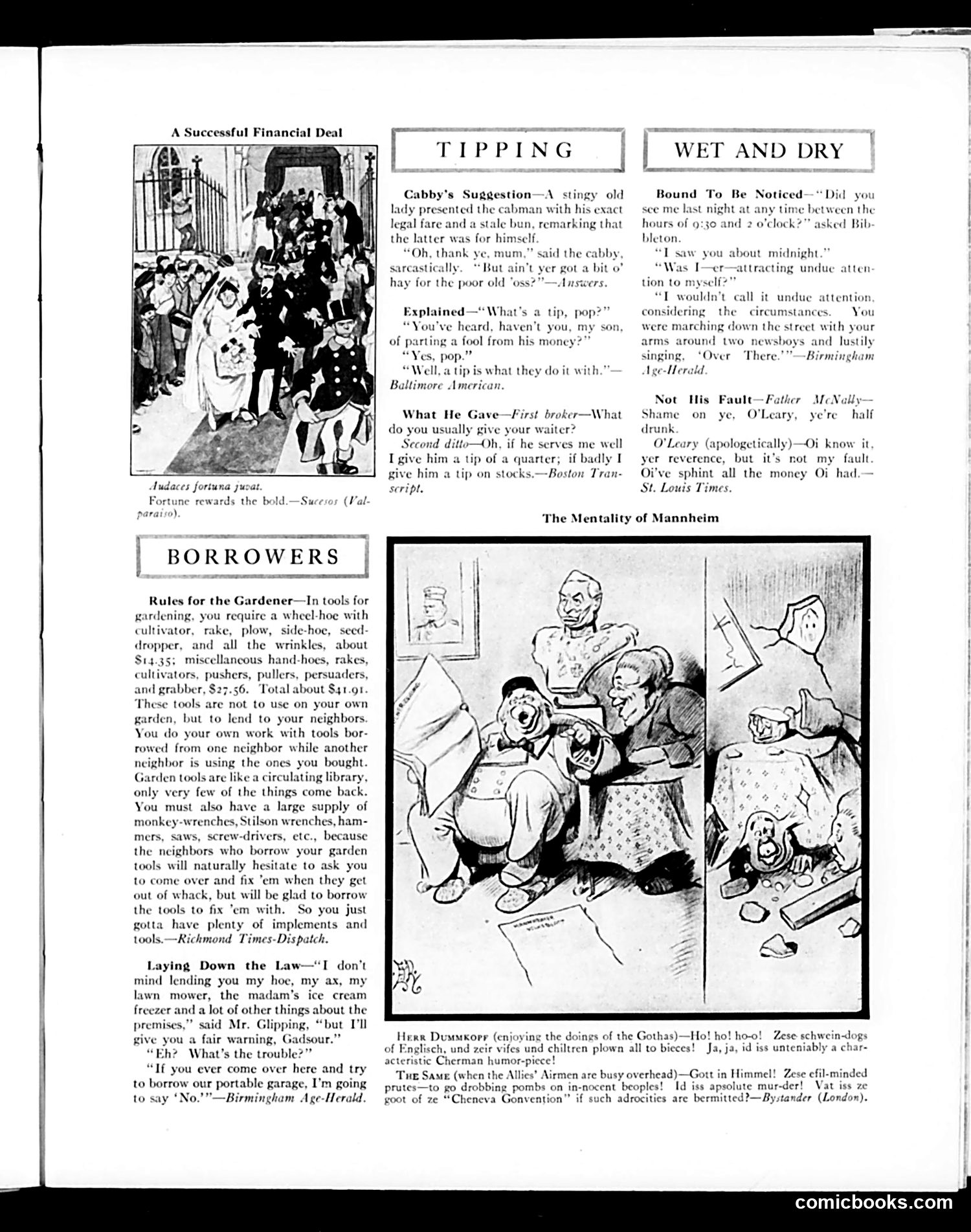
This page contains multiple satirical pieces targeting early 20th-century social customs and wartime attitudes. **"A Successful Financial Deal"** mocks the practice of borrowing garden tools among neighbors—you buy expensive equipment ($41.91) only to lend it out constantly while borrowing others' tools for your own use. The joke: tools rarely get returned, forcing you to maintain duplicates. **"Tipping" section** satirizes the confusion around tipping customs, defining a tip as "parting a fool from his money"—poking fun at both the practice itself and those who participate. **"Wet and Dry"** contains drinking-related humor, with one piece mocking a drunk man's behavior during wartime ("Over There" references WWI). **"The Mentality of Mannheim"** is overtly anti-German propaganda. Two German characters (Herr Dusendorf and "The Same") discuss bombing, with one horrified at civilian casualties while the other callously justifies it. The satire suggests German indifference to the Geneva Convention and civilian suffering—typical wartime propaganda portraying Germans as barbaric.
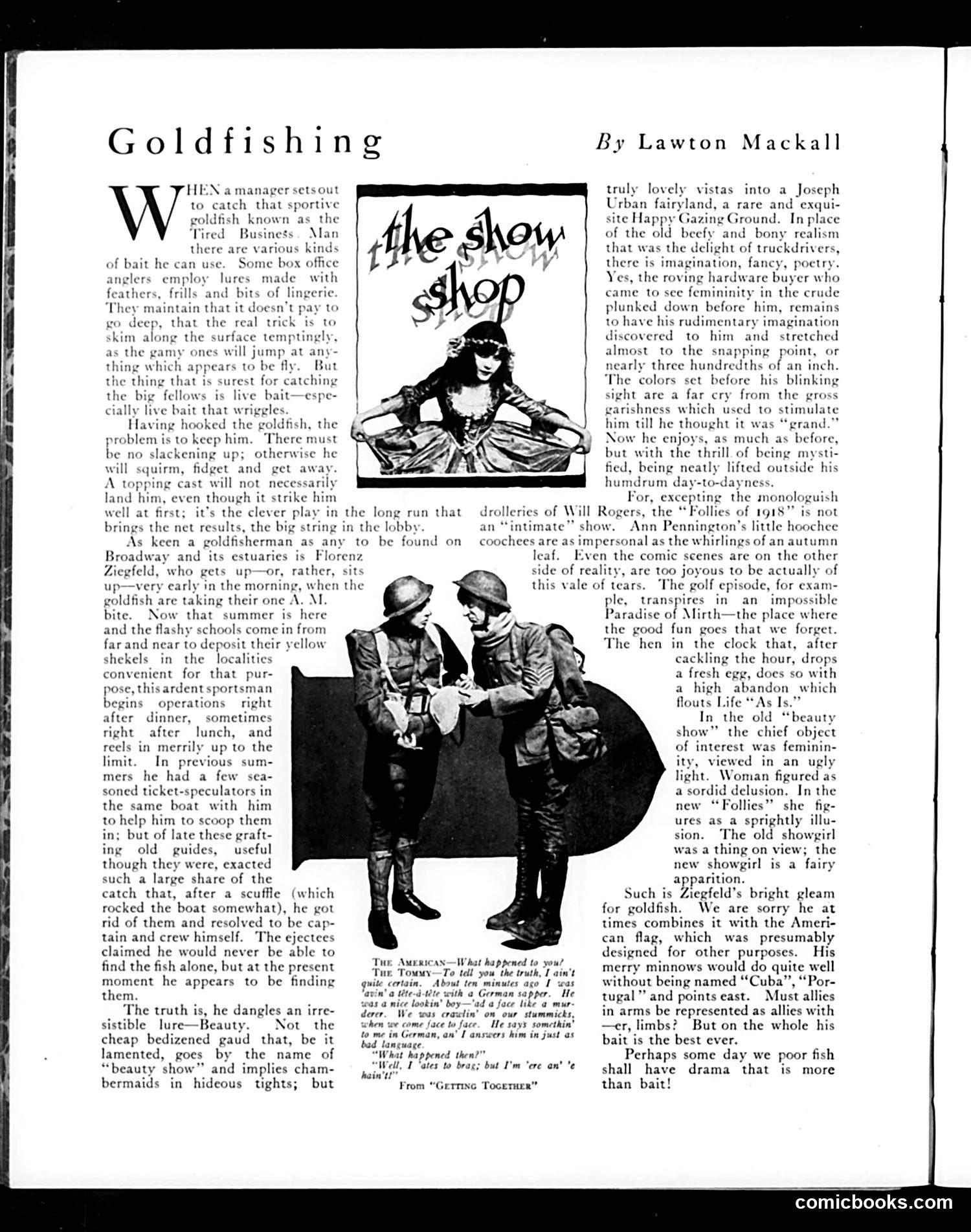
This article uses extended fishing metaphor to satirize Broadway impresario **Florenz Ziegfeld** and his theatrical enterprises. The "goldfish" represents the "Tired Business Man"—the wealthy male audience members Ziegfeld targets. The satire compares Ziegfeld's methods to fishing: he uses "live bait" (attractive women and spectacle) to hook audiences, then keeps them engaged ("reels in merrily"). The article notes Ziegfeld previously employed "ticket-speculators" as guides who took too large a share of profits—a veiled reference to business partners he apparently eliminated. The piece credits Ziegfeld's success to his "lure—Beauty," specifically the artistic vision of **Joseph Urban** (the set designer), which elevates his shows beyond cheap burlesque. The contrast between old "beefy and bony realism" and Urban's imaginative, poetic staging suggests Ziegfeld's shows offer aesthetic elevation disguised as entertainment for working-class audiences. The tone is admiring yet sardonic about Ziegfeld's calculated commercial strategy.
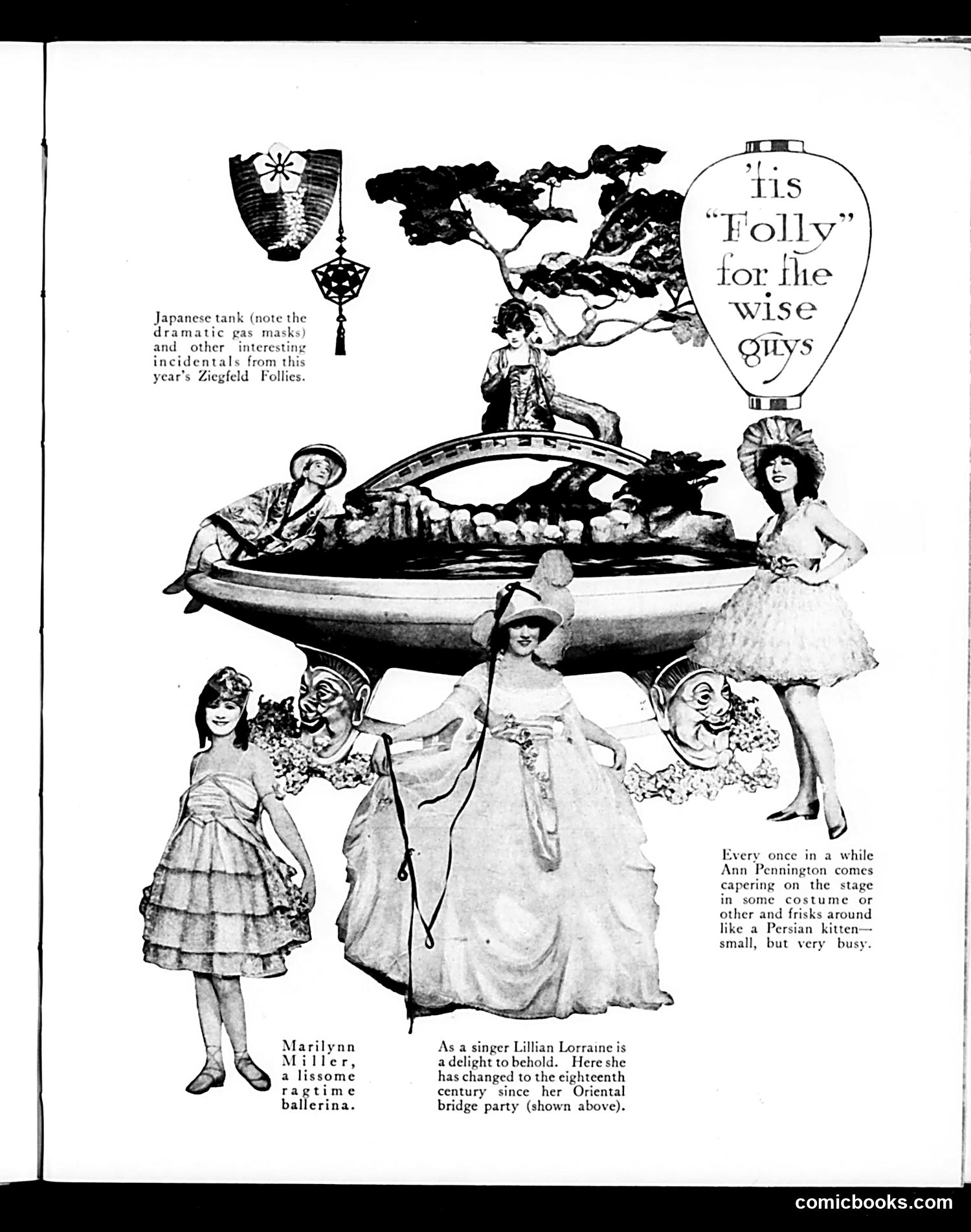
This page reviews the **Ziegfeld Follies**, a famous early-20th-century theatrical revue known for elaborate costumes and spectacle. The content celebrates specific performers: - **Marilynn Miller** is praised as a "lissome ragtime ballerina" - **Lillian Lorraine** is highlighted as a singer who has shifted from performing an Oriental-themed number to an 18th-century costume - **Ann Pennington** is noted for her energetic comedic appearances in various costumes The satire lies in the tagline "Folly for the wise guys"—suggesting that despite the Follies' often frivolous or absurd themes (like a Japanese tank with gas masks), educated audiences still found entertainment value in the spectacle and performers' talents. The review is essentially theater criticism wrapped in humorous observation about high-society audiences enjoying lowbrow entertainment dressed up as sophisticated production.
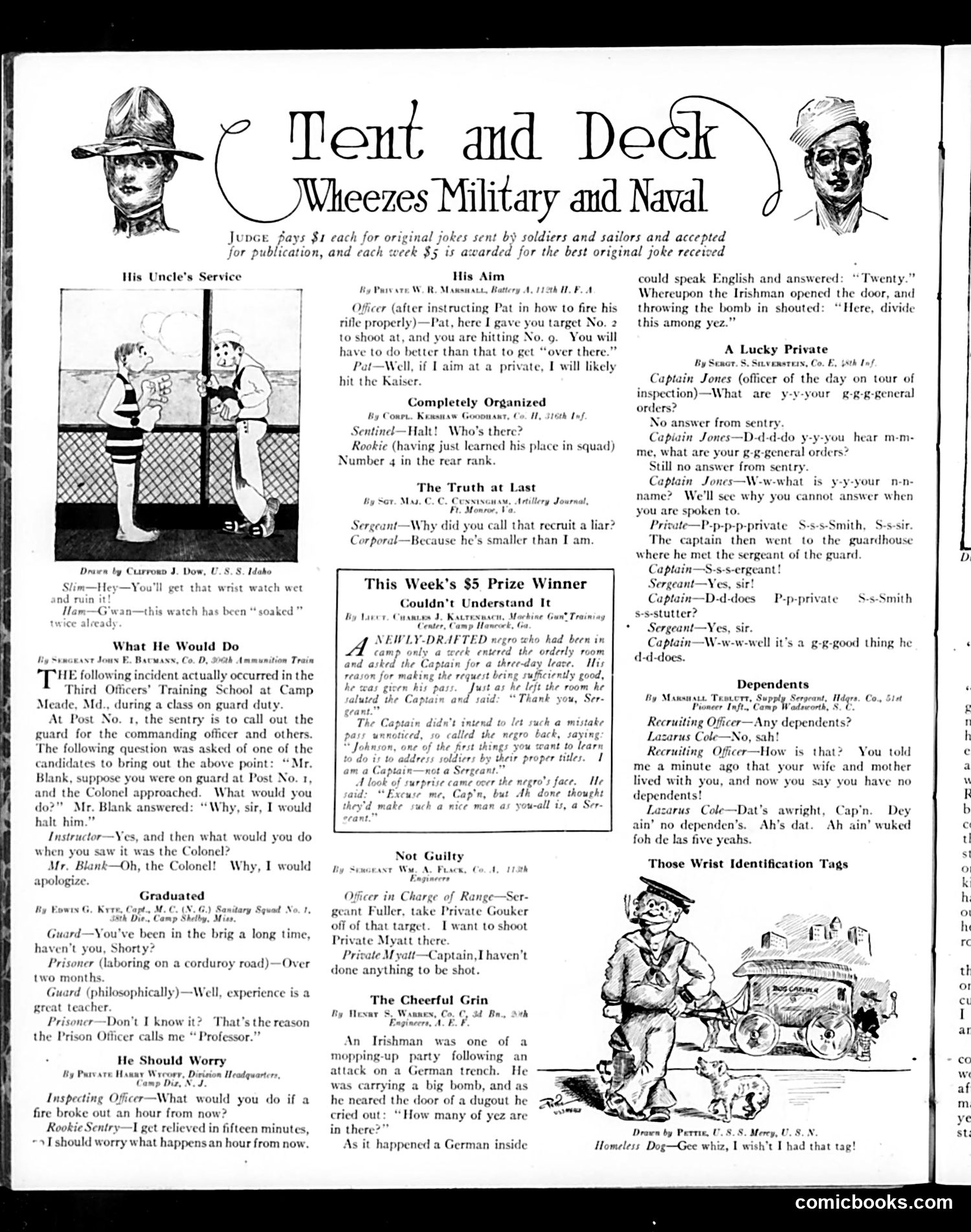
This page collects brief jokes submitted by soldiers and sailors during World War I, with a $5 prize for the best. The humor relies on military absurdities and the clash between enlisted men and officers. The jokes mock: incompetence (a soldier hitting the wrong target), bureaucratic confusion (a recruit not understanding proper ranks and titles), and the surreal dangers of trench warfare (an Irishman calmly dividing a bomb among German soldiers). Several jokes play on stuttering or mumbling officers being ignored by lower ranks—satirizing the breakdown of command hierarchy. The racial content in "Couldn't Understand It" reflects the magazine's dated attitudes; it presents a derogatory stereotype of a Black soldier confused by military formality. Overall, these are wartime morale pieces designed to generate laughs about military life's everyday frustrations and dangers, rather than commentary on the war's conduct or politics.
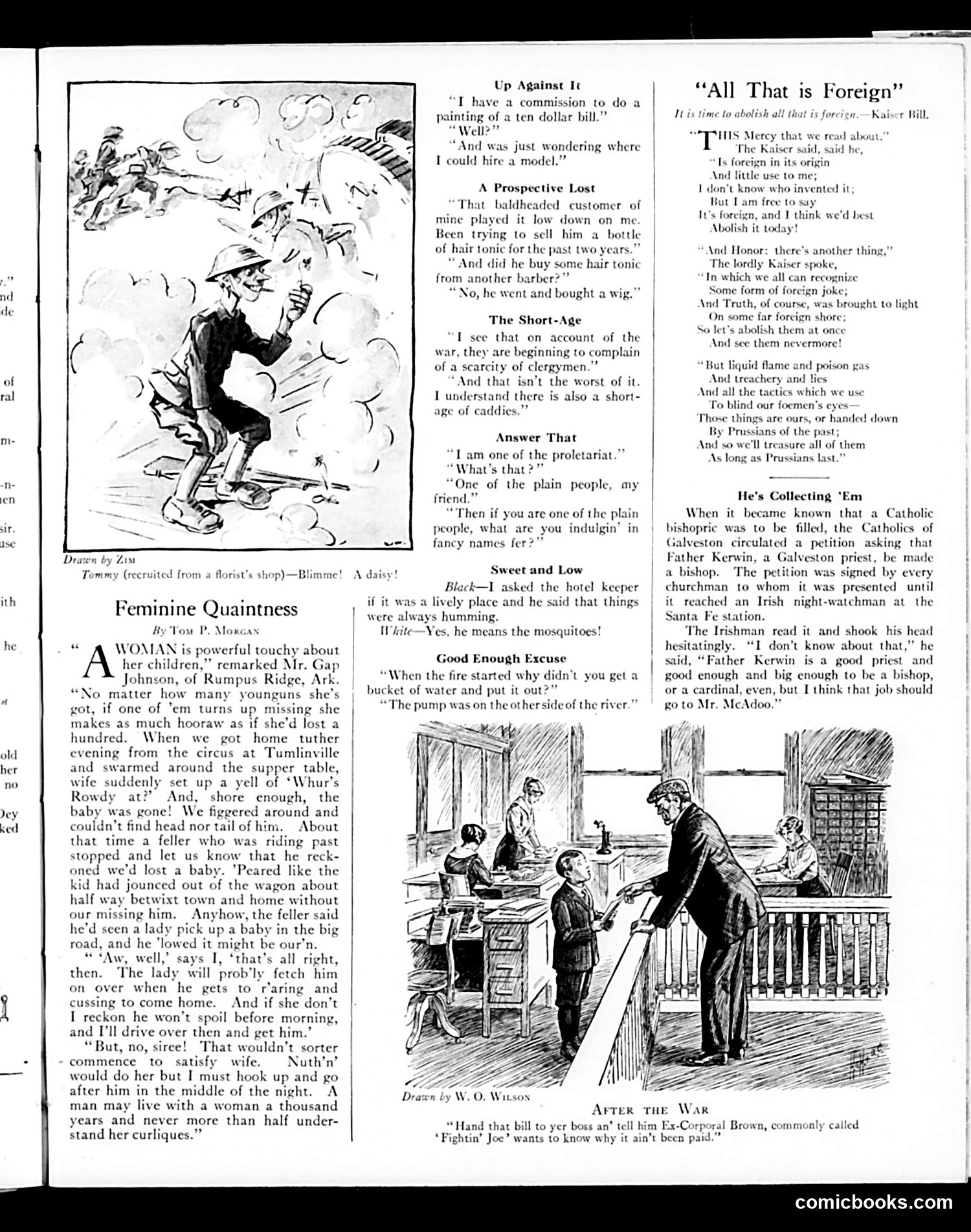
This Judge magazine page contains several short humorous pieces and cartoons satirizing American life and World War I attitudes. **"Feminine Quaintness"** mocks rural men's indifference to their children's welfare through exaggerated dialect. A father casually accepts his baby may be lost but won't retrieve him until morning—satirizing perceived masculine negligence. **"All That is Foreign"** directly attacks Kaiser Wilhelm II, ridiculing Germany's claim that concepts like mercy, honor, and truth are "foreign" while poison gas and treachery are supposedly Prussian virtues. This wartime propaganda piece sarcastically exposes German hypocrisy during WWI. The scattered short jokes ("Up Against It," "A Prospective Lost," "The Short-Age," etc.) are typical Judge humor—quick jabs at contemporary absurdities like hiring models for currency, barber competition, and wartime shortages. **"He's Collecting 'Em"** references a real incident: a petition to make Father Kerwin a bishop in Galveston, apparently collecting religious appointments. The page reflects American WWI-era sentiment and general satire of everyday foolishness.
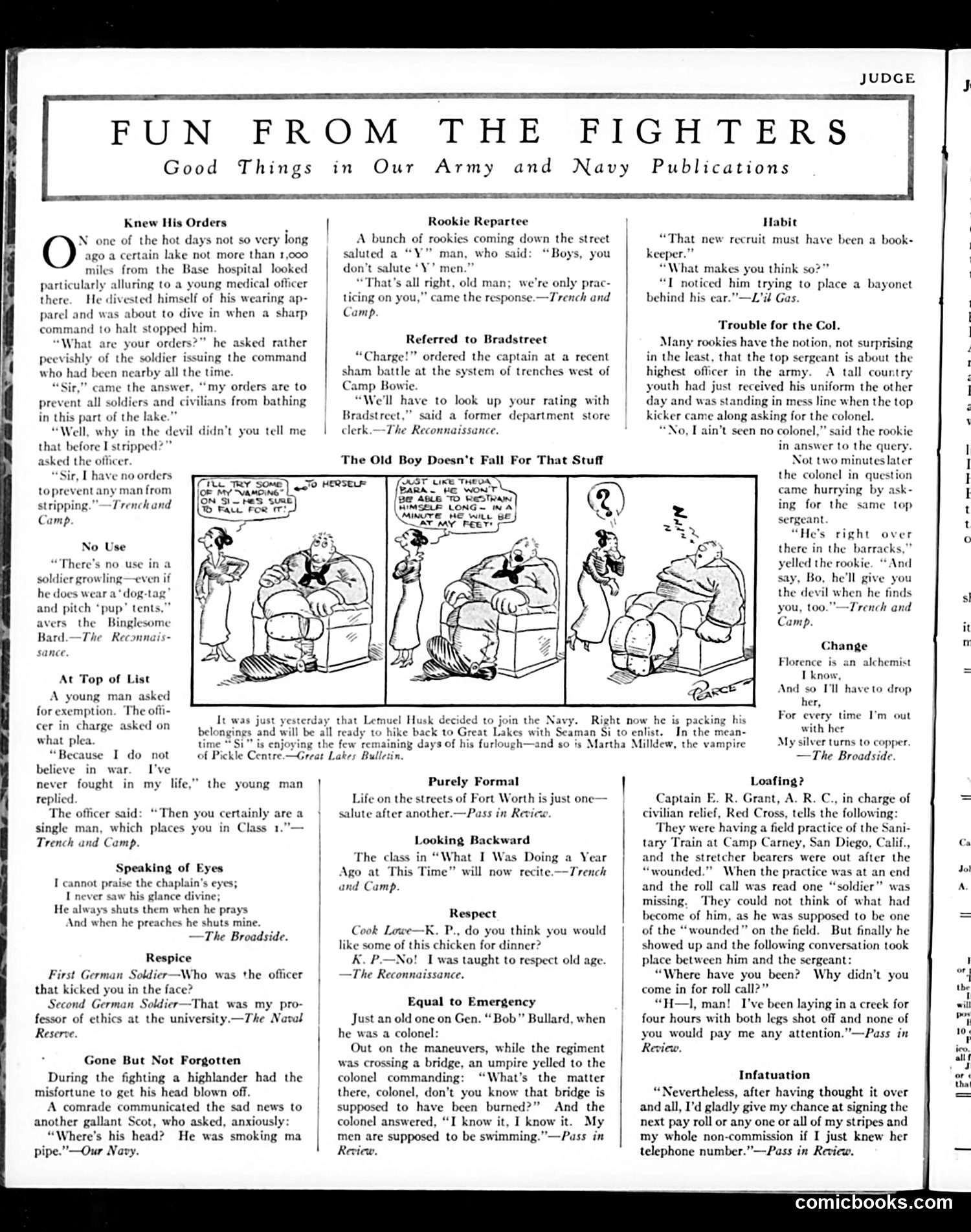
This page collects humorous anecdotes from American military personnel during World War I, organized under headings like "Rookie Repartee" and "Equal to Emergency." The humor relies on military absurdities and bureaucratic logic. Key jokes include: - **Bureaucratic rigidity**: A soldier prevents an officer from swimming because he has no "orders" to allow officers specifically - **Class consciousness**: A pacifist draftee is classified as "Class 1" (no exemptions) because he hasn't fought, making him technically single - **Officer competence**: General "Bob" Bullard adapts to wartime by having soldiers "suppose[d] to be swimming" across a "burned" bridge The cartoon "The Old Boy Doesn't Fall For That Stuff" depicts a recruit's failed attempt to convince an older soldier to enlist through flattery. The overall tone satirizes military inefficiency, the gap between officers and enlisted men, and the absurd situations created by rigid regulations—entertainment for American soldiers and civilians supporting the war effort.
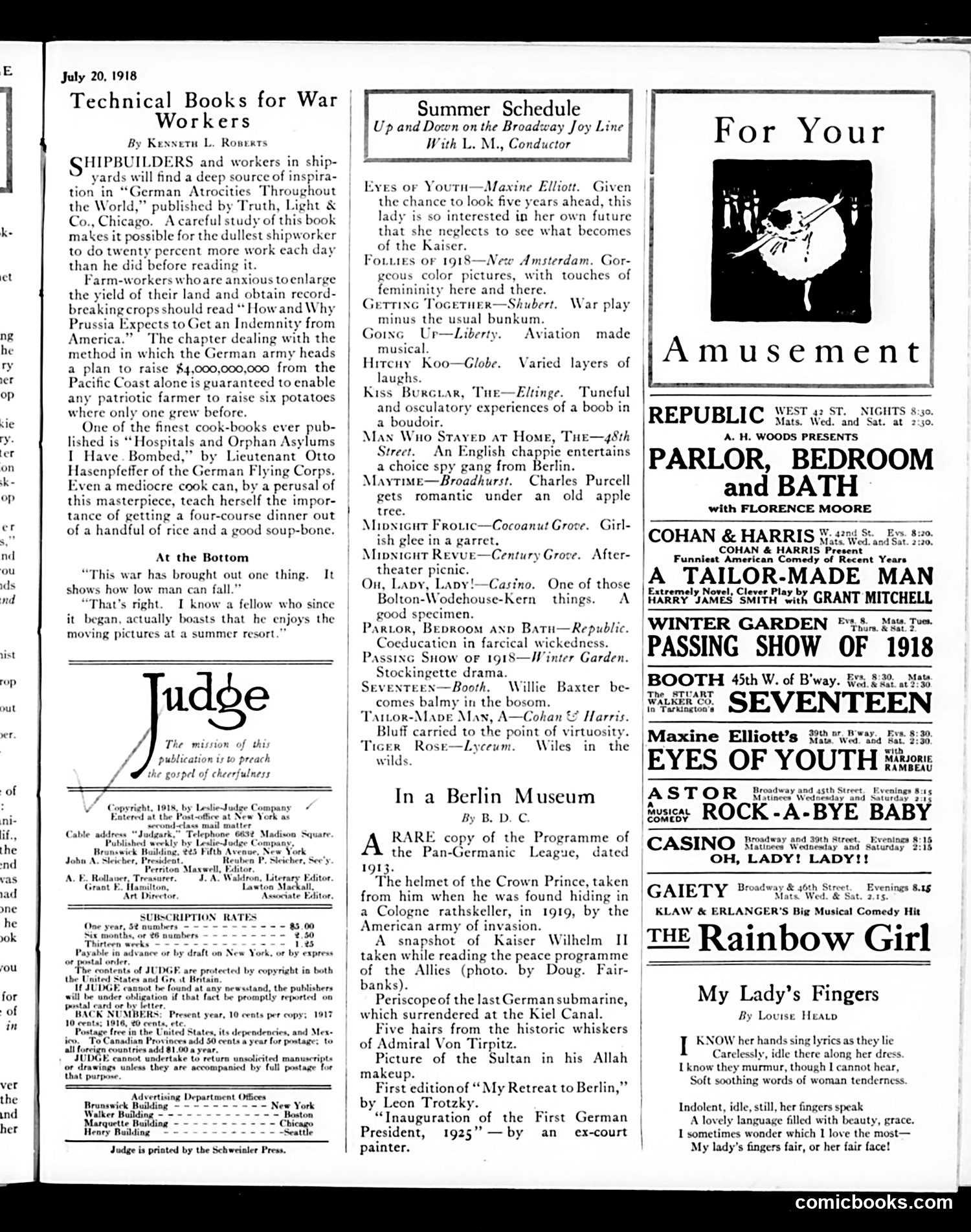
This page uses **biting satire** to mock German militarism during World War I (America had entered in April 1917). **The "Technical Books for War Workers" section** satirizes German publications by inventing absurd fake book titles. Each purportedly teaches Americans something, but actually ridicules German aggression: "How and Why Prussia Expects to Get an Indemnity from America" mocks German war aims; "Hospitals and Orphan Asylums I Have Bombed" denounces German atrocities; and a cookbook humorously trivializes German deprivation. **"At the Bottom" joke** suggests Germans have demonstrated humanity's capacity for moral collapse—a common American propaganda trope depicting Germans as uniquely barbaric. The quip about someone enjoying summer pictures despite the war subtly criticizes civilian morale. **The right side** is primarily theater advertising, typical of Judge's commercial content. This exemplifies how American satirical magazines employed humor as **wartime propaganda**, dehumanizing the enemy while rallying readers to the American cause.
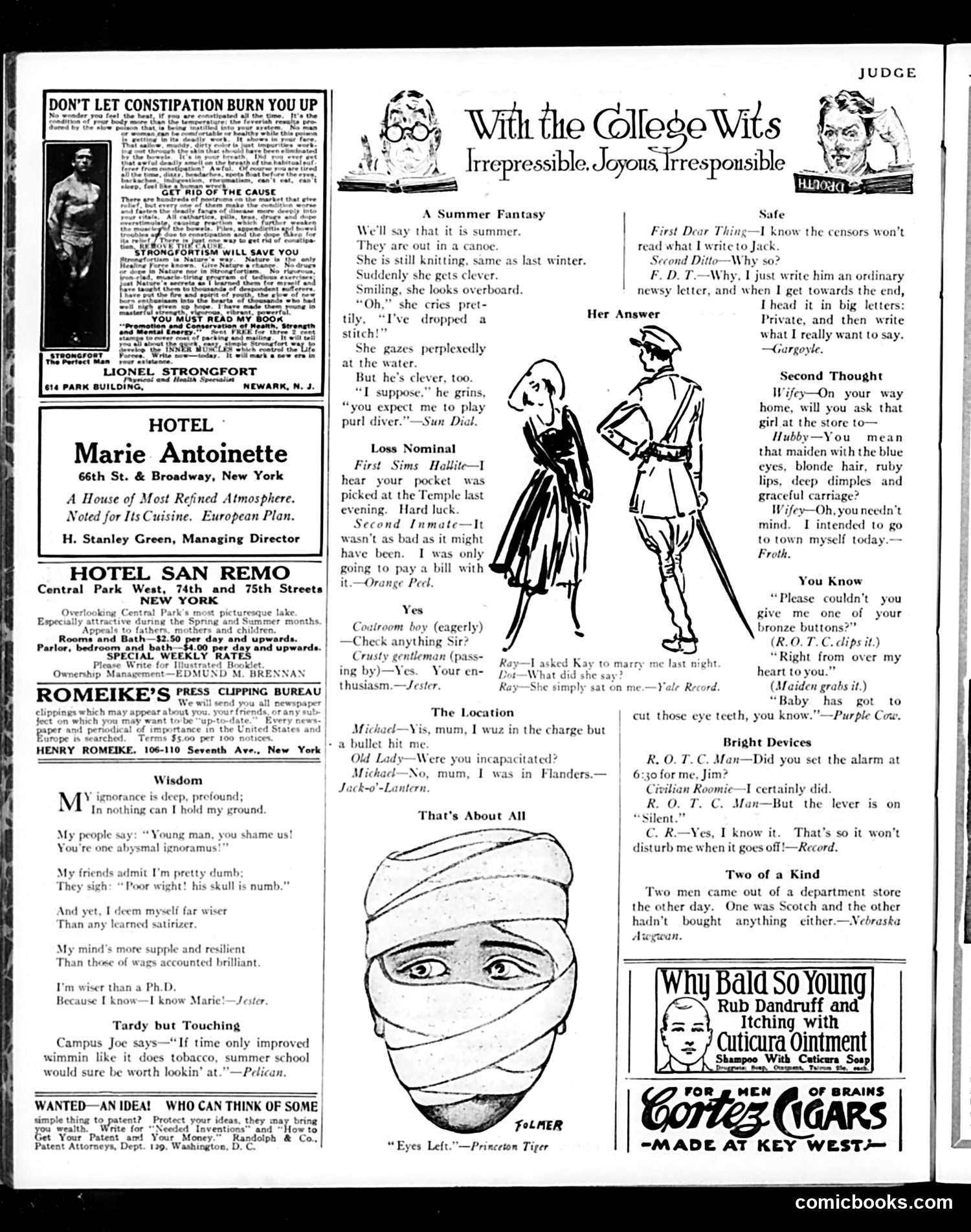
This is primarily a **humor and advertising page** from *Judge* magazine, not a political cartoon. The content consists of: **Main Feature:** "With the College Wits"—a collection of student jokes and witticisms, mostly dating humor and academic life. Examples include a canoe scene where a girl drops a knitting stitch and asks her date to be a "purl diver" (pun on pearl diver), and exchanges about censoring letters to servicemen. **Advertisements:** The page is heavily populated with ads for NYC hotels (Marie Antoinette, San Remo), Lionel Strongfort's physical fitness program, patent services, and Cuticura ointment. **Supporting Content:** A "Wisdom" poem mocking pretentious intellectualism, and various newspaper clippings from college humor publications. **Context:** This reflects post-WWI college culture—references to servicemen suggest wartime dating concerns. The humor is genteel and innocent by modern standards, focusing on courtship mishaps and student life rather than satire of current events.
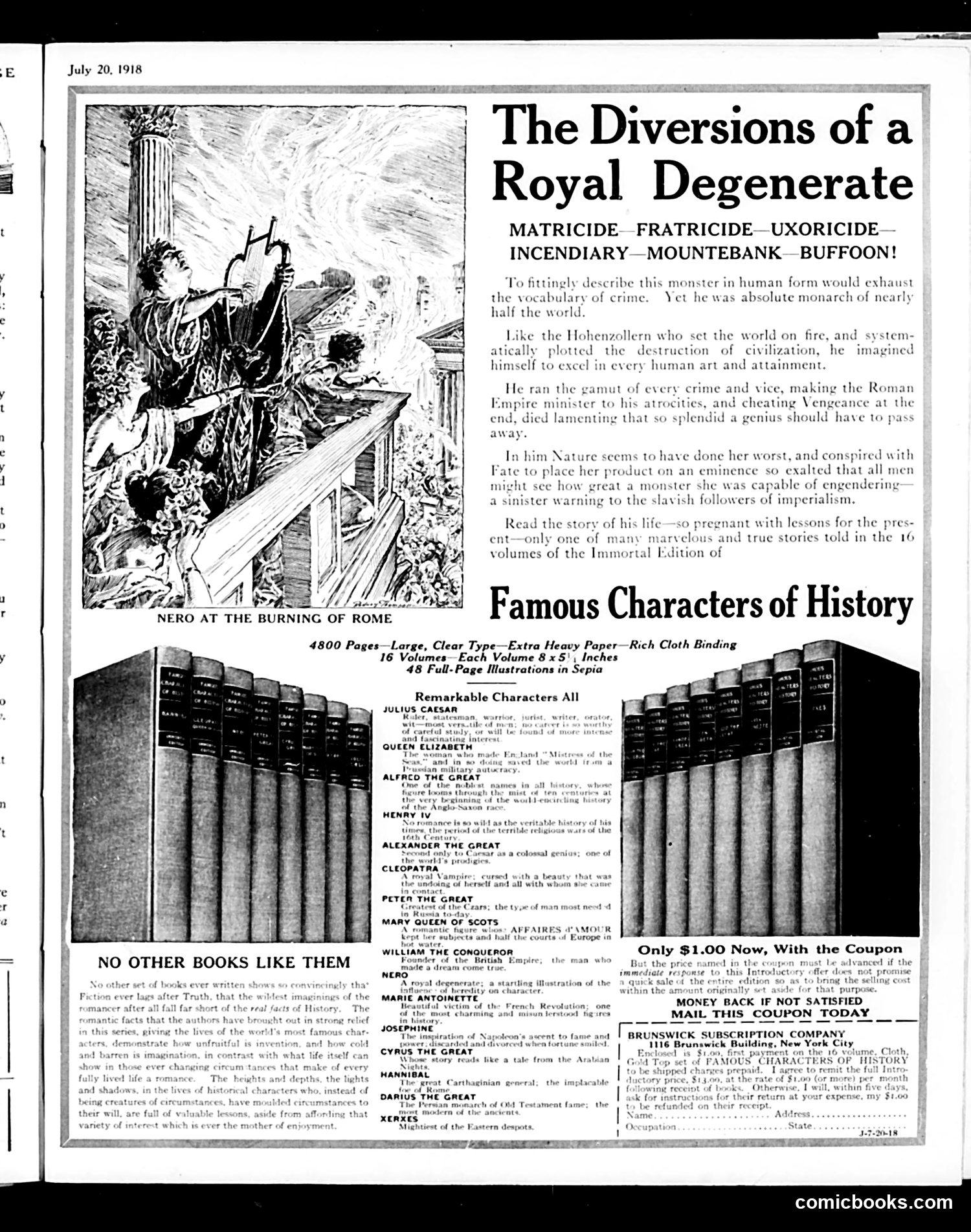
This July 1918 page attacks **Kaiser Wilhelm II** of Germany through a historical parallel. The cartoon depicts "Nero at the Burning of Rome," comparing the German emperor to the notorious Roman tyrant who allegedly fiddled while Rome burned. The headline's accusations—matricide, fratricide, uxoricide, incendiary—suggest Wilhelm's responsibility for World War I's devastation. The text explicitly references "the Hohenzollern who set the world on fire," identifying him as Wilhelm and blaming him for initiating the conflict that had killed millions across "nearly half the world." Published in summer 1918, as the war neared its end and German defeat became apparent, this satire frames Wilhelm as a degenerate monster whose crimes rival history's worst figures. The comparison to Nero—a ruler remembered for tyranny and destruction—serves as propaganda delegitimizing German leadership. The advertisement for "Famous Characters of History" on the same page appears coincidental rather than thematic.
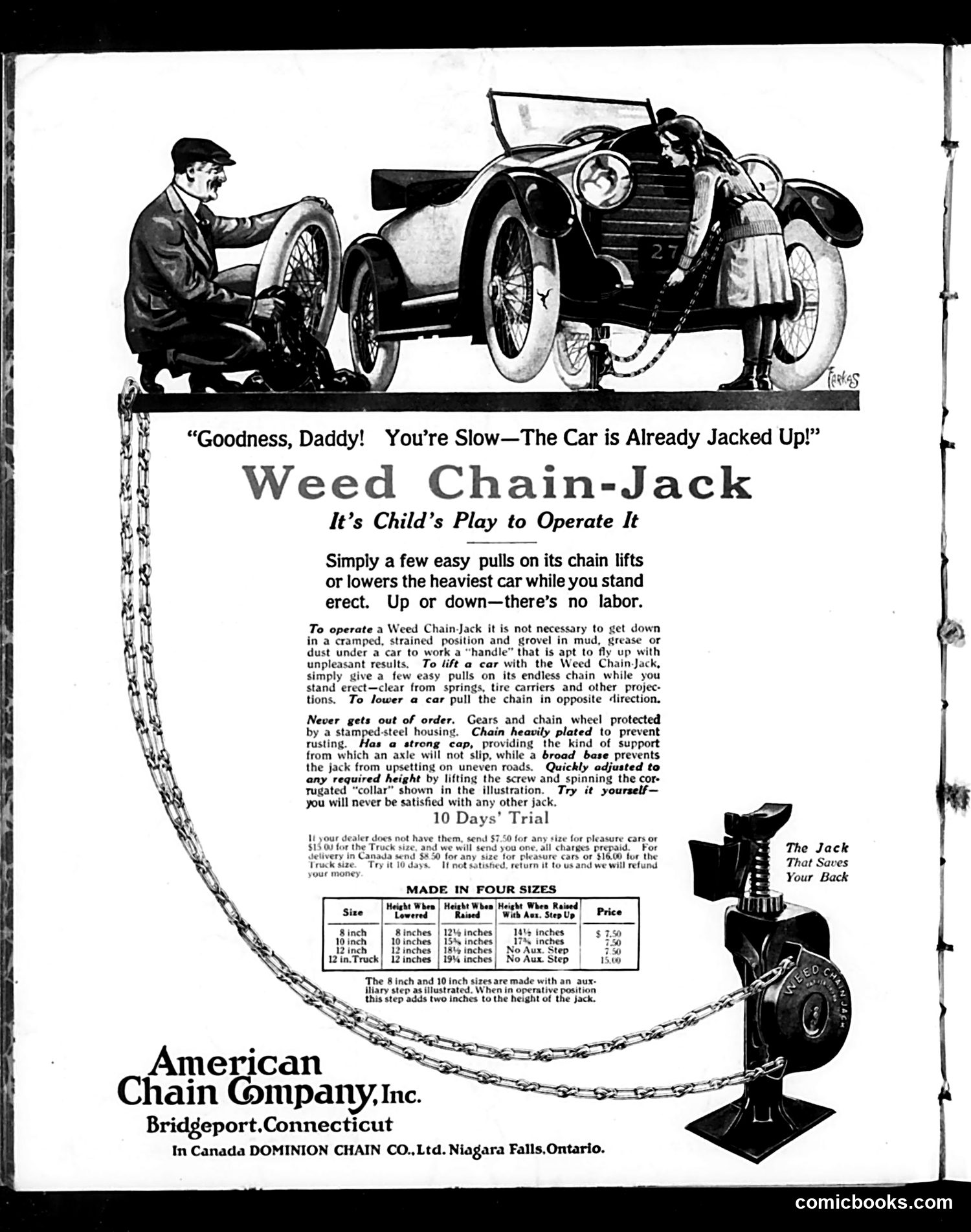
This is primarily a **product advertisement**, not political satire. It promotes the Weed Chain-Jack, a mechanical automobile jack manufactured by American Chain Company. The cartoon illustration depicts a father working on a car while a child comments that "the car is already jacked up"—implying the father is slow. This is an **advertising joke** highlighting the product's ease of use: even a child could operate it quickly by simply pulling a chain, rather than requiring the manual effort and cramped positioning of older jack designs. The social context: early-20th-century car maintenance was physically demanding and dirty work. The advertisement emphasizes labor-saving convenience—a major selling point of the era. The phrase "It's Child's Play to Operate It" reinforces simplicity as the key marketing message. There is no political commentary or satire here; this is straightforward commercial advertising using humor to sell industrial equipment to automobile owners.