
Judge, 1918-07-20 · page 14 of 32
Judge — July 20, 1918 — page 14: what you’re looking at
What you’re looking at
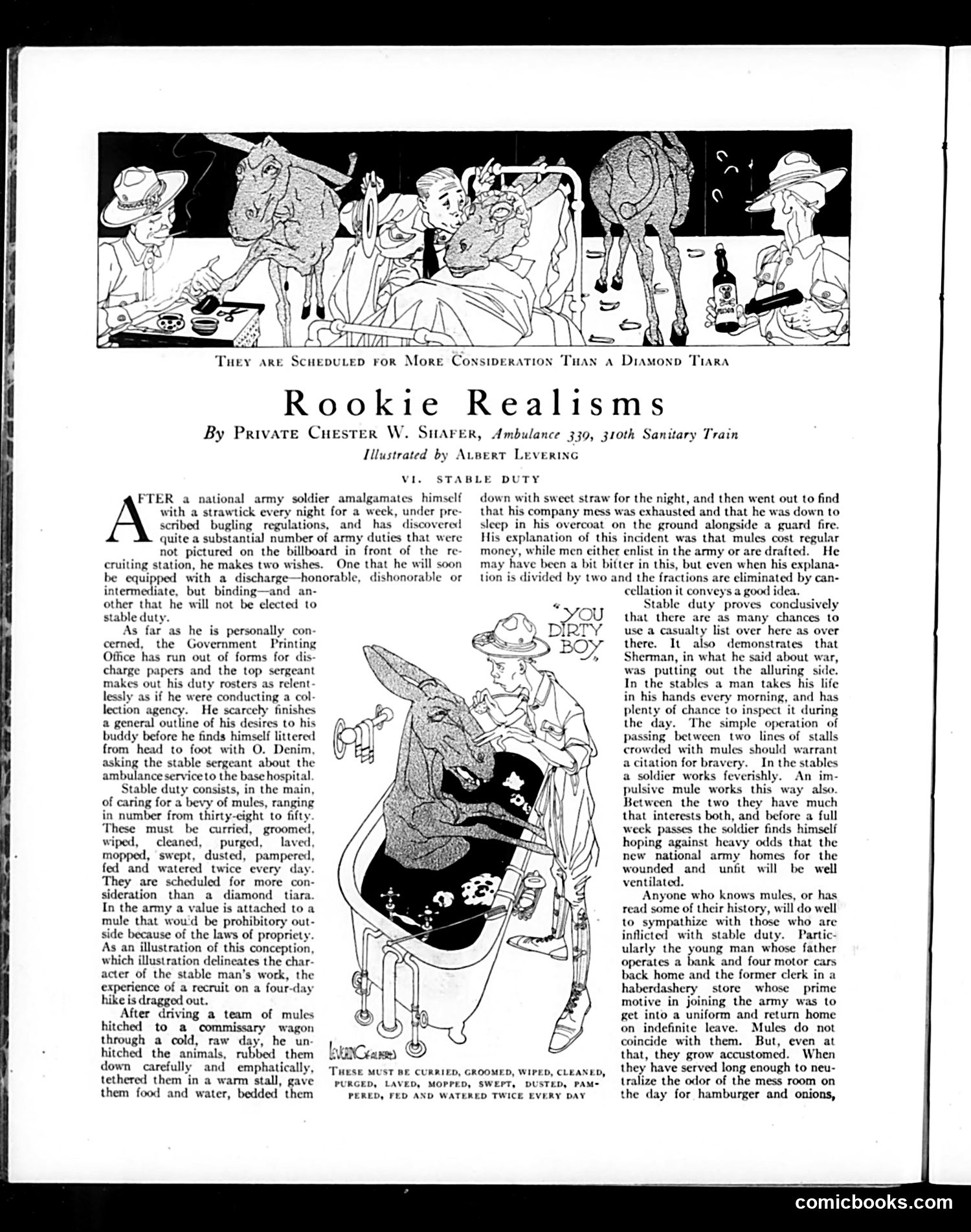
This WWI-era article satirizes the harsh reality of Army life for new recruits, specifically stable duty—caring for military mules. The writer (identified as Private Chester W. Shafer, Ambulance 339, 310th Sanitary Train) uses humor to expose the gap between recruitment propaganda and actual soldiering. The central joke: mules receive far better treatment than soldiers. A recruit must groom, feed, and pamper 30-50 mules twice daily—"scheduled for more consideration than a diamond tiara"—while enlisted men sleep outdoors on the ground. The illustration shows a soldier tending an enormous, demanding mule. Shafer mocks the Army's prioritization (mules cost money; soldiers either enlist or are drafted) and references General Sherman's famous "war is hell" quote, suggesting stable duty proves him right. The satire particularly targets privileged draftees (bankers' sons, clerks) unprepared for such labor, while implying the entire experience is dangerous and degrading.
📄 Transcribed text from this page (OCR, searchable)
Machine-transcribed from the original scan — historical spelling and the odd misread are preserved.
are ScHeDULED For More Consiperation Tuan a Diamonpo Tiara Rookie Realisms By Private Cuester W. SHAFER, Ambulance 339, 310th Sanitary Train Illustrated by Avpert Leverinc VI. STABLE DUTY FTER a national army soldier amalgamates himself with a strawtick every night for a weck, under pre- scribed bugling regulations, and has discovered quite a substantia] number of army duties that were not pictured on the billboard in front of the re- cruiting station, he makes two wishes. One that he will soon be equipped with a discharge—honorable, dishonorable or intermediate, but binding—and an- other that he will not be elected to stable duty. As far as he is personally con- cerned, the Government Printing Office has run out of forms for dis. charge papers and the top sergeant makes out his duty rosters as relent- lessly as if he were conducting a col- lection agency. He scarcely finishes a general outline of his desires to his buddy before he finds himself littered from head to foot with O. Denim, asking the stable sergeant about the ambulance service to the base hospital Stable duty consists, in the main, of caring for a bevy of mules, ranging in number from thirty-eight to fifty These must be curried, groomed, wiped, cleaned, purged, —_laved, mopped, swept, dusted, pampered, fed and watered twice every day. They are scheduled for more con- sideration than a diamond _ tiara. In the army a value is attached to a mule that wou'd be prohibitory out- side because of the laws of propriety. As an illustration of this conception, which illustration delineates the char- acter of the stable man’s work, the experience of a recruit on a four-day hike is dragged out. After driving a team of mules hitched to a commissary wagon through a cold, raw day, he un- hitched the animals, rubbed them down with sweet straw for the night, and then went out to find that his company mess was exhausted and that he was down to sleep his overcoat on the ground alongside a guard fire. His explanation of this incident was that mules cost regular money, while men either enlist in the army or are drafted. He may have been a bit bitter in this, but even when his explana- tion is divided by two and the fractions are eliminated by can- ccllation it conveys a good idea. Stable duty proves conclusively that there are as many chances to use a casualty list over here as over there. It also demonstrates that Sherman, in what he said about war, was putting out the alluring side. In the stables a man takes his life in his hands every morning, and has plenty of chance to inspect it during the day. The simple operation of passing between two lines of stalls crowded with mules should warrant a citation for b ry. In the stables a soldier works feverishly. An im- pulsive mule works this way also. Between the two they have much that interests both, and before a full week passes the soldier finds himself hoping against heavy odds that the new national army homes for the wounded and unfit will be well ventilated. Anyone who knows mules, or has read some of their history, will do well to sympathize with those who are inflicted with stable duty. Partic- ularly the young man whose father operates a bank and four motor cars back home and the former clerk in a haberdashery store whose prime motive in joining the army was to get into a uniform and return home on indefinite leave. Mules do not coincide with them. But, even at that, they grow accustomed. When down carefully and emphatically, Tyese wust ae curaixD, croosten, wiren, cLeaNen, they have served long enough to neu- tethered them in a warm stall, gave purcep, Laven, Morren, swert, pustep, ram- — tralize the odor of the mess room on them food and water, bedded them PERED, FED AND WATERED TWICE EVERY DAY the day for hamburger and onions, comicbooks.com