
Judge, 1918-07-20 · page 5 of 32
Judge — July 20, 1918 — page 5: what you’re looking at
What you’re looking at
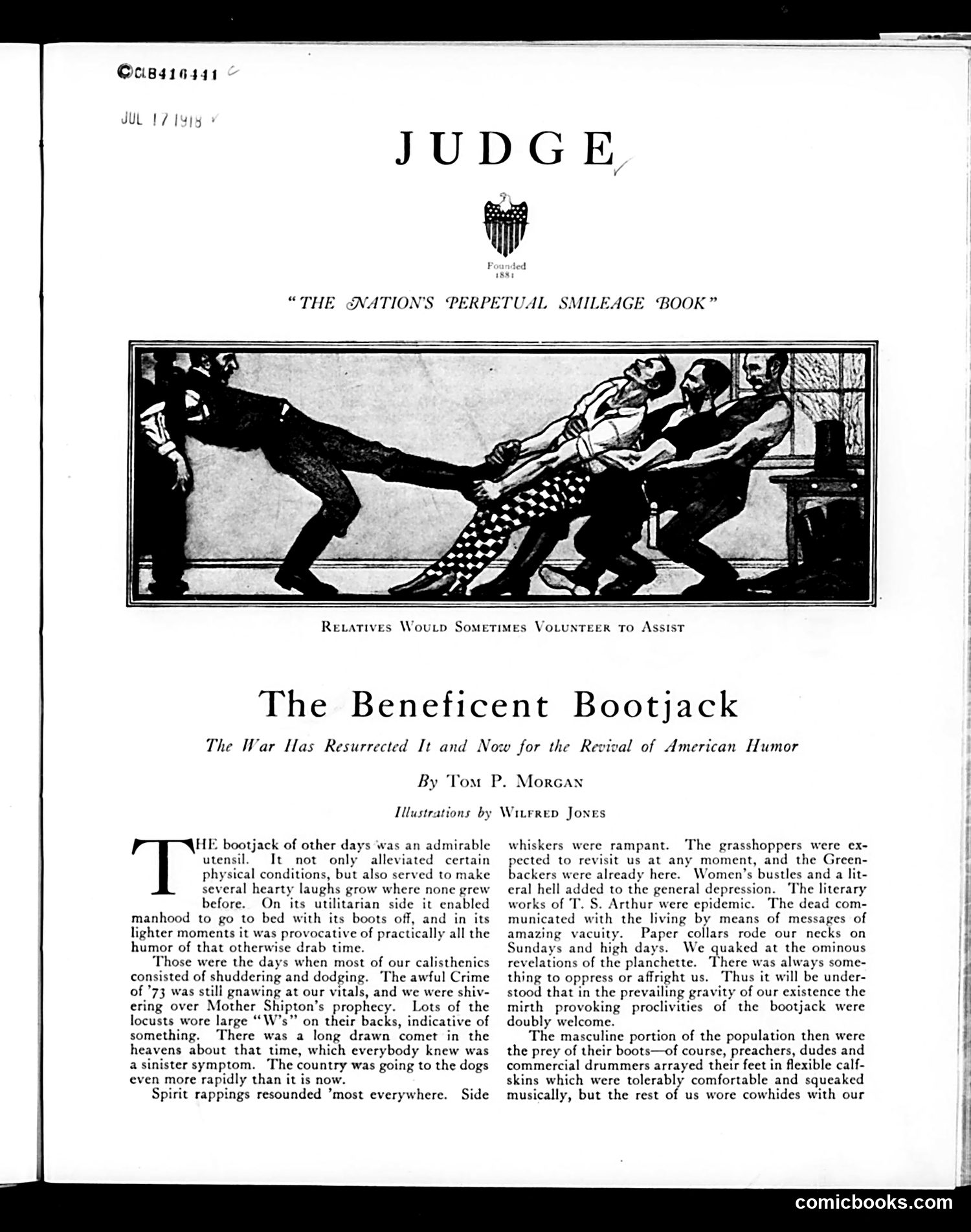
This satirical piece by Tom P. Morgan, illustrated by Wilfred Jones, uses the bootjack (a device for removing boots) as metaphor for humor's restorative social function during wartime. The cartoon depicts multiple figures struggling to pull off a large boot—likely representing collective effort to remove hardship or oppression. The caption states "Relatives Would Sometimes Volunteer to Assist," suggesting humor requires communal participation. Morgan's essay argues that pre-war American humor served important psychological purposes—providing relief from serious conditions and "mirth-provoking proclivities." He claims wartime circumstances have revived this tradition. The bootjack becomes emblematic of extracting society from difficult circumstances through laughter and satire, a recurring Judge magazine function during the World War I era.
📄 Transcribed text from this page (OCR, searchable)
Machine-transcribed from the original scan — historical spelling and the odd misread are preserved.
O@ciesi6441 JUL I 7 14g » Retatives Woutp Sometimes VoLtuNTEER To Assist The Beneficent Bootjack The War Has Resurrected It and Now for the Revival of American Humor By ‘Yom P. Morcan Illustrations by Witerep Jones HE bootjack of other days was an admirable utensil. It not only alleviated certain physical conditions, but also served to make several hearty laughs grow where none grew before. On its utilitarian side it enabled manhood to go to bed with its boots off, and in its lighter moments it was provocative of practically all the humor of that otherwise drab time. Those were the days when most of our calisthenics consisted of shuddering and dodging. The awful Crime of ’73 was still gnawing at our vitals, and we were shiv- ering over Mother Shipton’s prophecy. Lots of the locusts wore large ““W’s” on their backs, indicative of something. There was a long drawn comet in the heavens about that time, which everybody knew was a sinister symptom. The country was going to the dogs even more rapidly than it is now. Spirit rappings resounded ’most everywhere. Side whiskers were rampant. The grasshoppers were ex- pected to revisit us at any moment, and the Green- backers were already here. Women’s bustles and a lit- eral hell added to the general depression. The literary works of T. S. Arthur were epidemic. The dead com- municated with the living by means of messages of amazing vacuity. Paper collars rode our necks on Sundays and high days. We quaked at the ominous revelations of the planchette. There was always some- thing to oppress or affright us. Thus it will be under- stood that in the prevailing gravity of our existence the mirth provoking proclivities of the bootjack were doubly welcome. The masculine portion of the population then were the prey of their boots—of course, preachers, dudes and commercial drummers arrayed their feet in flexible calf- skins which were tolerably comfortable and squeaked musically, but the rest of us wore cowhides with our comicbooks.com