
Judge, 1918-07-20 · page 13 of 32
Judge — July 20, 1918 — page 13: what you’re looking at
What you’re looking at
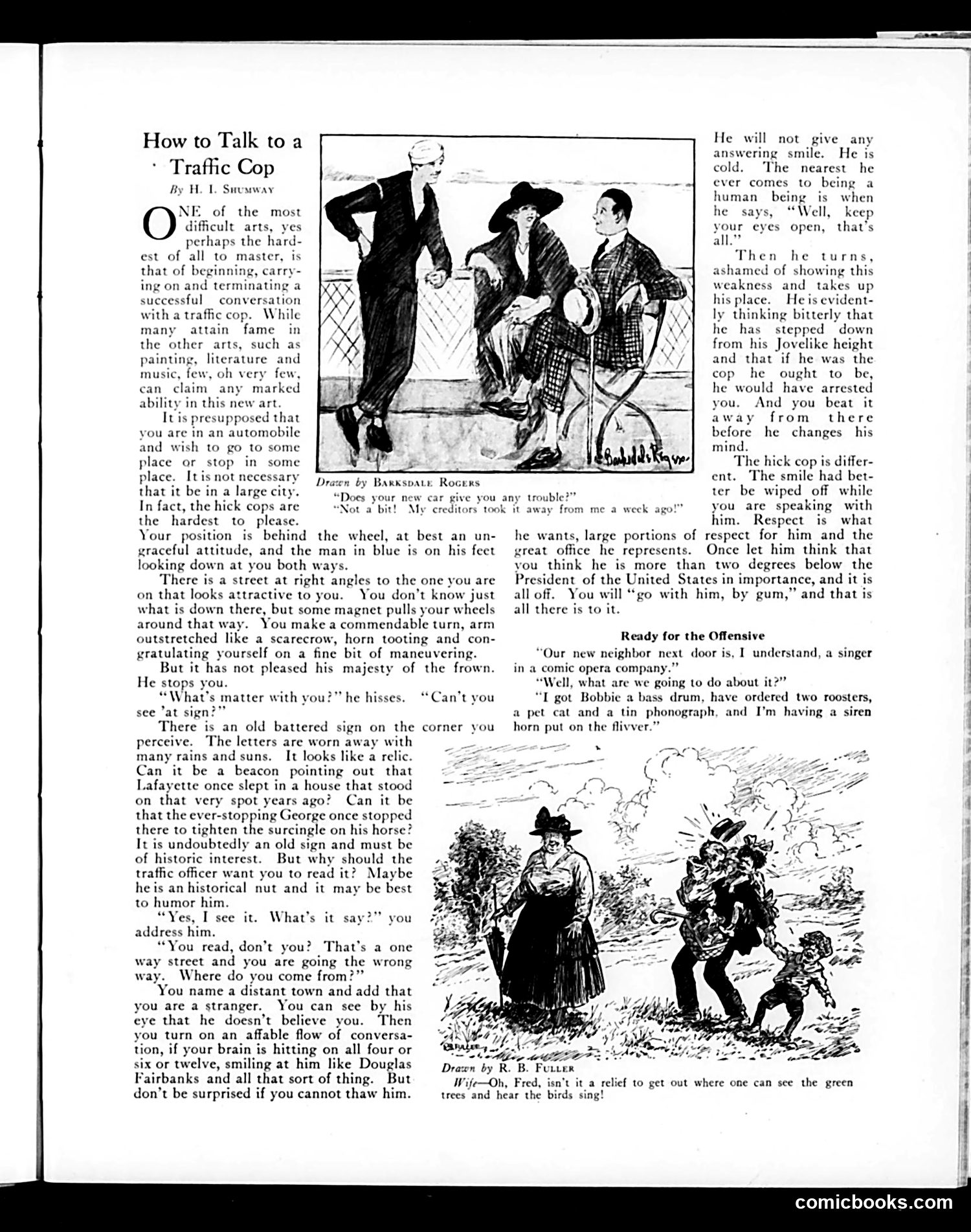
This page from *Judge* magazine satirizes the early automobile era's new phenomenon: traffic police enforcement. **Main Article:** "How to Talk to a Traffic Cop" humorously describes the power dynamic between drivers and officers. The author portrays traffic cops as humorless, authoritarian figures who hold absolute power over motorists. Key satire points include: cops won't smile or show humanity; they demand obedience to worn, illegible street signs; they're suspicious of strangers; and drivers must perform deference (smiling like Douglas Fairbanks) to avoid arrest. The distinction between "hick cops" (rural, requiring extra respect) and urban officers adds class-based humor. **Side Cartoon:** Shows a neighbor preparing retaliatory noise-making (bass drum, roosters, siren) against a new singer neighbor—slapstick humor about urban noise complaints. **Context:** This reflects early 1900s anxieties about new traffic laws, automobile culture, and police authority over previously unrestricted drivers. The condescending tone toward cops reflects class tensions and resentment of regulatory control during rapid modernization.
📄 Transcribed text from this page (OCR, searchable)
Machine-transcribed from the original scan — historical spelling and the odd misread are preserved.
How to Talk to a * Traffic Cop By H. 1. Suumway NE_ of the most O difficult arts, yes perhaps the hard- est of all to master, is that of beginning, carry- ing on and terminating a successful conversation with a traffic cop. While many attain fame in the other arts, such as painting, literature and music, few, oh very few, can claim any marked ability in this new art. It is presupposed that you are in an automobile and wish to go to some place or stop in some place. Itis not necessary that it be in a large city. In fact, the hick cops are the hardest to please. Your position is behind the wheel, at best an un- graceful attitude, and the man in blue is on his feet looking down at you both ways. There is a street at right angles to the one you are on that looks attractive to you. You don’t know just what is down there, but some magnet pulls your wheels around that way. You make a commendable turn, arm outstretched like a scarecrow, horn tooting and con- gratulating yourself on a fine bit of maneuvering. But it has not pleased his majesty of the frown. He stops you. “What's matter with you?” he hisses. ‘Can't you see at sign?” There is an old battered sign on the corner you perceive. The letters are worn away with many rains and suns. It looks like a relic. Can it be a beacon pointing out that Lafayette once slept in a house that stood on that very spot years ago? Can it be that the ever-stopping George once stopped there to tighten the surcingle on his horse? It is undoubtedly an old sign and must be of historic interest. But why should the traffic officer want you to read it?) Maybe he is an historical nut and it may be best to humor him. “Yes, I see it. What's it say address him. “You read, don’t you? That's a one y street and you are going the wrong Where do you come from?” You name a distant town and add that you are a stranger. You can see by his eye that he doesn’t believe you. Then you turn on an affable flow of conversa- tion, if your brain is hitting on all four or six or twelve, smiling at him like Douglas Fairbanks and all that sort of thing. But don’t be surprised if you cannot thaw him. Draven by Barkspate: Rocexs “Not a bit! My cre * you Does your new car give you any trouble? 5 : : tors took it away from me a week ago!” You are speaking with Alig oe Drawn by R. B. Furver Wife—Oh, Fred, isn’t ita relief to get out where one can see the green trees and hear the birds sing! He will not give any answering smile. He is cold. The nearest he ever comes to being a human being is when he says, “Well, keep your eyes open, that’s all.” Then he turns, ashamed of showing this weakness and takes up his place. He is evident- ly thinking bitterly that he has stepped down from his Jovelike height and that if he was the cop he ought to be, he would have arrested you. And you beat it from there he changes his mind. The hick cop is differ- ent. The smile had bet- ee ter be wiped off while him. Respect what he wants, large portions of respect for him and the great office he represents. Once let him think that you think he is more than two degrees below the President of the United States in importance, and it is all off. You will “go with him, by gum,” and that is all there is to it. Ready for the Offensive “Our new neighbor next door is, I understand, a singer in a comic opera company.” “Well, what are we going to do about it?” “I got Bobbie a bass drum, have ordered two roosters, a pet cat and a tin phonograph, and I'm having a siren horn put on the flivver.” CLIO comicbooks.com |