
Judge, 1918-07-20 · page 24 of 32
Judge — July 20, 1918 — page 24: what you’re looking at
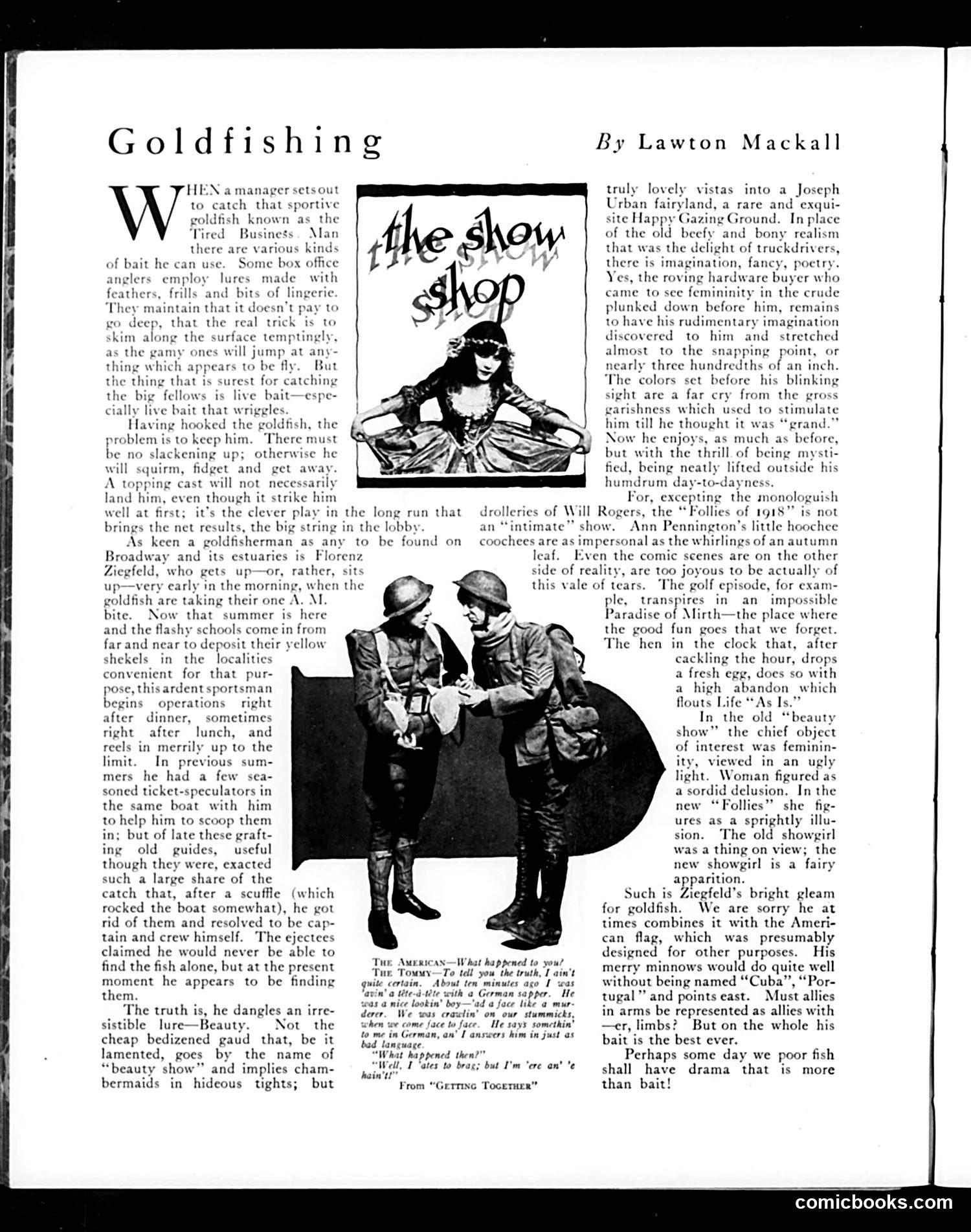
What you’re looking at
This article uses extended fishing metaphor to satirize Broadway impresario **Florenz Ziegfeld** and his theatrical enterprises. The "goldfish" represents the "Tired Business Man"—the wealthy male audience members Ziegfeld targets. The satire compares Ziegfeld's methods to fishing: he uses "live bait" (attractive women and spectacle) to hook audiences, then keeps them engaged ("reels in merrily"). The article notes Ziegfeld previously employed "ticket-speculators" as guides who took too large a share of profits—a veiled reference to business partners he apparently eliminated. The piece credits Ziegfeld's success to his "lure—Beauty," specifically the artistic vision of **Joseph Urban** (the set designer), which elevates his shows beyond cheap burlesque. The contrast between old "beefy and bony realism" and Urban's imaginative, poetic staging suggests Ziegfeld's shows offer aesthetic elevation disguised as entertainment for working-class audiences. The tone is admiring yet sardonic about Ziegfeld's calculated commercial strategy.
📄 Transcribed text from this page (OCR, searchable)
Machine-transcribed from the original scan — historical spelling and the odd misread are preserved.
oldfishin HEN a manager setsout to catch that sportive goldfish known as the Tired Business. Man there are various kinds of bait he can use. Some box office anglers employ lures made with feathers, frills and bits of lingerie. They maintain that it doesn’t pay to go deep, that the real trick is to skim along the surface temptingly, the gamy ones will jump at any- ig which appears to be fly. But the thing that is surest for catching the big fellows is live bait—espe- cially live bait that wriggles. Having hooked the goldfish, the problem is to keep him. There must be no slackening up; otherwise he will squirm, fidget and get away. A to; g cast will not necessarily land him, even though it strike him well at first; brings the net results, the big As keen a goldfisherman as any Broadway and its estuaries is Florenz Ziegfeld, who gets up—or, rather, up—very early in the morning, when the goldfish are taking their one A. M. bite. Now that summer is here and the flashy schools come in from far and near to deposit their yellow shekels in the localities convenient for that pur- pose, this ardent sportsman begins operations right after dinner, sometimes right after lunch, and reels in merrily up to the limit. In previous sum- mers he had a few sea- soned ticket-speculators in the same boat with him to help him to scoop them in; but of late these graft- ing old guides, useful though they were, exacted such a large share of the catch that, after a scuffle (which d the boat somewhat), he got rid of them and resolved to be cap- tain and crew himself. The ejectees claimed he would never be able to find the fish alone, but at the present moment he appears to be finding them. The truth is, he dangles an irre- sistible lure—Beauty. Not the cheap bedizened gaud that, be it lamented, goes by the name of “beauty show” and implies cham- bermaids in hideous tights; but string in it’s the clever play in the long run that to be found on drolle ¢ lobby. intimate” an “* leaf. E ies of Will Rogers, the “ show. coochees are as impersonal as the whirlings of an autumn n the comic scenes are on the other By Lawton Mackall into a Joseph rare and Pau truly lovely vistas Urban fairyland site Happy Gazing Ground. In place of the old beefy and bony realism that was the delight of truckdrivers, there is imagination, fancy, poetry. Yes, the roving hardware buyer who came to see femininity in the crude plunked down before him, remains to have his rudimentary imagination discovered to him and_ stretched almost to the snapping point, or nearly three hundredths of an inch. The colors set before his blinking sight are a far cry from the garishness which used to stimulate him till he thought it was “grand.” Now he enjoys, as much as before, but with the thrill of being mysti- fied, being neatly lifted outside his humdrum day-to-dayness. or, excepting the monologuish ‘ollies of 1918” is not Ann Pennington’s little hoochee gross j side of reality, are too joyous to be actually of this vale of tears. Tur, AweRicas—Waat happened to you? Tur. Towmy—To tell you the truth, I ain't quite certain, About ten minutes ago I was n'a téte-d-téte with a German sapper. He was @ nice lookin’ boy—'ad @ face like @ mur derer. We was crawtin’ om’ our stummicks, when we come face to face. He says somethin? to me in German, an’ I answers him in just as bad language “What happened then?” “Well, I ‘ates to brag; but I'm ‘ere an’ 'e hain't! From “Getminc Tocerurr” The golf episode, for exam- ple, transpires in) an impossible Paradise of Mirth—the place where the good fun goes that we forget. The hen in the clock that, after cackling the hour, drops a fresh egg, does so with a high abandon which flouts Life “As Is.” In the old “beauty show” the chief object of interest was feminin- ity, viewed in an ugly light. Woman figured as a sordid delusion. In the new “Follies” she fi ures as a sprightly illu- sion. The old showgirl was a thing on view; the new showgirl is a fairy apparition. Such is Ziegfeld’s bright gleam for goldfish. We are sorry he at times combines it with the Ameri- can flag, which was presumably designed for other purposes. His merry minnows would do quite well without being named “Cuba”, “Por- tugal”’ and points east. Must allies in arms be represented as allies with —er, limbs? But on the whole his bait is the best ever. Perhaps some day we poor fish shall have drama that is more than bait! comicbooks.com