
A complete issue · 36 pages · 1918
Judge — July 6, 1918
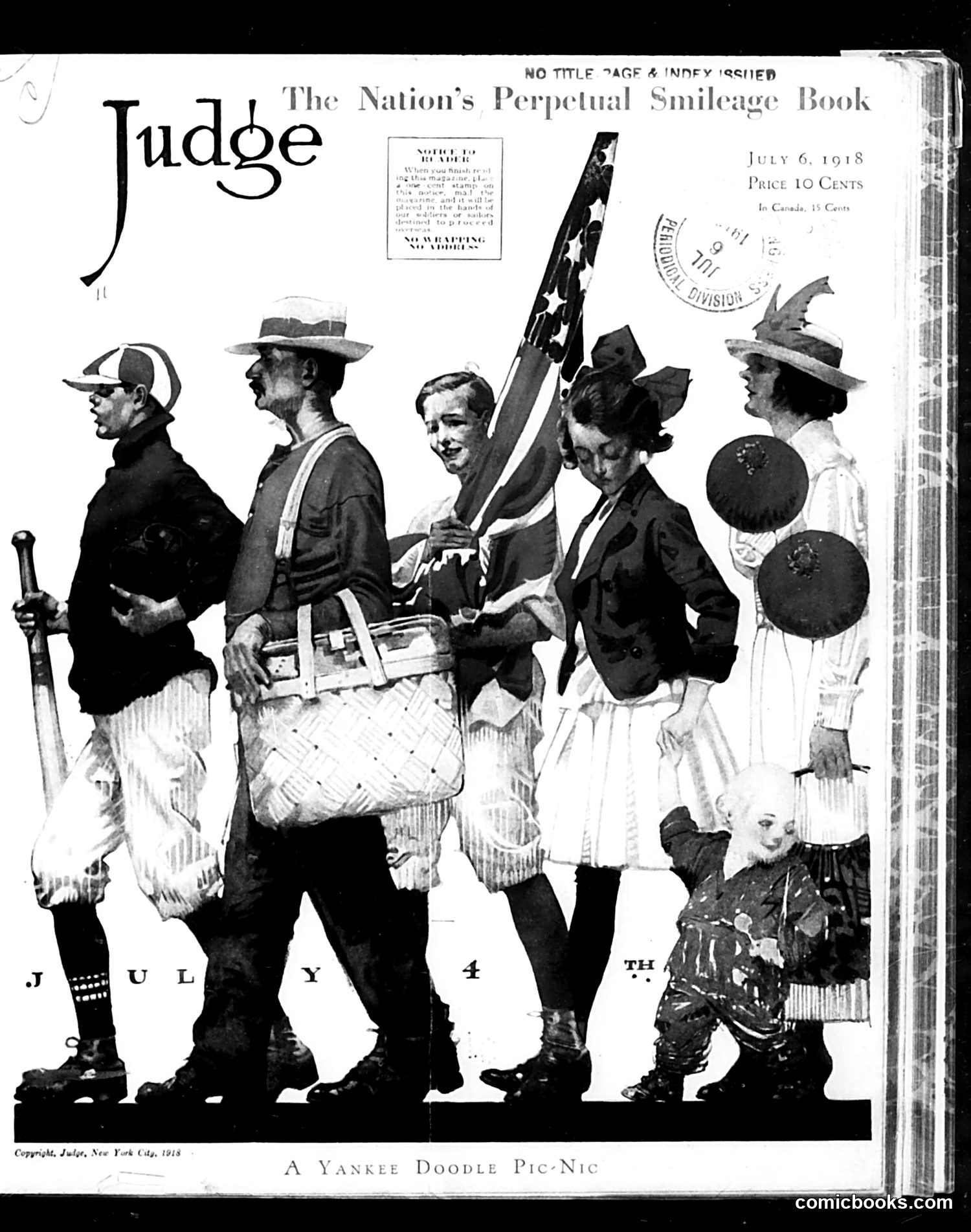
This July 4, 1918 Judge magazine cover satirizes American patriotic celebration during World War I. The cartoon depicts six figures in a "pic-nic" (picnic) procession carrying patriotic symbols: an American flag, a large drum, and what appear to be cannonballs or war-related objects. The figures represent different American social types or stereotypes participating in Independence Day festivities. The composition suggests a parade or celebratory march, with the title referencing the Revolutionary War song "Yankee Doodle." Published during America's active involvement in WWI (1917-1918), the satire likely comments on how Americans balanced traditional July 4th celebrations with wartime patriotism and sacrifice—mocking either excessive patriotic display or the disconnect between holiday revelry and military reality.
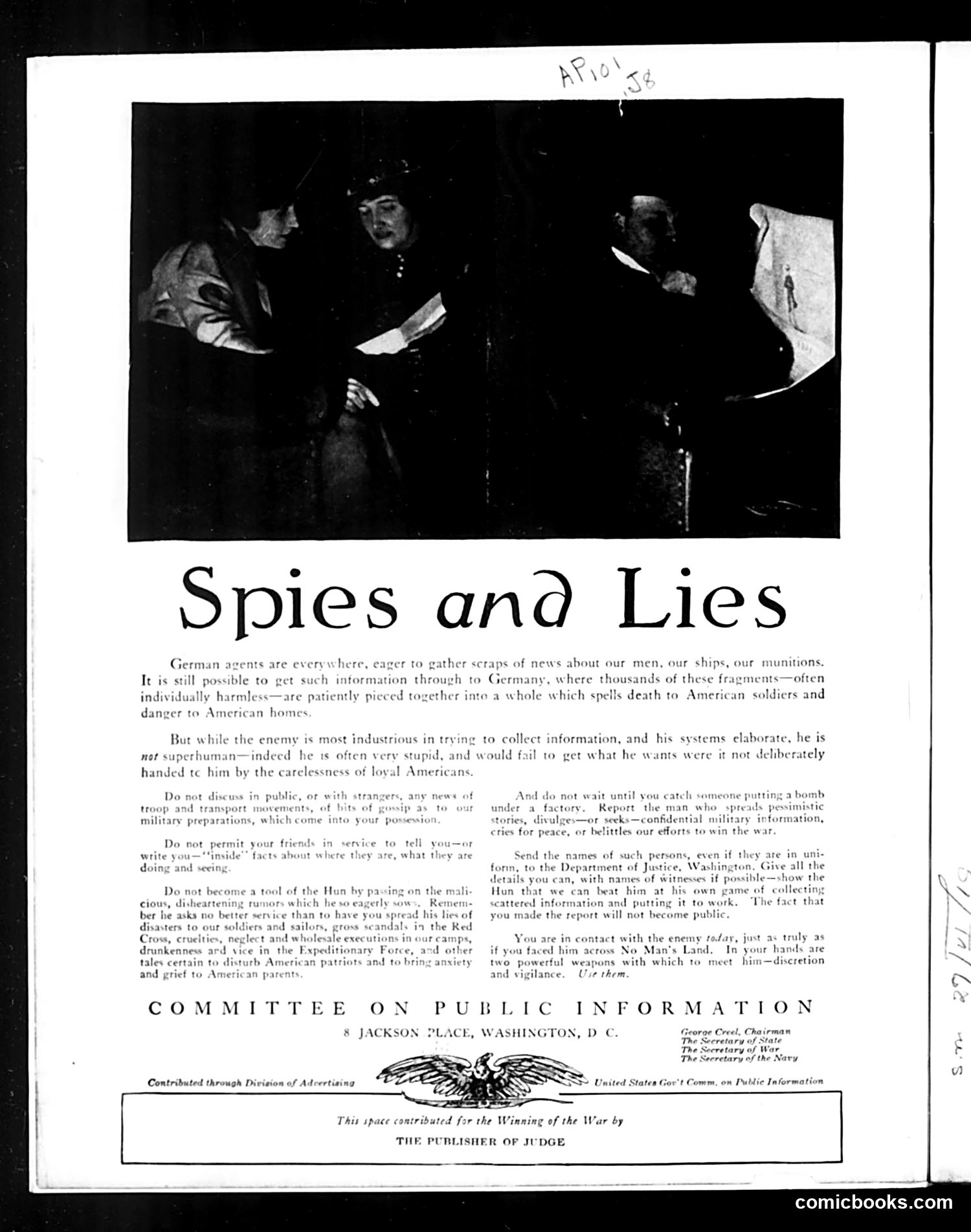
This is a WWI-era public service announcement from the Committee on Public Information (a U.S. government propaganda agency). The grainy photograph shows what appears to be people exchanging documents or information clandestinely. The message warns Americans against discussing military information with anyone, as German spies are actively gathering intelligence. The text emphasizes that even seemingly harmless details about "our men, our ships, our munitions" can be pieced together into actionable intelligence that endangers American soldiers. The advertisement instructs citizens to report suspected spies to the Department of Justice and warns that casual conversation—even with friends or family—could aid the enemy. This reflects the intense domestic surveillance paranoia and emphasis on civilian vigilance characteristic of American WWI mobilization.
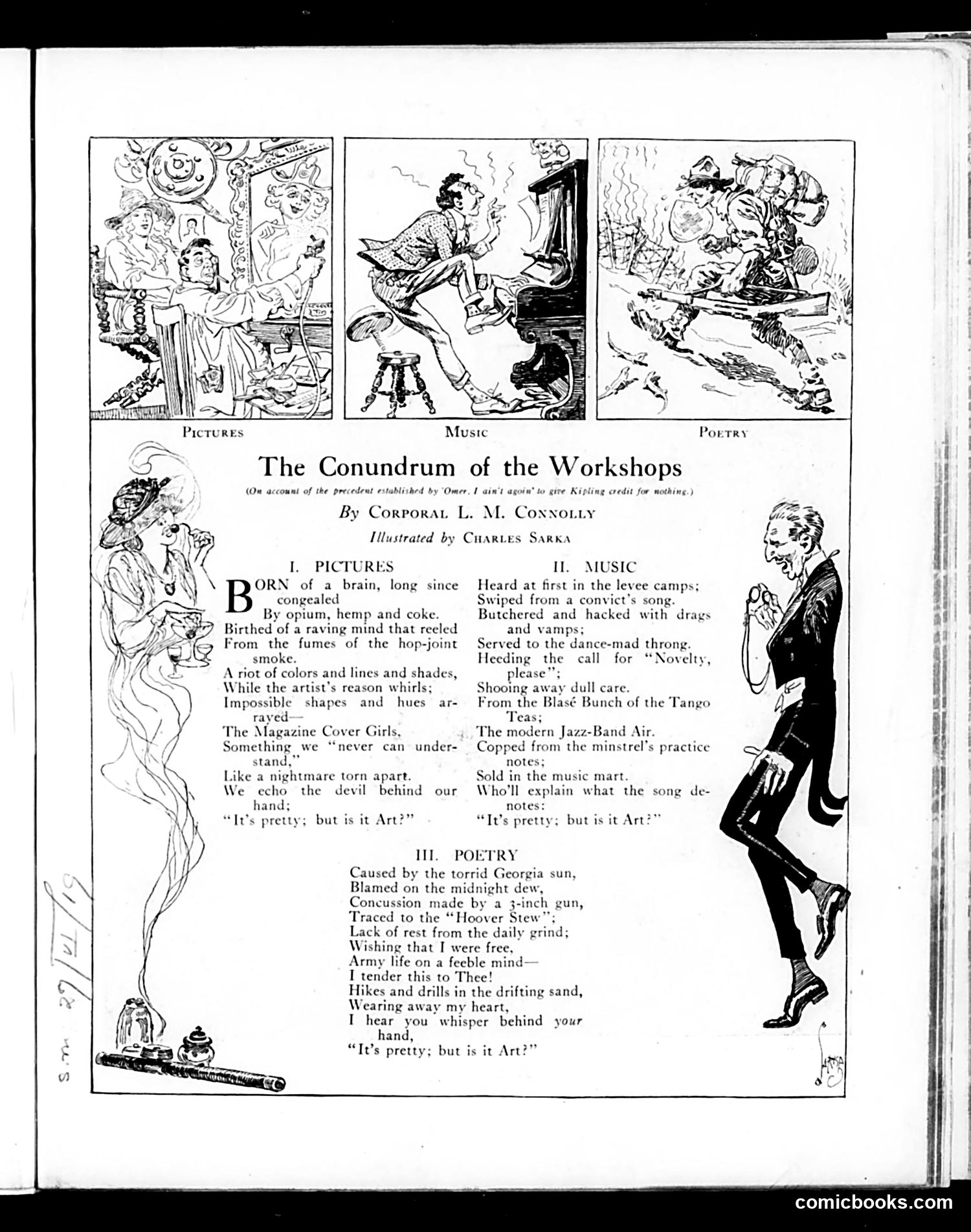
This satire by Corporal L.M. Connolly critiques three artistic/cultural pursuits as questionable "art." Each section mocks a creative workshop: **Pictures**: Satirizes magazine cover art and illustration as shallow, derivative work ("born of a brain, long since conjugated / By opium, hemp and coke"). **Music**: Attacks modern jazz and popular music as derivative trash—"butchered and hacked with drags and vamps," copied from lesser sources rather than original composition. **Poetry**: Mocks soldier/military poetry as clichéd complaint-writing about hardships (Georgia heat, army drills, homesickness). All three conclude identically: "It's pretty; but is it Art?"—the cartoon's point being that commercial entertainment and amateur creative output, while aesthetically pleasing, lack genuine artistic merit.
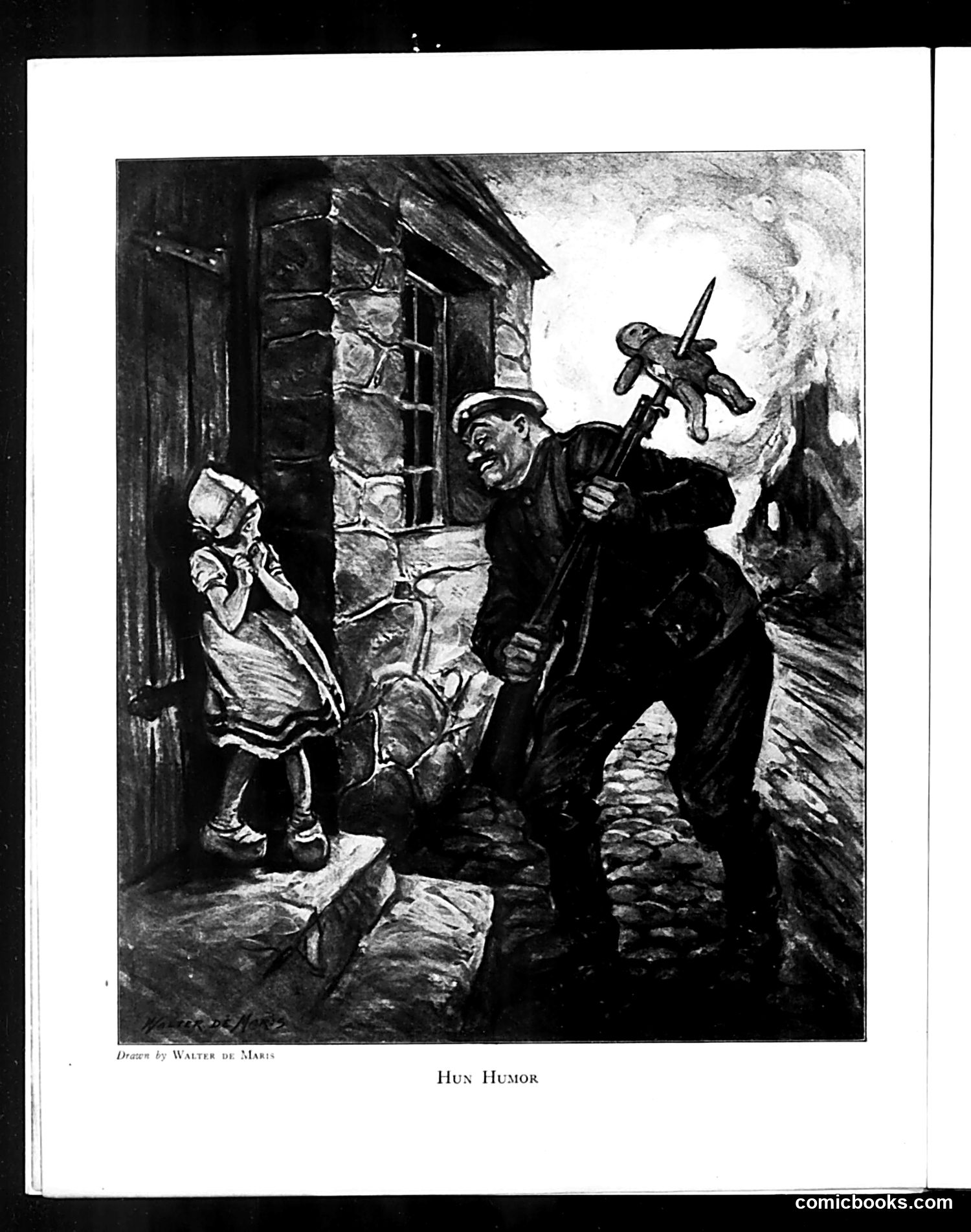
This satirical drawing by Walter de Maris depicts a menacing figure with exaggerated caricatured features holding an axe, confronting a small child at a doorway. The title "Hun Humor" is a derogatory reference to Germans (using WWI-era propaganda language). The cartoon appears to satirize German military brutality, likely referencing atrocities committed during World War I or the broader stereotype of German aggression promoted in American propaganda. The "Hun" figure's threatening posture toward the innocent child symbolizes the perceived threat Germans posed to civilian populations. The dark, sketchy artistic style emphasizes the menace. This reflects Judge magazine's anti-German sentiment during or immediately after WWI, when such caricatures were common in American satirical publications.
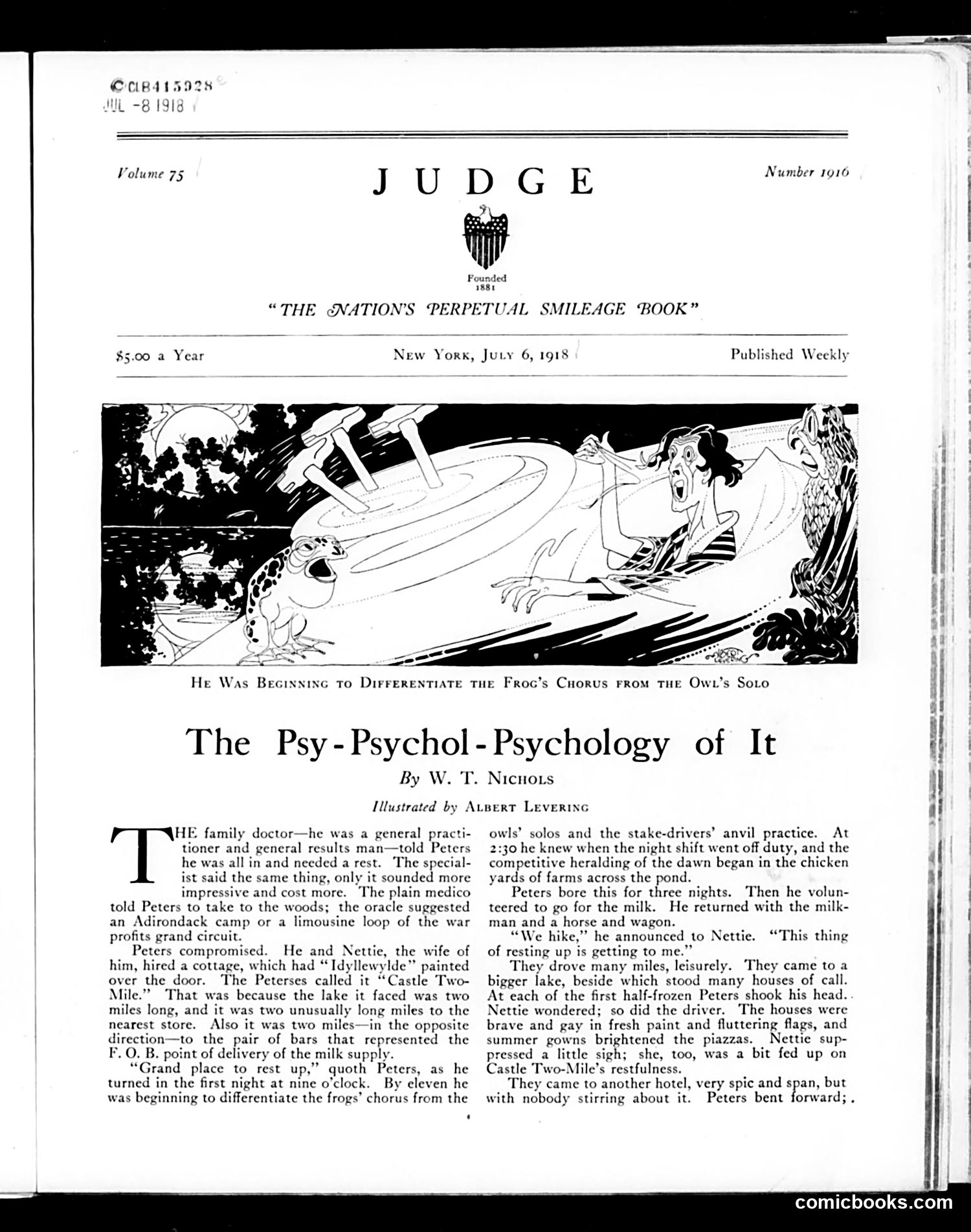
This is a **humor story page**, not political satire. The illustration caption reads "He Was Beginning to Differentiate the Frog's Chorus from the Owl's Solo," accompanying "The Psy-Psychol-Psychology of It" by W.T. Nichols. The cartoon depicts a humorous domestic scene: a man and woman at what appears to be a lakeside cottage. The illustration shows exaggerated, comedic expressions—the woman appears distressed or startled while the man gestures dramatically. The story concerns a city couple (Peters and Nettie) who rent a rural cottage for rest. The joke plays on their adjustment to country life—specifically, the strange sounds of nature at night (frogs and owls). The "psychology" referenced is likely their struggle adapting to unfamiliar rural experiences versus urban comfort. This is gentle, domestic humor typical of 1918 Judge magazine content, not political commentary.
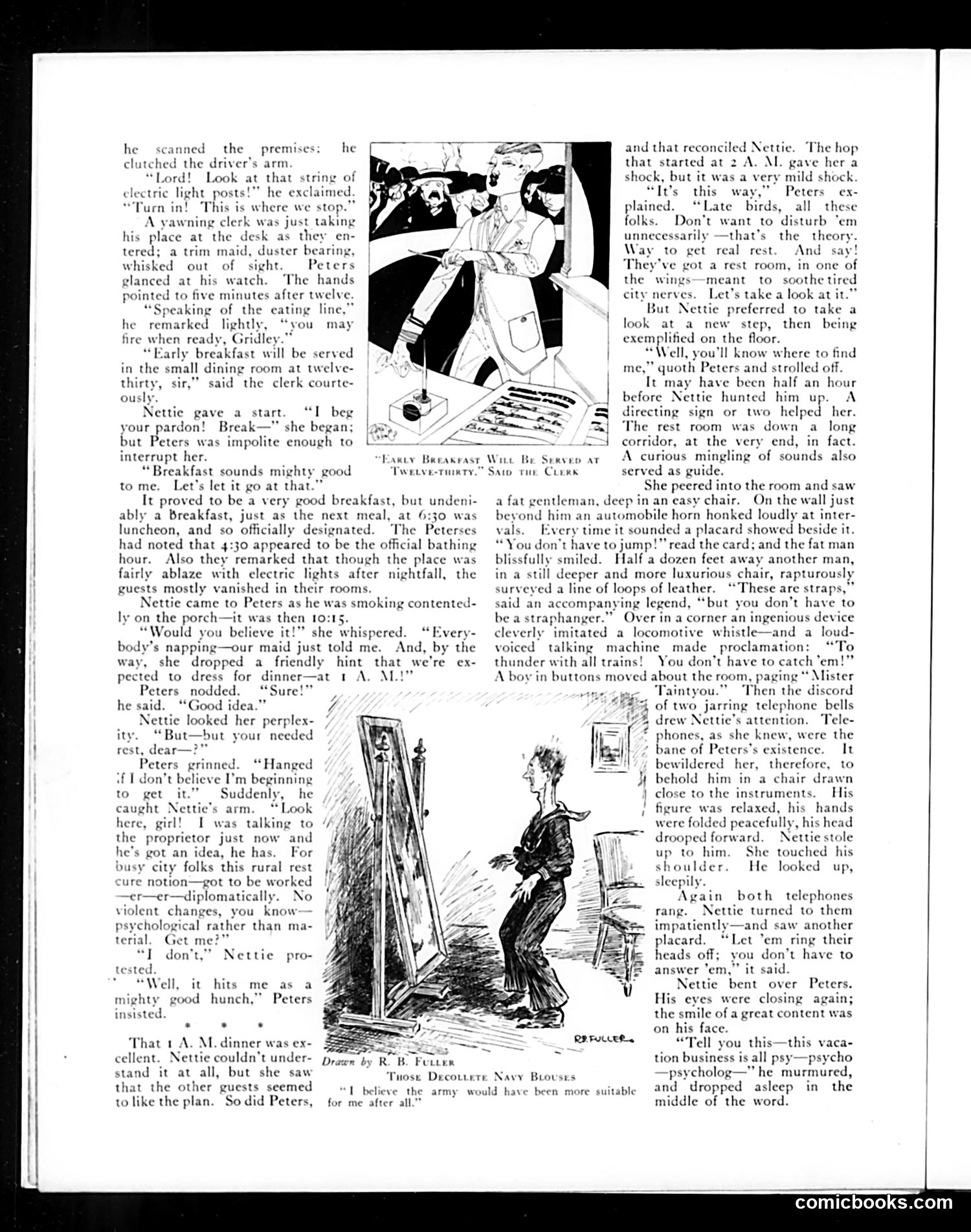
This page contains narrative fiction rather than political satire. The story follows characters named Peters and Nettie at what appears to be an early 20th-century hotel or inn. The illustrations by R.B. Fuller accompany a humorous domestic narrative about managing guests and accommodations. The text references "early breakfast," dress codes for dinner, and the proprietor's attempts to organize guests' schedules—typical hotel management concerns of the era. One illustration shows a figure near a telephone device, reflecting curiosity about early telephone technology in public spaces. The story's humor derives from everyday social situations (rest hours, meal times, noise complaints) rather than political commentary. This page represents Judge's fiction content, separate from its better-known satirical cartoons.
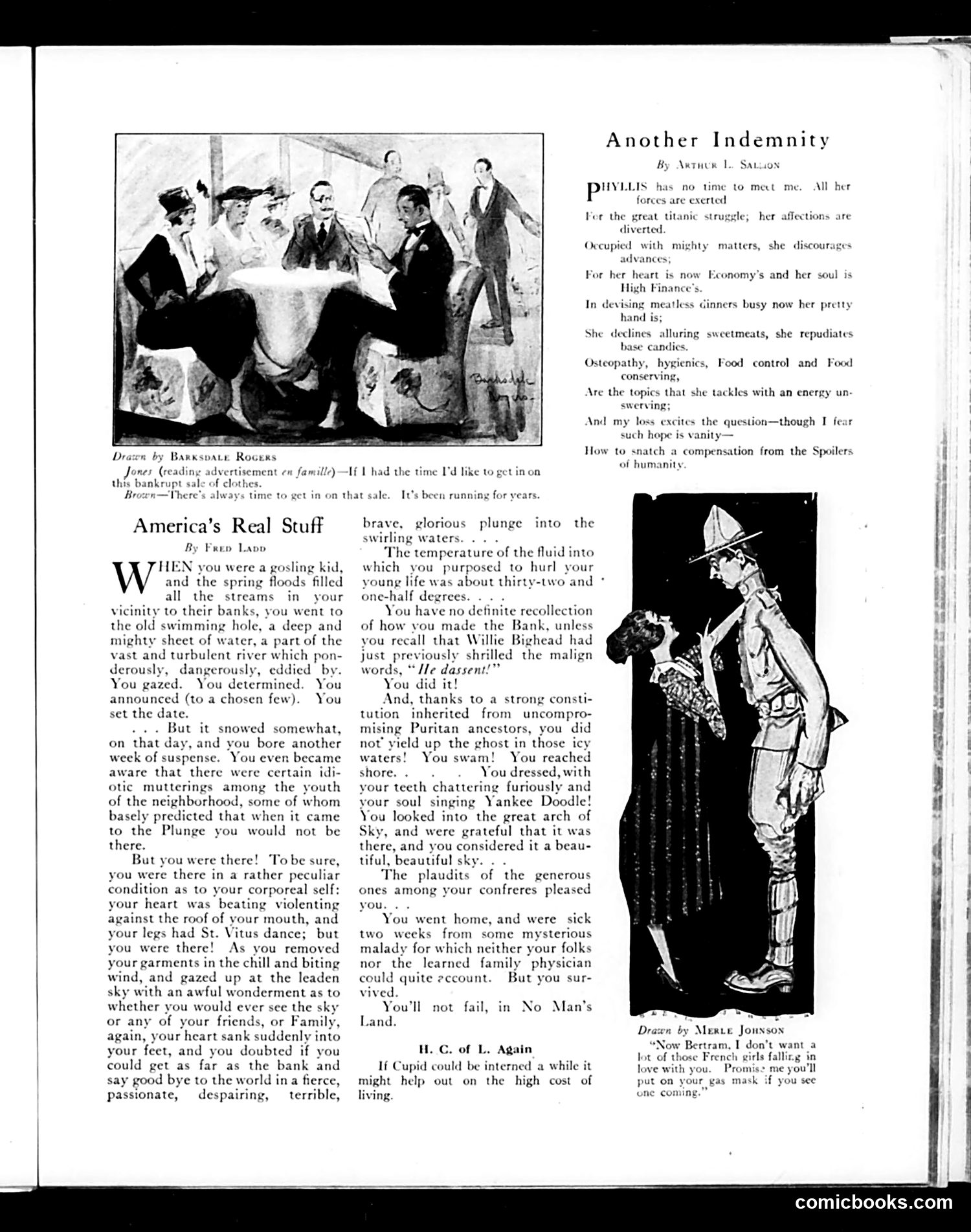
**"Another Indemnity"** (top) is a wartime poem satirizing how women's patriotic duties have replaced romance. The speaker laments that his girlfriend Phyllis now devotes all energy to wartime conservation efforts—meatless dinners, food control, osteopathy—leaving no time for courtship. He ironically asks how to claim "compensation from the Spoilers of humanity" for his romantic loss. This reflects WWI-era home-front mobilization where women's domestic roles became nationalized as economic sacrifice. **"America's Real Stuff"** is a nostalgic essay celebrating American boyhood courage through a swimming-hole dare. The author recalls jumping into an icy river despite terror, surviving illness afterward, and crediting his "Puritan ancestors" for his constitution. It's sentimental Americana emphasizing hardy self-reliance and youthful bravery—values the magazine likely positioned against perceived modern softness. Both pieces reflect 1910s-20s anxieties about changing social roles and national character during wartime disruption.
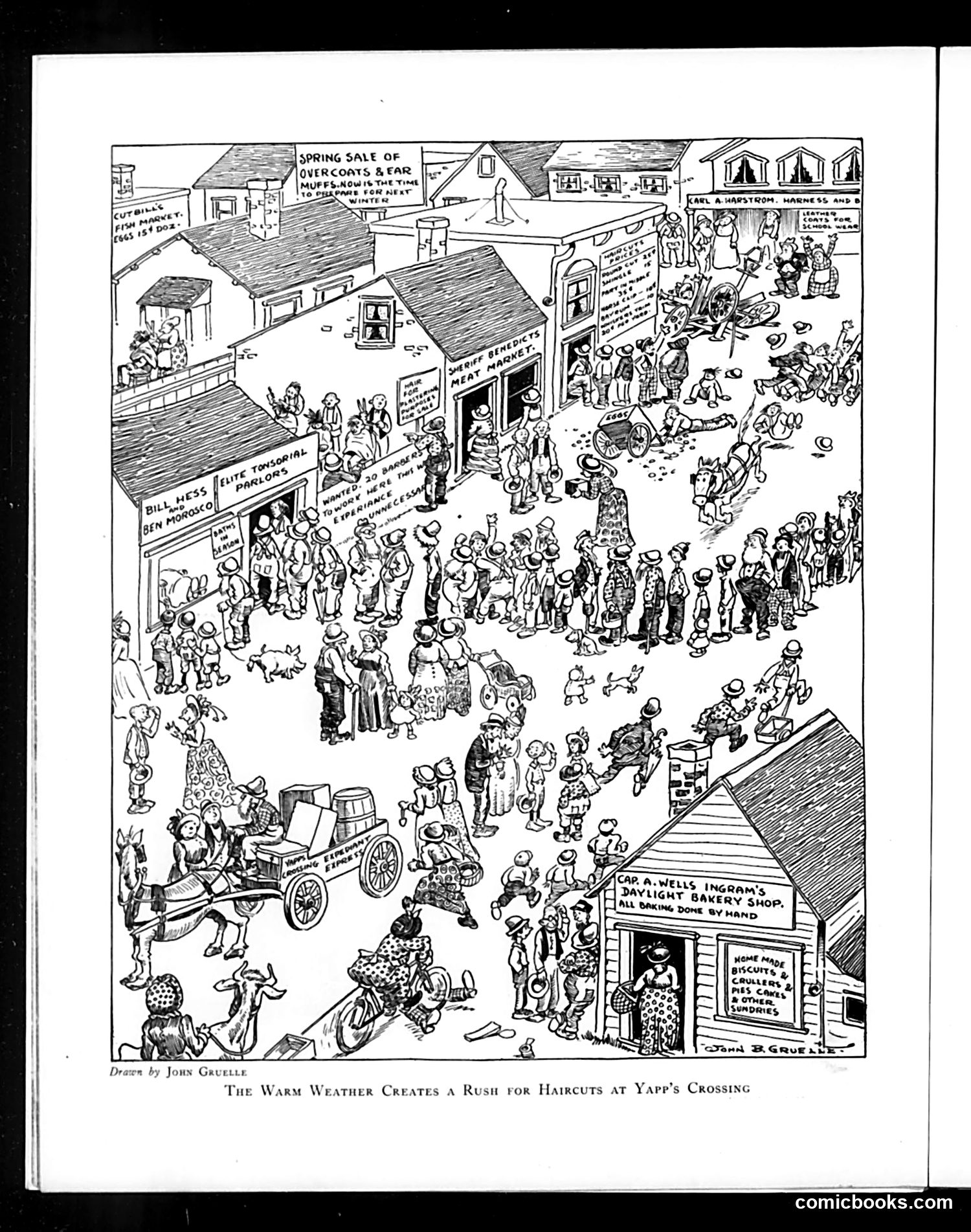
This is a humorous genre scene by John Gruelle depicting small-town American life, not political satire. The cartoon shows a bustling street scene where warm spring weather has prompted locals to seek haircuts at various establishments visible in the illustration—Bill Hess's Barber Shop, Merritt's Barbershop, and Car A. Wells Ingram's Daylight Bakery Shop among others. The joke is straightforward: seasonal change drives consumer demand. As people shed winter clothing and prepare for warmer months, they also get haircuts—a relatable, everyday observation. The crowded street filled with men, women, children, and various activity (including a horse-drawn cart) captures the commercial activity and social energy of a rural or small-town crossroads during busy season. There's no apparent political commentary—it's simply observational humor about American commerce and seasonal behavior.
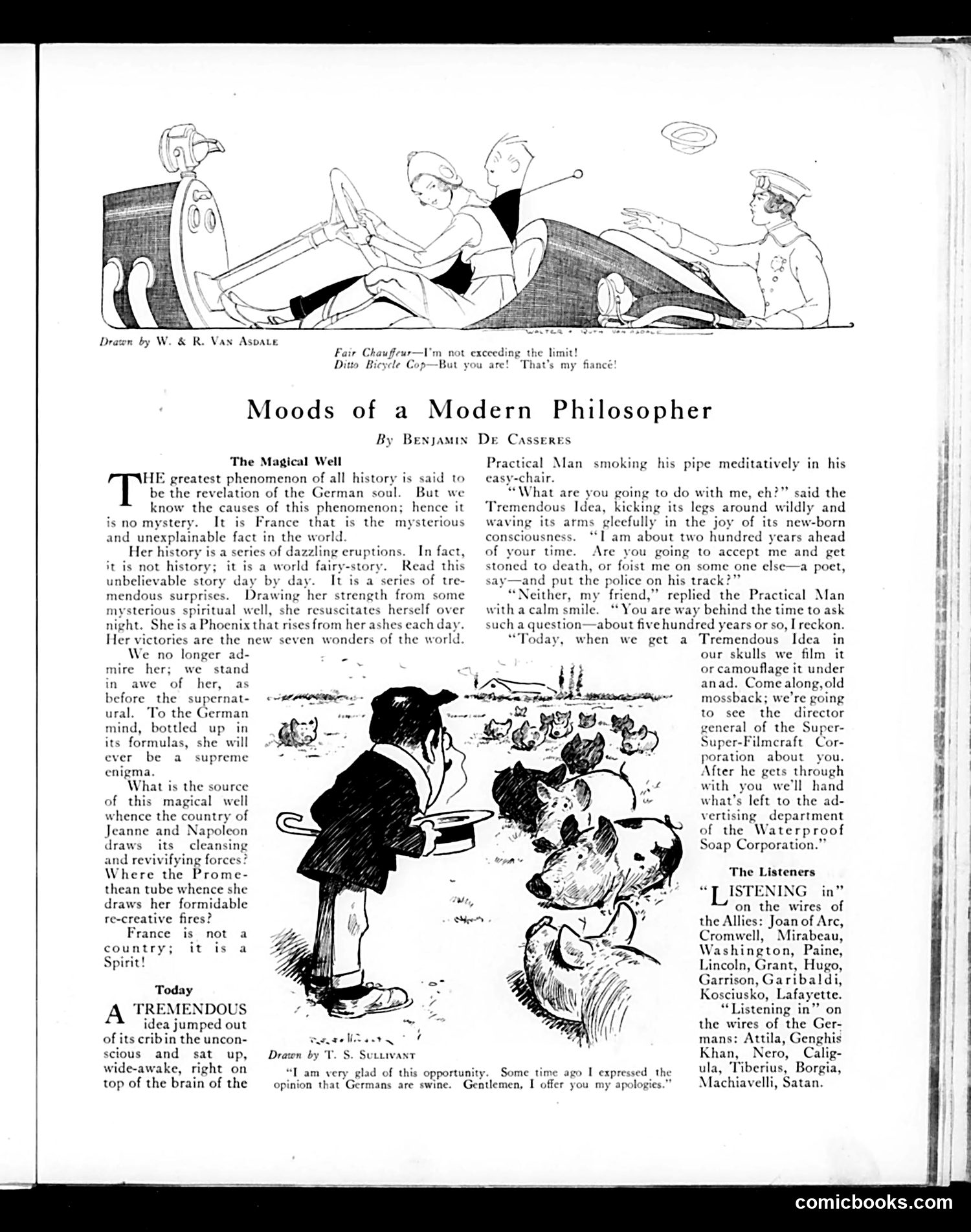
This Judge page contains three satirical pieces about World War I era politics and culture. **Top cartoon**: A domestic comedy about a woman exceeding speed limits on a bicycle while her fiancé (a "Dido Bicycle Cop") protests. The joke plays on the phrase "I'm not exceeding the limit" versus the officer's retort about her being his fiancée—a lighthearted jab at gender relations and courtship. **"The Magical Well"**: Benjamin De Casseres's essay praises France as mysteriously resilient and spiritually superior to Germany's rigid, formula-bound mind. Written during WWI, this reflects Allied propaganda portraying France as the romantic, creative nation versus Germany's mechanical coldness. **"Tremendous Idea"**: A satirical dialogue where a visionary idea pitches itself to a practical man, who dismisses it as outdated and plans to commercialize it through film and advertising—mocking modern culture's tendency to exploit and trivialize genuine innovation. **"The Listeners"**: A stark comparison listing noble Allied historical figures against infamous German/authoritarian villains—wartime rhetoric equating the enemy with history's worst figures.
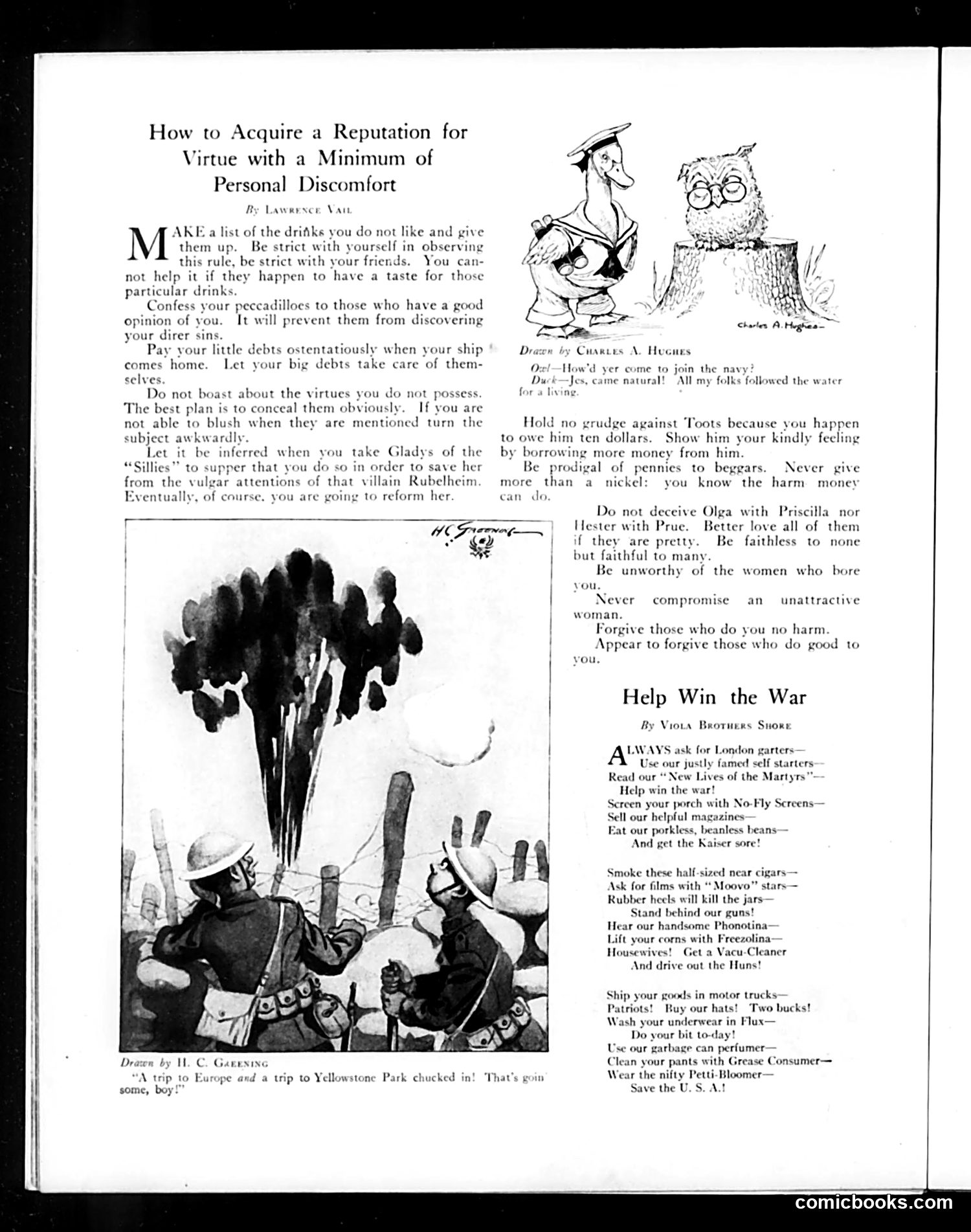
**Top Article:** "How to Acquire a Reputation for Virtue with a Minimum of Personal Discomfort" by Lawrence Vail is satirical advice for appearing virtuous without genuine moral effort. It mocks hypocrisy—suggesting readers ostentatiously pay small debts while ignoring large ones, confess minor sins to seem honest, and seduce women while appearing to "reform" them. The tone ridicules people who cultivate false reputations through performative morality. **Cartoons:** Two illustrated scenes by Charles A. Hughes and H.C. Greesing show military/naval recruitment humor, with one depicting soldiers and the caption about European travel being "chucked in." **Bottom Section:** "Help Win the War" by Viola Brothers Shore is wartime satirical advertising copy. It parodies jingoistic appeals and profiteering—listing absurd products (Freezolina, Petti-Bloomers, garbage perfume) marketed as patriotic duty, mocking how businesses exploited WWI-era nationalism to sell worthless goods while claiming to support the war effort.
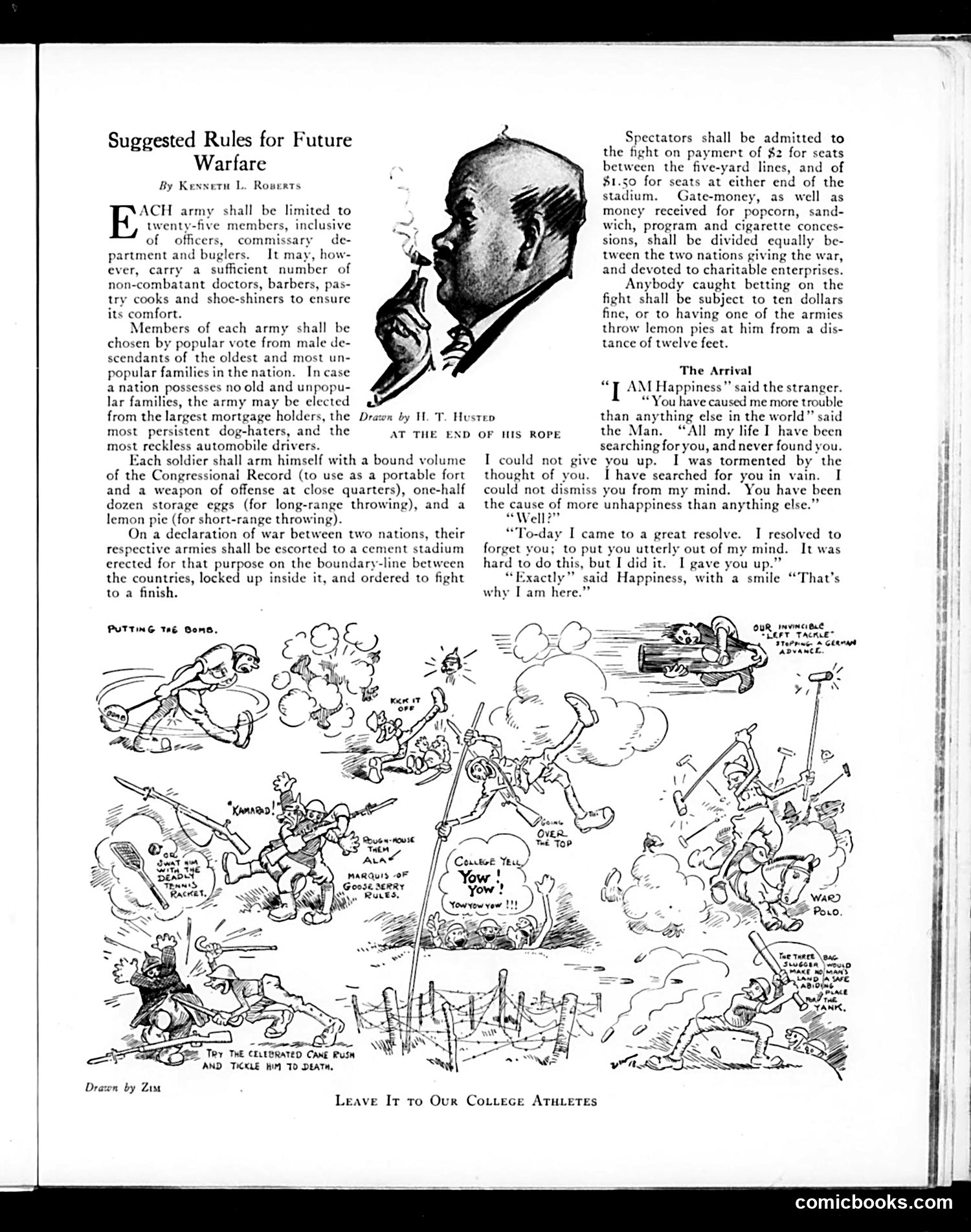
## "Suggested Rules for Future Warfare" This satirical article by Kenneth L. Roberts proposes absurd "rules" for warfare, mocking militarism and war itself. The humor lies in deliberately ridiculous proposals: armies limited to 25 members armed with Congressional Records and lemon pies, fights held in stadiums like sports events with paid admission, and profits donated to charity. The piece suggests that if warfare operated under such constraints—treating combat as entertainment or sport—its true absurdity would become obvious. It's anti-war satire disguised as practical reform. ## "The Arrival" Story This short narrative depicts a philosophical irony: a Man who spent his life pursuing Happiness never found it. Only by consciously *giving up* the pursuit does Happiness finally arrive. It's a commentary on the paradox that obsessive striving often prevents achievement. ## "Leave It to Our College Athletes" Cartoon The lower illustration, drawn by Zim, depicts college football players in exaggerated, chaotic action—appearing more violent and absurd than actual warfare. This reinforces the page's central joke: that modern sports (particularly college football) are themselves mock-battles, arguably as ridiculous as the proposed "future warfare."
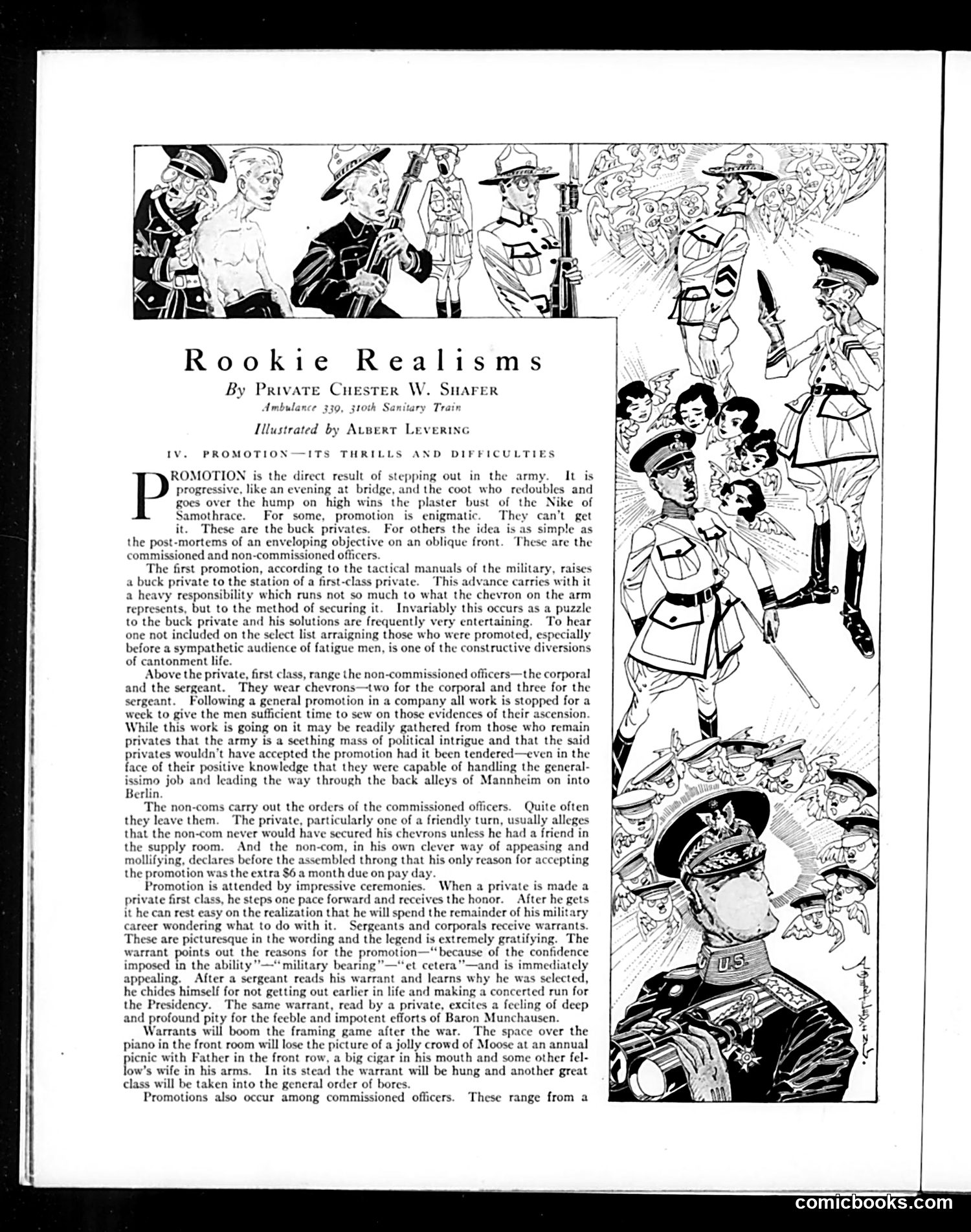
This is a satirical article by Private Chester W. Shafer (illustrated by Albert Levering) about military promotion during World War I, published in *Judge* magazine. The piece humorously critiques the army's promotion system and soldiers' attitudes toward advancement. The satire targets several aspects: the arbitrary nature of promotions (portrayed as mysterious "puzzles"), soldiers' conspiracy theories about favoritism ("a friend in the supply room"), and the contrast between how different ranks interpret their promotion warrants. Officers find the official language ("confidence imposed," "military bearing") genuinely inspiring, while enlisted men read the same language as evidence of bureaucratic absurdity—comparing it to Baron Munchausen's tall tales. The accompanying cartoon illustrations (right side) depict soldiers in various camp scenes. The humor lies in the gap between the army's official dignity and soldiers' cynical, irreverent reality.
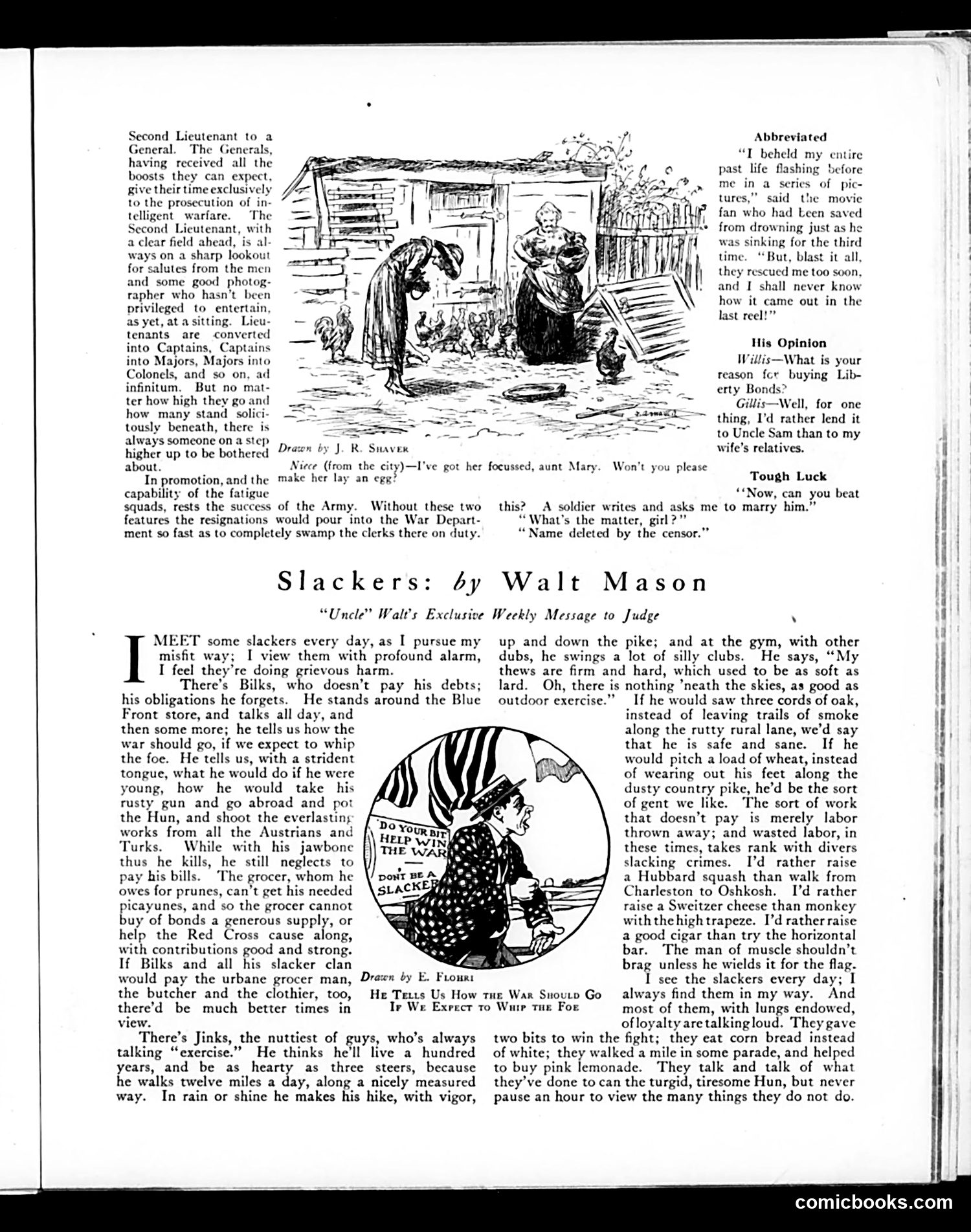
This page satirizes American "slackers" during World War I — men avoiding military service or productive contribution to the war effort. **The main article** targets specific types: "Bilks," who neglects debts and frequents pool halls spouting war rhetoric while refusing to pay local creditors (grocers, butchers), thus crippling community commerce and charities like the Red Cross; and "Jinks," an exercise fanatic who boasts about fitness while wasting labor on pointless hiking rather than productive farm or industrial work. **The cartoon** (by E. Flohr) depicts Jinks as this type — a muscular figure preaching about physical strength while avoiding genuine work contribution. The satire's point: slackers talk patriotically about defeating the enemy but won't sacrifice their comfort or pay their obligations, making them economically useless during wartime mobilization. The smaller jokes above reference military life and censorship (a soldier proposes but the censor deletes his name).
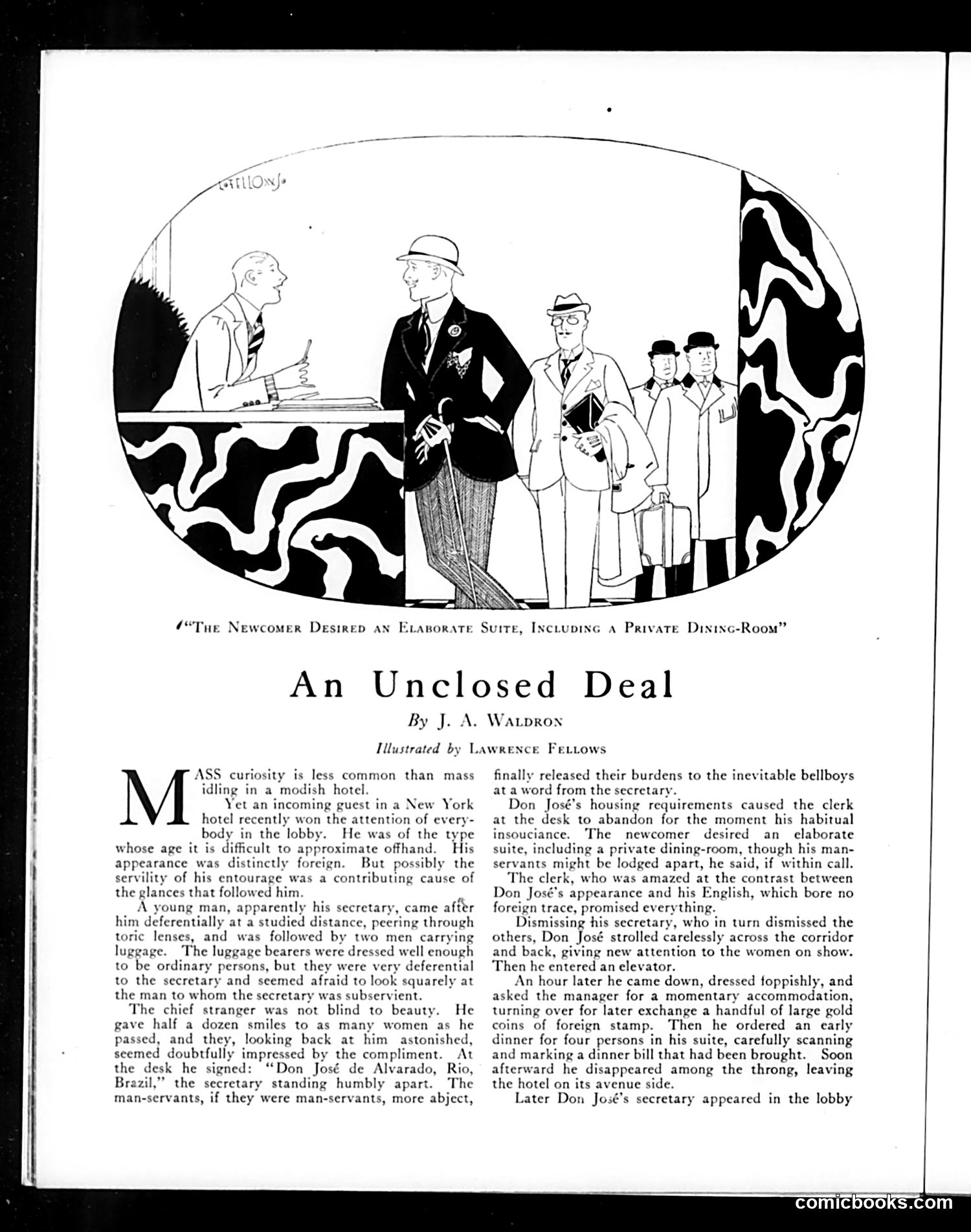
This is a short story (not a political cartoon) about a mysterious wealthy foreigner. "Don José de Alvarado" from Brazil arrives at a New York hotel with an entourage of deferential servants. His appearance is notably foreign, yet his English is fluent and accentless—a deliberate contradiction. He demands an elaborate suite with private dining room, flirts with women in the lobby, then mysteriously orders dinner for four and disappears. The satire targets the pretension and inscrutability of foreign wealth in Gilded Age America. The "unclosed deal" of the title suggests deception: Don José's contradictions (foreign appearance/perfect English, formal requests/casual behavior) hint he's a con artist or something more sinister. The story plays on American anxieties about wealthy foreign visitors whose true intentions and identities remain obscure—a common Judge theme mocking gullible hotel clerks and urban sophistication.
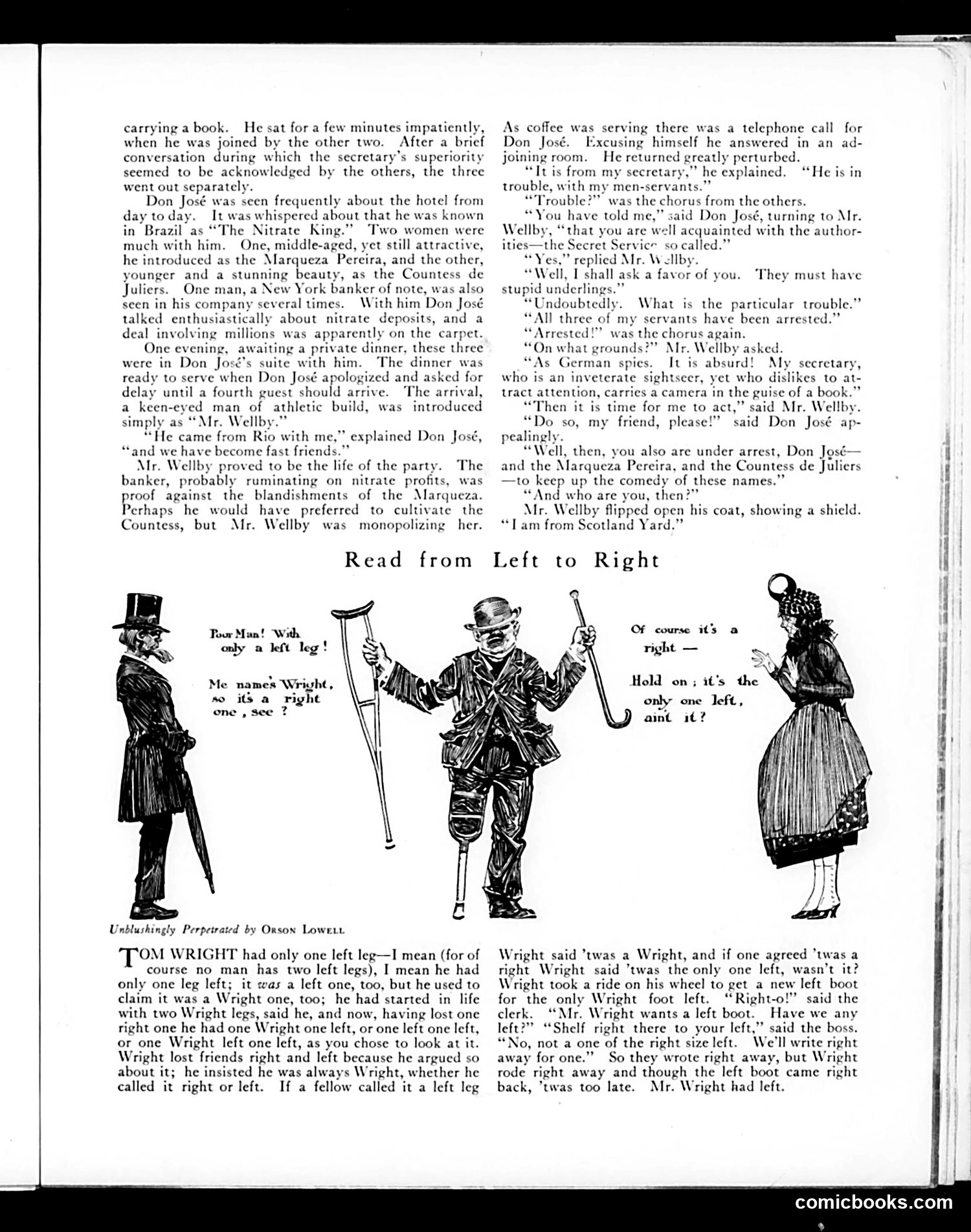
This page contains two distinct items: **Upper Section (Story Fragment):** A narrative about "Don José," a Brazilian businessman involved in nitrate dealing who entertains wealthy associates. The plot involves espionage accusations: Don José's servants are arrested as suspected German spies (one carries a camera disguised as a book). Mr. Wellby, initially presented as a Rio businessman, reveals himself as a Scotland Yard detective, arresting Don José and his companions "to keep up the comedy of these names." **Lower Section (Comic Strip):** An absurdist wordplay joke about a man named Tom Wright who lost his right leg but insists on calling his remaining left leg "Wright" (homophone for "right"). The comic plays on linguistic confusion—whether his leg is "right" or "left," "a Wright" or "a left"—with Wright stubbornly maintaining he's always correct regardless of which term applies. The repetitive arguments cost him friendships. Both items appear designed as light satirical humor rather than commentary on specific political events. The spy-arrest narrative and the leg-naming wordplay both emphasize confusion and absurdist logic as entertainment.
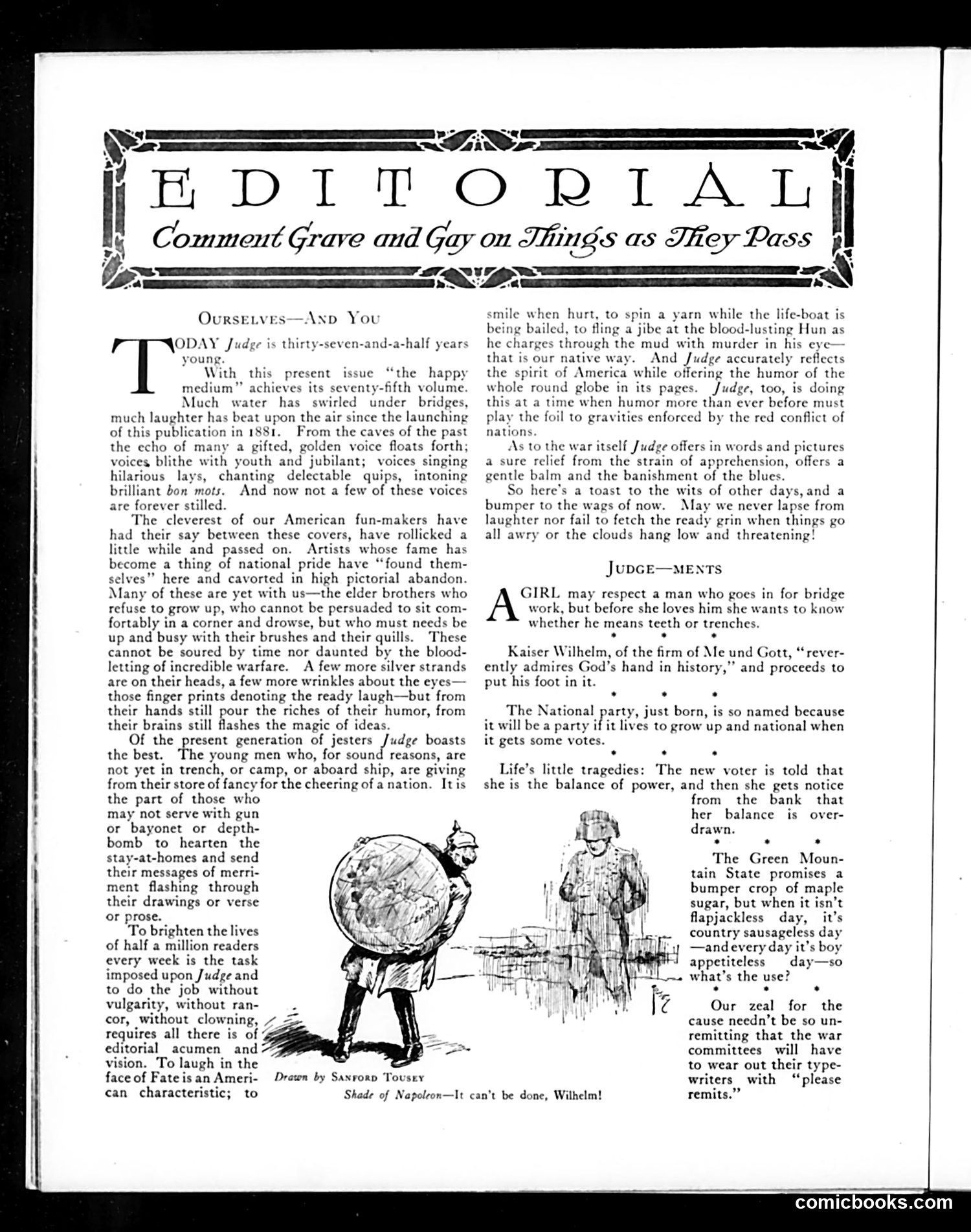
This is the editorial page from Judge magazine's 75th volume (published in 1881+37.5 years, during World War I). The main cartoon by Sanford Tousley depicts Kaiser Wilhelm II struggling to carry an enormous globe labeled "Shade of Napoleon—It can't be done, Wilhelm!" **The satire:** Wilhelm, Germany's leader, is shown as an overambitious figure attempting to conquer or control the world as Napoleon once did, but the burden proves impossible. The visual joke mocks his imperial ambitions as doomed. **Context:** This was published during America's WWI involvement. The editorial celebrates Judge's role providing wartime humor and morale-boosting satire to American readers. The shorter "Judge-ments" below are one-liner political jokes mocking the Kaiser and American politics (like skepticism about a newly-formed "National party"). The page emphasizes humor's patriotic duty: brightening civilians' lives while soldiers fight, and maintaining American resilience through laughter during "the red conflict of nations."
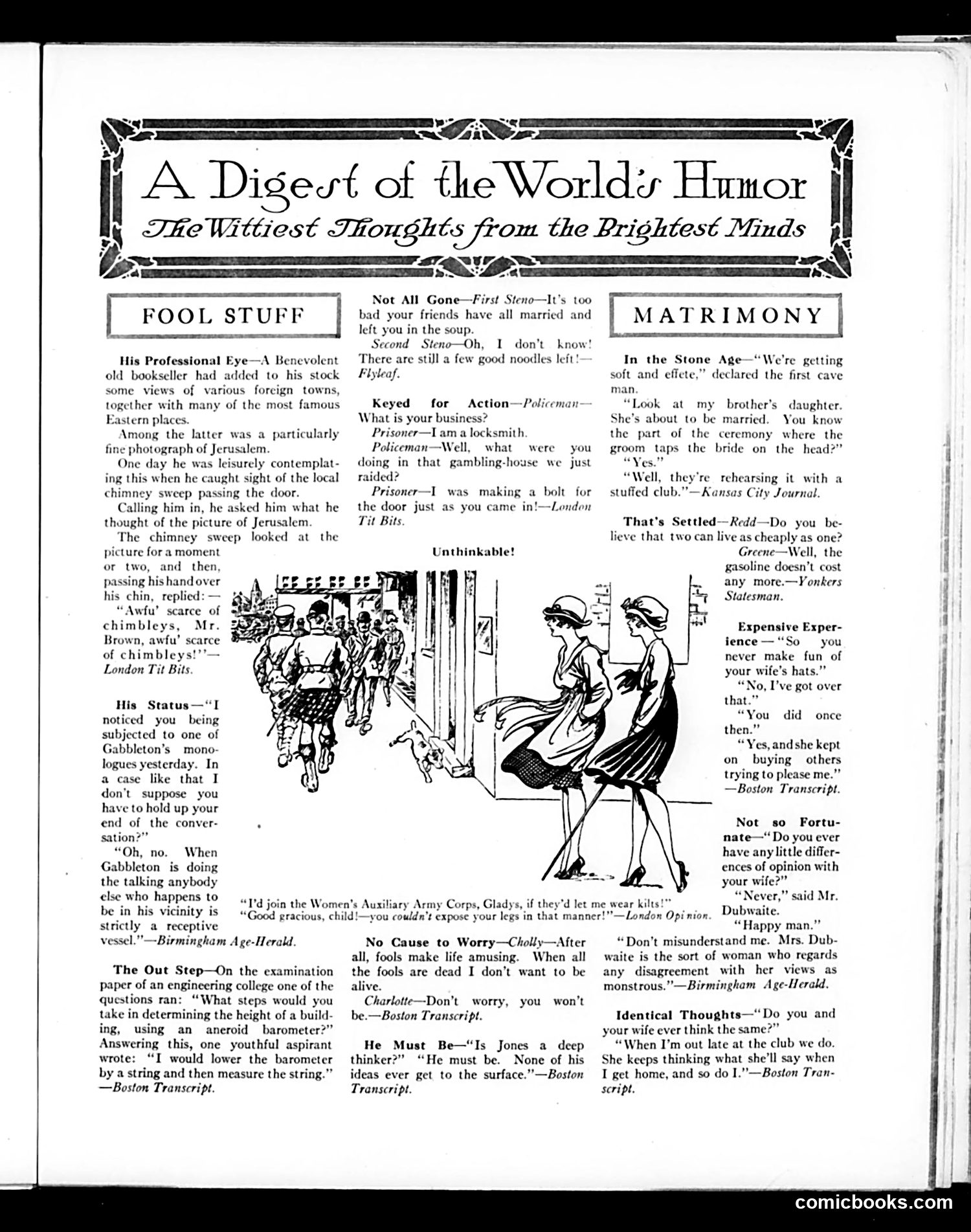
This page from *Judge* magazine presents a collection of short humor pieces and jokes organized into two columns: "Fool Stuff" (left) and "Matrimony" (right). The content reflects early 20th-century American comic sensibilities. The jokes rely on wordplay, misunderstandings, and social observation. "His Professional Eye" features a bookseller and chimney sweep discussing Jerusalem's lack of chimneys—humor based on the sweep's limited perspective. "Keyed for Action" uses a locksmith pun. "The Out Step" satirizes a student's overly literal answer to an engineering exam question. The "Matrimony" section jokes about marriage as an institution of compromise and quiet resignation. References to women's suffrage ("Women's Auxiliary Army Corps") and modern concerns (gasoline costs) anchor the humor in contemporary 1910s-20s America. The cartoons are simple line drawings accompanying these brief anecdotes, typical of satirical magazine format of the era. No specific political figures or events are referenced; instead, the humor targets universal social types and domestic situations.
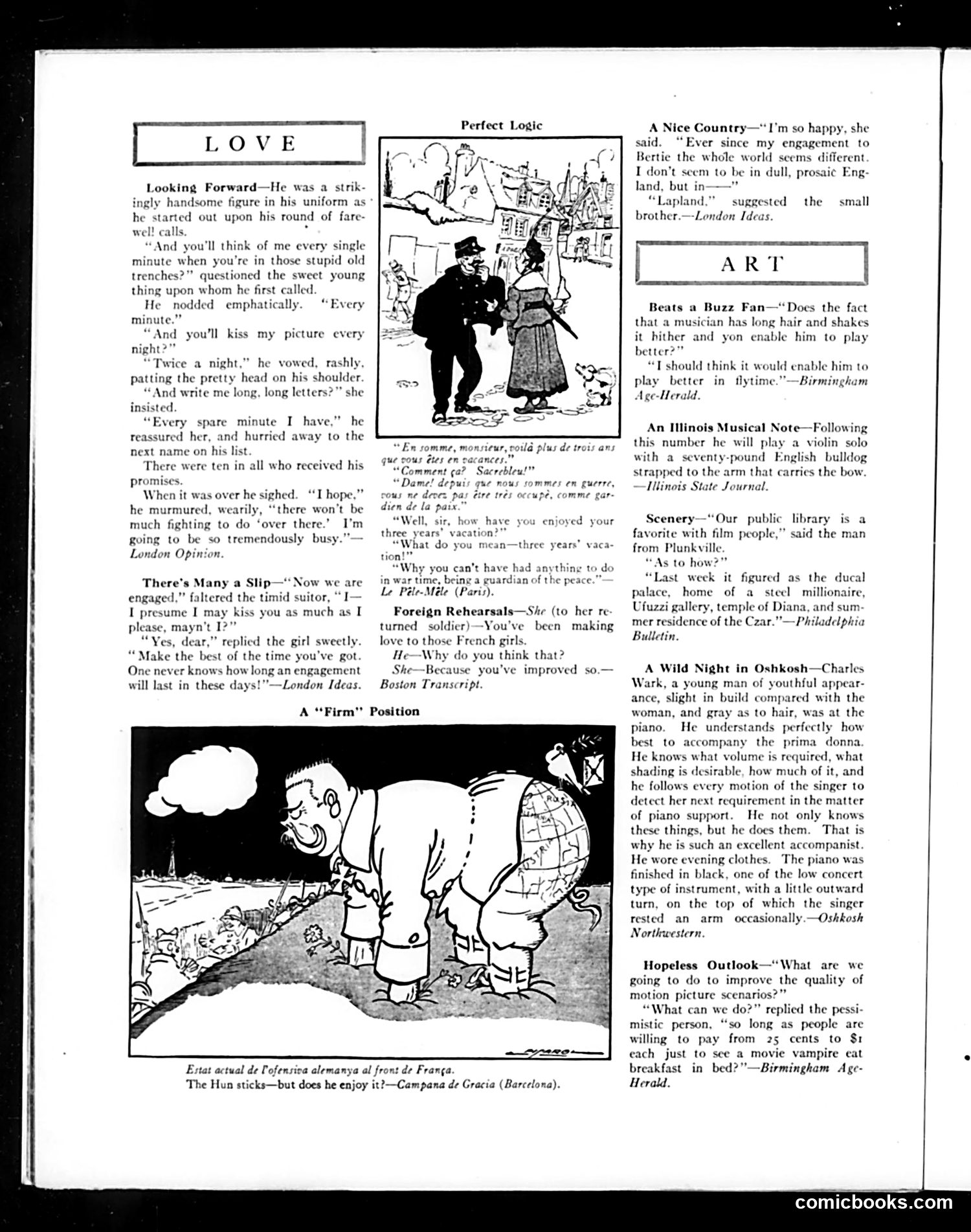
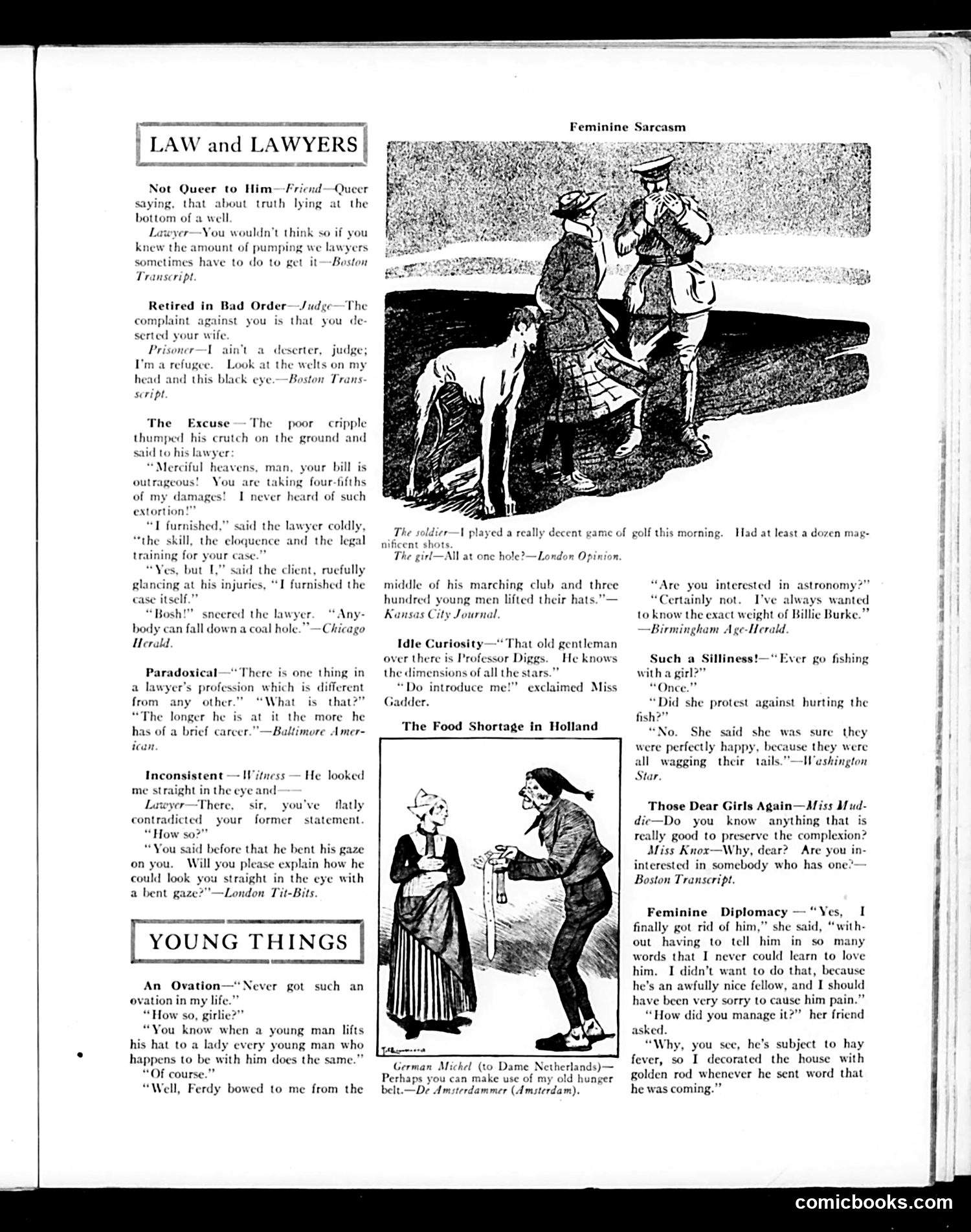
This page from *Judge* magazine contains humorous short anecdotes mocking lawyers, young courtship customs, and social pretension—typical early 20th-century American satirical fare. **"Law and Lawyers" section:** Jokes ridicule lawyers' high fees and evasiveness. One punchline suggests lawyers "pump" truth like water from a well; another shows a crippled client realizing his lawyer takes 80% of his damages settlement despite the client providing the actual injury (the "case itself"). **"Young Things" section:** Jokes about dating customs. One ridicules a young woman receiving attention from a soldier and his entire marching unit—she frames this as impressive. **"Feminine Sarcasm" / "The Food Shortage in Holland":** A German cartoon shows a starving Dutchwoman; a German soldier offers his belt as food, darkly joking about wartime hunger in occupied Holland (likely WWI-era). **Other items:** Mock women's vanity (interest in Billie Burke's weight), fishing etiquette, and "feminine diplomacy" (a woman decorates her house with ragweed to trigger a suitor's hay fever, subtly discouraging him).
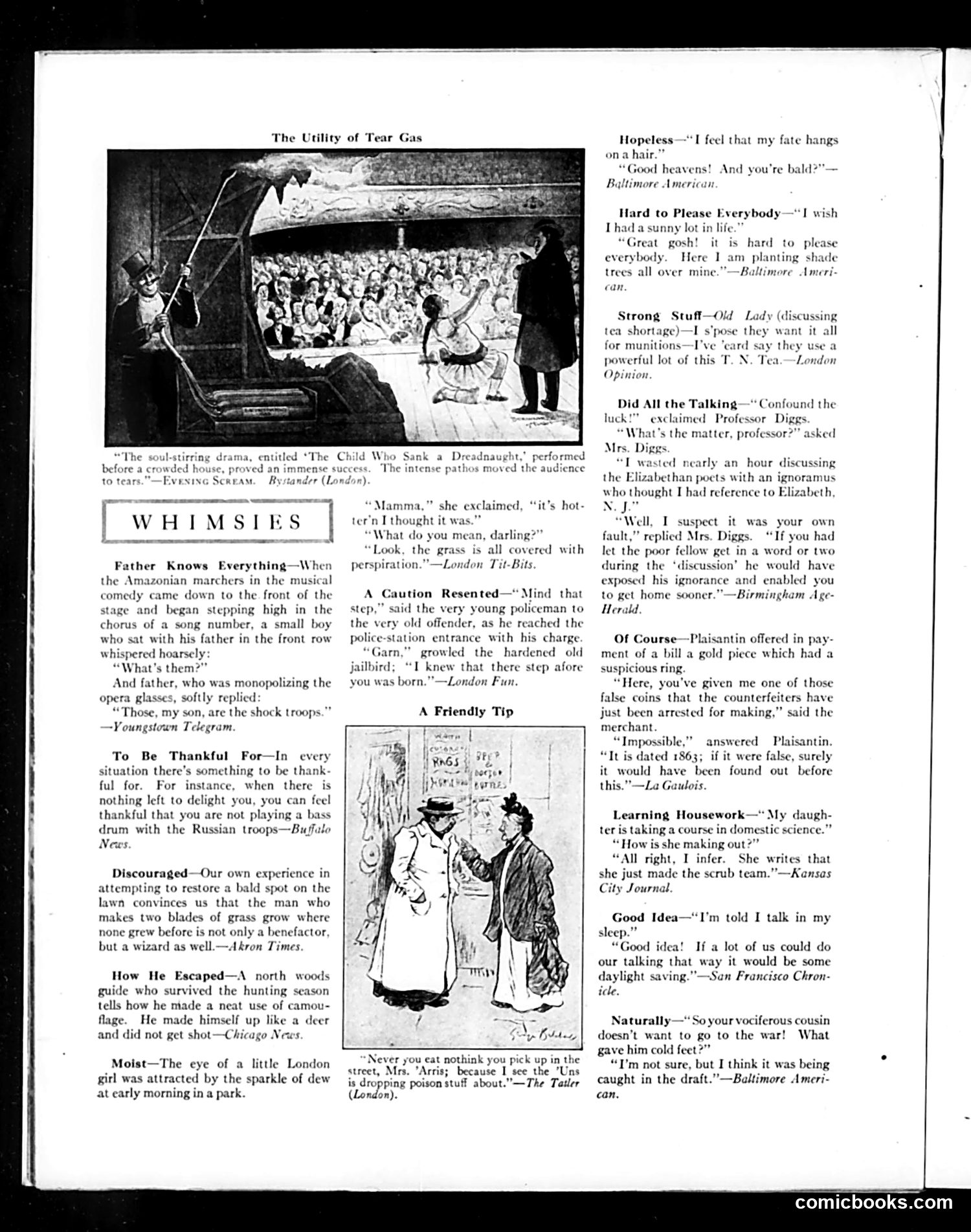
This page from Judge contains brief humorous anecdotes ("whimsies") rather than political cartoons. The humor reflects early 20th-century American life and concerns: **War References**: Multiple jokes reference WWI—mentions of "Russian troops," "munitions," "T.N.T. Tea," and the draft. One joke plays on a man avoiding war by disguising himself as a deer during hunting season, paralleling draft evasion. **Social Observations**: Jokes target everyday frustrations (bald spots, lawn care, loud professors, domestic help) and gender dynamics ("Hard to Please Everybody" about a man planting shade trees). **British vs. American humor**: Several items cite London publications (Tatler, Tit-Bits, Fun), reflecting Judge's use of international sources. One British joke warns against eating items found in streets, hinting at wartime poison fears. **The top image** shows an theatrical performance ("The Child Who Sank a Dreadnaught"), referencing WWI naval warfare through entertainment. The page reflects anxieties and preoccupations of wartime American culture circa 1914-1918.
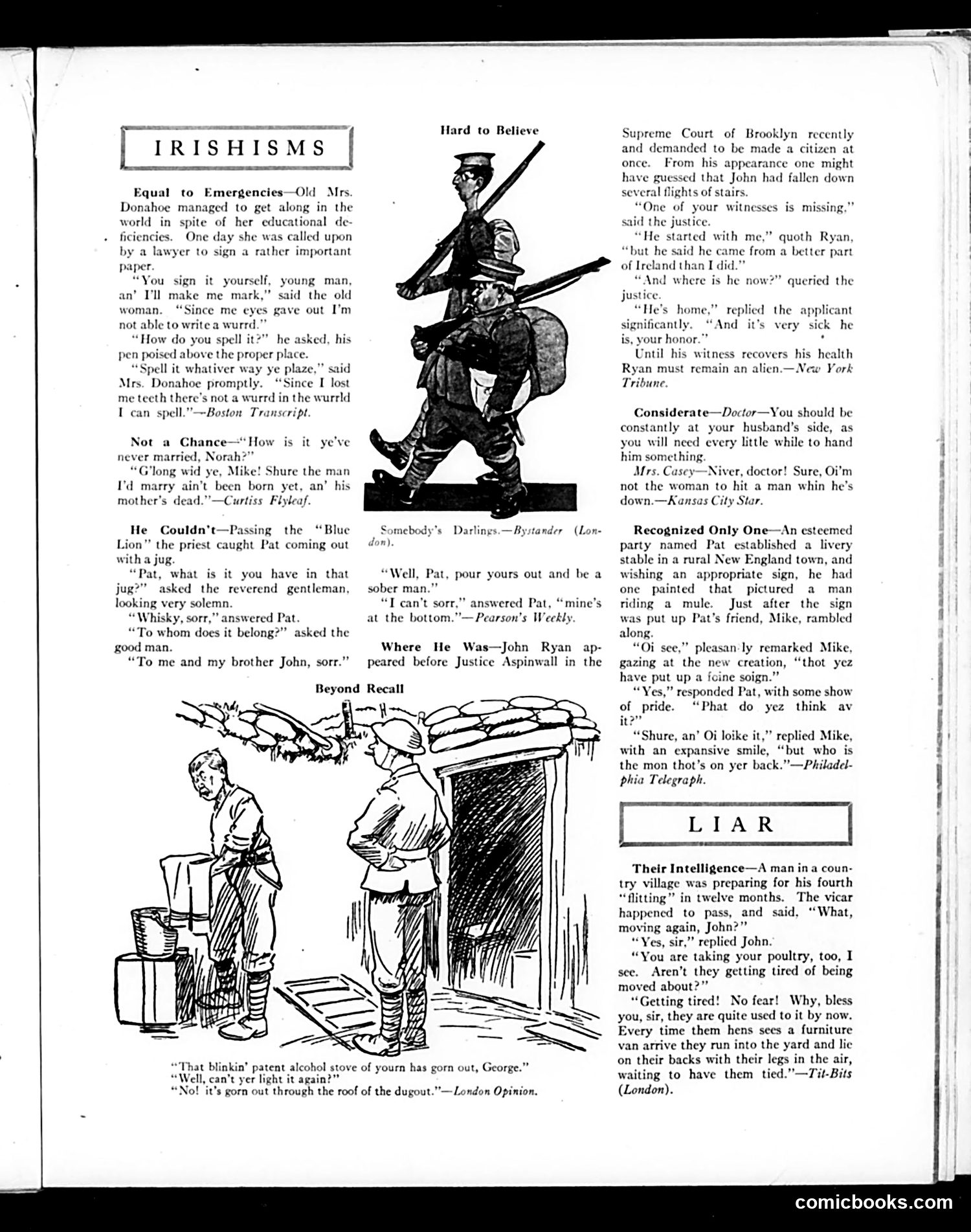
This page from Judge magazine presents **anti-Irish stereotypes** through humor—a common feature of late 19th/early 20th-century American satire. The "IRISHISMS" section collects jokes mocking Irish immigrants' supposed ignorance and malapropisms. The cartoons and anecdotes depict Irish characters (identifiable by names like Donahoe, Pat, Ryan, Mike) as uneducated, prone to drink, and dim-witted. Examples include: an illiterate woman who can't spell anything, a man claiming his liquor is "at the bottom" of a jug, and an immigrant appearing in court covered in bruises. **The satire's point**: These pieces reinforce ethnic prejudices common in American society, presenting Irish people as comically inferior through exaggerated dialect and foolish behavior. A modern reader should understand this reflects **xenophobic attitudes** of the era—what was considered acceptable "humor" would now be recognized as dehumanizing mockery. The content reveals how mainstream publications normalized anti-immigrant sentiment through supposedly lighthearted ridicule.
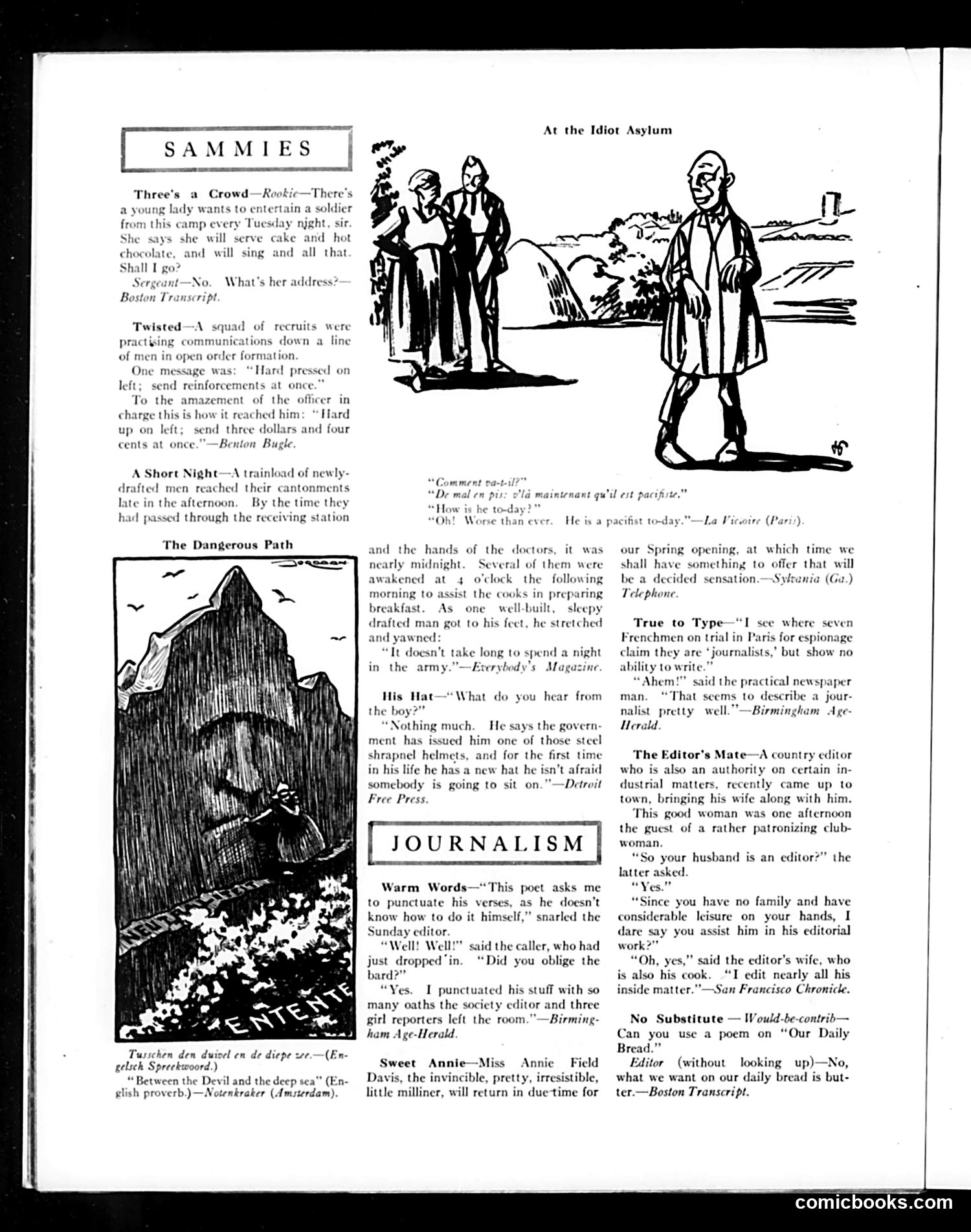
This page contains satirical vignettes about American soldiers ("Sammies") during WWI, reflecting period attitudes toward military life and journalism. **"Sammies" section**: Jokes about newly drafted recruits—their communication mishaps, exhaustion from processing, and pride in receiving their first new steel helmets (an unfamiliar dignity for working-class soldiers). **"The Dangerous Path"**: A woodcut illustration accompanying Dutch and English proverbs about difficult choices, unrelated to the surrounding content. **"Journalism" section**: Newspaper humor mocking poets' incompetence, journalists claiming credibility while writing poorly, and the practical division of labor in small-town editorial offices (where the editor's wife functions as cook and copyeditor). **Overall context**: The humor targets military bureaucracy's absurdities, class anxieties about new conscripts, and journalism's pretensions—typical Judge magazine fare satirizing American institutions during wartime.
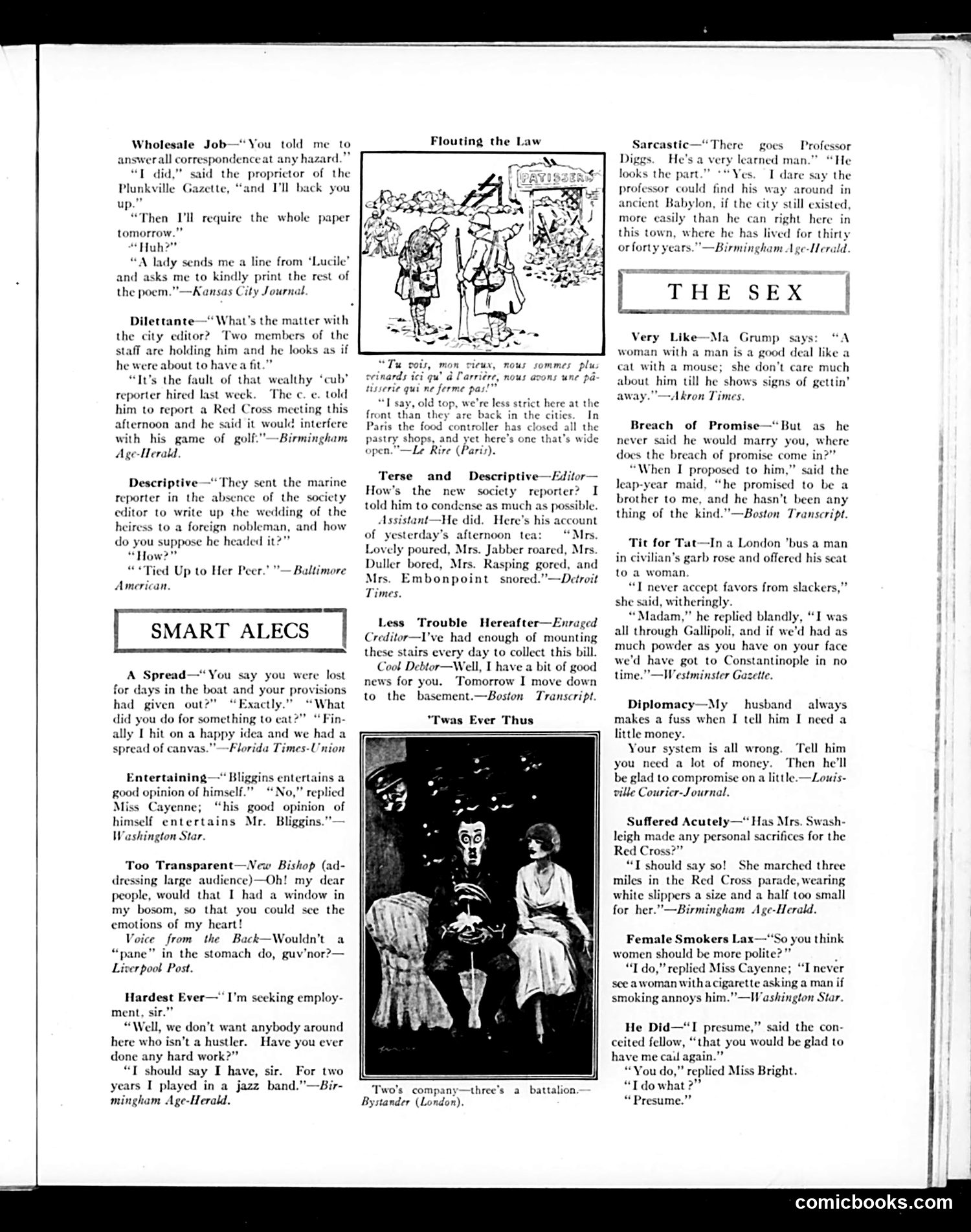
This single-panel cartoon depicts two World War I soldiers at the front discussing the relative strictness of law enforcement. One soldier marvels that the pastry shop remains open despite food rationing, contrasting this with Paris, where a "food controller" has shut down all bakeries. The satire targets the contradiction between wartime regulations imposed on civilians back home versus the looser enforcement at the front lines. The cartoon's caption—sourced from *Le Rire*, a French publication—suggests ironic amusement at this inconsistency. The "pastry shop" becomes emblematic of how authority breaks down in war zones, or how soldiers enjoy freedoms civilians are denied. The joke reflects European wartime frustrations (ca. 1914-1918) with food shortages and rationing policies perceived as unevenly applied.
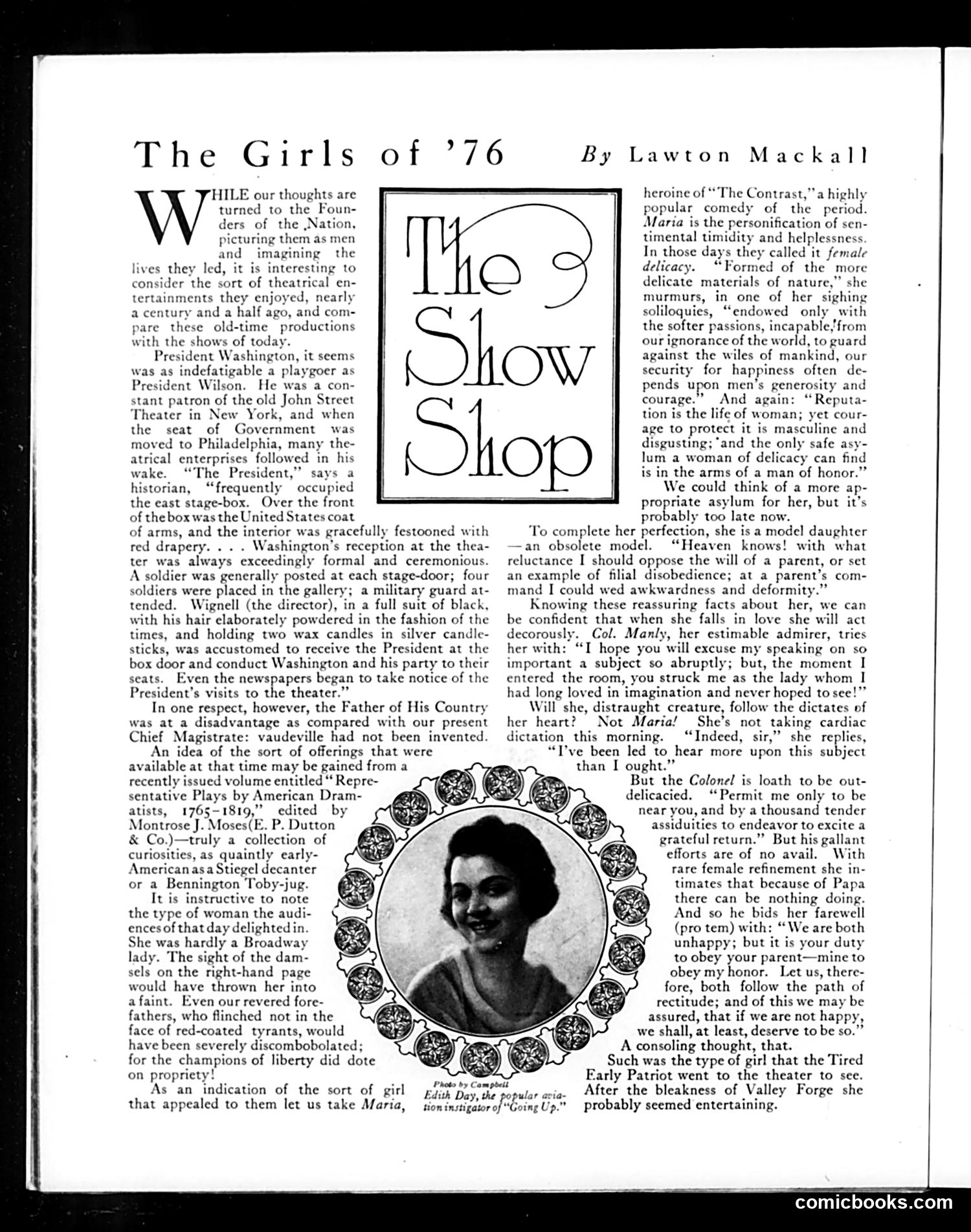
This article by Lawton Mackall contrasts 18th-century theatrical heroines with modern women, using *The Contrast*'s character Maria as the exemplar of old-fashioned femininity. Maria embodies "female delicacy"—helpless, timid, entirely dependent on male protection, her reputation her only value, bound by filial obedience. The satire targets how drastically female ideals have changed. The author notes that founding-era audiences prized propriety and delicate, passive women; modern readers (circa 1920s) would find such heroines absurdly restrictive. The accompanying photograph shows what appears to be actress Edith Day, representing contemporary womanhood—implicitly freer and more capable than her theatrical predecessors. By juxtaposing Washington-era theater conventions with present-day expectations, Mackall gently mocks both past rigidity and contemporary anxieties about women's changing roles.
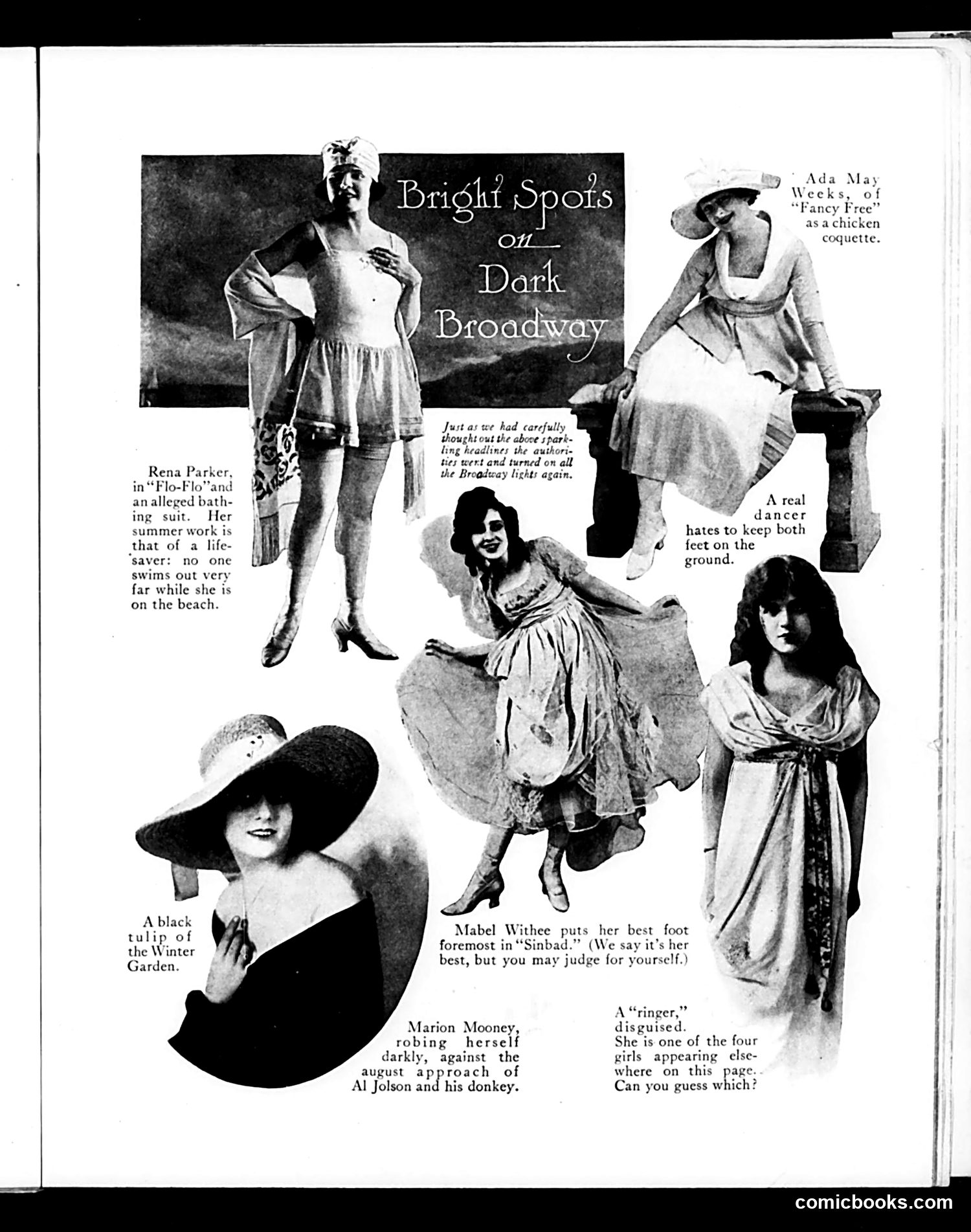
This Judge magazine page satirizes Broadway actresses and productions of the era. It features photographs of performers in various theatrical roles with humorous captions mocking their appearances or performances. The references include: - **Rena Parker** in a bathing suit role, joked about as a "life-saver" - **Marion Mooney** dressed darkly, with a sarcastic reference to **Al Jolson** (famous vaudeville/early film performer) and his donkey—suggesting her dark costume anticipates Jolson's arrival - **Mabel Withee** in "Sinbad," with commentary on her footwork - **Ada May** in "Fancy Free," posed like a flirtatious performer - A "ringer" (disguised performer) readers must identify The satire targets Broadway's theatrical conventions and performers' vanities. The closing reference to Broadway "lights being turned on" appears to mock theatrical spectacle or possibly electricity-related city infrastructure. The tone is lighthearted gossip about stage personalities rather than serious political commentary.
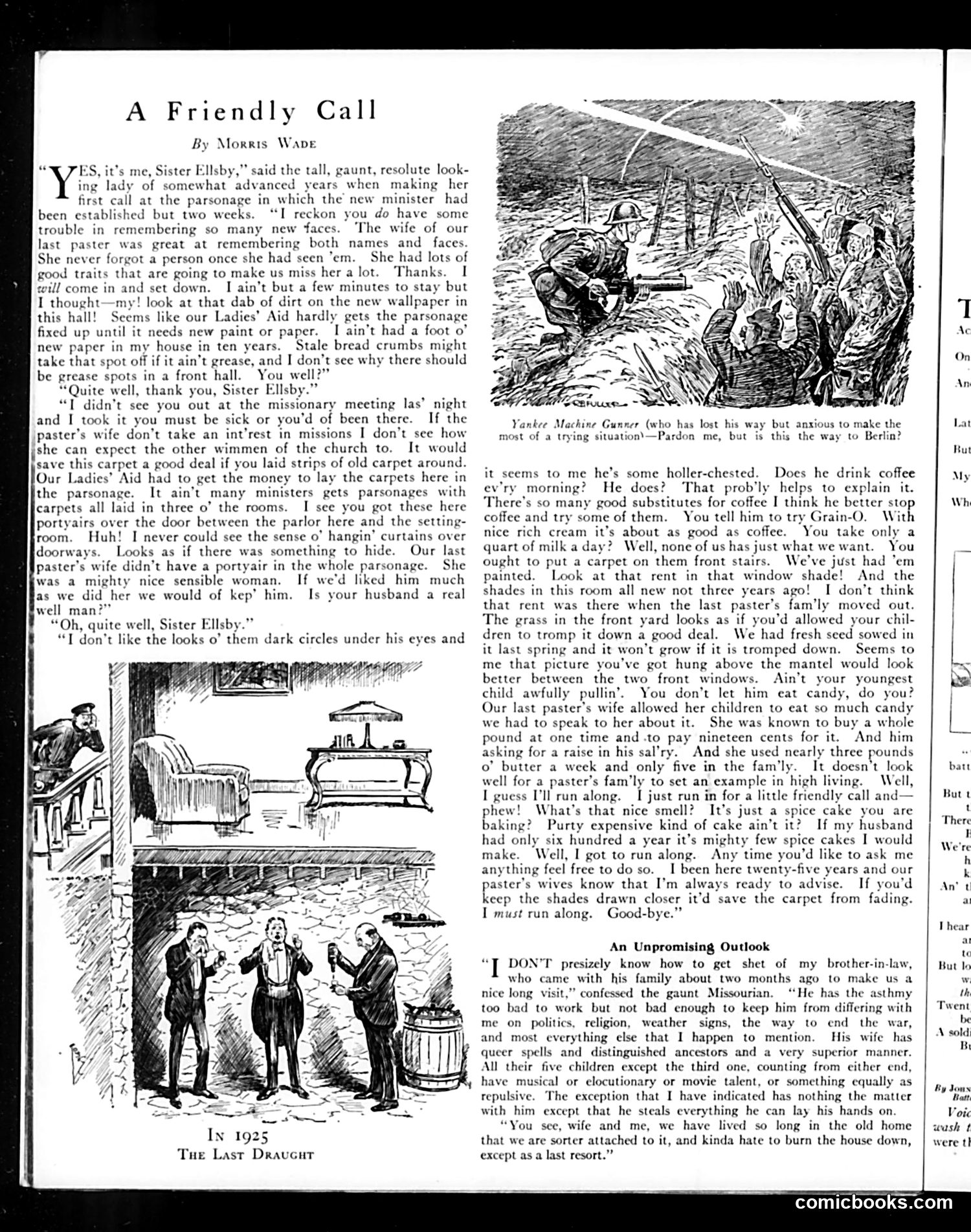
This satirical story depicts Sister Ellsby, a critical church member, making an unwelcome visit to the new minister's parsonage. The humor lies in her relentless, intrusive fault-finding: she complains about wallpaper stains, carpet wear, the minister's wife's missionary attendance, the parsonage décor, the children's behavior, and the family's spending habits (butter consumption, candy purchases). The satire targets small-town church busybodies who use social visits to assert moral superiority while disguising nosiness as concern. Sister Ellsby constantly invokes the "last pastor's wife" as superior, weaponizing comparison to undermine the new family. The illustration shows her as gaunt and severe, embodying her judgmental nature. The joke is that such "friendly calls" are fundamentally hostile—intrusive interrogations masquerading as neighborly concern. This reflects early 20th-century anxieties about social conformity and the policing power of church communities, particularly among women gatekeepers of respectability.
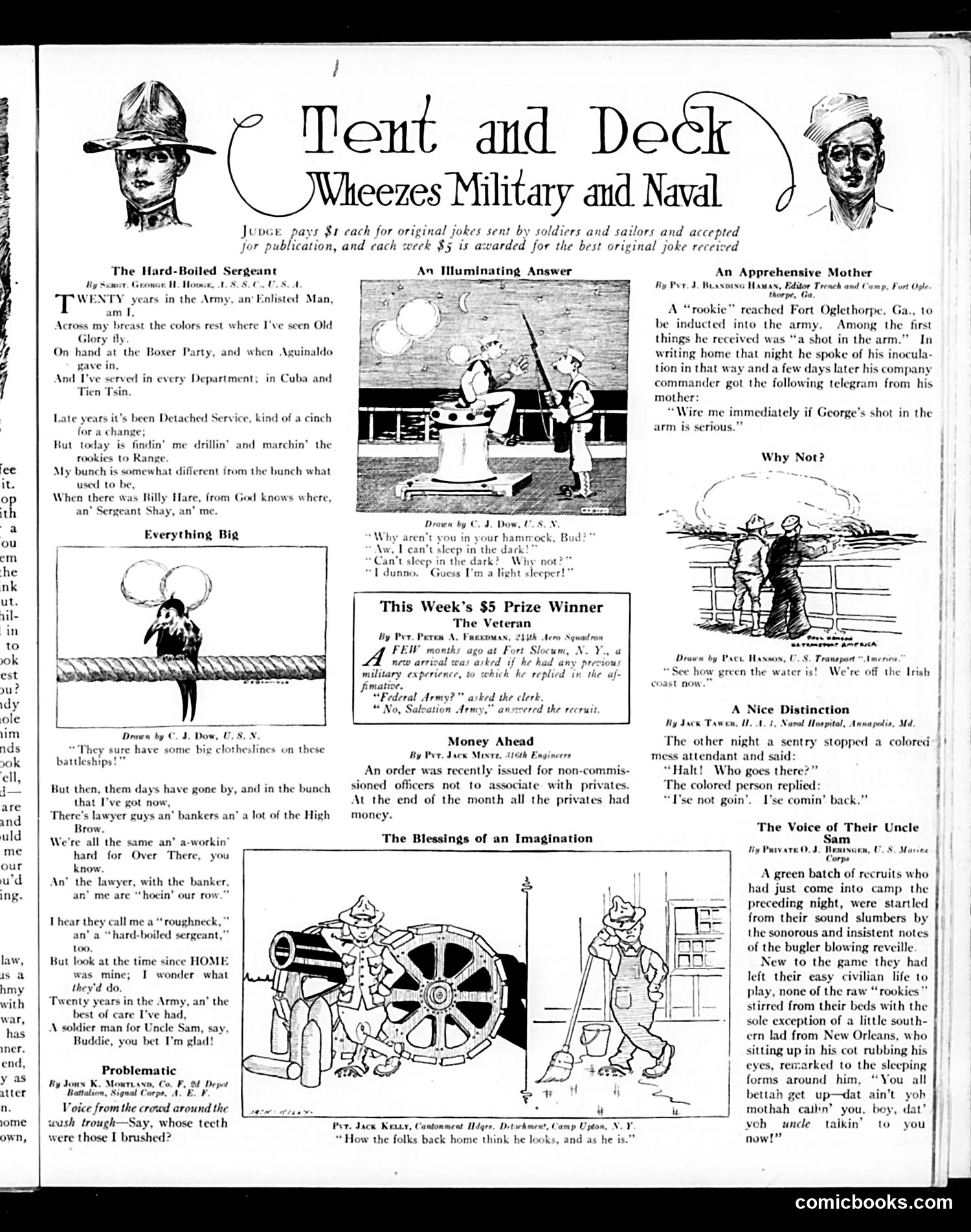
This page collects soldier and sailor jokes submitted to Judge magazine, which paid contributors $1 per accepted joke and awarded a $5 weekly prize. The content reflects WWI-era military life through humorous anecdotes. **Key content includes:** - **"The Hard-Boiled Sergeant"**: A veteran soldier reflects on twenty years of service (Boxer Rebellion, Cuba, Philippines) now training new recruits who differ from the "old guard." - **Race-related humor** ("A Nice Distinction," "Money Ahead"): Jokes depicting Black soldiers and mess attendants, reflecting period attitudes. These are period artifacts showing casual racial stereotyping common to the era. - **Recruit incompetence**: Multiple jokes mock newly drafted "rookies" for naiveté (sleeping in darkness, confusion about orders). - **Class commentary**: References to lawyer and banker soldiers serving alongside working men, suggesting democratization through military service. The cartoons and jokes collectively capture WWI military culture—the tension between seasoned soldiers and untrained recruits, homesickness, and the army's social mixing of different classes.
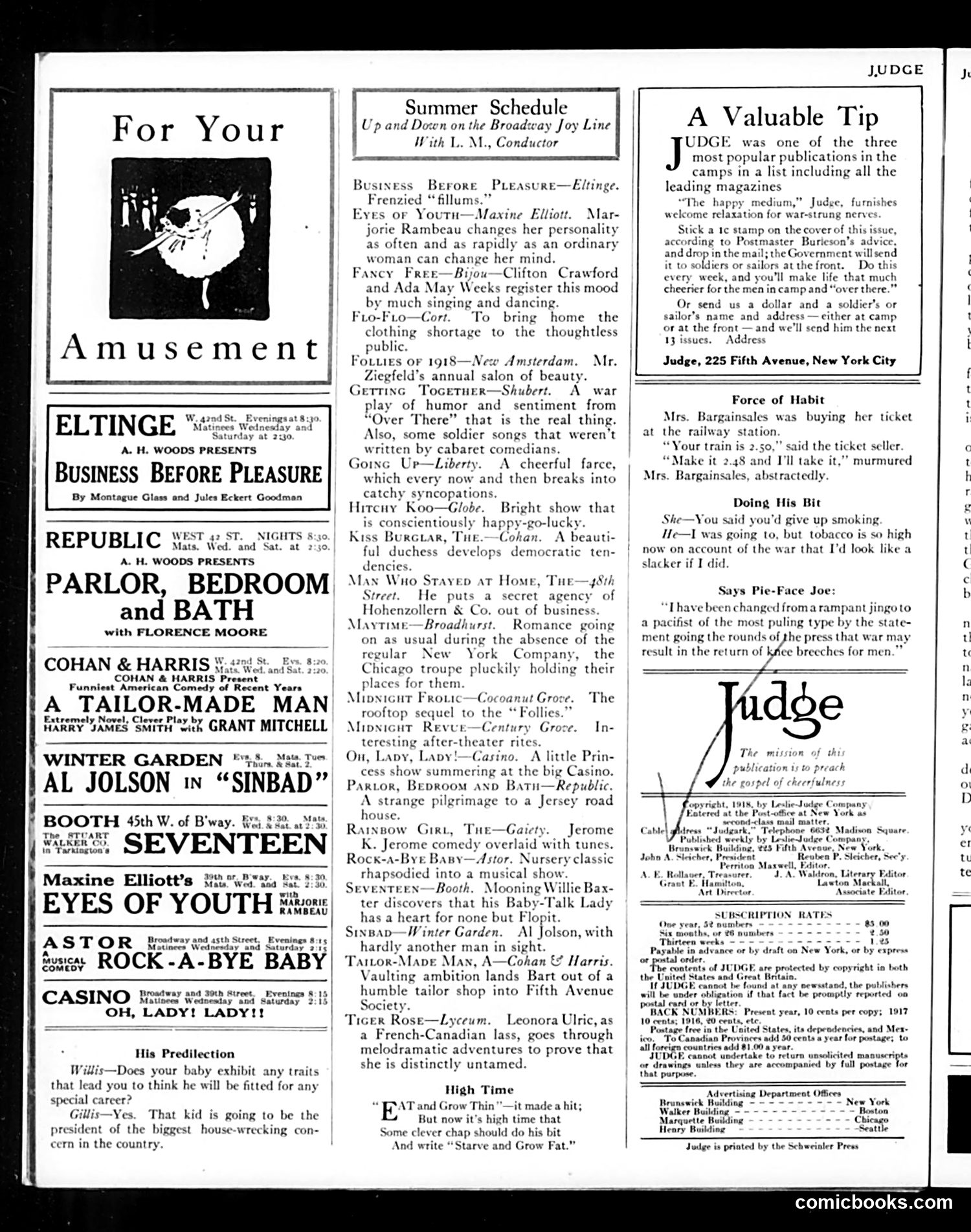
This page is primarily **theater advertising** with brief satirical humor sections. The main content consists of Broadway show listings from what appears to be WWI-era (references to "war" plays, soldier songs, absence of regular companies due to war). The two joke items visible are: 1. **"His Predilection"** — A brief dialogue joke about a baby who will become a "house-wrecking" company president, likely satirizing divorce as increasingly common ("house-wrecking" being slang for someone who breaks up marriages). 2. **"High Time"** — A quip mocking diet book trends. A previous book titled "Eat and Grow Thin" was popular; the joke suggests someone should write the opposite, "Starve and Grow Fat," as satire of such fad literature. The magazine promotes itself as providing "welcome relaxation for war-strung nerves," indicating this is wartime publication aimed at soldiers and civilians dealing with WWI stress. The advertisements emphasize theatrical escapism during wartime.
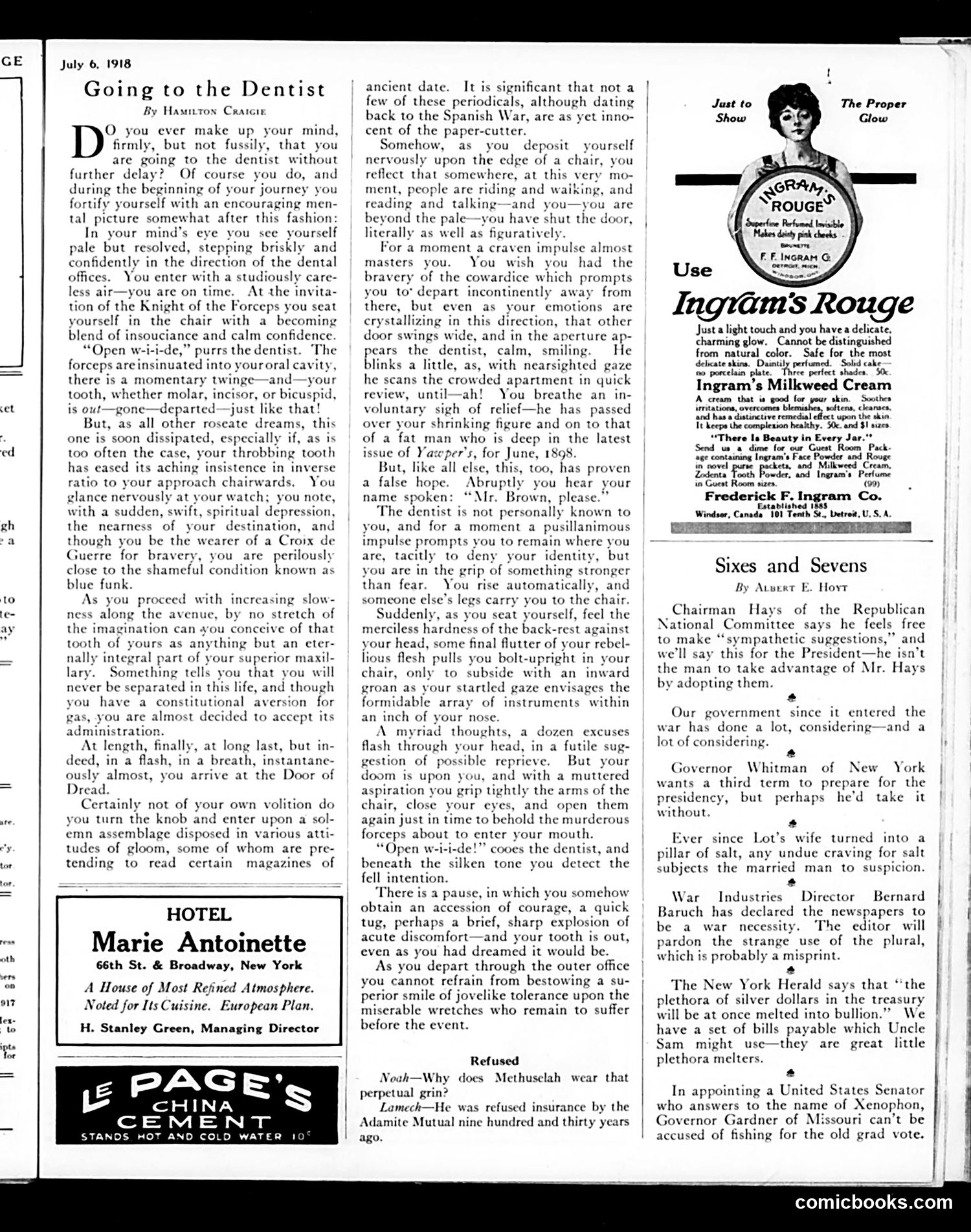
This is a humorous essay by Hamilton Craige satirizing the universal anxiety of visiting the dentist. The piece contrasts the patient's imagined confidence—entering calmly, tooth extracted painlessly—with reality: mounting dread as the appointment approaches, waiting among other anxious patients reading ancient magazines, and the disappointment when the dentist calls your name instead of someone else's. The satire targets human psychology: how we rationalize fears beforehand, then crumble under actual circumstance. A reference to wearing a "Croix de Guerre" (WWI French military decoration) humorously suggests even war heroes succumb to dental cowardice. The accompanying advertisements (Hotel Marie Antoinette, Ingram's Rouge cosmetics, Le Page's cement) are typical Judge magazine content. This is primarily a satirical essay rather than political cartoon—common fare for Judge in 1918.
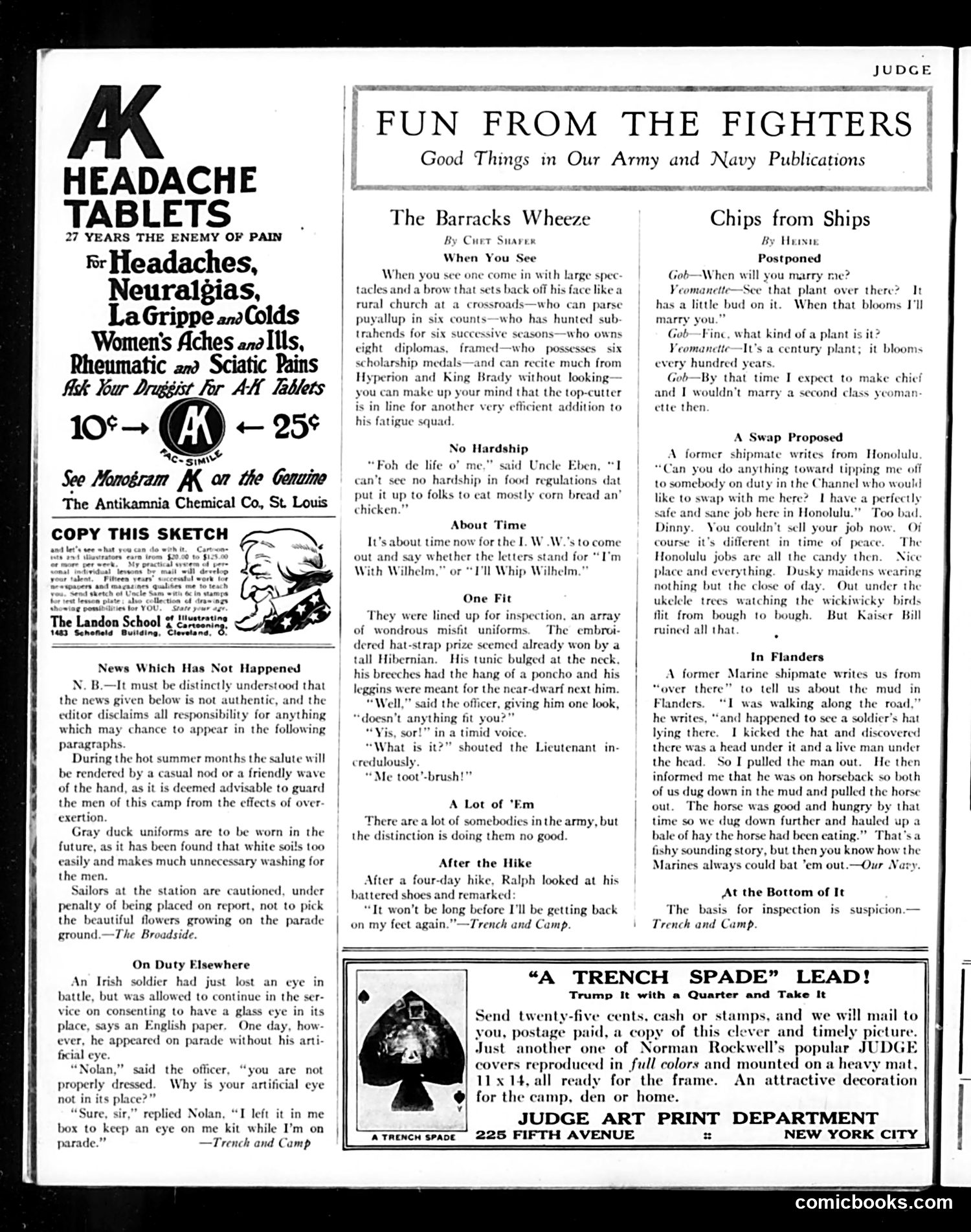
This page is primarily **humorous anecdotes** from Army and Navy publications, presented during World War I (evidenced by references to I.W.W., Wilhelm, Marines in Flanders, and military camp life). The jokes target military absurdities: a soldier's glass eye left behind to guard his kit; a recruit whose only properly-fitting item is his toothbrush; a yeomanette promising marriage when a century plant blooms (implying never). The "News Which Has Not Happened" section is satirical fiction—explicitly labeled as inauthentic—poking fun at camp policies like rendering salutes via casual nods in summer heat, or banning soldiers from picking flowers. The barracks humor focuses on **enlisted-men comedy**: incompetent soldiers, bureaucratic stupidity, and romantic complications. These appear in publications distributed to troops themselves—entertainment for the fighting men. The page also advertises AK Headache Tablets and a trench-spade print, reflecting wartime commerce. Overall: **lighthearted military satire** aimed at servicemembers, using period-specific references to WWI camps and Navy life.
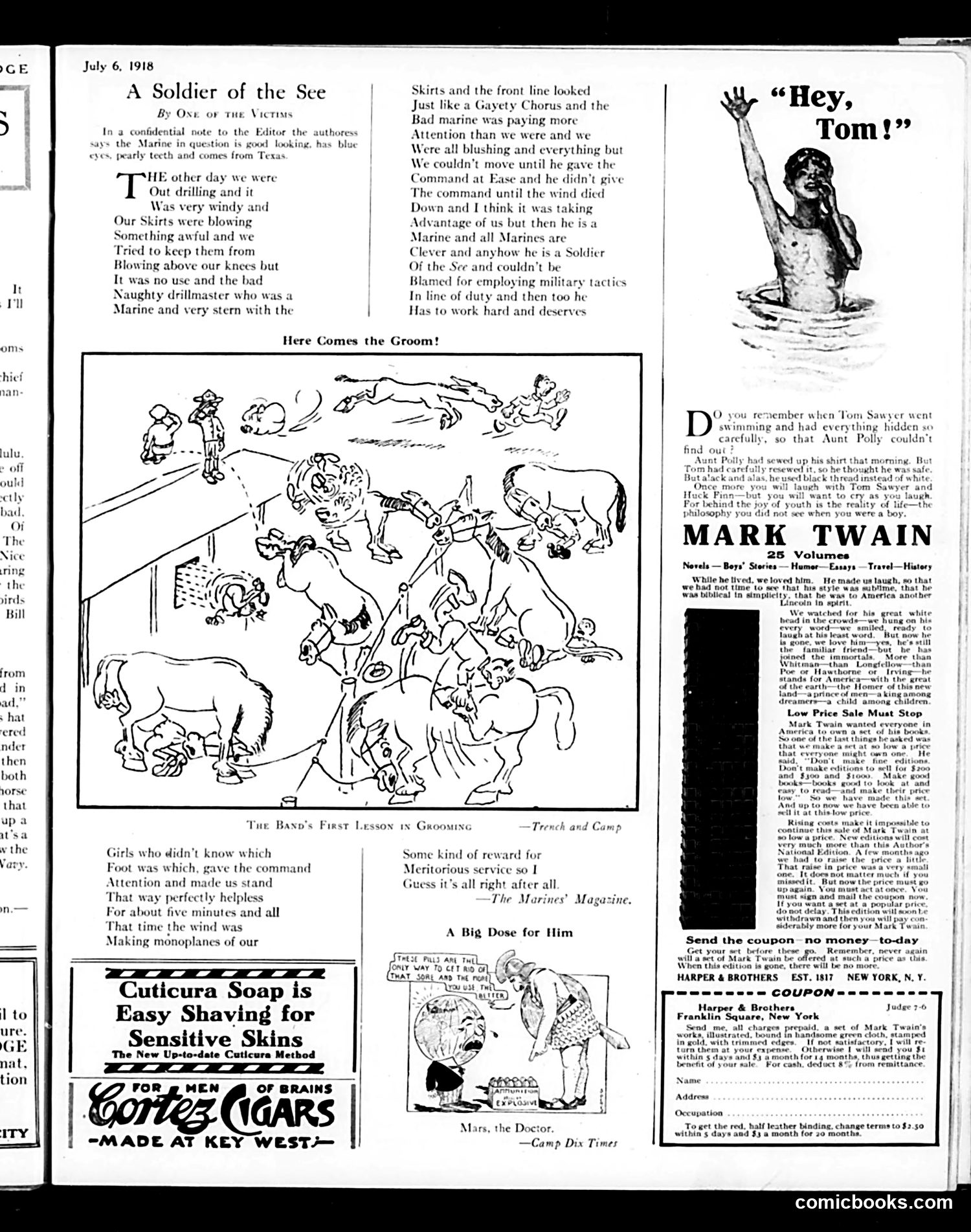
This page contains three distinct pieces: **"A Soldier of the Sea"** (top left): A humorous poem by "One of the Victims" describing female soldiers or recruits drilling in windy conditions. The joke centers on military discipline: a stern Marine drill sergeant deliberately delays the "at ease" command while the wind blows their skirts up, ostensibly as punishment for poor marching. The satire mocks both the absurdity of gendered embarrassment during military service and the sergeant's petty abuse of authority "in line of duty." **"Here Comes the Groom!"** (center): A comic illustration with accompanying verse about a military band's first grooming lesson, depicting chaotic animals. This appears to be light wartime humor about soldier training. **Mark Twain Advertisement** (right): A sales pitch for a 25-volume Mark Twain collection, using nostalgic language ("while he lived, we loved him") and urgency ("sale must stop") to drive purchases. The page is primarily **entertainment and advertising** typical of Judge's satirical-commercial format during WWI.
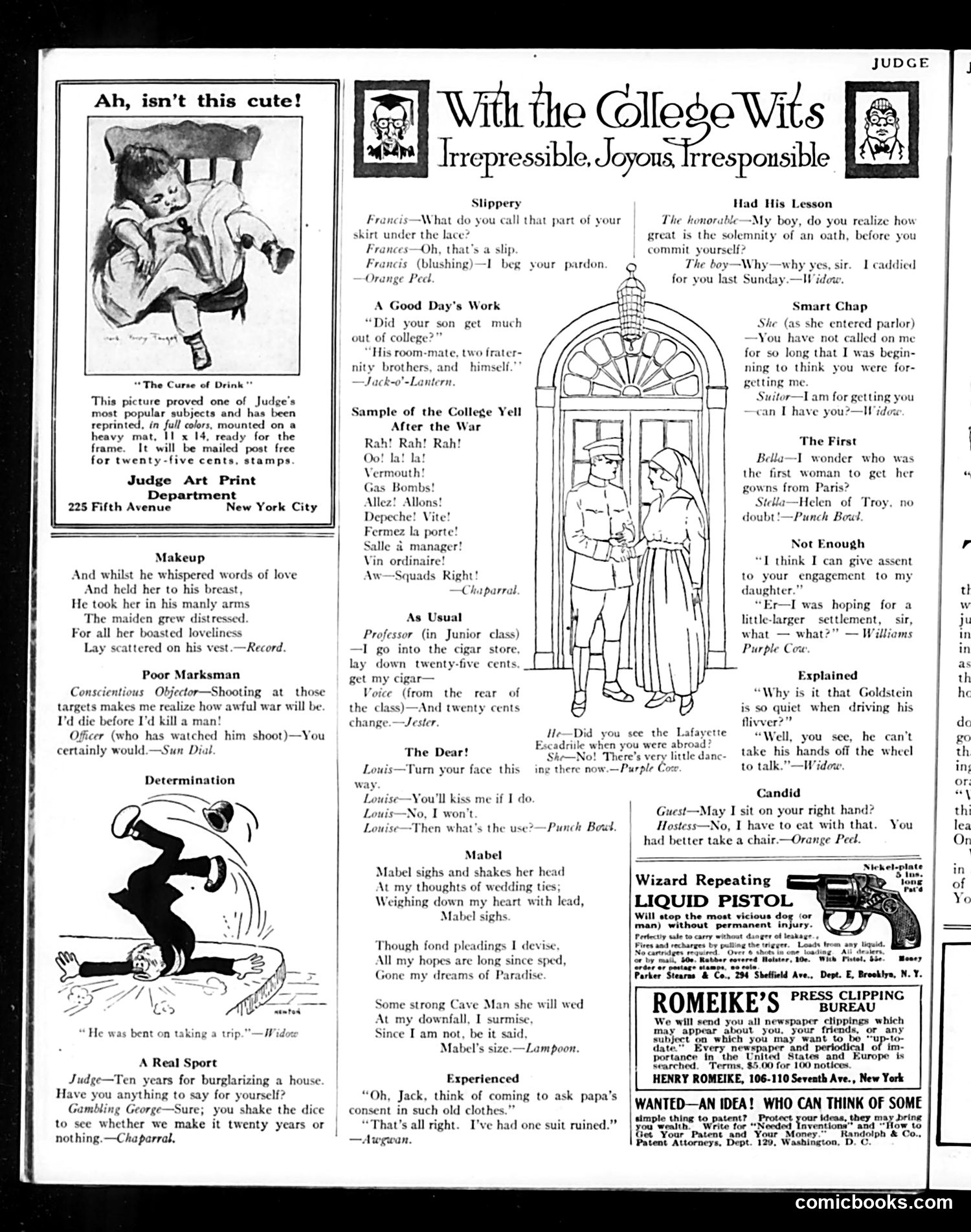
This is a miscellaneous humor page from *Judge* magazine featuring college-themed jokes and satirical items. The title section "With the College Wits" collects brief comedic exchanges mocking undergraduate life: pretentious French phrases, poor academic outcomes (sons learning from roommates rather than classes), and romantic fumbling. The "Sample of the College Yell After the War" lampoons how WWI had infiltrated even celebratory college chants—replacing traditional cheers with references to "Gas Bombs" and French phrases, reflecting the war's pervasive cultural impact on American institutions. Other jokes mock social pretension (a woman's makeup "scattered on his vest"), military ineptitude, and romantic miscalculations. The cartoons are generic comedy rather than political satire. The page also includes advertisements for art prints and novelty items like the "Liquid Pistol." The humor relies on dated wordplay and situational comedy targeting college students and young adults of the 1920s era.
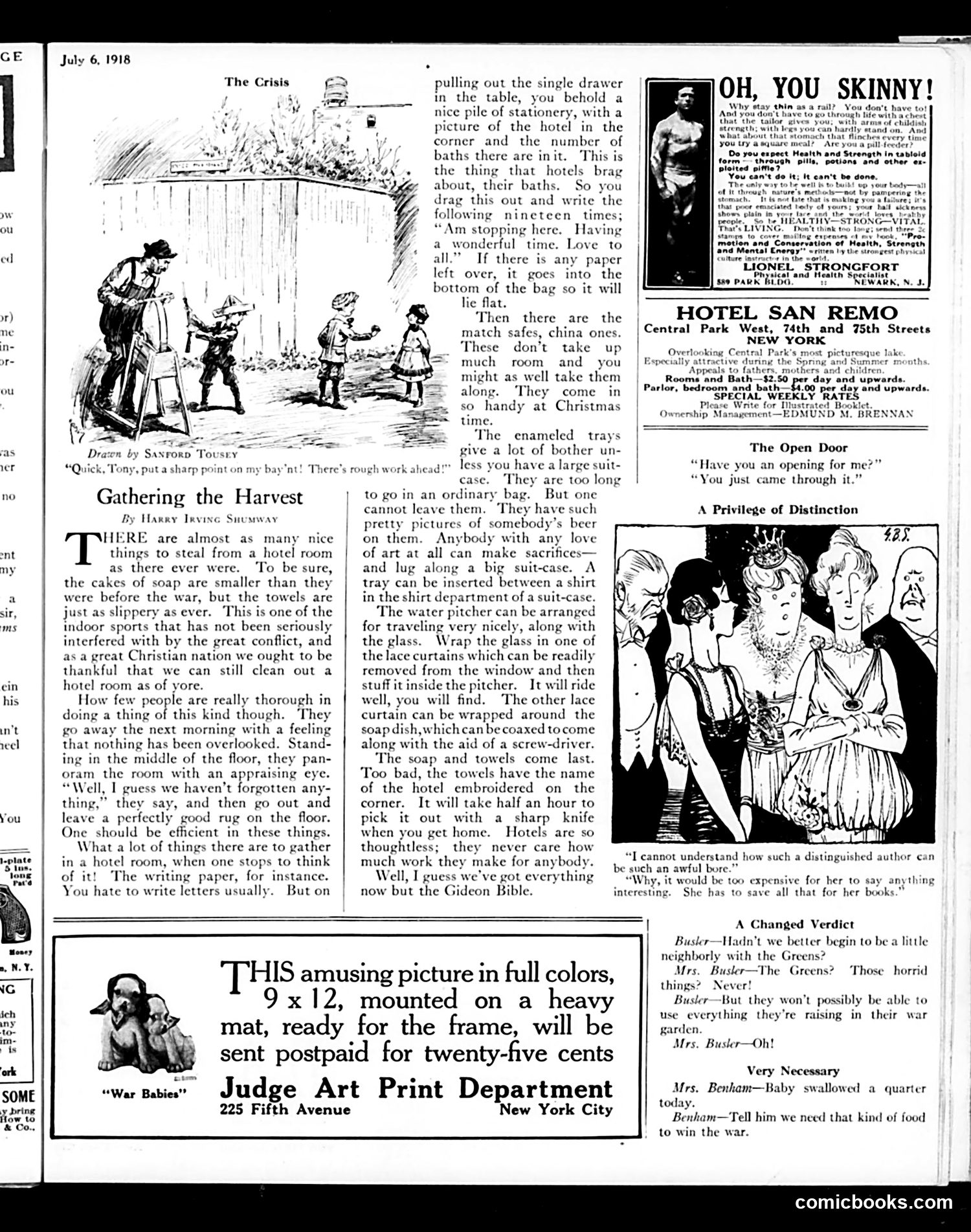
This article is **satire on hotel theft**. The author, Harry Irving Shuway, humorously catalogs items guests routinely steal from hotels—towels, stationery with the hotel logo, china match safes, enameled trays, lace curtains, water pitchers, soap dishes, and towels again—presenting petty larceny as an accepted "indoor sport" and "Christian" tradition. The cartoon illustration (by Sanford Tousey) shows a woman supervising children who appear to be gathering items, visualizing the text's theme. The satire's point: hotel theft was so commonplace in 1918 that Judge could mock it as normal behavior. The detailed, almost instructional tone—explaining how to pack stolen goods efficiently—amplifies the absurdity. The final joke (stealing "everything now but the Gideon Bible") suggests even morality has limits. This reflects pre-modern attitudes toward minor theft from commercial establishments as amusing rather than criminal.
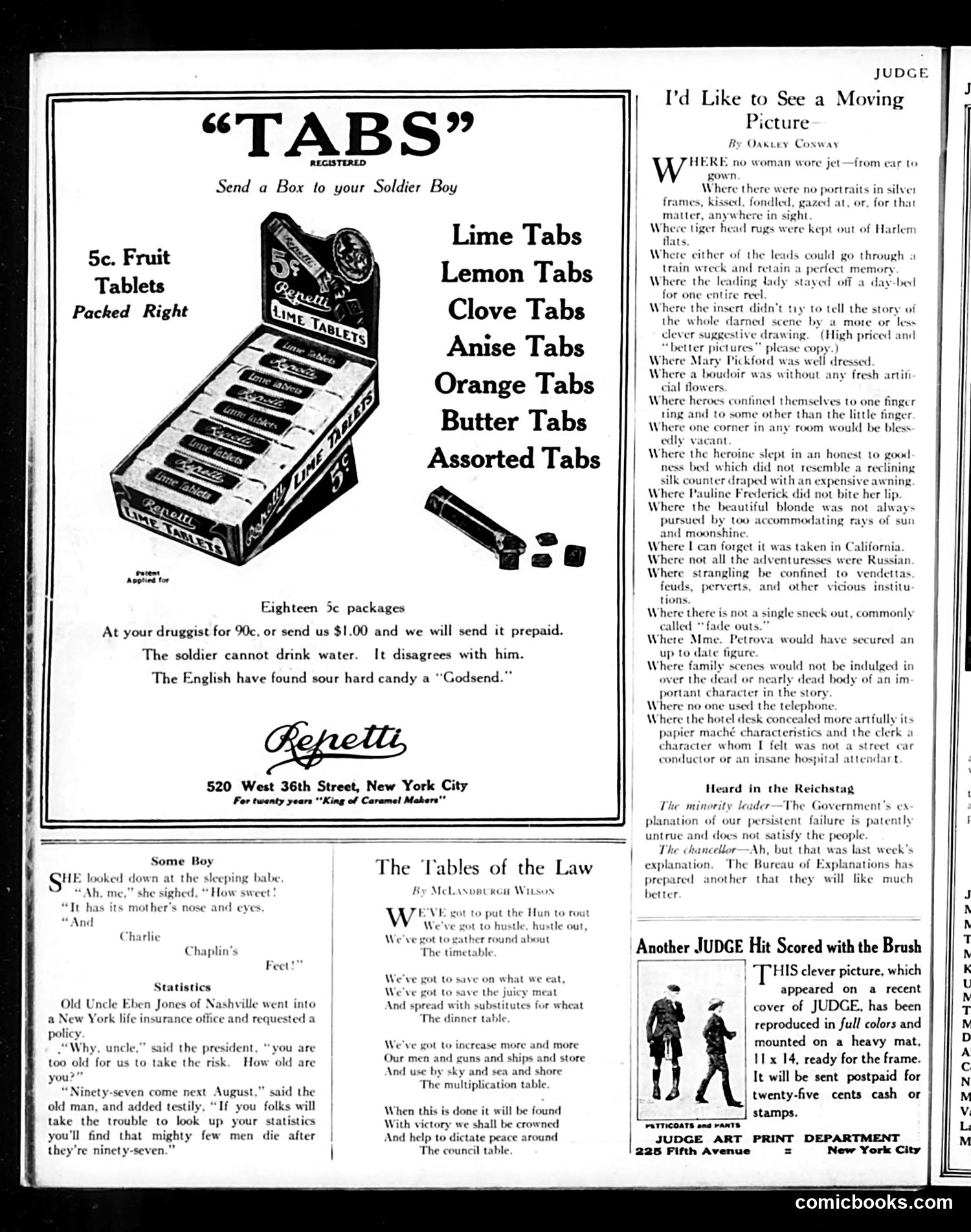
This page is primarily **advertising and filler content** rather than political satire. The **TABS advertisement** dominates the left side, marketing sour candy tablets for soldiers serving in World War I. The copy notes that soldiers "cannot drink water" and references the English finding sour hard candy useful—contextualizing this as wartime morale-boosting merchandise. The right column contains light humor pieces: "Some Boy" (a domestic joke about a baby), "Statistics" (an anecdote about an elderly man's insurance eligibility), and "The Tables of the Law" (WWI-themed verse about wartime rationing and sacrifice). The essay "I'd Like to See a Moving Picture" satirizes common Hollywood film clichés of the era—excessive jewelry, dramatic intertitles, artificial flowers, overdone lighting, and melodramatic character deaths. This reflects contemporary criticism of silent film conventions. The final snippet, "Heard in the Reichstag," offers mild satire about German government explanations during the war. Overall, this is **wartime-era content** mixing patriotic commerce with period-specific entertainment criticism.
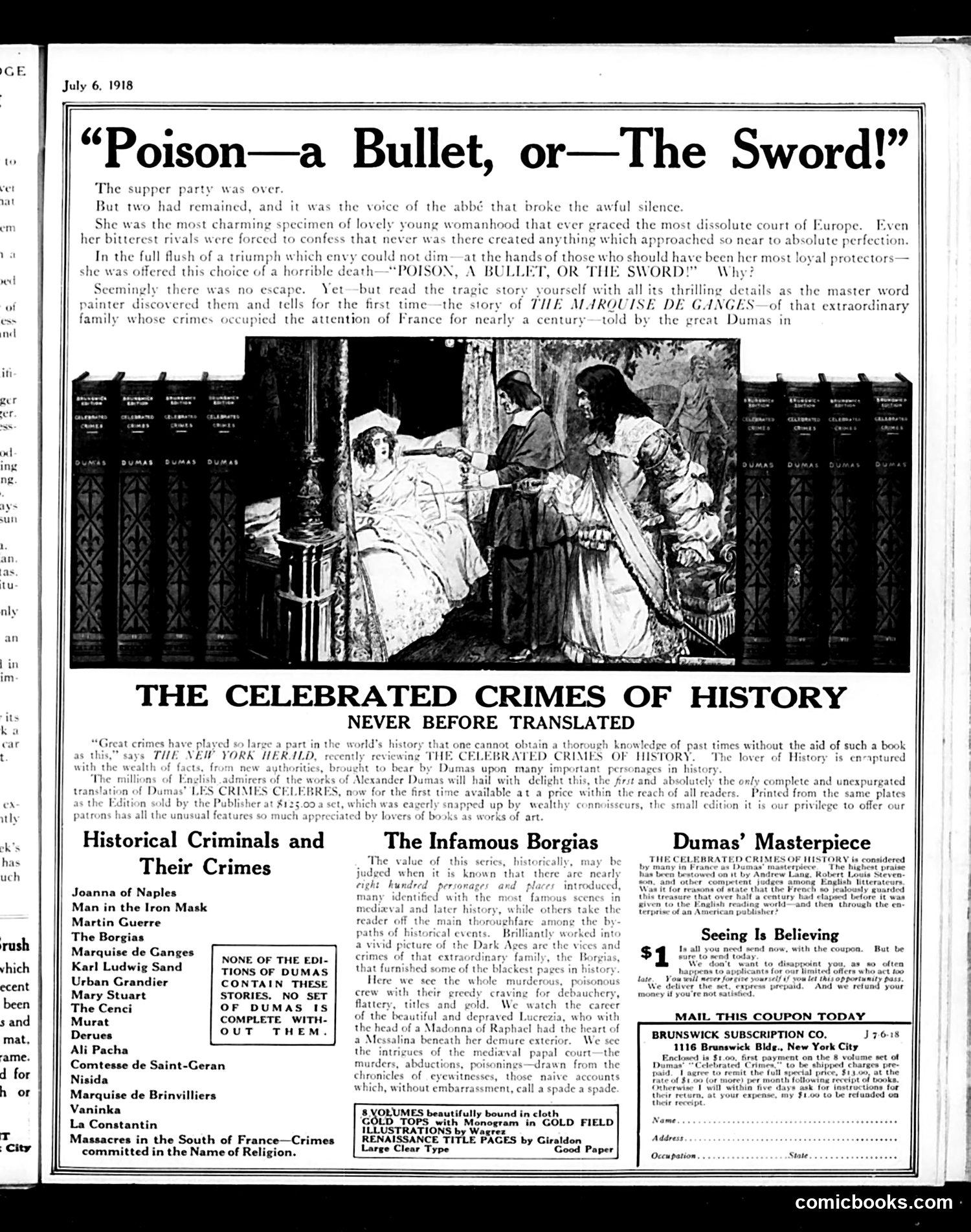
This page is primarily a **book advertisement** for Alexandre Dumas' *The Celebrated Crimes of History*, not political satire. The dramatic header "Poison—a Bullet, or—The Sword!" quotes the climactic choice facing a female character in one of Dumas' historical crime narratives. The advertisement leverages the popularity of true crime and European history among American readers. It promotes a newly complete, unabridged English translation of Dumas' work, listing infamous historical criminals (the Borgias, the Marquise de Ganges, etc.). The *timing*—July 1918, near WWI's end—may capitalize on American interest in European affairs, though the ad makes no explicit political statement. The illustration depicts a period bedroom scene consistent with the melodramatic crimes described. The "BRUNSWICK SUBSCRIPTION CO." pushes mail-order sales via coupon. This is essentially **commercial content**, not editorial commentary or political cartoon.
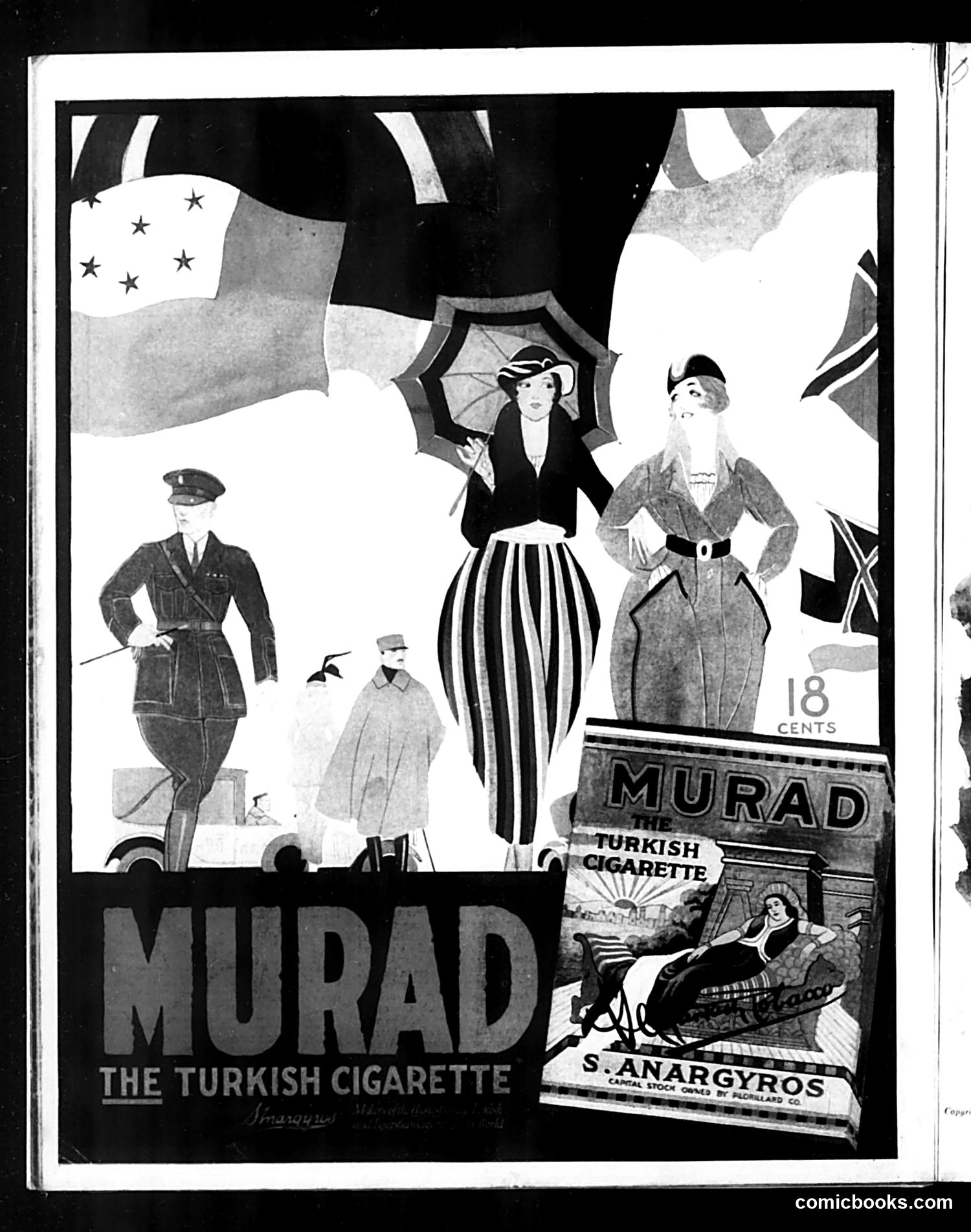
This is a magazine advertisement for Murad Turkish cigarettes, priced at 18 cents. The image depicts a glamorous, patriotic scene with five figures posed against large flags (appearing to include American flags with stars). The central figure is a well-dressed woman with a parasol, flanked by military personnel and fashionably-attired companions. The advertisement associates the product with sophistication, patriotism, and upscale lifestyle. The inclusion of military figures suggests appeals to national pride or wartime sentiment. The prominent display of an elegant woman reflects early 20th-century marketing that linked cigarette consumption to modernity and femininity—a notable shift, as women smoking was still relatively scandalous. This appears to be commercial advertising rather than satirical content.