
Judge, 1918-07-06 · page 24 of 36
Judge — July 6, 1918 — page 24: what you’re looking at
What you’re looking at
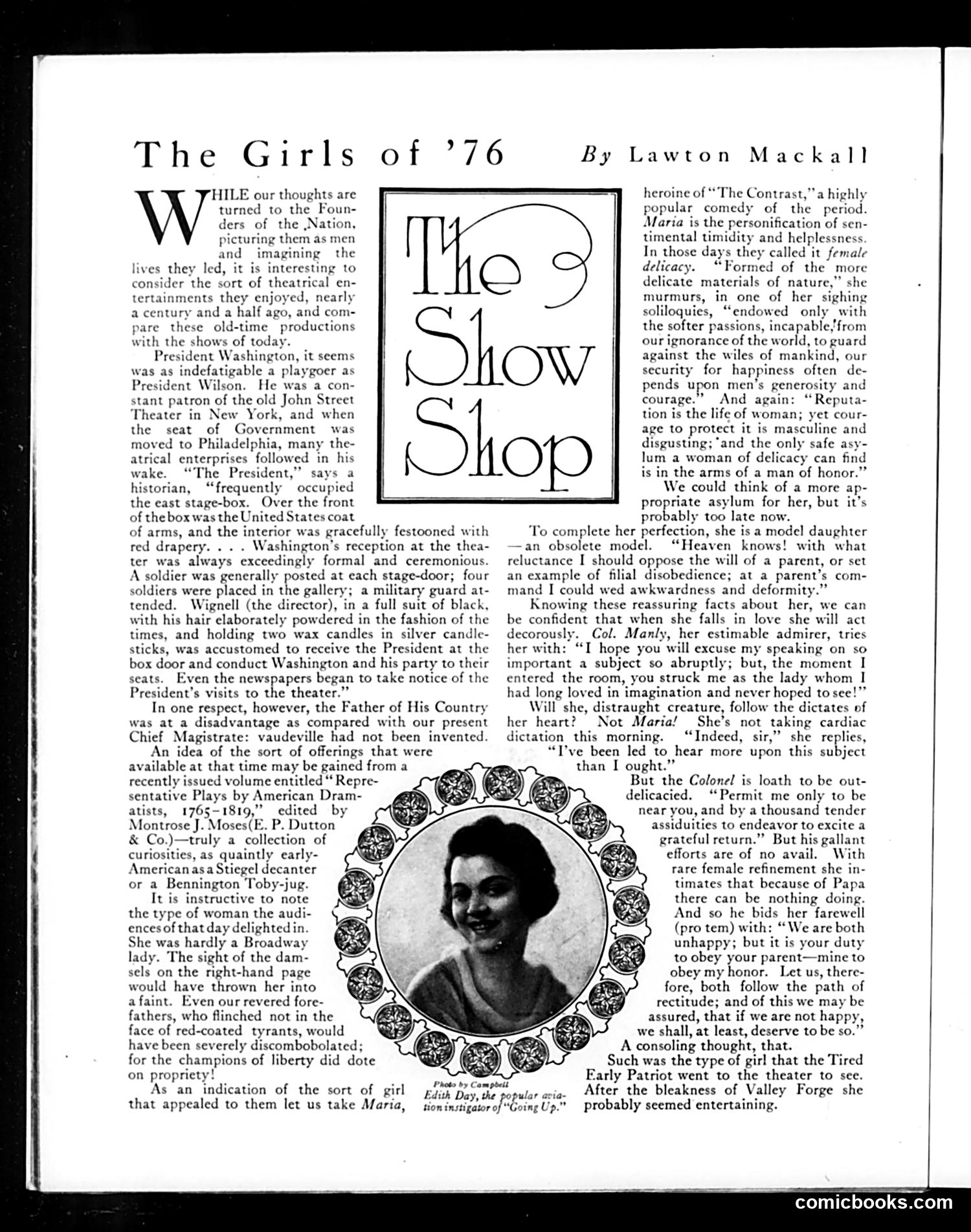
This article by Lawton Mackall contrasts 18th-century theatrical heroines with modern women, using *The Contrast*'s character Maria as the exemplar of old-fashioned femininity. Maria embodies "female delicacy"—helpless, timid, entirely dependent on male protection, her reputation her only value, bound by filial obedience. The satire targets how drastically female ideals have changed. The author notes that founding-era audiences prized propriety and delicate, passive women; modern readers (circa 1920s) would find such heroines absurdly restrictive. The accompanying photograph shows what appears to be actress Edith Day, representing contemporary womanhood—implicitly freer and more capable than her theatrical predecessors. By juxtaposing Washington-era theater conventions with present-day expectations, Mackall gently mocks both past rigidity and contemporary anxieties about women's changing roles.
📄 Transcribed text from this page (OCR, searchable)
Machine-transcribed from the original scan — historical spelling and the odd misread are preserved.
SS ———— The Girls of HILE our thoughts are turned to the Foun- ders of the Nation, picturing them as men and imagining the lives they led, it is interesting to consider the sort of theatrical en- tertainments they enjoyed, nearly a century and a half ago, and com- pare these old-time productions with the shows of today. President Washington, it seems was as indefatigable a playgoer as President Wilson. He was a con- stant patron of the old John Street Theater in New York, and when the seat of Government was moved to Philadelphia, many the- atrical enterprises followed in his wake. “The President,” says a historian, “frequently occupied the east stage-box. Over the front of the box was the United States coat of arms, and the interior was gracefully festooned with red drapery. . . . Washington’s reception at the thea- ter was always exceedingly formal and ceremonious. A soldier was generally posted at each stage-door; four soldiers were placed in the gallery; a military guard at- tended. Wignell (the director), in a full suit of black, with his hair elaborately powdered in the fashion of the times, and holding two wax candles in silver candle- sticks, was accustomed to receive the President at the box door and conduct Washington and his party to their seats. Even the newspapers began to take notice of the President’s visits to the theater.”” In one respect, however, the Father of His Country was at a disadvantage as compared with our present Chief Magistrate: vaudeville had not been invented. An idea of the sort of offerings that were available at that time may be gained from a recently issued volume entitled “ Repre- sentative Plays by American Dram- atists, 1765-1819," edited by Montrose J. Moses(E. P. Dutton & Co.)—truly a collection of curiosities, as quaintly early- Americanasa Stiegel decanter or a Bennington Toby-jug. It is instructive to note the type of woman the audi- ences of that day delighted in She was hardly a Broadway lady. The sight of the dam- sels on the right-hand page would have thrown her into afaint. Even our revered fore- fathers, who flinched not in the face of red-coated tyrants, would have been severely discombobolated; for the champions of liberty did dote on propriety! °76 UG, As an indication of the sort of girl Edith Day, he po that appealed to them let us take Maria, _ sion instigator o By Lawton Mackall heroine of “ The Contrast,” a highly popular comedy of the period. Maria is the personification of sen- timental timidity and helplessness In those days they called it female delicacy. “Formed of the more delicate materials of nature,” she murmurs, in one of her sighing soliloquies, “endowed only with the softer passions, incapable,'from our ignorance of the world, to guard against the wiles of mankind, our security for happiness often de- pends upon men’s generosity and courage.’ And again: “Reputa- tion is the life of woman; yet cour- age to protect it is masculine and disgusting; ‘and the only safe asy- lum a woman of delicacy can find is in the arms of a man of honor.” We could think of a more ap- propriate asylum for her, but it’s probably too late now. To complete her perfection, she is a model daughter —an obsolete model. “Heaven knows! with what reluctance I should oppose the will of a parent, or set an example of filial disobedience; at a parent’s com- mand I could wed awkwardness and deformity.” Knowing these reassuring facts about her, we can be confident that when she falls in love she will act decorously. Col. Manly, her estimable admirer, tries her with: “I hope you will excuse my speaking on so important a subject so abruptly; but, the moment | entered the room, you struck me as the lady whom I had long loved in imagination and never hoped to see!” Will she, distraught creature, follow the dictates of her heart? Not Maria! She’s not taking cardiac dictation this morning. “Indeed, sir,” she replies, “I've been led to hear more upon this subject than I ought.” But the Colonel is loath to be out- delicacied. “Permit me only to be near you, and by a thousand tender assiduities to endeavor to excite a grateful return.” But his gallant efforts are of no avail. With rare female refinement she in- a timates that because of Papa fore, both follow the path of After the bleakness of Valley Forge she € there can be nothing doing. rectitude; and of this we may be probably seemed entertaining. And so he bids her farewell (pro tem) with: “We are both unhappy; but it is your duty 3 to obey your parent—mine to obey my honor. Let us, there- assured, that if we are not happy, we shall, at least, deserve to be so.” A consoling thought, that. Such was the type of girl that the Tired Early Patriot went to the theater to see. pular avia- Going Up.” comicbooks.com