
Judge, 1918-07-06 · page 12 of 36
Judge — July 6, 1918 — page 12: what you’re looking at
What you’re looking at
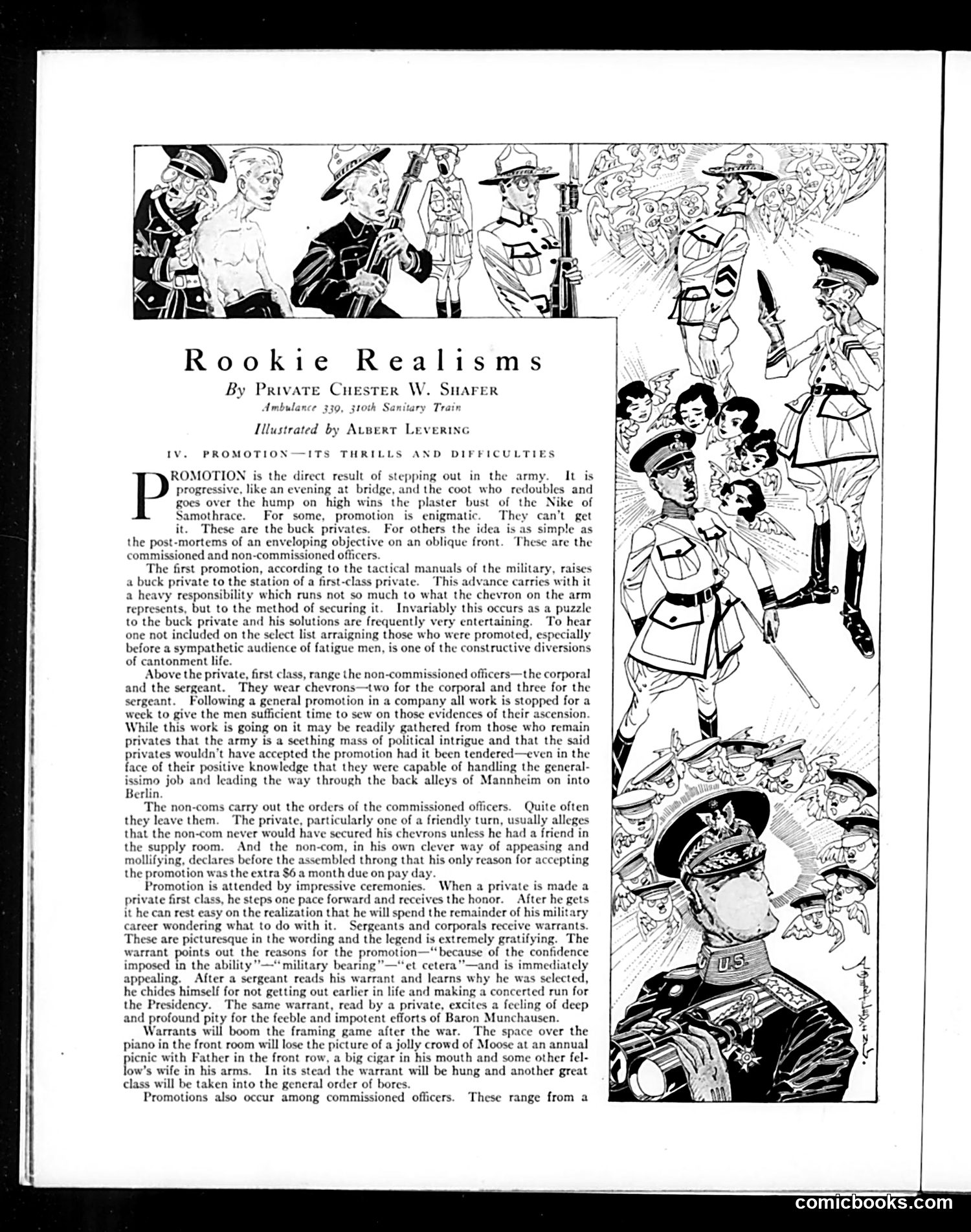
This is a satirical article by Private Chester W. Shafer (illustrated by Albert Levering) about military promotion during World War I, published in *Judge* magazine. The piece humorously critiques the army's promotion system and soldiers' attitudes toward advancement. The satire targets several aspects: the arbitrary nature of promotions (portrayed as mysterious "puzzles"), soldiers' conspiracy theories about favoritism ("a friend in the supply room"), and the contrast between how different ranks interpret their promotion warrants. Officers find the official language ("confidence imposed," "military bearing") genuinely inspiring, while enlisted men read the same language as evidence of bureaucratic absurdity—comparing it to Baron Munchausen's tall tales. The accompanying cartoon illustrations (right side) depict soldiers in various camp scenes. The humor lies in the gap between the army's official dignity and soldiers' cynical, irreverent reality.
📄 Transcribed text from this page (OCR, searchable)
Machine-transcribed from the original scan — historical spelling and the odd misread are preserved.
Rookie Realisms By Private Ci Rk W. SHAFER {mbulance 339, 3totk S Train Illustrated by Avpert Leverinc V. PROMOTION—ITS THRILLS AND DIFFICULTIES I ROMOTION is the direct result of stepping out in the army. It is D) progress! like an evening at bridge, and the coot who redoubles and goes over the hump on high wins the plaster bust of the Nike of Samothrace. For some, promotion is enigmatic. They can't get it. These are the buck privates. For others the idea is as simp! the post-mortems of an enveloping objective on an oblique front. These are the commissioned and non-commissioned officers. The first promotion, according to the tactical manuals of the mil: ‘aises a buck private to the station of a first-class private. This advance carries with it a heavy responsibility which runs not so much to what the chevron on the arm represents, but to the method of securing it. Invariably this occurs as a puzzle to the buck private and his solutions are frequently very entertaining. To hear one not included on the select list arraigning those who were promoted, especially before a sympathetic audience of fatigue men, is one of the constructive diversions of cantonment life. Above the private, first class, range the non-commissioned officers—the corporal and the sergeant. They wear chevrons—two for the corporal and three for the t. Following a general promotion in a company all work is stopped for a to give the men sufficient time to sew on those evidences of their ascension. While this work is going on it may be readily gathered from those who remain privates that the army is a scething mass of political intrigue and that the said privates wouldn't have accepted the promotion had it been tendered—even in the of their positive knowledge that the: apable of handling the general- issimo job and leading the way through the back alleys of Mannheim on into Berlin The non-coms carry out the orders of the commissioned officers. Quite often they leave them. he private, particularly one of a friendly turn, usually alleges that the non-com never would have secured his chevrons unless he had a friend in the supply room. And the non-com, in his own clever way of appeasing and mollifying, declares before the assembled throng that his only reason for accepting the promotion was the extra $6 a month due on pay day Promotion is attended by impressive ceremonies. When a private is made a private first class, he steps one pace forward and receives the honor. After he gets it he can rest easy on the realization that he will spend the remainder of his military career wondering what to do with it. Sergeants and corporals receive warrants. These are picturesque in the wording and the legend is extremely gratifying. The warrant points out the reasons for the promotion—“ because of the confidence imposed in the ability” —* military bearing”—"“et cetera”—and is immediately appealing. After a sergeant reads his warrant and learns why he was selected, he chides himself for not getting out earlier in life and making a concerted run for the Presidency. The same warrant, read by a private, excites a fecling of deep and profound pity for the feeble and impotent efforts of Baron Munchausen. Warrants will boom the framing game after the war. The space over the piano in the front room will lose the picture of a jolly crowd of Moose annual picnic with Father in the front row, a big cigar in his mouth and some other fel- low’s wife in his arms. In its stead the warrant will be hung and another great class will be taken into the gencral order of bores. Promotions also occur among commissioned officers. These range from a comicbooks.com