
Judge, 1918-07-06 · page 21 of 36
Judge — July 6, 1918 — page 21: what you’re looking at
What you’re looking at
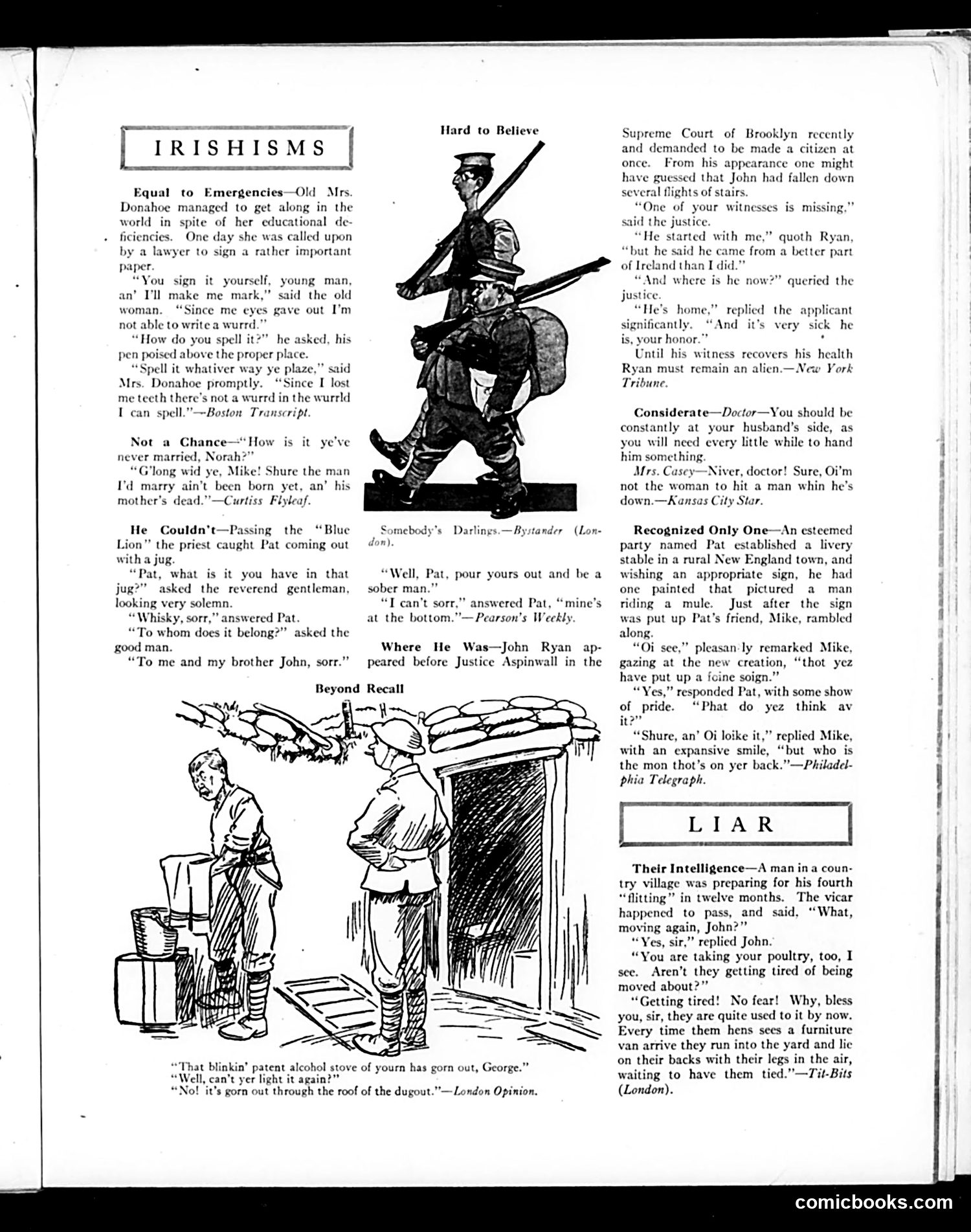
This page from Judge magazine presents **anti-Irish stereotypes** through humor—a common feature of late 19th/early 20th-century American satire. The "IRISHISMS" section collects jokes mocking Irish immigrants' supposed ignorance and malapropisms. The cartoons and anecdotes depict Irish characters (identifiable by names like Donahoe, Pat, Ryan, Mike) as uneducated, prone to drink, and dim-witted. Examples include: an illiterate woman who can't spell anything, a man claiming his liquor is "at the bottom" of a jug, and an immigrant appearing in court covered in bruises. **The satire's point**: These pieces reinforce ethnic prejudices common in American society, presenting Irish people as comically inferior through exaggerated dialect and foolish behavior. A modern reader should understand this reflects **xenophobic attitudes** of the era—what was considered acceptable "humor" would now be recognized as dehumanizing mockery. The content reveals how mainstream publications normalized anti-immigrant sentiment through supposedly lighthearted ridicule.
📄 Transcribed text from this page (OCR, searchable)
Machine-transcribed from the original scan — historical spelling and the odd misread are preserved.
IRISHISMS Equal to Emergencies—Old Mrs. Donahoe managed to get along in the world in spite of her educational de- ficiencies. One day she was called upon by a lawyer to sign a rather important paper “You sign it yourself, young man, an’ I'll make me mark,” said the old woman. “Since me eyes gave out I’m not able to write a wurrd.”” “How do you spell it?” he asked, his pen poised above the proper place. “Spell it whativer way ye plaze,” said Mrs. Donahoe promptly. “Since I lost me tecth there's not a wurrd in the wurrld I can spell."—Boston Transcript. Not a Chance—“How is it ye've never married, Norah “G'long wid ye, Mike! Shure the man I'd marry ain’t been born yet, an’ his mother's dead.”"—Curtiss Flyleaf. He Couldn't—Passing the “Bluc Lion” the priest caught Pat coming out with a jug. “Pat, what is it you have in that jug?” asked the reverend gentleman, looking very solemn. “Whisky, sorr,” answered Pat. “To whom does it belong?” asked the good man. “To me and my brother John, sorr.” Hard to Believe Somebody's Darlings.—Bystander (Lon- “Well, Pat, pour yours out and be a sober man.” “T can’t sorr,”” answered Pat, “mine’s at the bottom.”’—Pearson’s Weekly. Where He Was—John Ryan ap- peared before Justice Aspinwall in the Beyond Recall “That blinkin’ patent alcohol stove of yourn has gorn out, George.” “Well, can’t yer light it again?” ‘o! it’s gorn out through the roof of the dugout.”—London Opinion. Supreme Court of Brooklyn recently and demanded to be made a citizen at once. From his appearance one might have guessed that John had fallen down several flights of stairs “One of your witnesses is missing.” said the justice “He started with me,” quoth Ryan, “but he said he came from a better part of Ireland than I did.”” “And where is he now?” queried the justice is, your honor.” Until his witness recovers his health Ryan must remain an alien.—New York Tribune. Considerate—Doctor—You should be constantly at your husband's side, as you will need every little while to hand him something. Mrs. Casey—Niver, doctor! Sure, Oi’'m not the woman to hit a man whin he's down.—Kansas City Star. Recognized Only One—An esteemed party named Pat established a livery stable in a rural New England town, and wishing an appropriate sign, he had one painted that pictured a man riding a mule. Just after the sign was put up Pat’s friend, Mike, rambled along. “Qi see,” pleasan:ly remarked Mike, gazing at the new creation, “thot yez have put up a foine soign.” “Yes,” responded Pat, with some show “Phat do yez think av “Shure, an’ Oi loike it,” replied Mike, with an expansive smile, “but who is the mon thot’s on yer back.” —Philadel- phia Telegraph. [ctme] Their Intelligence—A man ina coun- try village was preparing for his fourth “flitting” in twelve months. The vicar happened to pass, and said, ‘What, moving again, John?” “Yes, sir,” replied John. “You are taking your poultry, too, I see. Aren’t they getting tired of being moved about?” “Getting tired! No fear! Why, bless you, sir, they are quite used to it by now. Every time them hens sees a furniture van arrive they run into the yard and lic on their backs with their legs in the air, waiting to have them tied.” —Tit-Bits (London). + ee Re pcm: con ma comicbooks.com