
Judge, 1918-07-06 · page 23 of 36
Judge — July 6, 1918 — page 23: what you’re looking at
What you’re looking at
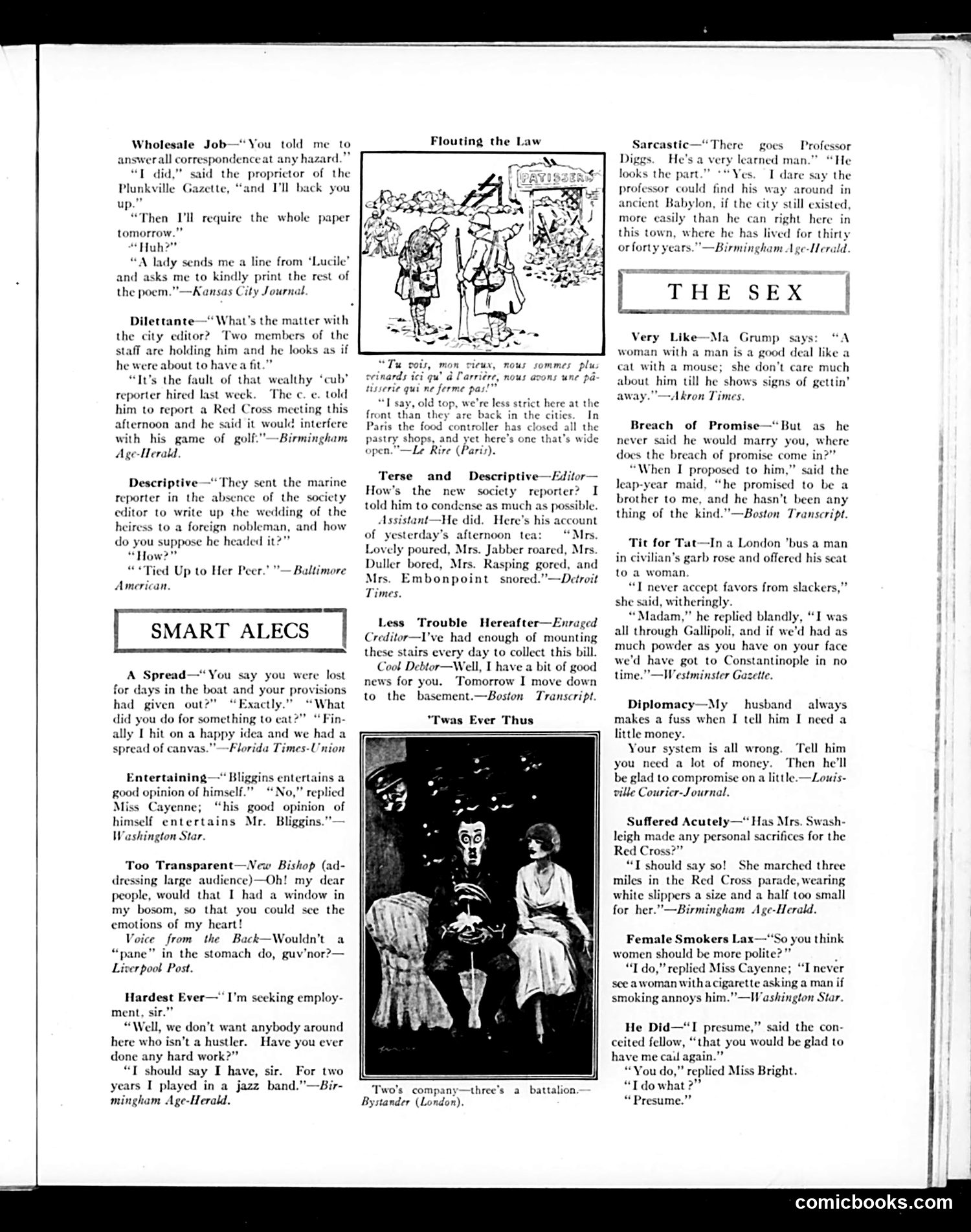
This single-panel cartoon depicts two World War I soldiers at the front discussing the relative strictness of law enforcement. One soldier marvels that the pastry shop remains open despite food rationing, contrasting this with Paris, where a "food controller" has shut down all bakeries. The satire targets the contradiction between wartime regulations imposed on civilians back home versus the looser enforcement at the front lines. The cartoon's caption—sourced from *Le Rire*, a French publication—suggests ironic amusement at this inconsistency. The "pastry shop" becomes emblematic of how authority breaks down in war zones, or how soldiers enjoy freedoms civilians are denied. The joke reflects European wartime frustrations (ca. 1914-1918) with food shortages and rationing policies perceived as unevenly applied.
📄 Transcribed text from this page (OCR, searchable)
Machine-transcribed from the original scan — historical spelling and the odd misread are preserved.
Wholesale Job—You told me to answerall correspondence at any hazard.” “T did,” said the proprietor of the Plunkville Gazette, “and I'll back you up.” “Then I'll require the whole paper tomorrow.” “Huh?” A lady sends me a line from ‘Lucile’ and asks me to kindly print the rest of the poem.” —Kansas City Journ “What's the matter with the city editor? Two members of the staff are holding him and he looks as if he were about to have a fit.” “It’s the fault of that wealthy ‘cub’ reporter hired last we The c. . told him to report a Red Cross meeting this afternoon and he said it would interfere with his game of golf.""—Birmingham Age-Herald. Dilettante Descriptive They sent the marine reporter in the absence of the society editor to write up the wedding of the heiress to a foreign nobleman, and how do you suppose he headed it?” “How?” “*Tied Up to Her Peer.’ ” American, Baltimore SMART ALECS | A Spread—“You say you were lost for days in the boat and your provisions had given out?” “Exactly.” “What did you do for something to eat?” “ Fin- ally I hit on a happy idea and we had a Florida Times-Union spread of canvas.” Entertaining—“Bliggins entertains a good opinion of himself.” 0,” replied Miss Cayenne; “his good opinion of himself entertains Mr. Bliggins.”— Washington Star. Too Transparent—New Bishop (ad- dressing large audience)—Oh! my dear people, would that I had a window in my bosom, so that you could sce the emotions of my heart! Voice from the Back—Wouldn't a “pane” in the stomach do, guv’nor?— Liver pool Post. Hardest Ever—"' I’m seeking employ- ment, sir.”” “Well, we don’t want anybody around here who isn’t a hustler. Have you ever done any hard work?” “T should say I have, sir. For two years I played in a jazz band.”—Bir- mingham Age-Herald. Flouting the Law “Tu vois, mon viewx, nows sommes plu ards ici qu’ d Carriére, nous avons une pa tisserie qui ne ferme pas! “I say, old top, we're less strict here at the front than they are back in the cities. In Paris food controller has closed all the pastry shops, and yet here’s one that’s wide open." —Le Rire (Par: Terse and Descriptive—Editor— How’s the new society reporter? I told him to condense as much as possible. Assistant—He did. Here's his account of yesterday’s afternoon t “Mrs. Lovely poured, Mrs. Jabber roared, Mrs. Duller bored, Mrs. Rasping gored, and Mrs. Embonpoint snored.”—Detroit Times. Less Trouble Hereafter—Enraged Creditor—l've had enough of mounting these stairs every day to collect this bill. Cook Debtor—Well, I have a bit of good news for you. Tomorrow I move down to the basement.—Boston Transcript. ‘Twas Ever Thus Two's company—three’s. a_ battalion. Bystander (London). Sarcastic—" There goes Professor Diggs. He's a very learned man.” “He looks the part.” °“ Yes. I dare say the professor could find his way around in ancient Babylon, if the city still existed, more casily than he can right here in this town, where he has lived for thirty or forty years.” —Birmingham Age-Herald. r THE SEX | Very Like—Ma Grump says: “A woman with a man is a good deal like a cat with a mouse; she don't care much about him till he shows signs of gettin’ away.” —Akron Times. Breach of Promise—‘But as he never said he would marry you, where does the breach of promise come in?” i “When I proposed to him,” said the leap-year maid, “he promised to be a ; brother to me, and he hasn't been any thing of the kind.”"—Boston Transcript. | Tit for Tat—In a London ‘bus a man in civilian’s garb rose and offered his seat to woman. I never accept favors from slackers,” she said, witheringly. : “Madam,” he replied blandly, “I was j all through Gallipoli, and if we'd had as much powder as you have on your face we'd have got to Constantinople in no time.” —Westminster Gazette. Diplomacy—My husband always makes a fuss when I tell him I need a little money. t Your system is all wrong. Tell him | you need a lot of money. Then he'll be glad to compromise on a little —Louis- ville Courier-Journal. Suffered Acutely—“H. leigh made any personal sacrifices for the | Red Cross: “T should say so! She marched three miles in the Red Cross parade, wearing white slippers a size and a half too small for her.”—Birmingham Age-Herald. Female Smokers Lax—“‘So you think women should be more polite?” ; “I do,” replied Miss Cayenne; “I never see a woman witha cigarette asking a man if smoking annoys him.” —Washington Star. He Did—“I presume,” said the con- ceited fellow, “that you would be glad to have me cal again.” “You do,” replied Miss Bright. “Tdowhat ?” “ Presume.” comicbooks.com