
A complete issue · 36 pages · 1918
Judge — June 8, 1918
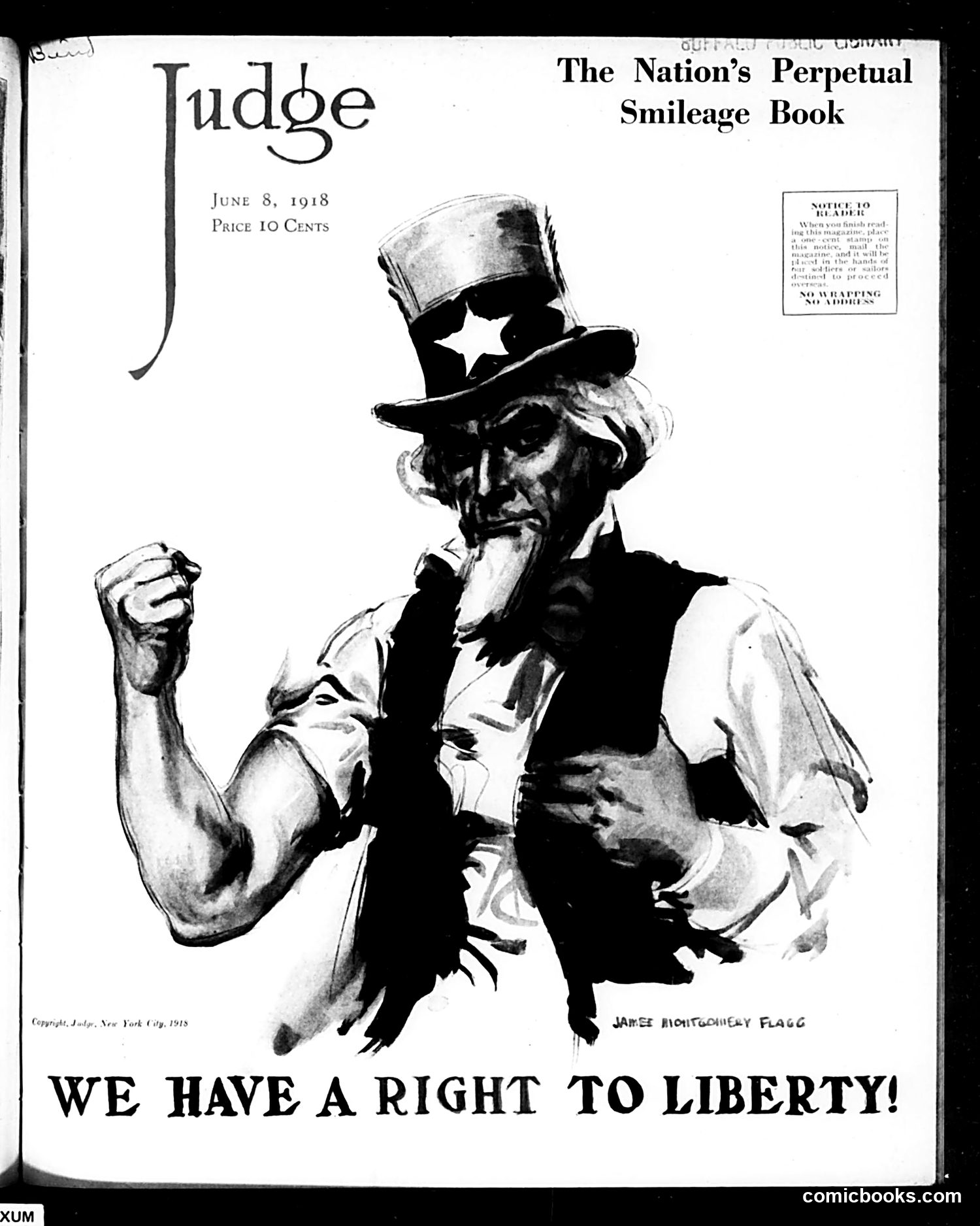
This is the cover of *Judge* magazine from June 8, 1918, during World War I. The illustration by James Montgomery Flagg depicts Uncle Sam—identifiable by his star-spangled top hat and goatee—in a forceful pose with clenched fist, declaring "WE HAVE A RIGHT TO LIBERTY!" The message is a patriotic call to arms, likely supporting American military involvement in WWI (the U.S. entered in 1917). The phrase "right to liberty" frames the war effort as a defense of American freedom against perceived threats. Flagg's dynamic, aggressive rendering emphasizes national resolve and determination. This exemplifies how American satirical and mainstream publications used their platforms for pro-war propaganda during the conflict.
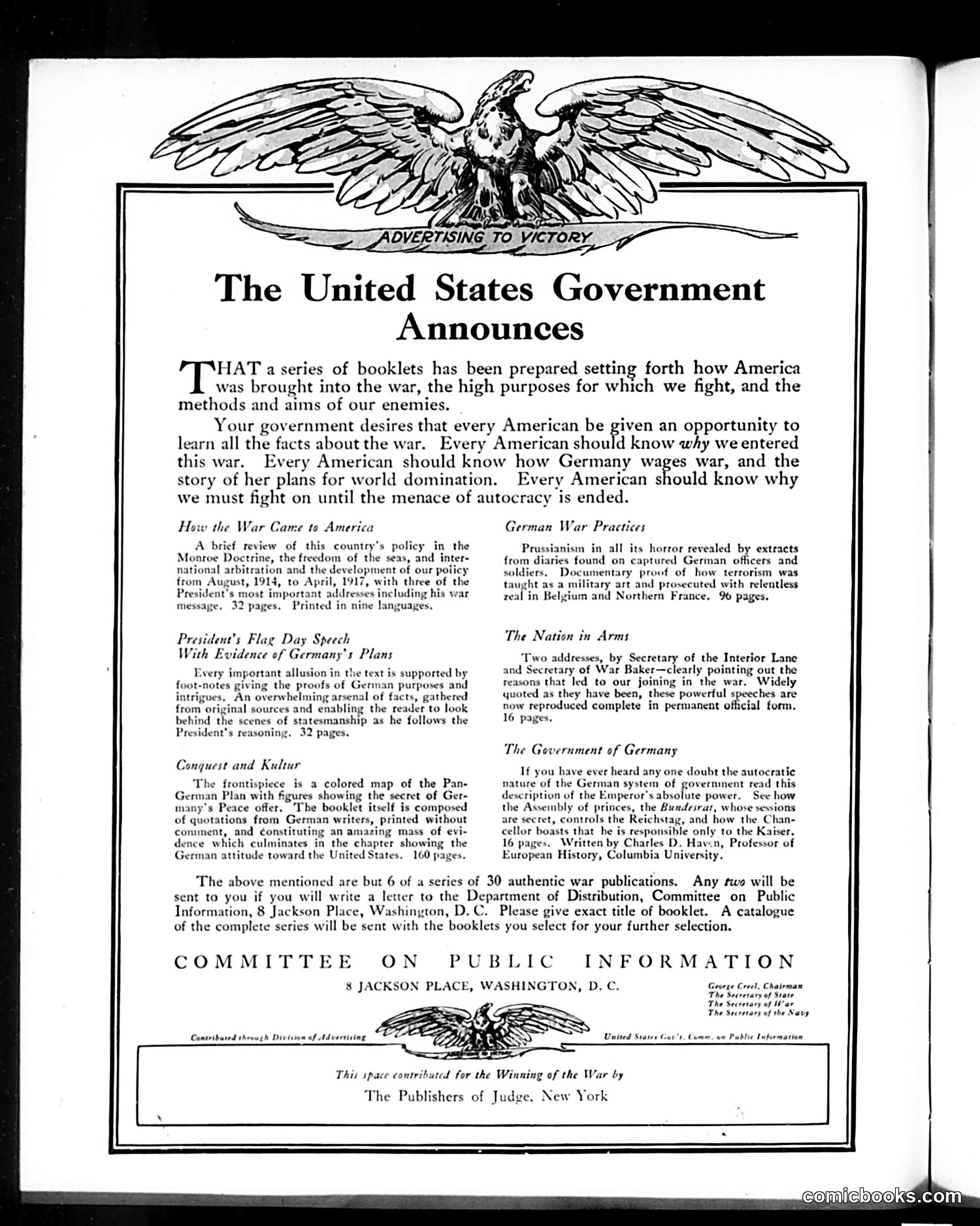
This page is **not a satirical cartoon** but rather **government propaganda**. It's an announcement from the Committee on Public Information (the U.S. government's WWI propaganda agency) promoting a series of 30 official war booklets explaining America's entry into World War I and German war aims. The content lists six booklets covering topics like how America entered the war, the President's speeches, German military practices, and the German government system. The messaging emphasizes educating Americans about why fighting Germany was necessary and exposing German authoritarianism. The eagle emblem and formal layout present this as official state communication. This represents the government's coordinated effort to build public support for the war effort through mass-distributed educational materials.
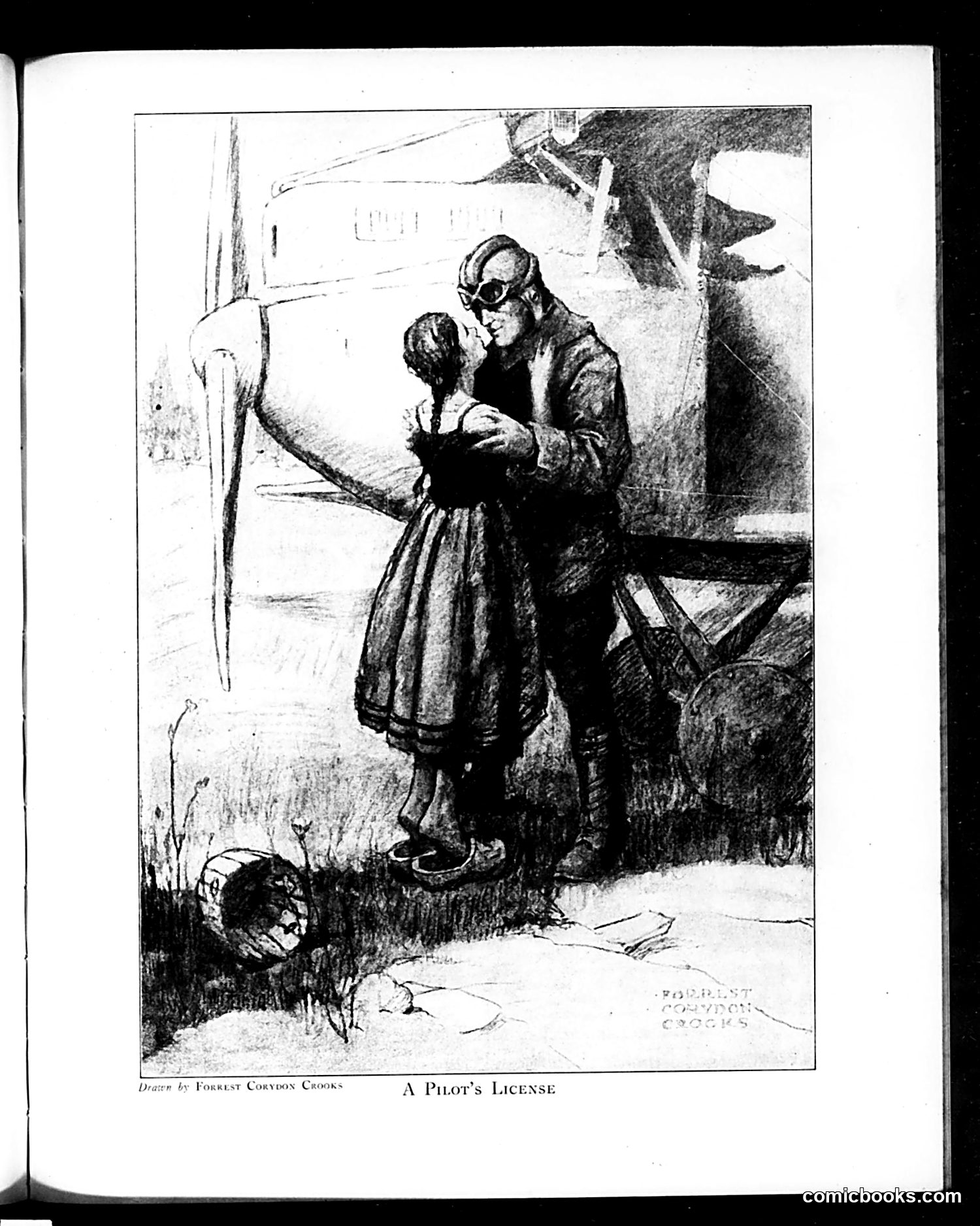
This cartoon by Forrest Corydon Crooks depicts a pilot showing his license to a woman near an aircraft. The satire likely references early aviation's rapid expansion and the novelty of pilot licensing requirements in the early 20th century. The joke appears to be about romantic or social implications: a pilot displays his credentials as if it were an impressive qualification for courting or impressing a woman—treating his professional license as a social asset. The woman's apparent interest in the airplane (or the pilot) suggests aviation's glamorous appeal during this era. The humor relies on the juxtaposition of technical certification with romantic aspiration, mocking either pretentious pilots or women's supposed fascination with them.
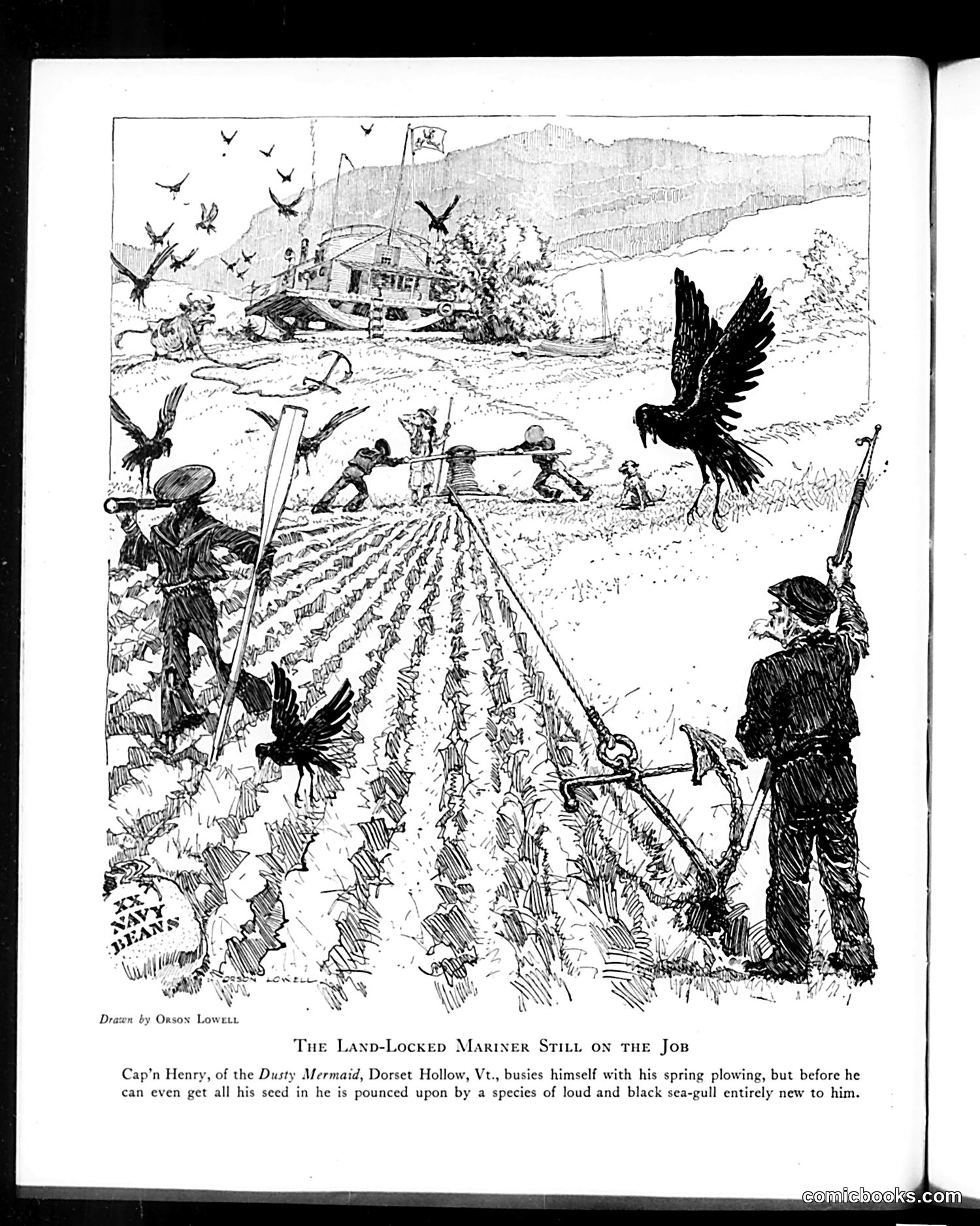
This illustration by Orson Lowell depicts Cap'n Henry of the *Dusty Mermaid* in Dorset Hollow, Vermont, attempting spring plowing. The satire concerns a sea captain who has relocated inland—a "land-locked mariner"—and is struggling to adapt to agricultural work. The joke centers on his inexperience: before he can finish planting seeds, aggressive sea-gulls attack him—birds entirely unfamiliar to inland Vermont. The cartoon mocks his inability to escape maritime troubles despite abandoning the sea, suggesting he's incompatible with landlocked life. The swarms of black sea-birds represent his past catching up with him, making farming as chaotic as seafaring.
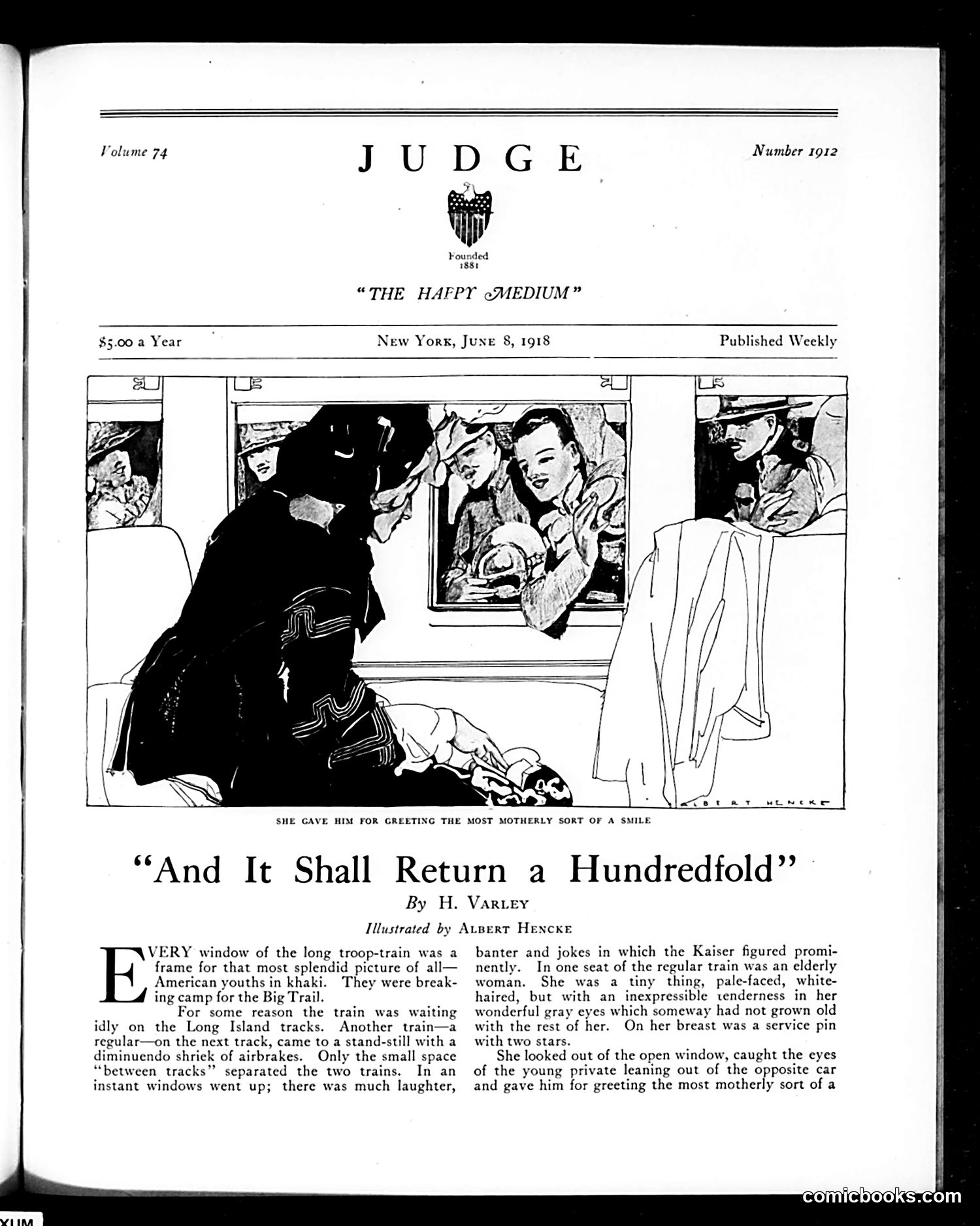
This page from *Judge* (June 8, 1918) features an illustrated story titled "And It Shall Return a Hundredfold" by H. Varley, illustrated by Albert Hencke. The cartoon depicts a wartime encounter on a troop train during World War I. An elderly woman appears to give a young American soldier a motherly smile through a train window. The text indicates this is a sentimental scene about soldiers heading to battle. The story's title suggests a moral theme about kindness returning to the giver. Published near the war's end, this reflects the American public's emotional investment in their soldiers and the sentimentality surrounding WWI service. The illustration emphasizes human connection during wartime rather than explicit satire or political criticism.
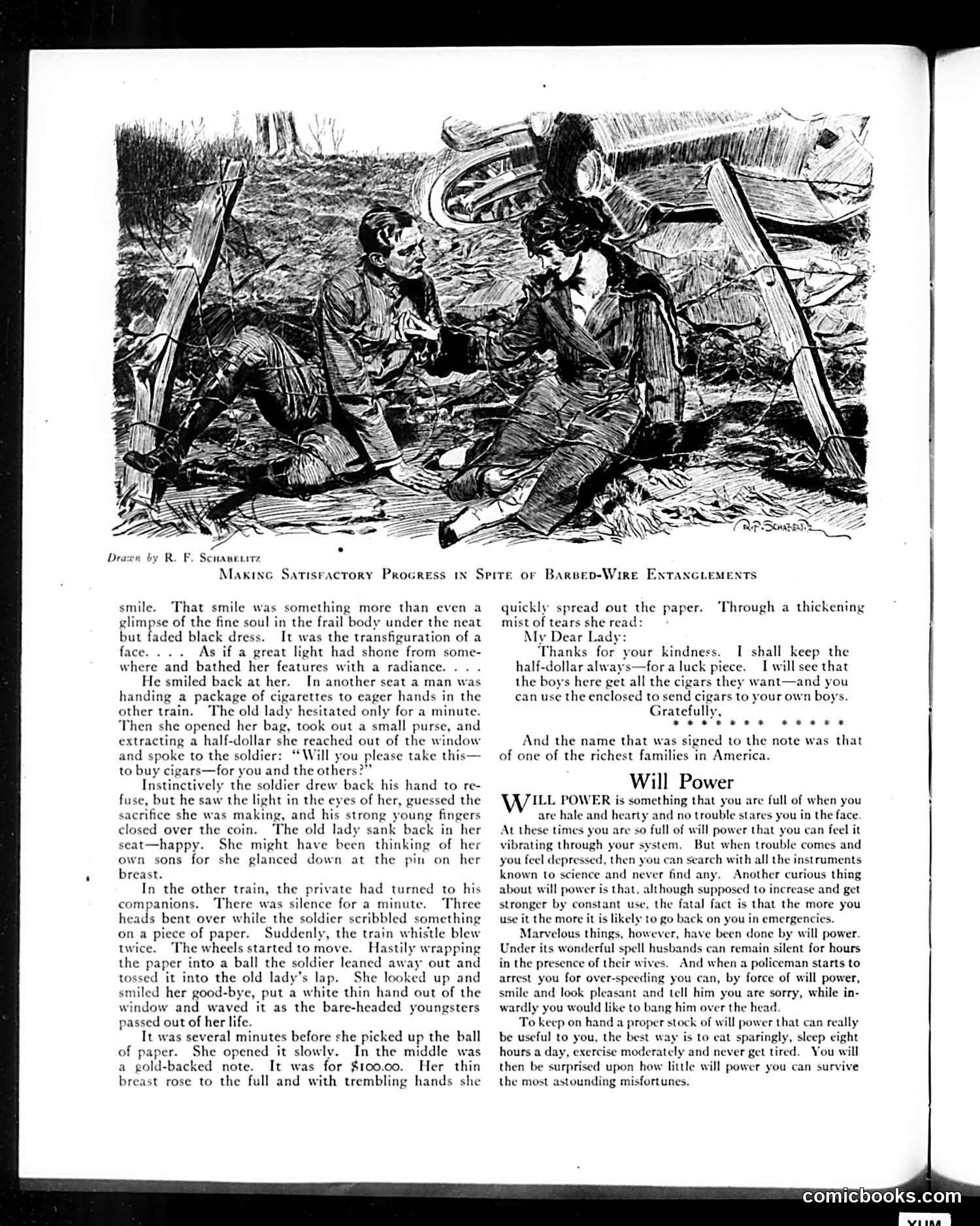
The illustration depicts soldiers on a train, with one elderly woman giving a half-dollar to a young soldier. The accompanying narrative describes her sending money and cigars to soldiers, signed by "one of the richest families in America." This appears to be sentimental wartime content rather than political satire. The piece celebrates wealthy Americans' charitable donations to troops, presenting it as noble patriotic duty. The contrasting section "Will Power" that follows is unrelated—it's a morality essay about self-discipline. The cartoon's point seems straightforward: to honor civilian support for soldiers and encourage similar generosity. There's no obvious satirical critique here; instead, it promotes the idea that the wealthy should contribute to military welfare. The tone is earnest rather than mocking.
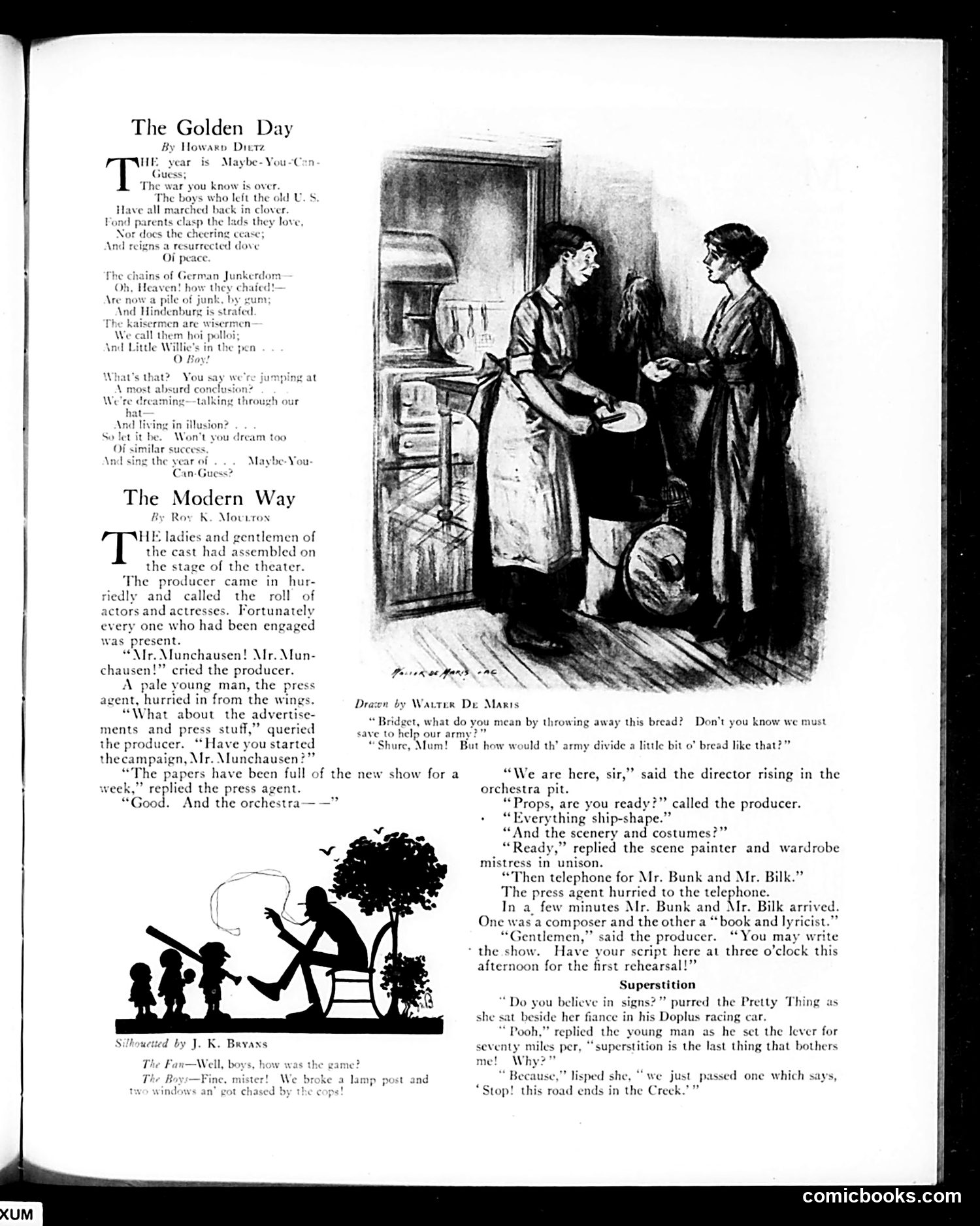
**"The Golden Day"** by Howard Dietz is a post-WWI poem imagining a peaceful future ("Maybe-You-Can-Guess") where American soldiers have returned home victorious and war has ceased. It's optimistic wartime propaganda, encouraging readers to dream of peaceful prosperity after the conflict. **"The Modern Way"** satirizes theatrical production. A producer assembles a cast and hires composers/lyricist "Mr. Bunk and Mr. Bilk" to write an entire show by 3 p.m.—mocking the rushed, commercialized nature of modern theater where shows are churned out quickly for profit rather than artistic merit. The names suggest "bunk" (nonsense) and "bilk" (swindle). **"Superstition"** jokes about a reckless young couple in a racing car. The woman warns about superstitions while her boyfriend dismissively speeds ahead, ignoring a road sign warning "this road ends in the Creek"—dark humor about overconfidence meeting consequences. All three pieces reflect post-WWI American attitudes: optimism about peace, cynicism about commercial entertainment, and satirical commentary on modern behavior.
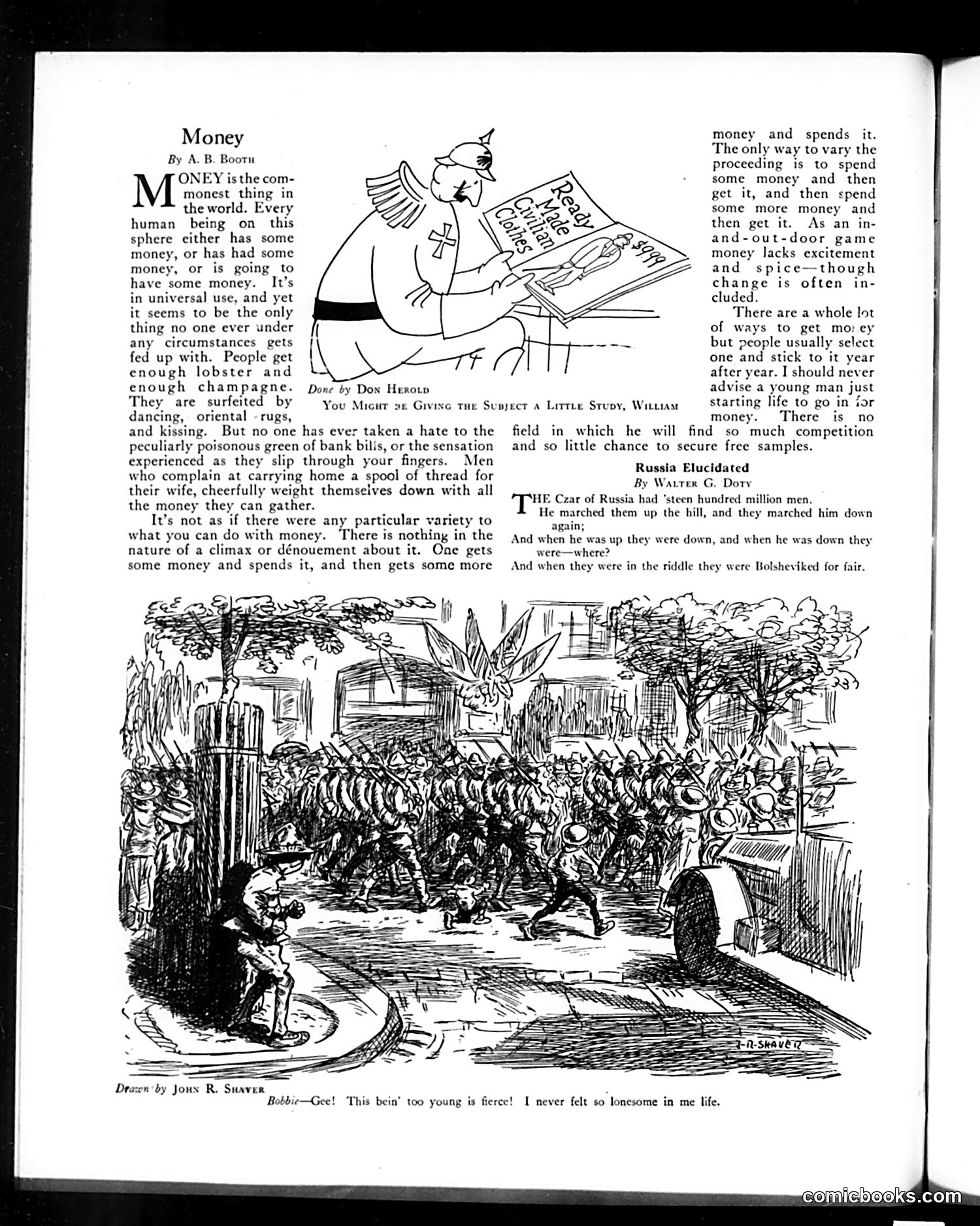
**"Money" Essay (A.B. Booth):** A humorous essay satirizing humanity's peculiar obsession with money—the only commodity people never tire of, despite its monotonous cycle of earning and spending. The accompanying illustration shows a German military figure (identifiable by spiked helmet) studying money, satirizing materialism and militarism. **"The Czar of Russia" Poem (Walter G. Doty):** A darkly comic reference to Russian political chaos, likely post-1917 Revolution. The nursery-rhyme structure mocks the Czar's inability to control his millions of troops, with "Bolsheviked" (the Bolsheviks' seizure of power) suggesting the regime's collapse. The final cartoon caption—a street urchin feeling lonely despite youth—appears unrelated to the Russia piece, merely filling space. **Overall context:** These pieces reflect American attitudes toward post-WWI upheaval and revolutionary instability abroad, combined with domestic satirical commentary on money and materialism.
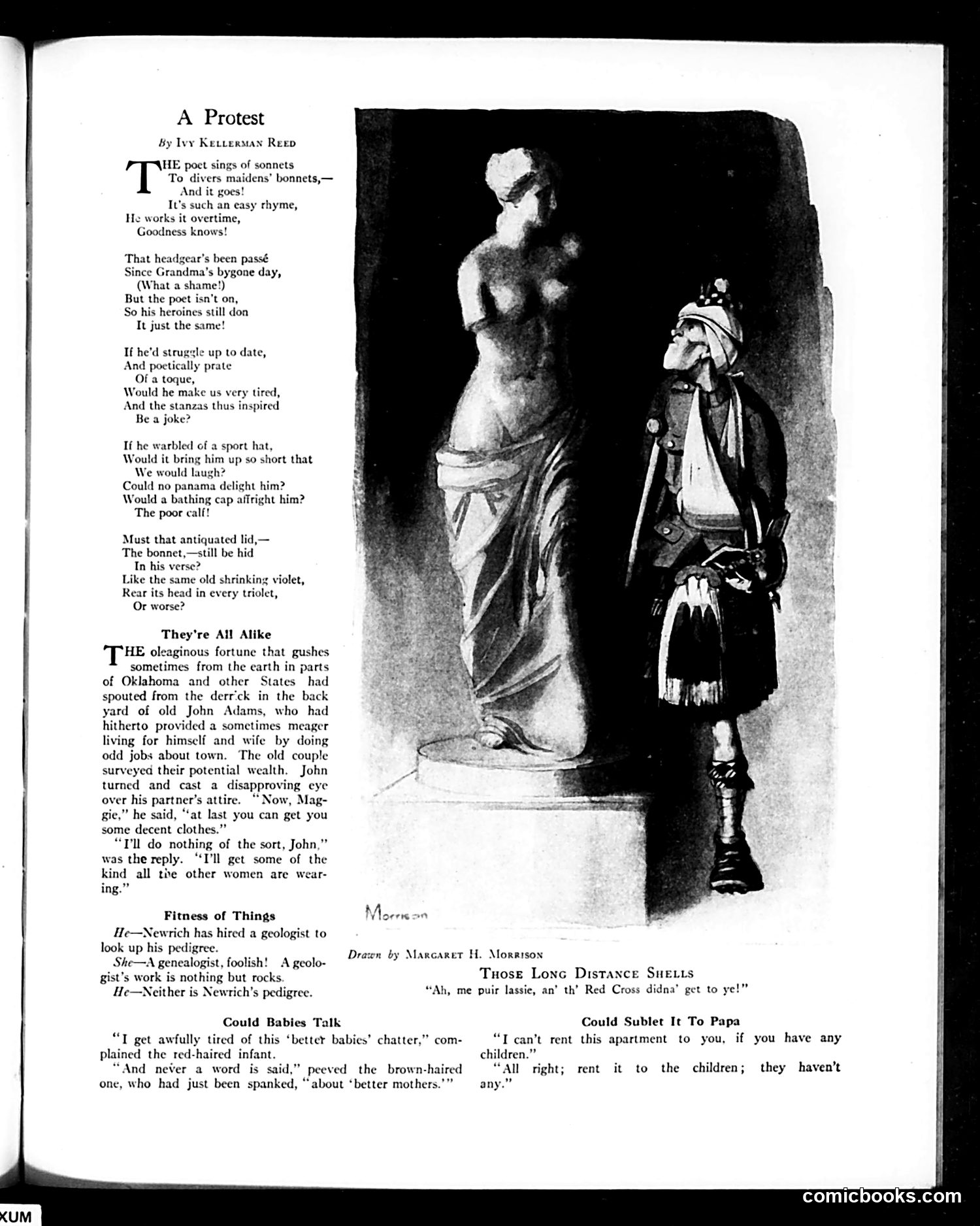
**"A Protest"** by Ivy Kellerman Reed mocks outdated Romantic poetry. The poem ridicules male poets who continuously write about women's bonnets—a fashion accessory "passé since Grandma's bygone day"—rather than updating their verse to contemporary subjects like sports hats or panama hats. The satire targets poets' lazy reliance on tired, conventional imagery and rhymes rather than engaging modern themes. **"They're All Alike"** satirizes nouveau-riche attitudes. When an oil strike makes John Adams suddenly wealthy, he urges his wife Maggie to buy fashionable clothes. She refuses, saying she'll wear what "all the other women are wearing"—suggesting that even newfound wealth doesn't change working-class conformity or taste. The joke is that social mobility doesn't guarantee social refinement. The accompanying illustration by Margaret H. Morrison (captioned "Those Long Distance Shells") appears unrelated, depicting a Scottish soldier and a classical statue, likely referencing WWI's distance from home.
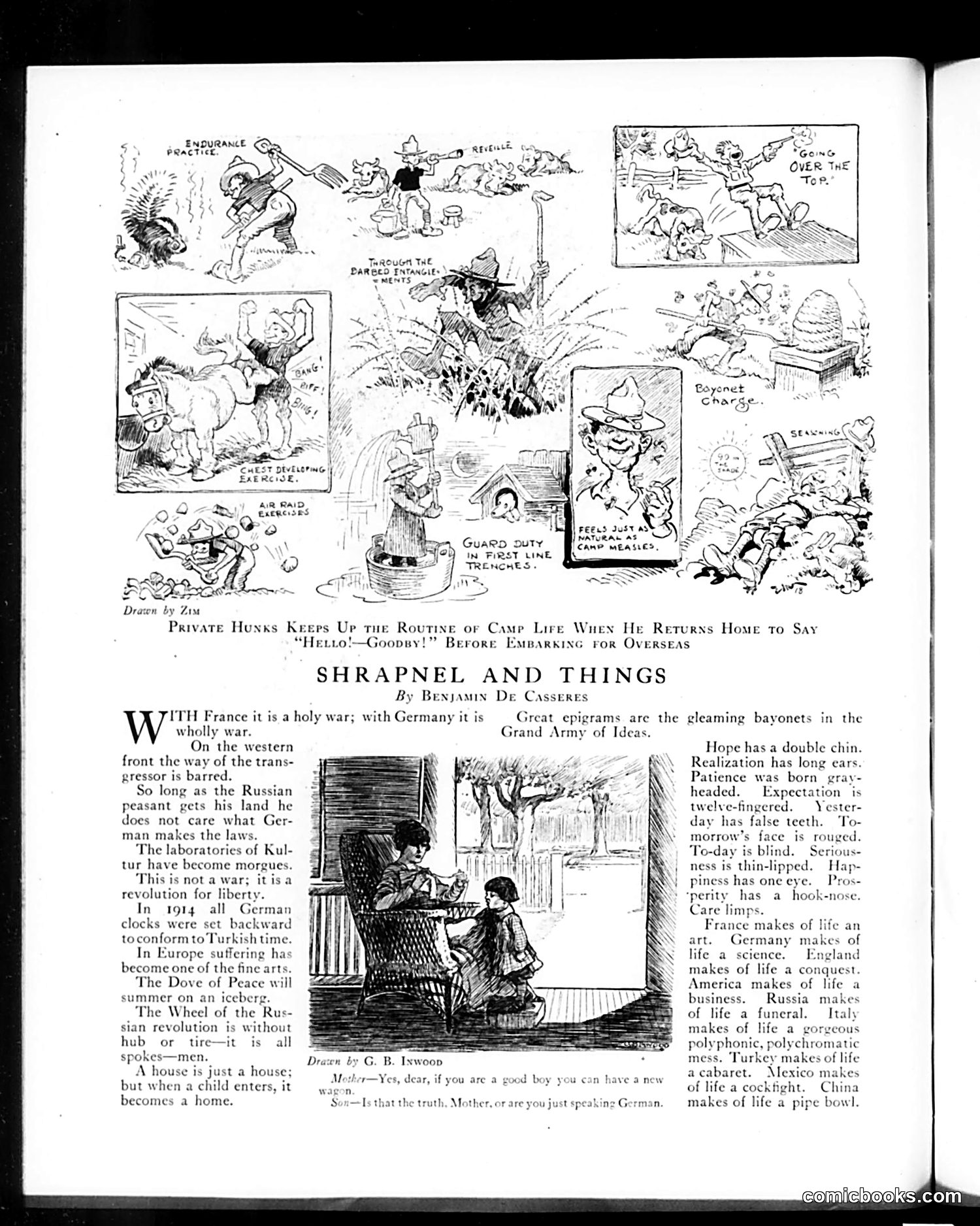
This Judge magazine page contains two distinct elements: **Top cartoon strip** (by "Zim"): Shows a soldier maintaining military routines—endurance drills, rifle practice, trench duty, air raid exercises, bayonet charges—before departing for overseas deployment in World War I. The humor lies in the contrast between the rigorous, repetitive nature of camp life and the soldier's casual "Hello! Goodbye!" upon returning home, suggesting the absurdity of intense preparation for departure. **"Shrapnel and Things" essay** (by Benjamin De Casseres): A satirical philosophical meditation on how different nations approach life during WWI. It characterizes France's war as "holy," Germany's as "wholly," then offers witty personifications (Hope has a double chin; Patience was born gray-headed) before concluding with national stereotypes about how each country conceptualizes life—France as art, Germany as science, America as business, Russia as funeral, etc. The satire critiques both the war's absurdity and national character stereotypes circulating at the time.
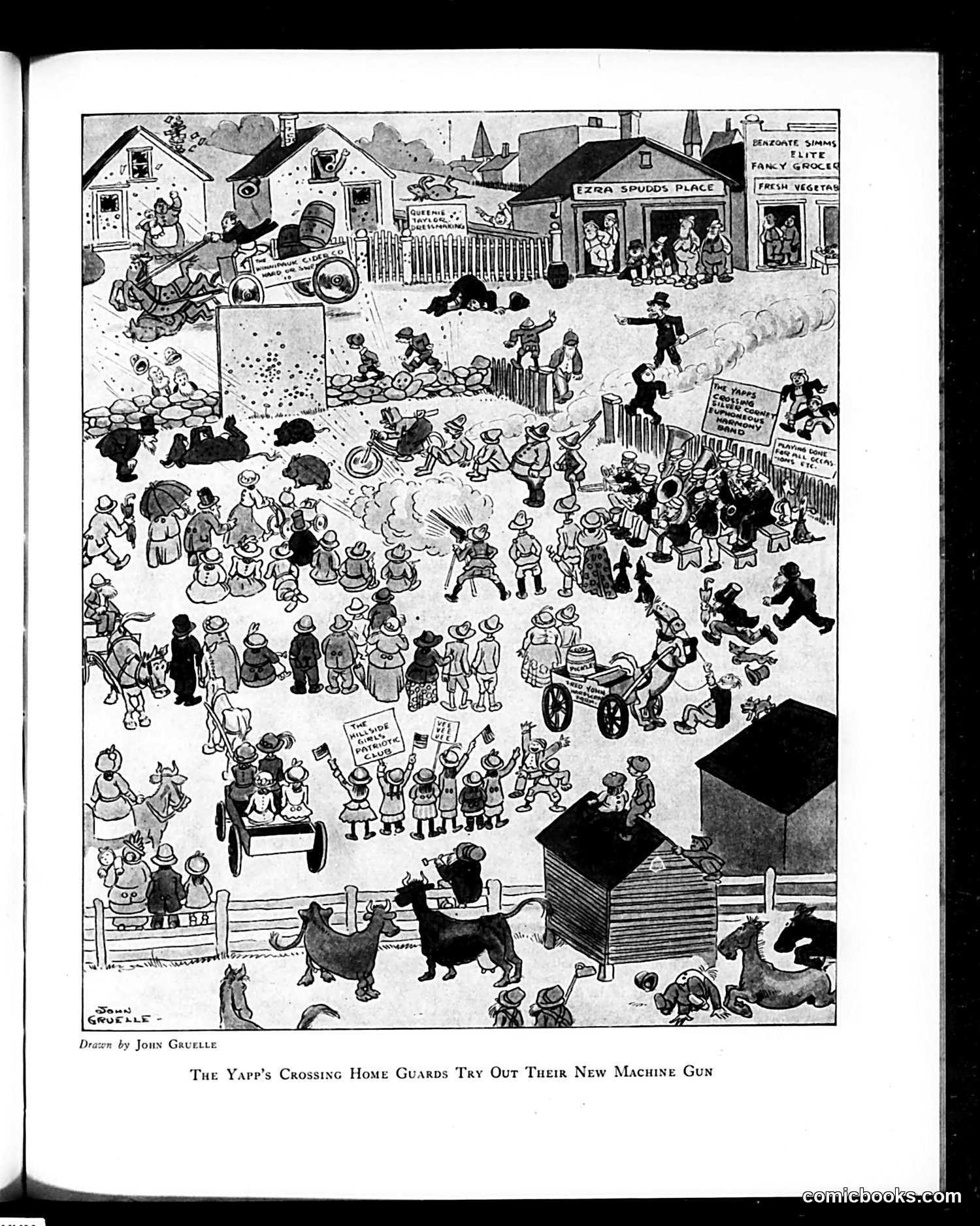
This John Gruelle cartoon depicts "The Yapp's Crossing Home Guards" testing a new machine gun in a crowded suburban neighborhood. The satire targets what appears to be an overzealous or incompetent local militia or home defense group operating a dangerous weapon in a populated civilian area—complete with children, families, animals, and shoppers nearby. The humor is dark: the Home Guards' reckless endangerment of ordinary citizens during peacetime (or home front activities) suggests either their incompetence or the absurdity of armed civilian groups operating without proper oversight. The dense crowd of innocent bystanders highlights the danger posed by untrained personnel handling military equipment in residential spaces. The cartoon likely critiques militia culture, weapons proliferation, or government military programs during this era.
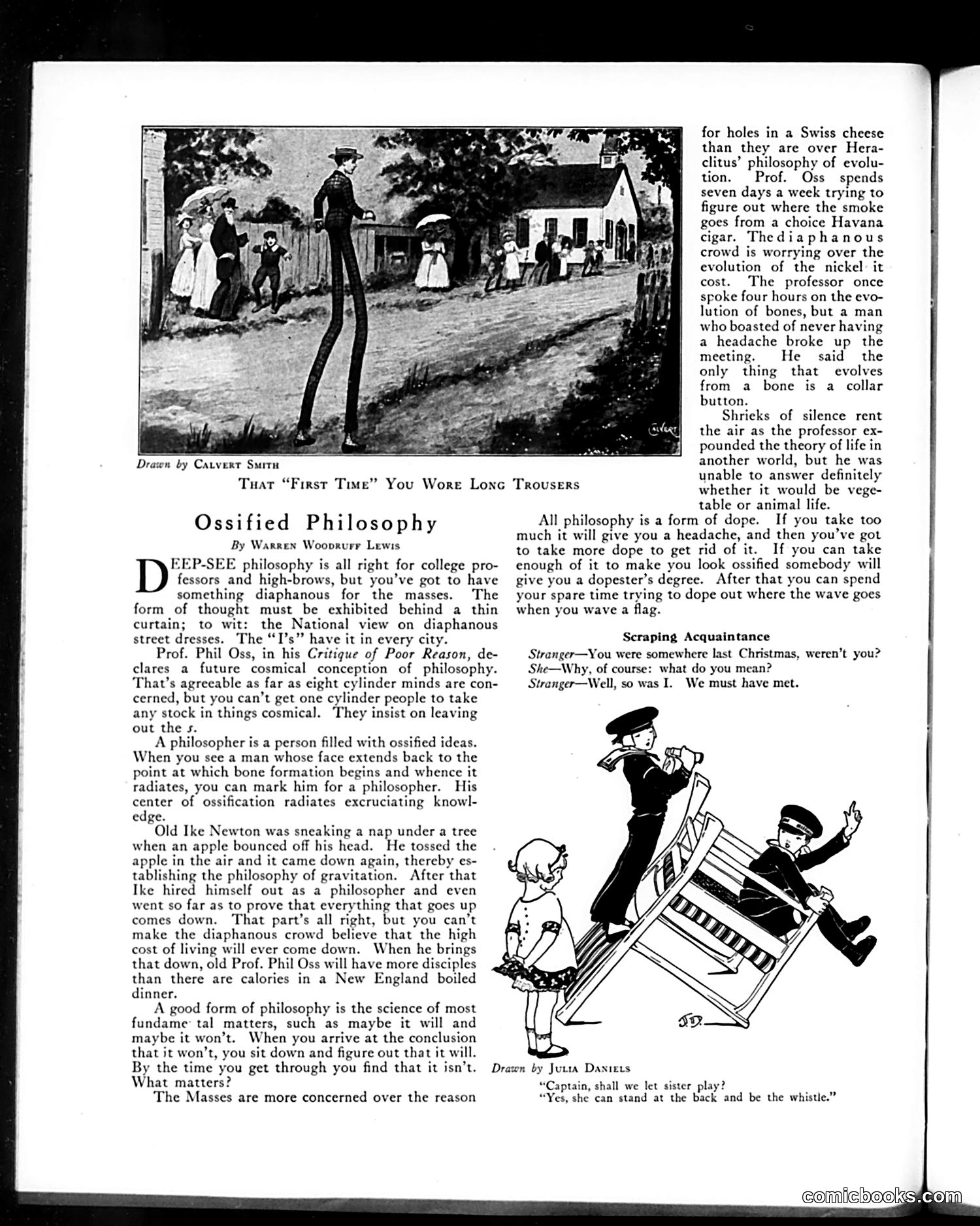
This Judge magazine page contains two distinct pieces of satire: **"Ossified Philosophy"** by Warren Woodruff Lewis mocks academic philosophy as irrelevant and overly abstract. The title "ossified" (hardened, rigid) suggests philosophers have fossilized minds. The piece ridicules Professor Phil Oss for pondering useless questions—like where cigar smoke goes or the evolution of collar buttons—while ordinary people care about practical concerns (the cost of living, rising prices). The Newton apple anecdote exemplifies how philosophers derive grand theories from trivial observations. The satire targets the disconnect between intellectual elites and common concerns during what appears to be a period of economic hardship. **"Scraping Acquaintance"** is a brief joke cartoon (drawn by Julia Daniels) where a stranger uses transparently false logic to claim familiarity with a woman—arguing that since both were somewhere last Christmas, they must have met. It's gentle humor about social pretense and awkward conversation starters. The page satirizes disconnected intellectualism and social awkwardness typical of 1910s-era Judge magazine humor.
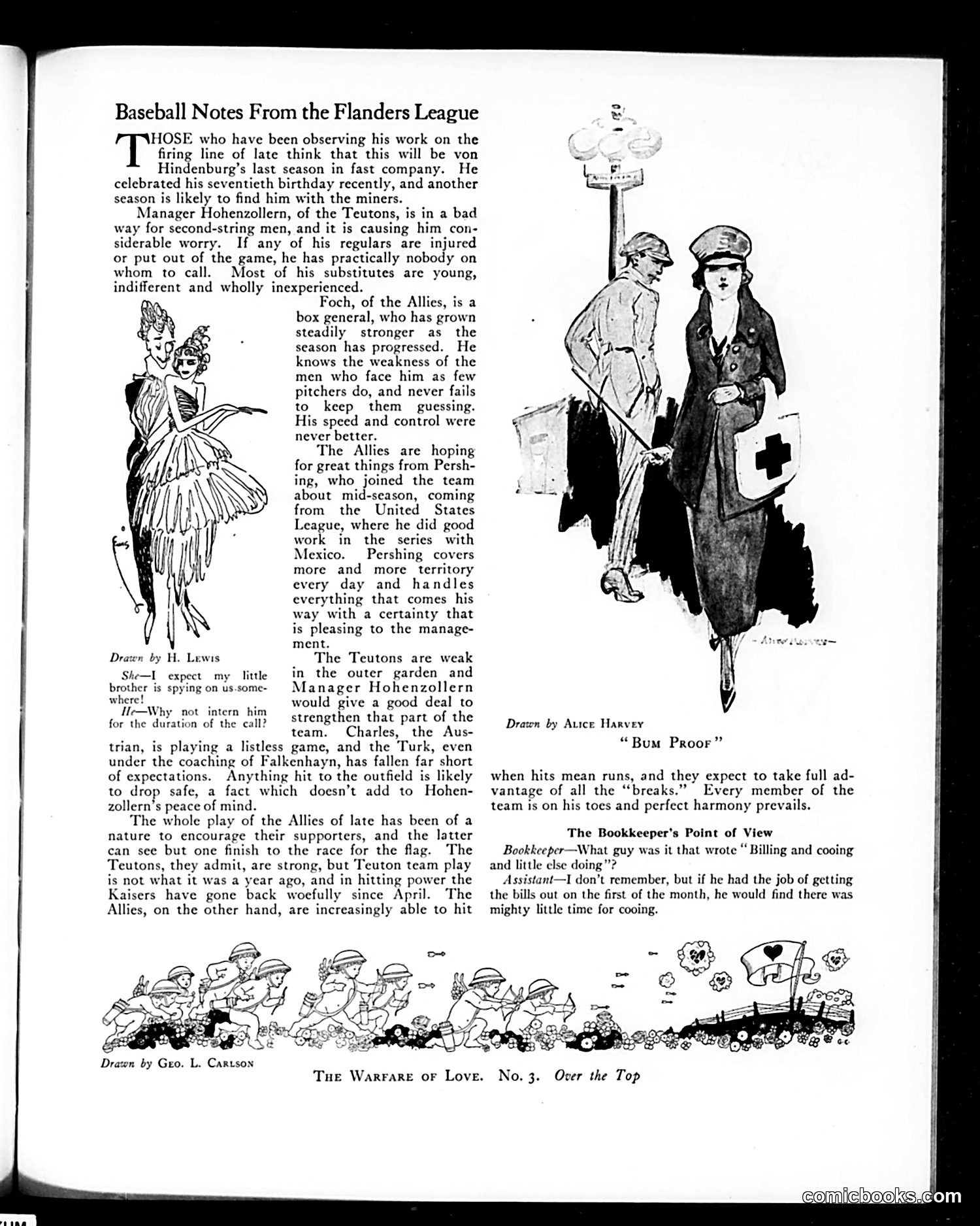
This 1918 *Judge* magazine page uses **baseball metaphors to satirize World War I**, mapping military leaders onto team players: **"Baseball Notes from the Flanders League"** casts the war as a championship game: - **Von Hindenburg** (German general) is aging and near retirement - **Kaiser Wilhelm II** ("Manager Hohenzollern") lacks adequate reserves; his teams (Austria, Turkey) are underperforming - **Ferdinand Foch** (French commander) is strategically superior, "knows weaknesses" - **John J. Pershing** (American general, recently joined the Allies mid-1918) is expanding territory and performing excellently The satire argues Germany is **losing the "game"**: weakened reserves, declining offensive power since April 1918, while Allied coordination and morale improve. The page's other cartoons ("Bum Proof," "Warfare of Love") appear unrelated domestic humor. This reflects genuine 1918 confidence that American entry had shifted the war decisively toward Allied victory—Germany would surrender that November.
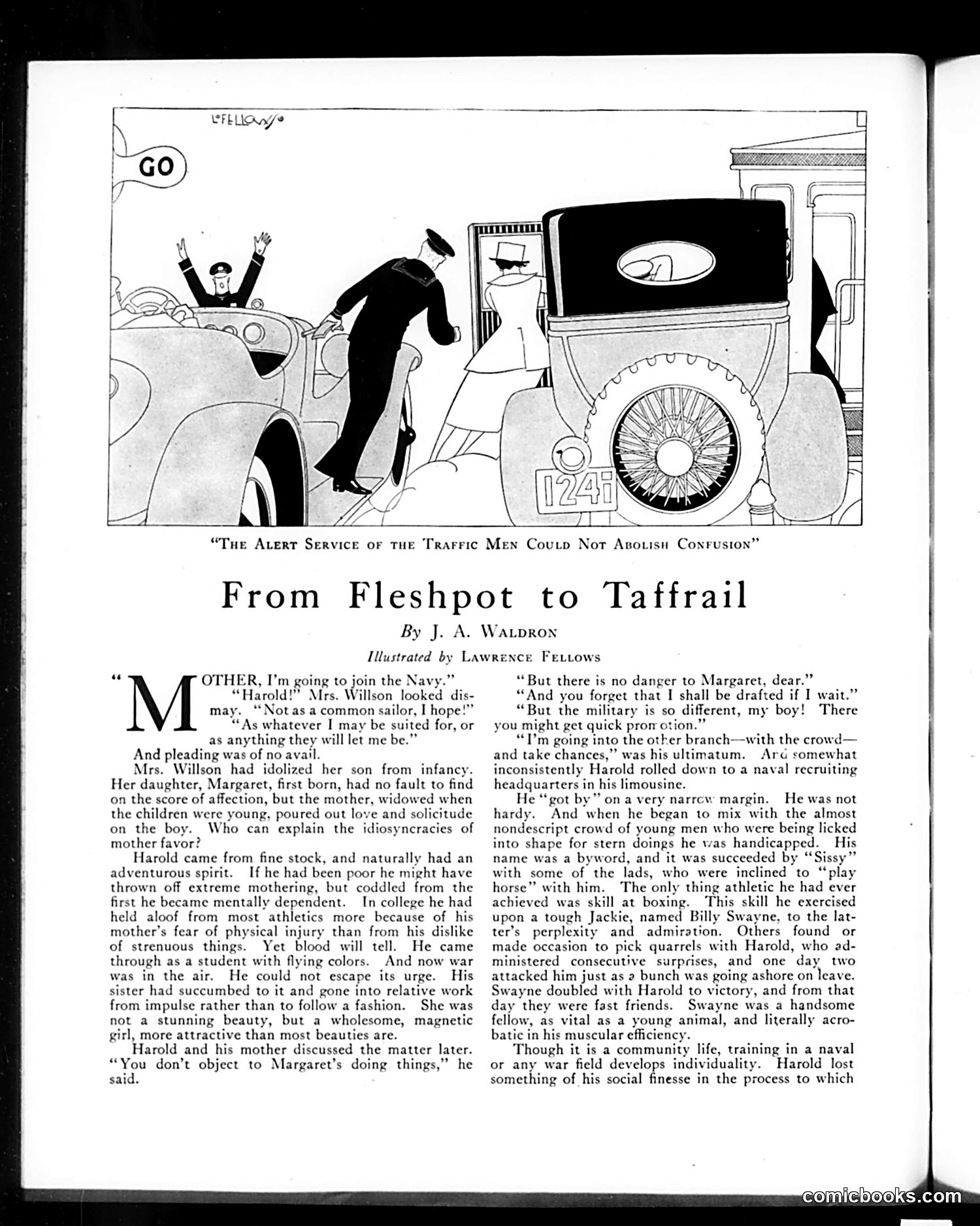
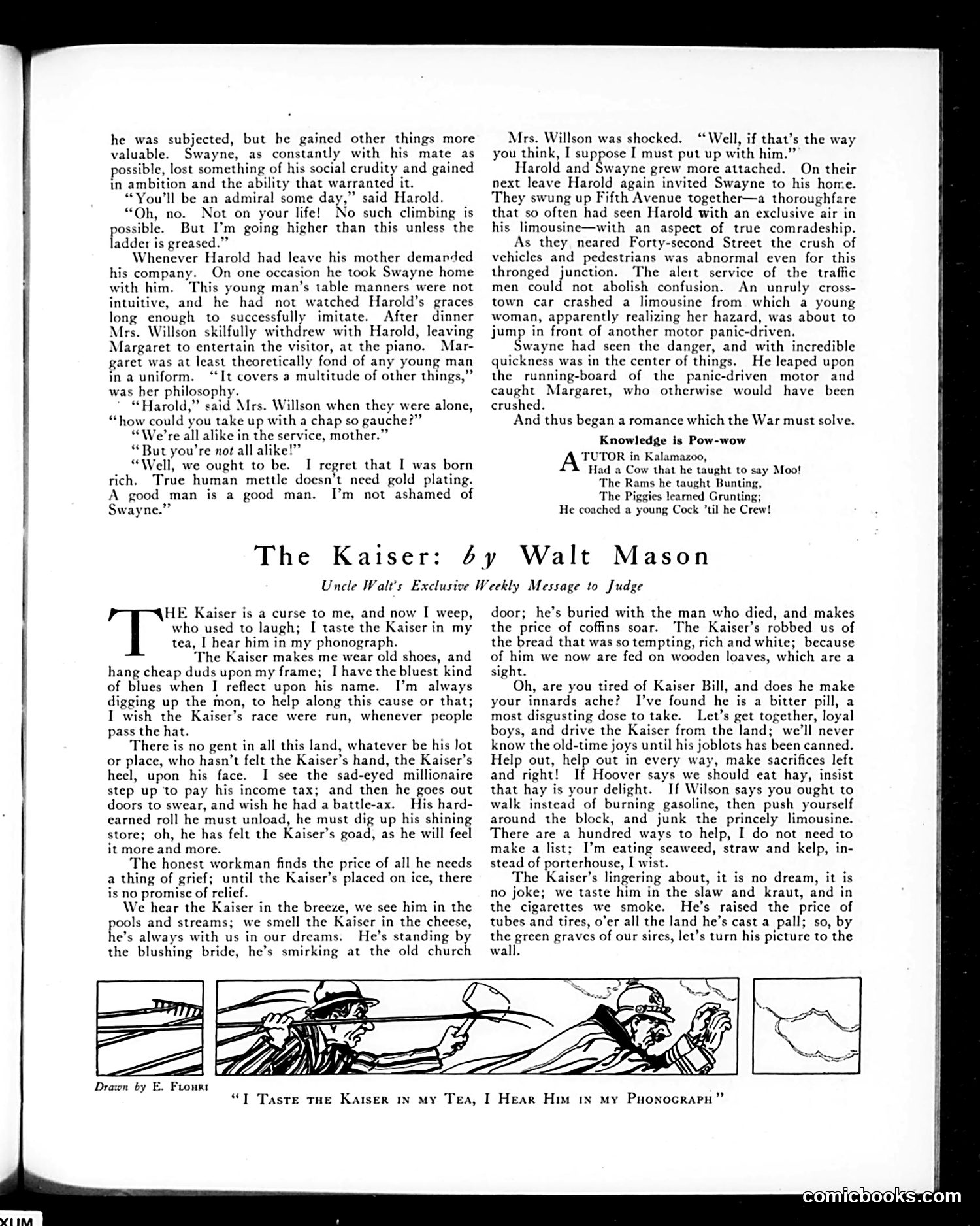
This page contains two distinct pieces of satirical content: **Upper section:** A serialized romantic fiction story about military officers, seemingly unrelated to the Kaiser content below. **Main feature:** Walt Mason's polemical verse attacking Kaiser Wilhelm II of Germany. Mason personifies the Kaiser as an omnipresent curse afflicting American life—making citizens wear shabby clothes, pay income taxes, and face constant economic hardship. The Kaiser "haunts" everyday experiences: tea, phonographs, breezes, cheese, and dreams. This is **wartime propaganda**, written when America was engaged against Germany in World War I. Mason's message conflates the Kaiser with wartime sacrifices and deprivation, blaming him personally for Americans' economic burdens and reduced living standards. The satire positions the Kaiser as an invasive, inescapable enemy—not just a foreign leader, but a malevolent force corrupting domestic peace. The crude caricature and angry tone reflect period attitudes toward Germany during the war.
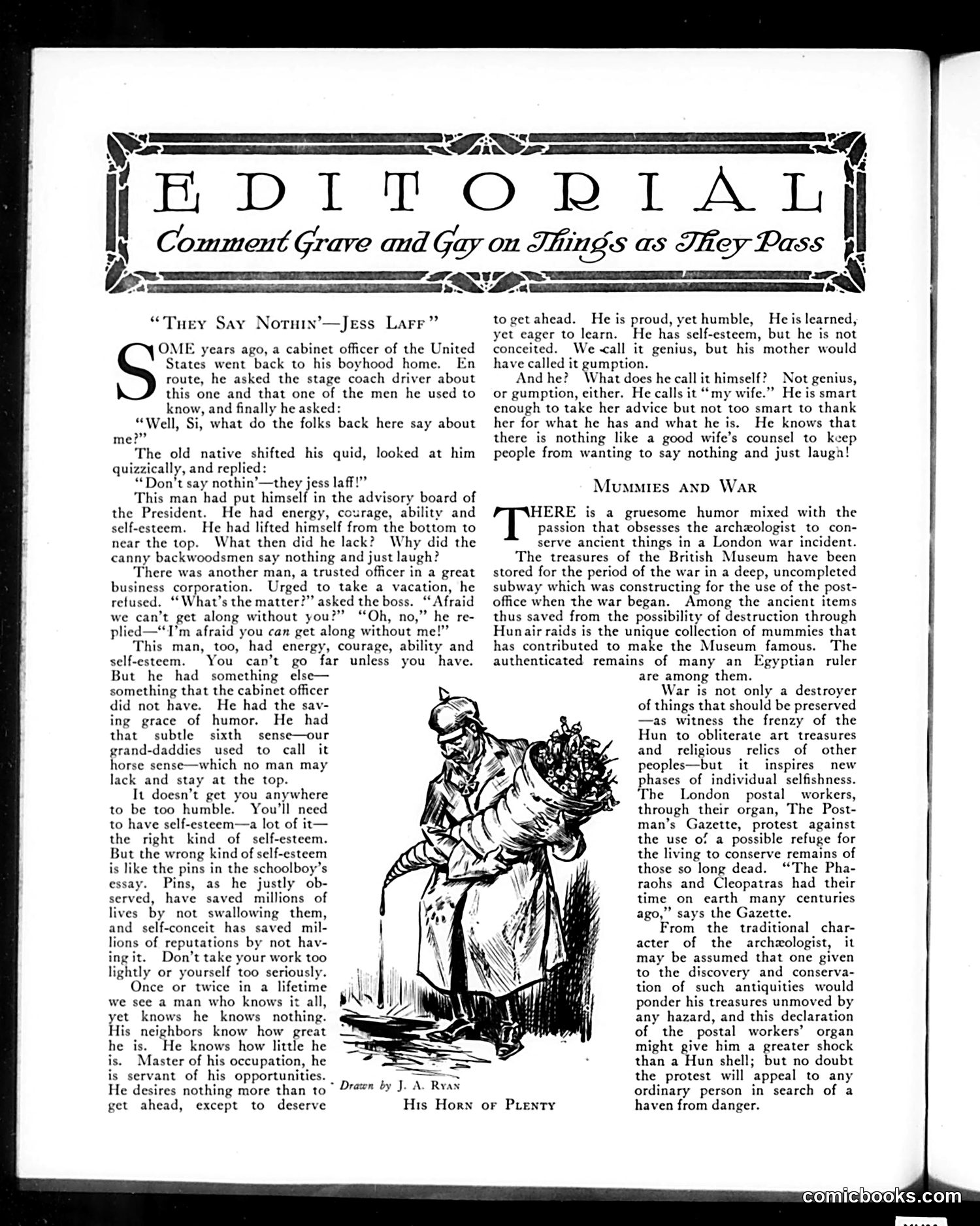
This page contains two separate satirical pieces: **"They Say Nothin'—Jess Laff"** (left column with illustration): A moral essay contrasting two successful men. One cabinet officer lacks humor and self-awareness, prompting backwoods people to laugh at him. A second, more successful businessman possesses "saving grace of humor"—that "horse sense" allowing him to recognize his own limitations. The satire targets excessive self-importance and lack of humility among ambitious men, suggesting that true success requires not just self-esteem, but humble self-awareness and the wisdom of listening to one's wife. **"Mummies and War"** (right column): Commentary on a real conflict during World War I. London postal workers protested using an underground subway (built for the post office) to store British Museum treasures, including Egyptian mummies. The satire criticizes workers' prioritizing comfort over cultural preservation during wartime, while also condemning German destruction of art. The piece suggests war reveals both noble preservation efforts and petty selfishness. Both pieces use humor to critique human vanity and priorities.
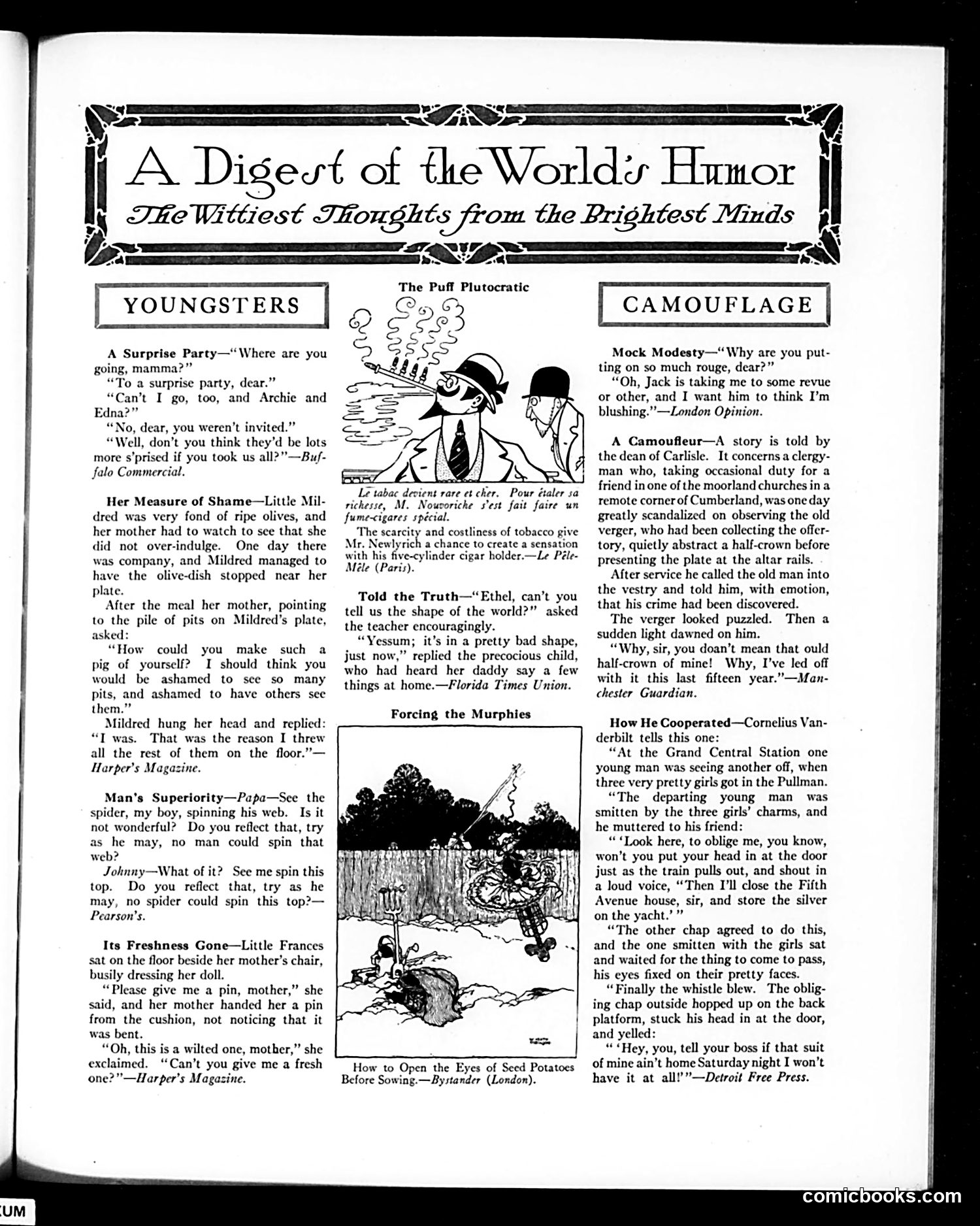
This page from Judge presents a collection of humorous anecdotes and one cartoon, organized into sections for different audiences. **"Youngsters" section:** Brief jokes about children's logic—a girl wanting uninvited guests to increase the "surprise," a child ashamed of olive pits, and a girl calling a bent pin "wilted." **"The Puff Plutocratic" cartoon:** Satirizes nouveau riche ostentation. A newly wealthy man ("M. Newlyrich") displays an absurdly elaborate five-cylinder cigar holder, mocking how the newly rich flaunt luxury goods to demonstrate wealth during tobacco scarcity. **"Camouflage" section:** Includes jokes about deception and revelation—a woman using rouge to appear modest, a clergyman discovering his verger's petty theft (which turns out to be longstanding), and Cornelius Vanderbilt's anecdote about a young man impressing girls by appearing wealthy (pretending to own Fifth Avenue property). The page reflects early-20th-century social anxieties: class mobility, conspicuous consumption by the newly rich, and the gap between appearances and reality.
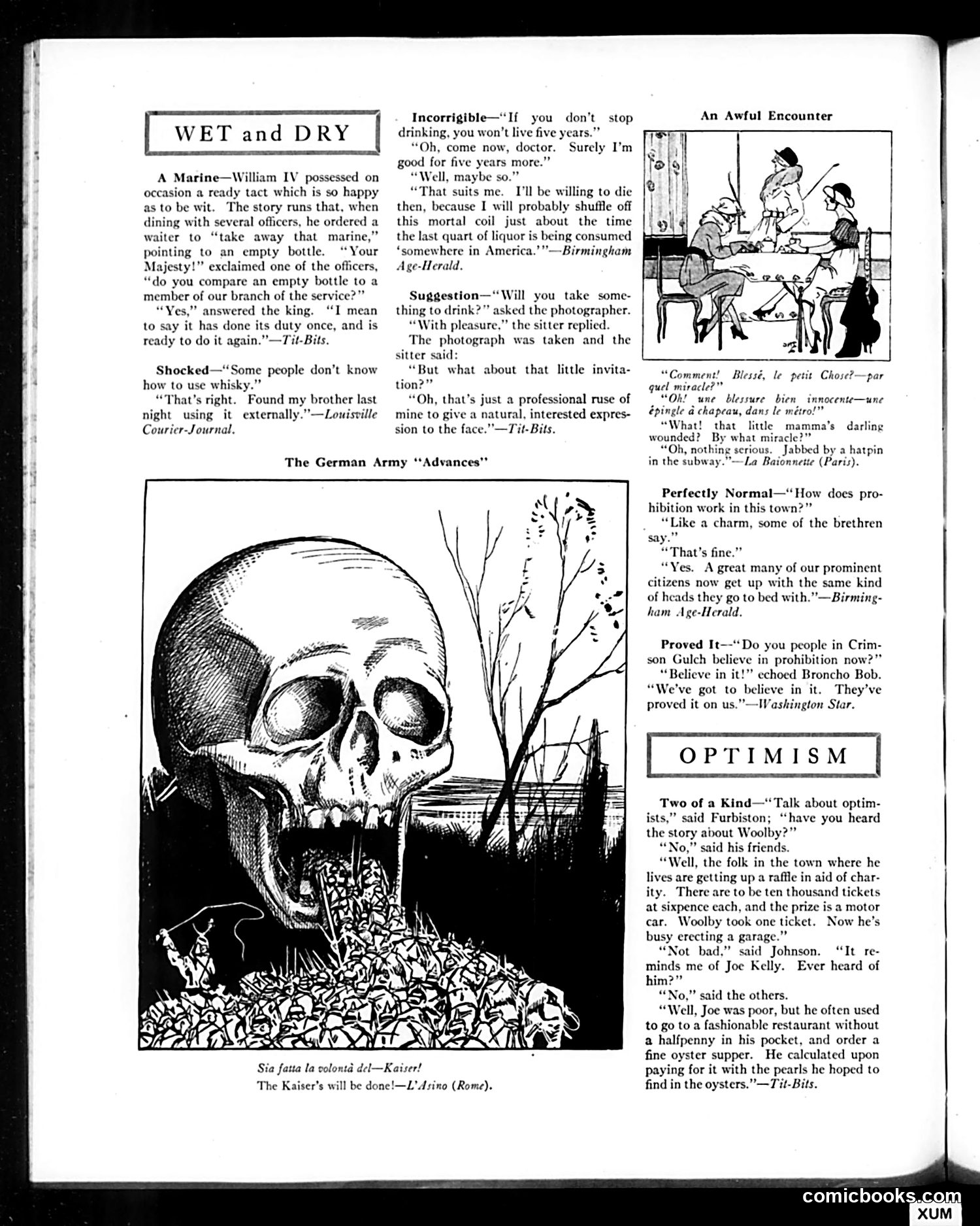
This page collects humorous anecdotes and satirical material typical of early 20th-century Judge magazine. **"Wet and Dry" section**: Brief jokes about alcohol consumption, including a historical anecdote about King William IV comparing an empty bottle to a marine soldier (a joke about duty completed). **"The German Army 'Advances'" cartoon**: A stark skull imagery with the caption "Sia fatta la volonta del—Kaiser!" (The Kaiser's will be done). This appears to be **WWI-era anti-German satire**, depicting German military advancement as death and destruction. The skull symbolizes the cost of the Kaiser's war ambitions. **"An Awful Encounter"** and **"Perfectly Normal"** sections**: Light humor about Prohibition and its social effects—noting that prominent citizens now have hangovers from bed-time drinking. **"Optimism" section**: Two anecdotes satirizing delusional optimism—one about a man buying a raffle ticket for a car then building a garage, another about a poor man ordering oysters hoping to find pearls inside to pay for them.
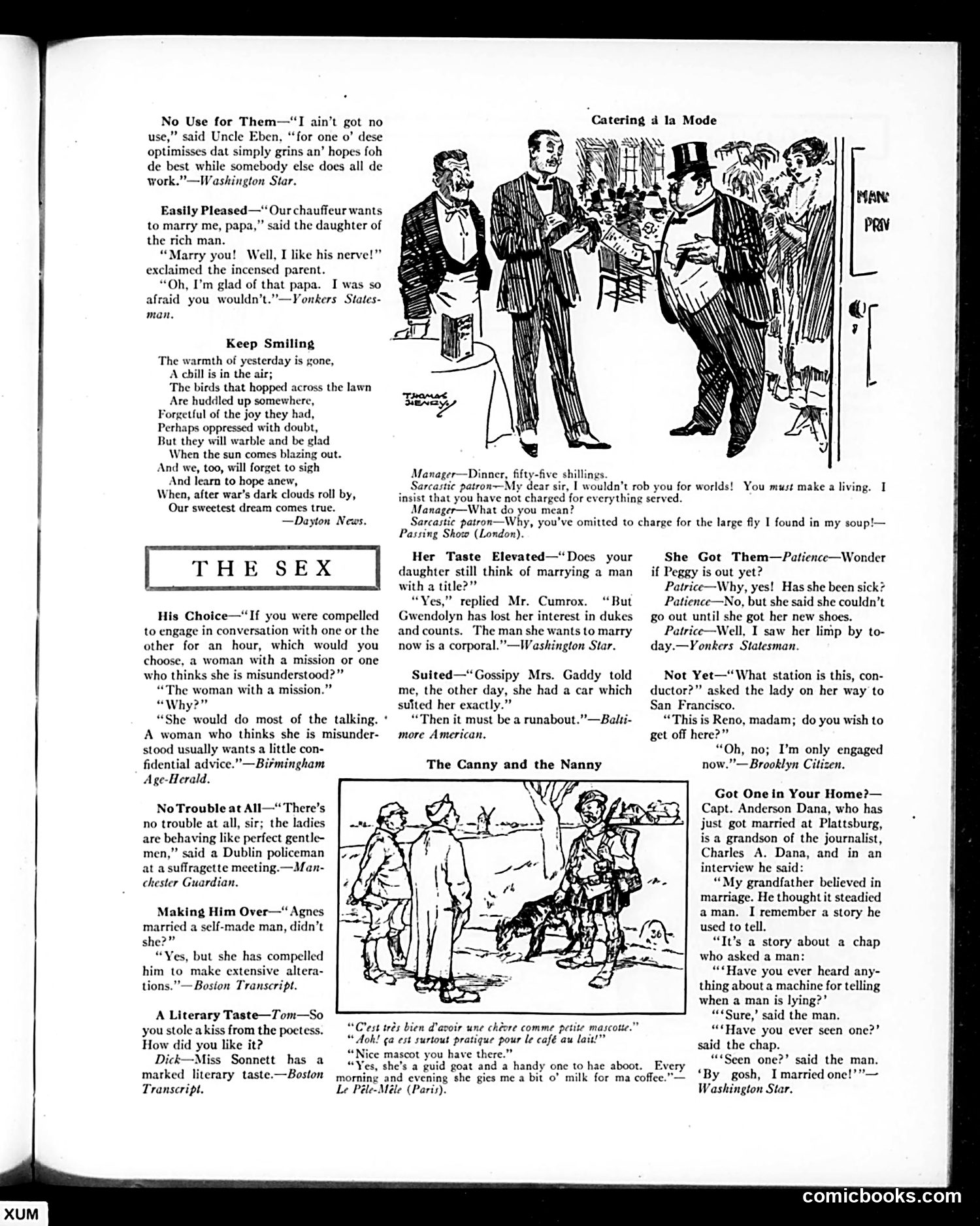
This page collects brief humorous anecdotes and satirical cartoons typical of early 20th-century American humor. **Key content:** The cartoons mock social pretensions and gender dynamics. "Catering à la Mode" satirizes both pretentious diners and struggling restaurants through a sarcastic patron who demands compensation for a fly in his soup—commenting on the economic struggles of service workers. "The Canny and the Nanny" shows a woman limping despite claiming she couldn't go out without new shoes, mocking female materialism and vanity. "His Choice" presents misogynistic stereotypes about women—those with "missions" being talkative busybodies, while those feeling "misunderstood" seek male attention and advice. References include "suffragette meeting," reflecting contemporary tensions over women's voting rights. The "Reno" joke alludes to Reno, Nevada as a divorce destination—significant because divorce was scandalous and location-dependent. Overall, the page reflects period attitudes: skepticism toward women's education/activism, workplace class dynamics, and marital/romantic anxieties. The humor relies on stereotypes now recognized as dated or offensive.
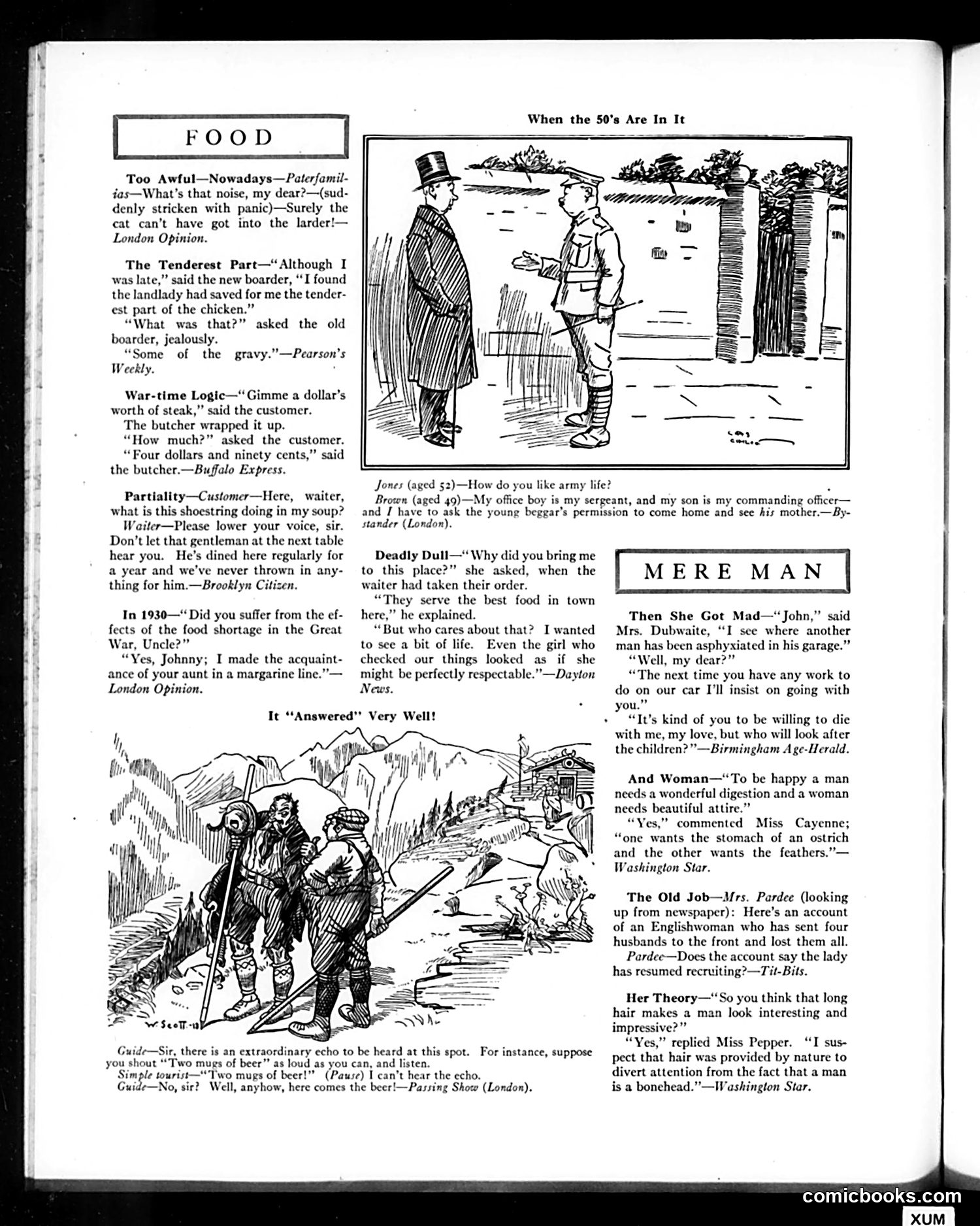
This page collects brief humorous anecdotes reflecting **wartime rationing and social disruption during World War I**. Key satirical points: **Food shortage jokes**: Multiple items mock scarcity—a butcher charging exorbitant prices, waiter serving "gravy" as chicken, someone meeting their spouse in a "margarine line" (rationed margarine queues). **Military hierarchy inversion**: "When the 50's Are In It" depicts an older man whose son is his commanding officer and office boy his sergeant—inverting normal age-based authority, likely mocking how WWI conscription displaced traditional social order. **Gender dynamics**: "Then She Got Mad" satirizes a woman insisting on accompanying her husband during car repairs, fearing he'll die in his garage (likely referencing carbon monoxide suicide, a period concern). **The echo cartoon** shows a guide deliberately tricking a tourist—shouting "Two mugs of beer" produces actual beer rather than an echo, mocking gullibility. The overall tone is **cynical about wartime hardship** while maintaining light, domestic humor typical of 1910s-20s satirical magazines.
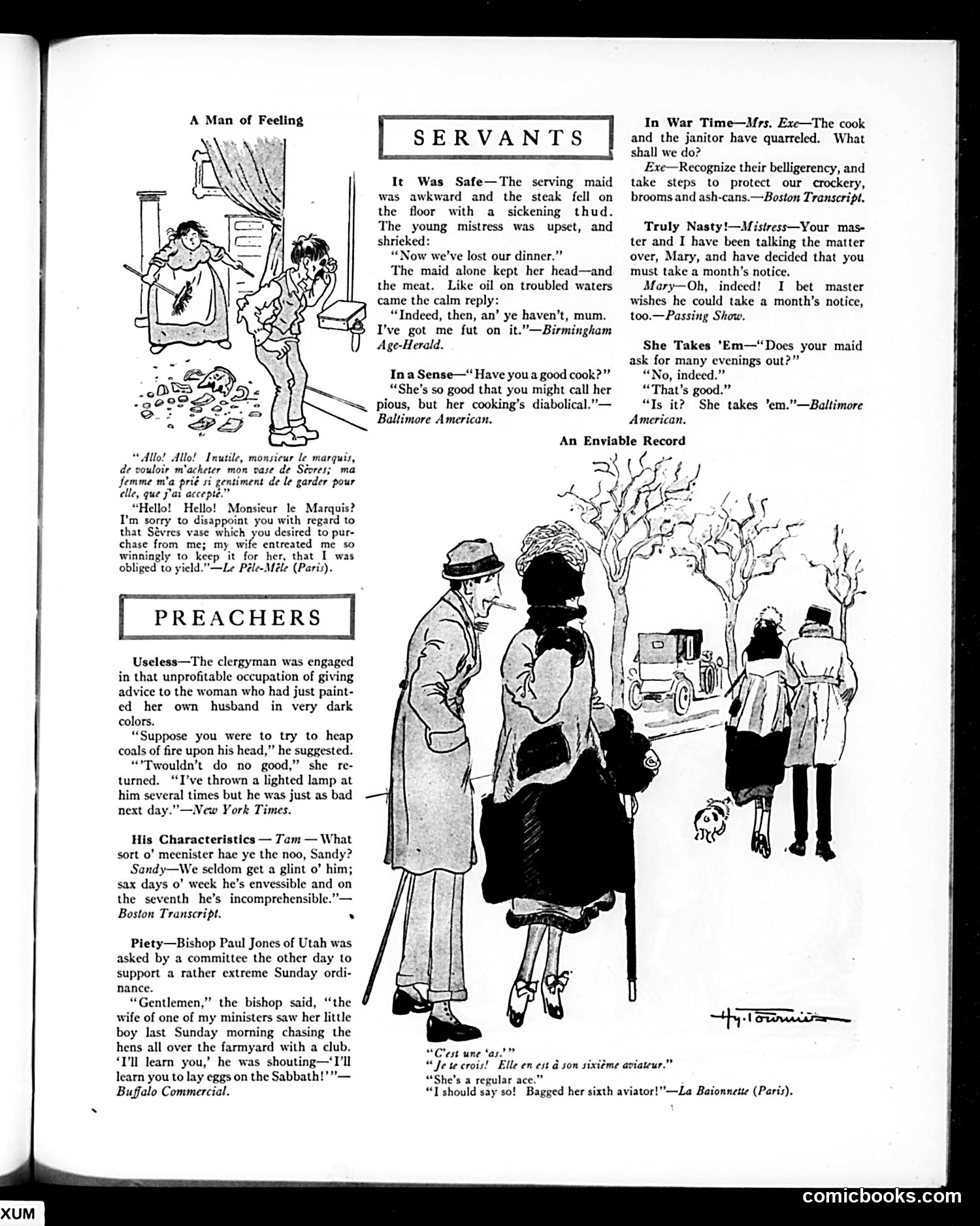
This page contains multiple short satirical pieces about domestic servants and clergy, reflecting early 20th-century class attitudes. **"Servants" section**: Brief humorous anecdotes mocking working-class speech and behavior—a maid's Irish brogue when she drops meat, a cook so bad her cooking is "diabolical," a maid who regularly demands evenings off. The humor relies on portraying servants as dim-witted or impudent. **"Preachers" section**: Satire targeting clergy as ineffectual. A minister gives useless marriage advice to an angry woman; a Scottish minister is never seen; a bishop is questioned about extreme Sunday laws. **"An Enviable Record"**: A French cartoon (La Baionnette) where a woman has had six aviator boyfriends—she's called an "ace." The satire suggests promiscuity during wartime. The page reflects period attitudes: servants depicted as comic figures, clergy as bumbling, and women's wartime behavior as scandalous. The international reprints suggest Judge's editorial practice of sharing content across Atlantic publications.
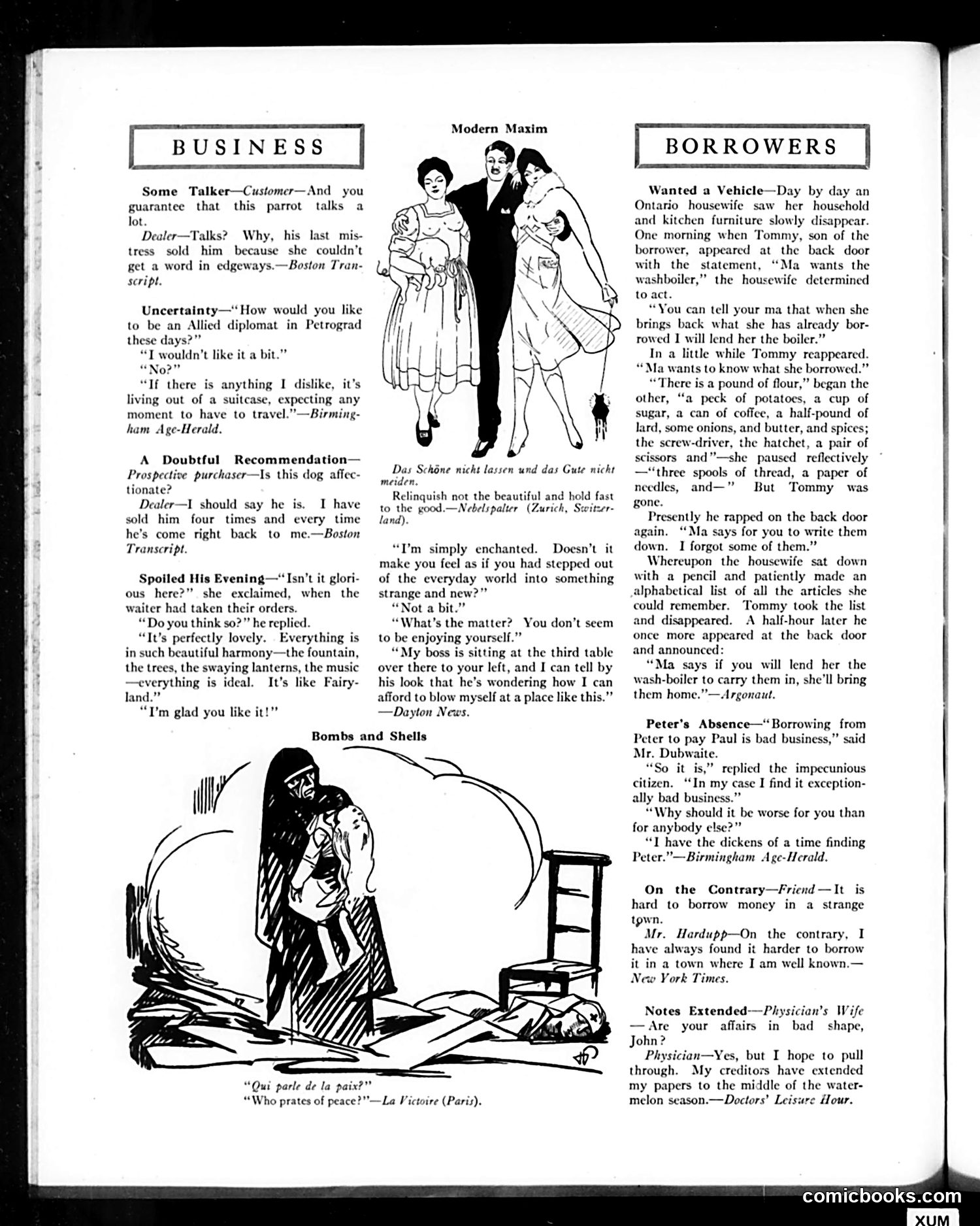
This page collects humorous anecdotes and cartoons reflecting early 20th-century American life and wartime concerns. **The Business section** includes jokes about everyday transactions: a talkative parrot, diplomatic uncertainty (likely referencing WWI-era Petrograd/Russian Revolution instability), and a dog repeatedly returned to its seller—satirizing consumer behavior and trust. **The "Modern Maxim"** presents a German aphorism about balancing beauty and goodness, alongside a cartoon labeled "Bombs and Shells" depicting a distressed woman amid war devastation, captioned in French asking "Who speaks of peace?"—reflecting contemporary anxiety about ongoing WWI. **The Borrowers section** satirizes a widespread social problem: chronic borrowing. Stories depict neighbors endlessly requesting household items without returning them, and financial desperation (borrowing from Peter to pay Paul). The humor targets both shameless borrowers and the social awkwardness of debt collection among acquaintances—a relatable concern during economically uncertain times.
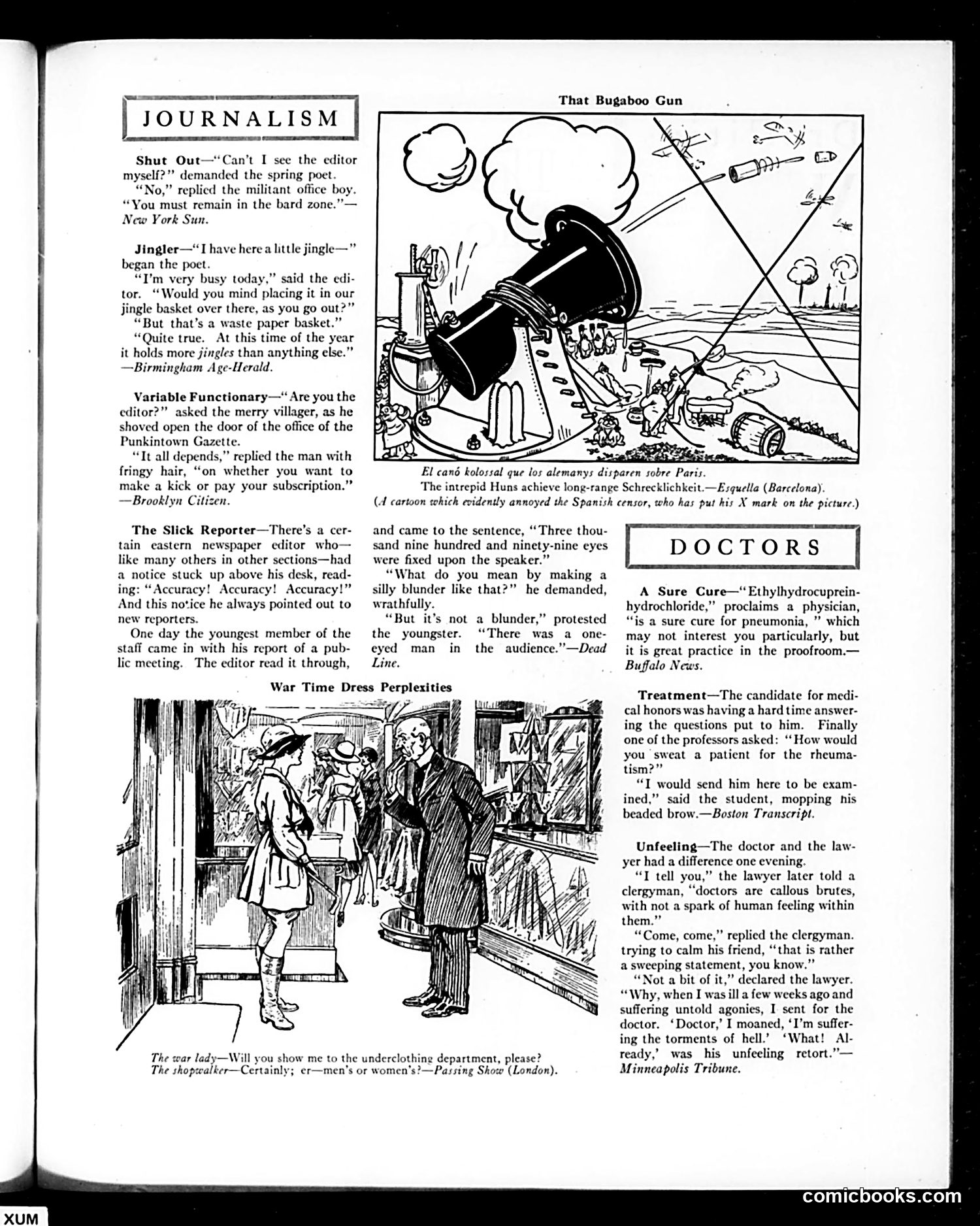
This page contains satirical commentary on three professions: journalism, medicine, and shopping. **Journalism Section:** Multiple short jokes mock newspaper editors and poets. Editors are portrayed as dismissive gatekeepers who reject unsolicited verse ("jingle basket"), prioritize payment over principles, and obsess over accuracy while tolerating obvious errors. One joke describes an editor who demands "Accuracy! Accuracy!" yet accepts a reporter's claim that "3,999 eyes" watched a speaker—impossible unless the audience included a one-eyed person. **"That Bugaboo Gun":** The cartoon depicts the German long-range gun bombarding Paris during WWI. The caption notes Spanish censorship marked it with an X, suggesting wartime sensitivity. **Doctors Section:** Jokes portray physicians as callous, pedantic, and indifferent to patient suffering. One doctor dismisses a patient's claim of "torments of hell" by saying "Already?"—implying the patient deserves such agony. The overall tone is cynical about institutional hypocrisy across professions.
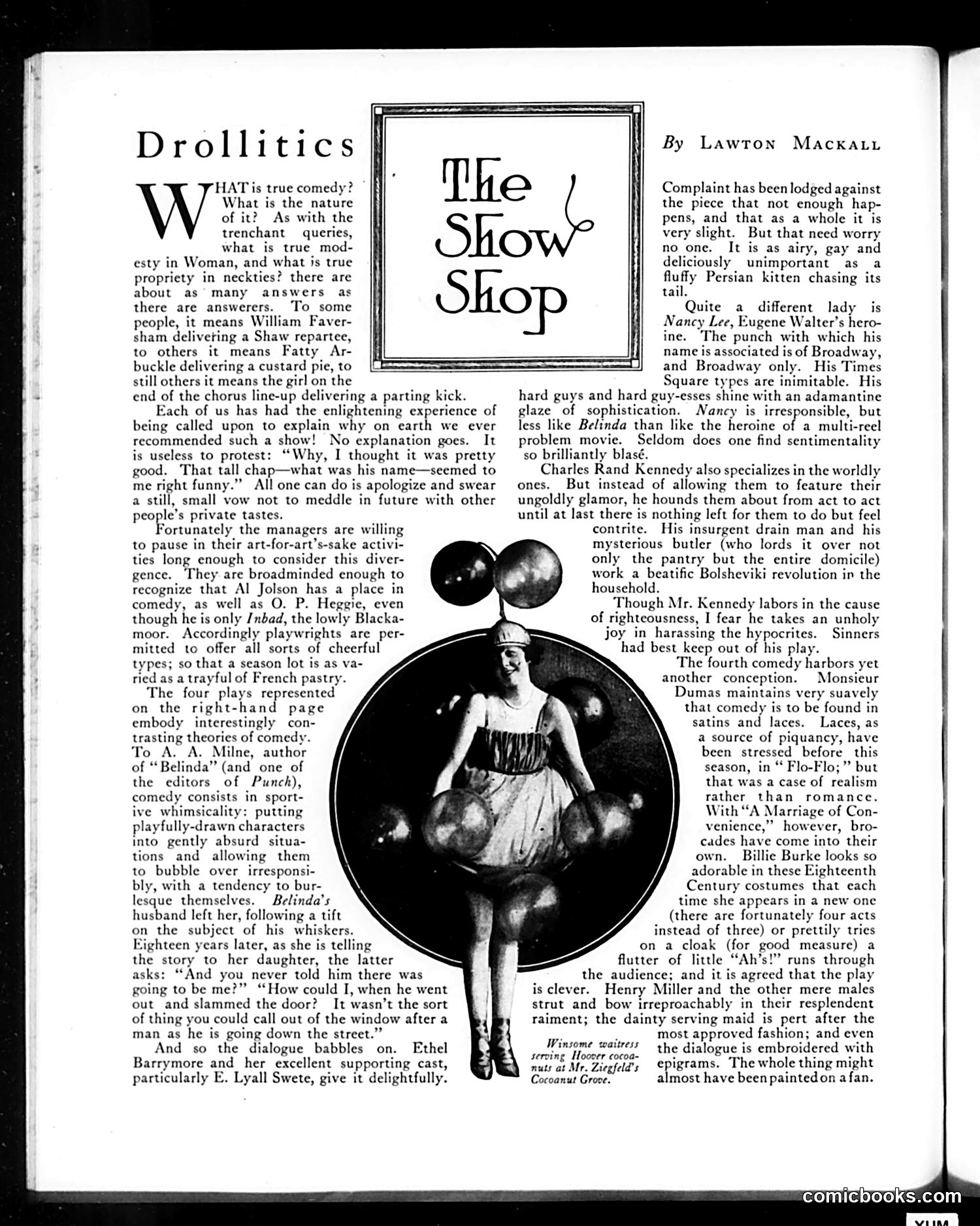
This is a theater review column by Lawton Mackall examining four contemporary Broadway comedies and their different approaches to comedy itself. **The plays discussed:** - *Belinda* by A.A. Milne: whimsical, absurdist humor featuring Ethel Barrymore - *Nancy Lee* by Eugene Walter: sophisticated but sentimental - A play by Charles Rand Kennedy: moralistic comedy punishing hypocrisy - A fourth play (incomplete in visible text) by Monsieur Dumas emphasizing costume/visual comedy **The central point:** Mackall argues that "comedy" has no single definition—different playwrights and audiences prefer different styles, from slapstick (Fatty Arbuckle, custard pies) to refined dialogue (Shaw repartee) to character-driven plots. Rather than defending one approach, he celebrates this diversity, comparing a season's comedies to "a trayful of French pastry." The photograph shows a woman in 1920s costume, likely promoting one of these theatrical productions.
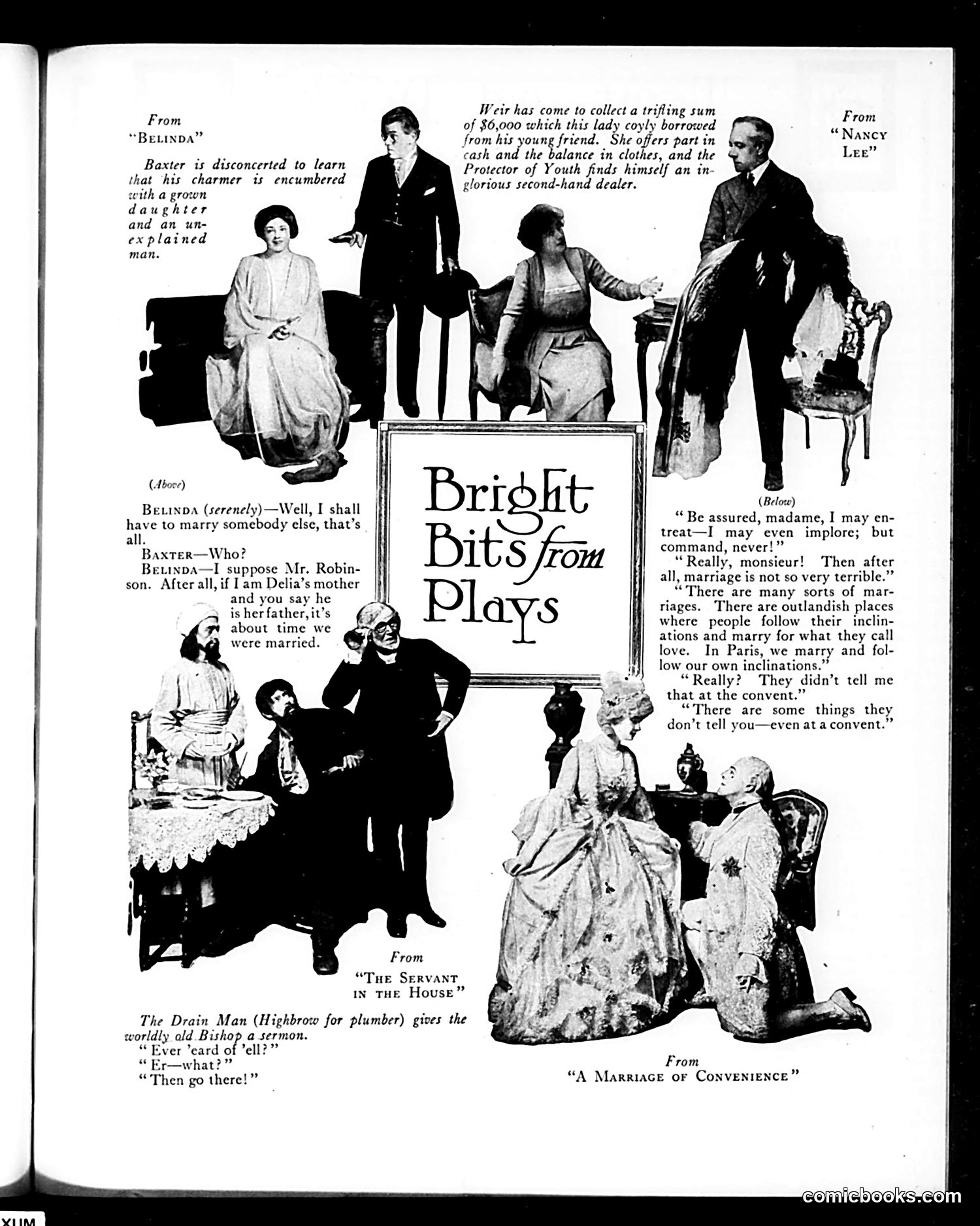
This page excerpts comedic dialogue from theatrical productions, satirizing marriage customs and social hypocrisy of the early 20th century. **"Belinda"** scene mocks opportunistic romance: a woman casually agrees to marry Mr. Robinson merely because they share a daughter and an "unexplained man"—suggesting unmarried cohabitation was socially scandalous enough to require hastily arranging matrimony. **"A Marriage of Convenience"** portrays a cynical Parisian marriage negotiation where a woman admits Paris allows marriages based on "inclinations" rather than love—implying this contrasts with supposedly more moral English/American practice. The joke criticizes French moral laxity. **"The Servant in the House"** features a working-class plumber lecturing a Bishop about hell—a reversal of expected social hierarchy that exposes the clergyman's worldliness. The overall satirical thrust: Judge mocks the gap between claimed respectability and actual behavior across classes and cultures, presenting marriage as transactional and religious authority as compromised.
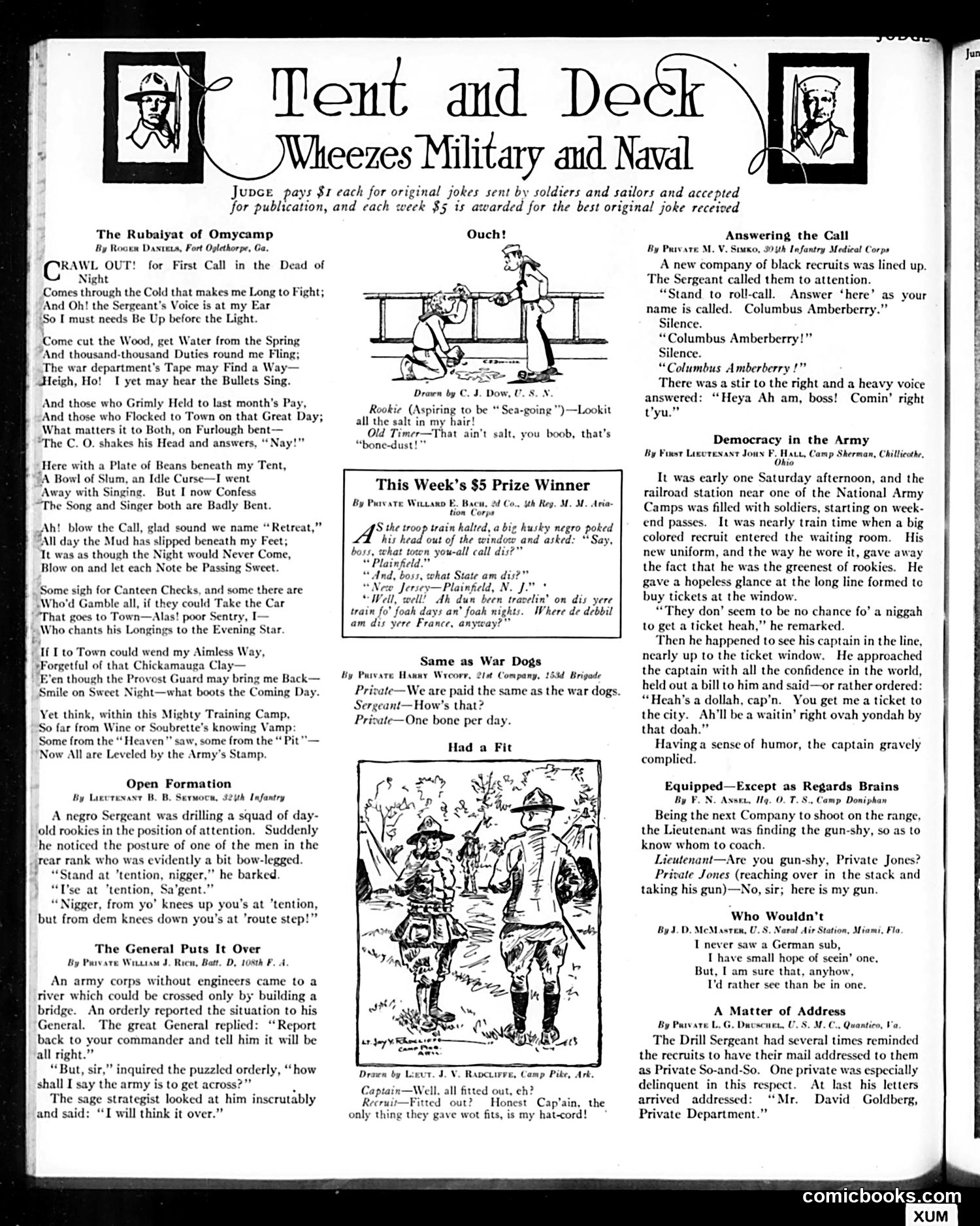
This is a humor page from *Judge* magazine's "Tent and Deck" section, which published soldiers' and sailors' jokes. The page collects various comic submissions from WWI-era military personnel, offering satirical commentary on Army life. **Key pieces:** 1. **"The Rubaiyat of Omycamp"**: A parody of Fitzgerald's *Rubaiyat of Omar Khayyam*, mocking monotonous camp routines—early reveille, endless fatigue duties, poor food ("Slum"), and enlisted men's universal resignation. 2. **"Open Formation"**: A racial dialect joke about a Black sergeant drilling recruits; humor derives from the soldier's bow-legged posture creating a military protocol absurdity. 3. **"Same as War Dogs"**: Enlisted men's complaint about poor pay equated to animal rations. 4. **Various sketches**: Depict rookie soldiers' confusion and hardship—salt-caked hair from troop trains, poorly-fitting uniforms, general disorientation. The overall tone reflects soldiers' griping about military life: tedium, poor conditions, inequitable pay, and the leveling effect of Army discipline on men from different social backgrounds.
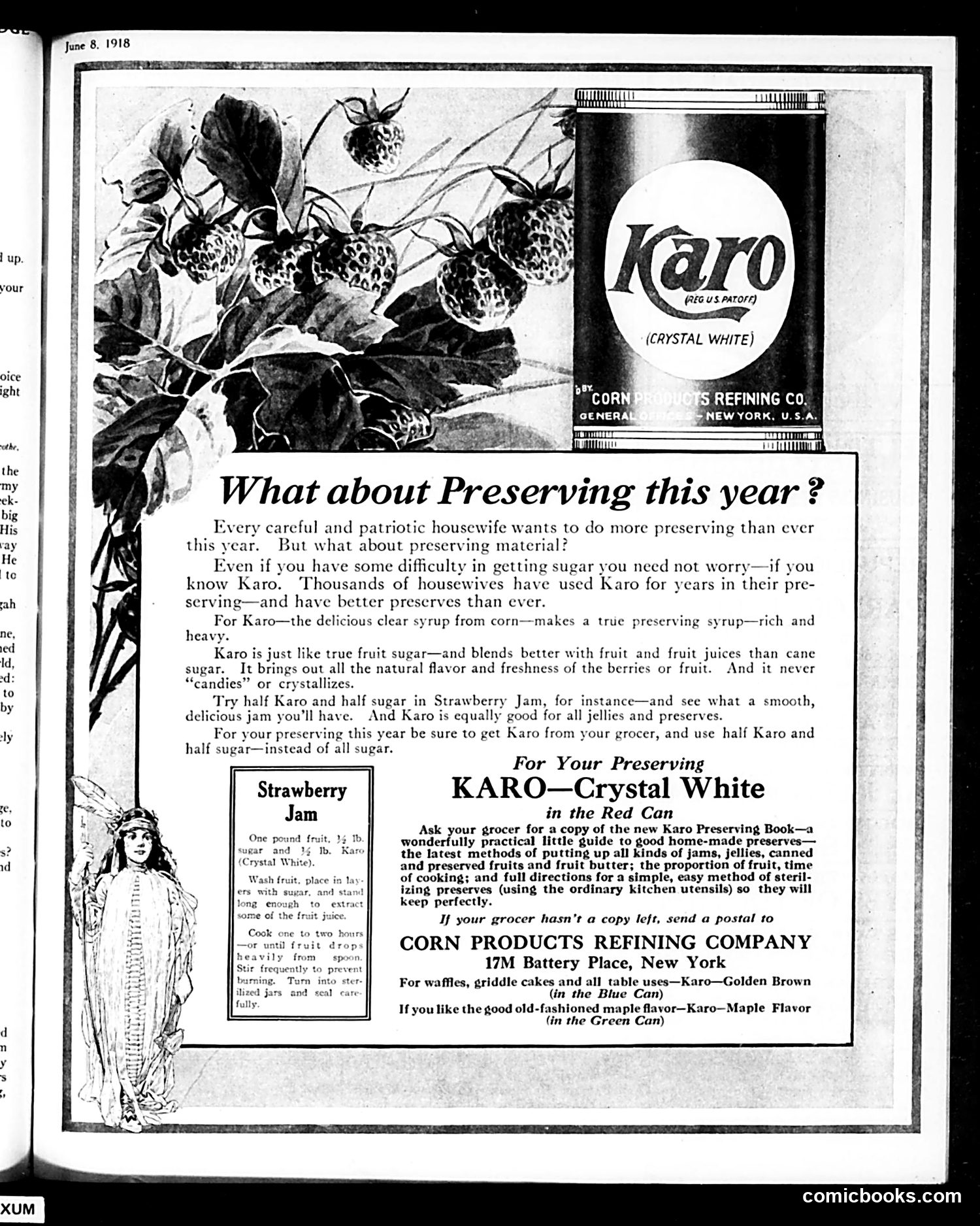
This page is primarily **a wartime advertisement**, not satire or political commentary. It's a Karo corn syrup ad leveraging 1918 patriotic anxieties. The context: During World War I, sugar was rationed as a strategic resource for the war effort. The ad addresses "every careful and patriotic housewife" worried about preserving food without adequate sugar—positioning Karo corn syrup as a patriotic substitute that "makes a true preserving syrup." The imagery shows strawberries and an illustrated corn stalk, emphasizing agricultural abundance. The strawberry jam recipe box offers practical wartime guidance. **The appeal is patriotic framing of consumption**: by using Karo instead of rationed sugar, housewives could preserve food while supporting the war effort. This is marketing disguised as civic duty—a common WWI-era advertising technique. The multiple Karo varieties (Crystal White, Golden Brown, Maple) suggest product line diversity for different household needs. **Not satirical**—this is straightforward propaganda advertising exploiting legitimate wartime scarcity to sell product.
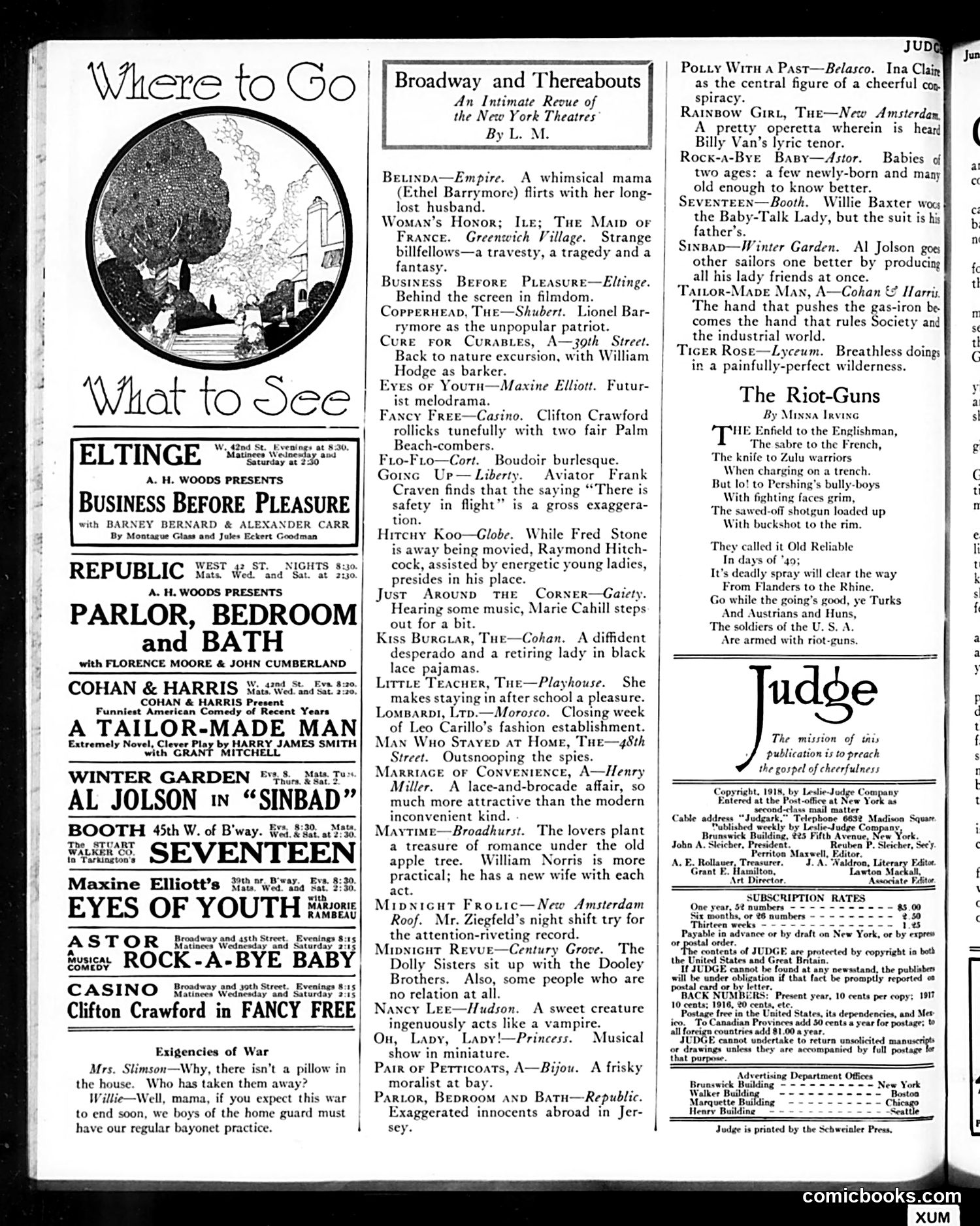
This page is primarily a **theater listings and reviews section** from Judge magazine, not political satire. The main content includes: **"What to See"** advertises Broadway shows playing in New York, including productions featuring Al Jolson in "Sinbad," Clifton Crawford in "Fancy Free," and others—typical 1918 entertainment. **"Broadway and Thereabouts"** provides brief, often witty plot summaries of current theatrical productions, using clever wordplay (e.g., "Business Before Pleasure" is set "Behind the screen in filmdom"). **"Exigencies of War"** is a single comic dialogue: a mother asks why pillows disappeared from the house; her son Willie replies the home guard boys need them for bayonet practice. This is a **WWI-era joke** mocking civilian "home guard" military drills as absurdly enthusiastic. The page reflects American theater culture and homefront attitudes during World War I, not political commentary or character caricature.
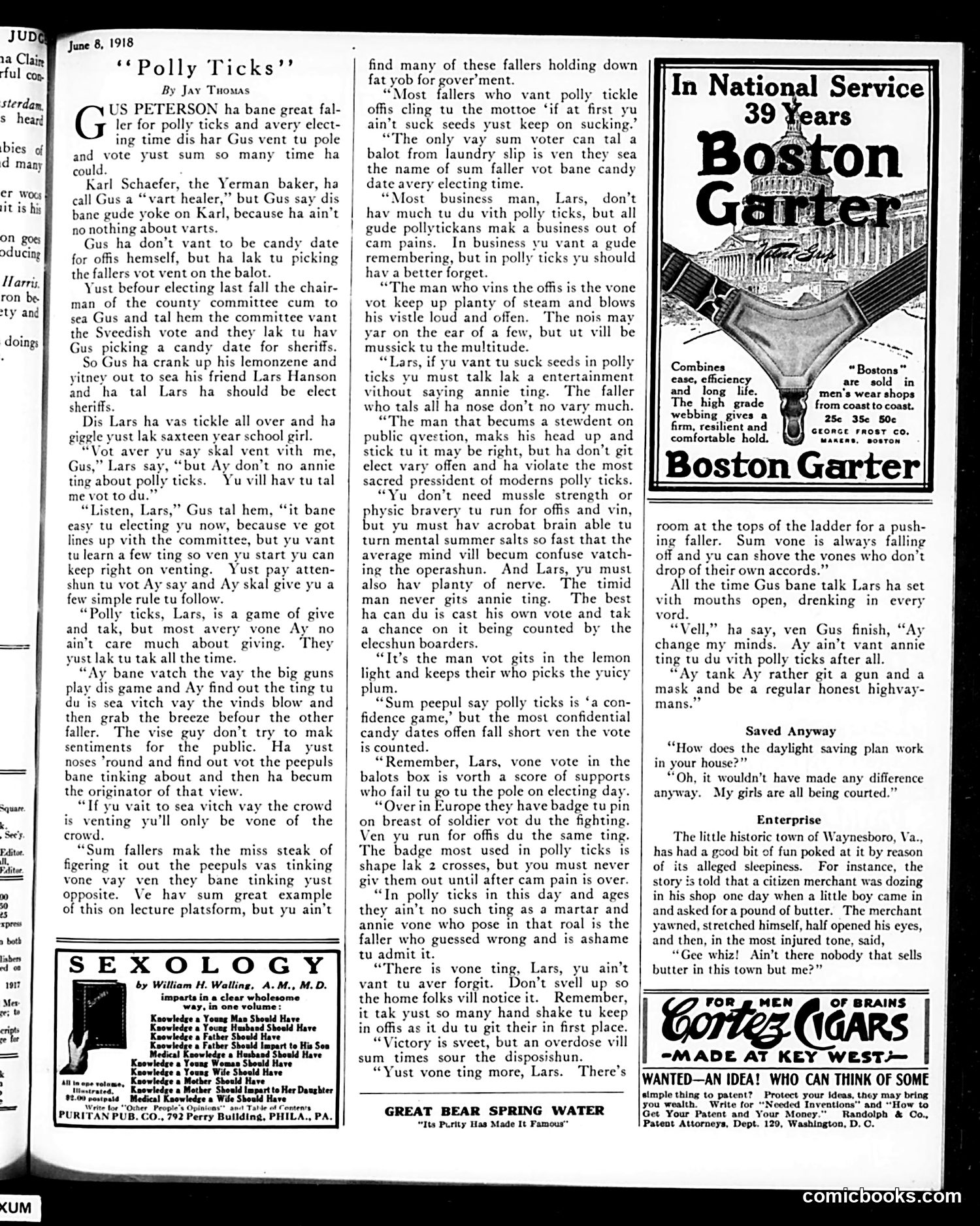
This is a humorous dialect piece by Jay Thomas featuring "Gus," an immigrant character (likely Swedish or German, based on phonetic spelling) dispensing cynical advice about American politics to his friend Lars, a candidate for sheriff. The satire targets core failures of early 20th-century democracy: voters blindly following established party lines; politicians prioritizing noise and charisma over substance; the disconnect between public rhetoric and actual competence; and casual corruption (fallers "holding down fat yob for gover'ment"). The heavy accent humor—typical of period Judge magazine—makes the critique palatable by distancing it through an "outsider" perspective. Gus essentially argues that successful politicians succeed not through honest conviction but through reading crowds, maintaining silence on actual issues, and projecting confident visibility. The advice is genuinely cynical: forget principles, forget remembering details, just blow your whistle loudly enough.
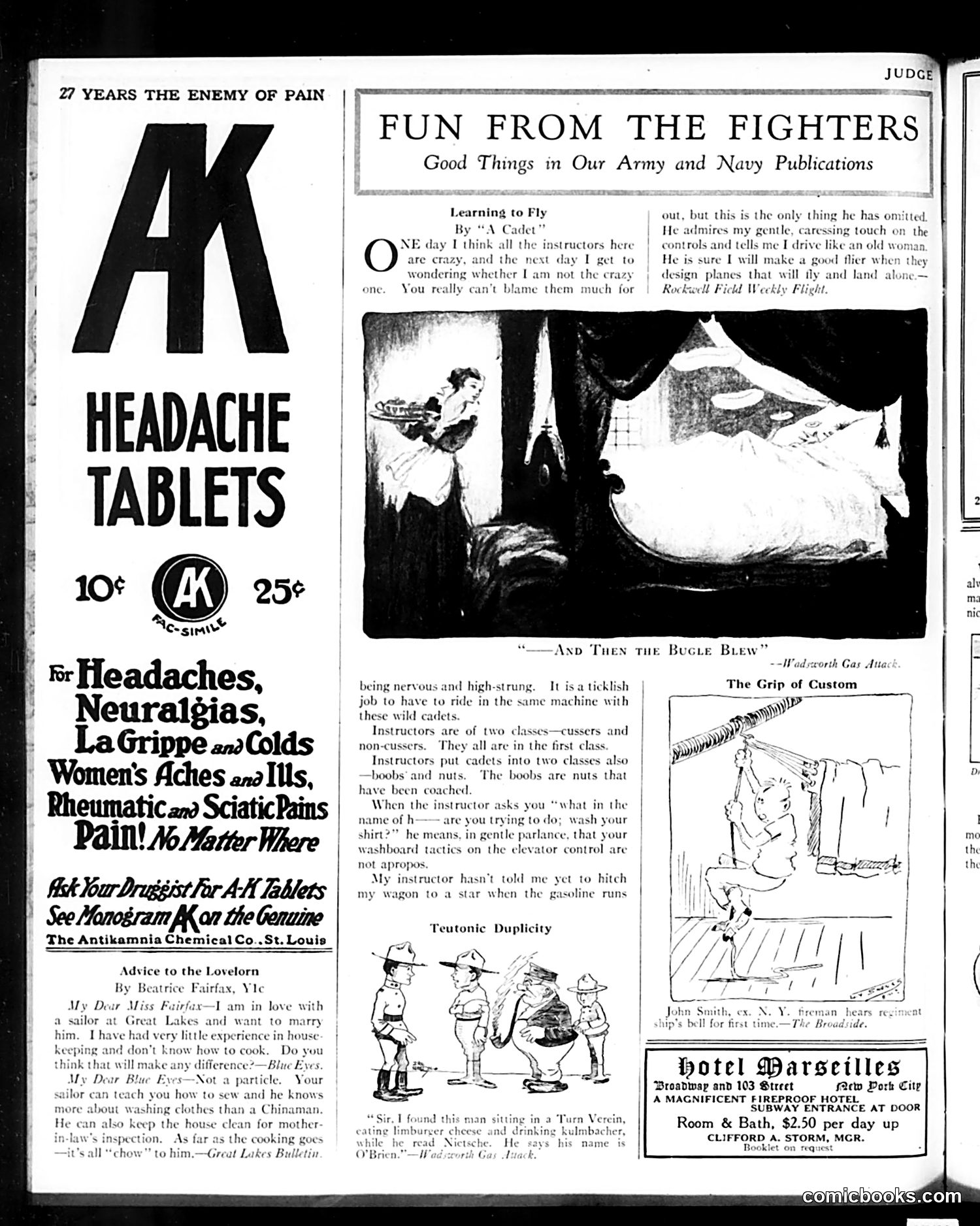
This page is primarily **advertisements and humor columns** rather than political satire. The main content includes: **Left side:** An A-K Headache Tablets ad claiming to cure various ailments for 10-25 cents—typical early 20th-century patent medicine marketing with exaggerated health claims. **Right side:** "Fun from the Fighters"—reprinted anecdotes from Army and Navy publications. These are lighthearted military humor pieces: - "Learning to Fly" features a flight cadet joking about instructors' nervousness during training flights - "The Grip of Custom" appears to be a cartoon about military life - "Teutonic Duplicity" (title visible) likely references German conduct, though content is cut off - "Advice to the Lovelorn" is an advice column by Beatrice Fairfax about dating a sailor The page reflects WWI-era American culture—celebrating military service humorously while promoting consumer products. There's no sophisticated political cartoon; rather, it's entertainment and advertising targeting a patriotic wartime audience.
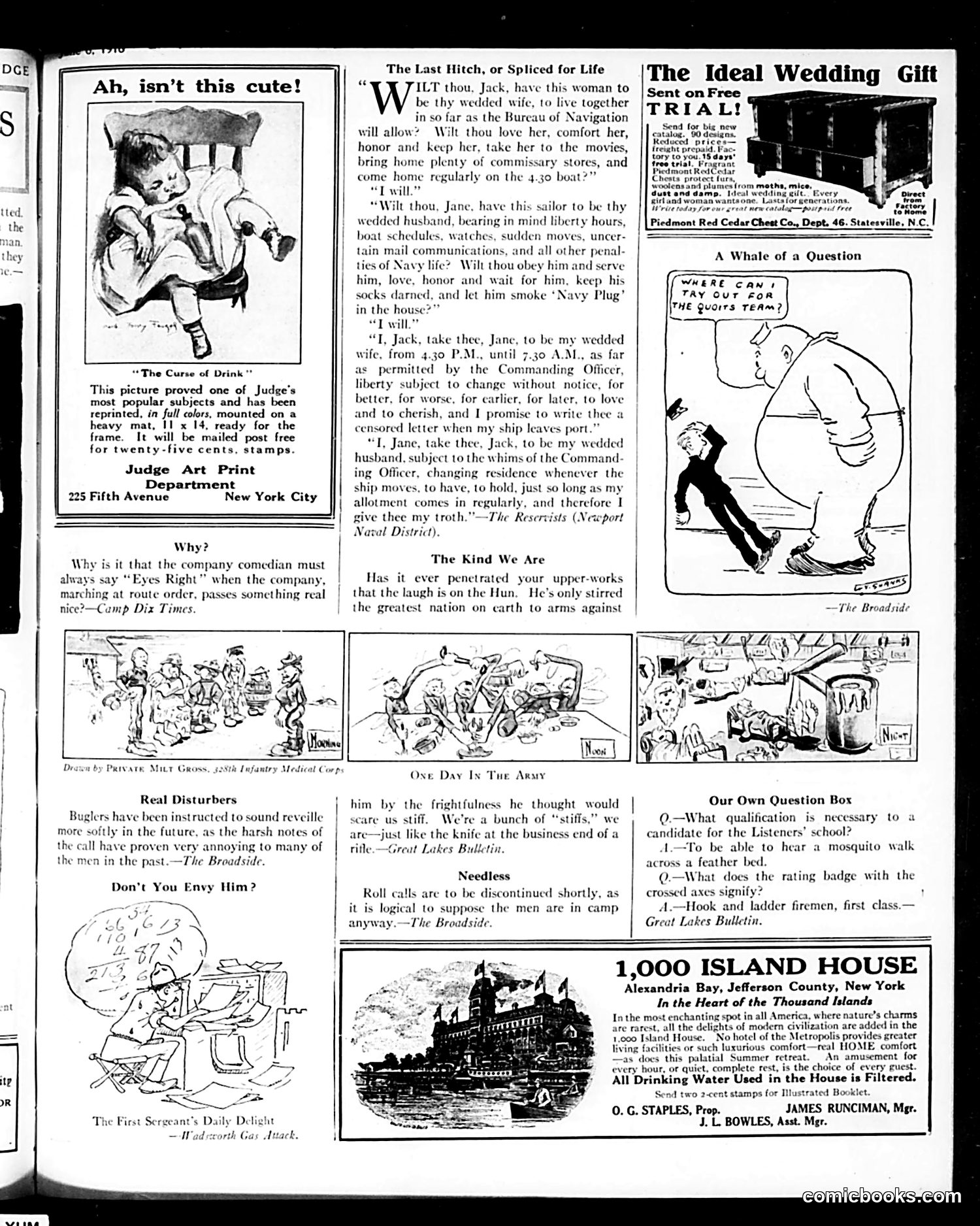
The main satirical piece mocks military marriages, particularly those involving Navy personnel. The cartoon presents a mock-wedding vow exchange where traditional marital promises are comically replaced with Naval constraints. **The Satire:** Instead of conventional marriage vows, the couple promises conditional commitment based on Navy schedules, commanding officers' orders, and logistical constraints. The bride must accept "liberty hours," changing residences, censored letters, and uncertain leave. The groom's commitment is limited to specific hours (4:30 P.M.–7:30 A.M.) "as far as permitted by the Commanding Officer." **The Point:** This mocks the reality that military marriages subordinate personal relationships to institutional demands. The couple's promises essentially reduce to: "I'll love you when the Navy allows." The humor stems from how thoroughly military bureaucracy infiltrates even marriage vows, making the woman's later statement about staying "just so long as my allotment comes in regularly" suggest mercenary rather than romantic motivation. The cartoon satirizes both the absurdity of Navy restrictions and the compromised nature of military family life during wartime (this appears to be WWI-era, given the "Newport Naval District" reference).
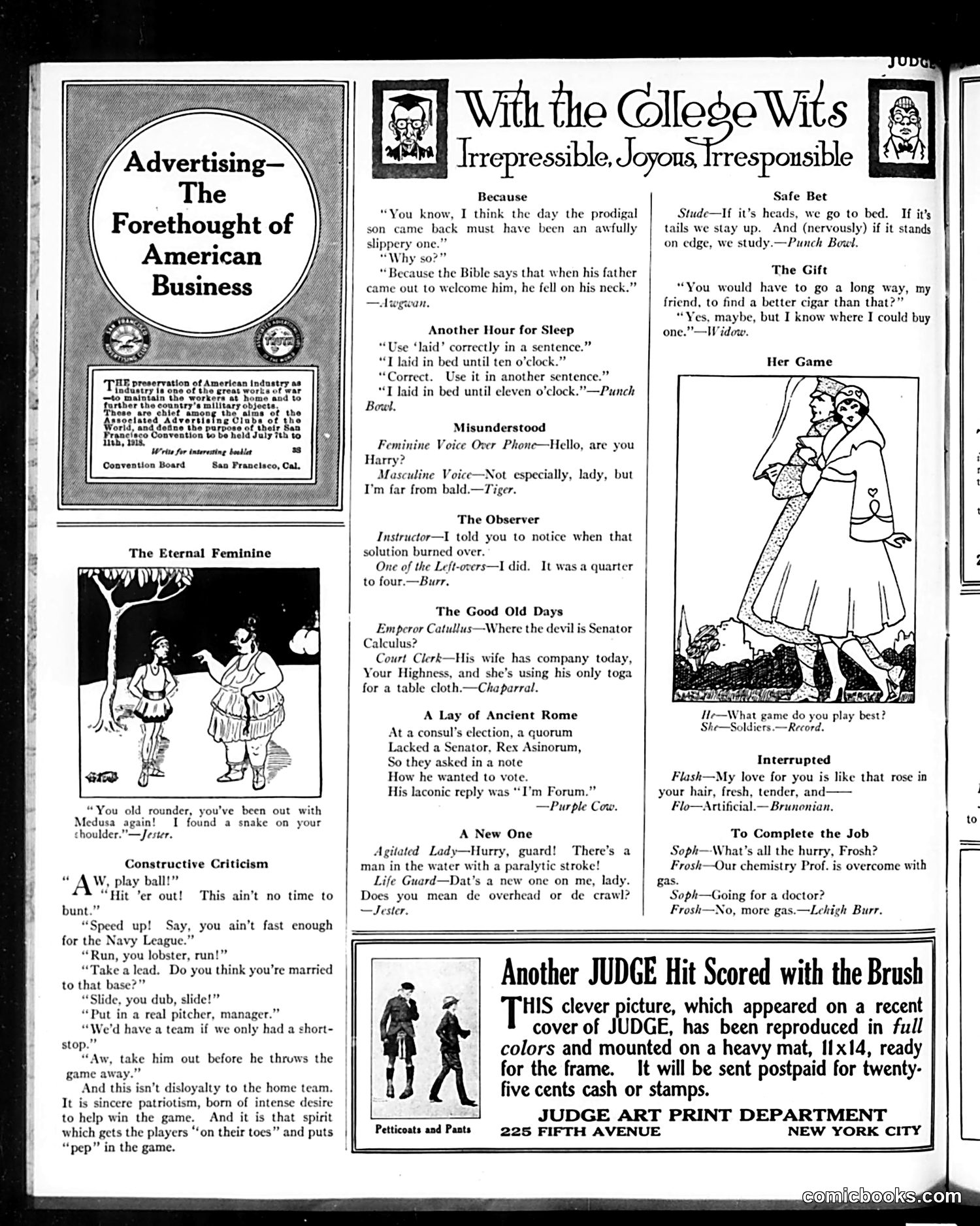
This page from *Judge* magazine contains satirical humor and advertisements typical of early 20th-century collegiate and social satire. **Left side:** The "Constructive Criticism" piece satirizes well-meaning baseball fans who constantly shout instructions at players, framing it paradoxically as "sincere patriotism." The joke is that fans believe their heckling helps the team win. **Center/Right "College Wits":** A collection of brief humor pieces mocking college students, including wordplay jokes (confusion over "laid" vs. "lain"), puns about misheard phone conversations, and jokes about studying. These target typical student behavior and academic laziness. **Bottom:** An advertisement for a *Judge* art print reproduction available for purchase. The mythological reference ("Medusa") and classical allusions ("Emperor Catullus," "ancient Rome") suggest this targets educated readers. Overall, the page represents early-1900s humor that relied on genteel wordplay, classical references, and observational comedy about American college life and sports culture.
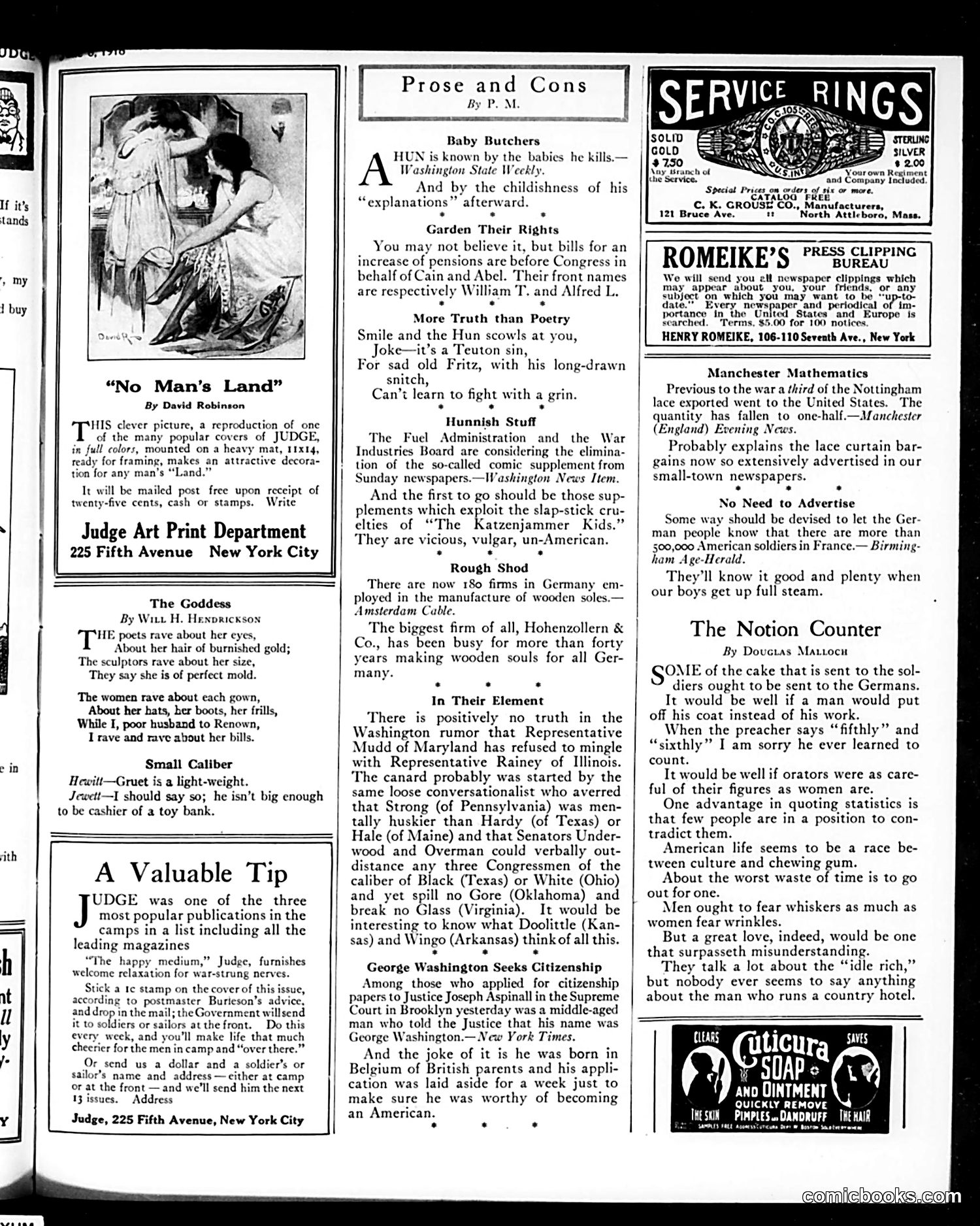
The main cartoon shows a woman in classical dress, likely representing "No Man's Land"—a satirical reference to the domestic sphere where husbands surrender authority to their wives. The accompanying poem "The Goddess" reinforces this: a husband "raves" about his wife's beauty and clothing, but privately obsesses over her bills, suggesting marriage as financial burden disguised as romance. The "Prose and Cons" section attacks Germany during WWI. "Baby Butchers" dehumanizes Germans ("Huns") as child-killers. References mock German leadership (Kaiser Wilhelm II implied in "Hohenzollern & Co."), wartime privations (wooden soles), and cultural exports (dismissing the comic strip "Katzenjammer Kids" as "vicious, vulgar, un-American"). The pun-heavy "In Their Element" section uses Congressmen's surnames (Black, White, Gore, Glass) to create double meanings, typical Judge wordplay. The page reflects WWI-era American propaganda and domestic humor conventions.
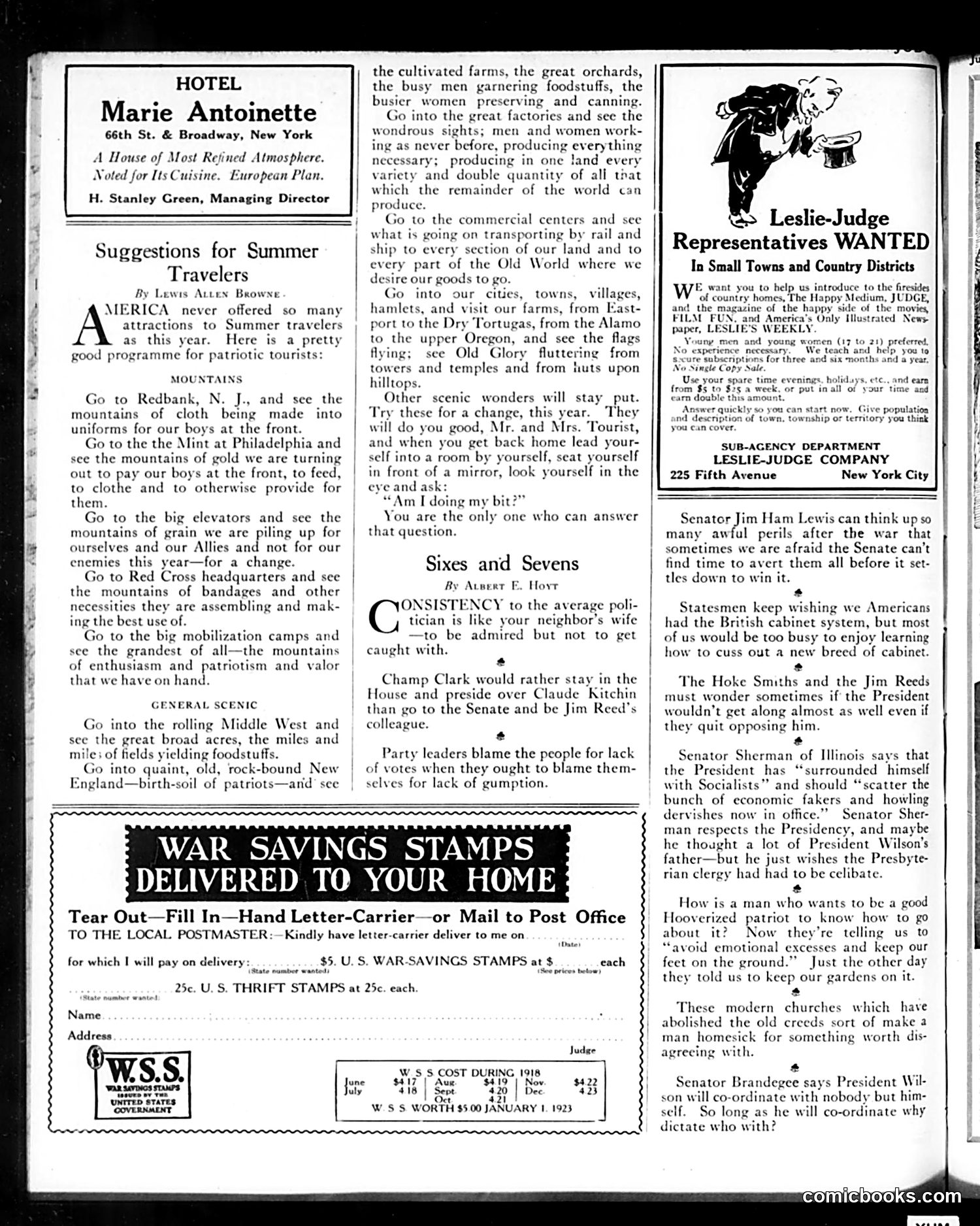
This page, from during World War I, contains mostly advertisements and patriotic content rather than political cartoons. **Main Content:** The "Suggestions for Summer Travelers" article urges Americans to visit domestic sites—factories producing uniforms and munitions, farms growing food for soldiers, Red Cross headquarters—emphasizing wartime production and patriotic duty. The repeated phrase "Am I doing my bit?" reflects the era's focus on individual contribution to the war effort. **Political Commentary:** The "Sixes and Sevens" section contains mild political humor about Congress members Champ Clark and Claude Kitchin, and Jim Reed, suggesting Clark prefers House leadership to Senate work. Party leaders are mildly criticized for blaming voters rather than themselves for low turnout. **Advertisements:** The page includes ads for the Hotel Marie Antoinette, Leslie-Judge magazine seeking sales representatives, and most prominently, a War Savings Stamps program encouraging home delivery of bonds. The content reflects American mobilization during WWI, emphasizing national unity and economic contribution to the war effort.
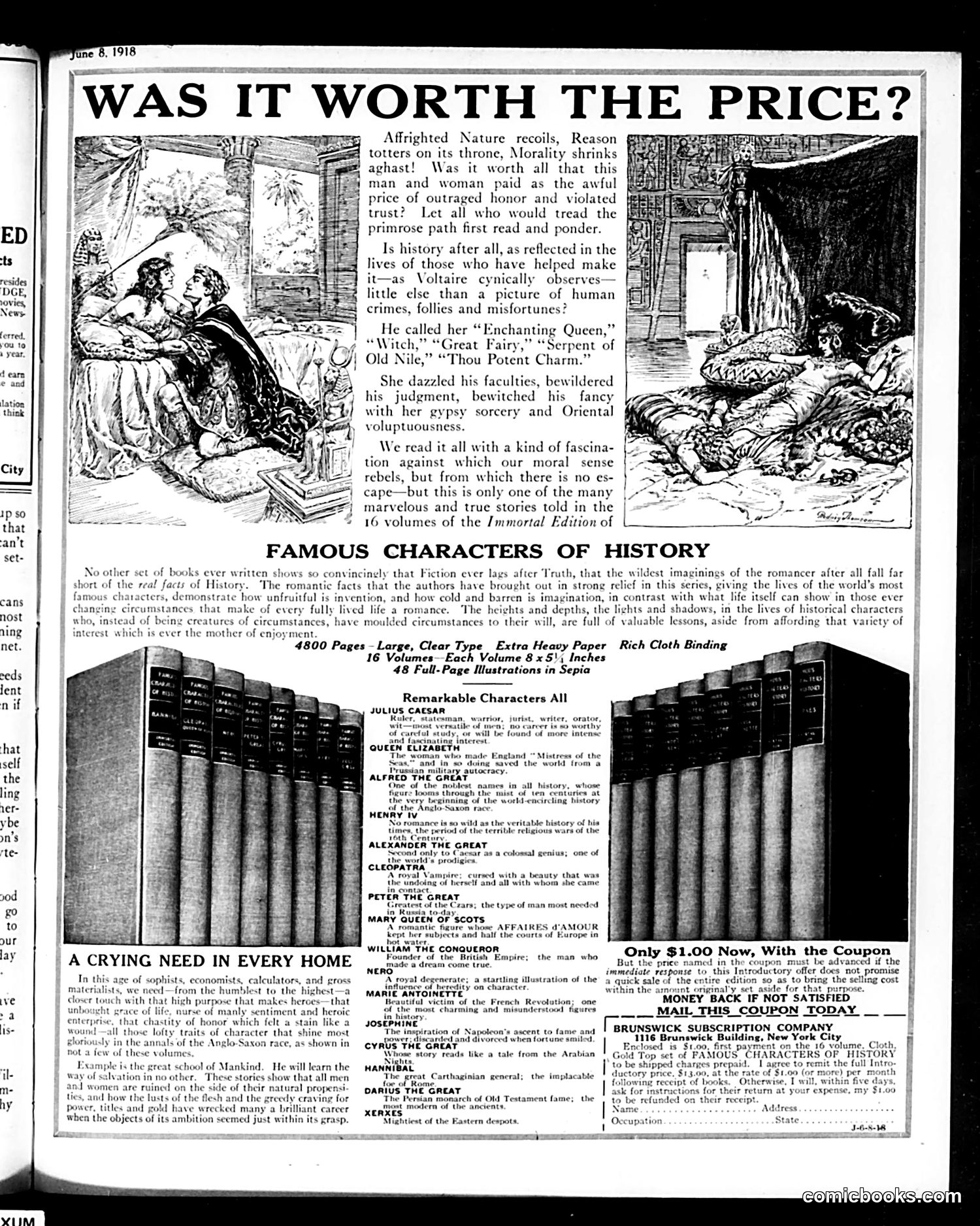
This page advertises a 16-volume encyclopedia of historical biography while using a morality tale as its hook. The two illustrations depict a seduction scene—a man and woman in compromising circumstances, with the text asking whether their "outraged honor and violated trust" was worth the price of their affair. The satire works on two levels: First, it exploits readers' prurient interest in scandalous history ("famous characters"). Second, it argues that real historical figures' actual moral failings are far more compelling than any fiction—that truth is stranger than invention. The advertisement promises that studying these "remarkable characters" (Julius Caesar, Cleopatra, Henry VIII, etc.) provides moral education through their real crimes and follies. It's a clever marketing pitch: buy these books for edification, but really, you'll read lurid historical gossip. The "crying need in every home" framing suggests moral improvement while selling sensationalism.
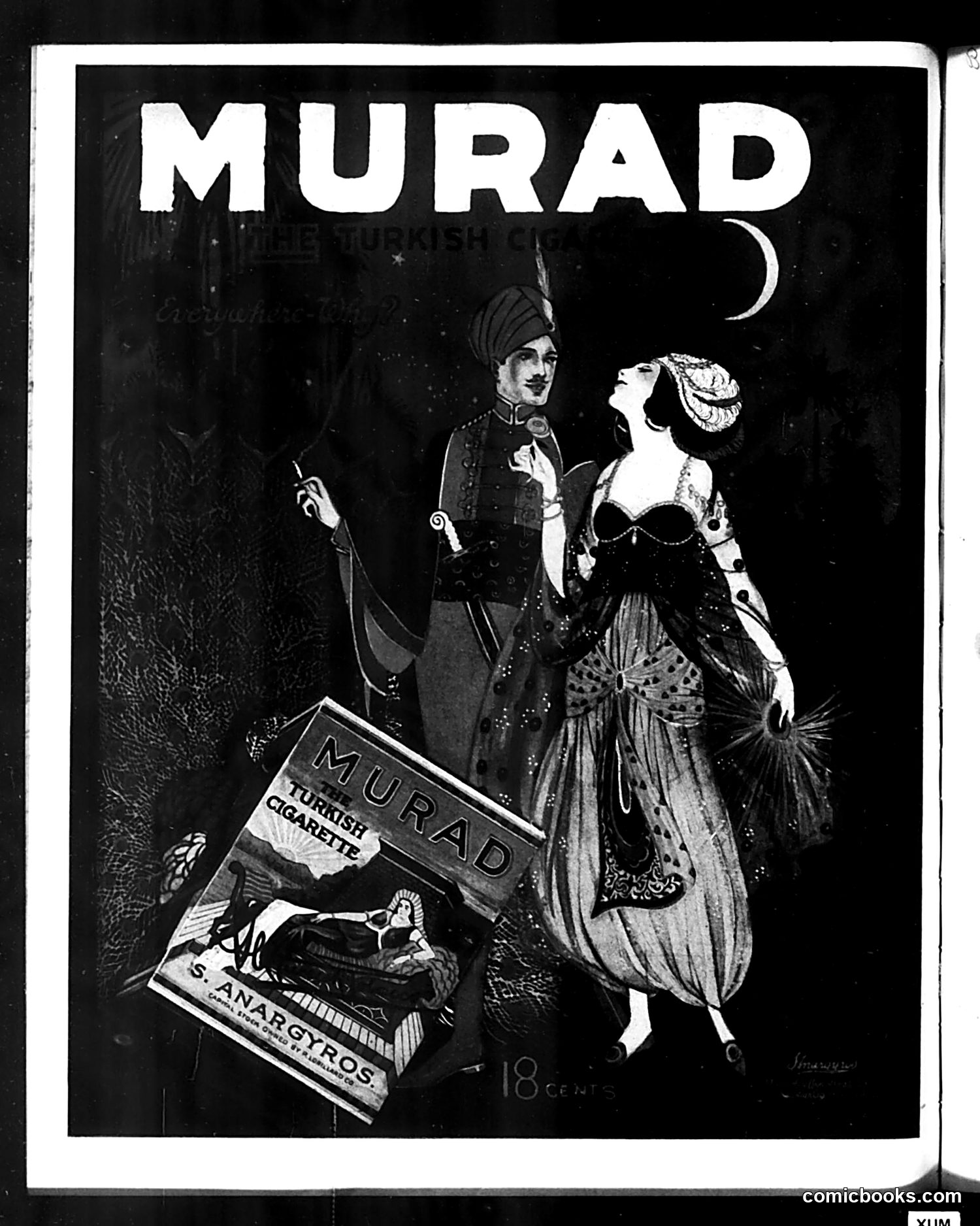
This is a cigarette advertisement for "Murad Turkish Cigarettes," not a political cartoon. The image depicts two elegantly dressed figures in an exotic, orientalist setting under a crescent moon. The woman wears an elaborate costume with jeweled headdress and flowing garments; the man wears a turban and ornate jacket, suggesting Turkish or Middle Eastern aesthetics. The advertisement leverages early 20th-century orientalism—marketing Turkish cigarettes through romanticized imagery of the "exotic East" to appeal to American consumers. The crescent moon and decorative styling reinforce the "Turkish" brand identity. A cigarette package is prominently displayed at the bottom left. This reflects common advertising practices of the era that used cultural exoticism to sell luxury consumer goods.