
Judge, 1918-06-08 · page 24 of 36
Judge — June 8, 1918 — page 24: what you’re looking at
What you’re looking at
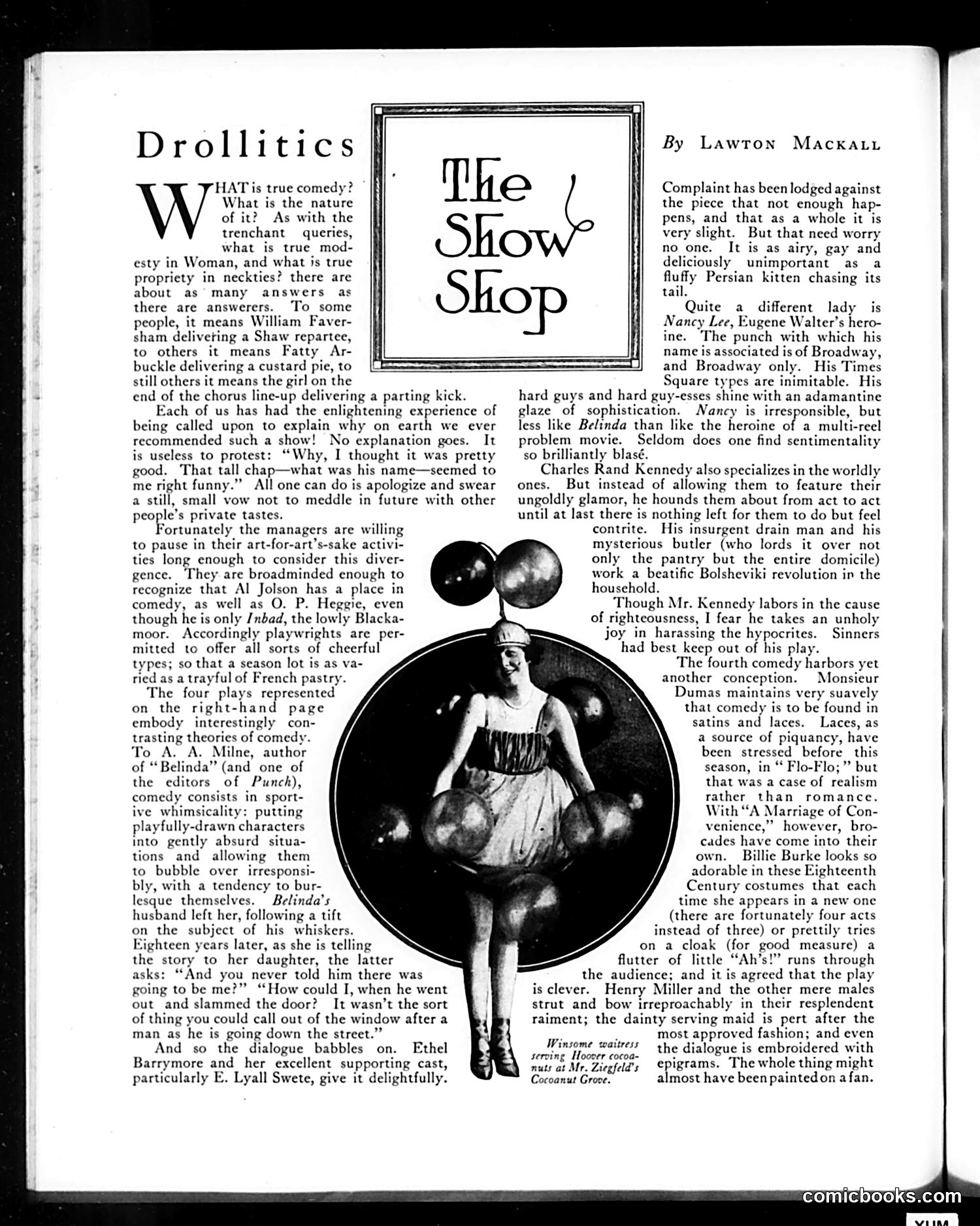
This is a theater review column by Lawton Mackall examining four contemporary Broadway comedies and their different approaches to comedy itself. **The plays discussed:** - *Belinda* by A.A. Milne: whimsical, absurdist humor featuring Ethel Barrymore - *Nancy Lee* by Eugene Walter: sophisticated but sentimental - A play by Charles Rand Kennedy: moralistic comedy punishing hypocrisy - A fourth play (incomplete in visible text) by Monsieur Dumas emphasizing costume/visual comedy **The central point:** Mackall argues that "comedy" has no single definition—different playwrights and audiences prefer different styles, from slapstick (Fatty Arbuckle, custard pies) to refined dialogue (Shaw repartee) to character-driven plots. Rather than defending one approach, he celebrates this diversity, comparing a season's comedies to "a trayful of French pastry." The photograph shows a woman in 1920s costume, likely promoting one of these theatrical productions.
📄 Transcribed text from this page (OCR, searchable)
Machine-transcribed from the original scan — historical spelling and the odd misread are preserved.
Drollitics HAT is true comedy? What is the nature of it?) As with the trenchant queries, what is true mod- esty in Woman, and what is true propriety in neckties? there are about as’ many answers as there are answerers. To some people, it means William Faver- sham delivering a Shaw repartee, to others it means Fatty Ar- MAcKALL By Lawton Complaint has been lodged against the piece that not enough hap- pens, and that as a whole it is very slight. But that need worry no one. It is as airy, gay and deliciously unimportant as a fluffy Persian kitten chasing its tail. Quite a different lady is Nancy Lee, Eugene Walter’s hero- ine. The punch with which his name is associated is of Broadway, buckle delivering a custard pie, to and Broadway only. His Times still others it means the girl on the end of the chorus line-up delivering a parting kick. Each of us has had the enlightening experience of being called upon to explain why on earth we ever recommended such a show! No explanation goes. It is useless to protest: “Why, I thought it was pretty good. That tall chap—what was his name—seemed to me right funny.” All one can do is apologize and swear a still, small vow not to meddle in future with other people’s private tastes. Fortunately the managers are willing to pause in their art-for-art’s-sake activi- ties long enough to consider this diver- gence, They are broadminded enough to recognize that Al Jolson has a place in comedy, as well as O. P. Heggie, even though he is only /nbad, the lowly Blacka- moor. Accordingly playwrights are per- mitted to offer all sorts of cheerful types; so that a season lot is as va- ried as a trayful of French pastry. The four plays represented on the right-hand page embody interestingly con- trasting theories of comedy. To A. A. Milne, author of “Belinda” (and one of the editors of Punch), comedy consists in sport- ive whimsicality: putting playfully-drawn characters into gently absurd situa- tions and allowing them to bubble over irresponsi- bly, with a tendency to bur- lesque themselves. Belinda’s husband left her, following a tift on the subject of his whiskers. Eighteen years later, as she is telling the story to her daughter, the latter asks: “And you never told him there was going to be me?” “How could I, when he went out and slammed the door? It wasn’t the sort of thing you could call out of the window after a man as he is going down the street.” And so the dialogue babbles on. Ethel Barrymore and her excellent supporting cast, particularly E. Lyall Swete, give it delightfully. Square types are inimitable. His hard guys and hard guy-esses shine with an adamantine glaze of sophistication. Nancy is irresponsible, but less like Belinda than like the heroine of a multi-reel problem movie. Seldom does one find sentimentality so brilliantly blasé. Charles Rand Kennedy also specializes in the worldly ones. But instead of allowing them to feature their ungoldly glamor, he hounds them about from act to act until at last there is nothing left for them to do but feel contrite. His insurgent drain man and his mysterious butler (who lords it over not only the pantry but the entire domicile) work a beatific Bolsheviki revolution in the household. Though Mr. Kennedy labors in the cause of righteousness, I fear he takes an unholy joy in harassing the hypocrites. Sinners had best keep out of his play. The fourth comedy harbors yet another conception. Monsieur Dumas maintains very suavely that comedy is to be found in satins and laces. Laces, as a source of piquancy, have been stressed before this season, in “ Flo-Flo;” but that was a case of realism rather than romance. With “A Marriage of Con- venience,” however, bro- cades have come into their own. Billie Burke looks so adorable in these Eighteenth Century costumes that each time she appears in a new one (there are fortunately four acts instead of three) or prettily tries on a cloak (for good measure) a flutter of little “Ah’s!” runs through the audience; and it is agreed that the play is clever. Henry Miller and the other mere males strut and bow irreproachably in their resplendent raiment; the dainty serving maid is pert after the most approved fashion; and even the dialogue is embroidered with epigrams. The whole thing might almost have been paintedon afan. Winsome waitress serving Hoover cocoa nuts at Mr. Ziegfeld’s Cocoanut Grove.